Solution manual intermediate accounting 9e ch04
Bạn đang xem bản rút gọn của tài liệu. Xem và tải ngay bản đầy đủ của tài liệu tại đây (853.42 KB, 84 trang )
To download more slides, ebook, solutions and test bank, visit
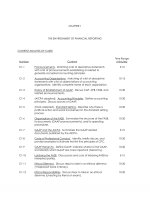
CHAPTER 4
THE INCOME STATEMENT AND STATEMENT OF CASH FLOWS
CONTENT ANALYSIS OF EXERCISES AND PROBLEMS
Number
Content
Time Range
(minutes)
E4-1
Income Statement. Merchandising. Multiple-step and singlestep format preparation from selected account balances.
10-15
E4-2
Income Statement. Manufacturing. Multiple-step and singlestep format preparation from selected account balances.
10-15
E4-3
Classifications. Identification of where various items would be
reported in the financial statements.
5-10
E4-4
Classifications. Identification of where various items would be
reported in the financial statements.
5-10
E4-5
Cost of Goods Sold. Schedule. Multiple-step and single-step
income statement preparation.
10-15
E4-6
Income Statement and Statement of Comprehensive Income.
Schedule of cost of goods sold. Multiple-step and single-step
income statement. Statement of comprehensive income.
15-20
E4-7
Cost of Goods Manufactured. Cost of goods sold, multiplestep, single-step income statement preparation.
15-20
E4-8
Income Statement and Statement of Comprehensive Income.
Cost of goods manufactured and sold. Multiple-step and
single-step income statement. Statement of comprehensive
income.
20-25
E4-9
Retained Earnings. Multiple-step income statement and
retained earnings statement preparation. Extraordinary item,
dividends, operating loss. Compute return on stockholders'
equity.
10-15
E4-10
Retained Earnings. Cost of goods sold, single-step income
statement, retained earnings statement preparation.
Extraordinary item, operating loss, obsolete materials,
dividends. Compute profit margin.
15-20
E4-11
Income Statement Calculations. Determination of various
amounts for a merchandising concern.
10-15
4-1
To download more slides, ebook, solutions and test bank, visit
Number
Content
Time Range
(minutes)
E4-12
Income Statement Calculations. Determination of various
amounts for a manufacturer.
15-20
E4-13
Results of Discontinued Operations. Preparation of results from
discontinued operations section when component is held for
sale at end of year.
10-15
E4-14
Results of Discontinued Operations. Preparation of results from
discontinued operations section when component is held for
sale at end of year.
15-20
E4-15
(AICPA adapted). Income Statement Deficiencies. Identify
appropriate and inappropriate disclosures. Provide rationale.
20-25
E4-16
Comprehensive Income. Preparation of income statement
and statement of comprehensive income under two different
methods.
10-15
E4-17
Net Cash Flow From Operating Activities. Preparation of
operating activities section of statement of cash flows from list
of items.
5-15
E4-18
Operating Cash Flows: Direct Method. Prepare cash flows
from operating activities section of statement of cash flows,
using the direct method.
10-15
E4-19
Statement of Cash Flows. Prepare simple statement of cash
flows from a list of items.
10-15
E4-20
Statement of Cash Flows. Prepare simple statement of cash
flows from a list of items.
10-15
P4-1
Comprehensive Income. Format preparation of multiple-step
income statement, statement of comprehensive income, and
retained earnings statement.
40-60
P4-2
Classifications. Matching of various items with reporting
component in the financial statements.
15-30
P4-3
Income Statement. Lower portion. Dividends, component
disposal, extraordinary item, prior period correction, change in
accounting principle. Retained earnings statement.
20-40
P4-4
Income Statement. Lower portion. Dividends, prior period
correction, extraordinary item, change in accounting estimate,
sale of division. Retained earnings statement.
20-40
P4-5
Comprehensive. Merchandising income statement.
Supporting schedules, single-step income statement, retained
earnings statement. Calculation of profit margin and
discussion.
45-60
4-2
To download more slides, ebook, solutions and test bank, visit
Number
Content
Time Range
(minutes)
P4-6
Comprehensive. Merchandising income statement.
Supporting schedules, multiple-step income statement,
retained earnings statement. Computation of return on
stockholders' equity and discussion.
40-60
P4-7
Comprehensive. Manufacturing income statement.
Supporting schedules, multiple-step income statement,
retained earnings statement. Computation of return on
stockholders' equity and discussion.
45-60
P4-8
Misclassifications. Identification of incorrectly classified items.
Preparation of a correct multiple-step income statement and
retained earnings statement.
30-45
P4-9
Misclassifications. Preparation of a correctly classified multiplestep income statement and retained earnings statement from
one that is misclassified.
20-40
P4-10
Classification. Recognition of unusual and/or infrequent items
and indication of where to disclose.
30-45
P4-11
Results of Discontinued Operations. Preparation of journal entry
for loss on held-for-sale division. Preparation of income
statement including results from discontinued operations
section. Preparation of partial balance sheet.
40-60
P4-12
Income Statement and Cash Flow Statement Disclosures.
Questions relating to the review of The Coca-Cola Company
income statement and cash flow statement disclosures in
Appendix A.
20-40
P4-13
(AICPA adapted). Complex Income Statement. Preparation
of multiple-step income statement, including results of
discontinued operations and extraordinary item.
30-45
P4-14
(AICPA adapted). Complex Income Statement. Preparation
of multiple-step income statement, including results of
discontinued operations and cumulative effect.
30-45
P4-15
(AICPA adapted). Income Statements. Comparative.
Preparation of a multiple-step comparative statement of
income.
30-45
P4-16
(AICPA adapted). Financial Statement Deficiencies.
Identification of non-arithmetic errors.
30-45
P4-17
(AICPA adapted). Violations of GAAP. Identification and
suggested corrective action.
30-45
P4-18
Comprehensive: Comparative Income Statements.
Preparation of comparative income statements.
20-30
4-3
To download more slides, ebook, solutions and test bank, visit
Number
Content
Time Range
(minutes)
P4-19
Net Income and Comprehensive Income. Preparation of
income statement and reporting of comprehensive income
using three different methods.
20-30
P4-20
Statement of Cash Flows. Preparation of the statement of cash
flows from a list of selected items.
10-20
P4-21
Statement of Cash Flows. Preparation of the statement of cash
flows from a list of selected items.
10-20
P4-22
Statement of Cash Flows: Direct Method. Preparation of the
statement of cash flows, using the direct method for operating
activities, from a list of selected items.
10-20
P4-23
Comprehensive: Balance Sheet and Cash Flows. Preparation
from a beginning balance sheet and an ending statement of
cash flows.
20-40
ANSWERS TO QUESTIONS
Q4-1
Under the capital maintenance concept, income for an accounting period is the
amount that may be paid to stockholders (or owners) during that accounting period
and still enable the corporation to be as well off at the end of the period as it was at
the beginning. The capital of a corporation (i.e., its assets and liabilities) at the
beginning and end of the period may be measured in a variety of different ways.
These alternative ways of measuring the net asset value (from which income is
subsequently determined) under the capital maintenance concept are: (1) the
present value of future cash flows, (2) the net realizable value, (3) the current market
value, (4) the current cost, or (5) the historical cost.
Q4-2
In the transactional approach, a company records its net assets at their historical cost
and it does not record changes in these assets and liabilities unless a transaction,
event, or circumstance has occurred that provides reliable evidence of a change in
value. The transactional approach is applied using the accrual basis of accounting.
In accrual accounting, a company records the financial impacts of transactions and
other events and circumstances in the periods in which they occur rather than only in
the periods in which it receives or pays cash. This is the approach to income
measurement that currently is used in accounting.
The transactional approach is consistent with the capital maintenance concept
based on historical cost since the income represents the difference between the
beginning and ending adjusted net assets on a historical cost basis. However, the
accrual-based transactional approach to income measurement is more informative
because it relates (matches) the accomplishments and the efforts so that the
reported income measures the performance of a company's earnings activities.
4-4
To download more slides, ebook, solutions and test bank, visit
Q4-3
Comprehensive income is the change in equity of a company during a period from
transactions, other events, and circumstances related to nonowner sources. It
includes all changes in equity during a period except those resulting from investments
by owners and distributions to owners.
The intent of the FASB is twofold: (1) to develop a concept of income broad enough
to include changes in value not traditionally reported in net income under the
transactional approach, and (2) to allow for flexibility as to where certain
components of income are reported in the financial statements.
Q4-4
(a) Return on investment is a measure of overall company performance.
Stockholders (investors) invest capital in order to obtain a return on capital.
Before a company can provide a return on investment, its capital must be
maintained.
(b) Risk is the uncertainty or unpredictability of the future results of a company. The
greater the range and time frame within which future results are likely to fall, the
greater the risk associated with an investment in or extension of credit to the
company. Generally, the greater the risk, the higher the rate of return expected.
(c) Financial flexibility is the ability of a company to adapt to unexpected needs
and opportunities. Financial flexibility stems from, among others, the ability to
adapt operations to increase net operating cash flows and the ability to sell
assets without disrupting operations.
(d) Operating capability refers to a company's ability to maintain a given physical
level of operations. This level of operations may be indicated by the quantity of
goods or services (e.g., inventory) produced in a given period or by the physical
capacity of the fixed assets (e.g., property, plant, and equipment).
Q4-5
The specific guidelines for reporting (presenting) revenues, expenses, gains, and
losses are:
1.
Those items that are judged to be unusual in amount based on past experience
should be reported separately.
2.
Revenues, expenses, gains, and losses that are affected in different ways by
changes in economic conditions should be distinguished from one another. For
instance, changes in revenues are the joint result of changes in sales volume and
selling prices. Information about both types of changes is helpful in assessing
future operating results.
3.
Sufficient detail should be given to aid in understanding the primary relationships
among revenues, expenses, gains, and losses. In particular, it is helpful to report
separately: (a) expenses that vary with volume of activity or with various
components of income, (b) expenses that are discretionary, and (c) expenses
that are stable over time, or depend upon other factors such as the level of
interest rates or the rate of taxation.
4.
When the measurements of revenues, expenses, gains, or losses are subject to
different levels of reliability, they should be reported separately.
4-5
To download more slides, ebook, solutions and test bank, visit
Q4-5 (continued)
5.
Items whose amounts must be known for the calculation of summary indicators
(e.g., rate of return) should be reported separately.
These guidelines are intended to provide assistance in decisions about the grouping
of items to show the components of net income and what elements should be
reported separately. The benefits of any additional information should, of course, be
weighed against the costs of providing the information.
Q4-6
Revenues are inflows of (or increases in) assets of a company or settlement of its
liabilities (or a combination of both) during a period from delivering or producing
goods, rendering services, or other activities that are the company's ongoing major
or central operations.
The operating activities that are likely to result in revenues may be described as a
company's "earning process" and include purchasing, producing, selling, delivering,
administrating, and collecting and paying cash.
Q4-7
The two criteria that ordinarily must be met for revenues to be recognized are:
1.
2.
Realization has taken place.
The revenues have been earned.
A company usually recognizes revenue at the time of sale.
Q4-8
Revenue might be recognized prior to the sale or after the sale in special cases to
more accurately reflect the nature of a company's operations (i.e., to increase the
predictive value and representational faithfulness of the accounting information).
The alternative revenue recognition methods include: (1) the percentage-ofcompletion method, used for certain long-term construction contracts, (2) the
proportional performance method, used for certain long-term service contracts, (3)
the installment method, used when the collectibility of the receivable is very
uncertain, and (4) the cost recovery method, used when the collectibility of the
receivable is extremely uncertain.
Q4-9
Expenses are outflows of (or decreases in) assets of a company or incurrences of
liabilities (or a combination of both) during a period from delivering or producing
goods, rendering services, or carrying out other activities that are the company's
ongoing major or central operations. Expenses are a measurement of the efforts or
sacrifices made in the operating activities.
4-6
To download more slides, ebook, solutions and test bank, visit
Q4-10
Q4-11
The three principles for recognizing the expenses to be matched against revenues, as
identified by the FASB are:
1.
Association of cause and effect. Some costs are recognized as expenses on the
basis of a presumed direct association with specific revenues. Examples are
sales commissions, cost of products sold, and transportation costs for delivery of
goods sold to customers.
2.
Systematic and rational allocation. Some costs are recognized as expenses in a
particular accounting period on the basis of a systematic and rational allocation
among the periods in which benefits are provided. Examples include
depreciation of fixed assets, amortization of intangible assets, and the allocation
of prepaid costs.
3.
Immediate recognition. Some costs are recognized as expenses in the current
accounting period because (a) the costs incurred during the period provide no
discernible future benefits (they do not result in assets), or (b) the allocation of
costs among accounting periods or due to cause and effect relationships is not
considered to serve a useful purpose. Examples are management's salaries and
most selling and administrative costs.
Gains are increases in the equity (net assets) of a company from peripheral or
incidental transactions, and from all other events and circumstances during a period
except those that result from revenues or investments by owners. Losses are
decreases in the equity (net assets) of a company from peripheral or incidental
transactions, and from all other events and circumstances during a period except
those that result from expenses or distributions to owners. Gains or losses may be
classified into three categories:
1.
Gains or losses from exchange transactions. Examples are gains or losses on
sales or disposals of fixed assets such as equipment or land.
2.
Gains or losses from holding resources or obligations while their values change.
Examples are a loss from writing inventory down from cost to market, a gain or
loss from the change in the market price of trading securities held by financial
institutions, a gain or loss from a change in value of a derivative financial
instrument, a loss from an impairment of property, plant, and equipment (or
intangibles), and a gain or loss from a change in a foreign exchange rate
between the time of a credit transaction and the related cash flow.
3.
Gains or losses resulting from nonreciprocal transfers between a company and
nonowners. Examples include those due to lawsuits, assessments of fines or
damages by a court, or natural catastrophes such as earthquakes or fires.
4-7
To download more slides, ebook, solutions and test bank, visit
Q4-12
Items included in a company's "income from continuing operations" are
1.
2.
3.
4.
5.
Sales revenues (net)
Cost of goods sold
Operating expenses
Other items
Income tax expense related to continuing operations
If the company uses a single-step format to prepare its income statement, those
items are classified into two categories: revenues or expenses. All operating and
other revenues are itemized and summed to determine the revenues. The cost of
goods sold, operating expenses, other expenses, and income tax expense are
summed to determine the total expenses. The difference between the total
revenues and total expenses is the income from continuing operations.
If the company uses a multiple-step format to prepare its income statement, the
format is as follows:
Sales revenues (net)
Less: Cost of goods sold
Gross profit
Less: Operating expenses
Operating income
Other items
Pretax income from continuing operations
Less: Income tax expense
Income from continuing operations
Q4-13
The current operating performance concept of income emphasizes that only the
normal, ordinary, recurring results of operations for the current period should be
included in a company's net income on the income statement. Any unusual and
nonrecurring items of income or loss should be reported in the statement of retained
earnings.
In the all-inclusive concept all transactions increasing or decreasing a company's
owners' equity during the current period, with the exception of dividends and capital
transactions, should be included in its net income. Unusual and nonrecurring income
or loss items are part of the earnings history of a company and their omission from the
income statement might cause them to be overlooked. Consequently, they should
be included in the income statement.
With the issuance of APB Opinions No. 9, 20, and 30, and FASB Statement No. 16, the
all-inclusive concept (except for reporting prior period adjustments on the retained
earnings statement) has gained prominence and is currently used in accounting
practice.
4-8
To download more slides, ebook, solutions and test bank, visit
Q4-14
Material recurring revenues and expenses (and gains and losses) that are not directly
related to the primary operations of a company are classified as other items on its
income statement. Examples are dividend revenue; interest revenue and expense;
gains and losses from changes in values of certain derivative financial instruments;
items such as rent, storage, and service revenues; gains and losses from the disposals
of facilities that are not considered to be significant components; and
nonextraordinary items that are either unusual in nature or infrequent in occurrence
(but not both), such as losses from the write-down of obsolete inventories, the gain or
loss from the disposal of property, the loss from the impairment of intangibles
(including goodwill), and the gain or loss from the extinguishment of debt.
Q4-15
Intraperiod tax allocation involves allocating a corporation's total income tax
expense for the accounting period to the various major components of its net
income, retained earnings, and other comprehensive income (if any). The rationale
behind this allocation is that it is necessary to give a fair presentation of the after-tax
impact of the major components on net income and retained earnings.
The portion of the income tax expense applicable to continuing operations is listed as
a separate item in computing income from continuing operations, but the results
from discontinued operations, each extraordinary item, and the cumulative effect of
a change in accounting principle, are shown net of the income tax effect. However,
it is sound accounting practice to disclose the amount of the tax impact on each of
these items either parenthetically or in a note to the financial statements.
Q4-16
Items included in a company's results from discontinued operations are (a) the
income or loss from the operations of a discontinued component (net of income
taxes) and (b) the gain or loss on the sale of the discontinued component (net of
income taxes).
A “component” of a company involves operations and cash flows that can be
clearly distinguished, operationally and for financial reporting purposes, from the rest
of the company.
Q4-17
An extraordinary item is an event or transaction that is unusual in nature and
infrequent in occurrence. These criteria are defined as follows:
1.
Unusual nature. The underlying event or transaction possesses a high degree of
abnormality and is of a type clearly unrelated to, or only incidentally related to,
the ordinary and typical activities of the company, taking into account the
environment in which the company operates.
2.
Infrequency of occurrence. The underlying event or transaction is of a type that
is not reasonably expected to recur in the foreseeable future, taking into
account the environment in which the company operates.
Examples of gains or losses from extraordinary items may include gains or losses from
earthquakes, tornadoes, floods, expropriation of assets by another country, and a
prohibition under a newly enacted law or regulation.
4-9
To download more slides, ebook, solutions and test bank, visit
Q4-18
Gains or losses resulting from events or transactions that are either unusual in nature
or infrequent in occurrence, but not both, such as the loss from the write-down of
obsolete inventories or the gain or loss from the disposal of property, are not
extraordinary items and are reported in the Other Items section on a company's
income statement.
Q4-19
A change in accounting principle occurs when a company adopts a generally
accepted accounting principle different from the one it previously had been using in
its financial reporting.
In most instances, for a change in accounting principle, a company reports the
cumulative effect on prior periods' earnings in its net income for the year in which it
makes the change. The related existing asset or liability balance at the beginning of
the current year is recalculated and a new balance determined under the
assumption that the new accounting principle had been applied during prior years.
This cumulative effect (net of the related income tax effect) is reported directly after
any extraordinary items and directly preceding Net Income.
Q4-20
Changes in accounting estimates arise because a company's financial statements
are presented on a periodic basis. These changes are due to the occurrence of new
events, as additional experience is acquired, or as more information is obtained.
Examples include changes in estimates of uncollectible receivables, inventory
obsolescence, service lives and residual values of depreciable or depletable assets,
and warranty costs. When a company changes an accounting estimate, it accounts
for the change in the current year and in future years if the change affects both. In
the year of the change in estimate, a note is included in the financial statements
which shows the effect of the change on that year's income before extraordinary
items, net income, and earnings per share.
Q4-21
"Earnings per share" usually is shown directly below the net income on a company's
income statement.
The components of earnings per share that should be disclosed are: earnings per
share related to income from continuing operations; results from discontinued
operations (if any); extraordinary items (if any); and the cumulative effect of a
change in accounting principle (if any). Each of these components is presented on
a per-share basis and summed to determine the total earnings per share related to
net income.
Q4-22
There are several differences between international and U.S. accounting standards in
regard to a company's income statement. Under international accounting
standards,
(a) a company may use either the percentage of completion or completed
contract method for long-term contracts
(b) a company may make adjustments to depreciation and cost of goods sold to
reflect the effects of changing prices
(c) a company in a hyperinflationary economy is required to restate its revenues
and expenses to reflect the general purchasing power
(d) research and development expense may differ from that reported in the U.S.
(e) income may arise from government grants
4-10
To download more slides, ebook, solutions and test bank, visit
Q4-23
The items included in a company's statement of retained earnings are: beginning
retained earnings; prior period adjustments (if any, and these must be shown net of
any income tax expense or tax credit); adjusted beginning retained earnings; net
income; dividends; and ending retained earnings.
Q4-24
An error in a company's financial statements may result from a mathematical
mistake, the incorrect use of existing facts, an oversight, the use of an accounting
principle that is not generally accepted, or fraud. The correction of a material error is
accounted for as a prior period adjustment to the beginning retained earnings
balance in the period that the accounts are corrected. The asset or liability account
in error at the beginning of the period is corrected, and the offsetting debit or credit
amount is made directly to the retained earnings account. Any related impact upon
income taxes is also recorded. The prior period adjustment (net of income taxes),
then, is appropriately described and reported as an adjustment to the company's
beginning retained earnings on its statement of retained earnings.
Q4-25
A company's comprehensive income consists of two parts: net income and other
comprehensive income. Currently, there are four items of a company's other
comprehensive income: (1) any unrealized increase (gain) or decrease (loss) in the
market (fair) value of its investments in available-for-sale securities, (2) any change in
the excess of its additional pension liability over unrecognized prior service cost, (3)
certain gains and losses on "derivative" financial instruments, and (4) any translation
adjustment from converting the financial statements of its foreign operations into U.S.
dollars.
Q4-26
A company may report its comprehensive income on the face of its income
statement, in a separate statement of comprehensive income, or in its statement of
changes in stockholders' equity.
Q4-27
A statement of cash flows is a statement that reports on a company's cash inflows,
cash outflows, and net change in cash from its operating, investing, and financing
activities during the accounting period, in a manner that reconciles the beginning
and ending cash balances. The statement of cash flows of a company includes
three major sections: (1) cash flows from operating activities, (2) cash flows from
investing activities, and (3) cash flows from financing activities.
Q4-28
When used with a company's other financial statements, the statement of cash flows
helps external users to assess: (a) the company's ability to generate positive future
cash flows, (b) the company's ability to meet its obligations and pay dividends, (c)
the company's need for external financing, (d) the reasons for differences between
the company's net income and associated cash receipts and payments, and (e)
both the cash and noncash aspects of the company's investing and financing
transactions during the accounting period.
Q4-29
The three types of activities that a statement of cash flows reports on for a company
are its:
1.
Operating activities which include all the transactions and other events relating
to its earning process. These include, for instance, transactions involving
acquiring, producing, selling, and delivering goods for sale, as well as providing
services.
4-11
To download more slides, ebook, solutions and test bank, visit
Q4-29 (continued)
2.
Investing activities which include transactions involving acquiring and selling
property, plant, and equipment; acquiring and selling long-term investments;
and lending money and collecting on the loans.
3.
Financing activities which include transactions involving obtaining resources
from owners and providing them with a return on, and of, their investment, as
well as obtaining resources from creditors and repaying the amounts borrowed.
Q4-30
Under the indirect method, the net cash provided by operating activities is
determined by adjusting net income (1) to eliminate certain amounts included in net
income that did not involve operating cash flows and (2) to include any changes in
current assets (other than cash) and current liabilities involved in the operating cycle
that affected cash flows differently than net income.
Q4-31
Under the direct method, the most common cash inflows from operating activities
are (1) collections from customers and (2) interest and dividends collected. The most
common cash outflows are (1) payments to suppliers and employees, (2) payments
of interest, and (3) payments of income taxes.
ANSWERS TO CASES
C4-1
Recognition is the process of formally recording and reporting an item in a company's
financial statements. To be recognized, an item must meet the definition of an element
and be reliably measured in monetary terms. Revenues are generally recognized when
two criteria are met: (1) realization has taken place and (2) they have been earned.
These criteria provide an acceptable level of assurance (i.e., reliability) of the existence
and amounts of revenues. Sometimes one and sometimes the other criterion is the most
important, but both must be satisfied to a reasonable degree for revenue to be
recognized.
In the first criterion, realization means the process of converting noncash resources into
cash or rights to cash. Realization encompasses two terms: (1) realized and (2) realizable.
Realized refers to the actual exchange of noncash resources into cash or near cash (e.g.,
receivables). Realizable refers to the situation where noncash resources are readily
convertible into known amounts of cash or claims to cash. "Readily convertible" noncash
resources have interchangeable units and can be sold at quoted prices on an active
market. In regard to the second criterion, revenues are earned when the earning process
is complete or essentially complete. This occurs when the company has accomplished
what it must do in order to be entitled to the benefits (e.g., assets) represented by the
revenues.
4-12
To download more slides, ebook, solutions and test bank, visit
C4-1 (continued)
A company usually recognizes revenue at the time goods are sold or services are
rendered. Revenue might be recognized prior to the sale or after the sale in special cases
to more accurately reflect the nature of a company's operations (i.e., to increase the
predictive value and representational faithfulness of the accounting information). These
exceptional cases arise when: (1) the economic substance of the event should take
precedence over the legal form of the transaction so as not to distort reality, (2) there is
great uncertainty about the collectibility of the receivable involved in the sale, and (3) the
risks and benefits of ownership are not transferred at the time of sale. The alternative
revenue recognition methods include: (1) the percentage-of-completion method, used
for certain long-term construction contracts, (2) the proportional performance method,
used for certain long-term service contracts, (3) the installment method, used when the
collectibility of the receivable is very uncertain, and (4) the cost recovery method, used
when the collectibility of the receivable is extremely uncertain.
C4-2
The three principles for recognizing the expenses to be matched against revenues are:
1.
Association of cause and effect. Some costs are recognized as expenses on the basis
of a presumed direct association with specific revenues. Some transactions result
simultaneously in both a revenue and an expense. The revenue and expense are
directly related to each other, so that the expense should be recognized at the same
time as the revenue. Examples include costs of products sold, transportation costs for
delivery of goods to customers, and sales commissions.
2.
Systematic and rational allocation. Some costs are recognized as expenses in a
particular accounting period on the basis of a systematic and rational allocation
among the periods in which benefits are provided. Many assets provide benefits for
several periods. In the absence of a direct cause-and-effect relationship, a portion of
the cost of each of these assets is rationally expensed each period. The allocation
system should be based upon the pattern of benefits anticipated and should appear
reasonable to an unbiased observer. Examples include depreciation of fixed assets,
amortization of intangible assets, and the allocation of prepaid costs.
3.
Immediate recognition. Some costs are recognized as expenses in the current
accounting period because (1) the costs incurred during the period provide no
discernible future benefits, or (2) the allocation of costs among accounting periods or
due to cause and effect relationships is not considered to serve a useful purpose.
Examples of costs which are immediately recognized as expenses in the current
period include items such as management's salaries and most selling and
administrative costs.
4-13
To download more slides, ebook, solutions and test bank, visit
C4-3 (AICPA adapted solution)
1.
a.
Cost is the amount measured by the current monetary value of economic resources
given up or to be given up in obtaining goods and services. Economic resources may
be given up by transferring cash or other property, issuing capital stock, performing
services, or incurring liabilities.
Costs are classified as unexpired or expired. Unexpired costs are assets and apply to
the production of future revenues. Examples of unexpired costs are inventories,
prepaid expenses, plant and equipment, and investments. Expired costs, which most
costs become eventually, are those that are not applicable to the production of
future revenues and are deducted from current revenues or charged against
retained earnings.
b.
Expense in its broadest sense includes all expired costs; that is, costs that do not have
any potential future economic benefit. A more precise definition limits the use of the
term expense to the expired costs arising from using or consuming goods and services
in the process of obtaining revenues; for example, cost of goods sold and selling and
administrative expenses.
c.
A loss is an unplanned cost expiration and for this reason is often included in the
broad definition of expenses. A more precise definition restricts the use of the term
loss to cost expirations that do not benefit the revenue-producing activities of the firm.
Examples include the unrecovered book value on the sale of fixed assets and the
write-off of goodwill due to unusual events within an accounting period.
The term loss is used also to refer to the amount by which expenses and extraordinary
items exceed revenues during an accounting period.
2.
a.
Cost of goods sold is an expired cost and may be referred to as an expense in the
broad sense of the term. On the income statement it is most often identified as a
cost. Inventory held for sale that is destroyed by an abnormal casualty should be
classified as a loss.
b.
Bad debts expense is usually classified as an expense. However, some authorities
believe that it is more desirable to classify bad debts as a direct reduction of sales
revenue (an offset to revenue). A material bad debt that was not provided for in the
annual adjustment, such as bankruptcy of a major debtor, may be classified as a loss.
c.
Depreciation expense for plant machinery is a component of factory overhead and
represents the reclassification of a portion of the machinery cost to product cost
(inventory). When the product is sold, the depreciation becomes a part of the cost of
goods sold, which is an expense. Depreciation of plant machinery during an
unplanned and unproductive period of idleness, such as during a strike, should be
classified as a loss. The term expense preferably should be avoided when making
reference to production costs.
d.
Spoiled goods resulting from normal manufacturing processing should be treated as a
cost of the product manufactured. When the product is sold the cost becomes an
expense. Spoiled goods resulting from an abnormal occurrence should be classified
as a loss.
4-14
To download more slides, ebook, solutions and test bank, visit
C4-3 (continued)
3.
Period costs and product costs are usually differentiated under one of two major
concepts. One concept identifies a cost as a period or a product cost according to
whether the cost expires primarily with the passage of time or directly for the production of
revenue. The other concept identifies a cost as a product or a period cost according to
whether or not the cost is included in inventory.
Under the first concept, period costs are all costs that expire within the accounting period
and are only indirectly related to the production of revenue within the period and product
costs are those costs associated with the manufacture of a firm's product and that
generate revenue in the period of its sale. Some costs are easily associated with the
production of revenue, such as the manufacturing or purchase cost of a product sold,
and are designated as product costs. Other costs may be incurred as costs of doing
business and are more difficult to relate to the production of revenue, such as general
and administrative costs, and are classified as period costs. Costs that cannot be readily
identified with the production of revenue in any particular period, such as the company
president's salary, which may produce revenue in many distant future accounting periods,
are also classified as period costs because they cannot be specifically identified with any
future accounting period.
Under the second concept, product costs include only the costs that are carried forward
to future accounting periods in inventory and all expired costs are period costs.
C4-4
The elements included in a company's results of discontinued operations section of its
income statement are (1) the operating income (or loss) from a discontinued component
and (2) the gain (or loss) on the sale of the discontinued component.
A “component” of a company involves operations and cash flows that can be clearly
distinguished, physically and operationally and for financial reporting purposes, from the
rest of the company.
When the company has operated the component for part of a year before the
component is sold, the company reports the operating income (or operating loss) from
the discontinued component for the period up to the date of sale separately from the
income from continuing operations of the rest of the company. To calculate the
operating income (or loss) of the discontinued component for the period of time up to the
date of sale, the revenues and expenses from operating the discontinued component are
segregated from those related to continuing operations. The expenses (including income
taxes) of the discontinued component are then subtracted from the related revenues to
determine the operating income or loss.
When the company sells a component in the same accounting period that its
management initially decided to sell the component, the calculation of the gain (loss) is
as follows. The company determines the pretax gain (loss) by subtracting the aggregate
book value of the net assets (assets minus liabilities) of the component from the net
proceeds received [selling price minus any selling costs (e.g., broker commissions, legal
fees, closing costs)]. This is similar to the accounting treatment for the sale of a single asset.
The company then deducts the related income taxes from the pretax gain or loss to
determine the after-tax gain or loss, which it reports in the results from discontinued
operations section.
4-15
To download more slides, ebook, solutions and test bank, visit
C4-5
1.
2.
The two criteria established by APB Opinion No. 30 that must be met in order for an event
or transaction to be classified as an extraordinary item are:
a.
Unusual nature. The underlying event or transaction possesses a high degree of
abnormality and is of a type clearly unrelated to, or only incidentally related to, the
ordinary and typical activities of the company. The environment in which a company
operates is a primary consideration with regard to the unusual nature criterion. The
environment includes such factors as the characteristics of the industry in which the
company operates, its geographical location, and the nature and extent of
government regulation. An event that is unusual in nature for one company may not
be unusual for another because of differences in their respective environments.
b.
Infrequency of occurrence. The underlying event or transaction is of a type that is not
reasonably expected to recur in the foreseeable future. The determination of
whether an event is infrequent in occurrence should take into consideration the
operating environment of the company.
a.
An earthquake is likely to be extraordinary for a company in Missouri but may not be
for one in southern California.
b.
A flood is likely to be extraordinary for a company in southern Nevada but may not be
for one in southern Louisiana.
c.
A tornado is likely to be extraordinary for a company in western Oregon but may not
be for one in Arkansas.
d.
A severe frost is likely to be extraordinary for a company in southern Arizona but may
not be for one in Florida.
In each of the preceding examples, the environment in which the company operates is
the primary determination of whether the two criteria (unusual in nature and infrequent in
occurrence) are met. Geographical locations are used as illustrations of how the
operating environment can affect whether or not an item is extraordinary. Other
examples could be equally appropriate.
3.
a.
An extraordinary item is reported separately (net of tax effect) immediately below the
section summarizing the results from discontinued operations. Individual extraordinary
items should be described and reported when practical; otherwise, disclosure in the
notes to the financial statements is also acceptable.
b.
If only one of the two criteria of extraordinary items is met, a gain or loss is reported as
a separate component of income from continuing operations, preferably in the Other
Items section. The gain or loss is not be shown net of tax.
C4-6 (AICPA adapted solution)
1.
Morgan should report the effects of the hailstorm as an extraordinary item in its income
statement because it meets both of the criteria for classification as an extraordinary item.
It is unusual in nature and infrequent in occurrence, taking into account the environment
in which the company operates.
4-16
To download more slides, ebook, solutions and test bank, visit
C4-6 (continued)
2.
The classification in the income statement of an extraordinary item differs from that of an
operating item in the following ways. First, an extraordinary item is shown as a separate
item in the income statement below the continuing operations section of the income
statement. Second, an extraordinary item is shown net of applicable income taxes. An
extraordinary item is unrelated to Morgan's normal and ongoing operations.
C4-7 (AICPA adapted solution)
1.
Lynn should report the results of discontinued operations separately from continuing
operations. Discontinued operations should be shown on Lynn's income statement
immediately below the continuing operations section.
Discontinued operations reported in the income statement should be composed of two
separate elements, with each element shown net of income taxes.
a.
Loss from operations of the discontinued component from the beginning of the year
to the date of sale.
b.
Loss on sale of the discontinued component.
2.
Both of the following criteria must be met for classification as an extraordinary item. An
extraordinary item must be unusual in nature and infrequent in occurrence, taking into
account the environment in which the company operates.
3.
First, the extraordinary loss should be shown as a separate item in the income statement
below discontinued operations and above cumulative effect of accounting changes.
Second, the extraordinary loss should be shown net of applicable income taxes.
C4-8
A statement of cash flows is a statement that reports on a company's cash inflows, cash
outflows, and net change in cash from its operating, investing, and financing activities
during the accounting period, in a manner that reconciles the beginning and ending cash
balances. The statement of cash flows provides information to external users to assess a
company's liquidity (the nearness to cash of its assets and liabilities), financial flexibility (its
ability to take effective actions to alter the amount and timing of future cash flows so the
company can respond to unexpected needs and opportunities), and operating
capability (its ability to maintain a given physical level of operations).
The statement of cash flows of a company includes three sections: (1) net cash flow from
operating activities, (2) cash flows from investing activities, and (3) cash flows from
financing activities. The Net Cash Flow From Operating Activities section reports on the
cash flows from the operating activities of the company. Under the indirect method,
generally this involves adjusting net income: (1) to eliminate certain amounts that were
included in net income but did not involve an operating cash inflow or outflow, and (2) to
include any changes in the current assets and current liabilities involved in the company's
operating cycle that affected cash flows differently than net income. The Cash Flows
From Investing Activities section includes all the cash inflows and cash outflows involved in
the investing activities transactions of the company. Similarly, the Cash Flows From
Financing Activities section includes all the cash inflows and cash outflows involved in the
financing activities transactions of the company. To complete the statement of cash
flows, the cash inflows and outflows within each section are subtotaled, the subtotals are
4-17
To download more slides, ebook, solutions and test bank, visit
C4-8 (continued)
summed to determine the net increase (or decrease) in cash of the company during the
accounting period, and the net change in cash is added to or subtracted from the
beginning cash balance to determine the ending cash balance.
C4-9
HILL CORPORATION
Income Statement (Lifetime)
January 1, 1992 to December 31, 2004
Net Assets at Liquidation
Assets' selling price
Less: Liabilities paid off
Total net asset liquidation value
$600,000
(50,000)
$550,000
Total Investments
Year 1992, $20 x 8,000
Year 1995, $25 x 1,600
Total investments
Net lifetime increase in stockholders' equity
Add: Lifetime cash dividends paid
Lifetime net income
$160,000
40,000
(200,000)
$350,000
100,000
$450,000
The additional information in which you might be interested includes:
1.
The history of the activities in which the corporation was involved.
2.
The revenues, expenses, net income, and asset data about each significant
operating segment in which this corporation operated.
3.
The cash and working capital flows (changes in current assets, current liabilities,
working capital, current ratio, etc.) through the lifetime of this corporation.
4.
In relation to items 2 and 3, the financing and investing activities (and sources and
uses of cash) during the corporation's lifetime.
5.
The debt ratio of the corporation throughout its lifetime to determine its overall capital
structure.
6.
Information about the earthquake: the cause, amount of losses, related insurance
policies, and likelihood of recurrence.
7.
The book value of the liquidated assets to determine whether the assets were sold at
a gain or a loss and what impact liquidation had on total net income.
8.
Accounting policies of this corporation as compared with other, similar corporations.
4-18
To download more slides, ebook, solutions and test bank, visit
C4-10 (AICPA adapted solution)
1.
Accrual accounting recognizes and reports the effects of transactions and other events
on the assets and liabilities of a company in the time periods to which they relate rather
than only when cash is received or paid. Accrual accounting attempts to match
revenues and the expenses associated with those revenues in order to determine the
company's net income for an accounting period. Revenues are recognized and
recorded when earned. Expenses are recognized and recorded as follows:
(a) Associating Cause and Effect. Some expenses are recognized and recorded on a
presumed direct association with specific revenue.
(b) Systematic and Rational Allocation. In the absence of a direct association with
specific revenue, some expenses are recognized and recorded by attempting to
allocate expenses in a systematic and rational manner among the periods in which
benefits are provided.
(c) Immediate Recognition. Some costs are associated with the current accounting
period as expenses because (1) costs incurred during the period provide no
discernible future benefits, (2) costs recorded as assets in prior periods no longer
provide discernible benefits, or (3) allocating costs either on the basis of association
with revenues or among several accounting periods is considered to serve no useful
purpose.
An accrual represents a transaction that affects the determination of a company's
income for the period but has not yet been reflected in its cash accounts of that period.
Accrued revenue is revenue earned but not yet collected in cash. An example of
accrued revenue is accrued interest revenue earned on bonds from the last interest
payment date to the end of the accounting period. An accrued expense is an expense
incurred but not yet paid in cash. An example of an accrued expense is salaries incurred
for the last week of the accounting period that are not payable until the subsequent
accounting period.
A deferral represents a transaction that has been reflected in the cash accounts of the
company for the period but has not yet affected the determination of its income for that
period. Deferred (prepaid) revenue is revenue collected or collectible in cash but not yet
earned. An example of deferred (prepaid) revenue is rent collected in advance by a
lessor in the last month of the accounting period, which represents the rent for the first
month of the subsequent accounting period. A deferred (prepaid) expense is an expense
paid or payable in cash but not yet incurred. An example of a deferred (prepaid)
expense is an insurance premium paid in advance in the current accounting period,
which represents insurance coverage for the subsequent accounting period.
2.
In cash accounting, the effects of transactions and other events on the assets and
liabilities of a company are recognized and reported only when cash is received or paid;
while in accrual accounting, these effects are recognized and reported in the time
periods to which they relate. Because cash accounting does not attempt to match
revenues and the expenses associated with those revenues, cash accounting is not in
conformity with generally accepted accounting principles.
4-19
To download more slides, ebook, solutions and test bank, visit
C4-11
Note to Instructor: This case does not have a definitive answer. From a financial reporting
perspective, GAAP is identified and summarized. From an ethical perspective, various
issues are raised for discussion purposes.
From a financial reporting perspective, when a company sells a component, it reports the
results of discontinued operations of the component in the year of the sale. In this situation,
the company includes on its income statement a results from discontinued operations
section which includes two elements (both shown net of taxes): (1) the income (loss) from
operating the discontinued component during the year up to the date of sale, and (2) the
gain (loss) on the sale of the component.
However, if the company has committed to a plan to sell a component and the sale has
not occurred by the end of the year, then the component is to be classified as held for
sale if several criteria are met. These criteria include: (1) management has committed to a
plan to sell the component, (2) the component is available for immediate sale in its
present condition, (3) management has begun an active program to locate a buyer, (4)
the sale is probable within one year, (5) the component is being marketed for sale at a
price that is reasonable in relation to the component’s current fair value, and (6) it is
unlikely that management will make significant changes to the plan. When a component
is classified as held for sale, the company records and reports the component at the lower
of its aggregate net book value or its fair value (less any costs to sell). In this situation, the
company also includes on its income statement a results from discontinued operations
section which includes two elements (both shown net of taxes): (1) the income (loss) from
operating the held-for-sale component for the year, and (2) the gain (loss) from the writedown of the held-for-sale component.
From an ethical perspective, the issue is when to report the results from discontinued
operations on Newell Company’s income statement. The timing of the reporting will have
an impact on the rights of, and fairness to, the stakeholders. The primary stakeholders
include the president and the accountant of Newell Company, as well as its creditors and
stockholders. If the criteria for identifying a held-for-sale component are met in 2004 and
the results from discontinued operations are not reported until 2005, the Newell
Company’s 2004 income from continuing operations and net income will be overstated.
External users may look favorably on the president’s management ability and the
president may look favorably upon the accountant’s ability. However, creditors and
stockholders may be misled into being overly optimistic about the company’s return on
investment, risk, operating capability, and financial flexibility. On the other hand, if the
criteria for identifying a held-for-sale component are not met in 2004 but the component is
treated as though it was held for sale, then the results from discontinued operations
section would be included on Newell Company’s 2004 income statement. Then, Newell
Company’s income from continuing operations would be understated, a loss on the writedown of the held-for-sale component would be included in the results from discontinued
operations, and its net income would be understated. This may cause the opposite effects
(from those discussed above) on the different stakeholders.
What is critical in this situation is to fairly determine whether each of the criteria for
classifying a significant component as held for sale is met. It appears that criteria (1), (4),
and (5) are met. However, from the information presented, it is unclear whether (2) the
component is available for immediate sale (since some legal work still has to be
completed), whether (3) there is an active program to locate a buyer, and whether (6) it
4-20
To download more slides, ebook, solutions and test bank, visit
C4-11 (continued)
is unlikely that management will make significant changes to the plan. If the answer is yes
for each of these latter criteria, then the results from discontinued operations section
should be included in Newell Company’s 2004 income statement; otherwise, it should be
included in the company’s 2005 income statement.
C4-12
Note to Instructor: Students are expected to cite paragraphs from the FASB Current Text or
FASB Original Pronouncements in their research of this issue. They may refer to the
"extraordinary items" section of this chapter for general guidance.
To:
President, Klote Company
From:
Student
I have researched the issue of how to report the $40,000 loss from the write-off of a major
customer's accounts receivable due to its bankruptcy on the Klote Company's 2004
income statement. According to the FASB Current Text, par. I17.502 (FASB Original
Pronouncements, AIN-APB 9, #1), losses from receivables, regardless of size, do not
constitute extraordinary losses. The fact that a loss arises from a receivable from a
company in bankruptcy proceedings does not alter this conclusion in any way. I22.101
(APB30, par. 26) states that a material event that is unusual or infrequent, but not both,
should be reported as a separate component of income from continuing operations.
Based on these findings, I recommend that the $40,000 loss be separately reported in the
"other items" section of the company's income from continuing operations as follows:
Other items
Loss from write-off of major customer's
receivable due to bankruptcy
$40,000
C4-13
Note to Instructor: Students are expected to cite paragraphs from the FASB Current Text or
FASB Original Pronouncements in their research of this issue. They may refer to Chapter 21
of this book for general reference.
To:
President, Kelly Company
From:
Student
I have researched the issue of how to report the purchase of a $100,000 building by
making a $20,000 down payment and signing an $80,000 mortgage on the Kelly
Company's 2004 statement of cash flows. According to the FASB Current Text, par.
C25.134 (FASB Original Pronouncements, FAS 95, par. 32), information about all investing
and financing transactions that affect assets or liabilities but do not result in cash receipts
or payments during the period must be reported in related disclosures to the statement of
cash flows, either in a narrative or summarized in a schedule. Some transactions are part
cash and part non-cash. Only the cash portion is reported in the statement of cash flows,
but the disclosures must relate the cash and noncash aspects.
4-21
To download more slides, ebook, solutions and test bank, visit
C4-13 (continued)
Based on these findings, I recommend that the $20,000 be reported on the company's
statement of cash flows for 2004 as follows:
Cash Flows From Investing Activities
Payment for purchase of building
$(20,000)
The $80,000 non-cash portion should be reported in a narrative or in a schedule. For
instance, the narrative or schedule might indicate that the company invested $80,000 in
the $100,000 building by financing the transaction through the issuance of an $80,000
mortgage.
ANSWERS TO MULTIPLE CHOICE
1.
c
3.
c
5.
a
7.
b
9.
d
2.
a
4.
b
6.
b
8.
c
10.
a
4-22
To download more slides, ebook, solutions and test bank, visit
SOLUTIONS TO EXERCISES
E4-1
1.
ALBERTSON COMPANY
Income Statement
For Year Ended December 31, 2004
Sales (net)
Cost of goods sold
Inventory, 1/1/2004
$20,000
Add: Purchases (net)
63,000
Cost of goods available for sale
$83,000
Less: Inventory, 12/31/2004
(31,000)
Cost of goods sold
Gross profit
Operating expenses
Operating income
Other items
Gain on sale of equipment
Income before income tax and extraordinary items
Income tax expense
Income before extraordinary items
Extraordinary loss (net of
$2,400 income tax credit)
Net Income
Components of Income
Income before extraordinary items
Extraordinary loss
Net income
4-23
$100,000
(52,000)
$ 48,000
(22,000)
$ 26,000
5,000
$ 31,000
(9,300)
$ 21,700
(5,600)
$ 16,100
Earnings per Common Share
(10,000 common shares)
$2.17
(0.56)
$1.61
To download more slides, ebook, solutions and test bank, visit
E4-1 (continued)
2.
ALBERTSON COMPANY
Income Statement
For Year Ended December 31, 2004
Revenues
Sales (net)
Gain on sale of equipment
Total revenues
Expenses
Cost of goods sold (Schedule 1)
Operating expenses
Income tax expense
Total expenses
Income before extraordinary items
Extraordinary loss (net of $2,400
income tax credit)
Net Income
Components of Income
Income before extraordinary items
Extraordinary loss
Net income
$100,000
5,000
$105,000
$ 52,000
22,000
9,300
(83,300)
$ 21,700
(5,600)
$ 16,100
Earnings per Common Share
(10,000 common shares)
$2.17
(0.56)
$1.61
ALBERTSON COMPANY
Schedule 1: Cost of Goods Sold
For Year Ended December 31, 2004
Inventory, 1/1/2004
Add: Purchases (net)
Cost of goods available for sale
Less: Inventory, 12/31/2004
Cost of goods sold
$20,000
63,000
$83,000
(31,000)
$52,000
4-24
To download more slides, ebook, solutions and test bank, visit
E4-2
1.
DIBB MANUFACTURING COMPANY
Income Statement
For Year Ended December 31, 2004
Sales (net)
Cost of goods sold
Finished goods inventory, 1/1/2004
$ 70,000
Add: Cost of goods manufactured
120,000
Cost of goods available for sale
$190,000
Less: Finished goods inventory, 12/31/2004
(60,000)
Cost of goods sold
Gross profit
Operating expenses
Operating income
Other items
Loss on sale of land
Income before income tax and extraordinary items
Income tax expense
Income before extraordinary items
Extraordinary gain (net of $1,800 income taxes)
Net Income
Components of Income
Income before extraordinary items
Extraordinary gain
Net income
4-25
$198,000
(130,000)
$ 68,000
(45,000)
$ 23,000
(5,000)
$ 18,000
(5,400)
$ 12,600
4,200
$ 16,800
Earnings per Common Share
(12,000 common shares)
$1.05
0.35
$1.40