đề kiểm tra học kì 2 môn tiếng Anh 10 thí điểm số 2
Bạn đang xem bản rút gọn của tài liệu. Xem và tải ngay bản đầy đủ của tài liệu tại đây (99.65 KB, 4 trang )
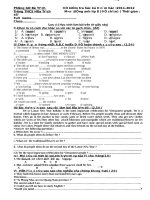
Name:________________
SECOND SEMESTER TEST 2
Choose the word whose underlined part is pronounced differently from that of the other words.
1. A. identify
B. qualify
C. improve
D. discriminate
2. A. educated
B. forced
C. degraded
D. depleted
Choose the word that has stress pattern different from that of the other words.
3. A. digital
B. effective
C. prestigious
D. polluted
4. A. damage
B. contrast
C. discharge
D. enrol
Choose the best answer among A, B, C or D that best completes each sentence.
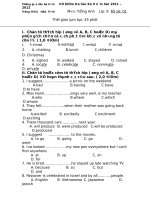
5. ______Statue of Liberty was a gift of friendship from______ France to______ United States.
A. the/ ø/ the
B. the/the/the
C. ø/the/the
D. ø/ ø/ the
6. Normally, it takes us ______hour and______ half to go there.
A. a/a
B. an/a
C. a/an
D. a/ ø
7. He talked about the books and the authors______interested him.
A. who
B. that
C. which
D. whom
8. All the people______have gone into the room are still young.
A. who
B. whom
C. whose
D. that
9. He wants to know whether I ______back tomorrow.
A. come
B. came
C. will come
D. would come
10. She asked me ______my holidays ______.
A. where I spent / the previous year
B. where I had spent/ the previous year
C. where I spent / last year
D. where did I spend / last year
11. You______yourself ill if you don’t eat properly.
A. were to make
B. make
C. would make
D. will make
12. If everyone ______an extra hour a day, it would greatly increase production.
A. work
B. works
C. working
D. worked
13. A supermarket is______a shopping center.
A. less convenient as
C. less convenient than
B. not so convenient than
D. the most convenient as
14. Enrich your time in Hawaii by learning about the ______of its islands.
A. flora and fauna
B. lawns and grass
C. floral and animals D. sea and sun
15. The gardens and islets near the Tien and Hau River are very attractive ecotourism ______ of the
region.
A. sights
B. destinations
C. views
16. If wastes are thrown ______, they can cause pollution in water, land and air.
A. eco-friendly
B. inappropriately
C. disappointingly
D. scenes
D. favourably
17. You should use electric fans instead of air conditioners ______ they don’t emit dangerous gases.
A. because
B. although
C. so
D. but
18. The teacher was surprised to discover that his students are quieter and more focused on their
assignments when they are allowed to listen to their soft music during ______.
A. private work
B. private homework
C. individual homework
D. individual classwork
19. The American idea of ______ has not changed much over the several centuries of its existence.
A. success
B. succeed
C. successful
D. successfully
20. The British usually pay a lot of attention______ good table manners. .
A. for
B. to
C. about
D. on
21. I suggest that teacher______ students from using their mobile phones in the class.
A. bans
B. banned
C. banning
D. ban
22. The Vietnamese government has done a lot to ______hunger and poverty.
A. promote
B. eliminate
C. enhance
D. encourage
Mark the letter A, B, C, or D on your answer sheet to indicate the sentence that is CLOSEST
in meaning to each of the following questions.
23. They are going to hold next year’s congress in San Francisco.
A. Congress is going to be held next year in San Francisco.
B. Congress in San Francisco is going to be held next year.
C. Next year’s congress is going to be held by them held next year.
D. Next year’s congress is going to be held in San Francisco.
24. “I am sorry but I won’t do the extra work,” Carol said.
A. Carol promise not to do the extra work.
B. Carol denied doing the extra work.
C. Carol refused to do the extra work.
D. Carol apologized for doing the extra work.
Mark the letter A. B. C, or D to indicate the word(s) CLOSEST in meaning to the underlined
word(s) in each of the following questions.
25. Female firefighters are sometimes the targets of laughter and anger from the coworkers
and local people.
A. reasons
B. sources
C. directions
D. victims
Mark the letter A, B, C, or D to indicate the word(s) OPPOSITE in meaning to the underlined
word(s) in each of the following questions.
26. The equipment is lightweight, portable and easy to store.
A. moveable
B. flexible
C. immobile
D. adjustable
Read the following passage and mark the letter A, B, C, or D to indicate the correct word that
best fits each of the numbered blanks.
Bowing is nothing less than an art form in Japan, respect pounded into children’s heads
from the moment they ______(27) school. For tourists, a simple inclination of the head or an
attempt at a bow at the waist will usually suffice. The duration and ______(28) of the bow is
proportionate to the elevation of the person you’re addressing. ______(29), a friend might get a
lightning-fast 30-degree bow; an office superior might get a slow, extended, 70-degree bow. It’s all
about position and circumstance.
There is no tipping in any situation in Japan — cabs, restaurants, personal care. To tip someone is
actually a little insulting; the services you’ve asked ______(30) are covered by the price given, so
why pay more? If you are in a large area like Tokyo and can’t speak any Japanese, a waiter or
waitress ______(31) take the extra money you happen to leave rather than force themselves to deal
with the awkward situation of explaining the concept of no tipping in broken English.
27. A. go
B. enter
C. leave
D. come
28. A. inclination
B. combination
C. explanation
D. temptation
29. A. However
B. Therefore
C. For example
D. Moreover
30. A. to
B. about
C. on
D. for
31. A. could
B. might
C. would
D. must
Read the following passage and mark the letter A, B, C, or D to indicate the correct answer to
each of the questions.
Many people think that we can learn a lot about the culture of a foreign country simply by living in
that country. However, this is not necessarily true. Often, the longer we stay in a foreign country, the
more we realize how little we actually know about the culture of that country.
Books and talks about other people’s culture can even be dangerous because they
concentrate on cultural differences and exaggerate national character, and sometimes a lot of
information they contain is untrue.
In a study recently carried out in Britain, people were asked to make a list of anything that
they thought was typical of Britain and would interest a foreign visitor there. Most mentioned
Shakespeare, the Queen, village inns, English folk dancing, English castles, and fish chips wrapped
in newspaper. Although all of these characters can be found in British culture, they do not show the
real interests of ordinary British people: (they are, in fact, simply stereotype- that is, general
character which people wrongly think are typical). What is surprising is that they were suggested by
British people themselves as representing their culture. If people have such a wrong impression of
their own culture, how much false would their impression of their culture be!
32. If we stay a long time in a foreign country, ______
A. we will usually realize that we know very little about its culture
B. we will sometimes forget about culture of our own country
C. we can often learn a lot about the culture of the foreign country
D. we can seldom find out anything at all about its culture
33. It is hard to learn about a country’s cultural from books because such books ______
A. concentrate on the dangers of the foreign culture
B. exaggerate national character
C. take no notice of culture different
D. contain little information about culture
34. When asked about their own culture, many British people ______
A. gave incorrect answers
B. were surprised by the question asked
C. argued they know little about British culture
D. said they themselves were not typical of British people
35. It can be inferred from the last paragraph that it’s easy to ______
A. give exact information about your own country
B. describe stereotypes of your country
C. know a lot about your own country’s culture
D. know the culture of other countries
36. Which of the following is true?
A. It’s easy to assimilate the culture of a foreign country.
B. Visitors to a country are soon assimilated into it culture.
C. British people understand their own culture more than other culture.
D. The culture of a foreign culture can not be learned by reading books.
Rewrite the following sentences.
37. They are going to rebuild the house next month. (using passive)
…………………………………………………………………………………………….
38. I've never met any more dependable person than George. (using comparisons)
…………………………………………………………………………………………….
39. Mr. Brown is a nice teacher. We studied with him last year. (using relative clauses)
…………………………………………………………………………………………….
40. She cannot cook because she feels very tired today. (using conditional sentences)
…………………………………………………………………………………………….
……………………………………………………………………………………………………
……………………………………………………………………………………………………
……………………………………………………………………………………………………
……………………………………………………………………………………………………
……………………………………………………………………………………………………
……………………………………………………………………………………
……………………………………………………………………………………………………
……………………………………………………………………………………………………
……………………………………………………………………………………………