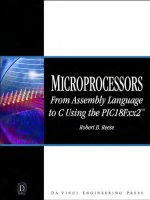
microcontrollers from assembly language to c using the pic24 family
Bạn đang xem bản rút gọn của tài liệu. Xem và tải ngay bản đầy đủ của tài liệu tại đây (30.09 MB, 734 trang )
Microcontrollers,
Second Edition:
From Assembly
Language to C Using
the PIC24 Family
Bryan A. Jones
Robert B. Reese
J.W. Bruce
Cengage Learning PTR
Australia, Brazil, Japan, Korea, Mexico, Singapore, Spain, United Kingdom, United States
Microcontrollers, Second Edition:
From Assembly Language to C
Using the PIC24 Family
Bryan A. Jones, Robert B. Reese,
and J.W. Bruce
Publisher and General Manager,
Cengage Learning PTR:
Stacy L. Hiquet
© 2015 Cengage Learning PTR.
CENGAGE and CENGAGE LEARNING are registered trademarks of Cengage
Learning, Inc., within the United States and certain other jurisdictions.
ALL RIGHTS RESERVED. No part of this work covered by the copyright
herein may be reproduced, transmitted, stored, or used in any form or by
any means graphic, electronic, or mechanical, including but not limited to
photocopying, recording, scanning, digitizing, taping, Web distribution,
information networks, or information storage and retrieval systems, except
as permitted under Section 107 or 108 of the 1976 United States Copyright
Act, without the prior written permission of the publisher.
Associate Director of Marketing:
Sarah Panella
Manager of Editorial Services:
Heather Talbot
Senior Product Manager:
Mitzi Koontz
Project and Copy Editor:
Kezia Endsley
Interior Layout:
Shawn Morningstar
Cover Designer:
Luke Fletcher
Proofreader:
Kelly Talbot Editing Services
Indexer:
Kelly Talbot Editing Services
For product information and technology assistance, contact us at
Cengage Learning Customer & Sales Support, 1-800-354-9706.
For permission to use material from this text or product,
submit all requests online at cengage.com/permissions.
Further permissions questions can be emailed to
All trademarks are the property of their respective owners. Noted figures
have been reprinted with permission of the copyright owner, Microchip
Technology Inc. All rights reserved. No further reprints or reproduction may
be made without Microchip Inc.’s prior written consent.
All images © Cengage Learning unless otherwise noted.
Library of Congress Control Number: 2014945697
ISBN-13: 978-1-305-07655-6
ISBN-10: 1-305-07655-9
eISBN-10: 1-305-07656-7
Cengage Learning PTR
20 Channel Center Street
Boston, MA 02210
USA
Cengage Learning is a leading provider of customized learning solutions with
office locations around the globe, including Singapore, the United Kingdom,
Australia, Mexico, Brazil, and Japan. Locate your local office at:
international.cengage.com/region.
Cengage Learning products are represented in Canada by Nelson Education, Ltd.
For your lifelong learning solutions, visit cengageptr.com.
Printed in the United States of America
1 2 3 4 5 6 7 16 15 14
Visit our corporate Web site at cengage.com.
RBR: To my wife (Donna) and sons (Bryan and Brandon)—thanks for
putting up with me.
BAJ: To my beloved wife and to my Lord; soli Deo gloria.
JWB: To all of my teachers. Thank you.
Acknowledgments
The authors would like to thank the following individuals for their assistance in preparing this book:
■
■
iv
ECE 4723/6723 and ECE 3724 students for their patience during the development of
this text and the accompanying software libraries. That includes ECE 3724 TAs Hejia Pan,
Ian Turnipseed, and Ryan Nazaretian for their assistance during this transition. Ryan also
served as an ECE 4723/6723 TA.
To the members of the Microchip Academic Program team at Microchip Technology Inc.
for their support in using Microchip products in a higher-education environment.
About the Authors
BRYAN A. JONES received B.S.E.E. and M.S. degrees in electrical engineering from Rice University,
Houston, TX, in 1995 and 2002, respectively, and a Ph.D. in electrical engineering from Clemson
University, Clemson, SC, in 2005. From 1996 to 2000, he was a Hardware Design Engineer for
Compaq, specializing in board layout for high-availability RAID controllers. Since 2005, he has
served in the Department of Electrical and Computer Engineering at Mississippi State University,
Mississippi State, where he is an Associate Professor. His research interests include literate programming, engineering education, embedded systems, and visual guidance for micro air vehicles.
ROBERT B. REESE received a B.S. from Louisiana Tech University, Ruston, in 1979 and M.S. and
Ph.D. degrees from Texas A&M University, College Station, in 1982 and 1985, respectively, all in
electrical engineering. He served as a member of the technical staff of the Microelectronics and
Computer Technology Corporation (MCC), Austin, TX, from 1985 to 1988. Since 1988, he has
been with the Department of Electrical and Computer Engineering at Mississippi State University,
Mississippi State, where he is an Associate Professor. Courses that he teaches include
Microprocessors, VLSI systems, Digital System Design, and Senior Design. His research interests
include self-timed digital systems and computer architecture.
J.W. BRUCE received a B.S.E. from the University of Alabama in Huntsville in 1991, an M.S.E.E. from
the Georgia Institute of Technology in 1993, and a Ph.D. from the University of Nevada Las Vegas in
2000, all in electrical engineering. Dr. Bruce has served as a member of the technical staff at the Mevatec
Corporation, providing engineering support to the Marshall Space Flight Center Microgravity
Research Program. He also worked in the 3D Workstation Graphics Group at the Integraph
Corporation, designing the world’s first OpenGL graphics accelerator for the Windows operating
system. Since 2000, Dr. Bruce has served in the Department of Electrical and Computer
Engineering at Mississippi State University. Dr. Bruce has contributed to the research areas of data
converter architecture design and embedded systems design. He has published more than 35 technical publications, several book chapters, and one book.
v
This page intentionally left blank
Contents
Introduction . . . . . . . . . . . . . . . . . . . . . . . . . . . . . . . . . . . . . . . . . . . . . . . . . .xv
PART I
DIGITAL LOGIC REVIEW
Chapter 1
AND
COMPUTER ARCHITECTURE FUNDAMENTALS . . .1
Number System and Digital Logic Review . . . . . . . . . . . . . . .3
Learning Objectives . . . . . . . . . . . . . . . . . . . . . . . . . . . . . . . . . . . . . . . . . . . . .3
Using Binary Data . . . . . . . . . . . . . . . . . . . . . . . . . . . . . . . . . . . . . . . . . . . . . .4
Unsigned Number Conversion . . . . . . . . . . . . . . . . . . . . . . . . . . . . . . . . . . . .7
Hex to Binary, Binary to Hex . . . . . . . . . . . . . . . . . . . . . . . . . . . . . . . . . . . 7
Combinational Logic Functions . . . . . . . . . . . . . . . . . . . . . . . . . . . . . . . . . . .12
Combinational Building Blocks . . . . . . . . . . . . . . . . . . . . . . . . . . . . . . . . . . .19
The Multiplexer . . . . . . . . . . . . . . . . . . . . . . . . . . . . . . . . . . . . . . . . . . . . 19
The Adder. . . . . . . . . . . . . . . . . . . . . . . . . . . . . . . . . . . . . . . . . . . . . . . . . 20
The Incrementer. . . . . . . . . . . . . . . . . . . . . . . . . . . . . . . . . . . . . . . . . . . . 21
The Shifter . . . . . . . . . . . . . . . . . . . . . . . . . . . . . . . . . . . . . . . . . . . . . . . . 22
Memory . . . . . . . . . . . . . . . . . . . . . . . . . . . . . . . . . . . . . . . . . . . . . . . . . . 22
Understanding Sequential Logic . . . . . . . . . . . . . . . . . . . . . . . . . . . . . . . . . .23
The Clock Signal . . . . . . . . . . . . . . . . . . . . . . . . . . . . . . . . . . . . . . . . . . . . 24
The D Flip-Flop . . . . . . . . . . . . . . . . . . . . . . . . . . . . . . . . . . . . . . . . . . . . . 25
Sequential Building Blocks . . . . . . . . . . . . . . . . . . . . . . . . . . . . . . . . . . . . . .27
The Register . . . . . . . . . . . . . . . . . . . . . . . . . . . . . . . . . . . . . . . . . . . . . . . 27
The Counter . . . . . . . . . . . . . . . . . . . . . . . . . . . . . . . . . . . . . . . . . . . . . . . 28
The Shift Register. . . . . . . . . . . . . . . . . . . . . . . . . . . . . . . . . . . . . . . . . . . 28
Encoding Character Data . . . . . . . . . . . . . . . . . . . . . . . . . . . . . . . . . . . . . . .30
Summary . . . . . . . . . . . . . . . . . . . . . . . . . . . . . . . . . . . . . . . . . . . . . . . . . . . . .31
Review Problems . . . . . . . . . . . . . . . . . . . . . . . . . . . . . . . . . . . . . . . . . . . . . .32
vii
viii
Table of Contents
Chapter 2
The Stored Program Machine . . . . . . . . . . . . . . . . . . . . . . . .33
Learning Objectives . . . . . . . . . . . . . . . . . . . . . . . . . . . . . . . . . . . . . . . . . . . .33
Problem Solving the Digital Way . . . . . . . . . . . . . . . . . . . . . . . . . . . . . . . . .34
Finite State Machine Design . . . . . . . . . . . . . . . . . . . . . . . . . . . . . . . . . . . . .35
Finite State Machine Implementation . . . . . . . . . . . . . . . . . . . . . . . . . . 37
A Stored Program Machine . . . . . . . . . . . . . . . . . . . . . . . . . . . . . . . . . . . . . .40
Instruction Set Design and Assembly Language . . . . . . . . . . . . . . . . . . 40
Hardware Design . . . . . . . . . . . . . . . . . . . . . . . . . . . . . . . . . . . . . . . . . . . 44
Modern Computers . . . . . . . . . . . . . . . . . . . . . . . . . . . . . . . . . . . . . . . . . . . .48
Summary . . . . . . . . . . . . . . . . . . . . . . . . . . . . . . . . . . . . . . . . . . . . . . . . . . . . .48
Review Problems . . . . . . . . . . . . . . . . . . . . . . . . . . . . . . . . . . . . . . . . . . . . . .48
PART II
PIC24 μC ASSEMBLY LANGUAGE PROGRAMMING . . . . . . . . . . . . . . . . .51
Chapter 3
Introduction to the PIC24 Microcontroller Family . . . . . . . .53
Learning Objectives . . . . . . . . . . . . . . . . . . . . . . . . . . . . . . . . . . . . . . . . . . . .53
Introduction to Microprocessors and Microcontrollers . . . . . . . . . . . . . . . .54
The PIC24 Microcontroller Family . . . . . . . . . . . . . . . . . . . . . . . . . . . . . . . . .55
Program Memory Organization . . . . . . . . . . . . . . . . . . . . . . . . . . . . . . . 57
Data Memory Organization . . . . . . . . . . . . . . . . . . . . . . . . . . . . . . . . . . 58
Arrangement of Multibyte Values in Data Memory . . . . . . . . . . . . . . . 60
Data Transfer Instructions and Addressing Modes . . . . . . . . . . . . . . . . . . .62
Register Direct Addressing . . . . . . . . . . . . . . . . . . . . . . . . . . . . . . . . . . . 62
File Register Addressing . . . . . . . . . . . . . . . . . . . . . . . . . . . . . . . . . . . . . . . .65
WREG—The Default Working Register . . . . . . . . . . . . . . . . . . . . . . . . . 67
Immediate Addressing. . . . . . . . . . . . . . . . . . . . . . . . . . . . . . . . . . . . . . . 69
Indirect Addressing . . . . . . . . . . . . . . . . . . . . . . . . . . . . . . . . . . . . . . . . . 70
Instruction Set Regularity . . . . . . . . . . . . . . . . . . . . . . . . . . . . . . . . . . . . 72
Basic Arithmetic and Control Instructions . . . . . . . . . . . . . . . . . . . . . . . . . .74
Three-Operand Addition/Subtraction. . . . . . . . . . . . . . . . . . . . . . . . . . . 74
Two-Operand Addition/Subtraction . . . . . . . . . . . . . . . . . . . . . . . . . . . . 76
Increment, Decrement Instructions . . . . . . . . . . . . . . . . . . . . . . . . . . . . 77
Program Control: goto . . . . . . . . . . . . . . . . . . . . . . . . . . . . . . . . . . . . . . 77
A PIC24 Assembly Language Program . . . . . . . . . . . . . . . . . . . . . . . . . . . . .79
C-to-PIC24 Assembly Language. . . . . . . . . . . . . . . . . . . . . . . . . . . . . . . . 80
16-Bit (Word) Operations . . . . . . . . . . . . . . . . . . . . . . . . . . . . . . . . . . . . 88
The Clock and Instruction Execution . . . . . . . . . . . . . . . . . . . . . . . . . . . . . .91
Summary . . . . . . . . . . . . . . . . . . . . . . . . . . . . . . . . . . . . . . . . . . . . . . . . . . . . .92
Review Problems . . . . . . . . . . . . . . . . . . . . . . . . . . . . . . . . . . . . . . . . . . . . . .92
Table of Contents
Chapter 4
Unsigned 8/16-Bit Arithmetic, Logical,
and Conditional Operations . . . . . . . . . . . . . . . . . . . . . . . . . .95
Learning Objectives . . . . . . . . . . . . . . . . . . . . . . . . . . . . . . . . . . . . . . . . . . . .95
Bitwise Logical Operations, Bit Operations . . . . . . . . . . . . . . . . . . . . . . . . .96
Using the Status Register . . . . . . . . . . . . . . . . . . . . . . . . . . . . . . . . . . . . . .100
Using Shift and Rotate Operations . . . . . . . . . . . . . . . . . . . . . . . . . . . . . . .102
Using Mixed 8-Bit/16-Bit Operations, Compound Operations . . . . . . . . .105
Working Register Usage . . . . . . . . . . . . . . . . . . . . . . . . . . . . . . . . . . . . 108
LSB and MSB Operations . . . . . . . . . . . . . . . . . . . . . . . . . . . . . . . . . . . . 108
Conditional Execution Using Bit Tests . . . . . . . . . . . . . . . . . . . . . . . . . . . .109
Unsigned Conditional Tests . . . . . . . . . . . . . . . . . . . . . . . . . . . . . . . . . . . . .111
Conditional Tests in C . . . . . . . . . . . . . . . . . . . . . . . . . . . . . . . . . . . . . . 111
Zero, Non-Zero Conditional Tests . . . . . . . . . . . . . . . . . . . . . . . . . . . . . 112
Bit Tests. . . . . . . . . . . . . . . . . . . . . . . . . . . . . . . . . . . . . . . . . . . . . . . . . . 115
Equality, Inequality Conditional Tests. . . . . . . . . . . . . . . . . . . . . . . . . . 116
Conditional Tests for >=, >, <, and <= . . . . . . . . . . . . . . . . . . . . . . . . . 116
Comparison and Unsigned Branch Instructions . . . . . . . . . . . . . . . . . . 118
Complex Conditional Expressions . . . . . . . . . . . . . . . . . . . . . . . . . . . . . . . .123
Looping . . . . . . . . . . . . . . . . . . . . . . . . . . . . . . . . . . . . . . . . . . . . . . . . . . . . .126
Summary . . . . . . . . . . . . . . . . . . . . . . . . . . . . . . . . . . . . . . . . . . . . . . . . . . . .128
Review Problems . . . . . . . . . . . . . . . . . . . . . . . . . . . . . . . . . . . . . . . . . . . . .129
Chapter 5
Extended Precision and Signed Data Operations . . . . . . .133
Learning Objectives . . . . . . . . . . . . . . . . . . . . . . . . . . . . . . . . . . . . . . . . . . .133
Extended Precision Operations . . . . . . . . . . . . . . . . . . . . . . . . . . . . . . . . . .134
32-Bit Assignment Operations . . . . . . . . . . . . . . . . . . . . . . . . . . . . . . . 134
32-Bit Bitwise Logical Operations . . . . . . . . . . . . . . . . . . . . . . . . . . . . . 136
32-Bit Addition/Subtraction . . . . . . . . . . . . . . . . . . . . . . . . . . . . . . . . . 137
32-Bit Logical Shift Right/Shift Left Operations. . . . . . . . . . . . . . . . . . 141
Zero, Non-Zero Conditional Tests . . . . . . . . . . . . . . . . . . . . . . . . . . . . . 141
Equality, Inequality . . . . . . . . . . . . . . . . . . . . . . . . . . . . . . . . . . . . . . . . 144
Comparisons of >, > =, <, and < = on Unsigned 32-Bit Operands . . . . 145
64-Bit Operations . . . . . . . . . . . . . . . . . . . . . . . . . . . . . . . . . . . . . . . . . . 146
Signed Number Representation . . . . . . . . . . . . . . . . . . . . . . . . . . . . . . . . .147
Signed Magnitude . . . . . . . . . . . . . . . . . . . . . . . . . . . . . . . . . . . . . . . . . 147
One’s Complement. . . . . . . . . . . . . . . . . . . . . . . . . . . . . . . . . . . . . . . . . 148
Two’s Complement. . . . . . . . . . . . . . . . . . . . . . . . . . . . . . . . . . . . . . . . . 149
Sign Extension . . . . . . . . . . . . . . . . . . . . . . . . . . . . . . . . . . . . . . . . . . . . 151
Two’s Complement Overflow . . . . . . . . . . . . . . . . . . . . . . . . . . . . . . . . 152
Operations on Signed Data . . . . . . . . . . . . . . . . . . . . . . . . . . . . . . . . . . . . .153
Shift Operations on Signed Data . . . . . . . . . . . . . . . . . . . . . . . . . . . . . 155
Comparisons of >, >=, <, and < = on Signed Operands. . . . . . . . . . . . 157
ix
x
Table of Contents
Sign Extension for Mixed Precision . . . . . . . . . . . . . . . . . . . . . . . . . . . 159
Branch Instruction Encoding . . . . . . . . . . . . . . . . . . . . . . . . . . . . . . . . . . . .161
Summary . . . . . . . . . . . . . . . . . . . . . . . . . . . . . . . . . . . . . . . . . . . . . . . . . . . .163
Review Problems . . . . . . . . . . . . . . . . . . . . . . . . . . . . . . . . . . . . . . . . . . . . .164
Chapter 6
Pointers and Subroutines . . . . . . . . . . . . . . . . . . . . . . . . . . .167
Learning Objectives . . . . . . . . . . . . . . . . . . . . . . . . . . . . . . . . . . . . . . . . . . .167
PIC24 Indirect Addressing Modes . . . . . . . . . . . . . . . . . . . . . . . . . . . . . . . .168
Register Indirect with Signed Constant Offset . . . . . . . . . . . . . . . . . . 170
What Instruction Forms Support Indirect Addressing? . . . . . . . . . . . . 170
Instruction Stalls Due to Data Dependencies. . . . . . . . . . . . . . . . . . . . 171
Using Subroutines . . . . . . . . . . . . . . . . . . . . . . . . . . . . . . . . . . . . . . . . . . . .172
The Stack and Call/Return, Push/Pop . . . . . . . . . . . . . . . . . . . . . . . . . . . . .174
The Data Memory Stack . . . . . . . . . . . . . . . . . . . . . . . . . . . . . . . . . . . . 175
Call/Return and the Data Memory Stack . . . . . . . . . . . . . . . . . . . . . . . 178
Stack Overflow/Underflow . . . . . . . . . . . . . . . . . . . . . . . . . . . . . . . . . . 179
Implementing Subroutines in Assembly Language . . . . . . . . . . . . . . . . . .179
Static versus Dynamic Parameter Allocation . . . . . . . . . . . . . . . . . . . . 180
Using Working Registers for Subroutine Parameters and Locals . . . . 182
The Shadow Registers . . . . . . . . . . . . . . . . . . . . . . . . . . . . . . . . . . . . . . 186
C Pointers and Arrays . . . . . . . . . . . . . . . . . . . . . . . . . . . . . . . . . . . . . . . . .186
Implementation of C Pointer/Array Operations in Assembly . . . . . . . 190
A Subroutine That Manipulates 32-Bit Data . . . . . . . . . . . . . . . . . . . . 193
C Strings . . . . . . . . . . . . . . . . . . . . . . . . . . . . . . . . . . . . . . . . . . . . . . . . . 195
The repeat Instruction . . . . . . . . . . . . . . . . . . . . . . . . . . . . . . . . . . . . . . 196
Stack Frames for Function Parameters and Local Variables . . . . . . . . . . .199
Program Space Visibility and Global Variable Initialization . . . . . . . . . . .203
Summary . . . . . . . . . . . . . . . . . . . . . . . . . . . . . . . . . . . . . . . . . . . . . . . . . . . .206
Review Problems . . . . . . . . . . . . . . . . . . . . . . . . . . . . . . . . . . . . . . . . . . . . .208
Chapter 7
Advanced Assembly Language: Higher Math . . . . . . . . . .213
Learning Objectives . . . . . . . . . . . . . . . . . . . . . . . . . . . . . . . . . . . . . . . . . . .213
Multiplication . . . . . . . . . . . . . . . . . . . . . . . . . . . . . . . . . . . . . . . . . . . . . . . .214
64-Bit Multiplication . . . . . . . . . . . . . . . . . . . . . . . . . . . . . . . . . . . . . . . 218
Division . . . . . . . . . . . . . . . . . . . . . . . . . . . . . . . . . . . . . . . . . . . . . . . . . . . .220
Fixed-Point and Saturating Arithmetic . . . . . . . . . . . . . . . . . . . . . . . . . . . .225
Decimal to x.y Binary Format . . . . . . . . . . . . . . . . . . . . . . . . . . . . . . . . 226
x.y Binary Format to Decimal Conversion . . . . . . . . . . . . . . . . . . . . . . 226
Signed Fixed-Point . . . . . . . . . . . . . . . . . . . . . . . . . . . . . . . . . . . . . . . . . 227
0.n Fixed-Point Format and Saturating Operations . . . . . . . . . . . . . . 228
The dsPIC® Microcontroller Family . . . . . . . . . . . . . . . . . . . . . . . . . . . . . . .230
Table of Contents
Floating-Point Number Representation . . . . . . . . . . . . . . . . . . . . . . . . . . .230
IEEE 754 Floating-Point Encoding. . . . . . . . . . . . . . . . . . . . . . . . . . . . . 230
Floating-Point Operations . . . . . . . . . . . . . . . . . . . . . . . . . . . . . . . . . . . 233
BCD Arithmetic . . . . . . . . . . . . . . . . . . . . . . . . . . . . . . . . . . . . . . . . . . . . . . .235
ASCII Data Conversion . . . . . . . . . . . . . . . . . . . . . . . . . . . . . . . . . . . . . . . . .237
Binary to ASCII-Hex . . . . . . . . . . . . . . . . . . . . . . . . . . . . . . . . . . . . . . . . 237
Binary to ASCII-Decimal . . . . . . . . . . . . . . . . . . . . . . . . . . . . . . . . . . . . . 239
ASCII-Hex to Binary . . . . . . . . . . . . . . . . . . . . . . . . . . . . . . . . . . . . . . . . 240
ASCII-Decimal to Binary . . . . . . . . . . . . . . . . . . . . . . . . . . . . . . . . . . . . . 242
Summary . . . . . . . . . . . . . . . . . . . . . . . . . . . . . . . . . . . . . . . . . . . . . . . . . . . .242
Review Problems . . . . . . . . . . . . . . . . . . . . . . . . . . . . . . . . . . . . . . . . . . . . .243
PART III
PIC24 μC INTERFACING USING
Chapter 8
THE
C LANGUAGE . . . . . . . . . . . . . . . .245
System Startup and Parallel Port I/O . . . . . . . . . . . . . . . . .247
Learning Objectives . . . . . . . . . . . . . . . . . . . . . . . . . . . . . . . . . . . . . . . . . . .247
High-Level Languages versus Assembly Language . . . . . . . . . . . . . . . . . .248
C Compilation for the PIC24 μC . . . . . . . . . . . . . . . . . . . . . . . . . . . . . . . . .250
Special Function Registers and Bit References. . . . . . . . . . . . . . . . . . . 251
PIC24 Compiler Runtime Code, Variable Qualifiers/Attributes. . . . . . 255
C Macros, Inline Functions. . . . . . . . . . . . . . . . . . . . . . . . . . . . . . . . . . . 256
Conditional Compilation . . . . . . . . . . . . . . . . . . . . . . . . . . . . . . . . . . . . 256
PIC24 Startup Schematic . . . . . . . . . . . . . . . . . . . . . . . . . . . . . . . . . . . . . . .258
Startup Schematic: Power . . . . . . . . . . . . . . . . . . . . . . . . . . . . . . . . . . . 260
Startup Schematic: Reset . . . . . . . . . . . . . . . . . . . . . . . . . . . . . . . . . . . . 261
Startup Schematic: PC Serial Communication Link . . . . . . . . . . . . . . . 262
Startup Schematic: In-Circuit Serial Programming . . . . . . . . . . . . . . . 262
Startup Schematic: Application Components . . . . . . . . . . . . . . . . . . . 263
ledflash.c—The First C Program for PIC24 Startup . . . . . . . . . . . . . . . . . .263
Clock Configuration. . . . . . . . . . . . . . . . . . . . . . . . . . . . . . . . . . . . . . . . 263
Flashing the LED . . . . . . . . . . . . . . . . . . . . . . . . . . . . . . . . . . . . . . . . . . 264
An Improved LED Flash Program . . . . . . . . . . . . . . . . . . . . . . . . . . . . . 265
echo.c—Testing the Serial Link . . . . . . . . . . . . . . . . . . . . . . . . . . . . . . . . . .267
asm_echo.s—Implementing Echo in Assembly . . . . . . . . . . . . . . . . . . 269
Datasheet Reading—A Critical Skill . . . . . . . . . . . . . . . . . . . . . . . . . . . . . .270
Configuration Bits . . . . . . . . . . . . . . . . . . . . . . . . . . . . . . . . . . . . . . . . . . . .272
Clock Generation . . . . . . . . . . . . . . . . . . . . . . . . . . . . . . . . . . . . . . . . . . . . .273
Power-On Reset Behavior and Reset Sources . . . . . . . . . . . . . . . . . . . . . .274
Watchdog Timer, Sleep, Idle, and Doze . . . . . . . . . . . . . . . . . . . . . . . . . . .276
The reset.c Test Program . . . . . . . . . . . . . . . . . . . . . . . . . . . . . . . . . . . . . . .280
xi
xii
Table of Contents
Parallel Port Operation . . . . . . . . . . . . . . . . . . . . . . . . . . . . . . . . . . . . . . . .284
Tristate Drivers . . . . . . . . . . . . . . . . . . . . . . . . . . . . . . . . . . . . . . . . . . . . 287
Schmitt Trigger Input. . . . . . . . . . . . . . . . . . . . . . . . . . . . . . . . . . . . . . . 288
Open-Drain Output . . . . . . . . . . . . . . . . . . . . . . . . . . . . . . . . . . . . . . . . 288
Internal Weak Pull-Ups and Pull-Downs. . . . . . . . . . . . . . . . . . . . . . . . 289
Digital versus Analog Inputs . . . . . . . . . . . . . . . . . . . . . . . . . . . . . . . . . 290
PIO Control Bits Summary . . . . . . . . . . . . . . . . . . . . . . . . . . . . . . . . . . . 291
PIO Configuration Macros/Functions . . . . . . . . . . . . . . . . . . . . . . . . . . 291
LED/Switch I/O and State Machine Programming . . . . . . . . . . . . . . . . . . .293
State Machine I/O Programming . . . . . . . . . . . . . . . . . . . . . . . . . . . . . 295
Extended State in a More Complex LED/Switch I/O Problem . . . . . . . 298
Interfacing to an LCD Module . . . . . . . . . . . . . . . . . . . . . . . . . . . . . . . . . .302
3.3 V to 5 V Interfacing . . . . . . . . . . . . . . . . . . . . . . . . . . . . . . . . . . . . . 303
LCD Commands . . . . . . . . . . . . . . . . . . . . . . . . . . . . . . . . . . . . . . . . . . . 304
LCD Code Example . . . . . . . . . . . . . . . . . . . . . . . . . . . . . . . . . . . . . . . . . 306
The PIC24E versus the PIC24F and PIC24H Families . . . . . . . . . . . . . . . . . .310
Summary . . . . . . . . . . . . . . . . . . . . . . . . . . . . . . . . . . . . . . . . . . . . . . . . . . . .311
Review Problems . . . . . . . . . . . . . . . . . . . . . . . . . . . . . . . . . . . . . . . . . . . . .312
Chapter 9
Interrupts and a First Look at Timers . . . . . . . . . . . . . . . . .317
Learning Objectives . . . . . . . . . . . . . . . . . . . . . . . . . . . . . . . . . . . . . . . . . . .317
Interrupt Basics . . . . . . . . . . . . . . . . . . . . . . . . . . . . . . . . . . . . . . . . . . . . . . .318
PIC24 μC Interrupt Details . . . . . . . . . . . . . . . . . . . . . . . . . . . . . . . . . . . . . .320
Vector Table . . . . . . . . . . . . . . . . . . . . . . . . . . . . . . . . . . . . . . . . . . . . . . 320
Interrupt Priorities . . . . . . . . . . . . . . . . . . . . . . . . . . . . . . . . . . . . . . . . . 322
Traps . . . . . . . . . . . . . . . . . . . . . . . . . . . . . . . . . . . . . . . . . . . . . . . . . . . . 322
Interrupt Latency . . . . . . . . . . . . . . . . . . . . . . . . . . . . . . . . . . . . . . . . . . 323
ISR Overhead . . . . . . . . . . . . . . . . . . . . . . . . . . . . . . . . . . . . . . . . . . . . . 324
ISR Functions in C . . . . . . . . . . . . . . . . . . . . . . . . . . . . . . . . . . . . . . . . . . . . .325
The Default Interrupt . . . . . . . . . . . . . . . . . . . . . . . . . . . . . . . . . . . . . . 325
An Example ISR . . . . . . . . . . . . . . . . . . . . . . . . . . . . . . . . . . . . . . . . . . . 327
Change Notification Interrupts . . . . . . . . . . . . . . . . . . . . . . . . . . . . . . . . . .329
Wake from Sleep/Idle . . . . . . . . . . . . . . . . . . . . . . . . . . . . . . . . . . . . . . 330
Using a Change Notification Interrupt to Measure Interrupt
Latency . . . . . . . . . . . . . . . . . . . . . . . . . . . . . . . . . . . . . . . . . . . . . . . . 330
INTx External Interrupts and Remappable Pins . . . . . . . . . . . . . . . . . . . . .332
Switch Inputs and Change Notification/INTx Interrupts . . . . . . . . . . . 336
Periodic Timer Interrupts . . . . . . . . . . . . . . . . . . . . . . . . . . . . . . . . . . . . . . .336
Timer Macros and Support Functions. . . . . . . . . . . . . . . . . . . . . . . . . . 339
Square Wave Generation . . . . . . . . . . . . . . . . . . . . . . . . . . . . . . . . . . . 341
Table of Contents
Interrupt-Driven LED/Switch I/O . . . . . . . . . . . . . . . . . . . . . . . . . . . . . . . . .343
Input Sampling. . . . . . . . . . . . . . . . . . . . . . . . . . . . . . . . . . . . . . . . . . . . 343
Change Notification with a Timer . . . . . . . . . . . . . . . . . . . . . . . . . . . . 346
Filtering Noisy Inputs . . . . . . . . . . . . . . . . . . . . . . . . . . . . . . . . . . . . . . . . . .353
A Rotary Encoder Interface . . . . . . . . . . . . . . . . . . . . . . . . . . . . . . . . . . . . .355
A Keypad Interface . . . . . . . . . . . . . . . . . . . . . . . . . . . . . . . . . . . . . . . . . . .359
On Writing and Debugging ISRs . . . . . . . . . . . . . . . . . . . . . . . . . . . . . . . . .365
Summary . . . . . . . . . . . . . . . . . . . . . . . . . . . . . . . . . . . . . . . . . . . . . . . . . . . .366
Review Problems . . . . . . . . . . . . . . . . . . . . . . . . . . . . . . . . . . . . . . . . . . . . .366
Chapter 10
Asynchronous and Synchronous Serial I/O . . . . . . . . . . . . .371
Learning Objectives . . . . . . . . . . . . . . . . . . . . . . . . . . . . . . . . . . . . . . . . . . .371
I/O Channel Basics . . . . . . . . . . . . . . . . . . . . . . . . . . . . . . . . . . . . . . . . . . . .372
Synchronous, Asynchronous Serial I/O . . . . . . . . . . . . . . . . . . . . . . . . . . . .374
Asynchronous Serial I/O Using NRZ Encoding . . . . . . . . . . . . . . . . . . . 375
The PIC24 UART . . . . . . . . . . . . . . . . . . . . . . . . . . . . . . . . . . . . . . . . . . . . . .380
UARTx Transmit Operation . . . . . . . . . . . . . . . . . . . . . . . . . . . . . . . . . . 383
UARTx Receive Operation . . . . . . . . . . . . . . . . . . . . . . . . . . . . . . . . . . . 384
Baud Rate Configuration . . . . . . . . . . . . . . . . . . . . . . . . . . . . . . . . . . . 384
Using the PIC24 UART with C . . . . . . . . . . . . . . . . . . . . . . . . . . . . . . . . . . .386
<stdio.h> Library Functions . . . . . . . . . . . . . . . . . . . . . . . . . . . . . . . . . . 389
Interrupt-Driven I/O with the PIC24 UART . . . . . . . . . . . . . . . . . . . . . . . . .390
Interrupt-Driven UART Receive . . . . . . . . . . . . . . . . . . . . . . . . . . . . . . . 390
Interrupt-Driven UART Transmit . . . . . . . . . . . . . . . . . . . . . . . . . . . . . . 394
The RS-232 Standard . . . . . . . . . . . . . . . . . . . . . . . . . . . . . . . . . . . . . . . . . .399
The Serial Peripheral Interface (SPI) . . . . . . . . . . . . . . . . . . . . . . . . . . . . . .401
SPI Example: The MCP41xxx Digital Potentiometer . . . . . . . . . . . . . . . . .408
SPI Example: PIC24 μC Master to DS1722 Thermometer . . . . . . . . . . . . . .411
SPI Example: PIC24 μC Master to PIC24 μC Slave . . . . . . . . . . . . . . . . . . . .414
The I2C Bus . . . . . . . . . . . . . . . . . . . . . . . . . . . . . . . . . . . . . . . . . . . . . . . . . .419
I2C Physical Signaling . . . . . . . . . . . . . . . . . . . . . . . . . . . . . . . . . . . . . . 421
I2C Transactions . . . . . . . . . . . . . . . . . . . . . . . . . . . . . . . . . . . . . . . . . . . 423
Library Functions for I2C Transactions . . . . . . . . . . . . . . . . . . . . . . . . . 424
I2C on the PIC24 μC . . . . . . . . . . . . . . . . . . . . . . . . . . . . . . . . . . . . . . . . . . .427
I2C Example: PIC24 μC Master to DS1631 Thermometer . . . . . . . . . . . . .432
I2C Example: PIC24 μC Master to 24LC515 Serial EEPROM . . . . . . . . . . . .436
Ping-Pong Buffering for Interrupt-Driven Streaming Data . . . . . . . . . . .441
Summary . . . . . . . . . . . . . . . . . . . . . . . . . . . . . . . . . . . . . . . . . . . . . . . . . . . .445
Review Problems . . . . . . . . . . . . . . . . . . . . . . . . . . . . . . . . . . . . . . . . . . . . .445
xiii
xiv
Table of Contents
Chapter 11
Data Conversion . . . . . . . . . . . . . . . . . . . . . . . . . . . . . . . . . .449
Learning Objectives . . . . . . . . . . . . . . . . . . . . . . . . . . . . . . . . . . . . . . . . . . .449
Data Conversion Basics . . . . . . . . . . . . . . . . . . . . . . . . . . . . . . . . . . . . . . . .450
Sensors and Transducers . . . . . . . . . . . . . . . . . . . . . . . . . . . . . . . . . . . . 450
Analog-to-Digital Conversion . . . . . . . . . . . . . . . . . . . . . . . . . . . . . . . . . . .453
Successive Approximation ADC. . . . . . . . . . . . . . . . . . . . . . . . . . . . . . . 457
Sample and Hold Amplifiers . . . . . . . . . . . . . . . . . . . . . . . . . . . . . . . . . 459
The PIC24 Analog-to-Digital Converter . . . . . . . . . . . . . . . . . . . . . . . . . . .460
PIC24 ADC Configuration . . . . . . . . . . . . . . . . . . . . . . . . . . . . . . . . . . . 463
PIC24 ADC Operation: Manual . . . . . . . . . . . . . . . . . . . . . . . . . . . . . . . 469
PIC24 ADC Operation: Recap . . . . . . . . . . . . . . . . . . . . . . . . . . . . . . . . 474
Digital-to-Analog Conversion . . . . . . . . . . . . . . . . . . . . . . . . . . . . . . . . . . .474
Flash DACs . . . . . . . . . . . . . . . . . . . . . . . . . . . . . . . . . . . . . . . . . . . . . . . 475
R-2R Resistor Ladder Flash DAC . . . . . . . . . . . . . . . . . . . . . . . . . . . . . . 475
External Digital-to-Analog Converter Examples . . . . . . . . . . . . . . . . . . . .482
DAC Example: The Maxim548A . . . . . . . . . . . . . . . . . . . . . . . . . . . . . . 483
Summary . . . . . . . . . . . . . . . . . . . . . . . . . . . . . . . . . . . . . . . . . . . . . . . . . . . .486
Review Problems . . . . . . . . . . . . . . . . . . . . . . . . . . . . . . . . . . . . . . . . . . . . .486
Chapter 12
Timers . . . . . . . . . . . . . . . . . . . . . . . . . . . . . . . . . . . . . . . . . .489
Learning Objectives . . . . . . . . . . . . . . . . . . . . . . . . . . . . . . . . . . . . . . . . . . .489
Pulse Width Measurement . . . . . . . . . . . . . . . . . . . . . . . . . . . . . . . . . . . . .490
Using a 32-Bit Timer. . . . . . . . . . . . . . . . . . . . . . . . . . . . . . . . . . . . . . . . 492
Pulse Width, Period Measurement Using Input Capture . . . . . . . . . . . . .496
The Input Capture Module . . . . . . . . . . . . . . . . . . . . . . . . . . . . . . . . . . 497
Pulse Width Measurement Using Input Capture . . . . . . . . . . . . . . . . . 498
Using Cascade Mode for 32-Bit Precision Input Capture . . . . . . . . . . 504
Period Measurement Using Input Capture . . . . . . . . . . . . . . . . . . . . . 504
Application: Using Capture Mode for an Infrared Decoder . . . . . . . . . . .507
The Output Compare Module . . . . . . . . . . . . . . . . . . . . . . . . . . . . . . . . . . .516
Square Wave Generation . . . . . . . . . . . . . . . . . . . . . . . . . . . . . . . . . . . 519
Pulse Width Modulation . . . . . . . . . . . . . . . . . . . . . . . . . . . . . . . . . . . . . . .520
A PWM Example . . . . . . . . . . . . . . . . . . . . . . . . . . . . . . . . . . . . . . . . . . 521
PWM Application: DC Motor Speed Control and Servo Control . . . . . . .523
DC Motor Speed Control . . . . . . . . . . . . . . . . . . . . . . . . . . . . . . . . . . . . 523
Hobby Servo Control . . . . . . . . . . . . . . . . . . . . . . . . . . . . . . . . . . . . . . . 524
PWM Control of Multiple Servos . . . . . . . . . . . . . . . . . . . . . . . . . . . . . 526
A PWM DAC . . . . . . . . . . . . . . . . . . . . . . . . . . . . . . . . . . . . . . . . . . . . . . . . .530
Time Keeping Using Timer1 and RTCC (PIC 24H/F Families) . . . . . . . . . . .532
The Real-Time Clock Calendar Module . . . . . . . . . . . . . . . . . . . . . . . . 534
Summary . . . . . . . . . . . . . . . . . . . . . . . . . . . . . . . . . . . . . . . . . . . . . . . . . . . .538
Review Problems . . . . . . . . . . . . . . . . . . . . . . . . . . . . . . . . . . . . . . . . . . . . .538
Table of Contents
Chapter 13
Advanced Hardware Topics . . . . . . . . . . . . . . . . . . . . . . . . .541
Learning Objectives . . . . . . . . . . . . . . . . . . . . . . . . . . . . . . . . . . . . . . . . . . .541
Direct Memory Access . . . . . . . . . . . . . . . . . . . . . . . . . . . . . . . . . . . . . . . . .542
Using the PIC24 μC as an I2C Slave . . . . . . . . . . . . . . . . . . . . . . . . . . . . . . .549
Bus Arbitration for the I2C Bus . . . . . . . . . . . . . . . . . . . . . . . . . . . . . . . . . .553
Reverse String Revisited . . . . . . . . . . . . . . . . . . . . . . . . . . . . . . . . . . . . 556
The Controller Area Network (CAN) . . . . . . . . . . . . . . . . . . . . . . . . . . . . .558
The PIC24 ECAN™ Module . . . . . . . . . . . . . . . . . . . . . . . . . . . . . . . . . . . . .562
Using an ECAN RX FIFO . . . . . . . . . . . . . . . . . . . . . . . . . . . . . . . . . . . . . 570
Using an Extended Data Frame . . . . . . . . . . . . . . . . . . . . . . . . . . . . . . 571
Run-Time Self-Programming . . . . . . . . . . . . . . . . . . . . . . . . . . . . . . . . . . . .572
A Sample Flash Application. . . . . . . . . . . . . . . . . . . . . . . . . . . . . . . . . . 576
Summary . . . . . . . . . . . . . . . . . . . . . . . . . . . . . . . . . . . . . . . . . . . . . . . . . . . .580
Review Problems . . . . . . . . . . . . . . . . . . . . . . . . . . . . . . . . . . . . . . . . . . . . .581
Chapter 14
Operating Systems for Embedded Systems . . . . . . . . . . . .583
Learning Objectives . . . . . . . . . . . . . . . . . . . . . . . . . . . . . . . . . . . . . . . . . . .583
Operating System Concepts . . . . . . . . . . . . . . . . . . . . . . . . . . . . . . . . . . . .584
Tasks . . . . . . . . . . . . . . . . . . . . . . . . . . . . . . . . . . . . . . . . . . . . . . . . . . . . 587
Multitasking and Schedulers . . . . . . . . . . . . . . . . . . . . . . . . . . . . . . . . . 588
Inter-Task Coordination: Semaphores . . . . . . . . . . . . . . . . . . . . . . . . . 592
Inter-Task Coordination and Communication: Messaging . . . . . . . . . 593
OS Services . . . . . . . . . . . . . . . . . . . . . . . . . . . . . . . . . . . . . . . . . . . . . . . 594
Embedded Systems Operating System for the Microchip PIC24 μC . . . . .596
ESOS Overview . . . . . . . . . . . . . . . . . . . . . . . . . . . . . . . . . . . . . . . . . . . . 597
User Tasks . . . . . . . . . . . . . . . . . . . . . . . . . . . . . . . . . . . . . . . . . . . . . . . . 598
Your First ESOS Program . . . . . . . . . . . . . . . . . . . . . . . . . . . . . . . . . . . . 602
ESOS Communication Services . . . . . . . . . . . . . . . . . . . . . . . . . . . . . . . 604
ESOS Timer Services . . . . . . . . . . . . . . . . . . . . . . . . . . . . . . . . . . . . . . . . 608
ESOS Semaphore Services . . . . . . . . . . . . . . . . . . . . . . . . . . . . . . . . . . . 611
ESOS Messaging Services . . . . . . . . . . . . . . . . . . . . . . . . . . . . . . . . . . . . 615
ESOS User Flags . . . . . . . . . . . . . . . . . . . . . . . . . . . . . . . . . . . . . . . . . . . 619
ESOS Child Tasks. . . . . . . . . . . . . . . . . . . . . . . . . . . . . . . . . . . . . . . . . . . 621
ESOS Interrupt Services . . . . . . . . . . . . . . . . . . . . . . . . . . . . . . . . . . . . . 624
Design: Adding an ESOS Service for I2C . . . . . . . . . . . . . . . . . . . . . . . . . . .628
I2C Operations Under ESOS. . . . . . . . . . . . . . . . . . . . . . . . . . . . . . . . . . 629
I2C Transactions Under ESOS. . . . . . . . . . . . . . . . . . . . . . . . . . . . . . . . . 632
Application Using the ESOS I2C Service and Semaphores . . . . . . . . . 636
Application Using the ESOS I2C Service and Messaging . . . . . . . . . . . 638
Summary . . . . . . . . . . . . . . . . . . . . . . . . . . . . . . . . . . . . . . . . . . . . . . . . . . . .641
Review Problems . . . . . . . . . . . . . . . . . . . . . . . . . . . . . . . . . . . . . . . . . . . . .642
xv
xvi
Table of Contents
PART IV
APPENDIXES . . . . . . . . . . . . . . . . . . . . . . . . . . . . . . . . . . . . . . . . . .643
Appendix A PIC24 Architecture and Instruction Set Summary . . . . . . . .645
Appendix B
Circuits 001 . . . . . . . . . . . . . . . . . . . . . . . . . . . . . . . . . . . . . . .653
Voltage, Current, and Resistance . . . . . . . . . . . . . . . . . . . . . . . . . . . . . . . .653
Ohm’s Law . . . . . . . . . . . . . . . . . . . . . . . . . . . . . . . . . . . . . . . . . . . . . . . 654
Resistors in Series . . . . . . . . . . . . . . . . . . . . . . . . . . . . . . . . . . . . . . . . . . 655
Resistors in Parallel . . . . . . . . . . . . . . . . . . . . . . . . . . . . . . . . . . . . . . . . 656
Polarization . . . . . . . . . . . . . . . . . . . . . . . . . . . . . . . . . . . . . . . . . . . . . . 657
Diodes . . . . . . . . . . . . . . . . . . . . . . . . . . . . . . . . . . . . . . . . . . . . . . . . . . . 657
Capacitors . . . . . . . . . . . . . . . . . . . . . . . . . . . . . . . . . . . . . . . . . . . . . . . . . . .658
Appendix C
Problem Solutions . . . . . . . . . . . . . . . . . . . . . . . . . . . . . . . . .661
Appendix D References . . . . . . . . . . . . . . . . . . . . . . . . . . . . . . . . . . . . . . .689
Index . . . . . . . . . . . . . . . . . . . . . . . . . . . . . . . . . . . . . . . . . . . . . . . . . . . . . . .695
Introduction
his book and its accompanying website—www.reesemicro.com—are intended as an introduction to microprocessors (μPs) and microcontrollers (μCs) for the student or hobbyist.
The book structure is as follows:
T
■
■
■
■
■
■
■
■
Chapter 1: Review of digital logic concepts.
Chapter 2: Computer architecture fundamentals.
Chapters 3 through 6: Coverage of assembly language programming in a C language
context using the PIC24 family.
Chapter 7: Advanced assembly language programming structured around computer
arithmetic topics.
Chapters 8 through 12: Fundamental microcontroller interfacing topics such as parallel
IO, asynchronous serial IO, synchronous serial IO (I2C and SPI), interrupt-driven IO,
timers, analog-to-digital conversion, and digital-to-analog conversion.
Chapter 13: Some advanced interfacing topics such as DMA, the ECAN standard, and
slave/multi-master I2C operations.
Chapter 14: An advanced chapter that covers the basics of real-time operating systems
using a cooperative multitasking OS written by the authors. Topics include tasks, schedulers,
scheduling algorithms, task synchronization and communication, semaphores, mailboxes,
and queues.
Chapter 15: Advanced techniques and examples for use in a senior capstone design course.
This chapter is available online only at www.reesemicro.com.
xvii
xviii
■
■
■
■
Introduction
Appendix A: A compact summary of the PIC24E/dsPIC33E instruction set.
Appendix B: A hobbyist-level introduction to basic circuits. It covers the basic components
(resistors, capacitors, and diodes) used in this book’s schematics.
Appendix C: Solutions to odd-numbered end-of-chapter problems.
Appendix D: References.
This Book’s Development
At Mississippi State University, majors in Electrical Engineering (EE), Computer Engineering (CPE),
Computer Science (CS), and Software Engineering (SE) take our first course in microprocessors.
Previous to Spring 2002, this course emphasized X86 assembly language programming with the lab
experience being 100 percent assembly language based and containing no hardware component.
We found that students entering our senior design course, which has the expectation of something
“real” being built, were unprepared for doing prototyping activities or for incorporating a microcontroller component into their designs. We did offer a course in microcontrollers, but it was an
elective senior-level course and many students had not taken that course previous to senior design.
In Spring 2002, the Computer Engineering Steering Committee reexamined our goals for the first
course in microprocessors, and the approach for this book’s predecessor (From Assembly Language
to C Using the PIC18Fxx2) was developed. From Fall 2003 through Spring 2004, we used the
Microchip PIC16 family, and then used the PIC18 family from Summer 2004 through Spring 2008.
In late Fall 2007, the authors reexamined the course once again and decided to switch to the PIC24
family because of its rich instruction set architecture, 16-bit organization, and advanced on-chip
peripherals. In 2013, significant advances in the field prompted the second edition, which focuses
on the redesigned and improved PIC24E/dsPIC33E family of PIC24/dsPIC33 microprocessors.
Using This Book in an Academic Environment
This book is intended for use as a first course in microcontrollers/microprocessors (μC/μP) using
the PIC24 family, with prerequisites of basic digital design and exposure to either C or C++ programming. The book begins with simple microprocessor architecture concepts, moves to assembly
language programming in a C language context, and then covers fundamental hardware interfacing topics such as parallel IO, asynchronous serial IO, synchronous serial I/O (I2C and SPI), interruptdriven IO, timers, analog-to-digital conversion, and digital-to-analog conversion. Programming
topics are discussed using both assembly language and C, while hardware interfacing examples use
C to keep code complexity low and improve clarity. The assembly language programming chapters
emphasize the linkage between C language constructs and their assembly language equivalent so
that students clearly understand the impact of C coding choices in terms of execution time and
memory requirements. A textbook with an assembly-only focus creates students who are experts only
in assembly language programming, with no understanding of high-level language programming
Using This Book in an Academic Environment
xix
techniques and limited hardware exposure. Most embedded software is written in C for portability
and complexity reasons, which argues favorably for reduced emphasis on assembly language and
increased emphasis on C. Embedded system hardware complexity is steadily increasing, which
means a first course in μC/μP that reduces assembly language coverage (but does not eliminate it)
in favor of hands-on experience with fundamental interfacing allows students to begin at a higher
level in an advanced course in embedded systems, the approach chosen for this textbook.
Hardware interface topics included in this book cover the fundamentals (parallel IO, serial IO,
interrupts, timers, analog-to-digital conversion, digital-to-analog conversion) using devices that do
not require extensive circuits knowledge because of the lack of a circuits course prerequisite. The
microcontroller interfacing topics presented in this textbook are sufficient for providing a skill set
that is extremely useful to a student in a senior design capstone course or in an advanced embedded system course.
Thus, a principal motivation for this book is that microcontroller knowledge has become essential
for successful completion of senior capstone design courses. These capstone courses are receiving
increased emphasis under ABET 2000 guidelines. This places increased pressure on Computer
Engineering and Electrical Engineering programs to include significant exposure to embedded systems topics as early in the curriculum as possible. A second motivation for this book is that the
ACM/IEEE Computer Engineering model curriculum recommends 17 hours of embedded system
topics as part of the Computer Engineering curriculum core, which is easily satisfied by a course
containing the topics in this book. A third motivating factor is the increased pressure on colleges and
universities to reduce hours in engineering curriculums; this book shows how a single course can
replace separate courses in assembly language programming and basic microprocessor interfacing.
The course sequence used at Mississippi State University that this book fits into is as follows:
■
■
■
■
Basic digital design (Boolean algebra and combinational and sequential logic), which is
required by EE, CPE, CS, and SE majors.
Introduction to microprocessors (this book), which is required for EE, CPE, CS, and SE
majors.
Computer architecture as represented by the topic coverage of the Hennessy and Patterson
textbook, Computer Organization & Design: The Hardware/Software Interface. This includes
reinforcement of the assembly language programming taught in the microprocessor course
via a general-purpose instruction set architecture (e.g., the MIPS), along with coverage of
traditional high-performance computer architecture topics (pipelined CPU design, cache
strategies, and parallel bus I/O). Required for CPE, CS, and SE majors.
Advanced embedded systems covering topics such as real-time operating systems, Internet
appliances, and advanced interfaces such as USB, CAN, Ethernet, and FireWire. Required
for CPE majors.
xx
Introduction
Chapter 1 provides a broad review of digital logic fundamentals. Chapters 2 through 6 and 8 through
13 cover the core topics of assembly language programming and microcontroller interfacing.
Chapters 7 and 14 have optional topics on advanced assembly language programming and the
basics of real-time operating systems, which can be used to supplement the core material. The
accompanying website provides a sequence of 11 laboratory experiments that comprise an off-theshelf lab experience: one experiment on fundamental computer architecture topics, four experiments
on PIC24 assembly language, and six hardware experiments. In addition, the website provides
Chapter 15 of the textbook in an online form; this chapter demonstrates a set of techniques and
projects that integrate and supplement material from the previous chapters.
The hardware labs cover all major subsystems on the PIC24 μC: A/D, timers, asynchronous serial
interface, SPI, and the I2C interface. The hardware experiments are based on a breadboard/parts kit
approach where the students incrementally build a PIC24 system that includes a serial EEPROM, an
external 8-bit DAC, and an asynchronous serial port via a USB-to-serial cable. A breadboard/parts
kit approach is used instead of a preassembled printed circuit board (PCB) for several important
reasons:
■
■
■
When handed a preassembled PCB, students tend to view it as a monolithic element.
A breadboard/parts kit approach forces students to view each part individually and read
datasheets to understand how parts connect to each other.
Hardware debugging and prototyping skills are developed during the painful process
of bringing the system to life. These hard-won lessons prove useful later when students
must do the same thing in a senior design context. This also provides students with the
confidence that, having done it one time, they can do it again—this time outside of a
fixed laboratory environment with guided instruction.
A breadboard/parts kit approach gives the ultimate flexibility to modify experiments
from semester to semester by simply changing a part or two; also, when the inevitable
part failures occur, individual components are easily replaced.
In using this laboratory approach at Mississippi State University, the authors have seen a “Culture
of Competence” develop in regard to microcontrollers and prototyping in general. All senior design
projects now routinely include a microcontroller component (not necessarily Microchip-based).
Students concentrate their efforts on design definition, development, and refinement instead of
spending most of their time climbing the learning curve on prototyping and microcontroller usage.
There are more topics in this book than can be covered in a 16-week semester. In our introductory
microprocessor course, we cover Chapters 1 through 6 for the assembly language coverage (about
6 weeks) and selected topics from Chapters 8 through 12 for the interfacing component. A course
with more emphasis on assembly language may include Chapter 7 and fewer interfacing topics.
Final Thoughts
xxi
Our follow-on embedded systems course uses Chapters 8 through 14, with an emphasis on writing applications using the embedded operating system approach described in Chapter 14 and a
more in-depth coverage of all interfacing topics. A first course in microcontrollers that contains no
assembly language component may want to assign Chapters 1 through 7 as background reading
and use Chapters 8 through 14 as the primary course material.
This book’s C examples on hardware interfacing strive for code clarity first and optimization second. A prefix naming convention (u8_, u16_, i32_, pu8_, and so on) is used for all variables, and a
robust set of macros and library functions have been developed to make access to the on-chip
resources easier for those encountering microcontrollers for the first time. The library functions
emphasize run-time error trapping and reporting as a way of shedding more light on malfunctioning applications. Please check the www.reesemicro.com website for updates to the library functions.
For the Hobbyist
This book assumes very little background, and thus is appropriate for readers with widely varying
experience levels. First, read Chapter 8 and visit the companion website at www.reesemicro.com to
build and install the hardware and software PIC24 development environment. Next, peruse the
example programs at this website and find the ones that interest you. Then, read the chapter that
is referenced by the experiment for the necessary background. This textbook includes numerous
examples complete with schematics and working code to operate a number of useful peripherals,
including temperature sensors, LCD displays, and RC servo control, providing a good starting point
for your designs.
Final Thoughts
We hope readers have as much fun exploring the world of μCs/μPs and the PIC24 family as the
authors had in creating this text. Because we know that μC/μP development does not sit still, let us
all look forward to new learning experiences beyond this text.
Bryan A. Jones, Bob Reese, and J. W. Bruce
Mississippi State University
Starkville, Mississippi
This page intentionally left blank
PART I
Digital Logic
Review and
Computer
Architecture
Fundamentals
Chapter 1
Number System and Digital Logic Review . . . . . . . . . . . . . . . . . . . . . . . . .3
Chapter 2
The Stored Program Machine . . . . . . . . . . . . . . . . . . . . . . . . . . . . . . . . . .33
This page intentionally left blank