ATC f8 materials FF8 AA (int)session28 j08
Bạn đang xem bản rút gọn của tài liệu. Xem và tải ngay bản đầy đủ của tài liệu tại đây (158.54 KB, 6 trang )
SESSION 28 – COMMUNICATIONS WITH MANAGEMENT AND THOSE CHARGED
WITH GOVERNANCE
OVERVIEW
Objective
To summarise the form and content of effective communications with management and
those charged with governance throughout the audit.
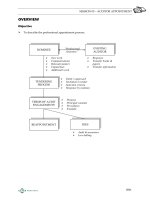
COMMUNICATIONS
with
MANAGEMENT
Definitions
Matters communicated
Matters discussed
THOSE CHARGED
WITH
GOVERNANCE
Scope
Need for effective communication
Basic principles
Forms of communications
Other considerations
MANAGEMENT
LETTERS
Session 13
2801
SESSION 28 – COMMUNICATIONS WITH MANAGEMENT AND THOSE CHARGED
WITH GOVERNANCE
1
COMMUNICATIONS WITH MANAGEMENT
Commentary
Most of what is within this session you will have already covered (in greater detail) in
your studies so far. This session just summarises the elements of management
communications under ISA 260 Communications of Audit Matters with Those
Charged with Governance.
1.1
Definitions
Management − officers and others who also perform senior managerial
functions. Management includes directors and the audit committee only in
those instances when they perform such functions.
Audit committee – a sub-committee of the main management board established
to assist the entity by reviewing financial reporting, auditing and internal
control issues.
1.2
Matters communicated
Throughout this study system, details of the main communications between
management and auditors have been noted, eg:
Terms of engagement (see Session 5);
Control weaknesses (see Session 13)
Management representations (see Session 20); and
Communications continuously take place with management, eg:
whilst planning the audit;
conducting the audit; and
closing down the audit.
1.3
Matters discussed
1.3.1
During the audit
An understanding of the business.
The audit plan.
The effect of new legislation or professional standards on the audit.
Information necessary for audit risk assessments.
Explanations, evidence and representations from management or from a lower level in
the organization.
2802
SESSION 28 – COMMUNICATIONS WITH MANAGEMENT AND THOSE CHARGED
WITH GOVERNANCE
Any observations and suggestions arising from the audit on such matters as operational
or administrative efficiencies, business strategies and other items of interest.
Unaudited information management is intending to publish with the audited financial
statements which the auditor considers is inconsistent or appears to be misleading. (See
also ISA 720 in Session 30.)
1.3.2
At the end of the audit
Any practical difficulties encountered in performing the audit.
Any disagreements with management relating to the financial statements.
Significant audit adjustments (whether or not reflected in the financial statements).
Significant concerns or problems relating to accounting policies and the disclosure of
items in the financial statements.
Any irregularities or suspected non-compliance with laws and regulations which came
to the attention of the auditor.
Significant risks or exposures faced by the entity.
Recommendations (e.g. on internal control matters) arising from the audit.
2
ISA 260 “COMMUNICATIONS OF AUDIT MATTERS
WITH THOSE CHARGED WITH GOVERNANCE”
2.1
Scope
ISA 260 provides standards and guidance on communications relating to the audit of
financial statements to those charged with governance of an entity.
It does not provide guidance on communications with outside parties (e.g. external
regulatory or supervisory agencies) required by national professional accountancy
bodies, legislation or regulation.
2.2
Need for effective communication
To reinforce auditors’ independence and objectivity and commitment to high quality
auditing.
To provide auditors with the relevant information concerning, for example, the risks the
entity faces.
To assist auditors in evaluating their findings.
To help directors and management understand issues raised by the audit and thereby
fulfil their financial reporting responsibilities.
2803
SESSION 28 – COMMUNICATIONS WITH MANAGEMENT AND THOSE CHARGED
WITH GOVERNANCE
2.3
Basic principles
2.3.1
Audit matters of governance interest
Those matters which, in the opinion of the auditor, are important and relevant to those
charged with governance that have come to the auditor’s attention whilst performing the
audit should be communicated to those charged with governance of an entity.
This specifically includes uncorrected misstatements aggregated by the auditor but
determined by the management as being immaterial.
The auditor is not required to design procedures for the specific purpose of identifying
matters of governance interest.
Examples of matters:
The general approach and overall scope of the audit, including any limitations.
Changes in significant accounting policies that could have a material effect on the
financial statements.
The potential effect on the financial statements of any significant risks and exposures
(e.g. pending litigation).
Audit adjustments that could have a significant effect on the financial statements.
Material uncertainties that may cast significant doubt on the going concern basis.
Disagreements with management about matters that could be significant to the entity’s
financial statements or the auditor’s report.
Expected modifications to the auditor’s report.
Material weaknesses in internal control, doubts about management integrity, and
management fraud.
2.3.2
Relevant persons
The relevant persons charged with governance should be determined by the auditor.
In some countries, the supervision function, and the management function are legally
separated into different bodies, e.g.:
a supervisory (wholly or mainly non-executive) board (e.g. audit committee); and
a management (executive) board.
In other countries, both functions are the legal responsibility of a single, unitary board
(although an audit committee may assist that board).
2804
SESSION 28 – COMMUNICATIONS WITH MANAGEMENT AND THOSE CHARGED
WITH GOVERNANCE
In establishing relevant person the auditor considers:
governance structure of the entity;
the circumstances of the engagement;
any relevant legislation;
the legal responsibilities of such persons.
When the entity’s governance structure is not well defined, or those charged with
governance are not clearly identified the auditor should agree with the entity to whom
audit matters of governance interest are to be communicated. This may apply, for
example, to some:
owner-managed entities;
not for profit organizations; and
government agencies.
2.3.3
Audit engagement letter
To avoid misunderstandings, an audit engagement letter may describe what, and with
whom, matters of governance interest will be communicated (and the form of any
communications).
2.3.4
Timing
Audit matters of governance interest must be communicated on a timely basis to enable
those charged with governance to take appropriate action.
To achieve timely communications, the auditor discusses with those charged with
governance the basis and timing of such communications.
In certain cases, because of the nature of the matter, the auditor may communicate that
matter sooner than previously agreed.
2.4
Forms of communications
May be made orally or in writing.
2.4.1
Factors to consider
The size, operating structure, legal structure, and communications processes of the
entity being audited.
The nature, sensitivity and significance of the audit matters of governance interest to be
communicated.
The arrangements made with respect to periodic meetings or reporting of audit matters
of governance interest.
The amount of on-going contact and dialogue the auditor has with those charged with
governance.
2805
SESSION 28 – COMMUNICATIONS WITH MANAGEMENT AND THOSE CHARGED
WITH GOVERNANCE
Oral communications must be documented in the working papers together with any
responses (e.g. in the form of minutes of the discussion
2.5
Other considerations
Such communications are not a substitute for a modification of the auditor’s report as
required by ISA 701 (see Session 30).
Whether matters previously communicated may have an effect on the current year’s
financial statements.
The auditor should consider taking legal advise there is a potential conflict between the
auditor’s ethical and legal obligations of confidentiality and reporting.
FOCUS
You should now be able to:
explain the need for timely communication with management and those charged with
governance throughout the audit process.
2806