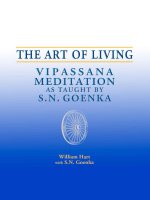
The art of living by william hart
Bạn đang xem bản rút gọn của tài liệu. Xem và tải ngay bản đầy đủ của tài liệu tại đây (786.56 KB, 112 trang )
The scanning, uploading, and distribution of this book via the Internet or by any other means without
the permission of the publisher violates the copyright.
You support Pariyatti in its mission by honoring the copyright and by not sharing this e-book broadly
with others who might otherwise purchase it. By encouraging others to purchase e-books, you will be
helping Pariyatti to continue to bring future books such as this one to a broader audience.
Please purchase only authorized electronic editions and do not participate in or encourage electronic
piracy of copyrighted materials. Thank you for your support.
Vipassana Research Publications
an imprint of
Pariy atti Publishing
867 Larmon Road, Onalaska, WA 98570
www.pariy atti.org
Grateful acknowledgement is made for permission to adapt from “Pure Mind: Exploring the path of Enlightenment,” interview with S.N. Goenka conducted by Steve Minkin, copy right © 1982 by East West Journal, reprinted by permission of
the publisher.
THE ART OF LIVING. Copy right © 1987 by William Hart. All rights reserved. First published in the United States of America by Harper & Row, 1987.
ISBN: 978-1-928706-65-6 E-book Mobi
Wisdom is the principal thing;
therefore get wisdom:
and with all thy getting
get understanding.
Proverbs, iv. 7. (KJV)
CONTENTS
Foreword by S. N. Goenka
Preface
Introduction
Story: Swimology
1. The Search
Story: To Walk on the Path
2. The Starting Point
Story: The Buddha and the Scientist
3. The Immediate Cause
Story: Seed and Fruit
4. The Root of the Problem
Story: The Pebbles and the Ghee
5. The Training of Moral Conduct
Story: The Doctor’s Prescription
6. The Training of Concentration
Story: The Crooked Milk Pudding
7. The Training of Wisdom
Story: The Two Rings
8. Awareness and Equanimity
Story: Nothing But Seeing
9. The Goal
Story: Filling the Bottle of Oil
10. The Art of Living
Story: The Striking of the Clock
Appendix A: The Importance of Vedanā in the Teaching of the Buddha
Appendix B: Passages on Vedanā from the Suttas
Glossary
Notes
FOREWORD
I am forever grateful for the change that Vipassana meditation has wrought in my life. When I
first learned this technique I felt as though I had been wandering in a maze of blind alleys and now at
last had found the royal road. In the years since then I have kept following this road, and with every
step the goal has become clearer: liberation from all suffering, full enlightenment. I cannot claim to
have reached the final goal, but I have no doubt that this way leads directly there.
For showing me this way I am always indebted to Sayagyi U Ba Khin and to the chain of teachers
who kept the technique alive through millennia from the time of the Buddha. On behalf of them all I
encourage others to take this road, so that they also may find the way out of suffering.
Although many thousands of people from Western countries have learned it, up to now no book has
appeared that accurately describes this form of Vipassana at length. I am pleased that at last a serious
meditator has undertaken to fill this gap.
May this book deepen the understanding of those who practice Vipassana meditation, and may it
encourage others to try this technique so that they too may experience the happiness of liberation. May
every reader learn the art of living in order to find peace and harmony within and to generate peace
and harmony for others.
May all beings be happy!
S. N. GOENKA
Bombay:
April 1986
PREFACE
Among the various types of meditation in the world today, the Vipassana method taught by S.
N. Goenka is unique. This technique is a simple, logical way to achieve real peace of mind and to
lead a happy, useful life. Long preserved within the Buddhist community in Burma, Vipassana itself
contains nothing of a sectarian nature, and can be accepted and applied by people of any background.
S. N. Goenka is a retired industrialist, and a former leader of the Indian community in Burma. Born
into a conservative Hindu family, he suffered from youth onward from severe migraine headaches.
His search for a cure brought him into contact in 1955 with Sayagyi U Ba Khin, who combined the
public role of a senior civil servant with the private role of a teacher of meditation. In learning
Vipassana from U Ba Khin, Mr. Goenka found a discipline that went far beyond alleviating the
symptoms of physical disease and transcended cultural and religious barriers. Vipassana gradually
transformed his life in the ensuing years of practice and study under the guidance of his teacher.
In 1969 Mr. Goenka was authorized as a teacher of Vipassana meditation by U Ba Khin. In that
year he came to India and began teaching Vipassana there, reintroducing this technique into the land of
its origin. In a country still sharply divided by caste and religion, Mr. Goenka’s courses have
attracted thousands of people of every background. Thousands of Westerners have also participated
in Vipassana courses, attracted by the practical nature of the technique.
The qualities of Vipassana are exemplified by Mr. Goenka himself. He is a pragmatic person, in
touch with the ordinary realities of life and able to deal with them incisively, but in every situation he
maintains an extraordinary calmness of mind. Along with that calmness is a deep compassion for
others, an ability to empathize with virtually any human being. There is, however, nothing solemn
about him. He has an engaging sense of humor which he exercises in his teaching. Course participants
long remember his smile, his laughter, and his often-repeated motto, “Be happy!” Clearly Vipassana
has brought him happiness, and he is eager to share that happiness with others by showing them the
technique that has worked so well for him.
Despite his magnetic presence, Mr. Goenka has no wish to be a guru who turns his disciples into
automatons. Instead he teaches self-responsibility. The real test of Vipassana, he says, is applying it
in life. He encourages meditators not to sit at his feet, but to go out and live happily in the world. He
shuns all expressions of devotion to him, instead directing his students to be devoted to the technique,
to the truth that they find within themselves.
In Burma it has traditionally been the prerogative of Buddhist monks to teach meditation. Like his
teacher, however, Mr. Goenka is a layman and is the head of a large family. Nevertheless, the clarity
of his teaching and the efficacy of the technique itself have won the approval of senior monks in
Burma, India, and Sri Lanka, a number of whom have taken courses under his guidance.
To maintain its purity, Mr. Goenka insists, meditation must never become a business. Courses and
centers operating under his direction are all run on a totally nonprofit basis. He himself receives no
remuneration for his work directly or indirectly, nor do the assistant teachers whom he has authorized
to teach courses as his representatives. He distributes the technique of Vipassana purely as a service
to humanity, to help those who are in need of help.
S. N. Goenka is one of the few Indian spiritual leaders as highly respected in India as in the West.
However, he has never sought publicity, preferring to rely on word of mouth to spread interest in
Vipassana; and he has always emphasized the importance of actual meditation practice over mere
writings about meditation. For these reasons he is less widely known than he deserves to be. This
book is the first full-length study of his teaching prepared under his guidance and with his approval.
The principal source materials for this work are the discourses given by Mr. Goenka during a tenday Vipassana course and, to a lesser extent, his written articles in English. I have used these
materials freely, borrowing not only lines of argument and organization of specific points, but also
examples given in the discourses, and frequently exact wording, even entire sentences. To those who
have participated in Vipassana meditation courses as taught by him, much of this book will certainly
be familiar, and they may even be able to identify the particular discourse or article that has been
used at a certain point in the text.
During a course, the explanations of the teacher are accompanied step by step by the experience of
the participants in meditation. Here the material has been reorganized for the benefit of a different
audience, people who are merely reading about meditation without necessarily having practised it.
For such readers an attempt has been made to present the teaching as it is actually experienced: a
logical progression flowing unbroken from the first step to the final goal. That organic wholeness is
most easily apparent to the meditator, but this work tries to provide non-meditators with a glimpse of
the teaching as it unfolds to one who practises it.
Certain sections deliberately preserve the tone of the spoken word in order to convey a more vivid
impression of the way in which Mr. Goenka teaches. These sections are the stories set between the
chapters and the questions and answers that conclude each chapter, dialogues taken from actual
discussions with students during a course or in private interviews. Some of the stories are drawn
from events in the life of the Buddha, others from the rich Indian heritage of folk tales, and others still
from the personal experiences of Mr. Goenka. All are narrated in his own words, not with the
intention of improving on the originals but simply to present the stories in a fresh way, emphasizing
their relevance to the practice of meditation. These stories lighten the serious atmosphere of a
Vipassana course and offer inspiration by illustrating central points of the teaching in memorable
form. Of the many such stories told in a ten-day course, only a small selection has been included here.
Quotations are from the oldest and most widely accepted record of the Buddha’s words, the
Discourse Collection (Sutta Piṭaka), as it has been preserved in the ancient Pāli language in
Theravadin Buddhist countries. To maintain a uniform tone throughout the book, I have attempted to
translate afresh all the passages quoted here. In doing so I have taken guidance from the work of
leading modern translators. However, since this is not a scholarly work, I have not striven to achieve
word-for-word accuracy in translating the Pāli. Instead I have tried to convey in straightforward
language the sense of each passage as it appears to a Vipassana meditator in the light of his
meditation experience. Perhaps the rendering of certain words or passages may seem unorthodox, but
in matters of substance, I hope, the English follows the most literal meaning of the original texts.
For the sake of consistency and precision, Buddhist terms used in the text have been given in their
Pāli forms even though in some cases the Sanskrit may be more familiar to readers of English. For
example, the Pāli dhamma is used in place of the Sanskrit dharma, kamma instead of karma,
nibbāna instead of nirvāṇa, saṅkhāra instead of saṃskāra. To make the text easier to understand,
Pāli words have been pluralized in English style, by adding s. In general, Pāli words in the text have
been kept to a minimum to avoid unnecessary obscurity. However, they often offer a convenient
shorthand for certain concepts unfamiliar to Western thought which cannot easily be expressed in a
single word in English. For this reason, at points it has seemed preferable to use the Pāli rather than a
longer English phrase. All Pāli forms printed in boldface type are defined in the glossary at the back
of this book.
The technique of Vipassana offers equal benefits to all who practice it, without any discrimination
on the basis of race, class, or sex. In order to remain faithful to this universal approach, I have tried to
avoid using sexually exclusive language in the text. At points, however, I have used the pronoun “he”
to refer to a meditator of unspecified gender. Readers are asked to consider the usage as sexually
indeterminate. There is no intention of excluding women or giving undue prominence to men, since
such a partiality would be contrary to the basic teaching and spirit of Vipassana.
I am grateful to the many who helped on this project. In particular, I wish to express my deep
gratitude to S. N. Goenka for taking time from his busy schedule to look over the work as it
developed, and even more for guiding me to take a few beginning steps on the path described here.
In a deeper sense, the true author of this work is S. N. Goenka, since my purpose is simply to
present his transmission of the teaching of the Buddha. The merits of this work belong to him.
Whatever defects exist are my own responsibility.
INTRODUCTION
Suppose you had the opportunity to free yourself of all worldly responsibilities for ten days,
with a quiet, secluded place in which to live, protected from disturbances. In this place the basic
physical requirements of room and board would be provided for you, and helpers would be on hand
to see that you were reasonably comfortable. In return you would be expected only to avoid contact
with others and, apart from essential activities, to spend all your waking hours with eyes closed,
keeping your mind on a chosen object of attention. Would you accept the offer?
Suppose you had simply heard that such an opportunity existed, and that people like yourself were
not only willing but eager to spend their free time in this way. How would you describe their
activity? Navel-gazing, you might say, or contemplation; escapism or spiritual retreat; selfintoxication or self-searching; introversion or introspection. Whether the connotation is negative or
positive, the common impression of meditation is that it is a withdrawal from the world. Of course
there are techniques that function in this way. But meditation need not be an escape. It can also be a
means to encounter the world in order to understand it and ourselves.
Every human being is conditioned to assume that the real world is outside, that the way to live life
is by contact with an external reality, by seeking input, physical and mental, from without. Most of us
have never considered severing outward contacts in order to see what happens inside. The idea of
doing so probably sounds like choosing to spend hours staring at the test pattern on a television
screen. We would rather explore the far side of the moon or the bottom of the ocean than the hidden
depths within ourselves.
But in fact the universe exists for each of us only when we experience it with body and mind. It is
never elsewhere, it is always here and now. By exploring the here-and-now of ourselves we can
explore the world. Unless we investigate the world within we can never know reality—we will only
know our beliefs about it, or our intellectual conceptions of it. By observing ourselves, however, we
can come to know reality directly and can learn to deal with it in a positive, creative way.
One method of exploring the inner world is Vipassana meditation as taught by S. N. Goenka. This
is a practical way to examine the reality of one’s own body and mind, to uncover and solve whatever
problems lie hidden there, to develop unused potential, and to channel it for one’s own good and the
good of others.
Vipassanā means “insight” in the ancient Pāli language of India. It is the essence of the teaching of
the Buddha, the actual experience of the truths of which he spoke. The Buddha himself attained that
experience by the practice of meditation, and therefore meditation is what he primarily taught. His
words are records of his experiences in meditation, as well as detailed instructions on how to
practice in order to reach the goal he had attained, the experience of truth.
This much is widely accepted, but the problem remains of how to understand and follow the
instructions given by the Buddha. While his words have been preserved in texts of recognized
authenticity, the interpretation of the Buddha’s meditation instructions is difficult without the context
of a living practice.
But if a technique exists that has been maintained for unknown generations, that offers the very
results described by the Buddha, and if it conforms precisely to his instructions and elucidates points
in them that have long seemed obscure, then that technique is surely worth investigating. Vipassana is
such a method. It is a technique extraordinary in its simplicity, its lack of all dogma, and above all in
the results it offers.
Vipassana meditation is taught in courses of ten days, open to anyone who sincerely wishes to learn
the technique and who is fit to do so physically and mentally. During the ten days, participants remain
within the area of the course site, having no contact with the outside world. They refrain from reading
and writing, and suspend any religious or other practices, working exactly according to the
instructions given. For the entire period of the course they follow a basic code of morality which
includes celibacy and abstention from all intoxicants. They also maintain silence among themselves
for the first nine days of the course, although they are free to discuss meditation problems with the
teacher and material problems with the management.
During the first three and a half days the participants practice an exercise of mental concentration.
This is preparatory to the technique of Vipassana proper, which is introduced on the fourth day of the
course. Further steps within the practice are introduced each day, so that by the end of the course the
entire technique has been presented in outline. On the tenth day silence ends, and meditators make the
transition back to a more extroverted way of life. The course concludes on the morning of the eleventh
day.
The experience of ten days is likely to contain a number of surprises for the meditator. The first is
that meditation is hard work! The popular idea that it is a kind of inactivity or relaxation is soon
found to be a misconception. Continual application is needed to direct the mental processes
consciously in a particular way. The instructions are to work with full effort yet without any tension,
but until one learns how to do this, the exercise can be frustrating or even exhausting.
Another surprise is that, to begin with, the insights gained by self-observation are not likely to be
all pleasant and blissful. Normally we are very selective in our view of ourselves. When we look
into a mirror we are careful to strike the most flattering pose, the most pleasing expression. In the
same way we each have a mental image of ourselves which emphasizes admirable qualities,
minimizes defects, and omits some sides of our character altogether. We see the image that we wish
to see, not the reality. But Vipassana meditation is a technique for observing reality from every angle.
Instead of a carefully edited self-image, the meditator confronts the whole uncensored truth. Certain
aspects of it are bound to be hard to accept.
At times it may seem that instead of finding inner peace one has found nothing but agitation by
meditating. Everything about the course may seem unworkable, unacceptable: the heavy timetable, the
facilities, the discipline, the instructions and advice of the teacher, the technique itself.
Another surprise, however, is that the difficulties pass away. At a certain point meditators learn to
make effortless efforts, to maintain a relaxed alertness, a detached involvement. Instead of struggling,
they become engrossed in the practice. Now inadequacies of the facilities seem unimportant, the
discipline becomes a helpful support, the hours pass quickly, unnoticed. The mind becomes as calm
as a mountain lake at dawn, perfectly mirroring its surroundings and at the same time revealing its
depths to those who look more closely. When this clarity comes, every moment is full of affirmation,
beauty, and peace.
Thus the meditator discovers that the technique actually works. Each step in turn may seem an
enormous leap, and yet one finds one can do it. At the end of ten days it becomes clear how long a
journey it has been from the beginning of the course. The meditator has undergone a process
analogous to a surgical operation, to lancing a pus-filled wound. Cutting open the lesion and pressing
on it to remove the pus is painful, but unless this is done the wound can never heal. Once the pus is
removed, one is free of it and of the suffering it caused, and can regain full health. Similarly, by
passing through a ten-day course, the meditator relieves the mind of some of its tensions, and enjoys
greater mental health. The process of Vipassana has worked deep changes within, changes that persist
after the end of the course. The meditator finds that whatever mental strength was gained during the
course, whatever was learned, can be applied in daily life for one’s own benefit and for the good of
others. Life becomes more harmonious, fruitful, and happy.
The technique taught by S. N. Goenka is that which he learned from his teacher, the late Sayagyi U
Ba Khin of Burma, who was taught Vipassana by Saya U Thet, a well-known teacher of meditation in
Burma in the first half of this century. In turn, Saya U Thet was a pupil of Ledi Sayadaw, a famous
Burmese scholar-monk of the late nineteenth and early twentieth centuries. Further back there is no
record of the names of the teachers of this technique, but it is believed by those who practise it that
Ledi Sayadaw learned Vipassana meditation from traditional teachers who had preserved it through
generations since ancient times, when the teaching of the Buddha was first introduced into Burma.
Certainly the technique agrees with the instructions of the Buddha on meditation, with the simplest,
most literal meaning of his words. And most important, it provides results that are good, personal,
tangible, and immediate.
This book is not a do-it-yourself manual for the practice of Vipassana meditation, and people who
use it this way proceed entirely at their own risk. The technique should be learned only in a course
where there is a proper environment to support the meditator and a properly trained guide. Meditation
is a serious matter, especially the Vipassana technique, which deals with the depths of the mind. It
should never be approached lightly or casually. If reading this book inspires you to try Vipassana, you
can contact the addresses listed at the back to find out when and where courses are given.
The purpose here is merely to give an outline of the Vipassana method as it is taught by S. N.
Goenka, in the hope that this will widen the understanding of the Buddha’s teachings and of the
meditation technique that is their essence.
Swimology
Once a young professor was making a sea voyage. He was a highly educated man with a
long tail of letters after his name, but he had little experience of life. In the crew of the ship on which
he was travelling was an illiterate old sailor. Every evening the sailor would visit the cabin of the
young professor to listen to him hold forth on many different subjects. He was very impressed with
the learning of the young man.
One evening as the sailor was about to leave the cabin after several hours of conversation, the
professor asked, “Old man, have you studied geology?”
“What is that, sir?”
“The science of the earth.”
“No, sir, I have never been to any school or college. I have never studied anything.”
“Old man, you have wasted a quarter of your life.”
With a long face the old sailor went away. “If such a learned person says so, certainly it must be
true,” he thought. “I have wasted a quarter of my life!”
Next evening again as the sailor was about to leave the cabin, the professor asked him, “Old man,
have you studied oceanography?”
“What is that, sir?”
“The science of the sea.”
“No, sir, I have never studied anything.”
“Old man, you have wasted half your life.”
With a still longer face the sailor went away: “I have wasted half my life; this learned man says
so.”
Next evening once again the young professor questioned the old sailor: “Old man, have you studied
meteorology?”
“What is that, sir? I have never even heard of it.”
“Why, the science of the wind, the rain, the weather.”
“No, sir. As I told you, I have never been to any school. I have never studied anything.”
“You have not studied the science of the earth on which you live; you have not studied the science
of the sea on which you earn your livelihood; you have not studied the science of the weather which
you encounter every day? Old man, you have wasted three quarters of your life.”
The old sailor was very unhappy: “This learned man says that I have wasted three quarters of my
life! Certainly I must have wasted three quarters of my life.”
The next day it was the turn of the old sailor. He came running to the cabin of the young man and
cried, “Professor sir, have you studied swimology?”
“Swimology? What do you mean?”
“Can you swim, sir?”
“No, I don’t know how to swim.”
“Professor sir, you have wasted all your life! The ship has struck a rock and is sinking. Those who
can swim may reach the nearby shore, but those who cannot swim will drown. I am so sorry,
professor sir, you have surely lost your life.”
You may study all the “ologies” of the world, but if you do not learn swimology, all your studies
are useless. You may read and write books on swimming, you may debate on its subtle theoretical
aspects, but how will that help you if you refuse to enter the water yourself? You must learn how to
swim.
Chapter 1
THE SEARCH
All of us seek peace and harmony, because this is what we lack in our lives. We all want to
be happy; we regard it as our right. Yet happiness is a goal we strive toward more often than attain.
At times we all experience dissatisfaction in life—agitation, irritation, disharmony, suffering. Even if
at this moment we are free from such dissatisfactions, we can all remember a time when they afflicted
us and can foresee a time when they may recur. Eventually we all must face the suffering of death.
Nor do our personal dissatisfactions remain limited to ourselves; instead, we keep sharing our
suffering with others. The atmosphere around each unhappy person becomes charged with agitation,
so that all who enter that environment may also feel agitated and unhappy. In this way individual
tensions combine to create the tensions of society.
This is the basic problem of life: its unsatisfactory nature. Things happen that we do not want;
things that we want do not happen. And we are ignorant of how or why this process works, just as we
are each ignorant of our own beginning and end.
Twenty-five centuries ago in northern India, a man decided to investigate this problem, the problem
of human suffering. After years of searching and trying various methods, he discovered a way to gain
insight into the reality of his own nature and to experience true freedom from suffering. Having
reached the highest goal of liberation, of release from misery and conflict, he devoted the rest of his
life to helping others do as he had done, showing them the way to liberate themselves.
This person—Siddhattha Gotama, known as the Buddha, “the enlightened one”—never claimed
to be anything other than a man. Like all great teachers he became the subject of legends, but no matter
what marvelous stories were told of his past existences or his miraculous powers, still all accounts
agree that he never claimed to be divine or to be divinely inspired. Whatever special qualities he had
were pre-eminently human qualities that he had brought to perfection. Therefore, whatever he
achieved is within the grasp of any human being who works as he did.
The Buddha did not teach any religion or philosophy or system of belief. He called his teaching
Dhamma, that is, “law,” the law of nature. He had no interest in dogma or idle speculation. Instead he
offered a universal, practical solution for a universal problem. “Now as before,” he said, “I teach
about suffering and the eradication of suffering.” He refused even to discuss anything which did not
lead to liberation from misery.
This teaching, he insisted, was not something that he had invented or that was divinely revealed to
him.. It was simply the truth, reality, which by his own efforts he had succeeded in discovering, as
many people before him had done, as many people after him would do. He claimed no monopoly on
the truth.
Nor did he assert any special authority for his teaching—neither because of the faith that people
had in him, nor because of the apparently logical nature of what he taught. On the contrary, he stated
that it is proper to doubt and to test whatever is beyond one’s experience:
1
Do not simply believe whatever you are told, or whatever has been handed down from past generations, or what is common
opinion, or whatever the scriptures say. Do not accept something as true merely by deduction or inference, or by considering
outward appearances, or by partiality for a certain view, or because of its plausibility, or because your teacher tells you it is so.
But when you yourselves directly know, “These principles are unwholesome, blameworthy, condemned by the wise; when
adopted and carried out they lead to harm and suffering,” then you should abandon them. And when you yourselves directly know,
“These principles are wholesome, blameless, praised by the wise; when adopted and carried out they lead to welfare and
happiness,” then you should accept and practise them.2
The highest authority is one’s own experience of truth. Nothing should be accepted on faith alone;
we have to examine to see whether it is logical, practical, beneficial. Nor having examined a teaching
by means of our reason is it sufficient to accept it as true intellectually. If we are to benefit from the
truth, we have to experience it directly. Only then can we know that it is really true. The Buddha
always emphasized that he taught only what he had experienced by direct knowledge, and he
encouraged others to develop such knowledge themselves, to become their own authorities: “Each of
you, make yourself an island, make yourself your refuge; there is no other refuge. Make truth your
island, make truth your refuge; there is no other refuge.”
The only real refuge in life, the only solid ground on which to take a stand, the only authority that
can give proper guidance and protection is truth, Dhamma, the law of nature, experienced and
verified by oneself. Therefore in his teaching the Buddha always gave highest importance to the direct
experience of truth. What he had experienced he explained as clearly as possible so that others might
have guidelines with which to work toward their own realization of truth. He said, “The teaching I
have presented does not have separate outward and inward versions. Nothing has been kept hidden in
the fist of the teacher.” He had no esoteric doctrine for a chosen few. On the contrary, he wished to
make the law of nature known as plainly and as widely as possible, so that as many people as
possible might benefit from it.
Neither was he interested in establishing a sect or a personality cult with himself as its center. The
personality of the one who teaches, he maintained, is of minor importance compared to the teaching.
His purpose was to show others how to liberate themselves, not to turn them into blind devotees. To a
follower who showed excessive veneration for him he said, “What do you gain by seeing this body,
which is subject to corruption? He who sees the Dhamma sees me; he who sees me sees the
Dhamma.”
Devotion toward another person, no matter how saintly, is not sufficient to liberate anyone; there
can be no liberation or salvation without direct experience of reality. Therefore truth has primacy, not
the one who speaks it. All respect is due to whoever teaches the truth, but the best way to show that
respect is by working to realize the truth oneself. When extravagant honors were paid to him near the
end of his life, the Buddha commented, “This is not how an enlightened one is properly honored, or
shown respect, or revered, or reverenced, or venerated. Rather it is the monk or nun, the lay male or
female follower who steadfastly walks on the path of Dhamma from the first steps to the final goal,
who practises Dhamma working in the right way, that honors, respects, reveres, reverences and
venerates the enlightened one with the highest respect.”
What the Buddha taught was a way that each human being can follow. He called this path the Noble
Eightfold Path, meaning a practice of eight interrelated parts. It is noble in the sense that anyone who
walks on the path is bound to become a noble-hearted, saintly person, freed from suffering.
It is a path of insight into the nature of reality, a path of truth-realization. In order to solve our
problems, we have to see our situation as it really is. We must learn to recognize superficial,
apparent reality, and also to penetrate beyond appearances so as to perceive subtler truths, then
ultimate truth, and finally to experience the truth of freedom from suffering. Whatever name we
choose to give this truth of liberation, whether nibbāna, “heaven,” or anything else, is unimportant.
The important thing is to experience it.
3
4
5
6
The only way to experience truth directly is to look within, to observe oneself. All our lives we
have been accustomed to look outward. We have always been interested in what is happening
outside, what others are doing. We have rarely, if ever, tried to examine ourselves, our own mental
and physical structure, our own actions, our own reality. Therefore we remain unknown to ourselves.
We do not realize how harmful this ignorance is, how much we remain the slaves of forces within
ourselves of which we are unaware.
This inner darkness must be dispelled to apprehend the truth. We must gain insight into our own
nature in order to understand the nature of existence. Therefore the path that the Buddha showed is a
path of introspection, of self-observation. He said, “Within this very fathom-long body containing the
mind with its perceptions, I make known the universe, its origin, its cessation, and the way leading to
its cessation.” The entire universe and the laws of nature by which it works are to be experienced
within oneself. They can only be experienced within oneself.
The path is also a path of purification. We investigate the truth about ourselves not out of idle
intellectual curiosity but rather with a definite purpose. By observing ourselves we become aware for
the first time of the conditioned reactions, the prejudices that cloud our mental vision, that hide reality
from us and produce suffering. We recognize the accumulated inner tensions that keep us agitated,
miserable, and we realize they can be removed. Gradually we learn how to allow them to dissolve,
and our minds become pure, peaceful, and happy.
The path is a process requiring continual application. Sudden breakthroughs may come, but they are
the result of sustained efforts. It is necessary to work step by step; with every step, however, the
benefits are immediate. We do not follow the path in the hope of accruing benefits to be enjoyed only
in the future, of attaining after death a heaven that is known here only by conjecture. The benefits must
be concrete, vivid, personal, experienced here and now.
Above all, it is a teaching to be practised. Simply having faith in the Buddha or his teachings will
not help to free us from suffering; neither will a merely intellectual understanding of the path. Both of
these are of value only if they inspire us to put the teachings into practice. Only the actual practice of
what the Buddha taught will give concrete results and change our lives for the better. The Buddha
said,
7
Someone may recite much of the texts, but if he does not practise them, such a heedless person is like a herdsman who only
counts the cows of others; he does not enjoy the rewards of the life of a truth-seeker.
Another may be able to recite only a few words from the texts, but if he lives the life of Dhamma, taking steps on the path
from its beginning to the goal, then he enjoys the rewards of the life of a truth-seeker.8
The path must be followed, the teaching must be implemented; otherwise it is a meaningless exercise.
It is not necessary to call oneself a Buddhist in order to practise this teaching. Labels are
irrelevant. Suffering makes no distinctions, but is common to all; therefore the remedy, to be useful,
must be equally applicable to all. Neither is the practice reserved only for recluses who are divorced
from ordinary life. Certainly a period must be given in which to devote oneself exclusively to the task
of learning how to practise, but having done so one must apply the teaching in daily life. Someone
who forsakes home and worldly responsibilities in order to follow the path has the opportunity to
work more intensively, to assimilate the teaching more deeply, and therefore to progress more
quickly. On the other hand, someone involved in worldly life, juggling the claims of many different
responsibilities, can give only limited time to the practice. But whether homeless or householder, one
must apply Dhamma.
It is only applied Dhamma that gives results. If this is truly a way from suffering to peace, then as
we progress in the practice we should become more happy in our daily lives, more harmonious, more
at peace with ourselves. At the same time our relations with others should become more peaceful and
harmonious. Instead of adding to the tensions of society, we should be able to make a positive
contribution that will increase the happiness and welfare of all. To follow the path we must live the
life of Dhamma, of truth, of purity. This is the proper way to implement the teaching. Dhamma,
practised correctly, is the art of living.
Questions and Answers
QUESTION: You keep referring to the Buddha. Are you teaching Buddhism?
S.N. GOENKA: I am not concerned with “isms.” I teach Dhamma, that is, what the Buddha taught. He
never taught any “ism” or sectarian doctrine. He taught something from which people of every
background can benefit: an art of living. Remaining in ignorance is harmful for everyone; developing
wisdom is good for everyone. So anyone can practise this technique and find benefit. A Christian will
become a good Christian, a Jew will become a good Jew, a Muslim will become a good Muslim, a
Hindu will become a good Hindu, a Buddhist will become a good Buddhist. One must become a good
human being; otherwise one can never be a good Christian, a good Jew, a good Muslim, a good
Hindu, a good Buddhist. How to become a good human being—that is most important.
You talk about conditioning. Isn’t this training really a kind of conditioning of the mind, even if a
positive one?
On the contrary, it is a process of de-conditioning. Instead of imposing anything on the mind, it
automatically removes unwholesome qualities so that only wholesome, positive ones remain. By
eliminating negativities, it uncovers the positivity which is the basic nature of a pure mind.
But over a period of time, to sit in a particular posture and direct the attention in a certain way is
a form of conditioning.
If you do it as a game or mechanical ritual, then yes—you condition the mind. But that is a misuse of
Vipassana. When it is practised correctly, it enables you to experience truth directly, for yourself.
And from this experience, naturally understanding develops, which destroys all previous
conditioning.
Isn’t it selfish to forget about the world and just to sit and meditate all day?
It would be if this were an end in itself, but it is a means to an end that is not at all selfish: a healthy
mind. When your body is sick, you enter a hospital to recover health. You don’t go there for your
whole life, but simply to regain health, which you will then use in ordinary life. In the same way you
come to a meditation course to gain mental health, which you will then use in ordinary life for your
good and for the good of others.
To remain happy and peaceful even when confronted by the suffering of others—isn’t that sheer
insensitivity?
Being sensitive to the suffering of others does not mean that you must become sad yourself. Instead
you should remain calm and balanced, so that you can act to alleviate their suffering. If you also
become sad, you increase the unhappiness around you; you do not help others, you do not help
yourself.
Why don’t we live in a state of peace?
Because wisdom is lacking. A life without wisdom is a life of illusion, which is a state of agitation,
of misery. Our first responsibility is to live a healthy, harmonious life, good for ourselves and for all
others. To do so, we must learn to use our faculty of self-observation, truth-observation.
Why is it necessary to join a ten-day course to learn the technique?
Well, if you could come for longer that would be better still! But ten days is the minimum time in
which it is possible to grasp the outlines of the technique.
Why must we remain within the course site for the ten days?
Because you are here to perform an operation on your mind. An operation must be done in a hospital,
in an operating theatre protected from contamination. Here within the boundaries of the course, you
can perform the operation without being disturbed by any outside influence. When the course is over
the operation has ended, and you are ready once again to face the world.
Does this technique heal the physical body?
Yes, as a by-product. Many psychosomatic diseases naturally disappear when mental tensions are
dissolved. If the mind is agitated, physical diseases are bound to develop. When the mind becomes
calm and pure, automatically they will go away. But if you take the curing of a physical disease as
your goal instead of the purification of your mind, you achieve neither one nor the other. I have found
that people who join a course with the aim of curing a physical illness have their attention fixed only
on their disease throughout the course: “Today, is it better? No, not better . . . Today, is it improving?
No, not improving!” All the ten days they waste in this way. But if the intention is simply to purify the
mind, then many diseases automatically go away as a result of meditation.
What would you say is the purpose of life?
To come out of misery. A human being has the wonderful ability to go deep inside, observe reality,
and come out of suffering. Not to use this ability is to waste one’s life. Use it to live a really healthy,
happy life!
You speak of being overpowered by negativity. How about being overpowered by positivity, for
example, by love?
What you call “positivity” is the real nature of the mind. When the mind is free of conditioning, it is
always full of love—pure love—and you feel peaceful and happy. If you remove the negativity, then
positivity remains, purity remains. Let the entire world be overwhelmed by this positivity!
To Walk on the Path
In the city of Sāvatthī in northern India, the Buddha had a large centre where people would
come to meditate and to listen to his Dhamma talks. Every evening one young man used to come to
hear his discourses. For years he came to listen to the Buddha but never put any of the teaching into
practice.
After a few years, one evening this man came a little early and found the Buddha alone. He
approached him and said, “Sir, I have a question that keeps arising in my mind, raising doubts.”
“Oh? There should not be any doubts on the path of Dhamma; have them clarified. What is your
question?”
“Sir, for many years now I have been coming to your meditation center, and I have noticed that
there are a large number of recluses around you, monks and nuns, and a still larger number of lay
people, both men and women. For years some of them have been coming to you. Some of them, I can
see, have certainly reached the final stage; quite obviously they are fully liberated. I can also see that
others have experienced some change in their lives. They are better than they were before, although I
cannot say that they are fully liberated. But sir, I also notice that a large number of people, including
myself, are as they were, or sometimes they are even worse. They have not changed at all, or have not
changed for the better
“Why should this be, sir? People come to you, such a great man, fully enlightened, such a powerful,
compassionate person. Why don’t you use your power and compassion to liberate them all?”
The Buddha smiled and said, “Young man, where do you live? What is your native place?”
“Sir, I live here in Sāvatthī, this capital city of the state of Kosala.”
“Yes, but your facial features show that you are not from this part of the country. Where are you
from originally?”
“Sir, I am from the city of Rājagaha, the capital of the state of Magadha. I came and settled here in
Sāvatthī a few years ago.”
“And have you severed all connections with Rājagaha?”
“No sir, I still have relatives there. I have friends there. I have business there.”
“Then certainly you must go from Savatthī to Rājagaha quite often?”
“Yes sir. Many times each year I visit Rājagaha and return to Sāvatthī.”
“Having travelled and returned so many times on the path from here to Rājagaha, certainly you must
know the path very well?”
“Oh yes, sir, I know it perfectly. I might almost say that even if I was blindfolded I could find the
path to Rājagaha, so many times have I walked it.”
“And your friends, those who know you well, certainly they must know that you are from Rājagaha
and have settled here? They must know that you often visit Rājagaha and return, and that you know the
path from here to Rājagaha perfectly?”
“Oh yes, sir. All those who are close to me know that I often go to Rājagaha and that I know the
path perfectly.”
“Then it must happen that some of them come to you and ask you to explain to them the path from
here to Rājagaha. Do you hide anything or do you explain the path to them clearly?”
“What is there to hide, sir? I explain it to them as clearly as I can: you start walking towards the
east and then head towards Banaras, and continue onward until you reach Gaya and then Rājagaha. I
explain it very plainly to them sir.”
“And these people to whom you give such clear explanation, do all of them reach Rājagaha?”
“How can that be, sir? Those who walk the entire path to its end, only they will reach Rājagaha.”
“This is what I want to explain to you, young man. People keep coming to me knowing that this is
someone who has walked the path from here to nibbāna and so knows it perfectly. They come to me
and ask, ‘What is the path to nibbāna, to liberation?’ And what is there to hide? I explain it to them
clearly: ‘This is the path.’ If somebody just nods his head and says, ‘Well said, well said, a very
good path, but I won’t take a step on it; a wonderful path, but I won’t take the trouble to walk over it,’
then how can such a person reach the final goal?”
“I do not carry anyone on my shoulders to take him to the final goal. Nobody can carry anyone else
on his shoulders to the final goal. At most, with love and compassion one can say, ‘Well, this is the
path, and this is how I have walked on it. You also work, you also walk, and you will reach the final
goal.’ But each person has to walk himself, has to take every step on the path himself. He who has
taken one step on the path is one step nearer the goal. He who has taken a hundred steps is a hundred
steps nearer the goal. He who has taken all the steps on the path has reached the final goal. You have
to walk on the path yourself.”
9
Chapter 2
THE STARTING POINT
The source of suffering lies within each of us. When we understand our own reality, we shall
recognize the solution to the problem of suffering. “Know thyself,” all wise persons have advised.
We must begin by knowing our own nature; otherwise we can never solve our own problems or the
problems of the world.
But actually what do we know about ourselves? We are each convinced of the importance of
ourselves, of the uniqueness of ourselves, but our knowledge of ourselves is only superficial. At
deeper levels, we do not know ourselves at all.
The Buddha examined the phenomenon of a human being by examining his own nature. Laying aside
all preconceptions, he explored reality within and realized that every being is a composite of five
processes, four of them mental and one physical.
Matter
Let us begin with the physical aspect. This is the most obvious, the most apparent portion of
ourselves, readily perceived by all the senses. And yet how little we really know about it.
Superficially one can control the body: it moves and acts according to the conscious will. But on
another level, all the internal organs function beyond our control, without our knowledge. At a subtler
level, we know nothing, experientially, of the incessant biochemical reactions occurring within each
cell of the body. But this is still not the ultimate reality of the material phenomenon. Ultimately the
seemingly solid body is composed of subatomic particles and empty space. What is more, even these
subatomic particles have no real solidity; the existence span of one of them is much less than a
trillionth of a second. Particles continuously arise and vanish, passing into and out of existence, like a
flow of vibrations. This is the ultimate reality of the body, of all matter, discovered by the Buddha
2500 years ago.
Through their own investigations, modern scientists have recognized and accepted this ultimate
reality of the material universe. However, these scientists have not become liberated, enlightened
persons. Out of curiosity they have investigated the nature of the universe, using their intellects and
relying on instruments to verify their theories. In contrast, the Buddha was motivated not simply by
curiosity but rather by the wish to find a way out of suffering. He used no instrument in his
investigation other than his own mind. The truth that he discovered was the result not of
intellectualizing but of his own direct experience, and that is why it could liberate him.
He found that the entire material universe was composed of particles, called in Pāli kalāpas, or
“indivisible units.” These units exhibit in endless variation the basic qualities of matter: mass,
cohesion, temperature, and movement. They combine to form structures which seem to have some
permanence. But actually these are all composed of minuscule kalāpas which are in a state of
continuously arising and passing away. This is the ultimate reality of matter: a constant stream of
waves or particles. This is the body which we each call “myself.”
Mind
Along with the physical process there is the psychic process, the mind. Although it cannot be
touched or seen, it seems even more intimately connected with ourselves than our bodies: we may
picture a future existence without the body, but we cannot imagine any such existence without the
mind. Yet how little we know about the mind, and how little we are able to control it. How often it
refuses to do what we want, and does what we do not want. Our control of the conscious mind is
tenuous enough, but the unconscious seems totally beyond our power or understanding, filled with
forces of which we may not approve or be aware.
As he examined the body, the Buddha also examined the mind and found that in broad, overall
terms it consisted of four processes: consciousness (viññāṇa), perception (saññā), sensation
(vedanā), and reaction (saṅkhāra).
The first process, consciousness, is the receiving part of the mind, the act of undifferentiated
awareness or cognition. It simply registers the occurrence of any phenomenon, the reception of any
input, physical or mental. It notes the raw data of experience without assigning labels or making value
judgments.
The second mental process is perception, the act of recognition. This part of the mind identifies
whatever has been noted by the consciousness. It distinguishes, labels, and categorizes the incoming
raw data and makes evaluations, positive or negative.
The next part of the mind is sensation. Actually as soon as any input is received, sensation arises, a
signal that something is happening. So long as the input is not evaluated, the sensation remains neutral.
But once a value is attached to the incoming data, the sensation becomes pleasant or unpleasant,
depending on the evaluation given.
If the sensation is pleasant, a wish forms to prolong and intensify the experience. If it is an
unpleasant sensation, the wish is to stop it, to push it away. The mind reacts with liking or disliking.
For example, when the ear is functioning normally and one hears a sound, cognition is at work. When
the sound is recognized as words, with positive or negative connotations, perception has started to
function. Next sensation comes into play. If the words are praise, a pleasant sensation arises. If they
are abuse, an unpleasant sensation arises. At once reaction takes place. If the sensation is pleasant,
one starts liking it, wanting more words of praise. If the sensation is unpleasant, one starts disliking it,
wanting to stop the abuse.
The same steps occur whenever any of the other senses receives an input: consciousness,
perception, sensation, reaction. These four mental functions are even more fleeting than the ephemeral
particles composing the material reality. Each moment that the senses come into contact with any
object, the four mental processes occur with lightning-like rapidity and repeat themselves with each
subsequent moment of contact. So rapidly does this occur, however, that one is unaware of what is
happening. It is only when a particular reaction has been repeated over a longer period of time and
has taken a pronounced, intensified form that awareness of it develops at the conscious level.
The most striking aspect of this description of a human being is not what it includes but what it
omits. Whether we are Western or Eastern, whether Christian, Jewish, Muslim, Hindu, Buddhist,
atheist, or anything else, each of us has a congenital assurance that there is an “I” somewhere within
us, a continuing identity. We operate on the unthinking assumption that the person who existed ten
years ago is essentially the same person who exists today, who will exist ten years from now, perhaps
who will still exist in a future life after death. No matter what philosophies or theories or beliefs we
hold as true, actually we each live our lives with the deep-rooted conviction, “I was, I am, I shall
1
be.”
The Buddha challenged this instinctive assertion of identity. By doing so he was not expounding
one more speculative view to combat the theories of others: he repeatedly emphasized that he was not
putting forth an opinion, but simply describing the truth that he had experienced and that any ordinary
person can experience. “The enlightened one has cast aside all theories,” he said, “for he has seen the
reality of matter, sensation, perception, reaction, and consciousness, and their arising and passing
away.” Despite appearances, he had found that each human being is in fact a series of separate but
related events. Each event is the result of the preceding one and follows it without any interval. The
unbroken progression of closely connected events gives the appearance of continuity, of identity, but
this is only an apparent reality, not ultimate truth.
We may give a river a name but actually it is a flow of water never pausing in its course. We may
think of the light of a candle as something constant, but if we look closely, we see that it is really a
flame arising from a wick which burns for a moment, to be replaced at once by a new flame, moment
after moment. We talk of the light of an electric lamp, never pausing to think that in reality it is, like
the river, a constant flow, in this case a flow of energy caused by very high frequency oscillations
taking place within the filament. Every moment something new arises as a product of the past, to be
replaced by something new in the following moment. The succession of events is so rapid and
continuous that it is difficult to discern. At a particular point in the process one cannot say that what
occurs now is the same as what preceded it, nor can one say that it is not the same. Nevertheless, the
process occurs.
In the same way, the Buddha realized, a person is not a finished, unchanging entity but a process
flowing from moment to moment. There is no real “being,” merely an ongoing flow, a continuous
process of becoming. Of course in daily life we must deal with each other as persons of more or less
defined, unchanging nature; we must accept external, apparent reality, or else we could not function at
all. External reality is a reality, but only a superficial one. At a deeper level the reality is that the
entire universe, animate and inanimate, is in a constant state of becoming—of arising and passing
away. Each of us is in fact a stream of constantly changing subatomic particles, along with which the
processes of consciousness, perception, sensation, reaction change even more rapidly than the
physical process.
This is the ultimate reality of the self with which each of us is so concerned. This is the course of
events in which we are involved. If we can understand it properly by direct experience, we shall find
the clue to lead us out of suffering.
2
Questions and Answers
QUESTION: When you say “mind,” I’m not sure what you mean. I can’t find the mind.
S. N. GOENKA: It is everywhere, with every atom. Wherever you feel anything, the mind is there.
The mind feels.
Then by the mind you don’t mean the brain?
Oh no, no, no. Here in the West you think that the mind is only in the head. It is a wrong notion.
Mind is the whole body?
Yes, the whole body contains the mind, the whole body!
You speak of the experience of “I” only in negative terms. Hasn’t it a positive side? Isn’t there an
experience of “I” which fills a person with joy, peace, and rapture?
By meditation you will find that all such sensual pleasures are im-permanent; they come and pass
away. If this “I” really enjoys them, if they are “my” pleasures, then “I” must have some mastery over
them. But they just arise and pass away without my control. What “I” is there?
I’m speaking not of sensual pleasures but of a very deep level.
At that level, “I” is of no importance at all. When you reach that level, the ego is dissolved. There is
only joy. The question of “I” does not arise then.
Well, instead of “I,” let us say the experience of a person.
Feeling feels; there is no one to feel it. Things are just happening, that’s all. Now it seems to you that
there must be an “I” who feels, but if you practice, you will reach the stage where ego dissolves.
Then your question will disappear!
I came here because I felt “I” needed to come here.
Yes! Quite true. For conventional purposes, we cannot run away from “I” or “mine.” But clinging to
them, taking them as real in an ultimate sense will bring only suffering.
I was wondering whether there are people who cause suffering for us?
Nobody causes suffering for you. You cause the suffering for yourself by generating tensions in the
mind. If you know how not to do that, it becomes easy to remain peaceful and happy in every
situation.
What about when someone else is doing wrong to us?
You must not allow people to do wrong to you. Whenever someone does something wrong, he harms
others and at the same time he harms himself. If you allow him to do wrong, you are encouraging him
to do wrong. You must use all your strength to stop him, but with only good will, compassion, and
sympathy for that person. If you act with hatred or anger, then you aggravate the situation. But you
cannot have good will for such a person unless your mind is calm and peaceful. So practice to
develop peace within yourself, and then you can solve the problem.
What is the point of seeking peace within when there is no peace in the world?
The world will be peaceful only when the people of the world are peaceful and happy. The change
has to begin with each individual. If the jungle is withered and you want to restore it to life, you must
water each tree of that jungle. If you want world peace, you ought to learn how to be peaceful
yourself. Only then can you bring peace to the world.
I can understand how meditation will help maladjusted, unhappy people, but how about someone
who feels satisfied with his life, who is already happy?
Someone who remains satisfied with the superficial pleasures of life is ignorant of the agitation deep
within the mind. He is under the illusion that he is a happy person, but his pleasures are not lasting,
and the tensions generated in the unconscious keep increasing, to appear sooner or later at the