Mechanics of materials 8th edition by russell c hibbeler
Bạn đang xem bản rút gọn của tài liệu. Xem và tải ngay bản đầy đủ của tài liệu tại đây (2.18 MB, 18 trang )
Link full download:Download here
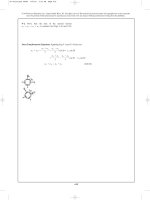
2–1. An air-filled rubber ball has a diameter of 6 in. If the air
pressure within it is increased until the ball’s diameter becomes
7 in., determine the average normal strain in the rubber.
d0 = 6 in.
d = 7 in.
pd - pd0
e=
pd0
= 7 - 6 = 0.167 in./in.
6
Ans.
2–2. A thin strip of rubber has an unstretched length of
15 in. If it is stretched around a pipe having an outer diameter
of 5 in., determine the average normal strain in the strip.
L0 = 15 in.
L = p(5 in.)
L - L0
e=
L0
5p - 15
=
15
= 0.0472 in.>in.
Ans.
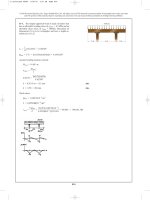
2–3. The rigid beam is supported by a pin at A and wires BD
and CE. If the load P on the beam causes the end C to be
displaced 10 mm downward, determine the normal strain
developed in wires CE and BD.
D
E
4m
P
¢LBD
¢LCE
=
3
7
¢LBD =
3 (10)
= 4.286 mm
7
¢L
CE
eCE =
L
¢L
BD
eBD =
A
L
B
3m
10
= 4000 = 0.00250 mm>mm
Ans.
4.286
= 4000 = 0.00107 mm>mm
Ans.
1
C
2m
2m
02 Solutions 46060
5/6/10
1:45 PM
Page 2
© 2010 Pearson Education, Inc., Upper Saddle River, NJ. All rights reserved. This material is protected under all copyright laws as they currently exist. No
portion of this material may be reproduced, in any form or by any means, without permission in writing from the publisher.
*2–4. The two wires are connected together at A. If the
force P causes point A to be displaced horizontally 2 mm,
determine the normal strain developed in each wire.
C
300
LAC
œ
2
2
= 2300 + 2 - 2(300)(2) cos 150° =
LAC
e =e =
AC
œ
- LAC
mm
301.734 mm
308
301.734 - 300
AB
P
A
L
AC
=
300
= 0.00578 mm>mm
Ans.
308
mm
300
B
•2–5. The rigid beam is supported by a pin at A and wires BD
and CE. If the distributed load causes the end C to be displaced
10 mm downward, determine the normal strain developed in
wires CE and BD.
E
D
2m
1.5 m
2m
A
3m
B
C
w
Since the vertical displacement of end C is small compared to the length of member AC,
the vertical displacement dB of point B, can be approximated by referring to the similar
triangle shown in Fig. a
dB 10
2 = 5 ; dB = 4 mm
LBD = 1500 mm and
The
unstretched lengths of wires BD and CE are
LCE = 2000 mm.
dB
4
Aeavg BBD =
L
BD
dC
Aeavg BCE =
= 1500 = 0.00267 mm>mm
10
Ans.
= 2000 = 0.005 mm>mm
Ans.
L
CE
2
02 Solutions 46060
5/6/10
1:45 PM
Page 3
© 2010 Pearson Education, Inc., Upper Saddle River, NJ. All rights reserved. This material is protected under all copyright laws as they currently exist. No
portion of this material may be reproduced, in any form or by any means, without permission in writing from the publisher.
2–6. Nylon strips are fused to glass plates. When moderately
heated the nylon will become soft while the glass stays
approximately rigid. Determine the average shear strain in the
nylon due to the load P when the assembly deforms as
indicated.
y
2 mm
3 mm
P
5 mm
3 mm
5 mm
3 mm
g = tan
-1
2
x
Ans.
a10 b = 11.31° = 0.197 rad
2–7. If the unstretched length of the bowstring is 35.5 in.,
determine the average normal strain in the string when it is
stretched to the position shown.
18 in.
6 in.
18 in.
Geometry: Referring to Fig2. a, the stretched length of the string is
2
2
L = 2L¿ = 2 18 + 6 = 37.947 in.
Average Normal Strain:
e
=
avg
L - L0
L0
37.947 - 35.5
=
35.5
= 0.0689 in.>in.
Ans.
3
02 Solutions 46060
5/6/10
1:45 PM
Page 4
© 2010 Pearson Education, Inc., Upper Saddle River, NJ. All rights reserved. This material is protected under all copyright laws as they currently exist. No
portion of this material may be reproduced, in any form or by any means, without permission in writing from the publisher.
*2–8. Part of a control linkage for an airplane consists of a rigid
member CBD and a flexible cable AB. If a force is applied to
the end D of the member and causes it to rotate by u = 0.3°,
determine the normal strain in the cable. Originally the cable is
unstretched.
u
D
P
300 mm
2
B
AB =
2400
AB¿ =
2
2
300 mm
+ 300 = 500 mm
2
2
400 + 300 - 2(400)(300) cos 90.3°
=501.255 mm
AB¿ - AB
501.255 - 500
eAB =
=
AB
500
= 0.00251 mm>mm
A
C
400 mm
Ans.
•2–9. Part of a control linkage for an airplane consists of a rigid
u
member CBD and a flexible cable AB. If a force is applied to
the end D of the member and causes a normal strain in the cable
of 0.0035 mm>mm, determine the displacement of point D.
Originally the cable is unstretched.
2
D
P
300 mm
2
AB = 2300 + 400 = 500 mm
B
300 mm
AB¿ = AB + eABAB
A
= 500 + 0.0035(500) = 501.75 mm
2
2
C
2
501.75 = 300 + 400 - 2(300)(400) cos a
a = 90.4185°
p
u = 90.4185° - 90° = 0.4185° = 180° (0.4185) rad
p
¢D = 600(u) = 600(180° )(0.4185) = 4.38 mm
400 mm
Ans.
4
02 Solutions 46060
5/6/10
1:45 PM
Page 5
© 2010 Pearson Education, Inc., Upper Saddle River, NJ. All rights reserved. This material is protected under all copyright laws as they currently exist. No
portion of this material may be reproduced, in any form or by any means, without permission in writing from the publisher.
2–10. The corners B and D of the square plate are given the
displacements indicated. Determine the shear strains at A and B.
y
A
16 mm
D
B
x
3 mm
3 mm
C
16 mm
Applying trigonometry to Fig. a
f = tan
-1
a = tan
-1
a
13
p rad
16 b = 39.09° a 180° b = 0.6823 rad
16
p rad
a 13 b = 50.91° a 180° b = 0.8885 rad
By the definition of shear strain,
p
AgxyBA = 2 - 2f =
p
AgxyBB = 2 - 2a =
p
2
- 2(0.6823) = 0.206 rad
Ans.
- 2(0.8885) = - 0.206 rad
Ans.
p
2
16 mm
16 mm
5
02 Solutions 46060
5/6/10
1:45 PM
Page 6
© 2010 Pearson Education, Inc., Upper Saddle River, NJ. All rights reserved. This material is protected under all copyright laws as they currently exist. No
portion of this material may be reproduced, in any form or by any means, without permission in writing from the publisher.
2–11. The corners B and D of the square plate are given the
displacements indicated. Determine the average normal strains
along side AB and diagonal DB.
y
A
16 mm
D
B
x
3 mm
3 mm
C
16 mm
Referring to Fig. a,
LAB = 2 162 + 162
2
LAB¿ = 2 16 + 13
= 2 512 mm
2
= 2 425 mm
LBD = 16 + 16 = 32 mm
LB¿D¿ = 13 + 13 = 26 mm
Thus,
L
-L
AB¿
Aeavg BAB =
L
Ans.
2
L
AB
-L
B¿D¿
Aeavg BBD =
2425 - 2 512
AB
=
BD
512
26 - 32
= - 0.0889 mm>mm
Ans.
L
BD
=
32
= - 0.1875 mm>mm
6
16 mm
16 mm
02 Solutions 46060
5/6/10
1:45 PM
Page 7
© 2010 Pearson Education, Inc., Upper Saddle River, NJ. All rights reserved. This material is protected under all copyright laws as they currently exist. No
portion of this material may be reproduced, in any form or by any means, without permission in writing from the publisher.
*2–12. The piece of rubber is originally rectangular.
Determine the average shear strain gxy at A if the corners B
and D are subjected to the displacements that cause the
rubber to distort as shown by the dashed lines.
y
3 mm
C
D
2
u1 = tan u1 = 300 = 0.006667 rad
3
u2 = tan u2 = 400 = 0.0075 rad
gxy = u1 + u2
400 mm
A
= 0.006667 + 0.0075 = 0.0142 rad
Ans.
•2–13. The piece of rubber is originally rectangular and
2
3 mm
2
2
400 mm
2
2 (300) + (2) = 300.00667
2
x
A
-1
w = tan a 300 b = 0.381966°
a = 90° - 0.42971° - 0.381966° = 89.18832°
2
2
D¿B¿ = 2 (400.01125) + (300.00667) - 2(400.01125)(300.00667) cos (89.18832°)
D¿B¿ = 496.6014 mm
2
C
D
2 (400) + (3) = 400.01125 mm
3
-1
f = tan a 400 b = 0.42971°
AB¿ =
x
B
2 mm
y
subjected to the deformation shown by the dashed lines.
Determine the average normal strain along the diagonal
DB and side AD.
AD¿ =
300 mm
2
DB = 2 (300) + (400) = 500 mm
496.6014 - 500
eDB =
500
= - 0.00680 mm>mm
Ans.
400.01125 - 400
eAD =
400
Ans.
= 0.0281(10
-3
) mm>mm
7
300 mm
B
2 mm
02 Solutions 46060
5/6/10
1:45 PM
Page 8
© 2010 Pearson Education, Inc., Upper Saddle River, NJ. All rights reserved. This material is protected under all copyright laws as they currently exist. No
portion of this material may be reproduced, in any form or by any means, without permission in writing from the publisher.
2–14. Two bars are used to support a load. When unloaded, AB
is 5 in. long, AC is 8 in. long, and the ring at A has coordinates
(0, 0). If a load P acts on the ring at A, the normal strain in AB
becomes P = 0.02 in
.>in ., and the normal
AB
strain in AC becomes P
y
B
C
608
= 0.035 in .>in . Determine the
AC
coordinate position of the ring due to the load.
5 in
8 in.
A
x
P
Average Normal Strain:
LAB
LAC
œ
œ
= LAB + eAB LAB = 5 + (0.02)(5) = 5.10 in.
= LAC + eACLAC = 8 + (0.035)(8) = 8.28 in.
Geometry:2
a=
2
2
2
8 - 4.3301 = 6.7268 in.
2
2
5.10 = 9.2268 + 8.28 - 2(9.2268)(8.28) cos u
u = 33.317°
x¿ = 8.28 cos 33.317° = 6.9191 in.
y¿ = 8.28 sin 33.317° = 4.5480 in.
x = - (x¿ - a)
= - (6.9191 - 6.7268) = - 0.192 in.
Ans.
y = - (y¿ - 4.3301)
= - (4.5480 - 4.3301) = - 0.218 in.
Ans.
8
02 Solutions 46060
5/6/10
1:45 PM
Page 9
© 2010 Pearson Education, Inc., Upper Saddle River, NJ. All rights reserved. This material is protected under all copyright laws as they currently exist. No
portion of this material may be reproduced, in any form or by any means, without permission in writing from the publisher.
2–15. Two bars are used to support a load P. When unloaded,
AB is 5 in. long, AC is 8 in. long, and the ring at A has
coordinates (0, 0). If a load is applied to the ring at A, so that it
moves it to the coordinate position (0.25 in., - 0.73 in.),
determine the normal strain in each bar.
y
B
C
608
5 in
8 in.
A
x
P
Geometry:2
2
a=
82- 4.3301 = 6.7268 in.
2
2
LA¿B = 2(2.5 + 0.25) + (4.3301 + 0.73)
= 5.7591 in.
2
LA¿C =
(6.7268 - 0.25) + (4.3301 + 0.73)
2
= 8.2191 in.
Average Normal Strain:
L
eAB =
-L
A¿B
AB
L
AB
5.7591 - 5
= 0.152 in.>in.
=
5
L
eAC =
Ans.
-L
A¿C
AC
L
AC
=
8.2191 - 8
8
= 0.0274 in.>in.
Ans.
9
02 Solutions 46060
5/6/10
1:45 PM
Page 10
© 2010 Pearson Education, Inc., Upper Saddle River, NJ. All rights reserved. This material is protected under all copyright laws as they currently exist. No
portion of this material may be reproduced, in any form or by any means, without permission in writing from the publisher.
*2–16. The square deforms into the position shown by the
dashed lines. Determine the average normal strain along each
diagonal, AB and CD. Side D¿B¿ remains horizontal.
Geometry:
y
3 mm
D¿
2
B¿
B
D
2
AB = CD2=
2
C¿D¿ =
2
50 + 50 = 70.7107 mm
2
53 mm
53 + 58 - 2(53)(58) cos 91.5°
50 mm
91.58
= 79.5860 mm
C
B¿D¿ = 502 + 53 sin 1.5° - 3 = 48.3874 mm
x
A
2
AB¿ =
C¿
2
50 mm
53 + 48.3874 - 2(53)(48.3874) cos 88.5°
8 mm
= 70.8243 mm
Average Normal Strain:
eAB = AB¿ - AB
AB
=
e =
CD
=
70.8243 - 70.7107
-3
= 1.61 A10 B mm>mm
70.7107
Ans.
C¿D¿ - CD
CD
79.5860 - 70.7107
-3
= 126 A10 B mm>mm
70.7107
Ans.
•2–17. The three cords are attached to the ring at B. When a
A¿
force is applied to the ring it moves it to point B¿, such that the
normal strain in AB is PAB and the normal strain in CB is PCB.
Provided these strains are small, determine the normal strain in
DB. Note that AB and CB remain horizontal and vertical,
respectively, due to the roller guides at A and C.
B¿
A
B
L
Coordinates of B (L cos u, L sin u)
Coordinates2 of B¿ (L cos u + eAB L cos u, L sin u + eCB L sin u)
L
2
DB¿
=(L cos u + eAB L cos u) + (L sin u + eCB L sin u)
L
DB¿
= L2
2
2
2
u
D
2
2
cos u(1 + 2eAB + eAB ) + sin u(1 + 2eCB + eCB )
Since eAB and eCB are small,
L
2
2
DB¿ = L2
1 + (2 eAB cos u + 2eCB sin u)
Use the binomial theorem,
LDB¿ = L ( 1 +
1
2 (2 eAB cos
2
2
u + 2eCB sin u))
2
2
= L ( 1 + eAB cos u + eCB sin u)
2
2
L( 1 + eAB cos u + eCB sin u) - L
Thus, eDB =
L
2
2
eDB = eAB cos u + eCB sin u
Ans.
C¿
C
10
02 Solutions 46060
5/6/10
1:45 PM
Page 11
© 2010 Pearson Education, Inc., Upper Saddle River, NJ. All rights reserved. This material is protected under all copyright laws as they currently exist. No
portion of this material may be reproduced, in any form or by any means, without permission in writing from the publisher.
2–18. The piece of plastic is originally rectangular. Determine
the shear strain gxy at corners A and B if the plastic distorts as
shown by the dashed lines.
y
5 mm
2 mm
2 mm
4 mm
B
C
300 mm
Geometry: For small angles,
2
2
D
mm
A
x
400 mm
a = c = 302 = 0.00662252 rad
3 mm
2
b = u = 403 = 0.00496278 rad
Shear Strain:
(gB)xy = a + b
= 0.0116 rad = 11.6 A10
-3
B rad
(gA)xy = - (u + c)
= - 0.0116 rad = - 11.6 A10
-3
Ans.
B rad
Ans.
2–19. The piece of plastic is originally rectangular.
Determine the shear strain gxy at corners D and C if the
plastic distorts as shown by the dashed lines.
y
5 mm
2 mm
2 mm
4 mm
B
C
300 mm
2
D
A
400 mm
3 mm
Geometry: For small angles,
2
a = c = 403 = 0.00496278 rad
2
b = u = 302 = 0.00662252 rad
Shear Strain:
(gC)xy = - (a + b)
= - 0.0116 rad = - 11.6 A10
-3
B rad
Ans.
(gD)xy = u + c
= 0.0116 rad = 11.6 A10
-3
B rad
Ans.
11
mm
x
02 Solutions 46060
5/6/10
1:45 PM
Page 12
© 2010 Pearson Education, Inc., Upper Saddle River, NJ. All rights reserved. This material is protected under all copyright laws as they currently exist. No
portion of this material may be reproduced, in any form or by any means, without permission in writing from the publisher.
*2–20. The piece of plastic is originally rectangular. Determine
the average normal strain that occurs along the diagonals AC
and DB.
y
5 mm
2 mm
2 mm
Geometry:
2
AC = DB = 2
DB¿ = 2
4 mm
B
C
400 + 300
405
2
+ 304
2
2
= 500 mm
300 mm
= 506.4 mm
2
D
2
x
400 mm
2
A¿C¿ = 2 401 + 300 = 500.8 mm
Average Normal Strain:
eAC = A¿C¿ - AC
mm
A
3 mm
500.8 - 500
=
AC
500
-3
= 0.00160 mm>mm = 1.60 A10
eDB = DB¿ - DB = 506.4 - 500
500
DB
= 0.0128 mm>mm = 12.8 A10
-3
B mm>mm
Ans.
B mm>mm
Ans.
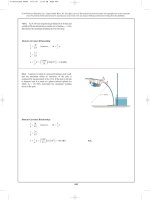
•2–21. The force applied to the handle of the rigid lever arm
D
causes the arm to rotate clockwise through an angle of 3° about
pin A. Determine the average normal strain developed in the
wire. Originally, the wire is unstretched.
600 mm
Geometry:2Referring to Fig. a, the stretched length of LB¿D can be determined using
the consine law,
2
LB¿D =
2
A
(0.6 cos 45°) + (0.6 sin 45°) - 2(0.6 cos 45°)(0.6 sin 45°) cos 93°
B
= 0.6155 m
Average Normal Strain: The unstretched length of wire BD is LBD = 0.6 m. We obtain
L
-L
B¿D
e
=
avg
BD
0.6155 - 0.6
L
BD
C
458
=
0.6
= 0.0258 m>m
Ans.
12
02 Solutions 46060
5/6/10
1:45 PM
Page 13
© 2010 Pearson Education, Inc., Upper Saddle River, NJ. All rights reserved. This material is protected under all copyright laws as they currently exist. No
portion of this material may be reproduced, in any form or by any means, without permission in writing from the publisher.
2–22. A square piece of material is deformed into the
y
dashed position. Determine the shear strain gxy at A.
15.18 mm
Shear Strain:
B
p
(gA)xy =
2
C
89.7°
-
¢
p
180°
= 5.24 A10- 3 B
≤
rad
15.24 mm
Ans.
15 mm
A
89.78
15 mm
15.18 mm
D
x