Intermediate accounting IFRS 3rd ch21
Bạn đang xem bản rút gọn của tài liệu. Xem và tải ngay bản đầy đủ của tài liệu tại đây (4.36 MB, 116 trang )
Prepared by
Coby Harmon
University of California, Santa Barbara
21-1
Westmont College
CHAPTER 21
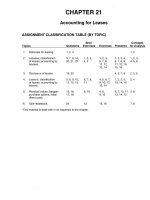
Accounting for Leases
LEARNING OBJECTIVES
After studying this chapter, you should be able to:
1.
Describe the environment related to leasing
transactions.
2.
21-2
Explain the accounting for leases by lessees.
3.
Explain the accounting for leases by lessors.
4.
Discuss the accounting and reporting for special
features of lease arrangements.
PREVIEW OF CHAPTER 21
Intermediate Accounting
IFRS 3rd Edition
Kieso ● Weygandt ● Warfield
21-3
LEARNING OBJECTIVE 1
The Leasing Environment
Describe the environment related to leasing
transactions.
A lease is a contractual agreement between a lessor and a lessee, that gives the lessee the right to use
specific property, owned by the lessor, for a specified period of time.
Largest group of leased equipment involves:
21-4
Information technology equipment
Transportation (trucks, aircraft, rail)
Construction
Agriculture
LO 1
ILLUSTRATION 21.2
What Do Companies Lease?
21-5
The Leasing Environment
Advantages of Leasing—Lessees
21-6
1.
100% financing at fixed rates.
2.
Protection against obsolescence.
3.
Flexibility.
4.
Less costly financing.
LO 1
The Leasing Environment
A Look at the Lessor
Captive Leasing
Banks
►
Credit Suisse (CHE)
►
Chase (USA)
►
Barclays (GBR)
►
Independents
Companies
►
CNH Capital (NLD) (for CNH
Global),
►
BMW Financial Services
(DEU) (for BMW)
Deutsche Bank (DEU)
►
IBM Global Financing (USA)
(for IBM)
14%
55%
21-7
Market Share
31%
LO 1
The Leasing Environment
Advantages of Leasing—Lessor
21-8
1.
Often provides profitable interest margins.
2.
It can stimulate sales of a lessor’s product.
3.
It often provides tax benefits to various parties in the lease.
4.
It can provide a high residual value to the lessor.
LO 1
LEARNING OBJECTIVE 2
Lease Accounting
Explain the accounting for leases by lessees.
Conveys the right to control the use of identified property, plant or equipment (an identified asset) for a
period of time in exchange for consideration.”
The various views on capitalization of leases are as follows.
21-9
1.
Do not capitalize any leased assets.
2.
Capitalize leases that are similar to installment purchases.
3.
Capitalize all long-term leases.
4.
Capitalize firm leases where the penalty for non-performance is substantial.
LO 2
Lease Accounting
IASB requires lessees to capitalize all leases.
Only exceptions:
leases covering a term of less than one year or
lease of property with a value less than $5,000.
Right to use property under the lease is an
21-10
asset, and
lessee’s obligation to make payments is a liability.
LO 2
Lease Accounting
The lessee
recognizes interest expense on the lease liability using the effective-interest method and
records depreciation expense on the right-of-use asset.
This accounting (finance lease) is applied whether the lease is effectively
21-11
a purchase of the asset or
when the lessee only controls the use of the asset.
LO 2
Measurement of the Lease Liability and Lease Asset
Lease Term
The fixed, non-cancelable term of the lease.
Bargain-renewal option can extend this period.
At the commencement of the lease, the difference between the renewal rental and the expected fair
rental must be great enough to make exercise of the option to renew reasonably certain.
21-12
LO 2
Lease Term
Illustration: Carrefour (FRA) leases Lenovo (CHN) PCs for two years at a rental of $100 per month per
computer and subsequently can lease them for $10 per month per computer for another two years. The
lease clearly offers a bargain-renewal option; the lease term is considered to be four years.
21-13
LO 2
Measurement of the Lease Liability and Lease Asset
Lease Payments
Fixed payments.
Variable payments that are based on an index or a rate.
Guaranteed residual value.
Payments related to purchase or termination options that the lessee is reasonably certain to
exercise.
21-14
LO 2
Measurement of the Lease Liability and Lease Asset
Discount Rate
Lessee should compute the present value of the lease payments using the implicit interest rate.
►
This rate, at commencement of the lease, which causes the aggregate present value of the lease
payments and unguaranteed residual value to be equal to the fair value of the leased asset.
In the event that it is impracticable to determine the implicit rate, the lessee uses its incremental
borrowing rate.
21-15
LO 2
Subsequent Lease Accounting
To illustrate the accounting for a lease using the finance lease method, assume that CNH Capital (NLD)
(a subsidiary of CNH Global) and Ivanhoe Mines Ltd. (CAN) sign a lease agreement dated January 1,
2019, that calls for CNH to lease a backhoe to Ivanhoe beginning January 1, 2019.
The terms and provisions of the lease agreement and other pertinent data are as follows.
21-16
LO 2
Terms and provisions of the lease agreement:
•
The term of the lease is five years. The lease agreement is non-cancelable, requiring equal rental payments of
€20,711.11 at the beginning of each year (annuity-due basis).
•
The backhoe has a fair value at the commencement of the lease of €100,000, an estimated economic life of five
years, and a guaranteed residual value of €5,000. (Ivanhoe expects that it is probable that the expected value of the
residual value at the end of the lease will be greater than the guaranteed amount of €5,000.)
21-17
•
The lease contains no renewal options. The backhoe reverts to CNH Capital at the termination of the lease.
•
Ivanhoe’s incremental borrowing rate is 5 percent per year.
•
Ivanhoe depreciates its equipment on a straight-line basis.
•
CNH sets the annual rental rate to earn a rate of return of 4 percent per year; Ivanhoe is aware of this rate.
LO 2
Lessee Accounting: Example 1
Ivanhoe computes the lease liability and the amount capitalized as a right-of-use asset as follows:
Payment
€ 20,711.11
Present value factor (i=4%,n=5)
x
PV of lease payments
4.62990
€95,890.35
*
Ivanhoe uses CNH's implicit interest rate of 4 percent instead of its incremental borrowing rate of 5 percent because
it is known to Ivanhoe.
21-18
* Rounded by €0.02.
LO 2
Lessee Accounting: Example 1
Ivanhoe records the finance lease on its books on January 1, 2019, as:
Right-of-Use Asset 95,890.35
Lease Liability
95,890.35
Ivanhoe records the first lease payment on January 1, 2019, as follows.
Lease Liability
Cash
21-19
20,711.11
20,711.11
LO 2
ILLUSTRATION 21.7
Lease Amortization Schedule—Lessee
21-20
LO 2
ILLUSTRATION 21.7
Prepare the entry to record accrued interest at Dec. 31, 2019.
Interest Expense
3,007.17
Lease Liability
21-21
* rounding
3,007.14
LO 2
Lessee Accounting: Example 1
Depreciation of the right-of-use asset over the five-year lease term, applying Ivanhoe’s normal depreciation policy
(straight-line method), results in the following entry at December 31, 2019.
Depreciation Expense
19,178.07
Right-of-Use Asset (€95,890.35 ÷ 5 years)
21-22
19,178.07
LO 2
Lessee Accounting: Example 1
The statement of financial position as it relates to lease transactions at December 31, 2019.
ILLUSTRATION 21.8
Statement of Financial Position
Presentation
On its December 31, 2019, income statement, Ivanhoe reports,
ILLUSTRATION 21.9
Income Statement presentation
21-23
ILLUSTRATION 21.7
Ivanhoe records the second lease payment as follows.
Lease Liability (€3,007.17 + €17,703.95) 20,711.11
Cash
21-24
* rounding
20,711.11
LO 2
ILLUSTRATION 21.7
If Ivanhoe purchases the equipment from CNH at the termination of the lease at a price of €5,000 and the estimated
remaining life of the equipment is two years, it makes the following entry.
Equipment
Cash
21-25
* rounding
5,000
5,000
LO 2