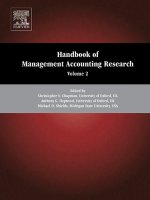
Management accounting retrospect and prospect by alnoor bhimani and michael bromwich
Bạn đang xem bản rút gọn của tài liệu. Xem và tải ngay bản đầy đủ của tài liệu tại đây (725.17 KB, 145 trang )
Management Accounting:
retrospect and prospect
This page intentionally left blank
Management Accounting:
retrospect and prospect
Alnoor Bhimani
and
Michael Bromwich
CIMA Publishing is an imprint of Elsevier
The Boulevard, Langford Lane, Kidlington, Oxford, OX5 1GB
30 Corporate Drive, Burlington, MA 01803, USA
First edition 2010
Copyright © 2010 Alnoor Bhimani and Michael Bromwich. Published by Elsevier Ltd.
All rights reserved.
The right of Alnoor Bhimani and Michael Bromwich to be identified as the authors of this
work has been asserted in accordance with the Copyright, Designs and Patents Act 1988
No part of this publication may be reproduced, stored in a retrieval system or transmitted
in any form or by any means electronic, mechanical, photocopying, recording or otherwise
without the prior written permission of the publisher
Permissions may be sought directly from Elsevier’s Science & Technology Rights
Department in Oxford, UK: phone: (144) (0) 1865 843830, fax: (144) (0) 1865 853333;
e-mail: Alternatively you can submit your request online by
visiting the Elsevier web site at and selecting
Obtaining permission to use Elsevier material
Notice
No responsibility is assumed by the publisher for any injury and/or damage to persons or
property as a matter of products liability, negligence or otherwise, or from any use or
operation of any methods, products, instructions or ideas contained in the material herein.
British Library Cataloguing in Publication Data
A catalogue record for this book is available from the British Library
Library of Congress Cataloging in Publication Data
A catalog record for this book is available from the Library of Congress
ISBN: 978-1-85617-905-8
For information on all CIMA Publishing publications visit our
website at books.elsevier.com
Printed and bound in Great Britain
10 11 12
10 9 8 7 6 5 4 3 2 1
Contents
Preface
Acknowledgements
About the Authors
Executive Summary
1 Then, Now and the Future
2 Structure of the Book
1
vii
xi
xiii
xv
xv
xxi
Management Accounting: Past and Present
1.1 Introduction
1.2 Cost Accounting and Management Accounting:
Then and Now
1.3 The Path to Today’s Cost Accounting
and Management Accounting
1.4 Other Research Thrusts
1.5 Management Accounting Now
1.6 Practice: Where We Stand Now
1.7 Management Accountants as Business Partners
1
1
5
7
8
16
19
2
Costs: Modern, Future and Strategic
2.1 Introduction
2.2 Costs for Decision Making
2.3 Management Accounting and Technology
2.4 Strategic Management Accounting
21
21
22
35
48
3
Flexible Technologies, Fluid Organisations and Digitisation
3.1 Introduction
3.2 A Trajectory of Flexibility
3.3 Flexible Organisational Technologies
3.4 Organisational Structure as Strategy
3.5 Risk Management as Strategy
3.6 Rethinking the Boundaries of Management Accounting
53
53
54
56
69
70
72
2
vi
Contents
4
Cost Co-creation and Globalisation
4.1 Introduction
4.2 The Finance Function and Information ‘Pull’
4.3 Customers as Product-Makers and Co-creation
4.4 The Changing Price–Cost–Product Interface
4.5 Cloud Costing
4.6 The Strategic Scorecard
4.7 Decision Making in an Age of Crisis
4.8 Regulation in a Risky World
5
The Rising Tide of Change in Management Accounting
5.1 Introduction
5.2 Questioning Management Accounting’s Raison d’être
5.3 The End of Traditionally Separate Entities
5.4 Cross-organisational Exchanges
5.5 Avenues of Change
References
Index
77
77
77
79
83
85
86
89
91
93
93
93
96
99
104
109
117
Preface
This is the third in a series of books which we have written that have been commissioned by the Chartered Institute of Management Accountants (CIMA). This
book is part of the celebrations to mark CIMA’s 90th anniversary in 2009. As is
fitting, this book first looks at the development of cost and management accounting from the founding of the Institute to the current time. Secondly, it considers a
number of immediate challenges to management accountants and surveys a number
of issues and challenges that will likely affect management accounting thought and
practice and the work of management accountants. This book builds upon two earlier publications by us sponsored by CIMA: Management Accounting: Evolution
not Revolution (1989) which evaluated the then promise of a variety of emerging
management accounting innovations including Activity Based Costing (ABC) and
Management Accounting: Pathways to Progress (1994) which sought to consider
‘approaches which may help expand the accountant’s role in a dynamic and turbulent environment embodying increasing global competition…’ This book reflects
the current and future status of management accounting, and expands on the earlier
books by focusing on what we believe are likely to be very significant changes in
the business environment, including management accounting in a time of financial
crisis, accelerating globalisation and fast-paced technological change and speculates
on other factors that may burgeon and affect the accountant’s role.
The history of cost and management accounting from the Institute’s founding
in 1919 spans cost bookkeeping geared to the valuation of inventory and for guiding pricing, the general establishment of the foundation techniques of management
accounting, such as standard costing and budgetary control in the 1950s and 1960s
and discounted cash flow capital budgeting in the 1970s, to accounting geared to
decision support and management control using approaches such as strategic management accounting (SMA), value added methods, balanced scorecards (BSC),
activity based costing (ABC) and its variants, and a variety of performance measurement systems. This history is important in understanding management accounting today as there is substantial evidence that accounting innovations often are not
accepted or are very slow to achieve widespread acceptance and moreover that they
are linked to a wide array of influencing conditions and forces. Thus for example,
viii
Preface
it took some 20–30 years for standard costing and budgetary control to gain extensive acceptance. The notion of standards of performance itself has a much more
protracted history. The take-up of more recent innovations, such as ABC and BSCs
has a lag of some 10 years approximately but adoption across industries and services has been quite variable. There is also strong evidence that extant management
accounting systems remain traditional, often employing quite dated techniques in a
substantially changed world subject to likely greater volatility.
It may seem inappropriate to presume the possibility of changes to come in the
field in the midst of a possibly lengthy major recession where there is a clear call
for accountants to use their well-practiced techniques to aid in downsizing and cost
containment and financial discipline. We believe however that times of retrenchment
and economic slowdown present possibilities and opportunities to effect change
and engage in reflection of a degree which surpasses that likely to take place under
more stable economic conditions of growth and expansion. The present is a time
that allows creativity and alternatives to be posited and experimented with such as
to redirect management accounting to paths otherwise unlikely to be explored.
This book looks at the possibilities for accountants to widen their focus to
become much more familiar with enterprise technology which determines the firm’s
cost structure and with the effects of multi-product production in multi-locations
such as economies or diseconomies of scale flowing from larger volumes and (dis)
economies of scope generated by producing large product portfolios marketed and
produced globally. This may require traditional cost models used by accountants to
be altered and to become more nuanced. We suggest how this may be accomplished.
One requirement that arises here if accountants are to understand enterprise technology and marketing strategy is that they need to work closely as business partners
where accountants work as part of management teams throughout the organisation
rather than remain grounded in specialist information provision roles.
With regard to the possible changes we see these as:
■ Both an acceleration of uncertainty as well as growing uncertainty about volatility across enterprise environments. This means that assumptions, projections,
prognostications and information analysis now takes place with different expectations and objectives. It is the management accountant’s obligation to assess
the propriety of continuing with the status quo.
■ The rise of firms that are fluid in terms of technologies they use and in terms
of mutable boundaries between them and suppliers and customers rejecting traditional management and governance structures, and strictly legal relationships
with suppliers and, indeed, with customers.
■ Firms are likely to abandon the traditional logic that is part of the industrial era
with its focus on the a priori conceptualisation, design and testing of products
Preface
ix
before production. Marketing and sales functions then account for and enable
customers access to the product. The present day context for many firms entails
instead, within many industrial, service-based and digital products, direct
involvement by the customer in input and design. This occurs sometimes with
products being separated from the associated source of revenue.
■ Concerns which in a world of extreme volatility and novel contingencies will
be questioned and potentially lead to the reshaping of management accounting. Collaborative alliances, virtual organisations and fluid structuring and other
enterprise related forms provide a focus also for dealing with globalisation.
■ Transparency and compliance stipulations with growing regulatory requirements
are increasingly affecting enterprises. Management accounting will have to
address issues of risk management and the design and implementation of appropriate governance mechanisms in the near term. Additionally, the growing concerns with sustainable business practices and environmental concerns will make
demands for effective record capture and reporting approaches. Requirement for
information of this novel type will be as much about communicating legitimacy
of activities as about enabling bases for action.
We argue that these factors call for management accountants to develop an
understanding of wider forces of change as well as of technical and organisation
specific factors. Ultimately, the ability of management accountants to understand
other areas of organisational functioning and other business models, and to integrate this emerging knowledge with the work, tasks and objectives of the changing
management accounting function, will be a key factor in the profession’s survival
and continued growth. The field must continue to retain adeptness in recognising
the significance and nature of emerging change as it evolves.
This page intentionally left blank
Acknowledgements
Our appreciation extends to the business executives, consultants and researchers
who gave their time generously to assist in this project, and to the anonymous
reviewers drawn from a variety of backgrounds. We also wish to express our gratitude to Kim Ansell, Head of Innovation at CIMA, and to her staff including Naomi
Smith and to the copy editing skills of Clare Donnelly. We are very grateful to
CIMA’s General Charitable Trust for funding this project. The secretarial and typing skills of Ann Cratchley have been especially appreciated as always. We are also
grateful for the assistance of Livia Radulescu in assisting with the bibliography.
This page intentionally left blank
About the Authors
Alnoor Bhimani is Professor of Management Accounting and Head of the Department
of Accounting at the London School of Economics (LSE). He possesses an MBA
from Cornell University where he was a Fulbright Scholar, and he holds a PhD
from LSE. He is also a Certified Management Accountant (Canada). He is author of
15 books and over 100 articles. His books entitled Management Accounting: Pathways
to Progress (CIMA, 1994), Strategic Finance (Strategy Press, 2008) and Management
and Cost Accounting (FT/Prentice Hall, 2008) are best-sellers, with translations in
several languages including French, Dutch, Italian, Portuguese, Japanese, Arabic and
Mandarin. Al has also edited several books with Oxford University Press on management accounting, which continue significantly to influence research thinking in the
area. He is an editorial board member of numerous established scholarly journals. He
has undertaken strategy, financial management and control related research in a variety of global enterprises and has presented his findings to corporate executives and
academic audiences in Europe, Asia and North America.
Michael Bromwich was CIMA’s Professor of Accounting and Financial
Management at the London School of Economics from October 1985 until 2006,
now Emeritus. After qualifying as an accountant with the Ford Motor Company, he
has taught in a number of UK universities. He has been for many years the Convener
of a research group on management accounting research sponsored by CIMA and the
ICAEW. He teaches both management accounting and financial corporate reporting.
He was voted ACCA/AA Distinguished Academic of the year in 1999. He is a Past
President of CIMA (1987/1988) and currently serves on CIMA’s Technical Committee
and was awarded the Institute’s Gold Medal in 2009. He has written a number of
books, including The Economics of Capital Budgeting (1976) and The Economics of
Accounting Standards Setting (ICAEW, 1985). His most recent books are Financial
Reporting, Information and Capital Markets (Pitman, 1992), Management Accounting:
Pathways to Progress (CIMA, 1994) and, with others, Following the Money: The
Enron Failure and the State of Corporate Disclosure (AEI-Brookings Joint Center for
Regulatory Studies, 2003) and Worldwide Global Reporting: the Development and
Future of Accounting Standards (OUP, 2006).
This page intentionally left blank
Executive Summary
1 Then, Now and the Future
This report provides a short review of the state of management accounting research
and practice in terms of the brief by the Chartered Institute of Management
Accountants (CIMA) that it:
will look at where the profession has been, what is its current state as CIMA
reaches its 90th birthday and will prompt thought about where management
accountancy is heading in the future with emphasis on the future of the profession in the light of globalisation, the increase in virtual organisations and
the changing role of the management accountant.
The book builds upon two earlier publications by us sponsored by CIMA:
Management Accounting: Evolution not Revolution (1989, ER below) which evaluated the then promise of a variety of emerging management accounting innovations
especially Activity Based Costing (ABC) and Management Accounting: Pathways
to Progress (1994, PP below) which sought to consider ‘approaches which may
help expand the accountant’s role in a dynamic and turbulent environment embodying increasing global competition…’ All three reports provide major pointers to
finance directors and chief financial officers as to ongoing trends, emerging challenges and possible opportunities for change acknowledging that historically any
major dispersion of management accounting innovations is generally slow. Chapter 1
indicates that formal management accounting systems, to a large degree, continue
to be structured along traditional routes in many enterprises. But firms desirous of
change, now face options and possibilities for altering their management accounting systems given the implications of the increasingly global, digital and volatile
environment faced by enterprises.
PP commenced by looking in some detail at a wide range of then current and
emerging challenges facing organisations and management accountants and
xvi
Executive Summary
examined their implications and possible responses. It first considered the strong
pressures to automate production activity with the introduction of numerical control devices, computer aided design and manufacturing and flexible manufacturing.
Chapter 3 of this report, Management Accounting: Retrospect and Prospect (R&P
below) indicates that this area of innovation has since exploded to such an extent that
many firms today can technologically adopt a ‘fluid and flexible’ form in the face of
the pressures of global integration, information exchanges and worldwide competition from production bases located across the globe and serviced by complex supply chains which themselves span locations around the world. ‘Fluid organisations’
were seen only on the horizon in PP in 1994 (see R&P Chapter 5). As they continue to rapidly evolve and develop, fluid and flexible firms will lead accountants to
seek solid grounding in knowledge about the technology available to and deployed
by the firm. Management accountants, it is anticipated, will aim to become skilled
in appraising the benefits, costs and contextual issues of different customer supply
networks and supply chains and report appropriately on the performance of such
structures.
It is argued also that, the traditional and conventional view that comprehensive
planning and decision making should precede operational action may falter as there
is evidence from firms today that decision objectives often emerge during the process of operations and that decisions may be made whilst operational actions and
production activities evolve in practice. It is thus the case that action is at times
subsumed in assessments of information. Here management accountants will possibly seek to tie information from operations into reformulating decision models.
Variances from plans may come to be seen as learning devices about the engagement of action and concurrent decisions rather than as instruments of formal
responsibility accounting.
Aside from reassessing conventional thinking about management accounting systems design where it is assumed that managers think about and evaluate
information prior to making decisions and taking action, in many enterprises nonformal information evaluation may be very significant in determining organisational
endeavours. Additionally, appeal to information following the making of decisions
often exists as a legitimacy endowing ritual. As enterprises increasingly operate in
contexts of rapid change and extreme uncertainty, the assumed structured logic of
information usage and decision making has to be questioned and reconsidered just
as the use of non-formal information and the value of legitimacy endowing information deployment must be taken into account.
Around the time of publishing PP, the very strong pressure from consultants and
some professional bodies to adopt ABC was probably at its height. At this time
there were many passionate pleas to revolutionise management accounting by the
wholesale adoption of ABC and its variants Activity Based Budgeting and Activity
Based Management. This revolution has not come to pass (R&P Chapter 1). Various
Executive Summary
xvii
estimates of the take-up in economically developed countries have been made but
20% by large firms is a reasonable estimate of the upper range of take-up and is
not surprising given the rigorous assumptions underlying ABC and the expense of
implementing ABC. ABC can now be presumed as being potentially part of the
accountant’s tool bag having contributed to a degree, to our understanding of some
overheads.
Chapter 1 of this book augments the consideration of many earlier developments
in management accounting by considering a number of more recent innovations.
For example, maximisation of shareholder value has been the publicly avowed
objective of almost all firms though how this is enacted differs among firms. It is
likely that these claims will become more muted in the current environment and
that explicit corporate objectives may be expanded to encompass more stakeholders. Economic value management systems, such as economic value added (EVA©),
are now used quite substantially by the larger international firms (Chapter 1). These
systems convert accounting results into economic ones by applying an interest
charge on the book value of assets to accounting profit. This incentivises managers to select projects that earn ‘super profits’. The evidence is that relatively few
firms link managerial incentives explicitly to economic value management systems.
Some firms have abandoned these approaches because of their perceived failure to
capture the full richness of corporate performance. The other major problem associated with these methods is the difficulty of ensuring that the yearly performance
measure correctly signals the lifetime performance of the project.
The creation of fluid and flexible organisations has been enabled by recent major
changes in relationships with suppliers which have altered the traditional approach
of seeking suppliers by formal legal and fully specified tenders and the substitution
of supplier partnerships involving new substantial information exchanges between
parties aided by digital technology including full knowledge of both the cost structures and production activities of all parties.
Trusted suppliers in such relationships may participate in the purchasing organisation’s planning and may contribute to designing both the production technology and the products of the purchasing firm. In supply partnerships, management
accountants may design information systems that allow more ready exchange of
information between parties than has been the case in conventional contracting
where extensive information is required of suppliers with purchaser information
being kept private. They also have to become comfortable with operating in regimes
having less formal management and governance structures than is traditional and
rely more extensively on trust between partners whilst still providing appropriate
performance reports.
Fluid and flexible firms founded on a strong digital platform experience new
ways to deal with customers by enabling them to directly establish their preferences
concerning product design, processing and capabilities and inserting these into the
xviii
Executive Summary
products to be consumed (R&P Chapter 4). For long, successful companies have
been less inclined to invent entirely new products and services without interrogating consumers. But now, a large number of enterprises construct platforms allowing customers direct access to product creation and to collaboration infrastructures.
Enterprises may co-create their products with the customer or they may go further
and allow total product creation by the customer providing them a platform for
doing so and thereby also enabling the generation of new consumer experiences in
the process. Although enterprises may not pre-design the consumer experience with
the product, they still invent the broad product concept and orchestrate the achievement of the product’s potential via the consumer. A variety of industrial, servicebased and digital products are created directly via customer input and design.
In electronic platform contexts, content of the website is generated by the consumers but it is the advertisements on the interactive platforms between users that form
the revenue source. In these contexts, pricing and costing issues do not follow a traditional model which may be cost-plus based or market based. Rather, the pricing has
to directly link into the strategy of the firm and its revenue generating model where
the product that is costed does not directly align with where sales are generated. Cocreation of products is not a choice but a necessity for many business models because
the product choices are infinite and cannot be conceptualised or delivered by one
‘producer’ and because the product created by the consumer is often not in fact the
product that is ultimately generating the firm’s revenues. Management accountants
have a new role here in determining the costs and profitability of satisfying each
of the specific preferences of consumers. That is, costing the product attributes
developed with or by consumers and seeking to also analyse plausible revenue propositions that may be dissociated from the consumer created products.
Fluid organisations can assume different forms by definition. They can be
informal grouping of firms or parts of firms seeking to achieve a specific shared
objective(s). Such groups emerge when the legal, managerial and governance structures of the parent firms are altered to allow the group to act ‘smart and quick’ in
a dynamic environment and to allow more immediate entrepreneurial or innovative
activity. The founding of such groups may be to allow accessing of skills not possessed by some of the parent firms, developing new skills, forming a portfolio of
skills so as to move into novel areas of activities, risk bearing, financing and planning projects too large for the individual founding entities of the group and to allow
new products to be created that are otherwise unlikely to appear.
Fluid organisations are founded not on traditional conceptions of corporate structures but are bound together by shared endeavours and continuously orchestrated
interfacing. This is one area where in order to contribute, management accountants
will seek to be seen as part of management and operational teams and thus to become
business partners. Management accountants will act possibly as the financial advisors
or business partners to teams and will need to understand the technology underlying
Executive Summary
xix
the organisation and learn to cope in such organisations without, at least, some of the
conventional formal management control structures or systems. This role will naturally come to be combined with reporting to parent entities (R&P Chapter 5).
The emergence of accountants as business partners is a major possible innovation extending to many large firms (R&P Chapter 5). The early evidence is that this
is welcomed by operations managers, who see business partners as being ‘on their
side’ and by the accountant business partners themselves as they seek to engage
in operational activities and to having a wider role than traditional management
accountants of the same level.
One area which will likely pose challenges is in attaining balance in the responsibilities of the business partner to the team manager and to the accounting division. Perhaps, this problem will be tackled contextually and informally with some
realignment of line responsibilities (R&P Chapter 5). Some enterprises are experimenting with business partners from other disciplines.
Virtual organisations represent a different form of fluidity extending far beyond
the concept of outsourcing, strategic alliances or joint ventures because of their reliance on digitised platforms of operation and coordination. The virtual firm is an
agglomeration of multiple ‘buy’ transactions weaved together by extensive technological structuring and managerial action coordination. Cost analyses are likely
to entail many factors reflective of the complexities such an agglomeration brings
together. A virtual enterprise is ultimately a goal-orientated arrangement between
several firms or units of firms which temporarily assembles competencies and capabilities wherever they arise. There is linkage by information technology to share
skills, costs and access to one anothers’ markets. These are prime areas for the
development of the management accounting function which are only now emerging
for many firms.
A major thrust of PP (1994) was to examine and evaluate a number of then innovative cost management approaches. The further evolution of these approaches is
charted in Chapter 1 of this report. Total quality approaches and Just-in-Time systems
are now relatively extensive in many competitive contexts. Strategic Management
Accounting and some of its approaches are reviewed in Chapter 2. Chapter 2 also
considers modern methods of dealing with fixed overheads focusing on the treatment
of joint costs. Chapter 4 of PP provides a more comprehensive treatment of this subject. It is notable today that the Balanced Scorecard and its variants are much used
though the depth of application varies. In many companies, management accountants
are responsible for consolidating the information for the balanced scorecard and publicising it within the organisation. This role requires accountants to cooperate with
other functions in the firm who ‘own’ the non-financial information in the balanced
scorecard. The use of the scorecard has moved over time from being a strategic performance system to a scorecard for some firms which seek to implement strategy
through communication, developing action plans and as a basis for incentives. More
xx
Executive Summary
developed applications are mostly still at early stages. There remains considerable
evidence that firms tend not to take a fully balanced view of the information provided, often concentrating on financial information and often considering information
not readily amenable to capture in simplistic balanced scorecard terms. As with many
managerial innovations, it may be difficult or impossible to quantify the benefits of
the balanced scorecard in financial terms. Many critics raise questions about any benefits accruing from its use.
CIMA introduced a ‘strategic scorecard’ to extend on the balanced scorecard
concept whereby strategy is sought to be linked to governance issues (see Chapters
1 and 4). The CIMA Strategic Scorecard TM attempts to report on strategic position, strategic options, strategic implementation and strategic risks. It is too early to
evaluate its likely take-up but it may fill an information gap for some enterprises.
One important alteration in management accounting in practice is the
re-engineering, restructuring and downsizing of the finance function (R&P Chapter
1). This endeavour was born and developed by firms with some assistance from
consultants. Much of this has become possible because of changes in computerised
information systems and alterations in communication platforms. It is likely that
such efforts will be redoubled in the current economic environment but there are
core competences relating to finance which some enterprises will be reluctant to
lose. Beyond this, transparency and compliance requirements with growing regulatory requirements will impinge on enterprises. This may put pressure on enterprises’
information and control functions and perhaps extend the finance function’s role in
new directions. Management accounting will have to address issues of risk management and the design and implementation of appropriate governance mechanisms.
Additionally, the growing concerns with business sustainability issues will make
demands for record capture and reporting approaches being seen as legitimate.
Increasingly, regulatory environments adopt and operate in standardised forms.
This is to a degree because transparency is regarded as enhanced due to the preference
for commonality of approach to measurement, valuation and financial representation.
Consequently, the management accountant needs to judge how economic flows can be
represented in a manner reconcilable with external demands for global uniformity.
This book departs from PP in that there are no country case studies in this report
considering management accounting developments in selected countries. This is in
part because of the global nature of financial management and control issues. But
also, because of a growing focus on knowledge interactions and development rather
than geographical boundaries driving change.
As organisations become more knowledge management orientated, it is argued
that the focus may turn to enhancing some notion of returns on people rather than
maximising capital returns. This will sponsor the creation of organisations that seek
to continuously adapt and evolve in line with knowledge input. If traditional structures give way to fluid enterprise designs and organisational forms which rest on
Executive Summary
xxi
expertise and knowledge creation potential, then the management accountant will
have rethink organisational control approaches.
In sum, this book reflects on the current and future status of management
accounting, focuses on emerging contemporary issues, including management
accounting in an environment of accelerating globalisation, fast-paced technological
change, financial crisis challenges and speculates on other factors that may burgeon
and affect the accountant’s future role.
2
Structure of the Book
A brief summary of the report is:
Chapter 1 Management Accounting: Past and Present
Provides a review of state of cost accounting at the time of the foundation of
CIMA in 1919 and the subsequent development of management accounting and
identifies current practices in management accounting.
Chapter 2 Costs: Modern, Future and Strategic
Strategic cost analysis with a focus particularly on multi-product costing,
strategy and management accounting in investment decisions including synergy,
portfolio effects and economies and diseconomies of scope. The economics of technological change on decisions and actions.
Chapter 3 Flexible Technologies, Fluid Organisations and Digitisation
Considers advances in a range of flexible organisational technologies and discusses the rise of ‘fluid’ organisations. It assesses the implications for risk and
explores further certain strategy considerations and the widening boundaries of
management accounting.
Chapter 4 Costs Co-creation and Globalisation
Assesses the changing nature of the product and the firm whereby the customer
contributes to product development on a continuous basis and competitors can collaborate on some dimensions. Also covered is the added complexity of regulatory
environments increasingly calling for standardised modes of compliance assurance
and a discussion of issues relating to commonality of approach in measurement,
valuation and financial representation.
Chapter 5 The Rising Tide of Change in Management Accounting
Explores aspects of the impact on management accounting of the global financial crisis beginning 2008, the sustained appeal to quantification in management
xxii
Executive Summary
decision making and the structured logic of executive decisions and actions. These
are concerns which in a world of extreme volatility and novel contingencies will be
questioned and potentially lead to the reshaping of management accounting. The
issue of collaborative alliances, virtual organisations as a special case of fluid structuring and other enterprise related effects provide a focus also for this chapter which
concludes with a summary of important broad points made in the book.
The prognosis of the report is that management accounting has built a significant
body of knowledge and of tested practices but that its potential for innovation and
its capacity for regeneration can be expected to further burgeon. What is certain is
that there is both an acceleration of uncertainty as well as growing uncertainty about
volatility itself across enterprise environments today. As a consequence, assumptions, projections, prognostications and information analyses now take place with
different expectations and objectives. It is incumbent on the management accountant to assess the propriety of continuing with the status quo. Now is the time to
consider the pressures of factors which have arisen very recently including globalisation forces, the rise of virtual organisations and business models resting on digitisation, the more extensive regulatory climate facing organisations which influences
norms of governance and transparency, and the engagement of greater risk analysis
across a multitude of enterprise activities and endeavours. These factors and conditions are inherent elements of the new organisational order and will in the future
influence management accounting discourse.
Chapter 1
Management Accounting: Past and
Present
1.1
Introduction
Most techniques currently used in management accounting have distant origins. An
understanding of their roots is useful in appreciating their deployment today. The first
section of this chapter briefly investigates the development of cost accounting to the
time of the founding in 1919 of the Institute of Cost and Works Accountants (ICWA)
which evolved into the Institute of Cost and Management Accountants (ICMA, 1972)
and in 1986 into CIMA. The chapter then tracks the development of cost accounting
and management accounting from then to the present. Finally, the chapter considers
the current state of management accounting and some of its practices.
There are different arguments for considering the past. One might suggest that
management accounting has evolved and progressed over a historical time frame,
essentially becoming more adept at confronting costing challenges. But such a view
would presume the field’s pursuit of betterment toward some ideal state and the
existence of a pre-existing conceptual framework awaiting discovery. This is a problematic stance as management accounting would then seem to be capable of moving
towards closure of some sort, for which no conclusive argument has ever been produced. A more viable approach is to understand the changes faced by management
accounting and its response in the light of continuous change. This view proffers
an understanding of the field’s strategic posture under different circumstances. It
permits assessments of its theoretical underpinnings as well as the practical changes
it has undergone and which caused it to change. Such a perspective allows us to discuss technical and practical aspects of management accounting mechanisms from
the vantage point of theoretical interests in their logic and structure. It also permits
us to consider the field’s reactions and potential changes as it faces an emerging
future in the context of modern day globalisation effects, digitisation and technological advances, concerns with risk management, governance and sustainability
and wider forces in evidence across markets, geographical borders and economic
and social terrains.
2
Management Accounting: Past and Present
1.2 Cost Accounting and Management Accounting:
Then and Now
We do not intend to review the history of management accounting in great detail
here; for this, see Edwards and Boyns (2006) and Fleischmann and Tyson (2006)
which provide extensive descriptions of the early historical development of cost
accounting in the UK and USA. These articles, and other research, indicate that
much of this history is contestable because of sparse records and the continuing
discovery of new sources of information. Many studies also suggest that market
pressures and changes in management structures drove firms to develop certain specific internal accounting procedures (Chandler and Daems, 1979; Johnson, 1983).
But there is evidence and arguments that accounting practices have much wider
and more dissipated origins (Baxter and Chua, 2006; Bhimani, 1996; Hopwood and
Miller, 1994; Miller and O’Leary, 1987).
1.2.1
Costing Then
The early history of accounting within the firm from the 1840s to approximately
1910 firstly involves predominantly bookkeeping for costs and for revenues, with a
major purpose being the valuation of inventories for financial accounting purposes.
Secondly, and secondarily, it involves the seeking of more sophisticated product
costs and more accurately costed jobs, batches and orders. These developments
tended to be the province not of accountants but engineers, and those accountants
who were involved were financial accountants. Everyday costing was the province
of a large army of unqualified clerks.
The most important accounting book on costing in the last quarter of the
19th century was an English book by Garcke and Fells, Factory Accounts: Their
Principles and Practice (1887, with a large number of subsequent editions).1
A good majority of their book addressed bookkeeping for costs and urged the integration of cost accounts with the financial accounting system, but their understanding of costs was surprisingly modern. For example, they discussed accounting for
prime cost (labour and material) and accounting to provide accurate costs for pricing. They recognised the importance of the distinction between fixed costs and costs
that are variable with output. They attributed those overheads to products that were
believed to vary with production, including depreciation and supervisory costs but
not fixed costs such as general administrative costs. This understanding of ‘modern’
fixed and variable costs supported early advocacy of the ‘break-even’ chart (Hess,
1
Garcke was a working electrical engineer and company chairman. John Fells was a financial accountant
who also worked in industry and became an adviser to many firms on keeping internal accounts.