Managerial accounting, 5th by jiambalvo test bank ch03
Bạn đang xem bản rút gọn của tài liệu. Xem và tải ngay bản đầy đủ của tài liệu tại đây (228.08 KB, 46 trang )
CHAPTER 3
Process Costing
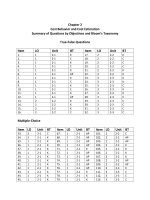
Summary of Questions by Objectives and Bloom’s Taxonomy
Item SO
BT
Item SO
BT
True-False Statements
1.
1
K
6.
1
K
2.
1
K
7.
1
K
3.
1
C
8.
1
C
4.
1
C
9.
1
K
5.
1
K
10.
1
C
Multiple Choice Questions
26.
1
K
48.
2
K
27.
1
C
49.
2
AP
28.
1
C
50.
2
C
29.
1
K
51.
2
K
30.
1
K
52.
2
AP
31.
1
K
53. 2,3
K
32.
1
K
54. 2,3
AP
33.
1
K
55.
3
AP
34.
1
K
56.
3
AP
35.
1
K
57.
3
K
36.
1
K
58.
3
C
37.
1
C
59.
3
K
38.
1
K
60.
3
K
39.
1
K
61.
2
C
40.
1
K
62.
4
AP
41.
1
K
63.
3
AP
42.
1
C
64.
3
AP
43.
2
K
65.
2
AP
44.
3
K
66.
3
AP
45.
2
AP
67.
3
AP
46.
2
AP
68.
3
AP
47.
2
K
69.
3
AP
Matching
133. 1,2,3,5 K
Exercises
134.
1
AP
138.
2
AP
135.
1
AP
139.
2
AP
136. 1,2
AP
140. 2,3
AP
137.
2
AP
141. 2,3
AP
Challenge Exercises
153.
2,4
AP
154.
1-4
AP
Short-Answer Essays
155.
1
K
157.
2
C
156.
1
K
158.
5
K
Item
SO
BT
11.
12.
13.
14.
15.
1
2
2
2
2
C
K
C
K
C
70.
71.
72.
73.
74.
75.
76.
77.
78.
79.
80.
81.
82.
83.
84.
85.
86.
87.
88.
89.
90.
91.
4
4
4
4
4
4
4
4
4
4
4
4
3
4
4
4
5
5
5
5
5
5
142.
143
144.
145.
159.
160.
Item
SO
BT
16.
17.
18.
19.
20.
2
3
3
3
4
K
C
C
C
C
AP
AP
AP
AP
AP
AP
AP
C
C
C
AP
AP
K
C
C
AP
AP
K
K
K
C
C
92.
93.
94.
95.
96.
97.
98.
99.
100.
101.
102.
103.
104.
105.
106.
107.
108.
109.
110.
111.
112.
113.
5
5
5
5
5
5
5
1
5
5
5
5
5
2
2
2
2
3
3
3
4
4
2-4
2-4
2-4
3
AP
AP
AP
AP
146.
147.
148.
149.
1
5
K
C
161.
Item
SO
BT
21.
22.
23.
24.
25.
4
5
5
5
5
C
AP
K
K
K
K
K
AP
AP
K
K
AP
AP
AP
AP
AP
AP
AP
AP
AP
AP
AP
AP
AP
AP
AP
AP
114.
115.
116.
117.
118.
119.
120.
121.
122.
123.
124.
125.
126.
127.
128.
129.
130.
131.
132.
4
4
4
2
3
4
5
5
2
3
2
3
2-4
2-5
2-4
2-5
2-5
2-5
2-5
AP
AP
AP
AP
AP
AP
AP
AP
AP
AP
AP
AP
AP
AP
AP
AP
AP
AP
AP
3,4
3,4
3,4
4
AP
AP
AP
AP
150.
151.
152.
2-5
3,5
5
AP
AP
AP
5
C
3-2
Test Bank to accompany Jiambalvo Managerial Accounting, 5th Edition
TRUE-FALSE
1.
Process costing systems are commonly used by companies that produce homogeneous items
using a continuous production process.
2.
A company such as Proctor & Gamble that produces large quantities of identical items, such as
shampoo and toothpaste, is likely to use a process costing system.
3.
In a process costing system, costs are transferred from the Work in Process inventory account
directly to the Cost of Goods Sold account.
4.
In the manufacturing operations of a company using process costing, a product must typically
pass through two or more departments.
5.
Material is generally added evenly throughout the production process.
6.
Materials and labor are often grouped together and called conversion costs.
7.
Transferred-in costs are the costs of the direct materials that are transferred into the company
when materials are purchased from a supplier.
8.
In process costing, a transferred-in cost is handled in the same manner as a material cost added at
the beginning of the process.
9.
In a process costing system, each department has a separate Work in Process account.
10.
A significant disadvantage of a process costing system is that it requires the use of actual
overhead costs rather than predetermined overhead rates.
11.
Recording transferred-in costs requires a debit to the Finished Goods inventory account and a
credit to a Work in Process account.
12.
An essential calculation in a process costing system is to calculate the average unit cost, also
known as the cost per equivalent unit.
13.
The number of equivalent units for materials is the same as the equivalent units for conversion
costs in each department, but will often differ from equivalent units of other departments.
14.
The number of fully complete units of product that could have been produced with the materials
used and processing costs in a particular accounting period is referred to as equivalent units.
15.
The number of equivalent units for conversion costs is always equal to or less than the number of
equivalent units for materials.
16.
Materials are always added at the beginning of every process.
17.
In order to calculate the cost per equivalent unit, one must know the number of equivalent units in
beginning inventory, ending inventory, units completed during the period, along with the total
product costs incurred during the period.
Chapter 3 Process Costing
3-3
18.
The cost per equivalent unit is determined by dividing the cost incurred in the current period by
the total equivalent units produced.
19.
The denominator in the formula for determining the cost per equivalent unit is determined by
adding the number of units completed to the equivalent units in the ending Work in Process
inventory.
20.
The cost transferred out is the cost of the inventory that was started and completed during the
period.
21.
When computing the cost of the ending Work in Process Inventory, the number of equivalent
units in Work in Process inventory is multiplied by the cost per equivalent unit separately for
material, and separately for conversion costs.
22.
If beginning inventory consisted of 400 units, ending inventory was 600 units, and 7,700 units
were started during the period, the number of units completed during the period was 8,700.
23.
Total cost accounted for is the sum of the cost of the units transferred out of the department plus
the cost of the ending Work in Process inventory.
24.
The cost of the items completed and transferred out of a department is the total cost per
equivalent unit times the number of units completed.
25.
The cost per equivalent unit used in process costing is the average of fixed and variable costs.
Answers
1
2
3
4
5
T
T
F
T
F
6
7
8
9
10
F
F
T
T
F
11
12
13
14
15
F
T
F
T
F
16
17
18
19
20
F
F
F
T
F
21
22
23
24
25
T
F
T
T
F
3-4
Test Bank to accompany Jiambalvo Managerial Accounting, 5th Edition
MULTIPLE CHOICE
26.
Which one of the following is a costing system commonly used by companies that produce a
large number of homogeneous units in a continuous production process?
A.
Unit costing system
B.
Job-order system
C.
Incremental analysis cost system
D.
Process costing system
27.
Which of the following companies will most likely use a process costing system?
A.
A law office
B.
A custom home builder
C.
A car repair business
D.
A food manufacturer
28.
In which of the following industries are companies least likely to use a process costing system?
A.
Canned vegetables
B.
Wooden pencils
C.
Shampoo
D.
Office cleaning services
29.
Which of the following describes the differences between job-order and process costing?
A.
Job-order costing is used in financial accounting, while process costing is used in
managerial accounting.
B.
Job-order costing can only be used by manufacturers; only service enterprises use process
costing.
C.
Job-order costing is voluntary, while process costing is required by GAAP.
D.
Job-order costing traces costs to jobs, while process costing traces costs to departments
and averages the costs among the units worked on during the period.
30.
In a process costing system with three departments, when items are sold, the cost of the items is
moved from
A.
Work in Process to Finished Goods.
B.
Work in Process to Cost of Goods Sold.
C.
Cost of Goods Sold to Finished Goods.
D.
Finished Goods to Cost of Goods Sold.
31.
In a process costing system, when raw materials are put into process, the cost of the materials is
moved from
A.
Work in Process to Finished Goods.
B.
Finished Goods to Cost of Goods Sold.
C.
Raw Materials to Work in Process.
D.
Finished Goods to Work in Process.
32.
Which of the following costs is not a cost added to the Work in Process account in a process
costing system?
A.
Manufacturing overhead
B.
Direct materials
C.
Direct labor
D.
Cost of goods sold
Chapter 3 Process Costing
3-5
33.
Which of the following sequences describes the typical flow of costs in a company that is using
process costing?
A.
Raw Materials Inventory, Work in Process, Finished Goods, Cost of Goods Sold
B.
Work in Process, Finished Goods, Raw Materials Inventory, Cost of Goods Sold
C.
Raw Materials Inventory, Cost of Goods Sold, Work in Process, Finished Goods
D.
Finished Goods, Raw Materials Inventory, Work in Process, Cost of Goods Sold
34.
Which one of the following is true of the manufacturing operations of a company using process
costing?
A.
A product typically must pass through two or more finished goods departments.
B.
Manufacturing overhead and direct labor costs are referred to as conversion costs.
C.
Transferred-in costs occur only in departments that have no direct labor costs.
D.
Costs transferred in must equal total costs transferred out of each work in process
department.
35.
Conversion costs
A.
are often assumed to be added at the beginning of the production process in each
department.
B.
are the sum of the direct materials and direct labor costs.
C.
are rarely a part of the cost transferred out of a process department.
D.
are often assumed to be added evenly throughout the process within a department.
36.
Labor and overhead are often grouped together and referred to as
A.
prime costs.
B.
conversion costs.
C.
total manufacturing costs.
D.
equivalent unit costs.
37.
Which of the following statements about process costing is true?
A.
Total transferred-in cost is equal to the total transferred-out cost during a period.
B.
The costs of inventory completed in its final department in the manufacturing process
will be transferred to Finished Goods inventory.
C.
If a department has transferred-in costs, it means that the inventory accounts were not
closed correctly at the end of the last period.
D.
None of the answer choices are correct.
38.
A cost incurred by the Baking Department that is transferred to the Packaging Department is
called a
A.
conversion cost by the Baking Department.
B.
transferred-out cost by the Packaging Department.
C.
equivalent unit cost by the Baking Department.
D.
transferred-in cost by the Packaging Department.
39.
When direct labor costs are incurred in the Mixing Department, the journal entry to record the
transaction includes a
A.
debit to Wages Payable.
B.
credit to Manufacturing Overhead.
C.
credit to Work in Process, Mixing Department.
D.
debit to Work in Process, Mixing Department.
3-6
Test Bank to accompany Jiambalvo Managerial Accounting, 5th Edition
40.
In a process costing system, manufacturing overhead is added to Work in Process
A.
using a predetermined overhead rate or based on actual overhead.
B.
only in the final production department.
C.
at the same rate as the direct materials are added.
D.
only when Work in Process is transferred to Finished Goods.
41.
Transferred-in costs are recorded with a journal entry that includes a credit to
A.
Raw Materials.
B.
Manufacturing Overhead.
C.
Work in Process.
D.
Finished Goods.
42.
Which of the following will never be a component of the cost of Work in Process in a company’s
initial production department?
A.
Direct material
B.
Direct labor
C.
Transferred-in costs
D.
Manufacturing overhead
43.
How are equivalent units calculated in a process costing system?
A.
By adding the units started to the equivalent units in beginning and ending inventory
B.
By adding the units completed to the equivalent units in ending Work in Process
C.
By subtracting the equivalent units in beginning inventory from the total units to account
for
D.
By adding the units started to the equivalent units in ending inventory
44.
In the calculation of the cost per equivalent unit, the denominator
A.
is the total work done during the period plus the equivalent units in ending inventory.
B.
includes both the number of units completed and the number of equivalent units in ending
Work in Process.
C.
equals the work done during the period less the work remaining to finish ending
inventory.
D.
is the work done for the current and preceding departments.
45.
The Baking Department began the period with 16,000 units which were 45% complete. During
the period, the department received another 78,000 units from the previous department, and at the
end of the period, 9,000 units remained which were 40% complete. Conversion costs are added
evenly throughout the process and materials are added at the beginning of the process. How much
are equivalent units for conversion costs in the Baking Department’s Work in Process inventory at
the end of the period?
A.
5,400 units
B.
3,600 units
C.
3,000 units
D.
9,000 units
Chapter 3 Process Costing
3-7
46.
The Shaping Department began June with 5,000 units which were 50% complete. During June,
the department received another 60,000 units from the prior department and completed 62,000
units. The remaining units were 75% complete as to conversion costs. Materials are added at the
beginning of the process. How much are equivalent units for conversion costs in the Shaping
Department’s Work in Process inventory at the end of June?
A.
3,000 units
B.
5,250 units
C.
2,250 units
D.
1,250 units
47.
When partially completed units are converted to a comparable number of completed units, they
are referred to as
A.
conversion units.
B.
transferred-out units.
C.
equivalent units.
D.
units to be accounted for.
48.
Equivalent units
A.
are used in calculating actual physical units completed in a process costing system.
B.
are partially completed units that have been converted to a comparable number of
completed units.
C.
represent the cost of producing one unit of product.
D.
All of these answer choices are correct.
49.
The Molding Department’s Work in Process inventory on May 1 consists of 1,400 units and its
Work in Process inventory on May 31 consists of 1,100 units. If 22,000 units were completed
during the period, how many units were started in the Molding Department during the month of
May?
A.
21,700 units
B.
23,100 units
C.
24,800 units
D.
21,400 units
50.
Why may the number of equivalent units in Work in Process inventory differ for material and for
conversion costs?
A.
A mistake was made in counting or recording the inventory amounts.
B.
Material and conversion costs enter the production process at different times and at
different rates.
C.
Conversion costs are calculated at the end of the accounting period.
D.
Some units may have been transferred in from previous departments.
51.
The number of equivalent units for an input cannot exceed the
A.
units started.
B.
units completed.
C.
units to account for.
D.
total cost to account for.
3-8
Test Bank to accompany Jiambalvo Managerial Accounting, 5th Edition
52.
HTC Calculators uses process costing. At the beginning June, there were 1,100 units in process,
70% complete with respect to material and 60% complete with respect to conversion costs.
During June, 24,000 units were started and 23,600 units were completed. The units in ending
Work in Process inventory were 90% complete with respect to material and 30% complete with
respect to conversion costs. How many equivalent units will be used in calculating the cost per
unit for materials?
A.
24,950 units
B.
24,050 units
C.
25,720 units
D.
22,950 units
53.
The cost per equivalent unit calculation is
A.
the cost carried forward from beginning inventory plus the current production costs
divided by equivalent units.
B.
based on the costs incurred in this period divided by the equivalent units.
C.
current period costs plus costs of beginning inventory multiplied by the equivalent units.
D.
the total of all transferred-in costs plus beginning inventory costs minus ending inventory
costs, all divided by equivalent units.
54.
Hanover Glassware produces crystal serve ware and uses process costing. At the start of May,
2,300 units were in process. During May, 11,000 units were completed and 2,000 units were in
process at the end of May. The units in process at the end of May were 80% complete with
respect to material and 30% complete with respect to conversion costs. Other information is as
follows:
Work in process, May 1:
Direct material
Conversion costs
Costs incurred during May:
Direct material
Conversion costs
$28,800
48,000
$198,000
242,000
How much is the cost per equivalent unit for direct materials?
A.
$18.00
B.
$25.00
C.
$15.71
D.
$39.75
55.
Mash Company uses process costing. During March, its Varnishing Department incurred costs of
$63,250 for conversion. The beginning inventory was 1,500 units and 9,700 units were
transferred to the Varnishing Department from the Sanding Department during March. The
Varnishing Department’s conversion costs in beginning inventory totaled $5,554. The ending
inventory consisted of 1,200 units that were 25% complete with respect to conversion costs.
Materials are added at the beginning of the process. What is the cost per equivalent unit for
conversion costs?
A.
$6.14
B.
$6.88
C.
$5.42
D.
$6.38
Chapter 3 Process Costing
56.
3-9
Hanover Glassware produces crystal serve ware and uses process costing. At the start of May,
2,300 units were in process. During May, 11,000 units were completed and 2,000 units were in
process at the end of May. These units in process were 80% complete with respect to material and
30% complete with respect to conversion costs. Other information is as follows:
Work in process, May 1:
Direct material
Conversion costs
Costs incurred during May:
Direct material
Conversion costs
$28,800
48,000
$198,000
242,000
Calculate the cost per equivalent unit for conversion costs.
A.
$43.00
B.
$25.00
C.
$39.75
D.
$17.45
57.
Which of the following is not needed in order to calculate the cost per equivalent unit in process
costing?
A.
Equivalent units in beginning Work in Process Inventory
B.
Cost added during the period
C.
Units completed and transferred out of the department
D.
Equivalent units in ending inventory
58.
Cost per equivalent unit in the Blending Department in July is used to determine the cost of the
A.
July 1 Work in Process inventory for the Blending Department.
B.
Materials added to production in the Blending Department in July.
C.
July 31 Work in Process inventory in the Blending Department.
D.
Total costs added in the Blending Department during July.
59.
Cost per equivalent unit amounts are usually calculated for
A.
direct materials, direct labor, and administrative costs.
B.
current period costs incurred only.
C.
direct material, direct labor, manufacturing overhead, and transferred-in costs.
D.
units transferred in by the suppliers and units transferred out as sales returns.
60.
The amount used to determine the ‘cost’ in the cost per equivalent unit amount is the sum of the
A.
cost of beginning Work in Process inventory and the cost of ending Work in Process
inventory.
B.
cost of beginning Work in Process inventory and the costs incurred in the current period.
C.
costs incurred in the current period and the cost of ending Work in Process inventory.
D.
cost of beginning Work in Process inventory, the cost of ending Work in Process
inventory, and the costs incurred in the current period.
3-10
Test Bank to accompany Jiambalvo Managerial Accounting, 5th Edition
61.
If materials are entered into a production process at the beginning of the process, the number of
units accounted for is
A.
determined by dividing the total units transferred out into the total cost of the units.
B.
equal to units to account for.
C.
equal to the number of units completed and transferred out during the period.
D.
equal to the number of equivalent units in beginning Work in Process.
62.
Parnelli Tires uses a process costing system and has 1,600 tires remaining in its Belting
Department’s Work in Process inventory at month end. These tires are 90% and 40% complete
with regard to materials and conversion costs, respectively. There were 6,500 tires completed and
transferred out during the period. Conversion costs during the beginning of the month were
$69,300 and added during the period were $116,340. How much is the conversion cost of the
ending Work in Process?
A.
$7,140
B.
$16,640
C.
$36,700
D.
$24,960
63.
America Productions uses a process costing system. Its Belting Department’s Work in Process
inventory account at March 31 consists of 7,000 units that are 100% complete with respect to
materials and 70% complete with respect to conversion costs. If the total conversion cost in the
Work in Process inventory account is $552,000 and the cost per equivalent unit for conversion
costs is $6.00, how many units were completed and transferred out?
A.
92,000 units
B.
85,000 units
C.
87,100 units
D.
99,000 units
64.
Department Alpha had no beginning inventory. The department added direct materials costing
$55,040 and conversion costs of $88,660 during the month of July. Materials are added at the
beginning of the process and conversion costs are added evenly throughout the process in this
department. During the month, 40,000 units were completed. At the end of July, 3,000 units
remained which were 10% complete with respect to conversion costs. Which one of the following
is a correct cost per equivalent unit for materials?
A.
$1.28
B.
$3.48
C.
$6.98
D.
$2.20
65.
The ending Work in Process inventory in the Mixing Department contains 500 units that are 25%
complete with respect to conversion costs. The beginning inventory of units totaled 350 units that
were 40% complete with respect to conversion costs. During the period, 7,000 units were started.
How many equivalent units for conversion costs are present in the ending inventory?
A.
6,850 units
B.
125 units
C.
6,975 units
D.
500 units
Chapter 3 Process Costing
66.
3-11
Weed Wackers uses process costing and has provided data for its Processing Department for June
as follows:
Units
Cost of Materials
Beginning Work in Process inventory
2,000
$21,020
Units started in June
77,000
48,500
Units completed
75,600
Ending Work in Process inventory
3,400
All materials are added at the beginning of the manufacturing process. How much is the cost per
equivalent unit for materials?
A.
$0.88
B.
$1.03
C.
$0.61
D.
Some other answer
67.
In the Assembly Department, all the direct materials are added at the beginning of processing.
Beginning Work in Process Inventory consists of 2,000 units with a direct materials cost of
$31,860. During the period, 15,000 units are started and direct materials costing $250,000 are
charged to the department. If there are 1,000 units in ending inventory, what is the cost per
equivalent unit for materials, assuming the company uses a process costing system?
A.
$15.93
B.
$15.63
C.
$14.83
D.
$16.58
68.
Mickler Productions uses process costing. Its Mixing Department incurred conversion costs of
$650,820 during January, and had a beginning Work in Process inventory of $30,430 for
conversion costs. 54,000 units were transferred out of the department, and the ending inventory
consisted of 2,500 units that are 20% complete with respect to conversion costs. What is the
conversion cost per equivalent unit?
A.
$12.50
B.
$12.05
C.
$12.17
D.
$12.62
69.
ColorWorks’ Painting Department uses a process costing system. It had a beginning Work in
Process Inventory of 160 units, which had direct material costs of $17,215. During June, 8,600
units were started and costs of $213,600 were incurred for direct materials. Ending inventory
consists of 250 units, which are 80% complete with respect to direct materials. What is the cost
per equivalent unit for direct materials?
A.
$26.09
B.
$26.23
C.
$26.35
D.
$26.50
3-12
Test Bank to accompany Jiambalvo Managerial Accounting, 5th Edition
70.
A company that uses process costing has 1,000 units in ending Work in Process Inventory that are
100% complete with respect to materials and 80% complete with respect to conversion costs. The
cost per unit for inventory is $2.15 for materials and $1.65 for conversion costs. What is the cost
assigned to the ending Work in Process inventory?
A.
$3,470
B.
$3,800
C.
$3,040
D.
$2,150
71.
Zanzibar Metals utilizes a process costing system with three processing departments—melting,
molding, and packaging. Its Melting Department had 500 units in Work in Process inventory at
June 1. Ending Work in Process inventory on June 30 consisted of 400 units. Materials are added
at the beginning of the process. The beginning cost of materials totaled $900. The cost of
materials added during June was $3,960. If the material cost per unit for June was $1.35, how
many units would have been completed and transferred out during the period?
A.
3,600 units
B.
3,200 units
C.
2,933 units
D.
3,100 units
72.
Jeffery Ltd uses a process costing system. Its Spackling Department had no beginning Work in
Process inventory. The department added direct materials of $200,000 and conversion costs of
$321,300 during the period. Materials are added at the beginning of the process and conversion
costs are added evenly throughout the process. During the period 75,000 units were completed,
and at the end of the period, 5,000 units remained which were 30% complete. How much is
transferred to the Finished Goods inventory account during the period?
A.
$521,300
B.
$488,719
C.
$502,500
D.
$556,053
73.
Wilson Inc. uses process costing. Its Sanitizing Department had no beginning Work in Process
inventory, though it added materials of $120,000 and conversion costs totaling $160,000 during
May. Materials are added at the beginning of the process and conversion costs are added evenly
throughout the process. During May, 75,000 units were completed. The May 31 Work in Process
inventory balance consisted of 25,000 units that were 20% complete. What is the cost of the
ending Work in Process inventory?
A.
$240,000
B.
$56,000
C.
$280,000
D.
$40,000
74.
Z-Bar Sweets uses a process costing system. During August, the Mixing Department transferred
out 65,000 units. On August 31, the Mixing Department held 22,000 equivalent units of material
and 20,150 equivalent units of labor and overhead. The cost per equivalent unit was $5.50 for
materials and $5.00 for labor and overhead. How much was the total balance in the Work in
Process inventory account on August 31?
A.
$271,250
B.
$463,750
C.
$221,750
D.
$192,500
Chapter 3 Process Costing
3-13
75.
For the month of June, Starlight Chocolates had a cost per equivalent unit of $2.50 for materials
and $0.40 for conversion costs in its Mixing Department. The company began June with 12,000
pounds of chocolate in production. By the end of the month, the company had completed 180,000
pounds of chocolate, and 9,000 pounds were in process. The in-process units were 100 percent
complete with respect to material and 40 percent complete with respect to labor and overhead.
How much is the cost of the ending Work in Process Inventory in the Mixing Department?
A.
$23,940
B.
$26,100
C.
$22,500
D.
$10,440
76.
For the month of June, Starlight Chocolates had cost per equivalent unit of $2.50 for materials in
its Mixing Department and $0.40 for conversion costs. The company began June with 12,000
pounds of chocolate in production. By the end of June, the company had completed 180,000
pounds, and 9,000 pounds were in process. The in-process units were 100 percent complete with
respect to material and 40 percent complete with respect to labor and overhead. How much is the
cost of the pounds completed and transferred out of the Mixing Department?
A.
$522,000
B.
$548,100
C.
$219,240
D.
$545,940
77.
In any department, the cost of beginning Work in Process inventory plus the costs incurred during
the current period must be
A.
less than the costs transferred to the next department.
B.
less than the costs in ending Work in Process inventory in the department.
C.
equal to the costs transferred to the next department and the costs in ending Work in
Process inventory
D.
less than the costs incurred in the next department.
78.
At the end of July, a journal entry is prepared to record the transfer of goods from the Mixing
Department to the Baking Department. Which one of the following indicates the amount of this
journal entry?
A.
Total costs incurred by Mixing Department during July
B.
Sum of the costs of the direct materials and nonmanufacturing overhead incurred in the
Mixing Department during July
C.
Number of units transferred from the Mixing Department to the Baking Department times
the cost per unit
D.
Number of equivalent units in the Mixing Department’s July 31 inventory times the cost
per equivalent unit
79.
Which of the following is true as it pertains to the ending Work in Process Inventory?
A.
It is determined by adding the cost in the beginning Work in Process Inventory and the
costs incurred in the current period and subtracting the cost of goods transferred out of
the department.
B.
It is the actual costs incurred plus the costs added during the period.
C.
It is always greater than the costs transferred into the department.
D.
It is greater than the ending inventory in the previous process department.
3-14
Test Bank to accompany Jiambalvo Managerial Accounting, 5th Edition
80.
Cheese Heads Cheddar utilizes a process costing system. The beginning Work in Process
Inventory in the Cutting Department consisted of 16,000 units which were 100% complete with
respect to materials and 20% complete with respect to conversion costs. The ending Work in
Process Inventory consisted of 12,000 units which were 100% complete with respect to materials
and 50% complete with respect to conversion costs. The total cost in beginning inventory was
$65,000 with an additional $270,400 added during the period. During the month, 62,000 units
were transferred out to the next department. The equivalent cost per unit was $1.50 for materials
and $3.30 for conversion costs. How much is the total cost of the inventory transferred out during
the period?
A.
$389,000
B.
$224,400
C.
$297,600
D.
$93,000
81.
Shiner Rock Car Wax uses a process costing system. The company has three processing
departments—mixing, melting, and packaging. Ending Work in Process Inventory of the Mixing
Department consists of 3,000 cans of wax in process carrying a total cost of $14,400. These units
are 80% complete with respect to materials. The equivalent cost per unit for materials and
conversion costs is $2.00 and $8.00, respectively. With regard to conversion costs, what
percentage of completion is the ending inventory?
A.
100%
B.
40%
C.
80%
D.
60%
82.
After the cost per equivalent unit is calculated, costs can be assigned to
A.
ending Work in Process inventory and the units completed and transferred out of the
department.
B.
beginning Work in Process inventory and ending Work in Process inventory.
C.
beginning Work in Process inventory and the units started this period.
D.
units started this period and units completed and transferred out this period.
83.
Which of the following statements regarding transferred-in costs is true?
A.
The number of equivalent units for transferred-in costs in ending Work in Process
inventory is the same as the number of physical units transferred-in present in the ending
Work in Process inventory.
B.
When considering only transferred-in costs, the cost of beginning inventory must equal
the cost of the ending inventory.
C.
Transferred-in units are assumed to be 0 percent complete when the cost per equivalent
unit calculation is performed.
D.
All of these answer choices are correct.
84.
Which one of the following components of Work in Process is always 100% complete at the
beginning of the processing in a department?
A.
Direct labor
B.
Manufacturing overhead
C.
Transferred-in costs
D.
Direct material
Chapter 3 Process Costing
3-15
85.
Calhoun Productions uses process costing. At the beginning of the month, there were 1,100 units
in process in the Welding Department, 40% complete with respect to conversion costs. Materials
are added at the beginning of the process. A total of 15,000 units were started during the month
and there were 1,400 units in the ending Work in Process inventory that were 100% complete
with respect to material and 30% complete with respect to conversion costs. How many units
were completed during the month?
A.
14,700 units
B.
16,100 units
C.
11,900 units
D.
15,300 units
86.
Selwyn Fabrics sold 60,000 yards of upholstery fabric for $22 per yard. The company’s unit
product cost using process costing is $5 per yard and the company has fixed costs of $86,000 per
month. The company predicts that a $2 decrease in the selling price will generate a 12% increase
in sales during the next period. If the company lowers the price, which of the following will occur
in the next period?
A.
Net income will increase by $24,000.
B.
Net income will decrease by $12,000.
C.
Total fixed costs will increase by $10,320.
D.
The variable costs per unit will decline by $0.60 per yard.
87.
The end of the month report for a process costing system which facilitates the determination of
the ending Work in Process inventory to be reported on the balance sheet is called a(n)
A.
inventory control report.
B.
production cost report.
C.
equivalent unit report.
D.
cost summary report.
88.
Which of the following will not appear on the production cost report?
A.
Number of units in beginning Work in Process inventory
B.
Cost of beginning Raw Materials inventory
C.
Cost of ending Work in Process inventory
D.
Cost of goods sold
89.
A production cost report
A.
is the same as a job-order cost sheet.
B.
summarizes the costs in all of the Work in Process accounts for a company.
C.
provides a reconciliation of units and a reconciliation of costs, as well as the details of the
cost per equivalent unit calculation.
D.
must be completed before a department starts production for the month.
90.
The number of units to account for is calculated as:
A.
the number of units in beginning inventory plus the number of units started this period.
B.
the number of units in beginning inventory plus the number of units in ending inventory.
C.
the number of units started during the period.
D.
the number of equivalent units produced during the period.
3-16
Test Bank to accompany Jiambalvo Managerial Accounting, 5th Edition
91.
Assuming no units are lost, the number of “units accounted for” should be the same as
A.
the number of units “to account for”.
B.
the sum of the number of units in ending Work in Process inventory and the number of
units completed and transferred out of the department.
C.
the sum of the number of units in beginning inventory and the number of units started this
period.
D.
All of these answer choices are correct.
92.
For each period, the total cost that must be accounted for is the sum of
A.
the costs in the beginning and ending Work in Process Inventory accounts.
B.
all costs that were incurred during this period.
C.
costs in the beginning Work in Process Inventory and costs incurred during the period.
D.
costs transferred out of the department and costs in the beginning Work in Process
Inventory.
93.
The first step in preparing the production cost report is to
A.
account for the number of physical units.
B.
calculate the cost per equivalent unit.
C.
assign costs to the items completed.
D.
determine the cost per equivalent unit.
94.
DynaVenture Enterprises uses a process costing system. During May, the Processing Department
transferred out 43,000 units. The Work in Process Inventory at May 31 in the Processing
Department consisted of 3,200 equivalent units of material and 960 equivalent units of labor and
overhead. The cost per equivalent unit was $1.50 for materials and $3.20 for labor and overhead.
Which of the following amounts will you find reported as “Total Cost to Account for” in the
production cost report for May?
A.
$209,972
B.
$202,100
C.
$217,140
D.
$206,612
95.
WallerCo’s Assembly Department began the period with 12,000 units partially complete. An
additional 275,000 units were transferred into this department during the period to be assembled
(the final step in the manufacturing process). At the end of the period, 15,000 units remained in
the Assembly Department. The company utilizes a process costing system. How many units were
transferred to Finished Goods Inventory during the period?
A.
287,000 units
B.
290,000 units
C.
272,000 units
D.
278,000 units
96.
When performing incremental analysis,
A.
process costing unit costs should always be considered as they are incremental costs.
B.
process costing unit costs should be considered as they are period costs.
C.
process costing unit costs should not be considered as they comprise of both product
costs and period costs.
D.
all process costing unit costs should not be considered as they are sunk costs.
Chapter 3 Process Costing
97.
3-17
The production cost report contains the four steps listed below:
1.
Assign costs to items completed and to the items remaining in Work in Process
2.
Account for the amount of product cost
3.
Calculate the cost per equivalent unit
4.
Account for the number of physical units
Which is the correct order of these steps?
A.
1, 2, 3, 4
B.
4, 2, 1, 3
C.
4, 2, 3, 1
D.
4, 3, 1, 2
98.
If beginning Work in Process inventory in the Assembly Department consists of 2,200 units,
ending inventory is 1,400 units, and 17,000 units were started during the period, how many units
were completed and transferred out of the Assembly Department?
A.
20,600 units
B.
16,200 units
C.
19,200 units
D.
17,800 units
99.
During 2014, Cost Savers Production used a predetermined overhead rate of $1.50 per machine
hour in the Cutting Department. Actual overhead for the year was $65,000. If 1,700 machine
hours were used during the year, what is the correct journal entry to record the application of
overhead?
A.
Manufacturing Overhead—Cutting Dept..
2,550
Work in Process—Cutting Dept.
2,550
B.
C.
D.
Work in Process—Cutting Dept.
Manufacturing Overhead
2,550
Cutting Dept. Expenses
Manufacturing Overhead—Cutting Dept.
2,550
Finished Goods
Work in Process—Cutting Dept.
2,550
2,550
2,550
2,550
100.
Wall Creations uses process costing. On June 1, its Soldering Department had 580 units in
process. The department transferred 6,500 units to the next department during June and there
were 670 units in process on June 30. How many units were received and started by the Soldering
Department during June?
A.
7,170 units
B.
6,500 units
C.
6,590 units
D.
6,680 units
101.
Creative Creations uses process costing. Its Molding Department started 21,300 units in August
and transferred 23,100 units to the Cutting Department. If the ending Work in Process inventory
was 880 units in the Molding Department, how many units were in process on August 1?
A.
2,680 units
B.
23,980 units
C.
22,180 units
D.
21,300 units
3-18
Test Bank to accompany Jiambalvo Managerial Accounting, 5th Edition
102.
The Work in Process Inventory account decreased from 1,832 units to 1,275 units during the
month. If 8,653 units were started during the month, how many units were transferred out?
A.
8,096 units
B.
3,107 units
C.
5,546 units
D.
9,210 units
103.
Macklin Products uses process costing. Ending Work in Process inventory consists of 2,600 units
that are 100% complete with respect to materials and 30% complete with respect to conversion
costs. What are the equivalent units for materials and for conversion costs, respectively, in the
ending Work in Process inventory?
A.
2,600 and 780 units
B.
780 and 2,600 units
C.
780 and 780 units
D.
2,600 and 2,600 units
104.
Rally Gifts uses process costing. In its Forming Department, all the materials are added at the
beginning of processing. At the end of the year, 6,000 units remain in Work in Process inventory
in the department. During the year, 54,000 units were completed and transferred out and 55,000
units were started. How many equivalent units will be used in the cost per equivalent unit
calculation for material costs?
A.
61,000 units
B.
54,000 units
C.
60,000 units
D.
48,000 units
105.
Ending Work in Process inventory in the Assembly Department consists of 700 units that are
50% complete with respect to conversion costs. The beginning inventory consisted of 2,000 units.
During the month, 6,000 units were started. How many equivalent units will be used in the cost
per equivalent unit calculation for conversion costs?
A.
7,650 units
B.
7,300 units
C.
8,000 units
D.
6,700 units
106.
Sanchez, Inc. uses process costing. Equivalent units for its Molding Department totaled 18,600
during January for conversion costs. 15,000 units were transferred out of the Molding Department
to the Finishing Department during the month. If the items remaining in ending Work in Process
inventory are 40% complete as to conversion costs and 80% complete as to materials, how many
physical units are there in ending Work in Process inventory in the Molding Department?
A.
24,000 units
B.
15,000 units
C.
4,500 units
D.
9,000 units
Chapter 3 Process Costing
3-19
107.
Wilson Carver Knives uses process costing. In its Cutting Department, all the materials are added
at the beginning of the process and conversion costs are added evenly during the processing.
During the first month of operations, the Cutting Department transferred 78,000 units to the
Packing Department. The Cutting Department’s ending Work in Process inventory consisted of
3,800 units that were 40% complete. What are the equivalent units for materials and for
conversion costs in the Cutting Department, respectively?
A.
81,800 and 81,800 units
B.
81,800 and 79,520 units
C.
79,520 and 79,520 units
D.
78,000 and 81,800 units
108.
The Packaging Department is the final processing department in Hector Manufacturing. During
March, 5,100 units were transferred into the Packaging Department from the Finishing Department
and 4,700 units were transferred out to Finished Goods. There were 900 units in ending inventory in
the Packaging Department. How many equivalent units are used to calculate the cost per equivalent
unit for transferred-in costs in the Packaging Department?
A.
4,700 units
B.
5,600 units
C.
5,200 units
D.
5,100 units
109.
The Cooking Department is the third department at Winslow Rice Production. During February,
there were 8,000 units of beginning inventory in the Cooking Department, and 50,000 units were
transferred in from the prior process. There were 4,000 units in ending inventory. The transferredin cost in the beginning inventory was $80,000, with $900,000 of additional cost for units
transferred in during the month. What is the cost per equivalent unit for transferred-in cost?
A.
$15.52
B.
$16.90
C.
$18.15
D.
There is not enough information to answer the question
110.
The Mixing Department is the first processing department in Sweet N’ Plenty. The beginning
Work in Process inventory had a value of $17,700 for conversion costs and additional conversion
costs of $214,000 were incurred by the department during the month. There were 2,000 units in
ending Work in Process inventory that were 10% complete and 66,000 units were transferred out
of the department during the month. The company uses process costing. What is the cost per
equivalent unit for conversion costs?
A.
$3.50
B.
$34.07
C.
$3.41
D.
There is not enough information to answer the question
3-20
Test Bank to accompany Jiambalvo Managerial Accounting, 5th Edition
111.
Riley Company uses process costing. Its Forming Department had 10,000 equivalent units of
production for direct materials and 7,500 equivalent units of production for conversion costs in
May. There were 2,000 units in beginning inventory. Costs were incurred in May as follows:
Beginning Work in Process
Incurred during May
Total
Direct Material
$ 3,000
12,800
$15,800
Conversion
$ 1,500
15,500
$17,000
Total
$ 4,500
28,300
$32,800
What is the total cost per equivalent unit?
A.
$3.85
B.
$3.28
C.
$4.37
D.
$1.87
112.
Sullivan Company uses process costing. Its Sewing Department had an equivalent cost per unit
for direct materials of $0.75 and for conversion costs of $0.50 during May. There were 20,000
units completed and transferred to Finished Goods, and 8,000 units in ending Work in Process
inventory that were 100% complete with respect to direct material and 75% complete with respect
to conversion costs. What was the amount transferred to Finished Goods?
A.
$25,000
B.
$34,000
C.
$9,000
D.
$6,000
113.
Fox Lane Gifts uses process costing and determined an equivalent cost per unit of $0.90 for direct
materials and $0.70 for conversion costs during May. There were 9,000 units completed and
transferred to Finished Goods, and 1,200 units in ending Work in Process Inventory that were
100% complete with respect to direct materials and 40% complete with respect to conversion
costs. What was the ending Work in Process inventory?
A.
$6,636
B.
$768
C.
$1,416
D.
$15,816
114.
Realm Company uses process costing and had an equivalent cost of $2.30 per unit for direct
materials and $1.80 per unit for conversion costs during May in its Rolling Department. There
were 11,600 units completed and transferred to Finished Goods, and 1,000 units in ending Work
in Process inventory that were 80% complete with respect to direct material and 60% complete
with respect to conversion costs. How much is the cost of completed goods transferred to
Finished Goods from the Rolling Department?
A.
$2,920
B.
$47,560
C.
$50,480
D.
$53,360
Chapter 3 Process Costing
3-21
115.
Realm Company uses process costing and had an equivalent cost of $2.30 per unit for direct
materials and $1.80 per unit for conversion costs during May in its Rolling Department. There
were 11,600 units completed and transferred to finished goods, and 1,000 units in ending Work in
Process inventory for the Rolling Department that were 80% complete with respect to direct
material and 60% complete with respect to conversion costs. How much is ending Work in
Process in the Rolling Department?
A.
$47,560
B.
$50,480
C.
$2,920
D.
$3,220
116.
Pilot Protectors manufactures pocket knives in three processes and uses process costing. All
materials are added at the start of the Forming Department process. The following unit
information is available for March production for the Forming Department:
Beginning Work in Process (20% complete)
2,000
Plus: Units started
34,000
Units to account for
36,000
Less: Ending Work in Process (70% complete)
4,000
Units completed
32,000
The following costs are available for March for the Forming Department:
Material
Conversion Cost
Total Cost
Beginning Work in Process
$ 11,800
$ 22,500
$ 34,300
Current cost
65,600
64,500
130,100
Total cost
$77,400
$87,000
$164,400
What is the total amount to be debited to the Forming Department’s Work in Process inventory
account during March?
A.
$130,100
B.
$164,400
C.
$13,228
D.
$15,600
117.
Pilot Protectors manufactures pocket knives in three processes and uses process costing. All
materials are added at the start of the Forming Department process. The following information is
available for March production for the Forming Department:
Beginning Work in Process (20% complete)
2,000
Plus: Units started
34,000
Units to account for
36,000
Less: Ending Work in Process (70% complete)
4,000
Units completed
32,000
The following costs are available for March:
Material
Conversion Cost
Total Cost
Beginning Work in Process
$ 11,800
$ 22,500
$ 34,300
Current cost
65,600
64,500
130,100
Total cost
$77,400
$87,000
$164,400
What are the equivalent units for conversion costs in the Forming Department?
A.
32,000 units
B.
36,000 units
C.
34,800 units
D.
2,800 units
3-22
Test Bank to accompany Jiambalvo Managerial Accounting, 5th Edition
118.
Pilot Protectors manufactures pocket knives in three processes and uses process costing. All
materials are added at the start of the Forming Department process. The following information is
available for March production for the Forming Department:
Beginning Work in Process (20% complete)
2,000
Plus: Units started
34,000
Units to account for
36,000
Less: Ending Work in Process (70% complete)
4,000
Units completed
32,000
The following costs are available for March:
Material
Beginning Work in Process
$ 11,800
Current cost
65,600
Total cost
$77,400
What is the cost per equivalent unit for materials?
A.
$2.15
B.
$2.50
C.
$2.22
D.
$4.72
119.
Conversion Cost
$ 22,500
64,500
$87,000
Total Cost
$ 34,300
130,100
$164,400
Pilot Protectors manufactures pocket knives in three processes and uses process costing. All
materials are added at the start of the Forming Department process. The following information is
available for March production for the Forming Department:
Beginning Work in Process (20% complete)
2,000
Plus: Units started
34,000
Units to account for
36,000
Less: Ending Work in Process (70% complete)
4,000
Units completed
32,000
The following costs are available for March:
Material
Conversion Cost
Total Cost
Beginning Work in Process
$ 11,800
$ 22,500
$ 34,300
Current cost
65,600
64,500
130,100
Total cost
$77,400
$87,000
$164,400
What is the cost of goods transferred to the next processing department during March?
A.
$15,600
B.
$148,800
C.
$167,400
D.
$130,100
Chapter 3 Process Costing
120.
3-23
Keystone Snow Boards Manufacturing Company produces entry-level snowboards and uses
process costing. All materials are added at the start of the process. The following information on
units is available for September production for the company’s Cutting Department:
Beginning Work in Process, 30% complete for conversion costs
14,000
Units started
125,000
Ending Work in Process, 60% complete for conversion costs
15,000
Units completed
124,000
The following costs are available for September:
Material
Conversion Cost
Total Cost
Beginning Work in Process
$ 8,200
$ 1,350
$ 9,550
Current cost
70,600
47,120
117,720
Total cost
$78,800
$48,470
$127,270
What is the dollar amount of the total costs to account for September in the Cutting Department?
A.
$127,270
B.
$117,720
C.
$48,470
D.
$78,800
121.
Keystone Snow Boards Manufacturing Company produces entry-level snowboards and uses
process costing. All materials are added at the start of the process. The following information on
units is available for September production for the company’s Cutting Department:
Beginning Work in Process, 30% complete for conversion costs
14,000
Units started
125,000
Ending Work in Process, 60% complete for conversion costs
15,000
Units completed
124,000
The following costs are available for September:
Material
Conversion Cost
Beginning Work in Process
$ 8,200
$ 1,350
Current cost
70,600
47,120
Total cost
$78,800
$48,470
What are the equivalent units for conversion costs in September?
A.
139,000 units
B.
124,000 units
C.
133,000 units
D.
140,000 units
Total Cost
$ 9,550
117,720
$127,270
3-24
Test Bank to accompany Jiambalvo Managerial Accounting, 5th Edition
122.
Keystone Snow Boards Manufacturing Company produces entry-level snowboards and uses
process costing. All materials are added at the start of the process. The following information on
units is available for September production for the company’s Cutting Department:
Beginning Work in Process, 30% complete for conversion costs
14,000
Units started
125,000
Ending Work in Process, 60% complete for conversion costs
15,000
Units completed
124,000
The following costs are available for September:
Material
Conversion Cost
Total Cost
Beginning Work in Process
$ 8,200
$ 1,350
$ 9,550
Current cost
70,600
47,120
117,720
Total cost
$78,800
$48,470
$127,270
Assume equivalent units for materials are 157,600 units. How much is the cost per unit for
materials?
A.
$0.50
B.
$0.81
C.
$0.57
D.
$2.00
123.
Rooftop Gutters produces polyurethane gutters and uses process costing. All materials are added
at the start of the Forming Department process. The following information is available for units
produced in the Forming Department for the month of April:
Beginning Work in Process, in linear feet
(20% complete with respect to conversion costs)
Units started
Ending Work in Process, in linear feet
(60% complete with respect to conversion costs)
Units completed
The following costs are available for April:
Material
Beginning Work in Process
$11,600
Current cost
63,300
Total cost
$74,900
What is the sum of total costs to account for?
A.
$74,900
B.
$104,840
C.
$29,940
D.
$144,760
Conversion Cost
$ 8,540
21,400
$29,940
11,500
42,000
9,000
44,500
Total Cost
$ 20,140
84,700
$104,840
Chapter 3 Process Costing
124.
3-25
Rooftop Gutters produces polyurethane gutters and uses process costing. All materials are added
at the start of the Forming Department process. The following information is available for units
produced in the Forming Department for the month of April:
Beginning Work in Process, in linear feet
(20% complete with respect to conversion costs)
Units started
Ending Work in Process, in linear feet
(60% complete with respect to conversion costs)
Units completed
The following costs are available for April:
Material
Beginning Work in Process
$11,600
Current cost
63,300
Total cost
$74,900
What are the equivalent units for conversion costs?
A.
53,500 units
B.
5,400 units
C.
9,000 units
D.
49,900 units
125.
Conversion Cost
$ 8,540
21,400
$29,940
11,500
42,000
9,000
44,500
Total Cost
$ 20,140
84,700
$104,840
Rooftop Gutters produces polyurethane gutters and uses process costing. All materials are added
at the start of the Forming Department process. The following information is available for units
produced in the Forming Department for the month of April:
Beginning Work in Process, in linear feet
(20% complete with respect to conversion costs)
Units started
Ending Work in Process, in linear feet
(60% complete with respect to conversion costs)
Units completed
The following costs are available for April:
Material
Beginning Work in Process
$11,600
Current cost
63,300
Total cost
$74,900
What is the cost per equivalent unit for materials?
A.
$0.56
B.
$2.00
C.
$1.40
D.
$1.50
Conversion Cost
$ 8,540
21,400
$29,940
11,500
42,000
9,000
44,500
Total Cost
$ 20,140
84,700
$104,840