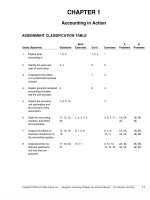
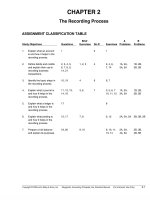
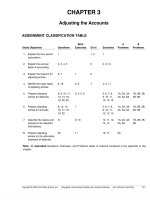
Solution manual accounting principles 8e by kieso ch10
Bạn đang xem bản rút gọn của tài liệu. Xem và tải ngay bản đầy đủ của tài liệu tại đây (257.44 KB, 58 trang )
CHAPTER 10
Plant Assets, Natural Resources,
and Intangible Assets
ASSIGNMENT CLASSIFICATION TABLE
Study Objectives
Questions
Brief
Exercises
Exercises
A
Problems
B
Problems
1.
Describe how the cost principle
applies to plant assets.
1, 2, 3
1, 2
1, 2, 3
1A
1B
2.
Explain the concept of
depreciation.
4, 5
3.
Compute periodic depreciation
using different methods.
6, 7, 22
3, 4, 5, 6
5, 6, 7
2A, 3A,
4A, 5A
2B, 3B,
4B, 5B
4.
Describe the procedure for
revising periodic depreciation.
8
7
8
4A
4B
5.
Distinguish between revenue
and capital expenditures, and
explain the entries for each.
9, 24
8
6.
Explain how to account for
the disposal of a plant asset.
10, 11
9, 10
9, 10
5A, 6A
5B, 6B
7.
Compute periodic depletion
of natural resources.
12, 13
11
11
8.
Explain the basic issues
related to accounting for
intangible assets.
14, 15, 16,
17, 18, 19
12
12, 13
7A, 8A
7B, 8B
4
10-1
ASSIGNMENT CLASSIFICATION TABLE (Continued)
Study Objectives
9. Indicate how plant assets,
natural resources, and
intangible assets are
reported.
*10. Explain how to account
for the exchange of plant
assets.
Questions
Brief
Exercises
Exercises
A
Problems
B
Problems
20, 21, 23
13, 14
14
5A, 7A, 9A
5B, 7B, 9B
25, 26
15, 16
15, 16
10-2
ASSIGNMENT CHARACTERISTICS TABLE
Problem
Number
Description
Difficulty
Level
Time
Allotted (min.)
1A
Determine acquisition costs of land and building.
Simple
20–30
2A
Compute depreciation under different methods.
Simple
30–40
3A
Compute depreciation under different methods.
Moderate
30–40
4A
Calculate revisions to depreciation expense.
Moderate
20–30
5A
Journalize a series of equipment transactions related to
purchase, sale, retirement, and depreciation.
Moderate
40–50
6A
Record disposals.
Simple
30–40
7A
Prepare entries to record transactions related to acquisition
and amortization of intangibles; prepare the intangible
assets section.
Moderate
30–40
8A
Prepare entries to correct errors made in recording and
amortizing intangible assets.
Moderate
30–40
9A
Calculate and comment on asset turnover ratio.
Moderate
5–10
1B
Determine acquisition costs of land and building.
Simple
20–30
2B
Compute depreciation under different methods.
Simple
30–40
3B
Compute depreciation under different methods.
Moderate
30–40
4B
Calculate revisions to depreciation expense.
Moderate
20–30
5B
Journalize a series of equipment transactions related to
purchase, sale, retirement, and depreciation.
Moderate
40–50
6B
Record disposals.
Simple
30–40
7B
Prepare entries to record transactions related to acquisition
and amortization of intangibles; prepare the intangible
assets section.
Moderate
30–40
8B
Prepare entries to correct errors made in recording and
amortizing intangible assets.
Moderate
30–40
9B
Calculate and comment on asset turnover ratio.
Moderate
5–10
10-3
10-4
Q10-21
Q10-23
9. Indicate how plant assets, natural
resources, and intangible assets
are reported.
Broadening Your Perspective
BE10-15
BE10-16
E10-15
E10-16
BE10-13 Q10-20 P10-5B P10-9A
BE10-14 P10-5A P10-7B P10-9B
E10-14 P10-7A
Q10-17 BE10-12 P10-7A P10-8B
Q10-19 E10-12 P10-8A
E10-13 P10-7B
BE10-11
E10-11
BE10-7
E10-8
P10-5A P10-3A
P10-2B P10-3B
P10-4B
P10-5B
BE10-9 E10-10 P10-5B
BE10-10 P10-5A P10-6B
P10-6A
E10-9
E10-6
E10-7
P10-2A
P10-4A
E10-2
E10-3
Analysis
Communication
Decision Making Across Financial Reporting
Exploring the Web the Organization
Comp. Analysis
Q10-26
Q10-14
Q10-15
Q10-16
8. Explain the basic issues related Q10-18
to accounting for intangible assets.
Q10-25
Q10-13
Q10-12
7. Compute periodic depletion of
natural resources.
*10. Explain how to account for the
exchange of plant assets.
Q10-11
BE10-8
Q10-9
Q10-24
5. Distinguish between revenue and
capital expenditures, and explain
the entries for each.
Q10-10
P10-4A
P10-4B
Q10-8
4. Describe the procedure for
revising periodic depreciation.
6. Explain how to account for the
disposal of a plant asset.
BE10-3
BE10-5
BE10-6
E10-5
Q10-4
E10-4
E10-1 BE10-1
P10-1A BE10-2
P10-1B
Application
Q10-6
Q10-7
Q10-22
Q10-5
Q10-1
Q10-2
Q10-3
Knowledge Comprehension
3. Compute periodic depreciation
using different methods.
2. Explain the concept of
depreciation.
1. Describe how the cost principle
applies to plant assets.
Study Objective
Synthesis
Decision Making
Across the
Organization
Ethics Case
Comp. Analysis
All About You
BE10-4
Evaluation
Correlation Chart between Bloom’s Taxonomy, Study Objectives and End-of-Chapter Exercises and Problems
BLOOM’S TAXONOMY TABLE
ANSWERS TO QUESTIONS
1.
For plant assets, the cost principle means that cost consists of all expenditures necessary to acquire
the asset and make it ready for its intended use.
2.
Examples of land improvements include driveways, parking lots, fences, and underground sprinklers.
3.
(a) When only the land is to be used, all demolition and removal costs of the building less any
proceeds from salvaged materials are necessary expenditures to make the land ready for its
intended use.
(b) When both the land and building are to be used, necessary costs of the building include
remodeling expenditures and the cost of replacing or repairing the roofs, floors, wiring, and
plumbing.
4.
You should explain to the president that depreciation is a process of allocating the cost of a plant
asset to expense over its service (useful) life in a rational and systematic manner. Recognition of
depreciation is not intended to result in the accumulation of cash for replacement of the asset.
5.
(a) Salvage value, also called residual value, is the expected value of the asset at the end of its
useful life.
(b) Salvage value is used in determining depreciation in each of the methods except the decliningbalance method.
6.
(a) Useful life is expressed in years under the straight-line method and in units of activity under
the units-of-activity method.
(b) The pattern of periodic depreciation expense over useful life is constant under the straight-line
method and variable under the units-of-activity method.
7.
The effects of the three methods on annual depreciation expense are: Straight-line—constant
amount; units of activity—varying amount; declining-balance—decreasing amounts.
8.
A revision of depreciation is made in current and future years but not retroactively. The rationale
is that continual restatement of prior periods would adversely affect confidence in the financial
statements.
9.
Revenue expenditures are ordinary repairs made to maintain the operating efficiency and productive
life of the asset. Capital expenditures are additions and improvements made to increase operating
efficiency, productive capacity, or useful life of the asset. Revenue expenditures are recognized
as expenses when incurred; capital expenditures are generally debited to the plant asset affected.
10.
In a sale of plant assets, the book value of the asset is compared to the proceeds received from the
sale. If the proceeds of the sale exceed the book value of the plant asset, a gain on disposal occurs. If
the proceeds of the sale are less than the book value of the plant asset sold, a loss on disposal occurs.
11.
The plant asset and its accumulated depreciation should continue to be reported on the balance
sheet without further depreciation adjustment until the asset is retired. Reporting the asset and
related accumulated depreciation on the balance sheet informs the reader of the financial statements
that the asset is still in use. However, once an asset is fully depreciated, even if it is still being
used, no additional depreciation should be taken. In no situation can the accumulated depreciation on
the plant asset exceed its cost.
10-5
Questions Chapter 10 (Continued)
12.
Natural resources consist of underground deposits of oil, gas, and minerals, and standing timber.
These long-lived productive assets have two distinguishing characteristics: they are physically
extracted in operations, and they are replaceable only by an act of nature.
13.
Depletion is the allocation of the cost of natural resources to expense in a rational and systematic
manner over the resource’s useful life. It is computed by multiplying the depletion cost per unit by
the number of units extracted and sold.
14.
The terms depreciation, depletion, and amortization are all concerned with allocating the cost of
an asset to expense over the periods benefited. Depreciation refers to allocating the cost of a
plant asset to expense, depletion to recognizing the cost of a natural resource as expense, and
amortization to allocating the cost of an intangible asset to expense.
15.
The intern is not correct. The cost of an intangible asset should be amortized over that asset’s
useful life (the period of time when operations are benefited by use of the asset). In addition,
some intangibles have indefinite lives and therefore are not amortized at all.
16.
The favorable attributes which could result in goodwill include exceptional management, desirable
location, good customer relations, skilled employees, high-quality products, and harmonious relations
with labor unions.
17.
Goodwill is the value of many favorable attributes that are intertwined in the business enterprise.
Goodwill can be identified only with the business as a whole and, unlike other assets, cannot be
sold separately. Goodwill can only be sold if the entire business is sold. And, if goodwill appears
on the balance sheet, it means the company has purchased another company for more than the
fair market value of its net assets.
18.
Goodwill is recorded only when there is a transaction that involves the purchase of an entire
business. Goodwill is the excess of cost over the fair market value of the net assets (assets less
liabilities) acquired. The recognition of goodwill without an exchange transaction would lead to
subjective valuations which would reduce the reliability of financial statements.
19.
Research and development costs present several accounting problems. It is sometimes difficult
to assign the costs to specific projects, and there are uncertainties in identifying the extent and
timing of future benefits. As a result, the FASB requires that research and development costs be
recorded as an expense when incurred.
20.
McDonald’s asset turnover ratio is computed as follows:
Net sales
Average total assets
=
$20.5 billion
= .71 times
$28.9 billion
10-6
Questions Chapter 10 (Continued)
21.
Since Resco uses the straight-line depreciation method, its depreciation expense will be lower in
the early years of an asset’s useful life as compared to using an accelerated method. Yapan’s
depreciation expense in the early years of an asset’s useful life will be higher as compared to
the straight-line method. Resco’s net income will be higher than Yapan’s in the first few years of
the asset’s useful life. And, the reverse will be true late in an asset’s useful life.
22.
Yes, the tax regulations of the IRS allow a company to use a different depreciation method on the
tax return than is used in preparing financial statements. Lopez Corporation uses an accelerated
depreciation method for tax purposes to minimize its income taxes and thereby the cash outflow
for taxes.
23.
By selecting a longer estimated useful life, May Corp. is spreading the plant asset’s cost over a
longer period of time. The depreciation expense reported in each period is lower and net income is
higher. Won’s choice of a shorter estimated useful life will result in higher depreciation expense
reported in each period and lower net income.
24.
Expensing these costs will make current period income lower but future period income higher because
there will be no additional depreciation expense in future periods. If the costs are ordinary repairs,
they should be expensed.
25.
When assets are exchanged, the gain or loss on disposal is computed as the difference between
the book value and the fair market value of the asset given up at the time of exchange.
26.
Yes, Tatum should recognize a gain equal to the difference between the fair market value of the
old machine and its book value. If the fair market value of the old machine is less than its book
value, Tatum should recognize a loss equal to the difference between the two amounts.
10-7
SOLUTIONS TO BRIEF EXERCISES
BRIEF EXERCISE 10-1
All of the expenditures should be included in the cost of the land. Therefore,
the cost of the land is $81,000, or ($70,000 + $3,000 + $2,500 + $2,000 + $3,500).
BRIEF EXERCISE 10-2
The cost of the truck is $31,900 (cash price $30,000 + sales tax $1,500 + painting
and lettering $400). The expenditures for insurance and motor vehicle license
should not be added to the cost of the truck.
BRIEF EXERCISE 10-3
Depreciable cost of $36,000, or ($42,000 – $6,000). With a four-year useful life,
annual depreciation is $9,000, or ($36,000 ÷ 4). Under the straight-line method,
depreciation is the same each year. Thus, depreciation is $9,000 for both the
first and second years.
BRIEF EXERCISE 10-4
It is likely that management requested this accounting treatment to boost
reported net income. Land is not depreciated; thus, by reporting land at
$120,000 above its actual value the company increased yearly income by
$120,000
or the reduction in depreciation expense. This practice is
$6,000,
20 years
not ethical because management is knowingly misstating asset values.
BRIEF EXERCISE 10-5
The declining balance rate is 50%, or (25% X 2) and this rate is applied to book
value at the beginning of the year. The computations are:
Book Value
Year 1
Year 2
$42,000
($42,000 – $21,000)
X
Rate
50%
50%
10-8
=
Depreciation
$21,000
$10,500
BRIEF EXERCISE 10-6
The depreciation cost per unit is 22 cents per mile computed as follows:
Depreciable cost ($33,500 – $500) ÷ 150,000 = $.22
Year 1
30,000 miles X $.22 = $6,600
Year 2
20,000 miles X $.22 = $4,400
BRIEF EXERCISE 10-7
Book value, 1/1/08.........................................................................................
Less: Salvage value ....................................................................................
Depreciable cost............................................................................................
Remaining useful life ...................................................................................
Revised annual depreciation ($18,000 ÷ 4)...........................................
$20,000
2,000
$18,000
4 years
$ 4,500
BRIEF EXERCISE 10-8
1.
2.
Repair Expense ....................................................................
Cash ................................................................................
45
Delivery Truck.......................................................................
Cash ................................................................................
400
45
400
BRIEF EXERCISE 10-9
(a) Accumulated Depreciation—Delivery
Equipment..........................................................................
Delivery Equipment ....................................................
41,000
(b) Accumulated Depreciation—Delivery
Equipment..........................................................................
Loss on Disposal..................................................................
Delivery Equipment ....................................................
39,000
2,000
10-9
41,000
41,000
BRIEF EXERCISE 10-9 (Continued)
Cost of delivery equipment
Less accumulated depreciation
Book value at date of disposal
Proceeds from sale
Loss on disposal
$41,000
39,000
2,000
0
$ 2,000
BRIEF EXERCISE 10-10
(a) Depreciation Expense—Office Equipment..................
Accumulated Depreciation—Office
Equipment ................................................................
5,250
(b) Cash .........................................................................................
Accumulated Depreciation—Office Equipment.........
Loss on Disposal .................................................................
Office Equipment ........................................................
20,000
47,250
4,750
Cost of office equipment
Less accumulated depreciation
Book value at date of disposal
Proceeds from sale
Loss on disposal
5,250
72,000
$72,000
47,250*
24,750
20,000
$ 4,750
*$42,000 + $5,250
BRIEF EXERCISE 10-11
(a) Depletion cost per unit = $7,000,000 ÷ 35,000,000 = $.20 depletion cost
per ton
$.20 X 6,000,000 = $1,200,000
Depletion Expense ..............................................
Accumulated Depletion ............................
1,200,000
(b) Ore mine ................................................................
Less: Accumulated depletion........................
$7,000,000
1,200,000
10-10
1,200,000
$5,800,000
BRIEF EXERCISE 10-12
(a) Amortization Expense—Patent ($120,000 ÷ 10) ..........
Patents.............................................................................
12,000
12,000
(b) Intangible Assets
Patents.............................................................................
$108,000
BRIEF EXERCISE 10-13
SPAIN COMPANY
Balance Sheet (partial)
December 31, 2008
Property, plant, and equipment
Coal mine ..................................................
Less: Accumulated depletion ...........
Buildings ...................................................
Less: Accumulated depreciation.....
Total property, plant, and
equipment ...................................
Intangible assets
Goodwill ....................................................
$ 500,000
108,000
1,100,000
650,000
$392,000
450,000
$842,000
410,000
BRIEF EXERCISE 10-14
$32.2 + $35.0
$51.2 ÷
= 1.52 times
2
BRIEF EXERCISE 10-15
Delivery Equipment (new) .........................................................
Accumulated Depreciation—Delivery Equipment.............
Loss on Disposal .........................................................................
Delivery Equipment (old) ..................................................
Cash.........................................................................................
10-11
24,000
30,000
12,000
61,000
5,000
BRIEF EXERCISE 10-15 (Continued)
Fair market value of old delivery
equipment
Cash
Cost of delivery equipment
$19,000
5,000
$24,000
Fair market value of old delivery
equipment
Book value of old delivery
equipment ($61,000 – $30,000)
Loss on disposal
$19,000
31,000
$12,000
BRIEF EXERCISE 10-16
Delivery Equipment (new)..........................................................
Accumulated Depreciation—Delivery Equipment .............
Gain on Disposal .................................................................
Delivery Equipment (old) ..................................................
Cash .........................................................................................
Fair market value of old delivery
equipment
Cash
Cost of new delivery equipment
Fair market value of old delivery
equipment
Book value of old delivery
equipment ($61,000 – $30,000)
Gain on disposal
10-12
$38,000
5,000
$43,000
$38,000
31,000
$ 7,000
43,000
30,000
7,000
61,000
5,000
SOLUTIONS TO EXERCISES
EXERCISE 10-1
(a) Under the cost principle, the acquisition cost for a plant asset includes
all expenditures necessary to acquire the asset and make it ready for its
intended use. For example, the cost of factory machinery includes the
purchase price, freight costs paid by the purchaser, insurance costs
during transit, and installation costs.
(b) 1.
2.
3.
4.
5.
6.
7.
8.
Land
Factory Machinery
Delivery Equipment
Land Improvements
Delivery Equipment
Factory Machinery
Prepaid Insurance
License Expense
EXERCISE 10-2
1.
2.
3.
4.
5.
6.
7.
8.
9.
Factory Machinery
Truck
Factory Machinery
Land
Prepaid Insurance
Land Improvements
Land Improvements
Land
Building
10-13
EXERCISE 10-3
(a) Cost of land
Cash paid........................................................................................
Net cost of removing warehouse ...........................................
($8,600 – $1,700)
Attorney’s fee................................................................................
Real estate broker’s fee.............................................................
Total.........................................................................................
$80,000
6,900
1,100
5,000
$93,000
(b) The architect’s fee ($7,800) should be debited to the Building account.
The cost of the driveways and parking lot ($14,000) should be debited
to Land Improvements.
EXERCISE 10-4
1. False. Depreciation is a process of cost allocation, not asset valuation.
2. True.
3. False. The book value of a plant asset may be quite different from its
market value.
4. False. Depreciation applies to three classes of plant assets: land improvements, buildings, and equipment.
5. False. Depreciation does not apply to land because its usefulness and
revenue-producing ability generally remain intact over time.
6. True.
7. False. Recognizing depreciation on an asset does not result in an accumulation of cash for replacement of the asset.
8. True.
9. False. Depreciation expense is reported on the income statement, and
accumulated depreciation is reported as a deduction from plant assets on
the balance sheet.
10. False. Three factors affect the computation of depreciation: cost, useful
life, and salvage value (also called residual value).
10-14
EXERCISE 10-5
(a) Depreciation cost per unit is $1.60 per mile
[($168,000 – $8,000) ÷ 100,000].
(b)
Computation
Year
2008
2009
2010
2011
End of Year
Annual
Units of Depreciation Depreciation
Activity X Cost /Unit = Expense
26,000
$1.60
$41,600
32,000
1.60
51,200
25,000
1.60
40,000
17,000
1.60
27,200
Accumulated
Book
Depreciation
Value
$ 41,600
$126,400
92,800
75,200
132,800
35,200
160,000
8,000
EXERCISE 10-6
(a) Straight-line method:
$120,000 – $12,000
= $21,600 per year.
5
2008 depreciation = $21,600 X 3/12 = $5,400.
(b) Units-of-activity method:
$120,000 – $12,000
= $10.80 per hour.
10,000
2008 depreciation = 1,700 hours X $10.80 = $18,360.
(c) Declining-balance method:
2008 depreciation = $120,000 X 40% X 3/12 = $12,000.
Book value January 1, 2009 = $120,000 – $12,000 = $108,000.
2009 depreciation = $108,000 X 40% = $43,200.
10-15
EXERCISE 10-7
(a) (1)
2008: ($30,000 – $2,000)/8 = $3,500
2009: ($30,000 – $2,000)/8 = $3,500
(2)
($30,000 – $2,000)/100,000 = $0.28 per mile
2008: 15,000 X $0.28 = $4,200
2009: 12,000 X $0.28 = $3,360
(3)
2008: $30,000 X 25% = $7,500
2009: ($30,000 – $7,500) X 25% = $5,625
(b) (1)
(2)
Depreciation Expense ..................................................
Accumulated Depreciation—Delivery Truck........
3,500
3,500
Delivery Truck.................................................................
Less: Accumulated Depreciation .............................
$30,000
(3,500)
$26,500
EXERCISE 10-8
(a) Type of Asset
Book value, 1/1/08
Less: Salvage value
Depreciable cost
Building
Warehouse
$686,000
37,000
$649,000
$75,000
3,600
$71,400
44
15
$ 14,750
$ 4,760
Revised useful life in years
Revised annual depreciation
(b) Dec. 31
Depreciation Expense—Building...............
Accumulated Depreciation—
Building.................................................
10-16
14,750
14,750
EXERCISE 10-9
Jan.
1
June 30
30
Dec. 31
31
Accumulated Depreciation—Machinery........
Machinery .......................................................
62,000
Depreciation Expense .........................................
Accumulated Depreciation—
Computer ($40,000 X 1/5 X 6/12).........
4,000
Cash...........................................................................
Accumulated Depreciation—Computer.........
($40,000 X 3/5 = $24,000; $24,000 + $4,000)
Gain on Disposal ..........................................
[$14,000 – ($40,000 – $28,000)]
Computer ........................................................
14,000
28,000
Depreciation Expense .........................................
Accumulated Depreciation—Truck ........
[($39,000 – $3,000) X 1/6]
6,000
Loss on Disposal ..................................................
Accumulated Depreciation—Truck .................
[($39,000 – $3,000) X 5/6]
Delivery Truck ...............................................
9,000
30,000
62,000
4,000
2,000
40,000
6,000
39,000
EXERCISE 10-10
(a)
(b)
Cash......................................................................................
Accumulated Depreciation—Equipment ..................
[($50,000 – $5,000) X 3/5]
Equipment.................................................................
Gain on Disposal ....................................................
28,000
27,000
Depreciation Expense.....................................................
[($50,000 – $5,000) X 1/5 X 4/12]
Accumulated Depreciation—Equipment........
3,000
Cash......................................................................................
Accumulated Depreciation—Equipment ..................
($27,000 + $3,000)
Equipment................................................................
Gain on Disposal ...................................................
28,000
30,000
10-17
50,000
5,000
3,000
50,000
8,000
EXERCISE 10-10 (Continued)
(c)
Cash.........................................................................................
Accumulated Depreciation—Equipment .....................
Loss on Disposal.................................................................
Equipment .....................................................................
11,000
27,000
12,000
(d) Depreciation Expense........................................................
[($50,000 – $5,000) X 1/5 X 9/12]
Accumulated Depreciation—Equipment .............
6,750
Cash.........................................................................................
Accumulated Depreciation—Equipment .....................
($27,000 + $6,750)
Loss on Disposal.................................................................
Equipment .....................................................................
11,000
33,750
50,000
6,750
5,250
50,000
EXERCISE 10-11
(a) Dec. 31
Depletion Expense..........................................
Accumulated Depletion........................
(100,000 X $.90)
Cost
Units estimated
Depletion cost per unit [(a) ÷ (b)]
90,000
90,000
(a) $720,000
(b) 800,000 tons
$0.90
(b) The costs pertaining to the unsold units are reported in current assets as
part of inventory (20,000 X $.90 = $18,000).
EXERCISE 10-12
Dec. 31
Amortization Expense—Patent .......................
Patents ($90,000 X 1/5 X 8/12).................
12,000
12,000
Note: No entry is made to amortize goodwill because it has an indefinite life.
10-18
EXERCISE 10-13
1/2/08
Patents ....................................................................
Cash ................................................................
560,000
Goodwill..................................................................
Cash ................................................................
(Part of the entry to record
purchase of another company)
360,000
Franchise................................................................
Cash ................................................................
440,000
Research and Development Expense...........
Cash ................................................................
185,000
12/31/08 Amortization Expense—Patent .......................
($560,000 ÷ 7)
Amortization Expense—Franchise ................
[($440,000 ÷ 10) X 1/2]
Patents.......................................................
Franchise ..................................................
80,000
4/1/08
7/1/08
9/1/08
Ending balances, 12/31/08:
Patent = $480,000 ($560,000 – $80,000).
Goodwill = $360,000
Franchise = $418,000 ($440,000 – $22,000).
R&D expense = $185,000
EXERCISE 10-14
Asset turnover ratio =
$4,900,000
= 3.5 times
$1,400,000
10-19
560,000
360,000
440,000
185,000
22,000
80,000
22,000
*EXERCISE 10-15
(a) Trucks (new)..........................................................................
Accumulated Depreciation—Trucks (old) ...................
Loss on Disposal .................................................................
Trucks (old)...................................................................
Cash ................................................................................
Cost of old trucks
Less: Accumulated depreciation
Book value
Fair market value of old trucks
Loss on disposal
$64,000
22,000
42,000
36,000
$ 6,000
Fair market value of old trucks
Cash paid
Cost of new trucks
$36,000
17,000
$53,000
(b) Machine (new).......................................................................
Accumulated Depreciation—Machine (old) ................
Gain on Disposal ........................................................
Machine (old)................................................................
Cash ................................................................................
Cost of old machine
Less: Accumulated depreciation
Book value
Fair market value of old
machine
Gain on disposal
Fair market value of old
machine
Cash paid
Cost of new machine
$12,000
4,000
8,000
9,000
$ 1,000
$ 9,000
3,000
$12,000
10-20
53,000
22,000
6,000
64,000
17,000
12,000
4,000
1,000
12,000
3,000
*EXERCISE 10-16
(a) Delivery Truck (new) ..........................................................
Loss on Disposal.................................................................
Accumulated Depreciation—Delivery
Truck (old).........................................................................
Delivery Truck (old) ...................................................
Cost of old truck
Less: Accumulated depreciation
Book value
Fair market value of old truck
Loss on disposal
Cost of old truck
Less: Accumulated depreciation
Book value
Fair market value of old truck
Gain on Disposal
$10,000
8,000
2,000
4,000
$ 2,000
Cost of new delivery truck*
$ 4,000
10-21
15,000
22,000
$22,000
15,000
7,000
4,000
$ 3,000
(b) Delivery Truck (new) ..........................................................
Accumulated Depreciation—Delivery
Trucks (old).......................................................................
Delivery Truck (old) ...................................................
Gain on Disposal ........................................................
*Fair value of old truck
4,000
3,000
4,000
8,000
10,000
2,000
SOLUTIONS TO PROBLEMS
PROBLEM 10-1A
Item
1
2
3
4
5
6
7
8
9
10
Land
($
Building
Other Accounts
4,000)
$700,000
$ 5,000
Property Taxes Expense
( 145,000)
35,000
10,000
(
2,000)
14,000
(
15,000)
(3,500)
($162,500)
$745,000
10-22
Land Improvements
PROBLEM 10-2A
(a)
Year
Computation
Cumulative
12/31
2006
2007
2008
BUS 1
$ 90,000 X 20% = $18,000
$ 90,000 X 20% = $18,000
$ 90,000 X 20% = $18,000
$ 18,000
36,000
54,000
2006
2007
2008
BUS 2
$120,000 X 50% = $60,000
$ 60,000 X 50% = $30,000
$ 30,000 X 50% = $15,000
$ 60,000
90,000
105,000
2007
2008
BUS 3
24,000 miles X $.60* = $14,400
34,000 miles X $.60* = $20,400
$ 14,400
34,800
*$72,000 ÷ 120,000 miles = $.60 per mile.
(b)
Year
Computation
Expense
(1)
2006
BUS 2
$120,000 X 50% X 9/12 = $45,000
$45,000
(2)
2007
$75,000 X 50% = $37,500
$37,500
10-23
PROBLEM 10-3A
(a) (1) Purchase price..............................................................................
Sales tax .........................................................................................
Shipping costs..............................................................................
Insurance during shipping .......................................................
Installation and testing ..............................................................
Total cost of machinery....................................................
Machinery......................................................................
Cash .......................................................................
40,000
40,000
(2) Recorded cost...............................................................................
Less: Salvage value...................................................................
Depreciable cost ..........................................................................
Years of useful life.......................................................................
Annual depreciation...........................................................
Depreciation Expense ...............................................
Accumulated Depreciation .............................
Book Value
at Beginning
of Year
$160,000
80,000
40,000
20,000
DDB
Rate
*50%*
*50%*
*50%*
*50%*
Annual Depreciation
Expense
$80,000
40,000
20,000
** 10,000
**100% ÷ 4-year useful life = 25% X 2 = 50%.
10-24
$ 40,000
5,000
$ 35,000
÷
5
$ 7,000
7,000
7,000
(b) (1) Recorded cost...............................................................................
Less: Salvage value...................................................................
Depreciable cost ..........................................................................
Years of useful life.......................................................................
Annual depreciation...........................................................
(2)
$ 38,000
1,700
150
80
70
$ 40,000
160,000
10,000
$150,000
÷
4
$ 37,500
Accumulated
Depreciation
$ 80,000
120,000
140,000
150,000
PROBLEM 10-3A (Continued)
(3) Depreciation cost per unit = ($160,000 – $10,000)/125,000 units = $1.20
per unit.
Annual Depreciation Expense
2008: $1.20 X 45,000 = $54,000
2009: 1.20 X 35,000 = 42,000
2010: 1.20 X 25,000 = 30,000
2011: 1.20 X 20,000 = 24,000
(c) The declining-balance method reports the highest amount of depreciation
expense the first year while the straight-line method reports the lowest.
In the fourth year, the straight-line method reports the highest amount of
depreciation expense while the declining-balance method reports the
lowest.
These facts occur because the declining-balance method is an accelerated depreciation method in which the largest amount of depreciation
is recognized in the early years of the asset’s life. If the straight-line
method is used, the same amount of depreciation expense is recognized
each year. Therefore, in the early years less depreciation expense will be
recognized under this method than under the declining-balance method
while more will be recognized in the later years.
The amount of depreciation expense recognized using the units-of-activity
method is dependent on production, so this method could recognize more
or less depreciation expense than the other two methods in any year
depending on output.
No matter which of the three methods is used, the same total amount
of depreciation expense will be recognized over the four-year period.
10-25