Solution manual accounting principles 8e by kieso ch07
Bạn đang xem bản rút gọn của tài liệu. Xem và tải ngay bản đầy đủ của tài liệu tại đây (310.73 KB, 98 trang )
CHAPTER 7
Accounting Information Systems
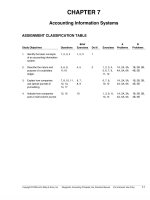
ASSIGNMENT CLASSIFICATION TABLE
Study Objectives
Questions
Brief
Exercises
A
Problems
B
Problems
1.
Identify the basic concepts
of an accounting information
system.
1, 2, 3, 4
1, 2, 3
2.
Describe the nature and
purpose of a subsidiary
ledger.
5, 6, 9,
11,16
4, 5
1, 2, 3, 4,
5, 6, 7, 9,
11, 12
1A, 2A, 3A,
4A, 5A, 6A
1B, 2B, 3B,
4B, 5B
3.
Explain how companies
use special journals in
journalizing.
7, 8, 10,
11, 12, 13,
14, 17
6, 7,
8, 9
6, 7, 8,
10, 12
1A, 2A, 3A,
4A, 5A, 6A
1B, 2B, 3B,
4B, 5B
4.
Indicate how companies
post a multi-column journal.
12, 15
10
1, 3, 9, 11,
13, 14
1A, 2A, 3A,
4A, 5A, 6A
1B, 2B, 3B,
4B, 5B
7-1
Exercises
ASSIGNMENT CHARACTERISTICS TABLE
Problem
Number
Description
Difficulty
Level
Time
Allotted (min.)
1A
Journalize transactions in cash receipts journal;
post to control account and subsidiary ledger.
Simple
30–40
2A
Journalize transactions in cash payments journal;
post to control account and subsidiary ledgers.
Simple
30–40
3A
Journalize transactions in multi-column purchases
journal; post to the general and subsidiary ledgers.
Moderate
40–50
4A
Journalize transactions in special journals.
Moderate
50–60
5A
Journalize in sales and cash receipts journals; post;
prepare a trial balance; prove control to subsidiary;
prepare adjusting entries; prepare an adjusted
trial balance.
Moderate
60–70
6A
Journalize in special journals; post; prepare
a trial balance.
Complex
60–70
1B
Journalize transactions in cash receipts journal;
post to control account and subsidiary ledger.
Simple
30–40
2B
Journalize transactions in cash payments journal;
post to the general and subsidiary ledgers.
Simple
30–40
3B
Journalize transactions in multi-column purchases
journal; post to the general and subsidiary ledgers.
Moderate
40–50
4B
Journalize transactions in special journals.
Moderate
50–60
5B
Journalize in purchases and cash payments journals;
post; prepare a trial balance; prove control to subsidiary;
prepare adjusting entries; prepare an adjusted trial
balance.
Moderate
60–70
7-2
7-3
Describe the nature and purpose
of a subsidiary ledger.
Explain how companies use
special journals in journalizing.
Indicate how companies post
a multi-column journal.
2.
3.
4.
Broadening Your Perspective
Identify the basic concepts
of an accounting information
system.
1.
Study Objective
Q7-5
Knowledge
E7-1
E7-3
E7-4
E7-5
E7-6
E7-7
E7-9
P7-2A
P7-3A
P7-4A
P7-5A
P7-6A
P7-1B
P7-2B
P7-3B
P7-4B
P7-5B
Financial Reporting
(Mini Practice Set)
E7-1
E7-3
E7-9
E7-13
E7-14
P7-1A
P7-6A Q7-11
P7-1B
P7-2B
P7-3B
P7-4B
P7-5B
Analysis
P7-4A P7-5BQ7-11
P7-5A
P7-6A
P7-1B
P7-2B
P7-3B
P7-4B
E7-11
E7-12
P7-1A
P7-2A
P7-3A
P7-4A
P7-5A
Application
BE7-6 E7-6
BE7-7 E7-7
BE7-8 E7-10
BE7-9 E7-12
E7-8 P7-1A
E7-10 P7-2A
P7-3A
BE7-1
BE7-2
BE7-3
Exploring the Web
Q7-12
Q7-15
BE7-10
E7-11
Q7-7
Q7-8
Q7-10
Q7-12
Q7-13
Q7-14
Q7-17
Q7-6
Q7-9
Q7-16
BE7-4
BE7-5
E7-2
E7-11
Q7-1
Q7-2
Q7-3
Q7-4
Comprehension
Synthesis
Decision Making
Across the
Organization
Communication
Ethics Case
All About You
Evaluation
Correlation Chart between Bloom’s Taxonomy, Study Objectives and End-of-Chapter Exercises and Problems
BLOOM’S TAXONOMY TABLE
ANSWERS TO QUESTIONS
1.
(a) An accounting information system collects and processes transaction data and communicates
financial information to decision makers.
(b) Disagree. An accounting information system applies regardless of whether manual or computerized procedures are used to process the transaction data.
2.
There are three principles for developing an accounting information system:
Cost effectiveness. The system must be cost-effective; that is, the benefits obtained from the
information must outweigh the cost of providing it.
Useful output. To be useful, information must be understandable, relevant, reliable, timely, and
accurate.
Flexibility. The system should accommodate a variety of users and changing information needs.
3.
Common features of a computerizied accounting package beyond recording transactions and
preparing financial statements are: easy data access and report preparation; audit trail, internal
controls, customization; and network compatibility.
4.
ERP systems go far beyond the functions of an entry level general ledger package. They integrate
all aspects of the organization, including accounting, sales, human resource management, and
manufacturing.
5.
A subsidiary ledger is a group of accounts with a common characteristic. The accounts are assembled
together to facilitate the accounting process by freeing the general ledger from details concerning
individual balances. The advantages of using subsidiary ledgers are that they:
Permit transactions affecting a single customer or single creditor to be shown in a single
account, thus providing necessary up-to-date information on specific account balances.
Free the general ledger of excessive details relating to accounts receivable and accounts
payable. As a result, a trial balance of the general ledger does not contain potentially thousands
and thousands of individual account balances.
Assist in locating errors in individual accounts by reducing the number of accounts in one ledger
and by using control accounts.
Permit a division of labor in posting by having one employee post to the general ledger and
(a) different employee(s) post to the subsidiary ledgers.
6.
(a) (1) Transactions to individual accounts are generally posted daily to the subsidiary ledger.
(2) In contrast, postings to the control accounts are usually made in total at the end of the month.
(b) A control account is a general ledger account that summarizes subsidiary ledger data. Subsidiary
ledger accounts keep track of specific account activity (i.e., specific debtors or creditors).
A subsidiary ledger is an addition to, and an expansion of, the general ledger.
7-4
Questions Chapter 7 (Continued)
7.
Sales journal. Records entries for all sales of merchandise on account.
Cash receipts journal. Records entries for all cash received by the business.
Purchases journal. Records entries for all purchases of merchandise on account.
Cash payments journal. Records entries for all cash paid.
Some advantages of each journal are given below:
Sales journal. (1) Since the sales journal employs only one line to record a Sales transaction,
its use reduces recording time; (2) the column totals are only posted to the general ledger
once an accounting period; and (3) the journal’s use separates responsibilities between
employees.
Cash receipts journal. (1) Its use aids in the posting process since the totals for Cash, Sales
Discounts, Accounts Receivable, and Sales are all recorded in the general ledger only at
the end of the month; and (2) it allows all accounts receivable credits to be posted to the
appropriate subsidiary ledger accounts daily.
Purchases journal. The advantages are similar to those of the sales journal except that
items involved are Merchandise Inventory debits and Accounts Payable credits.
Cash payments journal. Similar advantages to cash receipts journal except the columns
involved are different.
In general, special journals: (1) allow greater division of labor because various individuals can
record entries in different journals at the same time; and (2) reduce posting time of journals.
8.
The entry for the sales return should be recorded in the general journal. Since Thogmartin
Company has a single-column sales journal, only credit sales can be recorded there. A purchase
by Thogmartin Company has not taken place, so the use of the purchases journal is inappropriate.
Finally, no cash is received or paid, so neither the cash receipts or cash payments journal should
be used.
9.
At the end of the month, after all postings to both the general ledger and the subsidiary accounts
have been made, the total of the subsidiary account balances should equal the balance of the
control account in the general ledger. In this case, the control account balance will be $450 larger
than the total of the subsidiary accounts.
10.
The purpose of special journals is to facilitate the recording process of the business entity. Therefore,
the columns included in any special journal should correspond to the unique needs of the entity.
In particular, one type of business which might not require an Accounts Receivable column would
be grocery stores. These businesses rarely sell on credit to their customers. The minimum
frequency of the transaction implies no need for an Accounts Receivable column in the cash
receipts journal.
11.
(a) No, the customers’ ledger will not agree with the Accounts Receivable control account. The
customers’ ledger will be posted correctly, but the Accounts Receivable control account will
be incorrect.
(b) The trial balance will balance, although Cash will be $4,000 too high and Accounts Receivable
$4,000 too low.
12.
The special journal is the sales journal. The other account is Sales. (The cash receipts journal is
an incorrect answer because there would be more than two month-end postings to general ledger
accounts.)
7-5
Questions Chapter 7 (Continued)
13.
(a) General journal.
(b) General journal.
(c) Cash receipts journal.
(d) Sales journal.
(e) Cash receipts journal.
(f) General journal.
14.
(a) Cash receipts journal.
(b) Cash receipts journal.
(c) General journal.
(d) Purchases journal.
(e) General journal.
(f) Cash payments journal.
15.
Typically included would be credit purchases of equipment, office supplies, and store supplies.
However, any other item purchased on credit could also be included in a special column or the
“other” column.
16.
One such example is a purchase return. Here the Accounts Payable control and subsidiary account
must be debited for the same amount. The debit/credit equality is unaffected since the balance
sheet equation is computed using general ledger (control) accounts only. The subsidiary accounts
should prove to the control account balance.
17.
The general journal may be used to record such transactions as the granting of credit to a
customer for a sales return or allowance, the receipt of credit from a supplier for purchases
returned, acceptance of a note receivable from a customer, or the purchase of a plant asset by
issuing a note payable. In addition, all correcting, adjusting, and closing entries should be made
in the general journal.
7-6
SOLUTIONS TO BRIEF EXERCISES
BRIEF EXERCISE 7-1
1.
2.
3.
True.
False.
True.
BRIEF EXERCISE 7-2
1.
2.
3.
(e)
(d)
(a)
4. (b)
5. (c)
BRIEF EXERCISE 7-3
1.
2.
3.
4.
True.
False. The benefits obtained from information provided by the accounting
information system must outweigh the cost of providing that information.
True.
False. An accounting information system must be cost effective, provide useful output, and be flexible enough to accommodate changing
information needs.
BRIEF EXERCISE 7-4
Accounts Receivable Subsidiary Ledger
Date
Jan. 7
17
Date
Jan. 15
24
Date
Jan. 23
29
Ref.
Ref.
Ref.
General Ledger
Agler Co.
Debit Credit
10,000
7,000
Balance Date
10,000 Jan. 31
3,000
31
Barto Co.
Debit Credit
6,000
4,000
Balance
6,000
2,000
Maris Co.
Debit Credit
9,000
9,000
Balance
9,000
0
7-7
Accounts Receivable
Ref.
Debit
Credit
25,000
20,000
Balance
25,000
5,000
BRIEF EXERCISE 7-5
1.
2.
General ledger
Subsidiary ledger
3. General ledger
4. Subsidiary ledger
BRIEF EXERCISE 7-6
1.
2.
3.
Cash Receipts Journal
Cash Payments Journal
Cash Payments Journal
4. Sales Journal
5. Purchases Journal
6. Cash Receipts Journal
BRIEF EXERCISE 7-7
1.
2.
No
Yes
3. Yes
4. No
BRIEF EXERCISE 7-8
1.
2.
3.
4.
General Journal (if a one-column Purchases Journal)
Purchases Journal (if a multi-column Purchases Journal)
Purchases Journal
Cash Payments Journal
Sales Journal
BRIEF EXERCISE 7-9
1.
2.
3.
4.
5.
Cash Receipts Journal
Cash Receipts Journal
Cash Receipts Journal
Sales Journal and Cash Receipts Journal
Purchases Journal
BRIEF EXERCISE 7-10
1.
2.
Both in total and daily
In total
3. In total
4. Only daily
7-8
SOLUTIONS TO EXERCISES
EXERCISE 7-1
(a) $350,400. Beginning balance of $320,000 plus $161,400 debit from sales
journal less $131,000 credit from cash receipts journal.
(b) $85,900. Beginning balance of $77,000 plus $56,400 credit from purchases
journal less $47,500 debit from cash payments journal.
(c) The column total of $161,400 in the sales journal would be posted to
the credit side of the Sales account and the debit side of the Accounts
Receivable account in the general ledger.
(d) The accounts receivable column total of $131,000 in the cash receipts
journal would be posted to the credit side of the Accounts Receivable
account in the general ledger.
EXERCISE 7-2
To:
Andrea Barden, Chief Financial Officer
From:
Student
Subject:
Jeremy Dody account
The explanation of the three entries in the subsidiary ledger for the Jeremy
Dody account is as follows:
Sept. 2
This was a credit sale of merchandise to Dody. The entry was
recorded on page 31 of the Sales Journal.
Sept. 9
This was a sales return or allowance granted to Dody. The entry
was recorded on page 4 of the General Journal.
Sept. 27
This was a payment by Dody of the balance due. The entry was
recorded on page 8 of the Cash Receipts Journal.
If I can be of further help, please let me know.
7-9
EXERCISE 7-3
(a) & (b)
General Ledger
Accounts Receivable
Date
Explanation
Sept. 1 Balance
Ref.
Debit
S
CR
G
4,490
Credit
7,030
220
Balance
10,960
15,450
8,420
8,200
Accounts Receivable Subsidiary Ledger
Bannister
Date
Explanation
Sept. 1 Balance
Crampton
Date
Explanation
Sept. 1 Balance
Iman
Date
Sept. 1
Explanation
Kingston
Date
Explanation
Sept. 1 Balance
Ref.
Debit
S
CR
1,100
Ref.
Debit
S
CR
G
800
Ref.
Debit
S
CR
1,330
Ref.
Debit
CR
7-10
Credit
1,310
Credit
2,300
220
Credit
380
Credit
1,800
Balance
2,060
3,160
1,850
Balance
4,820
5,620
3,320
3,100
Balance
0
1,330
950
Balance
2,640
840
EXERCISE 7-3 (Continued)
Ruiz
Date
Sept. 1
Explanation
Balance
(c)
Ref.
Debit
S
CR
1,260
Credit
1,240
Balance
1,440
2,700
1,460
SEAVER COMPANY
Schedule of Customers
As of September 30, 2008
Bannister ..................................................................................................
Crampton..................................................................................................
Iman............................................................................................................
Kingston ...................................................................................................
Ruiz.............................................................................................................
Total...................................................................................................
$1,850
3,100
950
840
1,460
$8,200
Accounts Receivable............................................................................
$8,200
EXERCISE 7-4
(a)
(b)
(c)
(d)
$4,500 [$11,000 – ($4,000 + $2,500).
$13,000 [$11,000 + ($9,000 + $7,000 + $8,500) – ($8,000 + $2,500 + $9,000) – $3,000].
Smith
($4,000 + $9,000 – $8,000)
$ 5,000
Green
($2,500 + $7,000 – $2,500 – $3,000)
4,000
Koyan
($4,500 + $8,500 – $9,000)
4,000
$13,000
The sales return ($3,000) would be recorded in the general journal.
EXERCISE 7-5
(a)
(b)
(c)
(d)
$3,375 [$8,250 – ($3,000 + $1,875).
$9,750 [$8,250 + ($6,750 + $5,250 + $6,375) – ($6,000 + $1,875 + $6,750) – $2,250].
Jones
($3,000 + $6,750 – $6,000)
$3,750
Brown
($1,875 + $5,250 – $1,875 – $2,250)
3,000
Aatski
($3,375 + $6,375 – $6,750)
3,000
$9,750
The purchase return ($2,250) would be recorded in the general journal.
7-11
EXERCISE 7-6
(a) & (b)
MONTALVO COMPANY
Sales Journal
S1
Date
Account
Debited
2008
Sept. 2 T. Hossfeld
21 P. Lowther
Invoice
Accounts Receivable Dr. Cost of Goods Sold Dr.
No.
Ref.
Sales Cr.
Merchandise Inventory Cr.
101
102
720
800
1,520
420
480
900
MONTALVO COMPANY
Purchases Journal
Date
Account Credited
2008
Sept. 10
25
L. Rincon
W. Barone
Terms
Ref.
P1
Merchandise Inventory Dr.
Accounts Payable Cr.
2/10, n/30
n/30
600
860
1,460
EXERCISE 7-7
(a) & (b)
PHERIGO CO.
Cash Receipts Journal
CR1
Date
Account
Credited
2008
May 1 I. Pherigo, Cap.
2
22 M. Moody
Ref.
Cash
Dr.
50,000
6,300
9,000
65,300
Sales
Accounts
Discounts Receivable Sales
Dr.
Cr.
Cr.
Cost of Goods Sold
Other
Dr.
Accounts Merchandise Inventory
Cr.
Cr.
50,000
6,300
9,000
9,000
7-12
6,300
4,200
50,000
4,200
EXERCISE 7-7 (Continued)
PHERIGO CO.
Cash Payments Journal
CP1
Other
Accounts
Ref.
Dr.
Date
Ck.
No.
Account Debited
2008
May 3
14
101
102
Merchandise Inventory
Salary Expense
7,200
700
7,900
Accounts
Payable
Dr.
Cash
Cr.
7,200
700
7,900
EXERCISE 7-8
(a) Journal
1. Cash Payments
2. Cash Receipts
3. Cash Payments
4. Cash Payments
5.
6.
7.
8.
9.
10.
Cash Receipts
Cash Payments
Cash Payments
Cash Receipts
Cash Payments
Cash Receipts
(b) Columns in the journal
Cash (Cr.), Other Accounts (Dr.).
Cash (Dr.), Sales Discounts (Dr.), and
Accounts Receivable (Cr.).
Cash (Cr.), Other Accounts (Dr.).
Cash (Cr.), Merchandise Inventory (Cr.), and
Accounts Payable (Dr.).
Cash (Dr.), Accounts Receivable (Cr.).
Cash (Cr.), Other Accounts (Dr.).
Cash (Cr.), Other Accounts (Dr.).
Cash (Dr.), Other Accounts (Cr.).
Cash (Cr.), Other Accounts (Dr.).
Cash (Dr.), Sales (Cr.), Cost of Goods Sold (Dr.),
and Merchandise Inventory (Cr.).
7-13
EXERCISE 7-9
(a) Mar. 2
5
7
(b) To:
Equipment ...............................................................
Accounts Payable—Chang
Company ....................................................
9,400
Accounts Payable—Lyden
Company .............................................................
Merchandise Inventory...............................
9,400
410
410
Sales Returns and Allowances.........................
Accounts Receivable—Higley
Company ....................................................
400
Merchandise Inventory........................................
Cost of Goods Sold .....................................
260
400
260
President Velasquez
From:
Chief Accountant
Subject:
Posting of Control and Subsidiary Accounts
The posting of these accounts varies with the journals used in recording
the transactions.
Sales and purchases journals—the total for the month is posted to
the control accounts. The individual entries are posted daily to the
subsidiary accounts.
Columnar cash receipts and cash payments journals—the total of
the control account column for the month is posted to the control
account. The individual amounts in the column are posted daily to
the subsidiary accounts.
General journal—the individual entries are posted daily. Each entry
that pertains to a control and a subsidiary account is dual posted.
That is, it is posted to both the control account and the subsidiary
account.
I hope this memo answers your questions about posting.
7-14
EXERCISE 7-10
1.
2.
3.
4.
5.
6.
7.
Cash Payments Journal
General Journal
Cash Receipts Journal
Cash Receipts Journal
Sales Journal
Cash Receipts Journal
General Journal
8.
9.
10.
11.
12.
13.
Cash Receipts Journal
Cash Payments Journal
General Journal
General Journal
Cash Payments Journal
Purchases Journal
EXERCISE 7-11
(a) The debit posting reference on February 28 should be from the cash
payments journal to record the payments made during the month. The
general ledger debit amount should be $29,340 to balance. Tebbetts’
ending balance must be $2,600. (Accounts Payable control balance of
$9,500 less Perez, $4,600, and Zerbe, $2,300.)
(b) Only the general journal amounts were dual posted. Thus, the amounts
were $1,400 (Dr.), $265 (Cr.), and $550 (Cr.).
EXERCISE 7-12
(a)
Purchases Journal
Date
Account Credited
July 3
12
14
17
20
21
29
Brian Co.
Erik Co.
Drago Co.
Chacon Corp.
Brian Co.
Erik Co.
Chacon Corp.
Ref.
P1
Merchandise Inventory Dr.
Accounts Payable Cr.
2,400
500
1,100
1,400
700
600
1,600
8,300
120/201
7-15
EXERCISE 7-12 (Continued)
(b)
General Journal
Date
July
1
Accounts and Explanations
Store Equipment ...................................
Accounts Payable—Albin
Equipment Co. ........................
Ref.
153/
Debit
3,900
201/
Credit
3,900
15
Merchandise Inventory ....................... 120/
400
Accounts Payable—Heinen
Inc. .............................................. 201/
400
(This entry should have been recorded in the Purchases Journal.)
18
Accounts Payable—Chacon
Corp......................................................
Merchandise Inventory.............
201/
120/
100
Accounts Payable—Drago Co. ........
Merchandise Inventory.............
201/
120/
200
25
100
200
EXERCISE 7-13
$925 ($200 + $240 + $145 + $190 + $150). All of the debit postings to the subsidiary ledger accounts should be from sales invoices. The total of all these
debits should therefore be the total credit sales for the month, which would
be the same amount as the end-of-month debit to Accounts Receivable.
EXERCISE 7-14
(a)
(b)
(c)
(d)
(e)
$14,000 + $72,000 – $46,000 = $40,000
$22,000 + $100,000 – $45,000 = $77,000
$17,000 + $61,000 – $55,000 = $23,000
$13,500 + $72,000 – $1,000 – $63,600 = $20,900
$100,000 + $6,000 = $106,000
7-16
SOLUTIONS TO PROBLEMS
PROBLEM 7-1A
(a)
Cash Receipts Journal
CR1
Date
Account
Credited
Ref.
Apr. 1 O. Grider,
301
Capital
4 Baez
5 Eggleston Co.
8
10 Ogden
11 Merchandise
120
Inventory
23 Eggleston Co.
29 Chelsea
Cash
Dr.
7,200
1,764
920
7,245
600
740
1,500
1,200
21,169
(101)
(b)
Cost of Goods Sold
Sales
Accounts
Other
Dr.
Discounts Receivable Sales Accounts Merchandise Inventory
Dr.
Cr.
Cr.
Cr.
Cr.
7,200
36
1,800
920
7,245
4,347
600
740
36
(414)
1,500
1,200
6,020
(112)
7,245
(401)
7,940
(X)
4,347
(505)(120)
General Ledger
Accounts Receivable
Date
Explanation
Apr. 1 Balance
30
Ref.
Debit
CR1
Credit
6,020
No. 112
Balance
7,450
1,430
Accounts Receivable Subsidiary Ledger
Ogden
Date
Apr. 1
10
Explanation
Balance
Ref.
CR1
7-17
Debit
Credit
600
Balance
1,550
950
PROBLEM 7-1A (Continued)
Chelsea
Date
Apr. 1
29
Explanation
Balance
Debit
CR1
Eggleston Co.
Date
Explanation
Apr. 1 Balance
5
23
Baez
Date
Apr. 1
4
Ref.
Explanation
Balance
Ref.
1,200
Debit
CR1
CR1
Ref.
Credit
920
1,500
Debit
CR1
Credit
1,800
(c) Accounts receivable balance:
$1,430
Subsidiary account balances:
Ogden
Eggleston Co.
Total
$ 950
480
$1,430
7-18
Credit
Balance
1,200
0
Balance
2,900
1,980
480
Balance
1,800
0
PROBLEM 7-2A
(a)
Cash Payments Journal
CP1
Date
Ck.
No. Account Debited
Oct. 1
3
5
10
15
16
19
29
63
64
65
66
67
68
69
70
Merch. Inventory
Equipment
Bovary Company
Merch. Inventory
Pyron Co.
T. Ming, Drawing
Nyman Co.
Sims Company
Other
Accounts Merchandise
Accounts Payable
Inventory
Ref.
Dr.
Dr.
Cr.
120
157
300
800
120
2,250
306
400
2,700
1,800
3,750
(X)
(b)
54
1,600
2,500
8,600
(201)
32
86
(120)
Cash
Cr.
300
800
2,646
2,250
1,800
400
1,568
2,500
12,264
(101)
General Ledger
Accounts Payable
Date
Explanation
Oct. 1 Balance
31
Ref.
Debit
CP1
8,600
Credit
No. 201
Balance
10,700
2,100
Accounts Payable Subsidiary Ledger
Bovary Company
Date
Oct.
1
5
Explanation
Balance
Ref.
Debit
CP1
2,700
7-19
Credit
Balance
2,700
0
PROBLEM 7-2A (Continued)
Nyman Co.
Date
Explanation
Oct. 1 Balance
19
Pyron Co.
Date
Explanation
Oct. 1 Balance
15
Sims Company
Date
Explanation
Oct. 1 Balance
29
Ref.
Debit
CP1
1,600
Ref.
Debit
CP1
1,800
Ref.
Debit
CP1
2,500
(c) Accounts payable balance:
$2,100
Subsidiary account balances:
Nyman Co.
Sims Company
$ 900
1,200
$2,100
7-20
Credit
Balance
2,500
900
Credit
Balance
1,800
0
Credit
Balance
3,700
1,200
PROBLEM 7-3A
(a)
Purchases Journal
P1
Date
Account Credited (Debited)
July 1
2
5
13
Fritz Company
Wayward Shipping
Moon Company
Cress Supply
(Supplies)
Fritz Company
Anton Company
Lynda Advertisements
(Advertising Expense)
Moon Company
Cress Supply
(Equipment)
Wayward Shipping
15
15
18
24
26
28
Ref.
Accounts Merchandise
Other
Payable
Inventory
Accounts
Cr.
Dr.
Dr.
8,000
400
3,200
126/
8,000
400
3,200
720
3,600
3,300
610/
3,600
3,300
600
3,000
157/
3,000
900
380
24,100
(201)
380
21,880
(120)
720
600
900
2,220
(X)
Sales Journal
S1
Date
Account Debited
July 3
3
16
16
21
21
30
Pinick Company
Wayne Bros.
Sager Company
Wayne Bros.
Pinick Company
Haddad Company
Sager Company
Accounts Receivable Dr. Cost of Goods Sold Dr.
Ref.
Sales Cr.
Merchandise Inventory Cr.
1,300
1,500
3,450
1,570
310
2,800
5,600
16,530
(112)(401)
7-21
910
1,050
2,415
1,099
217
1,960
3,920
11,571
(505)(120)
PROBLEM 7-3A (Continued)
General Journal
Date
July
8
22
Accounts and Explanations
Ref.
Accounts Payable—Moon
Company............................................... 201/
Merchandise Inventory............... 120/
Debit
Sales Returns and Allowances
412/
Accounts Receivable—
112/
Pinick Company .......................
40
(b)
Accounts Receivable
Date
Explanation
July 31
22
Merchandise Inventory
Date
Explanation
July 31
8
31
Supplies
Date
Explanation
July 13
G1
Credit
300
300
40
General Ledger
Ref.
S1
G1
Ref.
P1
G1
S1
Ref.
P1
7-22
Debit
16,530
Credit
40
Debit
21,880
Credit
300
11,571
Debit
720
Credit
No. 112
Balance
16,530
16,490
No. 120
Balance
21,880
21,580
10,009
No. 126
Balance
720
PROBLEM 7-3A (Continued)
Equipment
Date
Explanation
July 26
Accounts Payable
Date
Explanation
July 31
8
Sales
Date
July 31
Explanation
Sales Returns and Allowances
Date
Explanation
July 22
Cost of Goods Sold
Date
Explanation
July 31
Advertising Expense
Date
Explanation
July 18
Ref.
P1
Ref.
P1
G1
Ref.
S1
Ref.
G1
Ref.
S1
Ref.
P1
7-23
Debit
900
Debit
Credit
No. 157
Balance
900
Credit
24,100
No. 201
Balance
24,100
23,800
300
Debit
Debit
40
Debit
11,571
Debit
600
Credit
16,530
No. 401
Balance
16,530
Credit
No. 412
Balance
40
Credit
No. 505
Balance
11,571
Credit
No. 610
Balance
600
PROBLEM 7-3A (Continued)
Accounts Receivable Subsidiary Ledger
Wayne Bros.
Date
Explanation
July 3
16
Ref.
S1
S1
Debit
1,500
1,570
Credit
Balance
1,500
3,070
Pinick Company
Date
Explanation
July 3
21
22
Ref.
S1
S1
G1
Debit
1,300
310
Credit
Balance
1,300
1,610
1,570
Sager Company
Date
Explanation
July 16
30
Ref.
S1
S1
Debit
3,450
5,600
Credit
Balance
3,450
9,050
Haddad Company
Date
Explanation
July 21
Ref.
S1
Debit
2,800
Credit
Balance
2,800
40
Accounts Payable Subsidiary Ledger
Cress Supply
Date
Explanation
July 13
26
Ref.
P1
P1
7-24
Debit
Credit
720
900
Balance
720
1,620
PROBLEM 7-3A (Continued)
Wayward Shipping
Date
Explanation
July 2
28
Ref.
P1
P1
Debit
Credit
400
380
Balance
400
780
Fritz Company
Date
Explanation
July 1
15
Ref.
P1
P1
Debit
Credit
8,000
3,600
Balance
8,000
11,600
Moon Company
Date
Explanation
July 5
8
24
Ref.
P1
G1
P1
Debit
Credit
3,200
3,000
Balance
3,200
2,900
5,900
Lynda Advertisements
Date
Explanation
July 18
Ref.
P1
Debit
Credit
600
Balance
600
Anton Company
Date
Explanation
July 15
Ref.
P1
Debit
Credit
3,300
Balance
3,300
7-25
300