- Trang chủ >>
- Đề thi >>
- Đề thi lớp 12
Đề kiểm tra học kỳ i năm học 20172018 môn tiếng anh 12 chuẩn mã đề 001
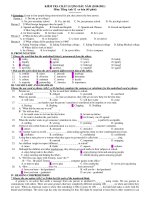
Bạn đang xem bản rút gọn của tài liệu. Xem và tải ngay bản đầy đủ của tài liệu tại đây (124.34 KB, 4 trang )
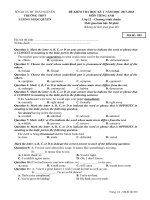
SỞ GD VÀ ĐT THÁI NGUYÊN
TRƯỜNG THPT
LƯƠNG NGỌC QUYẾN
ĐỀ KIỂM TRA HỌC KỲ I NĂM HỌC 2017-2018
MÔN TIẾNG ANH
Lớp 12 – Chương trình chuẩn
Thời gian làm bài: 50 phút
(Không kể thời gian giao đề)
Mã đề: 001
Họ, tên thí sinh: ……….........................................................................
Số báo danh: ...............................................................................
Question 1: Mark the letter A, B, C, or D on your answer sheet to indicate the word or phrase that
is CLOSEST in meaning to the italic part in the following sentence.
The teacher gave some suggestions on what could come out for the examination.
A. effects
B. symptoms
C. hints
D. demonstrations
Question 2: Choose the word whose underlined part is pronounced differently from that of the
others.
A. locked
B. forced
C. reserved
D. touched
Question 3: Choose the word whose underlined part is pronounced differently from that of the
others.
A. complain
B. command
C. compose
D. comment
Question 4: Mark A, B, C or D to indicate the word whose main stress differs from the rest.
A. endanger
B. commercial
C. habitat
D. destruction
Question 5: Mark the letter A, B, C, or D on your answer sheet to indicate the word or phrase that
is CLOSEST in meaning to the italic part in the following sentence.
If the headmaster were here, he would sign your paper immediately.
A. currently
B. right ahead
C. formally
D. right away
Question 6: Mark the letter A, B, C, or D to indicate the word or phrase that is OPPOSITE in
meaning to the italic part in the following question.
She denied having stolen the money.
A. avoided
B. admitted
C. advised
D. admired
Question 7: Mark A,B,C or D to indicate the word whose main stress differs from the rest.
A. wildlife
B. prevent
C. reserve
D. conserve
Question 8: Mark the letter A, B, C, or D to indicate the word or phrase that is OPPOSITE in
meaning to the italic part in the following question.
The earth is being threatened and the future looks bad.
A. done
B. made
C. defended
D. varied
Mark the letter A, B, C, or D to indicate the correct answer to each of the following questions
Question 9: A: I'm not sure about this soup. It tastes like something's missing.
B: ______ It tastes fine to me.
A. I don't think so
B. You're right.
C. I couldn't agree more.
D. Oh, I don't know,
Question 10: If we had known your new address, we ____________ to see you.
A. came
B. would come
C. will come
D. would have come
Question 11: A: You're a great dancer. I wish I could do half as well as you.
B: ______________ I'm an awful dancer!
A. That's a nice compliment!
B. You're too kind.
C. You've got to be kidding!
D. Oh, thank you very much.
Trang 1/4 - Mã đề thi 001
Question 12: In the future many large corporations will be wiped out and millions of jobs will be
lost.
A. companies
B. farms
C. services
D. supermarkets
Question 13: You should _______ more attention to what your teacher explains.
A. make
B. get
C. set
D. pay
Question 14: While girls lack of ___________, boys often overestimate their abilities.
A. confidences
B. confident
C. confidently
D. confidence
Question 15: The children ____________ to the zoo.
A. enjoyed being taken
B. were enjoyed taken
C. were enjoyed taking
D. enjoyed taking
Question 16: The person ___________ prepared this report has a real talent for writing.
A. she
B. whose
C. which
D. who
Choose the underlined part that needs correction.
Question 17: Suppose you haven't found your car keys, what would you have done?
A
B
C
D
Question 18: I regret informing you that we cannot accept your application.
A
B
C
D
Question 19: My friend’s son is very quick about learning foreign languages.
A
B
C
D
Mark the letter A, B, C, or D on your answer sheet to indicate the sentence that is closest in
meaning to each of the following questions.
Question 20: People say that the wanted man was found.
A. People are said to have been found the wanted man.
B. The wanted man is said to he found.
C. The wanted man said he was found.
D. The wanted man is said to have been found.
Question 21: What a pity! My friends didn't take part in the game with me.
A. I wish they would take part in the game with me.
B. I wish they had taken part in the game with me.
C. I wish they took part in the game with me.
D. I wish they didn't take part in the game with me.
Question 22: She started working as a teacher of English ten years ago.
A. She has been working as a teacher of English for ten years
B. She had worked with a teacher of English for ten years,
C. She had been working as a teacher of English tor ten years.
D. She has worked with a teacher of English for ten years,
Question 23: John didn’t have a map, so he couldn't find your house.
A. John will find your house if he has a map.
B. John have found your house because he has a map.
C. If John had a map, he would find your house.
D. If John had had a map, he would have found your house.
Question 24: “I will not do it again,” said Nancy.
A. Nancy told me she will not do it again,
B. Nancy invited me to do it again.
C. Nancy promised not to do it again.
D. Nancy threatened to do it again.
Trang 2/4 - Mã đề thi 001
Read the passage and choose the best answer (A or B, C, D) from 25 to 32
The relationship between students and teachers is (25)_________formal in the USA than in many
other countries, especially at the college(26)______. American college students do not stand up when
their teacher enters the room. Students are generally encouraged to ask questions in class, to stop in
the professor's of lice for extra help, and to phone if they are absent and need a(n) (27)_________.
Most teachers allow students to enter class late or leave early, if necessary. Despite the lack of
(28)______, students are still expected to be polite to their teacher and fellow classmates. When
students want to ask questions, they usually (29)__________a hand and wait to be called on. When
the teacher or a student is speaking to the class, it is (30)_________ to begin whispering
(31)_________another classmate. When a test is being given, talking to a classmate is not only rude
but also risky. Most American teachers consider that students who are talking to each other
(32)_________a test are cheating.
Question 25:
Question 26:
Question 27:
Question 28:
Question 29:
Question 30:
Question 31:
Question 32:
A. a little
A. mark
A. housework
A. formaly
A. rise
A. experience
A. to
A. during
B. much
B. scale
B. assignment
B. formation
B. raise
B. polite
B. at
B. by
C. less
C. grade
C. homework
C. formly
C. hold
C. rude
C. with
C. at
D. most
D. level
D. information
D. formality
D. hang
D. important
D. for
D. for
Read the passage and choose the best answer (A or B, C, D) from 33 to 40
Who talk more - men or women? Most people believe that women talk more. However,
linguist Deborah Tannen, who has studied the communication style of men and women, says that this
is a stereotype. According to Tannen, women are more verbal - talk more - in private situations, where
they use conversation as the "glue" to hold relationships together. But, she says, men talk more in
public situations, where they use conversation to exchange information and gain status. Tannen points
out that we can see these differences even in children. Little girls often play with one "best friend",
their play includes a lot of conversation. Little boys often play games in groups; their play usually
involves more doing than talking. In school, girls are often better at verbal skills, boys are often better
at mathematics.
A recent study at Emory University helps to shed light on the roots of this difference.
Researchers studied conversation between children age 3-6 and their parents. They found evidence
that parents talk very differently to their son than they do to their daughters. The startling conclusion
was that parents use more language with their girls. Specifically, when parents talk with their
daughters, they use more descriptive language and more details. There is also far more talk about
emotions, especially sadness, with daughters than with sons.
Question 33: Which sentence best expresses the main idea of the first paragraph?
A. Little girls and little boys have different ways of playing.
B. Women talk more in private, and men talk more in public
C. Women talk more than men.
D. It's stereotype that women talk more than men.
Question 34: Which sentence best expresses the main idea of the second paragraph?
A. An Emory University found that parents talk more with their daughters than with their sons.
B. Parents do not talk much about sadness with their sons.
C. Study at Emoiy University can help to explain the differences between communication styles of
boys and girls.
D. Researchers have studied the conversations of children and their parents.
Trang 3/4 - Mã đề thi 001
Question 35: Which of the following statements can be inferred from the first paragraph?
A. Women talk more in some situations, men talk more in others.
B. According to Deborah Tannen, the belief that women talk more is partly right but most wrong
and oversimplified.
C. Men are more sociable than women
D. Men and women have different styles of talking, which may begin in childhood.
Question 36: Which of the following statements can be inferred from the second paragraph?
A. A recent study found that parents talk differently to their sons and daughters.
B. Parents don't enjoy talking with their sons as much as with their daughters.
C. Girls have more practice discussing sadness than boys do.
D. Boys don't like to be with their parents as much as girls do.
Question 37: Which word is similar in meaning to "glue" in the first paragraph?
A. means
B. game
C. rope
D. sticky substance
Question 38: The word "they" in the passage refers to__________.
A. men
B. situations.
C. women
D. men and women
Question 39: Which can be used as a synonym of the word "emotions"?
A. anger
B. feelings
C. worries
D. thinking
Question 40: Which of the following phrases best explains the meaning of the word "verbal"?
A. using very loud noise
B. connected with the use of spoken language
C. being very talkative
D. deriving from verbs
-----------------------------------------------
----------- THE END ----------
Trang 4/4 - Mã đề thi 001