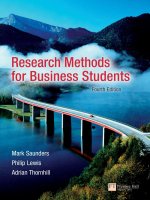
Research methods for BUsiness students 6th by suanders lewis and thornhill
Bạn đang xem bản rút gọn của tài liệu. Xem và tải ngay bản đầy đủ của tài liệu tại đây (13 MB, 729 trang )
SIXTH
EDITION
RESEARCH METHODS
FOR BUSINESS STUDENTS
Research Methods for Business Students has been fully updated for this
sixth edition and continues to be the market-leading textbook in its field,
guiding hundreds of thousands of student researchers to success in their
research methods modules, research proposals, projects and dissertations.
So, if you’re thinking . . .
‘How do I choose my topic and write my proposal?’
‘I’m confused by all these different philosophies’
‘How do I collect and analyse my data?’
‘How do I write up my research project?
. . . then open this book to find out more. This book contains:
✓
Regular checklists and ‘Progressing your research project’ sections giving you
step-by-step practical guidance on the process
✓
✓
A glossary of clear definitions for over 550 research terms
✓
Case studies, examples of students’ and academics’ research and topical news articles
illustrating research in practice
Detailed chapters on choosing your topic, reviewing the literature, understanding
philosophies, research design, access and ethics, data collection and analysis, and writing
and presenting your research
COVER PHOTOGRAPH © JOHN LUND/GETTY IMAGES
Don’t forget to visit www.pearsoned.co.uk/saunders, where you can use online
tutorials on research software, including IBM SPSS Statistics and NVivo, test yourself
with hundreds of multiple choice questions, analyse over 50 further case studies, and
learn how to search the Internet more efficiently and effectively with our Smarter Online
Searching Guide!
Start your research project with confidence and complete it with success.
Mark Saunders is Professor of Business Research Methods and Director of Postgraduate
Research Programmes at The Surrey Business School, University of Surrey.
Philip Lewis was a Principal Lecturer and Adrian Thornhill was a
Head of Department, both at The Business School, University of
Gloucestershire.
RESEARCH METHODS FOR BUSINESS STUDENTS SAUNDERS LEWIS THORNHILL
SIXTH EDITION
SIXTH EDITION
RESEARCH METHODS
FOR BUSINESS
STUDENTS
MARK SAUNDERS
PHILIP LEWIS
ADRIAN THORNHILL
www.pearson-books.com
CRVSAUN0758_06_SE_CRV.indd 1
05/03/2012 09:23
Research Methods for Business Students
Visit the Research Methods for Business Students, 6th edition, Companion
Website at www.pearsoned.co.uk/saunders to find valuable student learning
material including:
•
•
•
•
•
Multiple-choice questions to test your learning
Tutorials and datasets for Excel, NVivo and SPSS
Updated research datasets to practise with
Updated additional case studies with accompanying questions
Smarter Online Searching Guide – how to make the most of the Internet
in your research
• Online glossary
Research Methods
for Business
Students
Sixth edition
Mark Saunders
Philip Lewis
Adrian Thornhill
Pearson Education Limited
Edinburgh Gate
Harlow
Essex CM20 2JE
England
and Associated Companies throughout the world
Visit us on the World Wide Web at:
www.pearson.com/uk
First published under the Pitman Publishing imprint in 1997
Second edition 2000
Third edition 2003
Fourth edition 2007
Fifth edition 2009
Sixth edition 2012
© Pearson Professional Limited 1997
© Pearson Education Limited 2000, 2003, 2007, 2009
© Mark Saunders, Philip Lewis and Adrian Thornhill 2012
The rights of Mark Saunders, Philip Lewis and Adrian Thornhill to be identified as authors
of this work have been asserted by them in accordance with the Copyright, Designs and
Patents Act 1988.
All rights reserved; no part of this publication may be reproduced, stored in a retrieval
system, or transmitted in any form or by any means, electronic, mechanical, photocopying,
recording or otherwise without either the prior written permission of the publisher or a licence
permitting restricted copying in the United Kingdom issued by the Copyright Licensing Agency
Ltd, Saffron House, 6–10 Kirby Street, London EC1N 8TS.
All trademarks used herein are the property of their respective owners. The use of any trademark
in this text does not vest in the author or publisher any trademark ownership rights in such
trademarks, nor does the use of such trademarks imply any affiliation with or endorsement of
this book by such owners.
ISBN: 978-0-273-75075-8
British Library Cataloguing-in-Publication Data
A catalogue record for this book is available from the British Library
Library of Congress Cataloging-in-Publication Data
Saunders, Mark, 1959–
Research methods for business students / Mark Saunders, Philip Lewis, Adrian Thornhill. — 6th ed.
p. cm.
Includes bibliographical references and index.
ISBN 978-0-273-75075-8
1. Business—Research. 2. Business—Research—Data processing. I. Lewis, Philip, 1945–
II. Thornhill, Adrian. III. Title.
HD30.4.S28 2012
650.072—dc23
2011050137
12 11 10 9 8 7 6
15 14 13 12
Typeset in 9.5/12.5 ITC Slimbach Std. by 73
Printed and bound by Rotolito Lombarda, Italy
The publisher’s policy is to use paper manufactured from sustainable forests
Brief contents
How to use this book
Guided tour
Preface
Contributors
Publisher’s acknowledgements
1
xvii
xxii
xxv
xxvii
xxix
Business and management research, reflective diaries and the
purpose of this book
2
2
Formulating and clarifying the research topic
26
3
Critically reviewing the literature
70
4
Understanding research philosophies and approaches
126
5
Formulating the research design
158
6
Negotiating access and research ethics
208
7
Selecting samples
258
8
Using secondary data
304
9
Collecting primary data through observation
340
10
Collecting primary data using semi-structured, in-depth
and group interviews
372
11
Collecting primary data using questionnaires
416
12
Analysing quantitative data
472
13
Analysing qualitative data
544
14
Writing and presenting your project report
594
Bibliography
Appendices
Glossary
Index
632
644
665
685
v
Contents
How to use this book
Guided tour
Preface
Contributors
Publisher’s acknowledgements
1
Business and management research,
reflective diaries and the purpose of
this book
xvii
xxii
xxv
xxvii
xxix
2
Mark Saunders Philip Lewis and Adrian Thornhill
1.1
1.2
1.3
1.4
1.5
1.6
1.7
Learning outcomes
Introduction
The nature of research
Business and management research
The research process
Keeping a reflective diary or research notebook
The purpose and structure of this book
Summary
Self-check questions
Review and discussion questions
Progressing your research project: starting your
reflective diary or notebook
References
Further reading
Case 1: Reporting evidence from business
and management research
Mark Learmonth
2
2
4
6
12
13
15
19
19
19
Self-check answers
24
20
20
21
22
vii
Contents
2
Formulating and clarifying
the research topic
26
Mark Saunders Philip Lewis and Adrian Thornhill
2.1
2.2
2.3
2.4
2.5
2.6
3
Learning outcomes
Introduction
Attributes of a good research topic
Generating and refining research ideas
Turning research ideas into research projects
Writing your research proposal
Summary
Self-check questions
Review and discussion questions
Progressing your research project: from research
ideas to a research proposal
References
Further reading
Case 2: Self-service technology: does co-production
harm value co-creation?
Toni Hilton
26
26
28
30
40
50
59
60
60
Self-check answers
67
Critically reviewing the literature
61
61
63
63
70
Mark Saunders Philip Lewis and Adrian Thornhill
Learning outcomes
3.1 Introduction
3.2 The critical review
3.3 Literature sources available
3.4 Planning your literature search strategy
3.5 Conducting your literature search
3.6 Obtaining and evaluating the literature
3.7 Recording the literature
3.8 Using Systematic Review
3.9 Plagiarism
3.10 Summary
Self-check questions
Review and discussion questions
Progressing your research project: critically reviewing
the literature
References
viii
70
70
73
82
90
97
105
108
112
113
115
115
117
117
117
Contents
4
Further reading
Case 3: Individual workplace performance:
systematically reviewed
Céline Rojon
119
Self-check answers
123
Understanding research philosophies
and approaches
119
126
Mark Saunders Philip Lewis and Adrian Thornhill
4.1
4.2
4.3
4.4
Learning outcomes
Introduction
Understanding your research philosophy
Research approaches
Summary
Self-check questions
Review and discussion questions
Progressing your research project: diagnose your
research philosophy
References
Further reading
Case 4: Organisational learning in an English
regional theatre
Dawn Langley and Paul Tosey
Self-check answers
5
Formulating the research design
126
126
127
143
149
150
150
151
152
153
153
156
158
Mark Saunders Philip Lewis and Adrian Thornhill
5.1
5.2
5.3
5.4
5.5
5.6
5.7
Learning outcomes
Introduction
Choice and coherence in research design
Choosing a quantitative, qualitative or multiple methods
research design
Recognising the nature of your research design
Choosing a research strategy or strategies
Choosing a time horizon
Establishing the ethics of the research design
158
158
159
161
170
173
190
191
ix
Contents
5.8 Establishing the quality of the research design
5.9 Taking into account your role as researcher
5.10 Summary
Self-check questions
Review and discussion questions
Progressing your research project: deciding
on your research design
References
Further reading
Case 5: Sangita’s career
Mark Saunders Philip Lewis and Adrian Thornhill
6
191
195
196
197
198
198
199
201
202
Ongoing case: Researching emotional labour
Part 1: Some reading and a possible research design?
Karen Handley and Lindsay Williams
204
204
Self-check answers
206
Negotiating access and research ethics
208
Mark Saunders Philip Lewis and Adrian Thornhill
6.1
6.2
6.3
6.4
6.5
6.6
6.7
6.8
x
Learning outcomes
Introduction
Issues associated with gaining traditional access
Issues associated with Internet-mediated access
Strategies to gain access
Research ethics and why you should act ethically
Ethical issues at specific stages of the research process
An introduction to the principles of data protection
and data management
Summary
Self-check questions
Review and discussion questions
Progressing your research project: negotiating access
and addressing ethical issues
References
Further reading
Case 6: The impact of colour on children’s brand choices
Zoe Jowers
208
208
210
214
216
226
236
Self-check answers
255
247
249
250
250
251
251
253
253
Contents
7
Selecting samples
258
Mark Saunders Philip Lewis and Adrian Thornhill
7.1
7.2
7.3
7.4
Learning outcomes
Introduction
Probability sampling
Non-probability sampling
Summary
Self-check questions
Review and discussion questions
Progressing your research project: using sampling
as part of your research
References
Further reading
Case 7: Comparing UK and French perceptions and
expectations of online supermarket shopping
Marie Ashwin and Alan Hirst
Self-check answers
8
Using secondary data
258
258
262
281
291
292
294
295
295
296
297
300
304
Mark Saunders Philip Lewis and Adrian Thornhill
8.1
8.2
8.3
8.4
8.5
8.6
Learning outcomes
Introduction
Types of secondary data and uses in research
Locating secondary data
Advantages and disadvantages of secondary data
Evaluating secondary data sources
Summary
Self-check questions
Review and discussion questions
Progressing your research project: assessing the suitability
of secondary data for your research
References
Further reading
Case 8: Trust repair in a major finance company
Graham Dietz
Ongoing case: Researching emotional labour
304
304
307
314
317
321
331
331
332
332
333
334
335
337
xi
Contents
9
Part 2: Permission to collect data is unlikely, so what
about secondary data?
Karen Handley and Lindsay Williams
337
Self-check answers
338
Collecting primary data through
observation
340
Mark Saunders Philip Lewis and Adrian Thornhill
9.1
9.2
9.3
9.4
Learning outcomes
Introduction
Participant observation
Structured observation
Summary
Self-check questions
Review and discussion questions
Progressing your research project: deciding
on the appropriateness of observation
References
Further reading
Case 9: Strategy options in a mature market
Hester Nienaber
Self-check answers
10 Collecting primary data using
semi-structured, in-depth and
group interviews
340
340
342
355
362
363
364
364
364
365
366
369
372
Mark Saunders Philip Lewis and Adrian Thornhill
10.1
10.2
10.3
10.4
10.5
10.6
xii
Learning outcomes
Introduction
Types of interview and their link to the purpose
of research and research strategy
When to use semi-structured and in-depth interviews
Data quality issues associated with semi-structured
and in-depth interviews
Preparing for semi-structured or in-depth interviews
Conducting semi-structured or in-depth interviews
372
372
374
378
380
384
388
Contents
10.7
10.8
10.9
10.10
Managing logistical and resource issues
Group interviews and focus groups
Telephone, Internet- and intranet-mediated interviews
Summary
Self-check questions
Review and discussion questions
Progressing your research project: using semi-structured
or in-depth interviews in your research
References
Further reading
Case 10: Organisations in a flash?
Samantha Warren
Self-check answers
11 Collecting primary data using
questionnaires
398
400
404
408
408
409
410
410
411
412
414
416
Mark Saunders Philip Lewis and Adrian Thornhill
11.1
11.2
11.3
11.4
11.5
11.6
Learning outcomes
Introduction
An overview of questionnaires
Deciding what data need to be collected
Designing the questionnaire
Delivering and collecting the questionnaire
Summary
Self-check questions
Review and discussion questions
Progressing your research project: using questionnaires
in your research
References
Further reading
Case 11: A quantitative evaluation of students’
desire for self employment
Victoria Harte and Jim Stewart
Self-check answers
416
416
419
423
428
452
458
459
461
461
462
463
464
467
xiii
Contents
12 Analysing quantitative data
472
Mark Saunders, Philip Lewis, Adrian Thornhill and
Catherine Wang
12.1
12.2
12.3
12.4
12.5
12.6
Learning outcomes
Introduction
Preparing, inputting and checking data
Exploring and presenting data
Describing data using statistics
Examining relationships, differences and trends
using statistics
Summary
Self-check questions
Review and discussion questions
Progressing your research project: analysing
your data quantitatively
References
Further reading
Case 12: Food miles, carbon footprints and
supply chains
David Oglethorpe
Self-check answers
13 Analysing qualitative data
472
472
474
487
502
508
529
530
532
532
533
534
535
541
544
Mark Saunders Philip Lewis and Adrian Thornhill
13.1
13.2
13.3
13.4
13.5
13.6
13.7
13.8
13.9
13.10
xiv
Learning outcomes
Introduction
Qualitative data
Deciding on your approach to analysis
Preparing your data for analysis
Aids to help your analysis
Generic approaches to analysis
Specific approaches to analysis: inductive procedures
Specific approaches to analysis: deductive procedures
Using CAQDAS
Summary
Self-check questions
Review and discussion questions
Progressing your research project: analysing your
data qualitatively
544
544
546
548
550
553
556
566
578
581
583
584
584
585
Contents
References
Further reading
Case 13: Creating environmentally friendly
office spaces
Catherine Cassell and Bill Lee
585
587
587
Ongoing case: Researching emotional labour
Part 3: A revised research question, a variety of
secondary data, but what about the analysis?
Karen Handley and Lindsay Williams
589
Self-check answers
591
14 Writing and presenting your
project report
589
594
Mark Saunders Philip Lewis and Adrian Thornhill
14.1
14.2
14.3
14.4
14.5
14.6
14.7
14.8
Learning outcomes
Introduction
Getting started with writing
Structuring your project report
Organising the project report’s content
Developing an appropriate writing style
Meeting the assessment criteria
Oral presentation of the report
Summary
Self-check questions
Review and discussion questions
Progressing your research project: writing your
project report
References
Further reading
Case 14: Clare’s research project presentation
Lindy Blair
Self-check answers
Bibliography
594
594
596
600
610
614
619
620
624
624
625
625
625
626
627
630
632
xv
Contents
Appendices
1
2
3
4
Systems of referencing
Calculating the minimum sample size
Random sampling numbers
Guidelines for non-discriminatory language
Glossary
Index
644
659
661
662
665
685
Supporting resources
Visit www.pearsoned.co.uk/saunders to find valuable online resources:
Companion Website for students
•
•
•
•
•
Multiple-choice questions to test your learning
Tutorials and datasets for Excel, NVivo and SPSS
Updated research datasets to practise with
Updated additional case studies with accompanying questions
Smarter Online Searching Guide — how to make the most of the Internet
in your research
• Online glossary
For instructors
• Complete, downloadable Instructor’s Manual
• PowerPoint slides that can be downloaded and used for presentations
Also: The regularly maintained Companion Website provides the following
features:
• Search tool to help locate specific items of content
• E-mail results and profile tools to send results of quizzes to instructors
• Online help and support to assist with website usage and troubleshooting
For more information please contact your local Pearson Education sales
representative or visit www.pearsoned.co.uk/saunders
xvi
How to use this book
This book is written with a progressive logic, which means that terms and concepts are
defined when they are first introduced. One implication of this is that it is sensible for you
to start at the beginning and to work your way through the text, various boxes, self-check
questions, review and discussion questions, case studies and case study questions. You can
do this in a variety of ways depending on your reasons for using this book. However, this
approach may not necessarily be suitable for your purposes, and you may wish to read the
chapters in a different order or just dip into particular sections of the book. If this is true for
you then you will probably need to use the glossary to check that you understand some of the
terms and concepts used in the chapters you read. Suggestions for three of the more common
ways in which you might wish to use this book are given below.
As part of a research methods course or for
self-study for your research project
If you are using this book as part of a research methods course the order in which you read
the chapters is likely to be prescribed by your tutors and dependent upon their perceptions
of your needs. Conversely, if you are pursuing a course of self-study for your research
project, dissertation or consultancy report, the order in which you read the chapters is your
own choice. However, whichever of these you are, we would argue that the order in which
you read the chapters is dependent upon your recent academic experience.
For many students, such as those taking an undergraduate degree in business or
management, the research methods course and associated project, dissertation or consultancy report comes in either the second or the final year of study. In such situations it is
probable that you will follow the chapter order quite closely (see Figure P.1). Groups of
chapters within which we believe you can switch the order without affecting the logic of
the flow too much are shown on the same level in this diagram and are:
• those chapters associated with data collection (Chapters 8, 9, 10 and 11);
• those associated with data analysis (Chapters 12 and 13).
Within the book we emphasise the importance of beginning to write early on in the
research process as a way of clarifying your thoughts. In Chapter 1 we encourage you to
keep a reflective diary or notebook throughout the research process so it is helpful to read
this chapter early on. We recommend you also read the sections in Chapter 14 on writing
prior to starting to draft your critical review of the literature (Chapter 3).
Alternatively, you may be returning to academic study after a gap of some years, to
take a full-time or part-time course such as a Master of Business Administration, a Master
of Arts or a Master of Science with a Business and Management focus. Many students in
such situations need to refresh their study skills early in their programme, particularly
those associated with critical reading of academic literature and academic writing. If you
xvii
How to use this book
Chapter 1: Business and management
research, reflective diaries
Chapter 14: Writing and presenting
your project report
Chapter 2: Formulating and
clarifying the research topic
Chapter 3: Critically
reviewing the literature
Chapter 4: Understanding research
philosophies and approaches
Chapter 5: Formulating the
research design
Chapter 6: Negotiating access
and research ethics
Chapter 7: Selecting samples
Chapter 8:
Using
secondary
data
Chapter 9:
Collecting primary
data through
observation
Chapter 12: Analysing
quantitative data
Chapter 10:
Collecting primary
data using interviews
Chapter 13: Analysing
qualitative data
Chapter 14: Writing
and presenting
your project report
Figure P.1 Using this book in your second or final year of study
xviii
Chapter 11:
Collecting primary
data using
questionnaires
How to use this book
feel the need to do this, you may wish to start with those chapters that support you in
developing and refining these skills (Chapters 3 and 14), followed by Chapter 8, which
introduces you to the range of secondary data sources available that might be of use for
other assignments (Figure P.2). Once again, groups of chapters within which we believe
Chapter 1: Business and management
research, reflective diaries
Chapter 14: Writing
and presenting your project report
Chapter 3: Critically
reviewing the literature
Chapter 8: Using
secondary data
Chapter 2: Formulating and
clarifying the research topic
Chapter 4: Understanding research
philosophies and approaches
Chapter 5: Formulating the
research design
Chapter 6: Negotiating access
and research ethics
Chapter 7: Selecting samples
Chapter 9:
Collecting primary
data through
observation
Chapter 10:
Collecting primary data
using interviews
Chapter 12: Analysing
quantitative data
Chapter 11:
Collecting primary
data using
questionnaires
Chapter 13: Analysing
qualitative data
Chapter 14: Writing and
presenting your project report
Figure P.2 Using this book as a new returner to academic study
xix
How to use this book
you can switch the order without affecting the logic of the flow too much are shown on
the same level in the diagram and are:
• those chapters associated with primary data collection (Chapters 9, 10 and 11);
• those associated with data analysis (Chapters 12 and 13).
In addition, we would recommend that you reread Chapter 14 prior to starting to
write your project report, dissertation or consultancy report; or if you need to undertake
a presentation.
Whichever order you choose to read the chapters in, we would recommend that you
attempt all the self-check questions, review and discussion questions and those questions associated with the case studies. Your answers to the self-check questions can be
self-assessed using the answers at the end of each chapter. However, we hope that you
will actually have a go at each question prior to reading the answer! If you need further
information on an idea or a technique, then first look at the references in the further
reading section.
At the end of each chapter, the section headed ‘Progressing your research project’ lists
a number of tasks. Such tasks might involve you in just planning a research project or,
alternatively, designing and administering a questionnaire of your own. They all include
making an entry in your reflective diary or notebook. When completed, these tasks will
provide a useful aide-memoire for assessed work (including a reflective essay or learning log) and can be used as the basis for the first draft of your project report. It is worth
pointing out here that many consultancy reports for organisations do not require you to
include a review of the academic literature.
As a guide through the research process
If you are intending to use this book to guide you through the research process for a
research project you are undertaking, such as your dissertation, we recommend that you
read the entire book quickly before starting your research. In that way you will have a
good overview of the entire process, including the range of techniques available, and will
be better able to plan your work.
After you have read the book once, we suggest that you reread Section 1.5 on keeping
a reflective diary or notebook and Sections 14.5–14.6 on writing first. Then work your
way through the book again following the chapter order. This time you should attempt
the self-check questions, review and discussion questions and those questions associated
with each case study to ensure that you have understood the material contained in each
chapter prior to applying it to your own research project. Your responses to self-check
questions can be assessed using the answers at the end of each chapter.
If you are still unsure as to whether particular techniques, procedures or ideas are relevant, then pay special attention to the ‘focus on student research’, ‘focus on management
research’ and ‘focus on research in the news’ boxes. ‘Focus on student research’ boxes
are based on actual students’ experiences and illustrate how an issue has been addressed
or a technique or procedure used in a student’s research project. ‘Focus on management
research’ boxes discuss recent research articles in established refereed academic journals,
allowing you to see how research is undertaken successfully. These articles are easily
accessible via the main online business and management databases. ‘Focus on research
in the news’ boxes provide topical news stories of how particular research techniques,
procedures and ideas are used in the business world. You can also look in the ‘further
reading’ for other examples of research where these have been used. If you need further
xx
How to use this book
information on an idea, technique or procedure then, again, start with the references in
the further reading section.
Material in some of the chapters is likely to prove less relevant to some research topics than others. However, you should beware of choosing techniques because you are
happy with them, if they are inappropriate. Completion of the tasks in the section headed
‘Progressing your research project’ at the end of Chapters 2–13 will enable you to generate all the material that you will need to include in your research project, dissertation or
consultancy report. This will also help you to focus on the techniques and ideas that are
most appropriate to your research. When you have completed these tasks for Chapter 14
you will have written your research project, dissertation or consultancy report.
As a reference source
It may be that you wish to use this book now or subsequently as a reference source.
If this is the case, an extensive index will point you to the appropriate page or pages.
Often you will find a ‘checklist’ box within these pages. ‘Checklist’ boxes are designed
to provide you with further guidance on the particular topic. You will also find the
contents pages and the glossary useful reference sources, the latter defining nearly 600
research terms. In addition, we have tried to help you to use the book in this way by
including cross-references between sections in chapters as appropriate. Do follow these
up as necessary. If you need further information on an idea or a technique then begin by
consulting the references in the further reading section. Wherever possible we have tried
to reference books that are in print and readily available in university libraries.
xxi
Guided tour
Chapter
5
research project. The key to these selections will be to achieve coherence all the way through
your research design.
Formulating the research design
5.2 Choice and coherence in research design
Learning outcomes
Your research design is the general plan of how you will go about answering your research
question(s) (the importance of clearly defining the research question cannot be overemphasised). It will contain clear objectives derived from your research question(s), specify the
sources from which you intend to collect data, how you propose to collect and analyse these,
discuss ethical issues and the constraints you will inevitably encounter (e.g. access to data,
By the end of this chapter you should be able to:
•
•
•
•
•
•
•
•
understand the importance of your decisions when designing research
and the need to achieve methodological coherence throughout your
own research design;
explain the differences between quantitative, qualitative and multiple
methods research designs and choose between these to design your
own research;
explain the differences between exploratory, descriptive and explanatory research to understand the nature of your own research;
identify the main research strategies and choose from amongst these
to achieve coherence throughout your research design;
consider the implications of the time frames required for different
research designs when designing your own research;
consider some of the main ethical issues implied by your research design;
identify some of the issues that affect the quality of research and consider these when designing your own research;
consider the constraints of your role as researcher when designing
your own research.
Ridenour and Newman (2008) stress the
importance of coherence in research design
and represent the research process as an
interactive continuum. The cover shots of
recent editions of this book have indicated
that the research process is like a journey –
a journey along a road with you as the
driver of the vehicle (two wheels or four,
whichever you prefer!). Like many such
journeys, there is generally a choice of
roads to travel along. When you are thinking about setting out on a new journey
of some distance, you will probably find a
road map and look at the options to get
to your destination. A number of factors
Looking at a possible route from the top of St Paul’s
may influence your decision about which
Cathedral, London!
route to take, including speed, time, cost
Source: © Jan Thornhill 2011
and your preference between taking the
option presents itself as you travel along. In many
shortest route or staying on the motorway
network and main roads. The route you plan is likely ways, designing research is like planning a journey.
to be as coherent as you can work out from the map Formulating the most appropriate way to address
in front of you given your travel criteria. As you actu- your research question is similar to planning the
ally undertake your journey you will find yourself route to your destination, your research objectives
interacting with the reality of your planned route. are a little like your planning criteria, the need for
Some parts of the journey will go according to plan; coherence is the same in each situation and the jourother parts may not and you may need to alter your ney itself, like the research process, will necessarily
route. You may change your route because a better prove to be an interactive experience.
5.1 Introduction
In Chapter 4 we introduced the research onion as a way of depicting the issues underlying your
choice of data collection method or methods and peeled away the outer two layers – research
philosophies and research approaches. In this chapter we uncover the next three layers: methodological choice, research strategy or strategies and choosing the time horizon for your research.
As we saw in Chapter 4, the way you answer your research question will be influenced by your
research philosophy and approach to theory. Your research philosophy and research approach,
whether this is deliberate or by default, will subsequently influence your selections shown in
the next three layers of the research onion. These three layers can be thought of as focusing
on the process of research design, which is the way you turn your research question into a
158
M05_SAUN0758_06_SE_C05.indd 158
159
02/21/12 9:34 AM
M05_SAUN0758_06_SE_C05.indd 159
02/21/12 9:34 AM
Chapter 11 Collecting primary data using questionnaires
Chapter 11 Collecting primary data using questionnaires
Case 11
A quantitative evaluation of students’ desire
for self-employment
Sally was asked by her employer to undertake an anonymous survey of financial advisers’ ethical values. In
particular, her employer was interested in the advice
given to clients. After some deliberation she came
up with three questions that addressed the issue of
putting clients’ interests before their own:
Box 11.3
Focus on student
research
Opinion, behaviour
and attribute questions
Thomas is a part-time master’s student who has been successfully self-employed for the last six
years in the web technologies industry. As a consequence of his current employment status and
area of expertise, he has chosen to research the impact of
enterprise modules on undergraduate students at his university. He is interested in seeing
whether there has been an
increase over the past 10 years
in students considering selfemployment after their studies,
particularly in the high-technology industries. Furthermore, as
he is an expert in technology he
wishes to put his skills to use in
obtaining his data.
Thomas began his research
project with a comprehensive
search and review of the literature. He broke down his search
into three main areas: research
methods, enterprise education
Source: Shutterstock.com/Eimantas Buzas
and technologically oriented
students. Following his review
of the literature on research methods, Thomas felt his world view was most closely related to an
objectivist paradigm within a positivist philosophy. Thomas used his review of enterprise education literature to develop his research aims and form four hypotheses to test. These were:
2 How do you feel about the following statement? ‘Financial advisors should place their clients’ interest
before their own.’
strongly agree
mildly agree
(please tick the appropriate box)
neither agree or disagree
mildly disagree
strongly disagree
3 In general, do financial advisors place their clients’ interests before their own?
always yes
usually yes
(please tick the appropriate box)
sometimes yes
seldom yes
never yes
4 How often do you place your clients’ interests before your own?
81–100% of my time
61–80% of my time
(please tick the appropriate box)
41–60% of my time
21–40% of my time
0–20% of my time
Practical illustrations bring to life
some of the issues
and challenges
you will encounter
during your course
and beyond. These
include short Focus
on student research
and longer Cases.
Sally’s choice of question or questions to include
in her questionnaire was dependent on whether she
needed to collect data on financial advisors’ opinions
or behaviours. She designed question 2 to collect
data on respondents’ opinions about financial advisors placing their clients’ interest before their own.
This question asks respondents how they feel. In contrast, question 3 asks respondents whether financial
advisors in general place their clients’ interests before
their own. It is therefore concerned with their individual beliefs regarding how financial advisors act.
H1: Students’ desires to enter self-employment following graduation are greater compared
with 10 years ago
H2: More female students are considering self-employment following graduation compared
with 10 years ago
H3: More students wish become self-employed in the technology industry following graduation compared with 10 years ago
H4: Students who take at least one enterprise module are more likely to wish to enter selfemployment following graduation than those who do not
Less than 30 years
30 to less than 40 years
40 to less than 50 years
50 to less than 60 years
60 years or over
Thomas decided that the way forward for his research was to use an online questionnaire
delivered via an email with a weblink, as opposed to paper completion. His reasons for this
were twofold:
• literature had highlighted that students were now more technologically orientated than
in the past (Greenlaw and Welty-Brown 2009; Oblinger 2003) and so, he assumed,
would be willing to complete his online questionnaire;
426
M11_SAUN0758_06_SE_C11.indd 426
xxii
Question 4 focuses on how often the respondents
actually place their clients’ interests before their own.
Unlike the previous questions, it is concerned with
their actual behaviour rather than their opinion.
To answer her research questions and to meet her
objectives Sally also needed to collect data to explore
how ethical values differed between subgroupings of
financial advisors. One theory she had was that ethical values were related to age. To test this she needed
to collect data on the attribute age. After some deliberation she came up with question 5:
5 How old are you?
(please tick the appropriate box)
Chapter openers
provide a clear and
concise introduction
to the topics to be
covered, together
with a list of
Learning outcomes
that you should have
achieved by the end
of the chapter.
464
02/21/12 9:40 AM
M11_SAUN0758_06_SE_C11.indd 464
02/21/12 9:40 AM
Guided tour
Generating and refining research ideas
Box 2.7
Focus on
management
research
The rare case of a reported
preliminary inquiry
There are few reports in journal articles of the preliminary inquiries that researchers undertake. Generally
the ‘methods’ section of a journal article only
describes the research methodology and techniques
used in the actual study. This is probably due to word
limits and the presentation of research as an unproblematic process. However, in many studies there may
not be a well-defined theoretical base from which to
commence the research. There may instead be several
possible theoretical strands that might be useful for
the proposed study, which need to be explored first.
Researchers may need to search for and familiarise
themselves with theoretical strands that were previously unknown to them. These possibilities are likely
to be the case where the proposed research seeks to
explore a new area.
An excellent example describing the way a group
of researchers undertook a preliminary inquiry is
found in Elsbach et al. (2010). Their study, published in
Human Relations, examines ‘how passive “face time”
(i.e. the amount of time one is passively observed
without interaction) affects how one is perceived
at work’ (Elsbach et al. 2010: 735). For example, it
is likely to be important for new employees to create an impression of being a diligent worker, without
the observer knowing exactly what the person being
observed is actually doing. Being seen is what Elsbach
and colleagues call ‘expected face time’. Positive
impressions may be created by being seen in the right
places (e.g. at one’s desk, in meetings, taking part in
events) rather than being based on actual performance. There is also ‘extracurricular face time’, where
the impression an employee creates is also shaped by
his or her involvement outside work.
Elsbach et al. identified this as a research idea that
had not been investigated previously. They thought
that this was surprising because of the increasing
numbers of employees who spend much time working away from their work base, as well as the existence
of anecdotal evidence indicating that remote workers
may feel anxious about their lack of face time.
They conducted a preliminary inquiry that commenced with the collection of anecdotal evidence
which suggested that passive face time was linked
to the creation of positive impressions of employees
in professional jobs. This anecdotal evidence was
gleaned from newspaper articles, business magazines
and books. In order to understand this relationship
further they located two strands of theoretical literature which offered them ‘clues’ about ‘how and why
passive face time affects perceptions of employees
who display it’ (Elsbach et al. 2010: 739). These two
strands of literature related to research on organisational citizenship behaviour and research on trait
inferences. While these strands of literature had not
been designed to focus on passive face time, they
lent some support to the idea that being seen in the
workplace was likely to lead observers to infer positive
attributes about those being observed.
This preliminary inquiry led Elsbach and colleagues
to identify that this was an area worth researching to
close the gap in our understanding of this phenomenon. They devised a research question – ‘How do
observers perceive displayers of passive face time in
professional work contexts?’ – as a result of their preliminary inquiry, which led to a substantive research
project composed of two stages. The first of these,
called ‘Study 1’, involved an exploratory stage that
used semi-structured interviews which were analysed inductively using the principles of Grounded
Theory (see Chapters 4 and 5). The second of these,
called ‘Study 2’, involved an experimental design (see
Chapter 5) to test the ‘proposed effects of passive
face time’ (Elsbach et al. 2010: 748).
This published study by Elsbach et al. is rare in
terms of describing how their preliminary inquiry
helped to establish the need for a substantive
research study and the definition of that study. As
such, this article may be seen as a model example of
the process of a research project from conception to
execution.
39
M02_SAUN0758_06_SE_C02.indd 39
02/21/12 9:30 AM
Box 4.5
Focus on research
in the news
Crop science: global food presents
opportunity to reap a profit
The world already does a pretty miserable job of
providing adequate food for vast swathes of its
7bn-strong population. With that number set to
rise to close to 9bn by 2050, the issue of food security – ensuring people have access to an adequate
supply of safe, nutritious and affordable food – is
perhaps the most pressing facing crop scientists.
‘Global food security ultimately depends on growing enough crops’, says Professor Janet Allen, director of research at the Biotechnology and Biological
Sciences Research Council (BBSRC), the UK’s funding agency for biosciences. For crop scientists, that
means selecting crop traits and production systems
that can increase yields and reduce losses to pests
and diseases.
But population growth is not the only challenge
they face in their search for better, more hardy and
more abundant crops. Climate change, too, is a
big concern, with its potential to bring droughts
and floods, new pests and diseases, and geopolitical conflict for resources and raw materials. Even if
global food production can keep pace with population growth – and that is a big if – it is unlikely to
be enough to accommodate serious weather-related
disruptions in supply.
Addressing the productivity gap represents a significant business opportunity for the life sciences
companies that lead the market in crop protection:
Monsanto, Syngenta, Bayer, Dow and DuPont. These
companies are already active and vocal participants
in the global food security debate, but recognise that
new business models are required to address new
audiences in the developing world – and, perhaps, to
overcome public resistance to big companies profiting
from world hunger.
‘Growers are our customers and our aim is to
put them at the heart of our technology. That’s
just as true of smallholders in developing countries as it is of wealthier customers,’ argues Kavita
Prakash-Mani, head of food security agenda at
Syngenta. An increasing share of Syngenta’s profits,
she says, comes from the developing world, particularly Asia-Pacific and Latin America, but also Africa.
‘Farmers everywhere should be able to enjoy a choice
of solutions to help them feed their families and
communities, ones that are developed specifically
to suit their growing conditions and their pockets.’
Syngenta, for example, is working alongside its nonprofit arm, the Syngenta Foundation for Sustainable
Agriculture, and the International Maize and Wheat
Improvement Centre (Cimmyt), another non-profit
organisation based in Mexico, to develop droughttolerant maize for smallholder farmers in Asia who
lack access to irrigation. Drought-tolerant African
maize developed by Cimmyt will be crossed with
Syngenta varieties bred for Asia, applying Syngenta’s
genetic mapping technology to speed up the identification of the best varieties for the region in a project
set to last five years.
But the application of GM technology to crops
intended for the developing world – and, indeed,
elsewhere – remains deeply controversial. For example,
ActionAid, a development charity, fiercely opposes it,
contending that market domination of GM technology by a handful of multinationals gives them unfair
control over farmers’ choices of seeds and the chemicals to go with them. ‘It’s a question of making poor
people reliant on external inputs to succeed in feeding
their families’, argues Ruchi Tripathi, ActionAid’s head
of food rights. ‘Once farmers are on a chemical treadmill, they find it hard to get off.’ Instead, the charity
favours an approach based on knowledge development, seed conservation and the establishment of
gene banks for non-GM plant breeding, she says.
The fact remains, however, that developing countries
are planting GM crops at a more rapid rate than rich
countries. According to the International Service for
the Acquisition of Agri-biotech Applications, an industry body, Brazil has added some 10m hectares since
2008 and has overtaken Argentina as the second-biggest grower (after the US) of GM crops. India, meanwhile, increased land area given over to GM crops by
10 per cent in 2010. The most popular crop is soya,
while the most common modification is tolerance to
herbicides.
▲
Explore recent articles and up-to-date issues
in research practice through the Focus on
management research and Research in the
news features.
Chapter 4 Understanding research philosophies and approaches
138
M04_SAUN0758_06_SE_C04.indd 138
02/21/12 9:33 AM
Save time and improve your research results by using
the Tutorials on Excel, NVivo and SPSS, and the Smarter
Online Searching Guide. Both of these valuable resources
are accessible at www.pearsoned.co.uk/saunders.
xxiii
Guided tour
Conducting semi-structured or in-depth interviews
Box 10.14
Checklist
To help you conduct your semistructured or in-depth interview
Appearance at the interview
✔ How will your appearance at the interview
affect the willingness of the interviewee to
share data?
Opening the interview
✔ How will you commence the interview to gain the
confidence of your interviewee?
✔ What will you tell your interviewee about yourself, the purpose of your research, its funding and
your progress?
✔ What concerns, or need for clarification, may your
interviewee have?
✔ How will you seek to overcome these concerns or
provide this clarification?
✔ In particular, how do you intend to use the data
to which you are given access, ensuring, where
appropriate, its confidentiality and your
interviewee’s anonymity?
✔ What will you tell your interviewee about their
right not to answer particular questions and to
end the interview should they wish?
✔ How do you wish to conduct (or structure) the
interview?
Asking questions and behaviour during
the interview
✔ How will you use appropriate language and tone
of voice, and avoid jargon when asking questions
or discussing themes?
✔ How will you word open questions appropriately
to obtain relevant data?
✔ How will you word probing questions to build on,
clarify or explain your interviewee’s responses?
✔ How will you avoid asking leading questions that
may introduce forms of bias?
✔ Have you devised an appropriate order for your
questions to avoid asking sensitive questions
too early where this may introduce interviewee
bias?
✔ How will you maintain a check on the interview
themes that you intend to cover and to steer the
discussion where appropriate to raise and explore
these aspects?
✔ How will you avoid overzealously asking questions and pressing your interviewee for a response
where it should be clear that they do not wish to
provide one?
✔ How will you avoid projecting your own views or
feelings through your actions or comments?
✔ How might you identify actions and comments
made by your interviewee that indicate an aspect
of the discussion that should be explored in order
to reveal the reason for the response?
✔ How will you listen attentively and demonstrate
this to your interviewee?
✔ How will you summarise and test your understanding of the data that are shared with
you in order to ensure accuracy in your
interpretation?
✔ Where appropriate, how will you deal with difficult participants whilst remaining polite?
Chapter 9 Collecting primary data through observation
Progressing your
research project
Deciding on the appropriateness
of observation
• Return to your research question(s) and objectives. Decide how appropriate it would be to use
observation as part of your research strategy.
• If you decide that this is appropriate, explain the
relationship between your research question(s)
and objectives and observation. If you decide that
using observation is not appropriate, justify your
decision.
• Look again at the previous paragraph and ensure
that you have responded for both participant
observation and structured observation separately.
• If you decide that participant observation is
appropriate, what practical problems do you
foresee? Are you likely to be faced with any
ethical dilemmas (see Chapter 6)? How might you
overcome both sets of problems?
• If you decide that participant observation is
appropriate, what threats to validity and reliability
are you likely to encounter? How might you overcome these?
• If you decide that structured observation is appropriate, what practical problems do you foresee?
How might you overcome these?
• If you decide that structured observation is appropriate, what threats to validity and reliability are
you likely to encounter? How might you overcome these?
• If you decide that structured observation is appropriate, use an existing design or design your own
research instrument.
• Use the questions in Box 1.4 to guide your reflective diary entry.
Review and discussion questions
Recording data during the interview
✔ How would you like to record the data that are
revealed to you during the interview? Where this
involves using an audio recorder, have you raised
this as a request and provided a reason why it
would help you to use this technique?
✔ How will you allow your interviewee to
maintain control over the use of an audio
recorder, where used, where they may wish
to exercise this?
✔ Have you practised to ensure you can carry out
a number of tasks at the same time, including
listening, note taking and identifying where you
need to probe further?
9.5
9.6
9.7
Compile a behaviour observation sheet similar to that in Box 9.7 in respect of either your
job or that of a friend. Use this to compile a record of the behaviours observed.
Choose an everyday example of social behaviour, such as the way that motorists park
their cars in ‘open’ (not multi-storey) car parks. Observe this behaviour (for example,
the distance from the entrance/exit that they park) and draw general conclusions about
observed behaviour patterns.
Video record a current affairs (or similar) discussion on TV. Use the recording sheet in
Figure 9.2 to record the interactions and then assess interaction patterns.
References
Brannick, T. and Coghlan, D. (2007) ‘In defense of being native: The case for insider academic
research’, Organizational Research Methods, Vol. 10, No. 1, pp. 59–74.
Closing the interview
✔ How do you plan to draw the interview to a close
within the agreed time limit and to thank the
interviewee for their time and the data they have
shared with you?
Bryman, A. (1989) Research Methods and Organisation Studies. London: Unwin Hyman.
Cunliffe, A.L. (2010) ‘Retelling tales of the field: In search of organisational ethnography 20 years on’,
Organizational Research Methods, Vol. 13, No. 2, pp. 224–39.
Delbridge, R. and Kirkpatrick, I. (1994) ‘Theory and practice of participant observation’, in V. Wass
and P. Wells (eds) Principles and Practice in Business and Management Research. Aldershot,
Dartmouth, pp. 35–62.
Denzin, N. (1989) The Research Act: A Theoretical Introduction to Sociological Methods (3rd edn).
Englewood Cliffs, NJ: Prentice-Hall.
397
M10_SAUN0758_06_SE_C10.indd 397
02/21/12 9:39 AM
364
M09_SAUN0758_06_SE_C09.indd 364
02/21/12 9:38 AM
You will be given lots of opportunities to review your
progress! Every chapter includes handy Checklists,
tips on Progressing your research project, as well as
Self-check questions (at the end of the chapter). There
are additional interactive Multiple choice questions on
the Companion Website.
Self-check questions
However, when assessing the costs and benefits you must remember that data that are
not completely reliable and contain some bias are better than no data at all, if they enable
you to start to answer your research question(s) and achieve your objectives.
8.6 Summary
• Secondary data are data that you analyse further which have already been collected for some
other purpose, perhaps processed and subsequently stored. There are three main types of
secondary data: documentary, survey and multiple source.
• Most research projects require some combination of secondary and primary data to answer
•
•
•
•
•
your research question(s) and to meet your objectives. You can use secondary data in a variety
of ways. These include:
• to provide your main data set;
• to provide longitudinal (time-series) data;
• to provide area-based data;
• to compare with, or set in context, your own research findings.
Any secondary data you use will have been collected for a specific purpose. This purpose may
not match that of your research. Secondary data are often less current than any data you
collect yourself.
Finding the secondary data you require is a matter of detective work. This will involve you in:
• establishing whether the sort of data that you require are likely to be available;
• locating the precise data.
Once located, you must assess secondary data sources to ensure their overall suitability for
your research question(s) and objectives. In particular, you need to pay attention to the measurement validity and coverage of the data.
You must also evaluate the precise suitability of the secondary data. Your evaluation should
include both reliability and any likely measurement bias. You can then make a judgement on
the basis of the costs and benefits of using the data in comparison with alternative sources.
When assessing costs and benefits, you need to be mindful that secondary data that are not
completely reliable and contain some bias are better than no data at all if they enable you
partially to answer your research question(s) and to meet your objectives.
Self-check questions
Help with these questions is available at the end of the chapter.
8.1
8.2
A Summary, Self-check questions and Review
and discussion questions, and recommended
Further reading at the end of each chapter
enable you to reflect upon key points and
pursue topics in more depth.
8.3
331
M08_SAUN0758_06_SE_C08.indd 331
xxiv
Give three examples of different situations where you might use secondary data as part of
your research.
You are undertaking a research project as part of your course. Your initial research question is ‘How has the UK’s import and export trade with other countries altered since
its entry into the European Union?’ List the arguments that you would use to convince
someone of the suitability of using secondary data to answer this research question.
Suggest possible secondary data that would help you answer the following research
questions. How would you locate these secondary data?
a To what extent do organisations’ employee relocation policies meet the needs of
employees?
b How have consumer spending patterns in your home country changed in the last
10 years?
c How have governments’ attitudes to the public sector altered in the twenty-first century?
02/21/12 9:38 AM