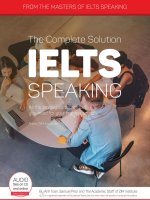
the complete solution IELTS speaking (có link tải file nghe nằm ở trang cuối cùng)
Bạn đang xem bản rút gọn của tài liệu. Xem và tải ngay bản đầy đủ của tài liệu tại đây (2.15 MB, 79 trang )
ZIM is an IELTS Training Institution with high
teaching quality under written guarantee.
With many experts in training students of
non-English speaking countries to achieve
different international certificates, ZIM
carries out the mission of making English the
second official language in Vietnam. For each
course and program, ZIM provides students
with constant and high quality support as an
endeavor to assist them to become
successful in the real tests. Apart from
official hours with teachers, ZIM also supply
students with self-studying materials which
are either collected from trusting sources or
composed by our professional staff. For
putting such priority on quality of each hour
of learning, ZIM receives non-stop advocacy
and is a trustworthy institution in training.
SELF STUDY RESOURCES
Key and Explanation Cambridge IELTS Reading Test –
Free Download –
IELTS Writing Task 2 – IELTS Simon’s Essay Analysis –
Free Download –
The Complete Solution IELTS Writing –
Free Download –
The Complete Solution IELTS Writing
Premium Version ( 29USD 49 USD 99 USD)
–
–
–
THE COMPLETE SOLUTION
SPEAKING
Anh Ngữ ZIM
Forewords
This book is written to assist students of foundation to advanced level who are preparing for
IELTS speaking test.
This small guide only acts as a self-study material and a supplement for students’ IELTS
speaking courses. Therefore, it is not recommended that students only take this book, albeit
helpful and valuable, as a sole source of preparation. Non-stop effort and diligence result in
success in the real exam!
This book is copyright © 2017. It is the product of considerable hard-work and the intellectual
property of Nguyen Anh Toan, Samuel Prior and other members of ZIM’s Academic
Department. Therefore, no part of this work, in whole or in part, may be printed, copied,
distributed or sold without the written permission from ZIM Institute.
Table of content
CHAPTER 1 .................................................................................................................................... 1
OVERVIEW .................................................................................................................................... 1
1.
What is the IELTS speaking test? .................................................................................... 2
2.
How will your performance be assessed? ..................................................................... 3
3.
What are they looking for? ............................................................................................. 4
CHAPTER 2 .................................................................................................................................... 6
TECHNIQUES ................................................................................................................................. 6
1.
Part 0: Greeting the examiner ......................................................................................... 7
2.
Part 1: Short interview ..................................................................................................... 8
3.
Part 2: Short presentation ............................................................................................. 13
4.
Part 3: Discussion ........................................................................................................... 17
CHAPTER 3 .................................................................................................................................. 23
TRAINING .................................................................................................................................... 23
PEOPLE .................................................................................................................................... 24
OBJECTS .................................................................................................................................. 33
EXPERIENCES .......................................................................................................................... 36
PLACES .................................................................................................................................... 44
FAVORITES .............................................................................................................................. 47
CHAPTER 4 .................................................................................................................................. 52
SELF-STUDY................................................................................................................................. 52
Part 1 questions ..................................................................................................................... 53
Part 2 topics ............................................................................................................................ 62
Part 3 questions ..................................................................................................................... 67
CHAPTER 1
OVERVIEW
1
1. What is the IELTS speaking test?
The IELTS speaking test is the final part of the exam. The test lasts between 11 and 14
minutes. You will be interviewed by an examiner who will record your conversation. Timing
is strictly controlled by the examiner, so do not be surprised if he or she interrupts you
during an answer.
There are 3 parts to the Speaking Test:
Good morning! My name is Tony Smith; and I am your examiner for today’s speaking
test.
- Can you tell me your full name?
- What should I call you?
- Where are you from?
- Can I see your identification, please?
Great, now we shall begin.
In the first part of the test, I will ask you some questions about yourself. Let’s begin:
Let’s talk about where you live:
- Do you live in a house or an apartment?
- What do you like best about your house/apartment?
- What would you like to change about your house/apartment?
- In the future, would you prefer to buy a house or an apartment?
I want to move on and talk about sports:
- Do you play any sports?
- What kinds of sport are popular in your country?
- Do you think that it is important for people to play sports?
Let’s talk about mathematics:
- At what age do people in your country usually have mathematics lessons at school?
- Do you think that it is reasonable to study mathematics at young age?
- What are the roles of mathematics in real life?
- Do you think that teachers should let their students use electronic devices like
calculators to solve mathematic problems?
Thank you! That is the end of the first part; and now I’d like to move on to the second
part. In this part, I will give you a topic. And I want you to talk about that topic for 1 to 2
minutes. Before you talk, you have 1 minute to think about what you are going to say;
and you can make some notes if you wish. Do you understand? Great! Here’s your paper
and pencil. I want you to describe a friend that is very important to you.
Describe an important friend
You should say:
- Who this friend is
- How the two of you met
- What you have done together
And explain why this friend is important to you
Part 0: Greeting the
examiner
Part 1: Short interview:
around 10-12 questions in
4 to 5 minutes.
Part 2: Short presentation:
talk for 2 minutes with 1
minute to prepare.
Possibly, the examiner may ask you 2 follow-up questions. But this doesn’t always
happen.
Thank you! That’s the end of the second part. I’d like to move on to our last part. We
have been talking about an important friends, now I want to ask you some more general
and abstract questions related to this.
- What can friends do to help each other?
- Do you have friends who are older or younger than you are?
- Do you think that it is easy to make friends with people who are older?
Let’s talk about friendship:
- In your opinion, how does our friendship change when we grow up?
- What is your opinion about friends on social media, such as Facebook?
- What are the dangers when we make friends with people on social media?
Part 3: Discussion: around
5-6 questions in 4 to 5
minutes.
Thank you! That’s the end of the speaking test!
2
=> Question to ponder: Do the 3 parts of the speaking test carry equal weighting when your
score is calculated, or is one part more important?
The answer is that the 3 parts are NOT scored separately, the examiner assesses your
performance as a whole. He/she will write the four sub-scores on a piece of paper during the
first part, and these four scores will be reduced or boosted as the test progresses.
2. How will your performance be assessed?
There are 4 different assessment criteria:
1.
Fluency & Coherence
2. Lexical resource
3. Grammatical range & accuracy
4. Pronunciation
A more detailed description might be downloaded here:
/>These four criteria share equal proportions in your final band score.
For example: If your scores are as follows:
Fluency
& Lexical resource
Coherence
4
Grammatical range Pronunciation
& accuracy
4
5
5
Then your overall band score would be: (4 + 4 + 5 + 5)/4 = 4.5
Both whole number and half band scores are given in the speaking test. If the overall score
is neither a whole number nor a half band score, it will be reduced to the next whole number
or 0.5 number.
For example: If the overall band score is 4.25 or 6.75, it will be reduced to 4.0 or 6.5.
3
3. What are they looking for?
It’s important to know what the examiner really expects from a high scorer. This is
something that most students either miss out or misunderstand during their first days of
preparation, which leads to certain failure in the real exam.
First, you need to know what the IELTS speaking test really is. Technically it’s a normal
conversation between you and the examiner. A lot of test takers unfortunately think it is a
formal talk and speak in a very complicated and “academic style”. The key factor to getting
a high score is to speak naturally without long pauses and to use a variety of verb tenses
correctly and flexibly.
During the first part of the test, the examiner expects you to give an immediate answer after
hearing his/her question. This part is to test your daily vocabulary and a warm-up stage
before going to part 2 and 3, so there is no need to show off good vocabulary here. You need
to focus on fluency and pronunciation by giving a random and simple answer. And
remember, keep your answer no longer than 3 sentences.
In the second part, the examiner expects you to give an organized response which lasts for,
usually, at least 1 minute and 30 seconds to 2 minutes. You should be able to show off a little
bit of your vocabulary and grammar but I advise you to focus on the coherence of your talk
and always tell a story. The examiner always wants to hear stories.
The last part of the speaking section, which is a two-way discussion where the examiner can
freely improvise his questions to follow up your answers, is to test your upper limit. The level
of difficulty increases and the examiner will try to ask you more abstract and challenging
questions. This is the part for you to show off your best vocabulary and grammar. Try to give
personal examples where possible.
Question to ponder: Is accent important to achieve a high score?
The answer is no! Accent has nothing to do with pronunciation; and therefore, it will
not affect the examiner’s assessment on your performance. You can speak in either
American, British or Vietnamese accent and still get a high score, provided that few
mistakes regarding pronunciation are made.
Points to focus on:
4
If you are aiming at band 6.0-6.5 or sometimes even higher, pay the least attention to
grammar and vocabulary. Try to speak fluently, naturally and clearly with few pronunciation
mistakes being made. Remember, “Simplicity is the ultimate sophistication’’.
5
CHAPTER 2
TECHNIQUES
6
1. Part 0: Greeting the examiner
This is the part where you can make a friendly impression on the examiner because he/she
will ask you several warm-up questions to get to know you. But there are certain things that
need to be paid attention to in order to avoid creating an awkward atmosphere.
Usually the conversation would go like this:
-
Examiner: Good morning/afternoon, my name is Tony Smith; and I am your examiner
for today’s speaking test.
Examinee: Good morning/afternoon Tony. Or Good morning/afternoon Mr. Smith.
Do not say: Good morning/afternoon Mr. Tony for Mr. only preceded a person’s family
name, not first name.
-
Examiner: Can you tell me your full name? What should I call you?
Examinee: My full name is Nguyen Anh Toan, but you can call me Toan for short.
There’s no need to expand your response any further.
-
Examiner: Where are you from?
Examinee: I am from Hanoi.
You can add some further information to this response as follows: “I was born and
raised in Hanoi, but I have moved to HCMC and been living and working in District 3 for
over 4 months.” But do not try to expand any further. You will not lose marks if you
give a short answer in this part of the test.
-
Examiner: Can I see your ID please?
-
Examinee: Sure/Certainly. Or Here you are
Do not say: Of course or here/there you go as these phrases are rather inappropriate
between you and the examiner.
7
2. Part 1: Short interview
1.
Overview
In the first part of the IELTS speaking section, the examiner will ask you approximately 10-12
questions (usually 3 different topics), all of which are about your life (work, study,
hometown, pets, sports etc.). This part lasts for about 4-5 minutes. You can check out an
example of questions in speaking part 1 in the previous section.
Note:
-
Not all part 1 questions are familiar and easy. Sometimes, they can be about social
issues (advertising, child education …) which often appear in part 3 and require more
advanced language skills to answer.
-
You will not get a high score if you only do well in this part. It only tests your everyday
vocabulary and basic grammar.
-
You have to answer 10-12 questions within 4-5 minutes, which leaves you 15-20
seconds to answer each question. Long answers will lead to the examiner
interrupting you.
-
Feel free to speak personally. Part 1 questions are about you so it’s best to talk about
yourself.
-
If you do not understand the question, politely ask the examiner to repeat it (he/she
is NOT allowed to help you or give further explanation regarding the meaning of the
questions) by saying: “I’m sorry I didn’t quite catch your question. Could you repeat
it for me please?”
2. How to answer part 1 questions:
-
Try to give short and simple answers
-
Try to answer the questions by giving at least a full sentence (3 sentences max)
-
Try to add as much information as possible within 15-20 seconds.
-
Don’t think too much about the content of your answers. Just give an immediate
answer. You will probably lose some marks if you make a long pause after hearing
the question.
8
Example:
- Do you live in a house or an apartment? Track 1.1
I live in a very large house with my family on the outskirts of Hanoi.
- What do you like best about your house/apartment? Track 1.2
Probably my small garden on the fifth floor where my parents grow chilies and
lettuce. It’s also my favorite spot for writing my blog while sipping a cup of coffee in
the morning.
- What would you like to change about your house/apartment? Track 1.3
I’d love it if my house had more bathrooms. It’s a 5 story-house but there’s only one
shared bathroom for 6 members, so sometimes it’s very inconvenient to wait for
your turn.
- In the future, would you prefer to buy a house or an apartment? Track 1.4
A house for sure. I love having a garden to enjoy my writing along with the tranquility
of the atmosphere. I don’t think buying an apartment would be a great choice
because it’s not possible for me to have a garden in an apartment.
- Do you play any sports? Track 1.5
I used to play soccer when I was younger, maybe 9-10 years back. However, I am
totally swamped with my teaching job and have almost no time to go out.
- What kinds of sport are popular in your country? Track 1.6
I would say it’s soccer which is considered the King of sport. And whenever our
national soccer team has a match with another team from abroad in our national
stadium My Dinh, the tickets are completely sold out. The crowd of fans really stirs
up the atmosphere and goes nuts after a victory of their home team.
9
- Do you think that it is important for people to play sports? Track 1.7
Yes absolutely. Playing sports is a great way to keep fit and stay healthy. Especially
the elderly should participate in Tai Chi clubs to maintain good health condition.
- At what age do people in your country usually have mathematics lessons at school?
Track 1.8
Usually from an early stage, probably at 6 years of age, Vietnamese children are
taught mathematics at primary school but lessons included in this level of education
are only about some basic calculations. The difficulty of such lessons increases as
children attend higher classes.
- Do you think that it is reasonable to study mathematics at young age? Track 1.9
No, not at all. Children should be given time to play with their parents and friends.
Through playing, they learn, and that’s the very natural and also the most suitable
way to foster their development. I don’t think making children sit at their desk to do
homework is a good practice.
- What are the roles of mathematics in real life? Track 1.10
There are a number of values that mathematics brings to us, certainly. It helps
develop our logical thinking and also our analytical ability, which contributes to our
development of problem solving skills. Besides, modern technologies, such as
rockets or space crafts, are invented based on mathematics.
- Do you think that teachers should let their students use electronic devices like
calculators to solve mathematic problems? Track 1.11
10
Although calculators and other devices offer great help to students, I don’t think it’s
a good idea to let students use them very often. Mathematics is about enhancing
individual skills, not about using tools to solve a given problem.
11
Language focus:
Words/phrases
Definition
Example of usage
On the outskirts of
The parts of a town
After a failed attempt to kill the
somewhere (n)
or a city that are the
president, Erik Lehnsherr, also known as
/ˈaʊtskəːts/
furthest from the
Magneto, decided to live on the outskirts
center
of a small town with his loving wife and
daughter, who was also a mutant.
Tranquility (n)
The quality of being
He truly enjoyed the tranquility of the
/traŋˈkwɪlɪti/
quiet and peaceful
town. Perfectly suitable for the life of a
retired international criminal who tried to
have a clean life again.
To be swamped with
To have more of
Although he was usually swamped with
work (phrase)
something than one
his work in a local factory, he managed to
/swɒmp/
can deal with
spare some time with his small family.
To stir up the
To make people feel
Every time he came home, his daughter
atmosphere (v) /stəː/
strong emotions
passionately hugged him and stirred up
the family’s atmosphere.
To go nuts (phrase)
To go crazy and
He thought his days of endless fights
uncontrollable
were finally over. The days of his mutant
fellows going nuts over discrimination
ended.
To keep fit and stay
To have a healthy
However, he still went to the gym to
healthy (phrase)
lifestyle
keep fit and stay healthy. (Okay this
example sucks T.T)
To foster something
To encourage
He always tried to foster his relationship
(v) /ˈfɒstə/
something to
with his neighbors and colleagues
develop
because he didn’t want them to know
about his past.
12
3. Part 2: Short presentation
1.
Overview
After you have finished the first part, you will be given a topic with 4 suggestions
presented. You will be asked to speak about that topic for 1-2 minutes after 1 minute of
preparation. You can make notes during this 1-minute period. Topics in the second part
mainly focus on 5 major areas:
-
Describe a person
-
Describe an object
-
Describe an experience
-
Describe a place
-
Describe a favorite
Note:
-
The most important thing to do in the second part is to KEEP TALKING for 1 to 2
minutes.
-
Don’t care much about grammar, focus on the content of the presentation
delivered in this part and also the fluency of your answer.
-
Expand your answer by focusing on the 4 suggestions that are provided.
-
You don’t need to maintain eye contact with the examiner in this part of the test.
-
Keep in mind that the examiner is NOT allowed to help you by any means in this
part.
2. How to give an impressive presentation
-
Make most use of your 1-minute period of preparation
Only write down a few key words, enough to help you remember the details of your
presentation.
13
For example:
Describe an important friend
You should say:
- Who this friend is
- How the two of you met
- What you have done together
And explain why this friend is important to you
Your note:
High school friend Roger
Desk mate
Soccer club
Confide + school bullies
Long notes would take away too much time and you might not be able to be well-prepared
in terms of the content of the presentation.
-
Have an easy and logical structure
Opening
Expansion
Ending
• Keep it clear, direct and simple
• You might start your presentation by simply saying: “I’m
going to talk about …”. This is a simple and direct opening.
• Try to tell a story and present real examples about yourself
• Follow the given suggestions.
• Keep the ending clear and simple.
• You could finish your presentation by saying: “That’s all I
want to talk about.”
14
3. Example:
Describe an important friend
You should say:
- Who this friend is
- How the two of you met
- What you have done together
And explain why this friend is important to you
Sample Track 02
I’m going to talk about my best friend Roger, whom I went to high school
A very simple and direct opening
with.
After 9th grade, I was sent to a high school which was located in the
center of Hanoi, 15 miles away from my neighborhood because my
parents believed it’d be better for me. I was set up to sit next to Roger in
the final row of my class. At first, I thought Roger was a total snob
because he bragged too much about him and his soccer team. But later I
realized that he’s a good sport after a few days and I spent more time
talking to him. We really hit it off quickly. He even invited me to join his
soccer team as he knew I was looking for an opportunity to integrate into
a new environment. We used to hang out with some other classmates at
Next, I’ll expand my response by
telling a story which is based on
the first 3 suggestions.
the backyard to play after class. Then we became closer and closer
together, he even helped me cram for math exams when I knew that he
was kind of a math freak. I was amazed that he could solve any sorts of
exercise in a perfectly timed manner. This is probably not something to
be proud of but he used to help me cheat during my final tests, which
really helped me survive through my high school years.
There are two main reasons why Roger is a very important person to me.
First, his kindness helped me a lot when I first moved to study there.
Without him, a sense of inferiority within me would have thrived because
unlike other kids, I was from the outskirts. He even protected me from
other students’ ridicule and made me feel more confident. Second, of all
people he understood me the most because he gave me a feeling that I
Then I’ll give more detail by
explaining the last suggestion
with 2 ideas, using a very simple
structure like this sample.
could trust him. Whenever I had any trouble, I would always tell him first
and he always stood by my side to offer some help.
That’s all I want to share about my friend Roger.
A very simple and direct ending
15
Language focus:
Words/phrases
Definition
Example of usage
To be a snob (n)
A person who thinks
Her boyfriends turned out to be a snob
/snɒb/
he/she is better than
after going out with her for a few weeks.
others
To brag about
To talk too proudly
He always bragged about how successful
something (v) /braɡ/
about something
he was since the first day he ran his
you own or
business in trafficking.
something you have
done.
To be a good sport
A generous and
She realized that her ex-boyfriend was
(idm)
cheerful person
actually a very good sport.
To hit it off (idm)
To have a good
She remembered that her ex and she hit
friendly relationship
it off very quickly after the first date.
with someone
To be a math freak
To be extremely
But she dumped him because he was a
(idm)
good at math
math freak and she didn’t like it.
A sense of inferiority
A feeling that other
After she broke up with him, he adopted
(np) /ɪnˌfɪərɪˈɒrɪti/
people are much
a sense of inferiority and committed
better that you are
suicide in his room.
Ridicule (n)
Unkind comments
Now, she is an object of ridicule among
/ˈrɪdɪkjuːl/
to make fun of
her friends.
someone
To stand by one’s
To support someone
She only hopes to find someone who will
side (idm)
in difficult situations
always stand by her side no matter what
might happen.
16
4. Part 3: Discussion
1.
Overview
In this part of the test, the examiner will ask you a series of questions which are related to
the topic in the second part. However, those questions are about more abstract ideas.
Note:
-
Try to give long answers. (30-40 seconds for each question)
-
You can ask the examiner to give you some time to think before giving an answer.
Sometimes, questions in part 3 can be very challenging in the sense that you cannot
give an immediate answer. However, with little time to think, you can give a decent
answer. The examiner understands that so it’s OK to ask for some preparation by
politely making comments on the questions as follows: “That’s quite difficult. Let
me think about that.”
-
In case you don’t know the answer, you can give a “I don’t know” answer. In the
speaking test, you will not lose marks if you start your answer with “I have no idea”
but make sure that you give a proper explanation why you don’t know the answer,
or you can present your guess if possible. As long as your explanations or guesses
makes sense, the examiner will not subtract your scores.
For example: How has technology affected people’s lives in big cities?
Actually I have no idea because I have been living in the countryside my entire life. My
village is completely untouched by modern technologies and I hardly go to any urban
areas so I’m in no place to tell that technology has negatively or positively changed
people’s lives. But I guess machinery aids people, especially blue-collar workers, a lot in
their work because my brother moved to Hanoi to work in a factory a few years ago. He
never stops talking about how convenient and efficient it is to use machines in
production whenever he comes home.
17
2. How to answer part 3 questions
-
Remember, direct answers are the best.
-
Expand your answers by giving real examples and facts (personal examples are
preferable)
-
Occasionally, follow the structure below:
Point
• Give a direct answer to the question
Explanation
• Present one or two reasons to support
your point
Example
• Give specific (personal where possible)
examples to illustrate the point
Alternative
• Sometimes, you can add further
information by using “Without sth”
3. Example
- What can friends do to help each other? Track 3.1
Friends can do a lot to help us in difficult times actually
because being a friend means that we always look out for
Point + explanation
one another, always stand side by side through thick and
thin. My high school friend Roger gave me a sense of trust
and I was not afraid of confiding in him whenever
Personal example
something troubled my mind. Without Roger, my high
school years would have been a complete nightmare
Alternative
because of other kids’ bullying and mockery.
18