eWork and ebusiness in architecture engineering and construction
Bạn đang xem bản rút gọn của tài liệu. Xem và tải ngay bản đầy đủ của tài liệu tại đây (25.49 MB, 1,167 trang )
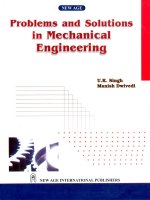
eWORK AND eBUSINESS IN
ARCHITECTURE, ENGINEERING
AND CONSTRUCTION
PROCEEDINGS OF THE 5th EUROPEAN CONFERENCE ON PRODUCT AND
PROCESS MODELLING IN THE BUILDING AND CONSTRUCTION INDUSTRY—
ECPPM 2004, 8–10 SEPTEMBER 2004, ISTANBUL, TURKEY
eWork and eBusiness in
Architecture, Engineering and
Construction
Edited by
Attila Dikbaş
Istanbul Technical University, Turkey
Raimar Scherer
University of Technology, Dresden, Germany
A.A.BALKEMA PUBLISHERS LEIDEN/LONDON/NEW
YORK/PHILADELPHIA/SINGAPORE
Copyright © 2004 Taylor & Francis Group plc, London, UK
All rights reserved. No part of this publication or the information contained herein may be
reproduced, stored in a retrieval system, or transmitted in any form or by any means, electronic,
mechanical, by photocopying, recording or otherwise, without written prior permission from the
publisher.
Although all care is taken to ensure the integrity and quality of this publication and the information
herein, no responsibility is assumed by the publishers nor the author for any damage to property or
persons as a result of operation or use of this publication and/or the information contained herein.
Published by: A.A.Balkema Publishers, a member of Taylor & Francis Group plc
and />This edition published in the Taylor & Francis e-Library, 2006.
To purchase your own copy of this or any of Taylor & Francis or Routledge’s collection of
thousands of eBooks please go to />ISBN 0-203-02342-0 Master e-book ISBN
ISBN 04 1535 938 4 (Print Edition)
eWork and eBusiness in Architecture, Engineering and Construction—Dikbaş & Scherer (eds.)
© 2004 Taylor & Francis Group, London, ISBN 04 1535 938 4
Table of Contents
Preface
xii
Organization
xv
Keynote papers
The future forces of change for the construction sector—a global perspective
R.Flanagan
Vectors, visions and values
P.S.Brandon
Help wanted: project information officer
T.M.Froese
The next generation of eBusiness and eWork—what is needed for the systemic
innovation? An executive summary of the EU supporting research and
innovation.
B.Salmelin
2
16
29
38
Product modelling technology
Virtual building maintenance: enhancing building maintenance using 3D-GIS
and 3D laser scanner (VR) technology
V.Ahmed, Y.Arayici, A.Hamilton & G.Aouad
Supporting standard data model mappings
R.W.Amor
Virtual building environments (VBE)—applying information modeling to
buildings
V.Bazjanac
A persistence interface for versioned object models
D.G.Beer, B.Firmenich, T.Richter & K.Beucke
Semantic parameterized interpretation: a new software architecture for
conceptual design systems
A.Eir
Harmonization of ISO 12006–2 and IFC—a necessary step towards
interoperability
A.Ekholm
41
50
58
73
92
108
A novel modelling approach for the exchange of CAD information in civil
engineering
B.Firmenich
Integration of product models with document-based information
T.M.Froese
Aligning IFC with the emerging ISO10303 modular architecture. Can AEC
community take advantages from it?
R.Jardim-Gonçalves, K.Farinha & A.Steiger-Garcao
Optimization of project processing in the steel construction domain
E.Holtzhauer & H.Saal
Location sensing for self-updating building models
O.Icoglu & A.Mahdavi
Modeling cast in place concrete construction alternatives with 4D CAD
R.P.M.Jongeling, T.Olofsson & M.Emborg
Pilot implementation of a requirements model
A.Kiviniemi & M.Fischer
A combined product-process model for building systems control
A.Mahdavi
FIDE: XML-based data model for the spanish AEC sector
J.M.Molina & M.Martinez
A framework for concurrent structure analysis in building industry
A.Niggl, R.Romberg, E.Rank, R.-P Mundani & H.-J.Bungartz
IFC supported distributed, dynamic & extensible construction products
information models
M.Nour & K.Beucke
Product definition in collaborative building design and manufacturing
environment
H.Oumeziane, J.C.Bocquet & P.Deshayes
Implementation of the ICT in the Slovenian AEC sector
T.Pazlar, M.Dolenc & J.Duhovnik
Adding sense to building modelling for code certification and advanced
simulation
I.A.Santos, F.Farinha, F.Hernández-Rodríguez & G.Bravo-Aranda
Towards engineering on the grid
Ž.Turk, M.Dolenc, J.Nabrzyski, P.Katranuschkov, E.Balaton, R.Balder &
M.Hannus
Managing long transactions in model server based collaboration
M.Weise, P.Katranuschkov & R.J.Scherer
A software generation process for user-centered dynamic building system models
G.Zimmermann & A.Metzger
Process modelling technology
123
136
144
155
167
178
191
206
222
233
249
261
270
284
296
311
326
Embedded commissioning for building design
Ö.Akin, M.T.Turkaslan-Bulbul, I.Gursel, J.H.Garrett Jr, B.Akinci & H.Wang
The development of a technical office organization structure for enhancing
performance and productivity in fast track construction projects
T.A.H.Barakat, A.R.J.Dainty & D.J.Edwards
Innovative production planning system for bespoke precast concrete products
V.Benjaoran, N.Dawood & R.Marasini
Process and information flow in mass customisation of multi-story housing
T.Olofsson, L.Stehn & E.Cassel-Engqvist
RoadSim: an integrated simulation system for road construction management
S.Castro & N.Dawood
Connet Turkey—gateway to construction in Europe
A.Dikbaş, S.Durusoy, H.Yaman, L.Tanaçan & E.Taş
Modelling collaborative processes for Virtual Organisations in the building
industry
M.Keller, P.Katranuschkov & K.Menzel
Process modelling in building engineering
M.König, A.Klinger & V.Berkhahn
Space competition on construction sites: assignment and quantification utilising
4D space planning tools
Z.Mallasi & N.Dawood
Project planning: a novel approach through a universal e-engineering Hub—a
case study of seismic risk analysis
G.Augenbroe, Z.Ren, C.J.Anumba, T.M.Hassan & M.Mangini
A decision support model for material supply management for the construction
industry
J.Perdomo, W.Thabet & R.Badinelli
Modeling processes and processing product model information based on Petri
Nets
U.Rueppel, U.F.Meissner & S.Greb
A building material information system: BMIS—in the context of CONNET–
Turkey project
E.Taş, L.Tanaçan, H.Yaman & A.Dikbaş
343
358
371
384
395
408
417
432
447
463
480
495
507
Ontologies
Managing changes in the AEC industry—how can ontologies help?
Q.Y.Cai & F.F.Ng
An ontology-driven approach for monitoring collaborative design knowledge
Y-C.Lai & M.Carlsen
Setting up the open semantic infrastructure for the construction sector in
Europe—the FUNSIEC project
C.Lima, B.Fiès, C.Ferreira da Silva & S.Barresi
518
528
540
Practical use of the semantic web: lessons learned and opportunities found
R.V.Rees, W.V.Vegchel & F.Tolman
Supporting ontology management through self-describing concepts
T.E.El-Diraby
555
569
eWork and eBusiness
An assessment methodology for eBusiness and eCommerce in the AEC sector
A.Grilo, R.Maló & R.Jardim-Gonçalves
The digital dormer—applying for building permits online
J.P.van Leeuwen, A.J.Jessurun & E.de Wit
An inquiry into building product information acquisition and processing
A.Mahdavi, G.Suter, S.Häusler & S.Kernstock
Usefulness and ease-of-use assessment of a project management tool for the
construction industry
B.Otjacques, G.Barrère, F.Feltz & M.Naaranoja
Development and implementation of a functional architecture for an eengineering Hub in construction
Z.Ren, C.J.Anumba, T.M.Hassan & G.Augenbroe
Legal and contractual issues—are they considered in RTD achievments
M.A.Shelbourn, T.M.Hassan & C.D.Carter
Modeling of ERP system solutions for the construction industry
M.O.Tatari, B-Y.Ryoo & M.J.Skibniewski
Construction informatics themes in the framework 5 programme
Ž.Turk
585
594
607
621
633
648
660
670
Collaborative working
Virtual pools of resources eliminate idle or missing equipment in AEC
companies
G.Antoniadis & K.Menzel
DIVERCITY: distributed virtual workspace for enhancing communication and
collaboration within the construction industry
Y.Arayici & G.Aouad
Cooperation and product modelling systems
S.Blokpoel, R.R.M.Jongeling & T.Olofsson
Linking early design decisions across multiple disciplines
R.Drogemuller, J.Crawford & S.Egan
State of the art of the implementation of Information Management Systems in the
construction industry in Spain
N.Forcada, M.Casals & X.Roca
Agent-enabled Peer-To-Peer infrastructure for cross-company teamwork
A.Gehre, P.Katranuschkov & R.J.Scherer
686
695
707
719
731
744
Virtual communities: design for collaboration and knowledge creation
I.L.Kondratova & I.Goldfarb
The design framework—a web environment for collaborative design in the
building industry
M.Huhn
Collaborative work practices in Turkey, five case studies
A.Sanal
Architecture for collaborative business process management—enabling dynamic
collaboration
S.Zang, O.Adam, A.Hofer, C.Hammer, M.Jerrentrup & S.Leinenbach
Comprehensive information exchange for the construction industry
J.Díaz
761
771
780
793
807
Mobile computing
Mapping site processes for the introduction of mobile IT
S.L.Bowden, A.Dorr, A.Thorpe & C.J.Anumba
Mobile field data entry for concrete quality control information
I.L.Kondratova
Issues of context sensitivity in mobile computing: restrictions and challenges in
the construction sector
K.Menzel, K.Eisenblätter & M.Keller
A context based communication system for construction
D.Rebolj, A.Magdič & N.Č.Babič
MOBIKO—mobile cooperation in the construction industry based on wireless
technology
R.Steinmann
817
831
843
862
873
Knowledge management
Support for requirement traceability in design computing: an integrated approach
with building data modeling
I.Özkaya & Ö.Akin
Interlinking unstructured text information with model-based project data: an
approach to product model based information mining
S.-E.Schapke & R.J.Scherer
Live capture and reuse of project knowledge in construction: a proposed strategy
C.E.Udeaja, J.M.Kamara, P.M.Carrillo, C.J.Anumba, N.Bouchlaghem & H.Tan
Development of product family structure for high-rise residential buildings using
industry foundation classes
T.Wallmark & M.M.Tseng
885
900
913
923
Construction site and project management
Assistance to building construction coordination by images
S.Kubicki, G.Halin & J.-C.Bignon
Gesprecons: eSafety and risk prevention in the construction sector
J.M.Molina, M.Martinez & I.García
Intelligent Construction Sites (ICSs)
T.Mills, Y.Jung & W.Thabet
Organizational point of view for the use of information technology in
construction projects
P.Praper
Virtual reality at the building site: investigating how the VR model is
experienced and its practical applicability
S.Woksepp, O.Tullberg & T.Olofsson
Evaluating competitiveness in construction industry: an alternative frame
A.Y.Toprakli, A.Dikbaş & Y.Sey
941
952
964
974
980
994
Seismic risk and environmental management
Analyses of Izmit earthquake by means of remotely sensed data: a case study,
Yalova city
S.Kaya, F.Bektas, C.Goksel & E.Saroglu
Do phased Environmental Management Systems actually benefit SMEs?
L.L.Hopkinson & C.Snow
Software based knowledge integration for seismic risk management
R.Pellegrini & P.Salvaneschi
Real-time earthquake prediction algorithms
S.Radeva, R.J.Scherer & D.Radev
1004
1013
1021
1031
IT supported architectural design
Hybrid approach to solve space planning problems in building services
G.Bi & B.Medjdoub
A computational architectural design approach based on fractals at early design
phases
Ö.Ediz & G.Çağdaş
APSIS architectural plan layout generator by exhaustive search
B.Kisacikoglu & G.Çağdaş
Architectural parametric design and mass customization
S Boer & K Oosterhuis
1042
1055
1063
1082
S.Boer & K.Oosterhuis
A model for hierarchical floorplan geometries based on shape functions
G.Zimmermann & G.Suter
1101
E-learning and education
Parametric representation of functional building elements with reference to
architectural education
M.Aygün & İ.Çetiner
Life long learning for improved product and process modeling support
p.Christiansson
E-learning with puzzle collages
C-H.Lin, T-W.Chang, L-C.Yang & S-C.Chen
1115
Author index
1144
1119
1133
eWork and eBusiness in Architecture, Engineering and Construction—Dikbaş & Scherer (eds.)
© 2004 Taylor & Francis Group, London, ISBN 04 1535 938 4
Preface
The global community has stepped into the next revolutionary phase of the long-term
evolution of the information society and is now facing a new challenging phenomenon:
Ambient Intelligence—providing and getting the right information to the right people in
the right configuration at the right time anywhere. Our business processes have started to
change. New working methods are available and asked for; new forms of organizations
have been proven to be efficient and effective—the vision of the previous decade have
been conquering practice. Ambient intelligence is the final keystone for a breakthrough
and the industry-wide business revolution, in particular for our one-of-a-kind multishareholder and hence very complex projects.
Intelligent management of the right information has become the focus of research.
Computing power is now available on the Web and basic technologies—like P2P, Grid,
Agents and Web services—have been developed to ripeness by the informatics
community for application in AEC/FM. Apply it to your benefit—this is the offer of the
informatics community—and also the challenge.
Making intelligence happen requires more than solely utilizing the basic technologies
and computing power on the Web. It means algorithms, either numerical or reasoning
ones and it means enhanced semantic data structures, in which the information and
knowledge is integrated and can be retrieved on request—when and where and how
desired. Intelligence does not mean merely powerful numerical algorithms for solving
and simulating complex engineering systems—as understood in computational
mechanics. In this context intelligence means autonomous problem specification,
decision preparation for problem solving and to some extent even problem solving itself.
Such systems, not necessarily located on one computer and eventually distributed
throughout the Web, should be capable of recognizing, deciding, retrieving and providing
any piece of information, not only explicitly stored data, and at the same time support the
co-operation with the end-user to serve him/her intelligently and polite. Data structures
and hence product and process modelling are as important as the respective algorithms to
make this happen, in particular for recognising the context, which is the prerequisite for
any autonomous action. Data structures, i.e. data schemata must inherit meanings,
semantics must be more than an identifier. They have to encapsulate knowledge on the
objects. This knowledge must be re-usable in a flexible way and provide for reasoning to
interrelate it with knowledge on other objects and their status described by the object data
in order to build up the current context. Recognizing the effective state and crystallizing
the particular problems and various actors in an instantaneous process we are able to
finally provide the right and focused information. This makes ambient intelligence
happen.
Research on and building of ontologies besides product data models have increasingly
been the focus of research activities in AEC/FM. However, do ontologies really replace
product data models? Or if not, do they subsume them? It is neither of them. Ontologies
extend product models adding a new functionality, namely carrying knowledge, which is
simply another objective. The main objective of product models is the very generic
representation of real world objects as well as their respective general relationships to
form a generic object net from the singular units, the objects to model a very generic
skeleton for any kind of application. Other extensions to the generic product model are
already on the way. For instance, product models are favoured, being the anchor for
project documents and structuring the document information space. Data and text mining
methods are increasingly applied to identify the representative semantic items of the
documents and mapping them to the semantics of the product model in order to interpret
the meaning of the document, i.e. recognizing its information contents and further multiinterlinking it with the product model. Again, being accessible via a VR building
environment, ambient intelligence makes document information tangible. The user is no
longer required to search for the right document in order to get the right information, he
only has to identify the building object in his VR model and the information system
provides him with the right information at any place and any time. The power of the
automatic selectiveness depends upon the capacity and power of the underlying contextsensitive system—and again context-sensitivity is first of all determined by logic
reasoning on product and process models based ontologies. We can subsume generic
product models and ontologies as well as any other knowledge-related extensions of
product models to be intelligent product models.
In recent years, the quality of product models has reached a level that allows for the
design of reasoning systems to check architecture and engineering systems consistency as
well as conformity with building codes and guidelines. The few existing and very
successful examples have to be considered first attempts, looking at the great variety of
reasoning methods provided by basic informatics—this new area has just been touched
on. However, the results gained are more than promising. The consistency checking
methods are an important pre-requisite for co-operative and concurrent working, namely
the consistency problems arising from long-term transactions in complex data bases, as it
is the case in our AEC/FM data bases. We have now the confidence that they can be
handled, but practically sufficient solutions still need valuable research and development
efforts to cope with the whole AEC/FM domain.
In this context, the numerical and reasoning algorithms are utilised in a new, separate
information process, namely the information configuration process, so that we can now
distinguish among processes on three different levels. Besides modelling the tangible
work processes such as the production, organizational as well as the planning and
controlling processes, we have to consider the intangible communication processes
supporting formal information management and information logistics as well as the
configuration processes to determine e.g. the user’s information needs, critical
notification events or the optimal configuration and presentation of the information. In
the future our research efforts will more and more shift from basic product and tangible
process modelling to enhanced intelligent product modelling and information process
modelling.
In recent years, new business concepts and modelling techniques have been developed
for the virtual enterprise that have demonstrated their proficiencies in several best
practice cases. Again ambient intelligence and additionally mobile computing are
expected to provide for a push to flexible adopt the formal business models in AEC/FM
practice. It will be of utmost importance to the industry to extend these organisational
models to efficient autonomous teamwork across enterprises anywhere and in any team.
Flexible systems and automatic configuration methods are required to install immediately
operable virtual teams within short lead times, that are supported by sound organization
structures, team-focused information spaces and corresponding information logistics.
Virtual enterprises will no longer be limited to strategic alliances providing
interoperability on a corporate and/or product level, but will also be able to significantly
reduce the management cost of true interenterprise collaboration on the team level.
Focusing on a few selected but outstanding topics of today’s research on Product and
Process Modelling the papers of the ECPPM 2004 draw a very good overview on the
current state of the art in practice, emerging new business models as well as on the
cutting edge technologies available for architecture, engineering and construction. It thus
provides for solid fundament to explore the outlined possibilities of applying ambient
intelligence in our domain.
The Istanbul Technical University, Turkey has been selected to host the ECPPM in
2004. After holding the ECPPM 2002 in the former candidate state of Slovenia, the
EAPPM therewith again takes a clear stand for integrating researchers from all over
Europe and aligning the various activities in product and process modelling for a better
future. Today, Turkey is potential new EU member state of great importance and an agile
economy. Moreover, it is the bridge between Europe and Asia and it has been a melting
pot of cultures for more than 3000 years.
In Istanbul the ECPPM 2004 again introduces a new platform to share knowledge and
transform it into an active, fimctional asset ready to be shared, integrated and traded.
Latest research results and businesses applications in the areas of eWork and eBusiness,
product and process modelling, collaborative working, mobile computing, knowledge
management, ontology will enable research and industry organisation to develop new
lines of services and usher in a new breed of research areas. The committees of ECPPM
2004 have selected the best papers and organized attractive sessions for their
presentation. The number of abstracts submitted was again unusually high and their
quality was remarkable.
Numerous people have made conference and the proceedings possible. We thank the
authors, the scientific committee members and the ITU Project Management Centre for
their contribution, support and encouragement in compiling this book. Sincere gratitude
to each and all of them.
Attila Dikbaş and Raimar Scherer
Istanbul and Dresden, June 2004
eWork and eBusiness in Architecture, Engineering and Construction—Dikba§ & Scherer (eds.)
© 2004 Taylor & Francis Group, London, ISBN 04 1535 938 4
ECPPM 2004 Organization
CONFERENCE CHAIR
Attila Dikbaş, Istanbul Technical University, Turkey
STEERING COMMITTEE
Raimar Scherer, University of Technology Dresden, Germany
Ziga Turk, University of Ljubljana, Slovenia
Gülsün Sağlamer, Istanbul Technical University, Turkey
Nüzhet Dalfes, Istanbul Technical University, Turkey
Yildiz Sey, Istanbul Technical University, Turkey
EDITORIAL BOARD
Amor, R., University of Auckland, New Zealand
Andersen, T., FMRI Consultant, Denmark
Augenbroe, G., Georgia Institute of Technology, USA
Bjoerk, B-C, Swedish School of Economics and Business Administration, Finland
Böhms, M., TNO, Netherlands
Cervenka, J., Cervenka Consulting, Czech Republic
Christiansson, R, Aalborg University, Denmark
Çağdaş, G., Istanbul Technical University, Turkey
Dağ, H., Istanbul Technical University, Turkey
Drogemuller, R., CSIRO, Australia
Ekholm, A., Lund University, Sweden
Fischer, M., Stanford University, USA
Froese, T., University of British Columbia, Canada
Fruchter, R., Stanford University, USA
Giritli, H., Istanbul Technical University, Turkey
Goncalves, R., Universidade Nova Lisboa, Portugal
Haas, W., Haas+Partner Ingenieurges. mbH, Germany
Kalay, Y., Berkeley University, USA
Kanoğlu, A., Istanbul Technical University, Turkey
Katranuschkov, R, TU Dresden, Germany
Lemonnier, A., ADEI, Spain
Menzel, K., TU Dresden, Germany
Mitchell, J., Graphisoft, Hungary
Moore, L., University of Wales, EG-SEA-AI, UK
Rezgui,Y., University of Salford, UK
Sağlamer, A., Istanbul Technical University, Turkey
Skibniewski, M., University of Purdue, USA
Smith, L, Federal Inst. of Tech., IABSE WC6, Switzerland
Steinmann, R., Nemetschek, Germany
Thomas, K., Waterford Institute of Technology, Ireland
Tzanev, D., University of Sofia, Bulgaria
Baslo, M., Istanbul Technical University, Project Management Center
Ergun, Z.N., Istanbul Technical University, Project Management Center
PROGRAM COMMITTEE
Amor, R., University of Auckland, New Zealand
Andersen, T., FMRI Consultant, Denmark
Anumba, C., Loughborough Uni., UK
Augenbroe, G., Georgia Institute of Technology, USA
Bjoerk, B-C., Swedish School of Economics and Business Administration, Finland
Böhms, M., TNO, Netherlands
Borkowski, A., Polish Acad. of Sciences, Poland
Cervenka, J., Cervenka Consulting, Czech Republic
Christiansson, P, Aalborg University, Denmark
Coyne, R., University of Edinburg, UK
Drogemuller, R., CSIRO, Australia
Ekholm, A., Lund University, Sweden
Fischer, M., Stanford University, USA
Froese, T., University of British Columbia, Canada
Fruchter, R., Stanford University, USA
Garas, F., Consultant, UK
Garrett, Jr., J., Carnegie Mellon University, USA
Goncalves, R., Universidade Nova Lisboa, Portugal
Gudnason, G., Icelandic Building Research, Iceland
Haas, W., Haas+Partner Ingenieurges. mbH, Germany
Hannus, M., VTT Technical Res. Centre of Finland
Howard, R., Technical University of Denmark
Juli, R., Obermayer Planen+Beraten, Germany
Kalay, Y., Berkeley University, USA
Katranuschkov, P, TU Dresden, Germany
Llambrich, A., ADEI, Spain
Lemonnier, A., ADEI, Spain
Liebich, T., AEC3, IAI, Germany
Mangini, M., Geodeco S.p.A., Italy
Martinez, M., AIDICO Constr. Tech. Inst., Spain
Mitchell, I, Graphisoft, Hungary
Moore, L., University of Wales, EG-SEA-AI, UK
Nolan, J., European Commission, Belgium
Rezgui,Y., University of Salford, UK
Skibniewski, M., University of Purdue, USA
Smith, L, Federal Inst. of Tech., IABSE WC6, Switzerland
Sozen, Z., Istanbul Technical University, Turkey
Steinmann, R., Nemetschek, Germany
Storer, G., Consultant, UK
Tzanev, D., University of Sofia, Bulgaria
Vanier, D., National Research Council, Canady
Winzenholler, J., Autodesk, Germany
Wix, J., AEC3, IAI, UK
Zarli, A., CSTB, France
LOCAL ORGANISING COMMITTEE
Akkoyun, I., ITU, Project Management Center
Artan, D., ITU, Project Management Center
Aslay, Z., ITU, Project Management Center
Baslo, M, ITU, Project Management Center
Çağdaş, G., ITU, Faculty of Architecture
Çelik, Ç., ITU, Project Management Center
Dağ, H., ITU, Informatics Institute
Erdem, A., ITU, Faculty of Architecture
Ergun, Z. N., ITU, Project Management Center
Gökçe, Umut, ITU Project Management Center, TU Dresden
Göksel, Ç., ITU, Faculty of Civil Engineering
Ilter, T., ITU, Project Management Center
Oraz, G., ITU, Faculty of Architecture
Öney, E., ITU, Faculty of Architecture
Sanal, A., ITU, Faculty of Architecture
Taşli, R., ITU, Faculty of Civil Engineering
Yaman, H., ITU, Faculty of Architecture
Keynote papers
eWork and eBusiness in Architecture, Engineering and Construction—Dikbaş & Scherer (eds.)
© 2004 Taylor & Francis Group, London, ISBN 04 1535 938 4
The future forces of change for the
construction sector—a global perspective
Roger Flanagan
The University of Reading, UK
ABSTRACT: All organisations, whether they are engineering and design
consultants, contractors, or manufacturers and suppliers in the
construction sector, need a strategy to survive, grow and succeed in a
rapidly changing world. This paper identifies nine drivers that are
impacting construction organisations. These drivers emanate from
political, environmental, technological, social and economic changes
impacting the global economy. In facing change, there is a need to balance
the internal juxtaposition of change and continuity. The error made by
some organisations is that they see all the new technology and materials
and feel it must be used as soon as possible. Stopping to develop a
strategy is important; it provides the framework to implement a plan for
the future whilst maintaining the goals and the direction of the
organisation.
1 INTRODUCTION
The challenge for all organisations is facing, managing and implementing change, whilst
at the same time ensuring profitability and maintaining customer satisfaction.
Construction organisations need to recognise today, the oppoijunities of tomorrow.
Realism must prevail; construction is predominantly a local business using mainly local
labour and complying with local requirements. The developed countries will have
different needs to developing, and newly industrialised countries. For example, India’s
need is to have an efficient industry that can provide work for the people, whereas in the
USA, with its higher cost base, the need is to build efficiently by exploiting technology,
more mechanisation, and off site pre-fabrication wherever possible.
Our lives have been transformed by electronics and information technology but, most
of all, by the processes of change itself. Knowledge has become pivotal and globalisation
has changed the face of competition.
Local issues will always be important, but construction sectors around the world are
not immune from the global issues that impact upon the economy, demand for their
services, and quality of life. Drivers can be defined as those forces that cannot be
changed and are an inevitable result of development in the broadest sense. The drivers of
change involve social, technological, economic, environmental and political trends. Many
countries have undertaken futures studies and Foresight studies with the aim of
identifying the drivers that will influence construction in the next 20 years. Studies from
10 developed countries (Australia, Canada, Finland, France, Germany, Ireland,
The future forces of change for the construction sector
3
Singapore, Sweden, UK and USA) were analysed, from which nine key drivers were
identified for the purposes of this paper; it is possible to identify many more drivers. Each
country is influenced by local needs and challenges, with different emphasis between the
developed and developing world. However, organisations need to consider the drivers of
change and ask: ‘How will the drivers affect our business in the future, are they a threat
or an opportunity, how should we react to the challenge?’
2 THE DRIVERS
1 Urbanisation, growth of cities, and transportation
2 Ageing population
3 Rapid technological and organisational change
4 Environmental and climate change
5 Shift from public to private
6 The knowledge economy and information overload
7 Technologies for tomorrow
8 People, safety and health
9 Vulnerability, security, corruption and crime
2.1 Urbanisation
The move from rural to urban communities, and the change from agricultural to industrial
societies in all parts of the world is putting pressure on infrastructure and changing
patterns of settlement. Between 1990 and 2025 the number of people living in urban
areas is projected to double to more than 5 billion (UN, 1996).
In 1800, only 2% of the world’s population was urbanised; this rose to over 30% in
1950, and 47% in 2000; a population that was growing three times faster than the
population as a whole. Figure 1 shows that the percentage of urbanisation is predicted to
be over 60% by 2030.
Growing urbanisation creates congestion, puts pressure on utilities, and results in
many social issues. In many cities built since the Industrial Revolution there is a decaying
infrastructure that is not meeting increased demand. By 1900 only 12 cities had 1 million
or more inhabitants, by 1950, this had grown to 83 cities. In 2004, there are over 410
cities with over 1 million people (UN). The current stock of infrastructure cannot cope,
and modification, modernisation and refurbishment will be required to the existing
infrastructure, with particular emphasis on the environmental impact. This dilemma is
typical of many countries around the world.
eWork and eBusisness in architecture, engineering and construction
4
Figure 1. The growth of urbanisation
(The Population Institute, 2004).
People are more mobile, using roads, rail and air more frequently. In the UK, the average
person travelled 5 miles per day in 1950, and 28 miles in 2001. Projections suggest this
could reach 60 miles a day by 2025 (Cabinet Office, 2001). New airport development is
fraught with social and environmental problems as airport development increases
urbanisation, putting pressure on available land. Increased airport capacity will involve
new regional airports with technology to cope with noise levels.
The future forces of change for the construction sector
5
2.1.1 Growth of cities
Congestion is an increasing problem in urban areas, impacting the economy and the
environment. European research showed that congestion costs between 1–2% of GDP
(Cabinet Office, 2001). New methods of car parking will be required on streets and in car
parks. Automatic (electro-mechanical) parking without manual assistance is being used in
congested city centres, based on an underground silo system making maximum use of
limited space (Trevipark, 2004).
2.1.2 Transportation
Modernisation and retrofit is required for existing transport infrastructure. Engineers will
retrofit roads with new technologies rather than reconstruct them; interactive vehicle-road
systems will be widespread.
Underground road construction will be inevitable as cities become more crowded.
According to one report, it is anticipated that 10% of the trunk road network in the UK
will be tunnelled by 2050. However, the report highlights the cost of tunnel
maintenance—about 10 times that of an equivalent surface road. Restricting tunnels to
cars and lighter vehicles can improve operation and reduce construction cost by around
40%. (RAC Foundation, 2002). This trend is also evident, for example in Sweden, the
Gota Tunnel, and the ‘Big Dig’ in Boston. Tunnelling must be seen in the future as a
viable option if all social and environmental costs are included.
Light rail systems and people movers will be used increasingly in urban areas. Rail
infrastructure is in need of renewal and improvement to take account of high speeds,
greater density of use, improved safety measures and modernisation of control systems.
Maglev (magnetically levitated) trains, that allow speeds of up to 350 km per hour, have
experienced a long period of research, but development and application is now
proceeding. For example, China is considering 250 km of rail extensions north and south
of Shanghai using a maglev system.
Greater demand management is needed including price tolling and inter-modality,
maintenance planning and durability. Advanced transport telematics (ATT), will become
prevalent, specifically concerned with improving safety and efficiency in all forms of
transport and reducing damage to the environment. ATT allows efficient management
and improvements in many areas of road transportation, such as demand management
and automatic debiting, driver information and guidance, pedestrian and vehicle safety;
monitoring of vehicle emissions; trip planning; integrated urban traffic control; public
transport; and freight transport.
2.2 Ageing population
The developed world has an ageing population whilst populations are getting younger in
the developing world. According to the United Nations, the number of persons aged 60
years or older was estimated to be nearly 600 million in 2000 and is projected to grow to
almost 2 billion by 2050, at which time the population of older persons will be larger than
the population of children (0–14 years) for the first time in human history (UN, 2004).
eWork and eBusisness in architecture, engineering and construction
6
The majority of the world’s older persons reside in Asia (53%) while Europe has the next
largest share (25%). Figures 2 and 3 show the percentage of population over 60 in
different countries across the world.
Figure 2. Percentage of population
over 60–2002 (UN, 2004).
Figure 3. Percentage of population
over 60–2050 (UN, 2004).
One of every 10 persons is now aged 60 years or older; by 2050, the United Nations
projects that 1 person of every 5 and, by 2150, 1 of every 3 will be aged 60 years or
older. The percentage is much higher in the more developed than in the less developed