IELTS reading final
Bạn đang xem bản rút gọn của tài liệu. Xem và tải ngay bản đầy đủ của tài liệu tại đây (1.5 MB, 180 trang )
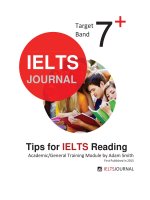
Target
Band
IELTS
7
+
JOURNAL
Tips for IELTS Reading
Academic/General Training Module by Adam Smith
First Published in 2015
IELTSJOURNAL
Contents
What’s in the Academic Reading test?
5
Approaching the IELTS Reading test
6
Finding: Step I (Skimming)
6
Mapping: Pin Dropping
7
What are keywords?
9
Finding: Step II (Scanning)
9
Understanding (Intensive reading)
11
Do reading tests without a time limit
15
IELTS Reading is a vocabulary test
17
Read to improve your vocabulary
18
Learning useful words
19
The Keyword Technique
19
Look for Keywords
20
Finding Similar Words or Phrases
21
Should you read the whole passage?
23
Think but DON’T ‘over-think’ the answer
23
The importance of vocabulary
26
Collecting Vocabulary
33
Difficult Vocabulary
34
Guessing the meanings of new words from the text
35
Guessing is a useful strategy
36
Understanding what writers are doing
39
Academic/General Reading Question Types
40
IELTS JOURNAL
2
Reading: Multiple choice
41
Multiple Choice Questions Activity
44
Identifying information
46
Identifying writer’s views or claims
48
Identifying Information and Writer’s Views
50
Matching information (Which paragraph contains …?) 55
Matching Information Activity
56
Matching headings
59
Matching Headings Activity
61
Top 4 tips for 'paragraph headings'
64
Matching features or classification
65
Matching Features Activity
68
Matching sentence endings
70
Matching Sentence Endings Activity
71
Sentence completion
74
Summary, note, table, flow-chart completion
76
Summary completion (Type A)
77
Summary completion (Type B)
78
Note completion
79
Table completion
80
Flow-chart completion
81
Summary, Note, Table, Flow-chart Completion Activity 82
Diagram label completion
84
Diagram Label Completion Activity
85
IELTS JOURNAL
3
Short-answer questions
87
Reading Advice
92
Always Analyze your Wrong Answers
92
Focused Practice Reading Exercises
93
Sample Academic Reading A: Questions
128
Why Study History?
138
Preparing for the IELTS reading test
147
IELTS READING FULL TESTS
156
Keep in touch!
180
NOTE: THE ANSWER KEY IS PROVIDED IN A SEPARATE FILE FOR EASIER ACCESS.
Use this book together with the instagram page @ieltsjournal
The instagram page contains lessons that show how to use the ideas from this
book. You can keep in touch with the author there and ask your questions.
IELTS JOURNAL
4
The IELTS Reading Test
What’s in the Academic Reading test?
The IELTS academic reading test consists of three reading texts with a total of 2,200 to
2,750 words and 40 questions with a variety of task types. The texts come from
magazines, journals, books and newspapers and have been written for a non-specialist
audience. At least one text contains detailed logical argument. The texts may include
diagrams, graphs or illustrations.
There is 1 mark for each correct answer. There is no negative mark. You have 60
minutes to answer 40 questions including time to copy your answers onto the answer
sheet.
While answering, Candidates are required to transfer their answers to an answer
sheet. Candidates must transfer their answers during the time allowed for the test. No
extra time is allowed for transfer. Care should be taken when writing answers on the
answer sheet as poor spelling and grammar are penalised.
Here are some of the problems students have with IELTS Reading:
‚
‚
‚
‚
Time is the biggest problem. Many students don't manage to finish the test.
The texts are long and contain some difficult vocabulary.
Students find "paragraph headings" questions difficult.
Students find "true/ false/ not given" questions difficult.
Tip: IELTS Reading is really a test of your vocabulary. If your knowledge of English
words and phrases is good, you will do well.
Note: There are techniques that can help you to work faster and cope with the difficult
question types. However, the best way to improve your IELTS Reading score is by doing
a lot of reading and vocabulary work.
IELTS JOURNAL
5
Approaching the IELTS Reading test
Many teachers and books talk about skimming and scanning as key techniques for
IELTS reading. But, here we refer to the words 'skimming' and 'scanning' as ‘finding’ in
my lessons as they may seem confusing to students. In fact, many students get the
wrong answers because they 'skim' too quickly and miss the words that they are
looking for. So, forget 'skimming' and 'scanning' and focus on 'finding' and intensive
reading as referred to 'understanding' here from now on.
1. Finding that is reading the text to find words from the question.
2. Understanding that is when you have found some key words from the question,
read that part of the text carefully in order to understand it and get the right
answer.
In fact, IELTS reading is really a test of 2 things:
1. Can you find the part of the text that contains the answer?
2. Do you understand that part of the text?
Finding: Step I (Skimming)
You need to be able to find the right part of the text quickly. You should practice
finding a lot and then decide which words in the question you need to search for.
Then, you should try to locate those words (or words with the same or similar
meaning) in the text.
While finding words, don’t try to understand every word. Jump from paragraph to
paragraph, finding the main point in each paragraph before moving on to the next
paragraph, like jumping across stepping-stones in a river. The main point of each
paragraph is often, though certainly not always, the first sentence in each paragraph.
The sentence with the main point is called the ‘topic sentence’ or ‘main idea’.
When you are looking at sentences to understand the main points, try to find the
keywords in the sentence, namely the subject, the verb and the object of the main
clause. Try to ignore the other words, particularly the relative clauses and adverbial
clauses. Say, for example, you are skimming through the following sentence in a
passage:
“Whale oil, rendered from the blubber, was used originally for lamp fuel and
later as a principal ingredient of soaps, margarine, paint oils and lubricants.”
While finding words or the main idea, it is enough to understand that ‘this oil’ was
used for something. Now, let’s find the main idea in this sentence:
IELTS JOURNAL
6
“Tea plants are grown on tea plantations, called gardens or estates, in areas that
have a great amount of rainfall and rich loamy soil.”
It is enough to understand that tea plants are grown on/in somewhere/somehow. If
you later find a question that relates to this sentence, you can come back and read it
more intensively.
Mapping: Pin Dropping
Every passage you see in the IELTS academic reading test may seem completely
strange to you. It is easy to get lost inside all the words you face in a passage. What
you need is a map which will help you orientate. Every paragraph in a passage has its
own main idea, which is different from all other paragraphs. On the margins near each
paragraph, write briefly what its main idea is. You can also underline the main idea or
the words in the paragraph which explain its main idea. This process is called mapping
or pin dropping. You can create a map while finding.
You can now practice finding main ideas and mapping. Make sure you find the main
ideas in the passage below as quickly as possible within the time limit.
IELTS JOURNAL
7
Exercise 1: Finding main ideas
Read the following passage as quickly as possible and underline the sentence that gives
the main idea (the topic sentence) of each paragraph. Time limit: 1 minute
Libraries
Libraries are quite difficult to define. If you ask most people to define a library, they
will probably say that it is a building with a lot of books. Strictly speaking, a library does
not have to be a building: it can be a room, or indeed any area where material is kept.
Equally, a library is not merely a collection of books: there are journals, newspapers,
CD-ROMs, microfilm, audio-visual materials and so on. So, to be more accurate we can
say that a library is a collection of information and material.
Libraries are organized in three ways. Most libraries will use one or more of the three
main classification systems that have been developed to detail the material in the
collection. They referred to as the Dewey Decimal System, the Universal Decimal
Classification and the Library of Congress System.
Nowadays libraries are under threat for a number of reasons. The primary challenge,
as never before, is funding. Hardware and personnel costs increase each time
technology expands. Equally there are challenges in the skills needed by users and
resource professionals.
It is difficult to predict the future of libraries. Our basic concept of libraries will almost
certainly, it would appear, change dramatically in that we will not think of them (and
access them) as physical places, which is the prevailing concept at the moment. But
beyond that, it is difficult to predict both usage patterns and preferred systems of data
recording and retrieval.
IELTS JOURNAL
8
What are keywords?
Keywords are the words which carry information such as nouns and verbs in
sentences. In IELTS reading it is very important to be able to find and understand
similar or synonymous words and phrases in passages. Underline the keywords in the
questions and the passage so that you can refer to them more easily.
While finding and looking for keywords, for example, draw a circle around Proper
Nouns (words which start with a Capital letter) and numerical values such as dates,
percentages and number strings. By doing this, the finding process up will speed up
especially if you need to refer to the same part of the passage to answer another
question relating to that part again.
Finding: Step II (Scanning)
When you have finished finding the main ideas in the passage, look at the questions
quickly. You need to know how many questions and what question types there are,
and you should approximately know what the questions are about.
When you have found the keywords in the questions, you need to find synonymous or
similar words and phrases to answer each question by the help of your map. Read the
sentences before and after the keywords that you have found. Then it becomes a test
of your vocabulary knowledge: if you don't understand the words that you are reading,
it will be difficult to get the right answer. However, remember that sometimes you
don’t need to understand the meaning of every new word! It is often helpful to guess
the meanings of new words by paying attention to the words that come before and
after the keywords.
When you look at each sentence in the passage, you need to understand only enough
to answer the question: “Is this what I am looking for?” So, you only need to
understand the topic of each sentence.
Let’s say you are doing the IELTS test and you are trying to answer a question about
‘shoes’. You look for keywords in the passage to find the information that will give you
the answer. You look at each sentence quickly. For example, you see this sentence:
“Like perfumes, cosmetics were originally used as an adjunct to religious ritual,
the ceremonial aspect gradually being lost as both men and women adorned
themselves with cosmetics.”
You locate the subject of the sentence ‘cosmetics’ and it is enough. It is not necessary
to read all the details. You now know that this sentence probably does not contain the
information you need. So, you should quickly move on to the next sentence. This is
IELTS JOURNAL
9
finding. You can now further practice the finding technique. Make sure you answer the
questions below as quickly as possible within the time limit.
Exercise 2: Finding Keywords
Now that you have a map of the passage about libraries, read again as quickly as
possible. Which sentence contains the information you need to answer the questions
below? Write the number of the sentence from the passage to each question.
Time limit: 2 minutes
Libraries
(1) Libraries are quite difficult to define. (2) If you ask most people to define a library,
they will probably say that it is a building with a lot of books. (3) Strictly speaking, a
library does not have to be a building: it can be a room, or indeed any area where
material is kept. (4) Equally, a library is not merely a collection of books: there are
journals, newspapers, CD-ROMs, microfilm, audio-visual materials and so on. (5) So, to
be more accurate we can say that a library is a collection of information and material.
(6) Libraries are organized in three ways. (7) Most libraries will use one or more of the
three main classification systems that have been developed to detail the material in
the collection. (8) They referred to as the Dewey Decimal System, the Universal
Decimal Classification and the Library of Congress System.
(9) Nowadays libraries are under threat for a number of reasons. (10) The primary
challenge, as never before, is funding. (11) Hardware and personnel costs increase
each time technology expands. (12) Equally there are challenges in the skills needed by
users and resource professionals.
(13) It is difficult to predict the future of libraries. (14) Our basic concept of libraries
will almost certainly, it would appear, change dramatically in that we will not think of
them (and access them) as physical places, which is the prevailing concept at the
moment. (15) But beyond that, it is difficult to predict both usage patterns and
preferred systems of data recording and retrieval.
Questions:
1.
2.
3.
4.
What kinds of materials does a library collect? …
What is the most accurate way to define ‘library’? …
What is the main problem that libraries are facing? …
What aspect of libraries is sure to change? …
IELTS JOURNAL
10
Understanding (Intensive reading)
Intensive reading or, as referred to here, ‘understanding’ is reading one section of the
passage carefully to understand what is needed to answer the question.
After you have found and located your information, you must read those sentences
intensively. In this step, it might be necessary to understand every word. Otherwise,
you might have difficulties finding the right answer. You can now practice
understanding (reading intensively). Make sure you answer the questions below as
quickly as possible within the time limit.
Exercise 3: Understanding
Time limit: 2 minutes
First, find the keywords in the questions below. Then, locate the sentences in the
passage about libraries on page … which contain the keywords of the questions. Then,
read the necessary parts of the passage and answer the following questions as quickly
as possible using NO MORE THAN FOUR WORDS AND/OR A NUMBER.
1.
2.
3.
4.
What is ONE type of material that libraries collect, beside books? …
How many types of classification systems are there? …
What kinds of costs increase when technologies expand? …
How do most people conceptualise libraries? …
Now further practice the reading strategies and techniques which you have learned so
far in the following exercises. Be careful to follow the suggested time limits.
IELTS JOURNAL
11
Exercise 4: Finding and understanding
Read the following passage and answer the questions below. Use NO MORE THAN
FOUR WORDS AND/OR A NUMBER in each answer. Make sure to do the task within the
time limit.
Time limit: 3 minutes
Esperanto
Esperanto is an artificial language designed to serve internationally as an auxiliary
means of communication among speakers of different languages. Esperanto, the
creation of Ludwig Zamenhof, a Polish-Jewish ophthalmologist, was first presented in
1887. An international movement to promote its use has continued to flourish and has
members in more than 80 countries.
Esperanto is used internationally across language boundaries by about one million
people, particularly in specialized fields. It is used in personal contacts, on radio
broadcasts, and in a number of publications as well as in translations of both modern
works and classics. Its popularity has spread from Europe – both East and West – to
such countries a s Brazil and Japan. It is in China, however, that Esperanto has had its
greatest impact. It is taught in universities and used in many translations (often in
scientific or technological works). El Popola Cinio, a monthly magazine in Esperanto
from the people’s Republic of China, is read worldwide. Radio Beijing’s Esperanto
program is the most popular program in Esperanto in the world.
Esperanto’s vocabulary is drawn primarily from Latin, the Romance languages, English
and German. Spelling is completely regular. A simple and consistent set of endings
indicates grammatical functions of words. Thus, for example, every noun ends in -o,
every adjective in -a, and the initiative of every verb in -i.
Questions:
1.
2.
3.
4.
5.
6.
7.
Who created Esperanto? …
When was Esperanto created? …
How many people use Esperanto? …
Name TWO countries where Esperanto is used. …
In which country is Esperanto taught at universities? …
Does Esperanto vocabulary come from eastern or western languages? …
What kinds of words end in -a in Esperanto? …
IELTS JOURNAL
12
Exercise 5: Finding and understanding
Read the following passage and then choose the best answer. Circle A, B, C or D.
Time limit: 3 minutes
Migrant Labour
Migrant workers, those workers who move repeatedly in search of economic
opportunity, typically perform society’s temporary jobs. The migrant’s low-paid work
includes ‘stooped labour’ like cultivating crops, menial services such as cleaning public
rest rooms, ‘sweatshops’ work such as making apparel, and assembly-line factory work
like putting together computer parts. Migrant workers are often pivotal for economic
growth.
Until the twentieth century, most migrant labour was internal. For example,
generations of former slaves from the southern parts of the United States annually
followed the crops north. Recently, however, most migrant labour in Europe and
America has been external – that is, workers from other countries.
Migrant workers rarely understand the customs and language of their host societies
and are frequently ill-housed, malnourished, underpaid, and denial basic legal rights.
Their children fall behind in school and are then apt to be put to work in violation of
child labour laws. Poor sanitation, unsafe drinking water and overcrowded living
conditions make migrant labourers especially susceptible to contagious diseases. In the
1980s and 1990s, their tuberculosis and hepatitis rates far exceeded national norms.
AIDS also spread rapidly. In short, the lives of migrant workers tend to be less
comfortable and shorter than those of non-migrants.
International economics determines where external migrants go. In the 1940s, when
railroad workers and farmhands went off to fight in World War II, the United States
reached an agreement with Mexico to provide millions of temporary Mexican
migrants. In the postwar period, ‘guest workers’ from southern Europe, Turkey and
North Africa helped rebuild north-western Europe. In the 1970s and 1980s, the oil
reach monarchs of Saudi Arabia and Kuwait flew Asians in to build their new cities.
Questions:
1. Cultivating crops is an example of …
A economic growth.
B stooped labour.
IELTS JOURNAL
13
C a typical job.
D factory work.
2. Migrant workers usually speak the language of their host society …
A very fluently.
B very poorly.
C as well as their first language.
D quite well.
3. The flow of migrant workers generally relates to …
A war.
B labour laws.
C legal rights.
D economic needs.
IELTS JOURNAL
14
Do reading tests without a time limit
As said before, IELTS reading is a vocabulary test. When studying, make sure you learn
some new vocabulary and collocation (words that usually come together) from each
practice test that you do. Use a dictionary, and don't worry about the time.
Almost all academic reading tests contain difficult but useful words like "corpus" (a
collection of written or spoken texts) and "lexicographical" (related to writing
dictionaries). Here are some more words from academic texts that you can look up in a
dictionary:
‚
‚
‚
‚
‚
incorporate (e.g. they are incorporating spoken English into their data)
verbal / non-verbal (e.g. a verbal warning, non-verbal communication)
portrayal (e.g. the portrayal of feelings)
convey (e.g. to convey feelings, convey a message)
an initiative (e.g. a Government initiative)
Exercise 6: Finding and understanding
Are the statements below True, False or Not Given according to the passage? Circle T,
F or NG.
Time limit: 3 minutes
Rice
Since ancient times, rice has been the most commonly used food grain for the majority
of people in the world. A member of the grass family Graminae, rice (Oryza sativa) can
be grown successfully under climatic conditions ranging from tropical to temperate.
Properly cultivated, rice produces higher yields than any other grain with the exception
of corn, and although the total area planted in rice is far smaller than that devoted to
wheat (the world total is about one-third less), the rice crop feeds a far greater
proportion of the world’s population.
In contrast to wheat and corn, only a small percentage of the total rice crop enters
international trade. Not quite 40% of the total worldwide becomes an export
commodity, although the United States exports approximately 45% of its production.
Limited international trade in rice has prevented the establishment of large, active
trading centres like those for marketing cereal grains, and formulation of official grain
standards for rice has been slow to develop.
IELTS JOURNAL
15
During the past quarter of a century, rice-breeding programs have been initiated in
several countries. Resistance to diseases and insects was the major objective of the
earlier research, but hybrid programs have dominated recently. High-yielding dwarf
plants that can withstand deep water and that respond to fertilizers have been
developed. Improved grain quality and higher protein levels have been added
objectives of new programs designed to improve nutrition.
Questions:
1.
2.
3.
4.
5.
6.
7.
8.
Rice has been eaten since ancient times.
Rice is a member of the grass family.
Rice can only be grown in tropical climates.
Some people eat rice three times a day.
Rice feeds more people than wheat.
Most rice is traded internationally.
Thailand is a major exporter of rice.
Rice breeding programs are concentrated in one country.
IELTS JOURNAL
16
T
T
T
T
T
T
T
T
F
F
F
F
F
F
F
F
NG
NG
NG
NG
NG
NG
NG
NG
IELTS Reading is a vocabulary test
You can't get a high score in the IELTS reading test without having a profound
knowledge of understanding paraphrased or reworded forms, that is conveying the
same message in other words by changing the words or grammatical structures in a
sentences. Look at the examples below.
By Words:
I need some water. = I am thirsty.
By Structures:
John is taller than Pat. = Pat is not as tall as John (is).
Here are some more examples of similar words and phrases that you may find in
academic reading passages.
‚
‚
‚
‚
‚
‚
‚
‚
‚
‚
remained = stayed
took a long time = slow
of varying (size, price etc) = of different (size, price)
virtually any = almost any
non-stop = continuous
unblemished = perfect, without a mark or scratch
molten (glass or metal) = in liquid form due to heat
instant commercial success = made a profit straight away
flaws = faults, mistakes, weaknesses
detecting = locating, finding, discovering
Tip: Write the new words or phrases that you read or hear and their synonymous
equivalence in a notebook - that's the best way to improve your vocabulary knowledge
step by step. Don’t forget that vocabulary learning is a gradual and time taking
process.
IELTS JOURNAL
17
Read to improve your vocabulary
While you are looking for keywords it is not necessary to understand every word in the
passage. However, you must know over 50% of the words if you want to understand
the main points of the passage. It is very important to have a program of vocabulary
development to learn 5 to 10 new words a day. One good useful way to do this is by
reading articles that you find interesting in newspapers, magazines, encyclopedias and
textbooks. The best way to improve your vocabulary knowledge is to read things that
interest you. Collect vocabulary (words, collocations, phrases) in a notebook. For every
new word you learn, find a good example sentence which includes the new word in it.
Expanding your vocabulary is important not only for your reading, but also for your
writing, speaking and listening.
Even a short article about football can contain useful expressions:
The organisers of the 2010 World Cup in South Africa are hoping it will stimulate the nation's
economy and leave a lasting physical and social legacy. Danny Jordaan, the man who led the bid
to secure the event, believes hosting the World Cup could be worth as much as $6 billion to
South Africa, while also boosting the construction, telecommunications and tourist industries.
South Africa predicts at least 400,000 people will visit the country for the tournament, the first World
Cup ever to be held in Africa. Some 160,000 jobs are expected to be created from hosting the event,
according to the national football bid committee. Furthermore, it is estimated that for each visitor to the
World Cup, another 150 will be indirectly influenced in their perceptions about the host country,
through word-of-mouth by the fans when they return home, or as a result of global television coverage
of the event.
Here are some "verb + noun" collocations from the text:
- stimulate the economy
- leave a legacy
- host/hold an event
- boost industries
- create jobs
- influence people's perceptions
IELTS JOURNAL
18
Learning useful words
There are different ways of learning new words. Keep trying them to decide which
approaches are the most useful for you. Write the words down. Write the words again
and again. Say the new words aloud many times. Create your own vocabulary
notebook. But, always write a simple example sentence to help you remember the
meaning of new words. For example, if you want to remember the word ‘various’, you
could write an easy sentence to illustrate the meaning of the word, for instance: “You
can cook eggs in various ways.”
Tip: Only look up those words you think might be very useful. Don’t try to learn every
new word.
The Keyword Technique
By 'keywords' I mean words in the text that have a similar meaning to words in the
questions. It is not possible or realistic to know the precise meaning of every word you
see. Sometimes it is necessary to accept an approximate meaning of words.
The table below shows the keywords that helped my students to find the answers to
the test on page 122 of Cambridge IELTS 6.
Keywords in Questions
‚
‚
‚
‚
‚
‚
‚
Similar Words in the Text
‚ a matter for disagreement
‚ wiped out three quarters of
species
‚ colonised all continents
‚ establishing definitely
‚ catching fish over open water
‚ proof of this
‚ are known today
conflicting theories
widespread destruction of life
existed all over the world
clear proof
hunted from the air
concrete evidence
have been discovered
Note: The table above comes from a General Training test, but the technique is the
same for both general and academic tests.
IELTS JOURNAL
19
Look for Keywords
Imagine the question asks about "longer days". If you read the text and find
"increasing day lengths", you know you have found the answer.
In other words, the technique for finding answers in the IELTS Reading test is to look
for keywords (similar words in the questions and in the text).
Exercise 7: Match the keywords (information points) on the left with the similar
words or phrases (words with the same meaning) on the right.
Keywords in Questions
1.
2.
3.
4.
5.
6.
7.
8.
9.
Similar Words in the Text
there is no limit …
depend on insects …
the availability of food …
temperatures are unpredictable
…
longer days …
there is plenty of scientific
evidence …
types of birds …
the trigger for …
scientists have yet to determine
…
a.
b.
c.
d.
e.
f.
g.
h.
require fertilisation by insects
increasing day lengths
adequate food resources
never reach a maximum
the cue for
species of birds
temperatures fluctuate greatly
the amount of experimental
evidence is considerable
i. it is not yet known
Note: Try finding the keywords in the table above if you have a copy of the book
Cambridge IELTS 5, page 94, to see whether they help you to get the right answer
more easily.
IELTS JOURNAL
20
Finding Similar Words or Phrases
A useful skill for IELTS Reading is to be able to match words in the questions with
words in the text.
Exercise 8: Find words in the following text that are similar to the words in the list
below.
What is an 'elevator pitch'?
An “elevator pitch” is an overview of a product, service, person, group,
organisation or project, and is often part of a fund-raising, marketing, brand or
public relations program. The name "elevator pitch" reflects the idea that it
should be possible to deliver a short but effective presentation in the time span
of an elevator ride from the ground floor to the directors’ boardroom on the top
floor of a building.
An elevator pitch is often used by an entrepreneur pitching an idea to an
investor to receive funding. Venture capitalists often ask entrepreneurs to give
an elevator pitch in order to quickly weed out bad ideas and weak teams. Other
uses include job interviewing, dating and professional services. Proposals for
books, screenplays, blogs and other forms of publishing are often delivered via
an elevator pitch, which may be presented in oral, written or video formats.
(Text adapted from Wikipedia)
1.
2.
3.
4.
5.
a summary ……..
succinct ……..
gain financial backing ……..
eliminate ……..
spoken ……..
Exercise 9: IELTS Reading is basically a test of your vocabulary knowledge. You need
to be able to find words in the text that are similar to words in the questions.
Part A. Read the following text about single-sex education (educating boys and girls
separately).
You might have thought that boys brought up in a single-sex environment would
find relationships with girls difficult to handle. Now research due to be published
tomorrow proves it. It shows that boys taught in single-sex schools are more
likely to be divorced or separated from their partner than those who attended a
mixed school by their early 40s.
IELTS JOURNAL
21
The findings, taken from studying a cohort of all those born in a single week of
1958, will be presented by Professor Diana Leonard, from London University's
Institute of Education. The research covered 17,000 adults who had been taught
in a range of institutions from private boarding schools to state comprehensives.
The majority had been brought up in day schools.
Dr Leonard's findings have fuelled claims from teachers' leaders and education
psychologists that boys brought up in a single-sex environment are less able to
relate to the opposite sex than those taught in a co-educational school. (Text
taken from The Independent)
Find words in the text that are similar to the words/phrases below.
1. raised ……..
5. a variety of ……..
2. to cope with ……..
6. high schools ……..
3. co-educational ……..
7. added weight to ……..
4. a group ……..
Part B. Read the following text about bad behaviour in schools.
The misbehaviour of children is common in all schools, although most schools
manage to maintain tolerable standards of discipline. Low levels of indiscipline
can result in a detrimental working environment for children, while poor
disciplinary management within a school can cause a more general breakdown
in order.
Problems with school discipline have also led to a reduction in the number of
people willing to become teachers, especially in schools regarded as difficult.
Student misbehaviour and rudeness is the leading cause of teacher resignations.
In some areas and countries, this has led to a severe teacher shortage, with
classes either not taught, or taught by an unqualified person. In some schools, a
class may have up to a dozen different teachers in a single year, as the
replacements decide to leave rather than deal with student behaviour. Many
countries are now trying to offer incentives to new teachers to remain in such
schools, but with very limited success.
Find words or phrases in the text that are similar to those in the list below.
4. main reason for ……..
5. serious ……..
6. as many as twelve ……..
1. sufficient levels ……..
2. negative ……..
3. resulted in ……..
IELTS JOURNAL
22
Should you read the whole passage?
1. Should you read the whole passage before looking at the questions?
2. Should you go to the questions first and then skim and scan to find the answers?
My answer to question 1 is no. You don't have time to read the whole passage unless
your English is almost 'native speaker' level.
My answer to question 2 is yes and no.
Yes - go to the questions first.
No - don't skim or scan unless the question contains a name or number.
My advice is to do the questions one by one. Instead of skimming or scanning, read the
passage carefully. The answers to most question sections will be in order in the
passage, so you will gradually read the whole passage as you find the answers.
Think but DON’T ‘over-think’ the answer
I've noticed that many students get the wrong answer because they think too much!
They worry about small differences in meaning. For example, look at the following part
of a reading passage:
The two week planned study into the psychological impact of prison life...
Now decide whether the following statement is true, false or not given:
The study aimed to investigate the mental and behavioural effects of life in prison.
The statement is true, but many students put not given because they "over-think" the
meaning of 'psychological'. They think that the definition of psychological must be
more complex than 'mental and behavioural'.
Don't think too hard about small differences in meanings. 'Mental and behavioural'
might not be a perfect definition of 'psychological', but the overall meaning is the same
(a simple definition of psychology is the study of the mind and behaviour).
Tip: Keeping this in mind, continue working on the following exercises.
IELTS JOURNAL
23
Key Words
Vocabulary is the key to doing well in IELTS Reading. Usually there are "keywords" in
the questions that are similar to the words you need to find in the text. For example, if
the text contains the word "global", the question might use the word "international".
Matching similar words
Exercise 10: Match the keywords (information points) on the left with the similar
words or phrases (words with the same meaning) on the right.
Keywords in Questions
1.
2.
3.
4.
5.
6.
7.
8.
9.
Similar Words or Phrases in the text
about 1900 …
records date from …
intensive burst of energy …
growing international importance
…
recognized at a younger age …
aims to develop power …
inadequate diet …
links to …
current knowledge is basic …
a. increasing global participation
b. focuses on increasing power
c. our understanding is
fundamental
d. began keeping records
e. identified early
f. the early years of the twentieth
century
g. can lead to
h. explosive release of energy
i. deficiencies in minerals
Note: Try finding the keywords in the table above if you have a copy of the book
Cambridge IELTS 4, page 88, to see whether they help you to get the right answer
more easily.
Exercise 11: Match the keywords (information points) on the left with the similar
words or phrases (words with the same meaning) on the right.
Tip: Remember that you should not look for absolute synonyms. Instead, you should
look for word or phrase pairs with the closest meaning similarities.
IELTS JOURNAL
24
Keywords in Questions
Similar Words in the Text
1.
2.
3.
4.
people power …
increases in travelling time …
higher incomes …
avoiding an overcrowded2 centre
…
5. benefits of working together …
6. improve the quality of life …
7. only averagely good …
a.
b.
c.
d.
e.
f.
g.
valuable to place people working
in related fields together
commuting1 times far higher
local pressure groups
reasonable but not special
pushing everyone into the city
centre was not the best approach
wealthier
creating a better place to live
Glossary:
1. Commuting: travelling (into a city) to work.
2. Overcrowded: too populated; overpopulated (too many people in one place)
Note: Try finding the keywords in the table above if you have a copy of the book
Cambridge IELTS 6, page 40, to see whether they help you to get the right answer
more easily.
IELTS JOURNAL
25