Financial accounting for decision makers 6e peter atrill and eddie mclaney
Bạn đang xem bản rút gọn của tài liệu. Xem và tải ngay bản đầy đủ của tài liệu tại đây (3.86 MB, 569 trang )
Financial Accounting for Decision Makers
Peter Atrill
Eddie McLaney
‘The book is written in a very friendly way,
from which students will benefit.’
Paulo Alves, University of Lancaster
A comprehensive and accessible introduction to the subject, Financial Accounting for Decision Makers focuses on
the ways in which financial statements and information can be used to improve the quality of decision making.
By introducing topics gradually and explaining technical terminology in a clear, friendly style, the authors cater
both for accounting students, and for those studying entry-level accounting within another field. A practical
emphasis throughout the book ensures that the material is always
relevant and suitable to the decision makers of the future.
Financial Accounting for Decision Makers offers:
• Interactive ‘open-learning’ style, ideal for self-study, encourages you to check your progress
continually.
• NEW chapter examining supplementary financial reports prepared by businesses.
• Interactive ‘open-learning’ style, ideal for self-study, encourages you to check your progress
continually.
• Fully integrated coverage of International Financial Reporting Standards (IFRS).
• NEW sections dealing with key standards and standard-setting issues.
• Numerous activities and exercises enable you to constantly test your understanding and reinforce
learning.
• Updated and expanded chapter on corporate governance outlines the issues and potential problems
inherent to the separation of ownership of a company from day-to-day control.
• Colourful and relevant examples from the real world, including company reports and survey data,
demonstrate the practical application and value of concepts and techniques learnt.
• Key terms, glossary and bulleted summaries providing excellent revision aids.
Visit the student companion website at www.pearsoned.co.uk/atrillmclaney to access a host of student study
resources including multiple choice questions and links to useful websites.
Authors
Peter Atrill is a freelance academic and author working with leading institutions in the UK, Europe and SE Asia.
He was previously Head of Business and Management and Head of Accounting and Law at the University of
Plymouth Business School.
Eddie McLaney is Visiting Fellow in Accounting and Finance at the University of Plymouth.
Front cover image: © Getty Images
CVR_ATRI0391_06_SE_CVR.indd 1
Sixth Edition
Financial Accounting
for Decision Makers
Peter Atrill
Eddie McLaney
Sixth
Edition
Atrill & McLaney
Audience
Suitable for all those studying an introductory course in financial accounting, who are seeking an understanding
of basic principles and underlying concepts without detailed technical knowledge.
Financial Accounting for Decision Makers
Sixth Edition
www.pearson-books.com
22/6/10 11:57:52
A01_ATRI0391_06_SE_FM.QXD
6/17/10
15:27
Page i
Financial Accounting
for Decision Makers
Visit the Financial Accounting for Decision Makers, sixth edition
Companion Website at www.pearsoned.co.uk/atrillmclaney
to find valuable student learning material including:
●
●
●
●
●
Self assessment questions to test your learning
A study guide to aid self-learning
Revision questions and exercises to help you check your
understanding
Extensive links to valuable resources on the web
Comments on case studies to aid interpretative and
analytical skills
A01_ATRI0391_06_SE_FM.QXD
6/17/10
15:27
Page ii
We work with leading authors to develop the strongest
educational materials in accounting, bringing cutting-edge
thinking and best learning practice to a global market.
Under a range of well-known imprints, including
Financial Times Prentice Hall, we craft high-quality print
and electronic publications which help readers to understand
and apply their content, whether studying or at work.
To find out more about the complete range of our
publishing, please visit us on the World Wide Web at:
www.pearsoned.co.uk
A01_ATRI0391_06_SE_FM.QXD
6/17/10
15:27
Page iii
6th
Edition
Financial Accounting
for Decision Makers
Peter Atrill
and
Eddie McLaney
A01_ATRI0391_06_SE_FM.QXD
6/17/10
15:27
Page iv
Pearson Education Limited
Edinburgh Gate
Harlow
Essex CM20 2JE
England
and Associated Companies throughout the world
Visit us on the World Wide Web at:
www.pearsoned.co.uk
Second edition published 1999 by Prentice Hall Europe
Third edition published 2002 by Pearson Education Limited
Fourth edition 2005
Fifth edition 2008
Sixth edition 2011
© Prentice Hall Europe 1996, 1999
© Pearson Education Limited 2002, 2011
The rights of Peter Atrill and Eddie McLaney to be identified as authors of this work have
been asserted by them in accordance with the Copyright, Designs and Patents Act 1988.
All rights reserved. No part of this publication may be reproduced, stored in a retrieval
system, or transmitted in any form or by any means, electronic, mechanical, photocopying,
recording or otherwise, without either the prior written permission of the publisher or
a licence permitting restricted copying in the United Kingdom issued by the
Copyright Licensing Agency Ltd, Saffron House, 6–10 Kirby Street, London EC1N 8TS.
All trademarks used herein are the property of their respective owners. The use of any
trademark in this text does not vest in the author or publisher any trademark ownership rights
in such trademarks, nor does the use of such trademarks imply any affiliation with or
endorsement of this book by such owners.
Pearson Education is not responsible for the content of third party internet sites.
ISBN: 978-0-273-74039-1
British Library Cataloguing-in-Publication Data
A catalogue record for this book is available from the British Library
Library of Congress Cataloging-in-Publication Data
Atrill, Peter.
Financial accounting for decision makers / Peter Atrill and Eddie
McLaney. — 6th ed.
p. cm.
ISBN 978-0-273-74039-1 (pbk.)
1. Accounting. 2. Decision making. I. McLaney, E. J. II. Title.
HF5636.A884 2010
658.15—dc22
2010018255
10 9 8 7 6 5 4 3 2 1
14 13 12 11 10
Typeset in 9.5/12.5pt Stone Serif by 35
Printed and bound by Rotolito Lombarda, Italy
A01_ATRI0391_06_SE_FM.QXD
6/17/10
15:27
Page v
Brief contents
Guided tour of the book
xiv
Guided tour of the Companion Website
xvi
Preface
How to use this book
Acknowledgements
1 Introduction to accounting
xviii
xx
xxii
1
2 Measuring and reporting financial position
30
3 Measuring and reporting financial performance
69
4 Accounting for limited companies (1)
114
5 Accounting for limited companies (2)
149
6 Measuring and reporting cash flows
186
7 Analysing and interpreting financial statements (1)
217
8 Analysing and interpreting financial statements (2)
261
9 Reporting the financial results of groups of companies
295
10 Increasing the scope of financial reporting
352
11
390
Governing a company
Appendix A Recording financial transactions
442
Appendix B Glossary of key terms
461
Appendix C Solutions to self-assessment questions
472
Appendix D Solutions to review questions
481
Appendix E Solutions to selected exercises
491
Index
528
A01_ATRI0391_06_SE_FM.QXD
6/17/10
15:27
Page vi
A01_ATRI0391_06_SE_FM.QXD
6/17/10
15:27
Page vii
Contents
Guided tour of the book
Guided tour of the Companion Website
Preface
How to use this book
Acknowledgements
1
xiv
xvi
xviii
xx
xxii
Introduction to accounting
1
Introduction
Learning outcomes
1
1
What is accounting?
Who are the users of accounting information?
The conflicting interests of users
How useful is accounting information?
Providing a service
But . . . is it material?
Weighing up the costs and benefits
Accounting as an information system
Management accounting and financial accounting
Scope of this book
Has accounting become too interesting?
The changing face of accounting
What kinds of business ownership exist?
How are businesses organised?
What is the financial objective of a business?
Balancing risk and return
Not-for-profit organisations
2
2
4
4
6
7
8
10
12
13
14
16
17
19
20
23
24
Summary
Key terms
Reference
Further reading
Review questions
25
27
27
28
29
2 Measuring and reporting financial position
30
Introduction
Learning outcomes
30
30
Making financial decisions
The major financial statements – an overview
31
31
A01_ATRI0391_06_SE_FM.QXD
viii
6/17/10
15:27
Page viii
CONTENTS
The statement of financial position
The effect of trading transactions
Classifying assets
Classifying claims
Statement layouts
Capturing a moment in time
The role of accounting conventions
Money measurement
Valuing assets
Meeting user needs
36
42
45
47
48
50
51
54
58
62
Summary
Key terms
Further reading
Review questions
Exercises
63
65
65
66
66
3 Measuring and reporting financial performance
Introduction
Learning outcomes
69
69
69
What does it mean?
The income statement
Different roles
Income statement layout
Further issues
Recognising revenue
Recognising expenses
Depreciation
Costing inventories
Trade receivables problems
Uses and usefulness of the income statement
70
70
72
73
74
77
81
86
96
101
105
Summary
Key terms
Further reading
Review questions
Exercises
106
108
108
109
109
4 Accounting for limited companies (1)
114
Introduction
Learning outcomes
114
114
Why limited companies?
The main features of limited companies
Legal safeguards
Public and private companies
Taxation
Transferring share ownership: the role of the Stock Exchange
115
115
119
119
121
122
A01_ATRI0391_06_SE_FM.QXD
6/17/10
15:27
Page ix
CONTENTS
Managing a company
Financing limited companies
Share capital
Reserves
Bonus shares
Share capital jargon
Raising share capital
Borrowings
Withdrawing equity
The main financial statements
Dividends
123
123
124
126
128
130
131
131
133
136
139
Summary
Key terms
Further reading
Review questions
Exercises
140
142
142
143
143
5 Accounting for limited companies (2)
149
Introduction
Learning outcomes
149
149
The directors’ duty to account
The need for accounting rules
Sources of accounting rules
Presenting the financial statements
Selected financial reporting standards
The framework of principles
Problems with standards
Accounting rules or accounting choice?
The auditors’ role
Directors’ report
Summary financial statements
Creative accounting
150
150
153
156
162
166
168
170
171
172
173
173
Summary
Key terms
Further reading
Review questions
Exercises
180
182
182
183
183
6 Measuring and reporting cash flows
186
Introduction
Learning outcomes
186
186
The statement of cash flows
Why is cash so important?
The main features of the statement of cash flows
A definition of cash and cash equivalents
187
188
189
189
ix
A01_ATRI0391_06_SE_FM.QXD
x
6/17/10
15:27
Page x
CONTENTS
The relationship between the main financial statements
The form of the statement of cash flows
Preparing the statement of cash flows
What does the statement of cash flows tell us?
Problems with IAS 7
190
191
195
202
204
Summary
Key terms
Reference
Further reading
Review questions
Exercises
206
207
207
207
208
208
7 Analysing and interpreting financial statements (1)
217
Introduction
Learning outcomes
217
217
Financial ratios
Financial ratio classifications
The need for comparison
Calculating the ratios
Profitability
Efficiency
Relationship between profitability and efficiency
Liquidity
Operating cash cycle
Financial gearing
218
219
220
221
225
231
237
239
242
244
Summary
Key terms
Further reading
Review questions
Exercises
251
252
252
253
253
8 Analysing and interpreting financial statements (2)
261
Introduction
Learning outcomes
261
261
Investment ratios
Financial ratios and the problem of overtrading
Trend analysis
Common-sized financial statements
Using ratios to predict financial failure
Limitations of ratio analysis
262
270
271
273
277
283
Summary
Key terms
References
Further reading
Review questions
Exercises
285
286
286
286
287
287
A01_ATRI0391_06_SE_FM.QXD
6/17/10
15:27
Page xi
CONTENTS
9 Reporting the financial results of groups
of companies
295
Introduction
Learning outcomes
295
295
What is a group of companies?
Why do groups exist?
Types of group relationship
Preparation of a group statement of financial position
Goodwill arising on consolidation and asset carrying amounts
Inter-company assets and claims
Preparation of a group income statement
The statement of comprehensive income
Inter-company trading
Group statement of cash flows
Accounting for less than a controlling interest – associate companies
The argument against consolidation
296
296
303
305
326
333
334
336
336
336
338
341
Summary
Key terms
Further reading
Review questions
Exercises
342
344
344
345
345
10 Increasing the scope of financial reporting
352
Introduction
Learning outcomes
352
352
The development of financial reporting
From stewardship to decision making
Segmental financial reports
Business review
Interim financial statements
The value added statement
Inflation accounting and reporting
353
354
354
358
363
366
375
Summary
Key terms
References
Further reading
Review questions
Exercises
384
386
386
386
387
387
11 Governing a company
390
Introduction
Learning outcomes
390
390
Corporate governance
The board of directors
The UK Corporate Governance Code
Tasks of the board
391
392
393
397
xi
A01_ATRI0391_06_SE_FM.QXD
xii
6/17/10
15:27
Page xii
CONTENTS
Chairing the board
The role of non-executive directors
The audit process
Assessing board performance
Remunerating directors
Setting performance targets
Total shareholder return
Economic value added (EVA®)
Earnings per share
Directors’ share options
Deciding on a target measure
The rise of shareholder activism
397
403
406
414
416
421
421
424
426
427
431
432
Summary
Key terms
References
Further reading
Review questions
Exercises
437
439
439
440
441
441
Appendix A Recording financial transactions
442
Introduction
Learning outcomes
442
442
The basics of double-entry bookkeeping
Recording trading transactions
Balancing accounts and the trial balance
Preparing the financial statements (final accounts)
The ledger and its division
443
445
448
452
455
Summary
Key terms
Further reading
Exercises
456
457
457
458
Appendix B
Appendix C
Appendix D
Appendix E
461
472
Index
Glossary of key terms
Solutions to self-assessment questions
Solutions to review questions
Solutions to selected exercises
481
491
528
A01_ATRI0391_06_SE_FM.QXD
6/17/10
15:27
Page xiii
Supporting resources
Visit www.pearsoned.co.uk/atrillmclaney to find valuable online resources
Companion Website for students
Self assessment questions to test your learning
● A study guide to aid self-learning
● Revision questions and exercises to help you check your understanding
● Extensive links to valuable resources on the web
● Comments on case studies to aid interpretative and analytical skills
●
For instructors
● Complete, downloadable Instructor’s Manual
● PowerPoint slides that can be downloaded and used for presentations
● Progress tests, consisting of various questions and exercise material with
solutions
● Tutorial/seminar questions and solutions
Also: The Companion Website provides the following features:
● Search tool to help locate specific items of content
● Online help and support to assist with website usage and troubleshooting
For more information please contact your local Pearson Education sales
representativeor visit www.pearsoned.co.uk/atrillmclaney
A01_ATRI0391_06_SE_FM.QXD
6/17/10
15:27
Page xiv
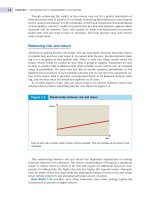
Guided tour of the book
38
CHAPTER 2
2
Activities These short
questions, integrated
throughout each
chapter, allow you
to check your
understanding as you
progress through the
text. They comprise
either a narrative
question requiring you
to review or critically
consider topics, or a
numerical problem
requiring you to deduce
a solution. A suggested
answer is given
immediately after each
activity.
MEASURING AND REPORTING FINANCIAL POSITION
Activity 2.2 continued
4 A recently purchased machine that will save the business £10,000 each year. It is
already being used by the business but it has been acquired on credit and is not yet
paid for.
Your answer should be along the following lines:
Measuring and reporting
financial position
1 Under normal circumstances, a business would expect a customer to pay the amount
owed. Such an amount is therefore typically shown as an asset under the heading
‘trade receivables’ (or ‘debtors’). However, in this particular case the customer is unable
to pay. As a result, the item is incapable of providing future benefits and the £1,000
owing would not be regarded as an asset. Debts that are not paid are referred to as
‘bad debts’.
2 The patent would meet all of the conditions set out above and would therefore be
regarded as an asset.
3 The new marketing director would not be considered as an asset. One argument for
this is that the business does not have exclusive rights of control over the director.
(Nevertheless, it may have an exclusive right to the services that the director provides.)
Perhaps a stronger argument is that the value of the director cannot be measured in
monetary terms with any degree of reliability.
4 The machine would be considered an asset even though it is not yet paid for. Once the
business has agreed to buy the machine and has accepted it, the machine represents
an asset even though payment is still outstanding. (The amount outstanding would be
shown as a claim, as we shall see below.)
Introduction
e saw in Chapter 1 that accounting has two distinct strands: financial
accounting and management accounting. This chapter, along with Chapters 3
to 6, examines the three major financial statements that form the core of financial
accounting. We start by taking an overview of these statements to see how each
contributes towards an assessment of the overall financial position and performance
of a business.
Following this overview, we begin a more detailed examination by turning our
attention towards one of these financial statements: the statement of financial
position. We shall see how it is prepared and examine the principles underpinning it.
We shall also consider its value for decision-making purposes.
W
The sorts of items that often appear as assets in the statement of financial position
of a business include:
● property
● plant and equipment
● fixtures and fittings
● patents and trademarks
Learning outcomes
● trade receivables (debtors)
● investments outside the business.
When you have completed this chapter, you should be able to:
●
explain the nature and purpose of the three major financial statements;
●
prepare a simple statement of financial position and interpret the information
that it contains;
●
discuss the accounting conventions underpinning the statement of financial
position;
●
discuss the uses and limitations of the statement of financial position for
decision-making purposes.
Activity 2.3
Can you think of two additional items that might appear as assets in the statement of
financial position of a typical business?
You may be able to think of a number of other items. Two that we have met so far, because
they were the only types of asset that were held by Paul’s wrapping-paper business (in
Examples 2.1 and 2.2), are inventories and cash.
➔
➔
Key terms The key
concepts and
techniques in each
chapter are highlighted
in colour where they are
first introduced, with
an adjacent icon in the
margin to help you refer
back to them.
Note that an asset does not have to be a physical item – it may be a non-physical
item that gives a right to certain benefits. Assets (such as inventories) that have a
physical substance and can be touched are referred to as tangible assets. Assets (such
as patents) that have no physical substance but which, nevertheless, provide expected
future benefits are referred to as intangible assets.
Learning outcomes Bullet points at the start of each chapter show what you
can expect to learn from that chapter, and highlight the core coverage.
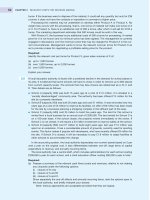
234
CHAPTER 7
ANALYSING AND INTERPRETING FINANCIAL STATEMENTS (1)
PREPARING THE STATEMENT OF CASH FLOWS
197
Example 6.2
Real World 7.5
Two-thirds of suppliers are being forced to accept arbitrary extensions of payment terms
by their customers as pressure on businesses to conserve cash becomes more acute, a
survey by the Institute of Credit Management has found.
The findings provide more evidence of the speed with which the recession is prompting many businesses to focus on preserving cash and managing working capital more
tightly.
The findings come after the Department for Business, Enterprise and Regulatory Reform
last week unveiled a voluntary ‘prompt payment code’, designed with the ICM. It aims to
help small businesses by discouraging bigger companies from using their purchasing power
to ease pressures on their cash flow by squeezing their supply chain.
In a poll of 600 members last month, the ICM asked whether any of their customers had
tried arbitrarily to extend their payment terms in the previous three months. Sixty-seven
per cent said Yes with the rest saying No.
For those answering Yes, 61 per cent said the extension applied retroactively as well
as to future business, with 39 per cent saying it applied to all future business.
Philip King, ICM director general, said: ‘We were certainly staggered by the volume and
the proportion of respondents who said they had experienced that. It’s no surprise that it’s
happening but for the number to be that high is a real surprise.’
The ICM is the largest organisation in Europe representing credit managers in trade
credit, credit insurance and insolvency.
In some cases, it said, there was ‘anecdotal evidence’ that some companies were
trying to delay paying their suppliers by challenging their invoices, but it stressed there
was ‘no scientific evidence’ of an increase.
Challenging the accuracy of invoices is common practice, but there are signs it is being
used more regularly to delay payment.
The head of a global employment agency with operations in the UK said it had taken
on more staff to process invoices. ‘It used to be that if there was a mistake with one line,
clients would pay the whole invoice and we’d resolve that one grey area. But now they’re
using one possible mistake as a way of withholding payment on the entire invoice,’ said
the executive.
Martin O’Donovan, an assistant director at the Association of Corporate Treasurers,
said: ‘People really are under strain and are pulling whatever levers they have got – even
those that are not the most politic ones and perhaps not in the longer-term interest of the
company.’
Source: ‘Payment squeeze on suppliers’, Jeremy Grant, Financial Times, 22 December 2008.
Average settlement period for trade payables
➔
The average settlement period for trade payables ratio measures how long, on average,
the business takes to pay those who have supplied goods and services on credit. The
ratio is calculated as follows:
Average settlement period for trade payables =
The relevant information from the financial statements of Dido plc for last year is
as follows:
FT
Taking credit where it’s not due
Average trade payables
Credit purchases
× 365
Profit before taxation (after interest)
Depreciation charged in arriving at profit before taxation
Interest expense
At the beginning of the year:
Inventories
Trade receivables
Trade payables
At the end of the year:
Inventories
Trade receivables
Trade payables
£m
122
34
6
15
24
18
17
21
19
The following further information is available about payments during last year:
Taxation paid
Interest paid
Dividends paid
£m
32
5
9
The cash flow from operating activities is derived as follows:
Profit before taxation (after interest)
Depreciation
Interest expense
Increase in inventories (17 − 15)
Decrease in trade receivables (21 − 24)
Increase in trade payables (19 − 18)
Cash generated from operating activities
Interest paid
Taxation paid
Dividends paid
Net cash from operating activities
➔
£m
122
34
6
(2)
3
1
164
(5)
(32)
(9)
118
As we can see, the net increase in working capital* (that is, current assets less
current liabilities) as a result of trading was £162 million (that is, 122 + 34 + 6).
Of this, £2 million went into increased inventories. More cash was received from
trade receivables than sales revenue was made. Similarly, less cash was paid to trade
payables than purchases of goods and services on credit. Both of these had a
favourable effect on cash. Over the year, therefore, cash increased by £164 million.
When account was taken of the payments for interest, tax and dividends, the net
cash from operating activities was £118 million (inflow).
Note that we needed to adjust the profit before taxation (after interest) by
the depreciation and interest expenses to derive the profit before depreciation,
interest and taxation.
* Working capital is a term widely used in accounting and finance, not just in the context
of the statement of cash flows. We shall encounter it several times in later chapters.
‘Real World’ illustrations Integrated throughout the text, these illustrative examples highlight the
practical application of accounting concepts and techniques by real businesses, including extracts
from company reports and financial statements, survey data and other insights from business.
Examples At frequent
intervals throughout
most chapters, there
are numerical examples
that give you step-bystep workings to follow
through to the solution.
A01_ATRI0391_06_SE_FM.QXD
6/17/10
15:27
Page xv
GUIDED TOUR OF THE BOOK
xv
Self-assessment questions Towards the end of most chapters you will encounter one of these questions,
allowing you to attempt a comprehensive question before tackling the end-of-chapter assessment material.
To check your understanding and progress, solutions are provided at the end of the book.
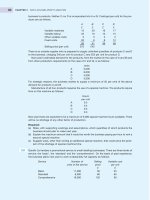
250
CHAPTER 7
ANALYSING AND INTERPRETING FINANCIAL STATEMENTS (1)
SUMMARY
Both Ali plc and Bhaskar plc operate wholesale electrical stores throughout the UK. The
financial statements of each business for the year ended 30 June 2010 are as follows:
Statements of financial position as at 30 June 2010
ASSETS
Non-current assets
Property, plant and equipment (cost less depreciation)
Land and buildings
Fixtures and fittings
Current assets
Inventories
Trade receivables
Cash at bank
Total assets
EQUITY AND LIABILITIES
Equity
£1 ordinary shares
Retained earnings
Non-current liabilities
Borrowings – loan notes
Current liabilities
Trade payables
Taxation
Total equity and liabilities
Ali plc
£m
Bhaskar plc
£m
360.0
87.0
447.0
510.0
91.2
601.2
592.0
176.4
84.6
853.0
1,300.0
403.0
321.9
91.6
816.5
1,417.7
320.0
367.6
687.6
250.0
624.6
874.6
190.0
250.0
406.4
16.0
422.4
1,300.0
275.7
17.4
293.1
1,417.7
Summary
The main points of this chapter may be summarised as follows:
Revenue
Cost of sales
Gross profit
Operating expenses
Operating profit
Interest payable
Profit before taxation
Taxation
Profit for the year
Bullet point chapter
summary Each chapter
ends with a ‘bullet-point’
summary. This highlights
the material covered in
the chapter and can be
used as a quick reminder
of the main issues.
The major financial statements
Income statements for the year ended 30 June 2010
Ali plc
£m
1,478.1
(1,018.3)
459.8
(308.5)
151.3
(19.4)
131.9
(32.0)
99.9
63
contributed by outside lenders. We can also see the different kinds of assets acquired
and how much is invested in each kind.
● It can provide a basis for assessing the value of the business. Since the statement of financial
position lists, and places a value on, the various assets and claims, it can provide a
starting point for assessing the value of the business. It is, however, severely limited
in the extent to which it can do this. We have seen earlier that accounting rules may
result in assets being shown at their historic cost and that the restrictive definition of
assets may exclude certain business resources from the statement of financial position.
Ultimately, the value of a business will be based on its ability to generate wealth in
the future. Because of this, assets need to be valued on the basis of their wealthgenerating potential. Also, other business resources that do not meet the restrictive
definition of assets, such as brand values, need to be similarly valued and included.
● Relationships between assets and claims can be assessed. It can be useful to look at
relationships between statement of financial position items, for example the relationship between how much wealth is tied up in current assets and how much is owed
in the short term (current liabilities). From this relationship, we can see whether the
business has sufficient short-term assets to cover its maturing obligations. We shall
look at this and other relationships between statement of financial position items in
some detail in Chapter 7.
● Performance can be assessed. The effectiveness of a business in generating wealth
(making a profit) can usefully be assessed against the amount of investment that was
involved. Knowing the relationship between profit earned over a particular period
and the value of the net assets involved can be very helpful to many of those involved
with the business concerned. It is particularly likely to be of interest to the owners
and the managers. This and similar relationships will also be explored in detail in
Chapter 7.
Self-assessment question 7.1
● There are three major financial statements: the statement of cash flows, the income
Bhaskar plc
£m
1,790.4
(1,214.9)
575.5
(408.6)
166.9
(27.5)
139.4
(34.8)
104.6
statement (profit and loss account) and the statement of financial position (balance
sheet).
● The statement of cash flows shows the cash movements over a particular period.
● The income statement shows the wealth (profit) generated over a particular period.
● The statement of financial position shows the accumulated wealth at a particular
point in time.
The statement of financial position
● This sets out the assets of the business, on the one hand, and the claims against
those assets, on the other.
● Assets are resources of the business that have certain characteristics, such as the
All purchases and sales were on credit. Ali plc had announced its intention to pay a
dividend of £135 million and Bhaskar plc £95 million in respect of the year. The market
values of a share in Ali plc and Bhaskar plc at the end of the year were £6.50 and
£8.20 respectively.
ability to provide future benefits.
● Claims are obligations on the part of the business to provide cash, or some other
benefit, to outside parties.
Key terms summary At the end of each chapter, there is a listing (with
page references) of all the key terms introduced in that chapter, allowing
you to refer back easily to the most important points.
386
CHAPTER 10
EXERCISES
INCREASING THE SCOPE OF FINANCIAL REPORTING
➔
Key terms
segmental financial reports p. 354
transfer price p. 357
integral method p. 364
discrete method p. 364
value added statement (VAS) p. 366
monetary items p. 378
current (or constant) purchasing
power (CPP) accounting p. 380
current cost accounting (CCA)
p. 381
References
1 Armitage, S. and Marston, C., ‘Corporate disclosure, cost of capital and reputation: evidence
from finance directors’, British Accounting Review, December 2008, pp. 314–36.
Review questions
Solutions to these questions can be found at the back of the book on page 483.
3.1
‘Although the income statement is a record of past achievement, the calculations required for
certain expenses involve estimates of the future.’ What does this statement mean? Can you
think of examples where estimates of the future are used?
3.2
‘Depreciation is a process of allocation and not valuation.’ What do you think is meant by this
statement?
3.3
What is the convention of consistency? Does this convention help users in making a more valid
comparison between businesses?
3.4
‘An asset is similar to an expense.’ Do you agree?
2 Accounting Standards Board, A Review of Narrative Reporting by UK Listed Companies in 2006,
January 2007.
3 Accounting Standards Committee, The Corporate Report, ASC, 1975.
4 Green, D., ‘Towards a theory of interim reports’, Journal of Accounting Research, Spring 1964,
pp. 35–49. (Note: Variations to this integral model can be found in the literature.)
Exercises
Exercises 3.6 to 3.8 are more advanced than Exercises 3.1 to 3.5. Exercises with coloured
numbers have solutions at the back of the book, starting on page 494.
If you wish to try more exercises, visit the students’ side of the Companion Website.
Further reading
If you would like to explore the topics covered in this chapter in more depth, we recommend the
following books:
3.1
Alexander, D., Britton, A. and Jorissen, A., International Financial Reporting and Analysis, 3rd edn,
Thomson Learning, 2007, Chapters 4 to 7.
Elliot, B. and Elliot, J., Financial Accounting and Reporting, 13th edn, Financial Times Prentice Hall,
2009, Chapters 3 to 5.
IASC Foundation Education, A Guide through International Financial Reporting Standards, September
2009, IFRS 8 and IAS 34.
You have heard the following statements made. Comment critically on them.
(a) ‘Equity only increases or decreases as a result of the owners putting more cash into the
business or taking some out.’
(b) ‘An accrued expense is one that relates to next year.’
(c) ‘Unless we depreciate this asset we shall be unable to provide for its replacement.’
(d) ‘There is no point in depreciating the factory building. It is appreciating in value each year.’
Reporting Statement: Operating and Financial Review, Accounting Standards Board, 2006.
3.2
Morley, M., The Value Added Statement, Gee Publishing, 1978.
Singh Enterprises, which started business on 1 January 2007, has an accounting year to
31 December and uses the straight-line method of depreciation. On 1 January 2007 the business bought a machine for £10,000. The machine had an expected useful life of four years and
an estimated residual value of £2,000. On 1 January 2008 the business bought another machine
for £15,000. This machine had an expected useful life of five years and an estimated residual
value of £2,500. On 31 December 2009 the business sold the first machine bought for £3,000.
109
Review questions
These short
questions encourage
you to review and/or
critically discuss your
understanding of the
main topics covered
in each chapter,
either individually or
in a group. Solutions
to these questions
can be found at the
back of the book.
Required:
Show the relevant income statement extracts and statement of financial position extracts for the
years 2007, 2008 and 2009.
3.3
Further reading This section comprises a
listing of relevant chapters in other textbooks
that you might refer to in order to pursue a topic
in more depth or gain an alternative perspective.
References Provides full details of sources of
information referred to in the chapter.
The owner of a business is confused and comes to you for help. The financial statements for the
business, prepared by an accountant, for the last accounting period revealed a profit of £50,000.
However, during the accounting period the bank balance declined by £30,000. What reasons
might explain this apparent discrepancy?
Exercises These comprehensive questions at the end of most
chapters. The more advanced questions are separately identified.
Solutions to five of the questions (those with coloured numbers) are
provided at the end of the book, enabling you to assess your progress.
Solutions to the remaining questions are available online for lecturers
only. Additional exercises can be found on the Companion Website at
www.pearsoned.co.uk/atrillmclaney.
A01_ATRI0391_06_SE_FM.QXD
6/17/10
15:27
Page xvi
Guided tour of the Companion Website
Extra material has been prepared to help you study using Financial Accounting for Decision Makers.
This material can be found on the book’s Companion Website at www.pearsoned.co.uk/atrillmclaney.
Self assessment questions
For each chapter there is
a set of interactive self
assessment questions,
including multiple choice and
fill-in-the-blanks questions.
Test your learning and get
automatic grading on your
answers.
Revision questions
Sets of questions covering
the whole book are designed
to help you check your overall
learning while you are revising.
A01_ATRI0391_06_SE_FM.QXD
6/17/10
15:27
Page xvii
GUIDED TOUR OF THE COMPANION WEBSITE
Weblinks
A full set of relevant weblinks
allows further study of each
particular topic.
xvii
A01_ATRI0391_06_SE_FM.QXD
6/17/10
15:27
Page xviii
Preface
This text provides a comprehensive introduction to financial accounting. It is aimed
both at students who are not majoring in accounting and at those who are. Those
studying introductory-level financial accounting as part of their course in business,
economics, hospitality management, tourism, engineering, or some other area, should
find that the book provides complete coverage of the material at the level required.
Students who are majoring in accounting should find the book a useful introduction
to the main principles, which can serve as a foundation for further study. The text does
not focus on the technical aspects, but rather examines the basic principles and underlying concepts. The ways in which financial statements and information can be used
to improve the quality of decision making are the main focus of the book. To reinforce
this practical emphasis, there are, throughout the text, numerous illustrative extracts
with commentary from company reports, survey data and other sources.
In this sixth edition, we have taken the opportunity to make improvements that
have been suggested by both students and lecturers who used the previous edition.
We have brought up to date and expanded the number of examples from real life. We
have incorporated the many changes that have occurred with International Financial
Reporting Standards since the last edition. We have also picked up on developments
that have arisen in the area of corporate governance.
We have also greatly expanded the coverage of financial reports beyond the income
statement, statement of financial position (balance sheet) and statement of cash flows.
This expanded coverage forms a new chapter, Chapter 10. The financial reports covered
in Chapter 10 include both those that are mandatory for certain businesses as well as
those that individual businesses may choose to prepare.
The text is written in an ‘open-learning’ style. This means that there are numerous
integrated activities, worked examples and questions throughout the text to help you
to understand the subject fully. You are encouraged to interact with the material and
to check your progress continually. Irrespective of whether you are using the book as
part of a taught course or for personal study, we have found that this approach is more
‘user-friendly’ and makes it easier for you to learn.
We recognise that most of you will not have studied financial accounting before,
and, therefore, we have tried to write in a concise and accessible style, minimising the
use of technical jargon. We have also tried to introduce topics gradually, explaining
everything as we go. Where technical terminology is unavoidable we try to provide
clear explanations. In addition, you will find all of the key terms highlighted in the
text, and then listed at the end of each chapter with a page reference. All of these key
terms are also listed alphabetically, with a concise definition, in the glossary given in
Appendix B towards the end of the book. This should provide a convenient point of
reference from which to revise.
A further important consideration in helping you to understand and absorb the
topics covered is the design of the text itself. The page layout and colour scheme have
been carefully considered to allow for the easy navigation and digestion of material.
A01_ATRI0391_06_SE_FM.QXD
6/17/10
15:27
Page xix
PREFACE
The layout features a large page format, an open design, and clear signposting of the
various features and assessment material. More detail about the nature and use of
these features is given in the ‘How to use this book’ section below; and the main points
are also summarised, using example pages from the text, in the ‘Guided tour’ on
pp. xiv–xv.
We hope that you will find the book both readable and helpful.
Peter Atrill
Eddie McLaney
xix
A01_ATRI0391_06_SE_FM.QXD
6/17/10
15:27
Page xx
How to use this book
We have organised the chapters to reflect what we consider to be a logical sequence
and, for this reason, we suggest that you work through the text in the order in which
it is presented. We have tried to ensure that earlier chapters do not refer to concepts or
terms that are not explained until a later chapter. If you work through the chapters in
the ‘wrong’ order, you will probably encounter concepts and terms that were explained
previously.
Irrespective of whether you are using the book as part of a lecture/tutorial-based
course or as the basis for a more independent mode of study, we advocate following
broadly the same approach.
Integrated assessment material
Interspersed throughout each chapter are numerous activities. You are strongly advised
to attempt all of these questions. They are designed to simulate the sort of quick-fire
questions that your lecturer might throw at you during a lecture or tutorial. Activities
serve two purposes:
● to give you the opportunity to check that you understand what has been covered
so far;
● to encourage you to think about the topic just covered, either to see a link between
that topic and others with which you are already familiar, or to link the topic just
covered to the next.
The answer to each activity is provided immediately after the question. This answer
should be covered up until you have deduced your solution, which can then be
compared with the one given.
Towards the middle/end of Chapters 2–11 there is a self-assessment question. This
is more comprehensive and demanding than most of the activities, and is designed to
give you an opportunity to check and apply your understanding of the core coverage
of the chapter. The solution to each of these questions is provided in Appendix C at the
end of the book. As with the activities, it is important that you attempt each question
thoroughly before referring to the solution. If you have difficulty with a self-assessment
question, you should go over the relevant chapter again.
End-of-chapter assessment material
At the end of each chapter there are four review questions. These are short questions
requiring a narrative answer or discussion within a tutorial group. They are intended
to help you assess how well you can recall and critically evaluate the core terms and
concepts covered in each chapter. Answers to these questions are provided in Appendix D
at the end of the book.
A01_ATRI0391_06_SE_FM.QXD
6/17/10
15:27
Page xxi
HOW TO USE THIS BOOK
At the end of each chapter, except for Chapter 1, there is a set of exercises. These are
mostly computational and are designed to reinforce your knowledge and understanding.
Exercises are graded as either ‘basic’ or ‘more advanced’ according to their level of
difficulty. The basic-level questions are fairly straightforward; the more advanced ones
can be quite demanding but can be successfully completed if you have worked conscientiously through the chapter and have attempted the basic exercises. Solutions to
some of the exercises in each chapter are provided in Appendix E at the end of the book.
A coloured exercise number identifies these questions. Here, too, a thorough attempt
should be made to answer each exercise before referring to the solution.
Solutions to the other exercises are provided in a separate Instructors’ Manual.
To familiarise yourself with the main features and how they will benefit your study
from this text, an illustrated ‘Guided tour’ is provided on pp. xiv–xv.
Content and structure
The text comprises eleven main chapters. The market research for this text revealed a
divergence of opinions, given the target market, on whether or not to include material
on double-entry bookkeeping techniques. So as to not interrupt the flow and approach
of the main chapters, Appendix A on recording financial transactions (including activities
and three exercise questions) has been placed after Chapter 11.
xxi
A01_ATRI0391_06_SE_FM.QXD
6/17/10
15:27
Page xxii
Acknowledgements
We are grateful to the following for permission to reproduce copyright material:
Figures
Figure 10.4 from The 2009 Value Added Scoreboard, www.innovation.go.uk, Department for Business Innovation and Skills, Crown Copyright material is reproduced with
permission under the terms of the Click-Use Licence; Figure 8.4 from Financial Ratios
as Predictors of Failure, Empirical Research in Accounting: Selected Studies, Journal of
Accounting Research, Supplement to Volume 5, pp. 71–111 (Beaver, W.H. 1966).
Text
Real World 1.2 from The Times, Business Section, 26/09/2002, 25, The Times, Business
Section, 26 September 2002. nisyndication.com; Real World 1.3 from Business big
shot, The Times, 27/01/2009, 39, The Times, 27 January 2009. nisyndication.com;
Real World 2.1 adapted from Balance sheets: the basics, accessed 19 October 2009,
www.businesslink.gov.uk; Real World 3.2 from TUI Travel plc, Annual Report and
Accounts 2008, p. 68; Real World 3.8 from Findel shares plunge as Yorkshire home
shopping firm’s bad debts rise, Yorkshire Evening Post, 17/04/2008 (Scott, N.), reproduced
by kind permission of the Yorkshire Evening Post; Real World 4.7 from Rolls-Royce
plc, Annual Report and Accounts 2008, note 14; Real World 4.8 from Eurotunnel
pays first dividend since 1987 float, Ian King, 4 March 2009, www.timesonline.co.uk,
4 March 2009. nisyndication.com; Real World 5.2 from Tottenham Hotspur plc
Annual Report 2009, p. 57; Real World 5.4 from Dirty laundry: how companies fudge
the numbers, The Times, Business Section, 22/09/2002, The Times, Business Section,
22 September 2002. nisyndication.com; Real World 6.2 from www.tescocorporate.com,
Tesco Annual Review 2009, p. 24; Real World 6.3 adapted from LiDCO Group plc,
Annual Report 2009; Real World 8.4 from Marks and Spencer plc, Annual Report
2009; Real World 9.4 from Forbes, T. Technical update – Inadequate IFRS 3, Finance
Week 30 January 2007, www.financeweek.co.uk, www.financeweek.co.uk/item/4760;
Real World 10.2, 11.10 from Tesco plc, www.tesco.com, Annual Report and Financial
Statements 2009; Real World 10.3, 10.4, 10.5, 10.6, 10.7 from Tesco plc, www.tesco.com,
Annual Report and Financial Statements 2009, Business Review; Real World 11.7 from
Marks and Spencer plc, Annual Report 2009, p. 55; Real World 11.8 from Tesco plc,
www.tesco.com, Annual Report and Financial Statements 2009, Business Review, p. 51;
Real World 11.12 adapted from SSL International plc, Annual Report and Accounts
2009, pp. 44–5; Real World 11.16 from Corporate Governance and Voting Policy January
2008, p. 14, www.jupiteronline.co.uk.
A01_ATRI0391_06_SE_FM.QXD
6/17/10
15:27
Page xxiii
ACKNOWLEDGEMENTS
The Financial Times
Real World 1.1 from Morrison in uphill battle to integrate Safeway, Financial Times,
26/05/2005 (Elizabeth Rigby); Real World 1.5 from Fair shares?, Financial Times,
11/06/2005 (Michael Skapinker); Real World 1.6 from How we’ve poisoned the well
of wealth, Financial Times, 15/02/2009 (Goyder, M.); Real World 2.5 from Akzo Nobel
defends ICI takeover, Financial Times, 24/02/2009 (Michael Steen); Real World 4.1 from
Monotub Industries in a spin as founder gets Titan for £1, Financial Times, 23/01/2003
(Urquhart, L.); Real World 5.3 from Battlelines are drawn up for fight on standards,
Financial Times, 7/01/2008 (Bruce, R.); Real World 5.5 from Dell to lower writedowns
on restated earnings, Financial Times, 30/10/2007 (Allison, K.); Real World 5.10 from It
pays to read between the lines, Financial Times, 17/09/2005; Real World 6.1 from Rations
cut for army of buyers, Financial Times, 20/10/2008; Real World 7.4 from Investing
in Bollywood, Lex column, Financial Times, 25/06/2007; Real World 7.5 from Payment
squeeze on suppliers, Financial Times, 22/12/2008 (Grant, J.); Real World 7.6 from
Gearing levels set to plummet, Financial Times, 10/02/2009 (Grant, J.); Real World 8.1
adapted from Financial Times, 14/11/2009; Real World 8.6 from New study re-writes
the A to Z of value investing, Financial Times, 14/08/2009 (Mathurin, P.); Real World
11.3 from M&S shareholders give Rose a dressing down, Financial Times, 9/07/2009
(Braithwaite, T., Rigby, E. and Burgess, K.); Real World 11.4 from An expert hand behind
the scenes, Financial Times, 30/09/2008 (Willman, J.); Real World 11.5 from Hefty pay
rises for non-executives, Financial Times, 15/02/2009 (Kelleher, E.); Real World 11.9
from Shake-up at Shell after pay backlash, Financial Times, 11/09/2009 (Burgess, K.);
Real World 11.13 from Ebay seeks to alter terms of stock options, Financial Times,
11/03/2009 (Gelles, D.); Real World 11.15 from Shareholders revolt over C&W pay,
Financial Times, 18/07/2009 (Parker, A.).
In some instances we have been unable to trace the owners of copyright material, and
we would appreciate any information that would enable us to do so.
xxiii
A01_ATRI0391_06_SE_FM.QXD
6/17/10
15:27
Page xxiv