Sự hòa hợp giữa chủ ngữ và động từ
Bạn đang xem bản rút gọn của tài liệu. Xem và tải ngay bản đầy đủ của tài liệu tại đây (168.11 KB, 10 trang )
Sự hòa hợp giữa chủ ngữ và động từ
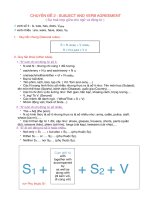
1. Các trường hợp chủ ngữ đứng tách khỏi động từ
Trong câu tiếng Anh, có nhiều trường hợp rất khó xác định được đâu là chủ ngữ của câu
do chủ ngữ và động từ không đi liền với nhau.
The boys in the room are playing chess.
Thông thường trong các trường hợp đó, một ngữ giới từ (một giới từ mở đầu và các danh
từ theo sau – in the room) thường nằm giữa chủ ngữ và động từ. Các ngữ giới từ này
không ảnh hưởng đến việc chia động từ.
The study of languages is very interesting.
Serveral theories on this subject have been proposed.
The view of these disciplines varies from time to time.
The danger of forest fires is not to be taken lightly.
Chú ý: 1. với các từ dưới đây, động từ sẽ chia theo chủ ngữ trước
Together with
along with
accompanied by
as well as
Mary, along with her manager and some friends, is going to a party tonight.
Mr. Robbins, accompanied by her wife and children, is arriving tonight.
2. Nếu 2 danh từ làm chủ ngữ nối với nhau bằng and thì động từ phải chia ở ngôi thứ 3
số nhiều
Mary and her manager are going to a party tonight.
3. 2 đồng chủ ngữ nối với nhau bằng or thì động từ phải chia theo danh từ đứng sau or.
Nếu danh từ đó là số ít thì động từ phải chia số ít và ngược lại.
Mary or her manager is going to answer the press interview.
Chú ý: nếu chủ ngữ kết hợp bởi and nhưng ám chỉ 1 người hoặc 1 vật thì ta vẫn phải chia
động từ ở số ít . Và nếu chủ ngữ nối bằng and này có từ every đứng trước ta cũng dùng
động từ số ít
Macaroni and cheese is my favorite food.
The librarian and reading teacher is Mrs. Jones.
Every dog and cat has been vaccinated.
2. Trường hợp 2
Với các chủ ngữ là một trong các từ dưới đây, chia động từ ở ngôi thứ 3 số ít.
* Either và neither là số ít nếu chúng không đi với or hoặc nor.
Cụm từ many a cũng chia với động từ số ít.
Everybody who wants to buy a ticket should be in this line.
Something is in my eye.
Anybody who has lost his ticket should report to the desk.
Neither of his pens is able to be used.
If either of you takes a vacation now, we will not be able to finish the work.
No problem is harder than this one.
Nobody works harder than John does.
Với chủ ngữ là những từ sau chia với động từ số nhiều
PLURAL: several, few, both, many
Ví dụ: both do a great deal of work in the office
Chú ý: một số từ có thể chia với động từ số ít hoặc nhiều ( nếu từ đó đi cùng danh từ
không đếm được dùng động từ chia ở số ít và ngược lại.
Ví dụ: some, any, none, all, most
Some of the sugar is in the floor.
Some of the books are in the floor.
3. Cách sử dụng None và No
None và No đều dùng được với cả danh từ số ít và số nhiều.
None of the + non-count noun + singular verb
None of the + plural count noun + plural verb
None of the counterfeit money has been found.
None of the students have finished the exam yet.
· Nếu sau No là một danh từ đếm được số ít hoặc không đếm được thì động từ phải ở
ngôi thứ 3 số ít. Nếu sau nó là một danh từ số nhiều thì động từ phải ở ngôi thứ 3 số
nhiều
No + {singular noun / non-count noun} + singular verb
No + plural noun + plural verb
No example is relevant to this case.
No examples are relevant to this case.
4. Cách sử dụng cấu trúc either... or (hoặc...hoặc) và neither... nor (không...mà cũng
không)
Điều cần lưu ý nhất khi sử dụng cấu trúc này là động từ phải chia theo danh từ đi sau or
hoặc nor. Nếu or hoặc nor xuất hiện một mình (không có either hoặc neither) thì cũng áp
dụng quy tắc tương tự (như đã đề cập ở phần trên)
Neither John nor his friends are going to the beach today.
Either John or his friends are going to the beach today.
Neither the boys nor Carmen has seen this movie before.
Either John or Bill is going to the beach today.
Neither the director nor the secretary wants to leave yet.
5. V-ing làm chủ ngữ
Khi V-ing dùng làm chủ ngữ thì động từ cũng phải chia ở ngôi thứ 3 số ít.
Knowing her has made him what he is.
Not studying has caused him many problems.
Washing with special cream is recommended for scalp infection.
Being cordial is one of his greatest assets.
Writing many letters makes her happy.
Chú ý: Động từ nguyên thể cũng có thể dùng làm chủ ngữ và động từ sau nó sẽ chia ở
ngôi thứ 3 số ít. Nhưng người ta thường dùng chủ ngữ giả it để mở đầu câu.
To find the book is necessary for him = It is necessary for him to find the book.
6. Các danh từ tập thể
Đó là các danh từ ở bảng sau dùng để chỉ 1 nhóm người hoặc 1 tổ chức nhưng trên thực
tế chúng là những danh từ số ít, do vậy các đại từ và động từ theo sau chúng cũng ở ngôi
thứ 3 số ít.
Congress
family
group
committee
class
Organization
team
army
club
crowd
Government
jury
majority*
minority
public
The committee has met, and it has rejected the proposal.
The family was elated by the news.
The crowd was wild with excitement
Congress has initiated a new plan to combat inflation.
The organization has lot many members this year.
Our team is going to win the game.
Tuy nhiên nếu các thành viên trong nhóm đang hoạt động riêng rẽ, động từ sẽ chia ở ngôi
thứ 3 số nhiều:
Congress votes for the bill. (Quốc hội bỏ phiếu cho dự luật, gồm tất cả mọi người)
Congress are discussing about the bill. (Quốc hội đang tranh luận về dự luật, tức là một
số tán thành, một số phản đối.
* Danh từ majority được dùng tuỳ theo thành phần sau nó để chia động từ
The majority + singular verb
The majority of the + plural noun + plural verb
The majority believes that we are in no danger.
The majority of the students believe him to be innocent.
· The police/the sheep/the fish + plural verb.
The sheep are breaking away
The police come only to see the dead bodies and a ruin in the bank
· A couple + singular verb
A couple is walking on the path
· The couple + plural verb
The couple are racing their horses through the meadow.
· Các cụm từ ở nhóm sau chỉ một nhóm động vật hoặc gia súc. Cho dù sau giới từ of là
danh từ số nhiều thì động từ vẫn chia theo ngôi chủ ngữ chính – ngôi thứ 3 số ít: flock of
birds/ sheep, school of fish, herd of cattle, pride of lions, pack of dogs
The flock of birds is circling overhead.
The herd of casttle is breaking away.
A school of fish is being attacked by sharks.
· Tất cả các danh từ tập thể chỉ thời gian, tiền bạc, số đo, ... khi được đề cập đến như một
thể thống nhất thì đều được xem là một danh từ số ít. Do đó các động từ và đại từ theo
sau chúng phải ở ngôi thứ 3 số ít.
Twenty-five dollars is too much for the meal.
Fifty minutes isn’t enough time to finish this test
Twenty dollars is all I can afford to pay for that radio.
Two miles is too much to run in one day.
He has contributed $50, and now he wants to contribute another fifty.
7. Cách sử dụng a number of, the number of:
A number of = “Một số những ...”, đi với danh từ số nhiều, động từ chia ở số nhiều.
A number of + plural noun + plural verb
A number of students are going to the class picnic (Một số sinh viên sẽ đi ...)
A number of applicants have already been interviewed.
The number of = “Số lượng những ...”, đi với danh từ số nhiều, động từ vẫn ở ngôi thứ 3
số ít.
The number of + plural noun + singular verb...
The number of days in a week is seven. (Số lượng ngày trong tuần là 7)
The number of residents who have been questioned on this matter is quite small.
8. Các danh từ luôn ở số nhiều
Bảng sau là những danh từ bao giờ cũng ở hình thái số nhiều vì chúng bao gồm 2 thực
thể nên các đại từ và động từ đi cùng với chúng cũng phải ở số nhiều.
scissors
shorts
pants
jeans
tongs
trousers
eyeglasses
pliers
tweezers
Nếu muốn chúng thành ngôi số ít phải dùng a pair of...
The pants are in the drawer.
A pair of pants is in the drawer.
These scissors are dull. (Cái kéo này cùn. Chú ý chỉ có 1 cái kéo nhưng cũng dùng
với these)
Chú ý: một số danh từ có dạng thức số nhiều nhưng chia với động từ số ít ( như measles,
politics, mathematics, …………….
9. Cách dùng there is, there are
ngữ thật của câu là là danh từ đi sau động từ. Nếu nó là danh từ số ít thì động từ to be
chia ở ngôi thứ 3 số ít và ngược lại.
There has been an increase in the importation of foreign cars.
Threre is a storm approaching.
There was an accident last night.
There was water on the floor.
There have been a number of telephone calls today.
There were too many people at the party.
Lưu ý:
•
•
Các cấu trúc: there is certain/ sure/ likely/ bound to be = chắc chắn là sẽ có
There is sure to be trouble when she gets his letter. (Chắc chắn là sẽ có rắc rối khi
cô ấy nhận được thư anh ta)
Do you think there is likely to be snow. (Anh cho rằng chắc chắn sẽ có tuyết chứ)
Trong dạng tiếng Anh quy chuẩn hoặc văn chương một số các động từ khác ngoài
to be cũng được sử dụng với there:
Động từ trạng thái: stand/ lie/ remain/ exist/ live
Động từ chỉ sự đến: enter/ go/ come/ follow/ develop
In a small town in Germany there once lived a poor shoemaker. (Tại một thị trấn nhỏ ở
Đức có một ông thợ giày nghèo sống ở đó)
There remains nothing more to be done . (Chả còn có gì nữa mà làm)
Suddenly there entered a strange figure dressed all in black. (Bỗng có một hình bóng kì
lạ mặc toàn đồ đen đi vào)
There followed an uncomfortable silence. (Sau đó là một sự im lặng đến khó chịu)
There + subject pronoun + go/ come/ be: kìa/ thế là/ rồi thì
There he comes (Anh ta đã đến rồi kia kìa)
There you are, I have been waiting for you for over an hour. (Anh đây rồi, tôi đang chờ
anh đến hơn một tiếng rồi đấy)
EXERCISE I : Choose the correct form of the verbs in parentheses in the following
sentences.
A.
1. John along with twenty friends, (is / are) ________ planning a party.
2. The picture of the soldiers (bring / brings) ________ back many memories.
3. The quality of these recordings (is / are) ________ not very good.
4. If the duties of these officers (isn’t / aren’t) ________ reduced, there will not be
enough
time to finish the project.
5. Neither Bill nor Mary (is / are) ________ going to the play tonight.
6. Anything (is / are) ________ better than going to another movie tonight.
7. A number of reporters (was / were) ________ at the conference yesterday.
8. There (was / were) ________ some people at the meeting last night.
9. Each student (has / have) ________ answered the first three questions.
10. Either John or his wife (make / makes) ________ breakfast each morning.
11. The army (has / have) ________ eliminated this section of the training test.
12. The number of students who have withdrawn from class this quarter (is / are)
appalling.
13. Every elementary school teacher (has / have) ________ to take this examination.
14. The police (come / comes) ________ to the site of the accident.
15. These pictures, as well as photograph (brighten / brightens) ________ the room.
16. What he told you (seem / seems) ________ to be of on importance.
17. Tow years (is / are) ________ a long time to wait.
18. Bread and butter (is / are) ________ what she asks for.
19. Measles (is / are) ________ cured without much difficulty nowadays.
20. After a long day’s work (is / are) not the right time to dancing.
B.
1. Either the physicians in this hospital or the chief administrator (is/are) going to have
to make a decision.
2. (is/are) my boss or my sisters in the union going to win this grievance?
3. Some of the votes (seem/seems) to have been miscounted.
4. The tornadoes that tear through this county every spring (is/are) more than just a
nuisance.
5. Everyone selected to serve on this jury (have/has) to be willing to give up a lot of
time.
6. Kara Wolters, together with her teammates, (present/presents) a formidable opponent
on the basketball court.
7. He seems to forget that there (is/are)______ things to be done before he can graduate.
8. There (have/has)_______ to be some people left in that town after yesterday's flood.
9. Some of the grain (appear/appears)__________ to be contaminated.
10. Three-quarters of the students (is/are)__________ against the tuition hike.
11. Three-quarters of the student body (is/are)__________ against the tuition hike.
12. A high percentage of the population (is/are)_________ voting for the new school.
13. A high percentage of the people (was/were) _________ voting for the new school.
C.
1. Dr. Ferndon is one of those professors who (seem/seems)___________ distracted
most of the time.
2. (have/has)___________ either Luis or his parents written to Angela?
3. Neither Luis nor his parents (is/are)___________ the least bit interested in keeping in
touch with her.
4. Everybody on this team (try/tries)__________ really hard to please the new coach.
5. Because there (is/are)___________ so many students in that class, I can sometimes
sleep in the back row.
6. Neither traffic light--neither the one on Asylum Avenue nor the one on Farmington
Avenue-(was/were)- ___________ working after the storm.
7. Mr. Bradley, along with his two sisters, have/has___________ lived in this town for
thirty years.
8. There (is/are)___________ no reasons for this horrible development that I can see.
9. Some of the water (have/has)___________ already gone bad.
10. One of these students(have/has)___________ obviously cheated on the exam.
11. Either the UConn Women's Team or the UConn Men's Team (is/are)___________
going to be national champion this year.
12. Carlos and his brother Raoul (is/are)___________ traveling across the country next
summer.
13. Several of the students (have/has)___________ decided to withdraw from the course.
D.
1. There _(is/are)___________ several reasons why you should reconsider your decision.
2. Howard and Vincent, who ( run/runs) ____________ a copy center in town, have
decided to expand their business.
3. Both of the statues on the shelf (is/are)____________ broken.
4. The fishing boat that has been tied up at the pier for three days
_(was/were)___________ finally on its way this morning.
Remember that a subject and its verb are not always together.
5. The chairman, along with his two assistants,(plans/plan) ____________ to attend the
annual convention.
6. The issues of inflation and tax reform (continue/continues) ____________ to be on
everyone's mind.
7. Juan or Julian (prepare/prepares)____________ the conference room each week.
8. Not one of the performers (was/were) ____________ at the party after the concert.
9. The results of the election (was/were) ____________ not available for two days.
10. When there _(is/are)___________ thunderstorms approaching, we are always
reminded of the threat of tornadoes.
1. Neither of us (was/were)________ able to predict the outcome of today's game.
2. Macaroni and cheese_(is/are) ________ my favorite dish.
3. At the foot of the mountain (was/were)________ two enormous vineyards, both owned
by the same woman.
4. A small percentage of the grain (was/were)_______ ruined by the prolonged rain.
5. Most parents mistakenly think that mumps (have/has)_______ been eliminated as a
childhood disease.
6. Our college should change (its/their) _______ policy about withdrawals.
7. Coaches Espinoza and Calhoun coach different sports. Neither Espinoza nor Calhoun
scheduled (her/their)________ team for the gym this afternoon.
8. No one has offered to let us use (her/their/his or her)_______ home for the department
meeting.
9. If I ever find my glasses, I think I'll have (it/them)________ replaced.
10. General Motors will probably recall most of (its/their)_________ four-wheel-drive
vehicles.
E.
1. Neither of us (was/were)________ able to predict the outcome of today's game.
2. Macaroni and cheese (is/are)________ my favorite dish.
3. At the foot of the mountain (was/were)________ two enormous vineyards, both owned
by the same woman.
4. A small percentage of the grain (was/were)_______ ruined by the prolonged rain.
5. Most parents mistakenly think that mumps (has/have)_______ been eliminated as a
childhood disease.
6. Our college should change(its/their) _______ policy about withdrawals.
7. Coaches Espinoza and Calhoun coach different sports. Neither Espinoza nor Calhoun
scheduled (her/their) ________ team for the gym this afternoon.
8. No one has offered to let us use (her/their/his or her) _______ home for the department
meeting.
9. If I ever find my glasses, I think I'll have (it/them)________ replaced.
10. General Motors will probably recall most of (its/their)_________ four-wheel-drive
vehicles.
EXERCISE II : Either .... or .... Neither ... nor ...
Insert “is, am, are, was, were, has, have, do or does”
1. That clown shows that either snow or rain ________ about to fall.
2. Neither the cock nor the hens ________ in the ward.
3. By what time ________ either you or your father decided to go ?
4. Either one or tow apples ________ been picked up ripe.
5. Neither the moon nor stars ________ visible in this dark night.
6. To what place ________ either the man or his son wish to go ?
7. Neither the master nor his pupils ________ idle.
8. Neither he nor you ________ heard of this before.
9. No girl or boy ________ allowed to play in the school.
10. Neither the man nor his wife ________ much work.
EXERCISE III : As well as.
Insert “is, am, are, was, were, has, have, do or does”.
1. This house as well as that ________ for sale, which will you have ?
2. The horse as well as the rider ________ hurt by the fall.
3. James as well as Mary ________ won a prize this term.
4. Beauty as well as health ________ fallen to her lot in life.
5. I myself as well as James ________ gone to the party.
6. The cock as well as the hens ________ calling for food.
7. A garden as well as stables ________ attached to the house.
8. A garden as well as a stable ________ attached to the house.
9. The hens as well as the cock ________ calling for food.
10. Stables as well as a garden ________ attached to the house.
1. A black cat (bring, brings) bad luck, according to an old superstition.
2. Young children often (protest, protests) when bedtime (roll, rolls) around.
3. My thoughts often (become, becomes) confused when I sit down to write an essay.
4. When it is hot and humid, my clothes (stick, sticks) to me.
5. A person (need, needs) to set goals if he or she wants to succeed.
6. The damages (were, was) not serious, but the cost of repairs was over a thousand
dollars.
7. My head (feel, feels) as if it is about to burst.
8. Joseph (have, has) two sisters, one brother, and several pets.
9. When a tree (fall, falls) in a forest and no one is present, does it make a sound?
10. The food containers (is, are) stacked in the lower cabinet.
11. Mothers (like, likes) to see their children grow into independent adults.
12. My brother (work, works) at the Baptist Hospital as a physical therapist.
13. The little girl (have, has) a beautiful smile, even though her two front teeth (are, is)
missing.
14. A kitten (open, opens) its eyes when it is about ten days old.
15. Some boys (pitch, pitches) with one hand and (bat, bats) with another.
1. Marvin’s excuses for not having completed his research paper (bore, bores) me.
2. Speeding in restricted zones, especially those near schools, (endanger, endangers)
lives.
3. One computer for two or three students (seem, seems) inadequate.
4. The popularity of violent movies (reflect, reflects) the values of our society.
5. Honeydews, one of the favorite melons of consumers, (taste, tastes) clean and sweet.
6. Coaches who are disciplined and who demand discipline from their players usually
(have, has) winning teams.
7. The annual sales of video games in the United States probably (exceed, exceeds) a
billion dollars.
8. Small amounts of tar and nicotine (damage, damages) the health of smokers.
9. Fiberglass, often used as an insulating material in homes, (cause, causes) allergic
reactions in some people.
10. The women riding in the back seat of the car (was, were) not injured in the accident.
11. Animals which sleep in the day and are active at night (have, has) good night vision.
12. The students waiting in line for tickets to the concert (expect, expects) to get good
seats.
13. A teenager who tries to conform to the expectations of adults (is, are) often ridiculed
by his or her peers.
14. The bark of some trees (have, has) been used for years by herbalists to treat certain
diseases.
1. Ben and Pete (want, wants) to buy a new computer.
2. The color and style (is, are) important to most teenagers.
3. The price or warranty (is, are) not as important as other factors.
4. Neither a new television nor stereo (interest, interests) Ben and Pete.
5. A large monitor and quality sound (impress, impresses) them.
6. The manager and sales clerk (try, tries) to convince them to buy an expensive model.
7. Neither Ben nor Pete (want, wants) to make a rush decision about the computer.
8. Video editing and computer graphics (provide, provides) new possibilities for the user.
9. Most people know when a computer system or program (work, works) properly, and
they can
usually do minor repairs themselves.
10. A computer course and a reference guide (is, are) necessary for serious users.
11. A new keyboard or mouse (attract, attracts) those interested in upgrading their
systems.
12. The sales clerk or the parents (select, selects) age-appropriate computer games for
children.
13. Neither the directions on the package nor the brochure (explain, explains) how to play
the
game.
14. Both the hard drive and the software installed on our old computer (is, are) damaged.
1. (Does, Do) every boy and girl in kindergarten visit the museum?
2. Clowns and fools, as well as heroes, (appear, appears) in many of
Shakespeare's plays.
3. Either the plaintiff or the defendant (has, have) changed his mind about the suit.
4. Neither the President nor his family members (was, were) safe.
5. Fish and chips (is, are) a specialty of local restaurants.
6. Every dog and cat (is, are) required to wear a tag certifying that it has been vaccinated.
7. The cook and housekeeper (is, are) paid a larger salary than the gardener because of
the
extra requirements of her job.