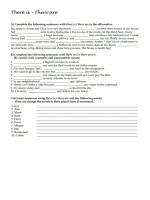
there is there are
Bạn đang xem bản rút gọn của tài liệu. Xem và tải ngay bản đầy đủ của tài liệu tại đây (126.76 KB, 7 trang )
UNIT : THERE IS / THERE ARE – INDEFINITE QUANTIFIERS
I. There is / There are
1.1 Affimative form (Thể khẳng định)
THERE IS + Danh từ số ít + Trạng ngữ (nếu có)
II. Indefinite Quantifiers
+ Trước danh từ số ít đếm được, cần dùng A hoặc AN hoặc ONE
+ Trước danh từ số ít không đếm được không thêm A/AN nhưng có thể thêm NO (không), A
LITTLE (một ít), LITTLE (ít) , MUCH (nhiều), A LOT OF (rất nhiều)
+ There is = There's
Ex:
+ There is an apple on the table
+ there is no water in the tank
+ there is a lot of sugar in vietnamese white coffee
THERE ARE + Danh từ số nhiều + Trạng ngữ (nếu có).
NOTE
+ Trước danh từ số nhiều, thường có số từ từ hai trở lên (TWO, THREE, FOUR) hoặc không có
số từ mà có MANY (nhiều), A FEW (một số), SOME (vài) A LOT OF (rất nhiều)
+ There are = There're
Ex:
+ There are twenty members online now.
+ there are good people and bad people everywhere.
1.2 Negative form (Thể phủ định)
THERE IS NOT + ANY + Danh từ số ít + (nếu có).
There is not = There isn't
* 1.3 Interrogative form
IS THERE ANY + Danh từ số ít + Trạng ngữ (nếu có) ?
- Có thể thay ANY = SOME
Ex:
+ Is there any milk in the fridge?
+ is there anyone home? =
+ is there a way to fix this computer
ARE THERE ANY + Danh từ số nhiều + Trạng ngữ (nếu có) ?
+ Are there any egss in the kitchen?
+ There are a lot of beggars in vietnam
NOTE
* “a” dùng trước danh từ đếm được số ít, bắt đầu bằng một phụ âm Ex:- There is a pen.
* “an” dùng trươc danh từ đếm được số ít, bắt đầu bằng một nguyên âm (u,e,o,a, i).
Ex: There is an eraser
* Some:
- Dùng trong câu khẳng định
- Đứng trước danh từ đếm được số nhiều và danh từ không đếm được
- Some cũng được dùng trong câu hỏi
VD: I have some friends
* Any:
- Dùng trong câu phủ định và câu hỏi
- Đứng trước danh từ đếm được số nhiều và danh từ không đếm được
VD: There aren’t any books in the shelf
* Many:
- Thường dùng trong câu hỏi và câu phủ định, câu khẳng định được dùng ít hơn
- Đi với danh từ đếm được số nhiều
VD: Do you have many cars?
* A lot of/ lots of:
- Được dùng trong câu khẳng đinh và câu nghi vấn
- Đi với danh từ không đếm được và danh từ đếm được số nhiều
- Thường mang nghĩa “informal”
VD: We spent a lot of money
* A few:
- Dùng trong câu khẳng định
- Dùng với danh từ đếm được số nhiều
VD: She enjoys her life here. She has a few friends and they meet quite often.
(Cô ấy thích cuộc sống ở đây. Cô ấy có một vài người bạn và họ gặp nhau rất thường
xuyên).
Ở đây a few friends nói đến số lượng người bạn mà cô ấy có là một vài người chứ không
phải ám chỉ cô ấy có ít bạn.
* A little:
- Dùng trong câu khẳng định
- Đi với danh từ không đếm được
VD: Have you got any money? - Yes, a little. Do you want to borrow some? (Bạn
có tiền không? Có, một ít. Anh có muốn vay không?) A little ở đây hàm ý là có
không nhiều nhưng đủ cho anh muợn một ít.
PRACTICE
I. Write questions and short answers
Example:
/ any Brazilian footballers in your favourite team?
Are there any Brazilian footballers in your favourite team? Yes there are.
1. / a skateboard park near here?
Yes, __________________________
_____________________________
4. / any interesting places near your
house?
No, __________________________
_____________________________
2. / a Hollywood in Ireland?
No, __________________________
_____________________________
5. / an English boy in your class?
Yes, __________________________
_____________________________
3. / any famous football teams in your
town?
No, __________________________
_____________________________
II. There is, there are
1. _________ some fantastic beaches at the Costa del Sol.
2. _________ (not) a hole in the floor.
3. _________ (not) a tram station in Alhaurin de la Torre.
4. _________ many schools in Fuengirola.
5. _________ (not) a swimming pool in town.
6. _________ many animals in the Zoo.
7. _________ (not) a snake in the window.
8. _________ an eel in the aquarium?
9. _________ any children in the park?
10. _________ (not) a gorilla in the tree.
11. _________ a lot of traffic in Valencia.
12. _________ anywhere to park around here?
13. _________ only one way to solve this problem.
14. _________ enough time to finish?
15. _________ (not) many tigers left in the world.
16. _________ any public buses in Los Angeles.
17. _________ anyone here who wants to volunteer?
18. _________ many windows in the room?
19. _________ (not) a TV in my kitchen.
20. _________ two chairs in the living room.
III. Fill in the blanks using “little” or “few”.
1.
There is
money in the wallet.
2.
I’ve got a
books.
3.
My mum has got a
4.
I can’t wait for you. I’ve got
5.
Fred has got a
6.
Brenda has got a
cigarettes in the packet.
time.
English books.
friends.
7.
There is
8.
There are
people at the cinema as the film is not very good.
9.
I have got
magazines. I prefer books.
10. There is a
butter left. We need to buy some.
pizza in the fridge if you are hungry.
IV. Fill in the blanks using “much” or “many”.
1.
How
books did you buy?
2.
How
money do you have
3.
How
did the car cost?
4.
How
apples are there in the basket?
5.
How
times have you been to the dentist?
6.
How
butter do you need?
7.
How
oranges do you want?
8.
How
wine does he drink?
9.
How
girls are there in your class?
10. How
stamps have you got in your collection?
V. Fill in the blanks using “a/an”, “ some”, “any” , “much” or “many”.
1.
I ate
sandwich for lunch.
2.
We had
3.
I often have
4.
There aren’t
5.
Would you like
6.
Don’t eat so
chocolate or you’ll get fat.
7.
I don’t drink
beer. I don’t like it.
8.
There is
9.
The child put
sand into the bucket.
10. I can lend you
money if you need it.
cake with the tea.
fried egg for dinner.
pears left. Only two.
tea?
tub of margarine in the fridge.
VI. Fill “a few, a little” in each gap.
1. She asks us …………. questions.
2. I can speak …………. French.
3. ………. people go to the meeting.
4. There are only ………..books on the shelf.
5. My father is eating ………. chicken soup.
6. They will have ………. milk for breakfast.
7. There are ……….. letters in the letter-box.
8. He has ……….money and he will buy ……….. vegetables.
VII. Fill “little, few” in each gap.
1. Hurry up or we’ll be late. We’ve got very ………… time.
2. Very ……….. people come to hear him play the piano because they are too busy.
3. There are ……….. cars parked outside the bank today.
4. I am so cold that there is very …………. feeling in my legs.
VIII. Supply the correct form of the adjs in the brackets.
1. Mr Tan works ……….. hours than my father. (many)
2. Summer vacation is the …………. vacation. (long)
3. He drinks ………… wine than Mr.Hai. (little)
4. Christmas is one of the ……….. vacation in America. (important)
5. This old woman has …………money than all of her daughters. (much)
6. Bill is ………… than you. (good)
7. These shoes are …………. than those shoes. (expensive)
8. Riding a bike is ………… than walking. (dangerous)