Hafez a radi, john o rasmussen auth principles of physics for scientists and engineers 2 21
Bạn đang xem bản rút gọn của tài liệu. Xem và tải ngay bản đầy đủ của tài liệu tại đây (813.32 KB, 30 trang )
490
14 Oscillations and Wave Motion
the phase angle φ, the maximum speed vmax , and the maximum acceleration
amax . (c) Write down the position, velocity, and acceleration in terms of time
t, then substitute with t = π/8 s and find their values.
Equilibrium position
x
x
x=0
x=0
(a)
xi
(b)
Fig. 14.33 See Exercise (12)
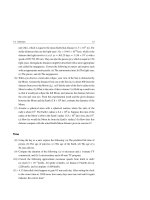
(14) A bullet of mass m = 10 g is fired horizontally with a speed v into a stationary
wooden block of mass M = 4 kg. The block is resting on a horizontal smooth
surface and attached to a massless spring with spring constant kH = 150 N/m,
where the other end of the spring is fixed through a wall, as shown in Fig. 14.34a.
In a very short time, the bullet penetrates the block and remains embedded
before compressing the spring, as shown in Fig. 14.34b. The maximum distance
that the block compresses the spring is 8 cm, as shown in Fig. 14.34c. (a) What
is the speed of the bullet? (b) Find the period T and frequency f of the oscillating
system.
Before collision
(a)
M
Just after collision
M+m
V
8cm
(c)
At maximum
compression
Fig. 14.34 See Exercise (14)
M+m
Stage 1
(b)
v
Stage 2
m
14.8 Exercises
491
Section 14.2 Damped Simple Harmonic Motion
(15) An object of mass m = 0.25kg oscillates in a fluid at the end of a vertical
spring of spring constant kH = 85 N/m, see Fig. 14.35. The effect of the fluid
resistance is governed by the damping constant b = 0.07kg/s. (a) Find the period
of the damped oscillation. (b) By what percentage does the amplitude of the
oscillation decrease in each cycle? (c) How long does it take for the amplitude
of the damped oscillation to drop to half of its initial value?
Fig. 14.35 See Exercise (15)
kH
m
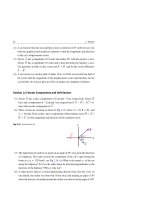
(16) A simple pendulum has a length L and a mass m. Let the arc length s and
the angle θ measure the position of m at any time t, see Fig. 14.36. (a) When
a damped force Fd = −bvs exists, show that the equation of motion of the
pendulum is given for small angles by:
m
d2θ
mg
dθ
+
θ =0
+b
2
dt
dt
L
(b) By comparison with Eq. 14.25, show that the above differential equation
has a solution given by:
θ = θ◦ e−bt/2m cos(ωd t), ωd =
b2
g
−
L 4m2
where θ◦ is initial angular amplitude at t = 0 and ωd = 2π fd is damped angular
frequency, see Fig. 14.9b. (c) When the pendulum has L = 1 m, m = 0.1 kg,
and the angular amplitude θ becomes 0.5 θ◦ after 1 minute, find the damping
constant b and the ratio (f − fd )/f , where f is the undamped frequency.
492
14 Oscillations and Wave Motion
Fig. 14.36 See Exercise (16)
θ
L
m
s
s
O
−b s
θ
mg
−m g sinθ
Section 14.3 Sinusoidal Waves
(17) Given a sinusoidal wave represented by y = (0.2 m) sin(k x − ω t), where
k = 4 rad/m, and ω = 8 rad/s, determine the amplitude, wavelength, frequency,
and speed of this wave.
(18) A harmonic wave traveling along a string has the form y = (0.25 m) sin(3 x −
40 t), where x is in meters and t is in seconds. (a) Find the amplitude, wave
number, angular frequency, and speed of this wave. (b) Find the wavelength,
period, and frequency of this wave?
Section 14.4 The Speed of Waves on Strings
(19) A uniform string has a mass per unit length of 5 × 10⁻³ kg/m. The string
passes over a massless, frictionless pulley to a block of mass m = 135 kg, see
Fig. 14.37, and take g = 10 m/s2 . Find the speed of a pulse that is sent from one
end of the string toward the pulley. Does the value of the speed change when
the pulse is replaced by a sinusoidal wave?
Fig. 14.37 See Exercise (19)
At time t
τ
mg
14.8 Exercises
493
(20) Assume a transverse wave traveling on a uniform taut string of mass per unit
length μ = 4 × 10⁻³ kg/m. The wave has an amplitude of 5 cm, frequency of
50 Hz, and speed of 20 m/s. (a) Write an equation in SI units of the form
y = A sin(kx − ω t) for this wave. (b) Find the magnitude of the tension in the
string.
Section 14.5 Energy Transfer by Sinusoidal Waves on Strings
(21) A sinusoidal wave of amplitude 0.05 m is transmitted along a string that has a
linear density of 40 g/m and is under 100 N of tension. If the wave source has
a maximum power of 300 W, what is the highest frequency at which the source
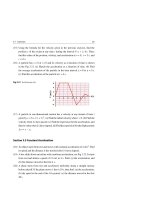
can operate?
(22) A long string has a mass per unit length μ of 125 g/m and is taut under tension
τ of 32 N. A wave is supplied by a generator as shown in Fig. 14.38. This wave
travels along the string with a frequency f of 100 Hz and amplitude A of 2
cm. (a) Find the speed and the angular frequency of the wave. (b) What is the
rate of energy that must be supplied by a generator to produce this wave in the
string? (c) If the string is to transfer energy at a rate of 100 W, what must be
the required wave amplitude when all other parameters remain the same?
Fig. 14.38 See Exercise (22)
y
Vibrator
A
V
x
(23) A sinusoidal wave is traveling along a string of linear mass density μ = 75 g/m
and is described by the equation:
y = (0.25 m) sin(2 x − 40 t)
where x is in meters and t in seconds. (a) Find the speed, wavelength, and
frequency of the wave. (b) Find the power transmitted by the wave.
494
14 Oscillations and Wave Motion
Section 14.6 The Linear Wave Equation
(24) A one-dimensional wave traveling with velocity v is found to satisfy the partial
differential equation [see Eq. 14.58]:
∂ 2y
1 ∂ 2y
−
=0
∂x 2
v2 ∂ t2
Show that the following functions are the solutions to this linear wave equation:
(a) y = A sin(k x − ω t). (b) y = A cos(k x − ω t). (c) y = exp[b(x − v t)], where
b is a constant. (d) y = ln[b(x − v t)], where b is a constant. (e) Any function
y having the form y = f (x − v t).
(25) If the linear wave functions y1 = f1 (x, t) and y2 = f2 (x, t) satisfy the wave Eq.
14.58, then show that the combination y = C1 f1 (x, t)+C2 f2 (x, t) also satisfies
the same equation, where C1 and C2 are constants.
Section 14.7 Standing Waves
(26) A standing wave having a frequency of 20 Hz is established on a rope 1.5 m
long that has fixed ends. Its wavelength is observed to be twice the rope’s length.
Determine the wave’s speed.
(27) A stretched string of length 0.6 m and mass 30 g is observed to vibrate with a
fundamental frequency of 30 Hz. The amplitude of any antinodes in the standing
wave is 0.04 m. (a) What is the amplitude of a transverse wave in the string?
(b) What is the speed of a transverse wave in the string? (c) Find the magnitude
of the tension in the string.
(28) A student wants to establish a standing wave with a speed 200 m/s on a string
that is fixed at both ends and is 2.5 m long. (a) What is the minimum frequency
that should be applied? (b) Find the next three frequencies that cause standing
wave patterns on the string.
(29) Two identical waves traveling in opposite directions in a string interfere to
produce a standing wave of the form:
y = [(2 m) sin(2 x)] cos(20 t)
where x is in centimeters, t is in seconds, and the arguments of the sine and
cosine are in radians. Find the amplitude, wavelength, frequency, and speed of
the interfering waves.
14.8 Exercises
495
(30) A standing wave is produced by two identical sinusoidal waves traveling in
opposite directions in a taut string. The two waves are given by:
y1 = (2 cm) sin(2.3 x − 4 t) and y2 = (2 cm) sin(2.3 x + 4 t)
where x and y are in centimeters, t is in seconds, and the argument of the
sine is in radians. (a) Find the amplitude of the simple harmonic motion of an
element on the string located at x = 3 cm. (b) Find the position of the nodes
and antinodes on the string. (c) Find the maximum and minimum y values of
the simple harmonic motion of a string element located at any antinode.
(31) A guitar string has a length L = 64 cm and fundamental frequency
f1 = 330 Hz, see part (a) of Fig. 14.39. By pressing down with your finger on the
string, it is found that the string is shortened in a way so that it plays an F note
with a fundamental frequency f1 = 350 Hz, see part (b) of Fig. 14.39. [Assume
the speed of the wave remains constant before and after pressing] How far is
your finger from the near end of the string?
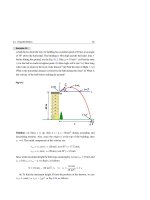
L = λ 1 /2
L′= λ ′1 /2
f1
n =1
(a)
f1′
n =1
(b)
Fig. 14.39 See Exercise (31)
(32) A violin string oscillates at a fundamental frequency of 262 Hz when unfingered. At what frequency will it vibrate if it is fingered two-fifths of the length
from its end?
(33) A string that has a length L = 1 m, mass per unit length μ = 0.1 kg/m, and
tension τ = 250 N is vibrating at its fundamental frequency. What effect on
the fundamental frequency occurs when only: (a) The length of the spring is
doubled. (b) The mass per unit length of the spring is doubled. (c) The tension
of the spring is doubled.
(34) Show that the resonance frequency fn of standing waves on a string of length L
and linear density μ, which is under a tensional force of magnitude τ , is given
√
by fn = n τ/μ/2L, where n is an integer.
496
14 Oscillations and Wave Motion
(35) Show by direct substitution that the standing wave given by Eq. 14.62,
y = (2 A sin k x) cos ω t
is a solution of the general linear wave Eq. 14.58:
∂ 2y
1 ∂ 2y
−
=0
∂x 2
v2 ∂ t2
(36) End A of a string is attached to a vibrator that vibrates with a constant frequency
f, while the other end B passes over a pulley to a block of mass m, see Fig. 14.40.
The separation L between points A and B is 2.5 m and the linear mass density
of the string is 0.1 kg/m. When the mass m of the block is either 16 or 25 kg,
standing waves are observed; however, standing waves are not observed for
masses between these two values. Take g = 10 m/s2 . (Hint: The greater the
tension in the string, the smaller the number of nodes in the standing wave)
(a) What is the frequency of the vibrator? (b) Find the largest m at which a
standing wave could be observed.
L
Vibrator A
B
m
Fig. 14.40 See Exercise (36)
(37) Two identical sinusoidal waves traveling in opposite directions on a string of
length L = 3 m interfere to produce a standing wave pattern of the form:
y = [(0.2 m) sin(2π x)] cos(20π t)
where x is in meters, t in seconds, and the arguments of the sine and cosine
are in radians. (a) How many loops are there in this pattern? (b) What is the
fundamental frequency of vibration of the string?
(38) Two strings 1 and 2, each of length L = 0.5 m, but different mass densities
μ1 and μ2 , are joined together with a knot and then stretched between two
14.8 Exercises
497
fixed walls as shown in Fig. 14.41. For a particular frequency, a standing wave
is established with a node at the knot, as shown in the figure. (a) What is
the relation between the two mass densities? (b) Answer part (a) when the
frequency is changed so that the next harmonic in each string is established.
Knot
μ1
Srting 1
μ2
Srting 2
Fig. 14.41 See Exercise (38)
(39) The strings 1 and 2 of exercise 38 have L1 = 0.64 m, μ1 = 1.8 g/m, L2 = 0.8 m,
and μ2 = 7.2 g/m, respectively, and both are held at a uniform tension τ =
115.2 N. Find the smallest number of loops in each string and the corresponding
standing wave frequency.
(40) In the case of the smallest number of loops in exercise 39, determine the total
number of nodes and the position of the nodes measured from the left end of
string 1.
Sound Waves
15
Sound waves are the most common examples of longitudinal waves. The speed of
sound waves in a particular medium depends on the properties of that medium and
the temperature. As discussed in Chap. 14, sound waves travel through air when air
elements vibrate to produce changes in density and pressure along the direction of
the wave’s motion.
Sound waves can be classified into three frequency ranges:
(1) Audible waves: within the range of human ear sensitivity and can be generated
by a variety of ways such as human vocal cords, etc.
(2) Infrasonic waves: below the audible range but perhaps within the range of
elephant-ear sensitivity.
(3) Ultrasonic waves: above the audible range and lie partly within the range of
dog-ear sensitivity.
15.1
Speed of Sound Waves
The motion of a one-dimensional, longitudinal pulse through a long tube containing
undisturbed gas is shown in Fig. 15.1. When the piston is suddenly pushed to the
right, the compressed gas (or the change in pressure) travels as a pulse from one
region to another toward the right along the pipe with a speed v.
The speed of sound waves depends on the compressibility and density of the
√
medium. We can apply equation v = τ/μ, which gives the speed of a transverse
wave along a stretched string, to the speed of longitudinal sound waves in fluids or
H. A. Radi and J. O. Rasmussen, Principles of Physics,
Undergraduate Lecture Notes in Physics, DOI: 10.1007/978-3-642-23026-4_15,
© Springer-Verlag Berlin Heidelberg 2013
499
500
15 Sound Waves
Fig. 15.1 Motion of a
Undisturbed gas
longitudinal sound pulse in a
Compressed gas
gas-filled tube
Compressed gas
Compressed gas
rods. In fluids we replace τ with the bulk modulus B, and in rods we replace τ with
Young’s modulus Y. In both, we replace μ with the density ρ. Then:
v=
⎧√
⎨ B/ρ
elastic property
=
medium property ⎩ √Y /ρ
(In fluids)
(15.1)
(In solid rods)
Table 15.1 depicts the speed of sound in several different materials.
Table 15.1 The speed of sound in different materials
Medium
v(m/s)
Gases
Medium
Solids
Oxygen (0 ◦ C)
317
Rubber
(0 ◦ C)
Air
v(m/s)
1,600
331
Lead
1,960
Air (20 ◦ C)
343
Lucite
2,680
Helium (0 ◦ C)
972
Gold
3,240
Hydrogen (0 ◦ C)
1,286
Brass
4,700
Liquids at (25 ◦ C)
Copper
5,010
Kerosene
1,324
Pyrex
5,640
Mercury
1,450
Iron
5,950
Water
1,493
Granite
6,000
Sea water
1,533
Aluminum
6,420
For sound traveling through air, the relation between the speed and the temperature
of the medium is given by the following relation:
15.1 Speed of Sound Waves
501
v = (331 m/s) 1 +
TC
273 ◦ C
(15.2)
where 331 m/s is the speed of sound at 0 ◦ C, and TC is the temperature of the medium
in degrees Celsius.
Example 15.1
Water at 20 ◦ C has an approximate bulk modulus B of 2.1 × 10⁹ N/m2 and density
ρ of 103 kg/m3 . (a) Find the speed of sound in water. (b) Dolphins use sound waves
to locate distant food targets by estimating the time t between the moment of
emitting a sound pulse toward the food and the moment of receiving its reflection,
see Fig. 15.2. Calculate such a
t when the food is 100 m away from the dolphin.
100 m
Sound pulse
Fig. 15.2
Solution: (a) Using Eq. 15.1, we find that:
v=
B
=
ρ
2.1 × 10⁹ N/m2
= 1,449 m/s
103 kg/m3
(b) The total distance traveled by the sound pulse from the dolphin to the food
and back to the dolphin is
x = 2 × 100 m = 200 m. Thus:
t=
200 m
x
=
= 0.138 s
v
1,449 m/s
502
15 Sound Waves
15.2
Periodic Sound Waves
As a result of continuous push and pull of a piston in a gas tube, continuous
regions of compressions and expansions (or called rarefactions) are generated,
see Fig. 15.3a. The darker-colored areas in the figure represent regions where the gas
is compressed, and thus the pressure and density are above their equilibrium values.
The lighter-colored areas in the same figure represent regions of expansions, where
the pressure and density are below their equilibrium values.
Oscillating piston
with frequency
At time t
Compression
λ
Expansion
f
(a)
x
Equilibrium
position
Δx
x
s
(b)
x+Δx
Oscillating
element
Cross
sectional
area A
smax
smax
Fig. 15.3 (a) A longitudinal, sinusoidal sound wave is traveling through a long gas-filled tube with a
speed v. The wave consists of a moving pattern of compressions and expansions. The wave is shown
at an arbitrary time t. (b) An element of thickness
x is displaced at a distance s to the right from its
equilibrium position. Its maximum displacement, either right or left, is smax , where smax
Consider a thin element of air of thickness
λ
x located at a position x along the
tube. As the wave passes through the tube, this element oscillates back and forth in
simple harmonic motion about its equilibrium position, see Fig. 15.3b. To describe
this element from its equilibrium position, we can use either a sine function or a
cosine function. In this book, we use a cosine function of the form:
s(x, t) = smax cos(kx − ω t)
(15.3)
where smax is the maximum displacement of the air element to either side of the
equilibrium position, see Fig. 15.3b, and is called the displacement amplitude of the
15.2 Periodic Sound Waves
503
wave. For this longitudinal sound wave, the wave number k, wavelength λ, angular
frequency ω, frequency f, speed v, and period T are all defined and interrelated
exactly as for the transverse waves on strings in Sect. 14.3, except that λ is now along
the direction of the wave.
For the sinusoidal longitudinal sound wave shown in Fig. 15.4a, the displacement
s(x, t) of Eq. 15.3 at t = 0 is displayed in Fig. 15.4b. Accordingly, the variation in the
gas pressure P about the equilibrium value must also be periodic, see Fig. 15.4c,
and based on Eq. 15.3 it must be in the form:
P=
where
Pmax sin(kx − ω t)
(15.4)
Pmax is the maximum change in pressure from the equilibrium value and is
called the pressure-variation amplitude, as shown in Fig. 15.4c.
Oscillating piston
with frequency f
At t = 0
(a)
s
smax
λ
(b)
x
ΔP
Δ Pmax
(c)
x
Fig. 15.4 (a) A snapshot at t = 0 of a longitudinal sinusoidal sound wave traveling through a long
gas-filled tube with a speed v. The variation of both: (b) the displacement amplitude s and (c) the pressure
difference
P as a function of position
∗
To find Pmax in Eq. 15.4, we start with the definition of bulk modulus B, given
by Eq. 10.14, and express the change in pressure at any time t as follows:
P = −B
V
V
(15.5)
504
15 Sound Waves
The quantity V is the volume element, given by:
V =A
The quantity
x
(15.6)
V is the change in volume that arises from the difference
s between
the displacements of the two faces of the element in Fig. 15.3. That is,
x, t) − s(x, t). Thus:
s = s(x +
V =A s
(15.7)
Substituting Eqs. 15.6 and 15.7 into Eq. 15.5 we get:
P = −B
Allowing for the differential limit,
s
x
x → 0 at any time t, we get:
P = −B
∂s
∂x
(15.8)
The partial derivative ∂s/∂x indicates how s changes with x at any time t. Using
Eq. 15.3, and treating t as a constant, we find:
∂s
∂x
Thus:
=
∂
∂x
[smax cos(kx − ω t)] = −ksmax sin(kx − ω t)
P = B k smax sin(kx − ω t)
(15.9)
(15.10)
Comparing the two Eqs. 15.4 and 15.10, we find that:
Pmax = B k smax
(15.11)
Using Eq. 15.1 allows us to eliminate the bulk modulus B and get the following
relation:
Pmax = ρv 2 k smax
(15.12)
Also, we can eliminate k by using v = ω/k, Eq. 14.38, to find:
Pmax = ρvω smax
(15.13)
15.2 Periodic Sound Waves
505
Example 15.2
The human ear can tolerate the loudest sound which has a pressure-variation
amplitude Pmax = 28 Pa (the threshold of pain), and can detect the faintest
sound which has Pmax = 2.8 × 10⁻⁵ Pa (the threshold of hearing). For a sound
of frequency 1,000 Hz traveling with a speed v = 343 m/s in air of density
ρ = 1.21 kg/m3 , calculate the displacement amplitude smax for the loudest and
the faintest sounds.
Solution: From Eq. 15.13, we can find the displacement amplitude smax for the
loudest sound wave as follows:
Pmax
Pmax
=
ρvω
ρv(2π f )
28 Pa
=
3
(1.21 kg/m )(343 m/s)(2π × 1,000 Hz)
smax =
= 1.1 × 10⁻⁵ m
11 µm
(Loudest; threshold of pain)
The displacement amplitude for the loudest sound that can be tolerated by the
human ear is about one-tenth the thickness of this page.
Also, from Eq. 15.13, we find the following for the faintest sound wave:
Pmax
Pmax
=
ρvω
ρv(2π f )
2.8 × 10⁻⁵ Pa
=
3
(1.21 kg/m )(343 m/s)(2π × 1,000 Hz)
smax =
= 1.1 × 10⁻¹¹ m
(Faintest; threshold of hearing)
This is a remarkably small number! This displacement amplitude is about onetenth the size of a typical atom (diameter ≈10−10 m). Indeed, the ear is an
extremely sensitive detector for sound waves. On the other hand, the ear can
detect a sound-wave pulse whose total energy is about the same as the total energy
required to remove an outer electron from a single atom.
15.3
Energy, Power, and Intensity of Sound Waves
In Sect. 14.5, we showed that waves transport kinetic and potential energy when they
propagate through a medium. The same concept applies to sound waves. Consider
an element of air of mass m and length x in front of a piston oscillating with a
frequency f in one dimension, as shown in Fig. 15.5.
506
15 Sound Waves
Area A
Oscillating piston
with frequency f
Δm
Δx
Fig. 15.5 A piston oscillates with frequency f in an air-filled tube. The piston transfers energy to an
adjacent air element that has a mass
m and length
x, causing it to oscillate with an amplitude smax
The piston transfers energy to this element and hence the energy is propagated
away through the tube by the sound wave. As the sound wave propagates away, the
displacement of this element with respect to its equilibrium position will be given
by Eq. 15.3, i.e.:
s(x, t) = smax cos(k x − ω t)
(15.14)
The speed of this element can be found by taking the partial time derivative of s as
follows:
v(x, t) =
∗
∂
∂t
s(x, t) =
∂
∂t
The kinetic energy
[smax cos(k x − ω t)] = + ω smax sin(k x − ω t)
K associated with the air element of mass
(15.15)
m = ρA x,
where ρ is the air density, will be given by:
2
sin2 (k x − ω t)
K = 21 m v 2 = 21 ρ A x ω2 smax
(15.16)
When we allow x to approach zero, this relation becomes a differential relationship
and will take the following form:
2
sin2 (k x − ω t)dx
dK = 21 ρ A ω2 smax
(15.17)
At a given instant, let us integrate this expression over all the elements in a
complete sound wavelength, which will give us the total kinetic energy Kλ in one
wavelength:
λ
Kλ =
2
dK = 21 ρ A ω2 smax
sin2 (k x − ω t)dx
0
(15.18)
15.3 Energy, Power, and Intensity of Sound Waves
507
If we take a snapshot at time t = 0, then we can evaluate the above integral by
performing the following steps:
z = kλ = 2π
x=λ
sin2 (k x)dx = 1k
sin2 z dz
x=0
z=0
2π
= 1k
1
1
2 [1 − cos 2z]dz = 2k
z−
1
2
sin 2z
2π
0
0
=
1
2k
(2π −
1
2
sin 4π ) − 0 =
λ
λ
2π =
4π
2
(15.19)
where we have used z = k x, sin2 z = (1 − cos 2z)/2 and k = 2π/λ to arrive to the
above result. Of course, we get the same answer if we perform the above steps at any
other time different from zero. When we substitute the above result into Eq. 15.18,
we get:
2
Kλ = 41 ρ Aω2 smax
λ
(15.20)
A similar analysis to the total potential energy Uλ in one wavelength will give exactly
the same result. Thus:
2
Uλ = 41 ρ A ω2 smax
λ
(15.21)
The total energy in one wavelength of the sound wave (Eλ ) is the sum of the obtained
kinetic and potential energies. Thus:
2
Eλ = Kλ + Uλ = 21 ρ A ω2 smax
λ
(15.22)
As the sinusoidal sound wave travels along the tube, this amount of energy (Eλ ) will
cross any given point in the tube during a time interval equal to one period of the
oscillation. Thus, the rate of energy (power) transferred by the sound wave through
the air is:
P=
E Eλ
=
t
T
where we used the symbol P for the power in this section to avoid confusion with
the symbol P for pressure. Therefore:
2
P = 21 ρ A ω2 smax
λ
T
508
15 Sound Waves
Using the relation v = λ/T , given by Eq. 14.38, we finally reach the following
power form:
2
P = 21 ρ A v ω2 smax
(15.23)
Thus, the power of a periodic sound wave is proportional to the square of the angular
frequency and the square of the displacement amplitude (as in the case of periodic
string waves).
For a wave crossing a particular surface, we define its intensity I as the power
per unit area, or the rate of energy transfer (power P) of the wave through a unit area
perpendicular to the direction of the propagation of the wave, i.e. I = P/A. Therefore:
I=
P
A
⇒
2
I = 21 ρvω2 smax
(15.24)
By using Eq. 15.13, Pmax = ρvω smax , the last relation can be written in terms
of the pressure amplitude Pmax as:
I=
2
Pmax
2ρv
On the other hand, we can express the pressure amplitude
measurable quantities ρ, v, and I as follows:
Pmax =
√
2ρvI
(15.25)
Pmax in terms of the
(15.26)
In three dimensions, we consider a point source S emitting sound waves uniformly
in all directions as spherical waves, see Fig. 15.6. When we construct an imaginary
sphere of radius r centered at the sound source, the power emitted by this source
must be distributed uniformly over this spherical surface, which has an area 4π r 2 .
From the definition of the intensity, I = P/A, given by Eq. 15.24, the intensity I
at any point on the spherical surface will be given by:
I=
P
4π r 2
(15.27)
This equation is known as the inverse square law and tells us that the intensity of
sound waves emitted from an isotropic point source decreases with the square of the
distance r from the source, i.e. the intensity is inversely proportional to the square of
the distance r.
15.3 Energy, Power, and Intensity of Sound Waves
509
r
r
λ
S
r
λ
λ
Point source
S
(a) Three dimensional view
(b) Cross sectional view
Fig. 15.6 (a) A point source S emitting sound waves uniformly in all directions with the waves passing
through an imaginary sphere of radius r. (b) A cross-sectional view showing the wavelength λ between
consecutive crests of the sound waves
Example 15.3
At a frequency of 1,000 Hz, the human ear can detect the loudest and faintest
sounds with intensities of about 1.0 W/m2 and 1.0 × 10⁻¹² W/m2 , respectively.
For sound waves traveling with a speed of v = 343 m/s, find the pressure amplitude Pmax for the faintest and the loudest sound waves, assuming the air’s density
is ρ = 1.21 kg/m3 .
Solution: From Eq. 15.26, we can find the pressure amplitude
loudest sound waves as follows:
Pmax for the
Pmax = 2ρvI = 2(1.21 kg/m3 )(343 m/s)(1 W/m2 )
= 28.8 N/m2 = 28.8 Pa
(Loudest; threshold of pain)
Also, from Eq. 15.26, we find the pressure amplitude
Pmax for the faintest
sound waves as follows:
Pmax =
2ρvI = 2(1.21 kg/m3 )(343 m/s)(1 × 10−12 W/m2 )
= 2.88 × 10⁻⁵ N/m2
= 2.88 × 10⁻⁵ Pa
(Faintest; threshold of hearing)
510
15 Sound Waves
Example 15.4
A point source emits sound waves with a power of 50 W. (a) Find the intensity
of the sound waves 2 m away from the source. ( b) Find the distance at which the
intensity of the sound is 10−6 W/m2 .
Solution: (a) The point source S shown in Fig. 15.7. emits energy in the form of
spherical sound waves centered at the source. Thus, when using Eq. 15.27 we find
that:
I=
P
4π r 2
=
50 W
= 0.995 W/m2
4π(2 m)2
which is close to the intensity of the threshold of pain, see Example 15.3.
(b) Expressing r in Eq. 15.27 in terms of P and I, we obtain:
r=
P
4π I
=
50 W
= 1,995 m
4π(10−6 W/m2 )
Fig. 15.7
2 km
I
I
r=2
m
S(50W)
I
15.4
I
The Decibel Scale
According to Example 15.2, the displacement amplitude smax for the human ear
ranges from about 10−5 m for the loudest tolerable sound to about 10−11 m for
faintest detectable sound, a ratio of 106 . From Eq. 15.24, we see that the intensity
I varies as the square of smax , so the ratio of intensities at these two limits of the
human audibility is 1012 . This goes to show that the human ear can accommodate
an enormous range of intensities.
We can better represent large ranges of I by using logarithms. Now, consider the
following logarithmic relation of the base 10:
15.4 The Decibel Scale
511
y = log x
It is usual to suppress explicit references to the base 10 (such as log10 x) and instead
write log x. If x in this equation is multiplied by 10, then y increases by 1, i.e.:
y = log10 x = log 10 + log x = 1 + log x = 1 + y
Similarly, if we multiply x by 1012 , y increases only by 12.
Consequently, instead of speaking of intensity I of a sound wave, it is much more
convenient to speak of its sound level β (Greek beta), defined by:
β = (10 dB)log
I
I◦
(15.28)
Here dB is the abbreviation for decibel, the unit of sound level, a name chosen to
recognize the work of Alexander Graham Bell. The constant I◦ in Eq. 15.28 is the reference intensity, taken to be near the threshold of hearing, i.e. I◦ = 1.0 × 10⁻¹² W/m2 .
The intensity I in the same equation is measured in watts per square meter.
On this scale, the threshold of hearing (I = 1.0 × 10⁻¹² W/m2 ) corresponds to a
sound level of:
β = (10 dB)log
1.0 × 10⁻¹² W/m2
I
= (10 dB)log
I◦
1.0 × 10⁻¹² W/m2
= (10 dB)log1
= 0 dB
(Threshold of hearing)
So our threshold of hearing level corresponds to zero decibel. Also, the threshold of
pain (I = 1.0 W/m2 ) corresponds to a sound level of:
β = (10 dB)log
1.0 W/m2
I
= (10 dB)log
I◦
1.0 × 10⁻¹² W/m2
= (10 dB)log1012 = (10 dB) × 12
= 120 dB
(Threshold of pain)
In general, β = 10 × n dB corresponds to an intensity that is 10n times the reference
intensity, i.e. corresponds to I = 10n I◦ = 10n−12 W/m2 . Table 15.2 lists some soundlevel values for some environments.
512
15 Sound Waves
Table 15.2 Approximate sound levels (dB) for several sources
Source of sound
β(dB)
I(W/m2 )
Threshold of hearing in human auditory system
0
10−12
Quiet rustling leaves, calm human breathing
10
10−11
Very calm room
20
10−10
Whispering
30
10−9
Mosquito buzzing
40
10−8
Normal talking (1 m distant)
50
10−7
TV set—typical home level, 1 m distant
60
10−6
Vacuum cleaner
70
10−5
Traffic noise for a main road, 10 m distant
80
10−4
Machine gun
90
10−3
Jack hammer, 1 m distant
100
10−2
Jet engine, 100 m distant
110
10−1
Threshold of pain in human auditory system
120
1
Example 15.5
(a) Find the sound level in decibels for a sound wave of intensity 1.59 × 10⁻⁵ W/m2 .
(b) Find the sound intensity of a source rated at a 35 dB sound level.
Solution: (a) From Eq. 15.28, we find that:
I
I◦
1.59 × 10⁻⁵ W/m2
= (10 dB)log
1.0 × 10⁻¹² W/m2
β = (10 dB)log
= (10 dB)log1.59 × 107
= 72 dB
(b) Substituting in Eq. 15.28 with β = 35 dB, dividing both sides by 10, and
taking the antilog of both sides, we can find I by performing the following steps:
β = (10 dB)log
I
I◦
35 dB = (10 dB)log
3.5 = log
I
I◦
I
I◦
15.4 The Decibel Scale
513
antilog(3.5) = antilog log
103.5 =
I
I◦
I
I◦
I = 103.5 × I◦
Thus, with the reference intensity I◦ = 1.0 × 10⁻¹² W/m2 , we find that:
I = 103.5 × 1.0 × 10−12 W/m2
= 3.16 × 10⁻⁹ W/m2
Example 15.6
Two identical point sources, S1 and S2 , have the same power and driven by one
oscillator. The positions of the two sources relative to an observer is depicted in
Fig. 15.8. The sound intensity at the observer’s location from S2 is found to be
I2 = 3.0 × 10⁻⁶ W/m2 . (a) Find the total intensity of the combined sound waves
that is received by the observer from the two sources. (b) Find the difference
in sound level when the two sources operate simultaneously and when only the
second source operates.
r2 = 2 r1
r1
S1
S2
Fig. 15.8
Solution: (a) If I1 and I2 are the intensities received by the observer from the point
sources S1 and S2 , respectively, then their ratio will be:
514
15 Sound Waves
I1
=
I2
P
P
4π r12
4π r22
=
r22
r12
=
(2r1 )2
=4
r12
⇒
I1 = 4 I2
This means that the intensity I1 from S1 is four times the intensity I2 from S2 .
Thus, the total intensity becomes:
Itot = I1 + I2 = 4I2 + I2 = 5I2 = 5(3.0 × 10⁻⁶ W/m2 ) = 1.5 × 10⁻⁵ W/m2
(b) If β2 is the sound level when only the second source operates and βtot is
the sound level when both sources operate together, then:
β2 = (10 dB)log
I2
Itot
5I2
and βtot = (10 dB)log
= (10 dB)log
I◦
I◦
I◦
Then: β = βtot − β2 = (10 dB)log
15.5
5I2
I2
5I2
− (10 dB)log = (10 dB)log
= 7 dB
I◦
I◦
I2
Hearing Response to Intensity and Frequency
The threshold of hearing in the human auditory system depends on the intensity of
the sound (or the sound level in dB) and its frequency. We learned in the previous
section that the threshold of hearing at 1,000 Hz requires an intensity of 10−12 W/m2
and corresponds to a sound level of 0 dB. Conversely, at 100 Hz sound must have an
intensity level of about 30 dB to be barely audible.
Figure 15.9 maps the sound regions that humans can respond to for a range of
sound levels β (or intensity I) and sound frequencies f. Tentatively, the figure also
overlays some sample sources. The lower blue curve of the white area shows the
dependence of the threshold of hearing β on the frequency. This curve indicates
that humans are sensitive to frequencies ranging from about 20 to 20,000 Hz. The
upper bound to the white area is the threshold of pain, and does not depend much on
frequency. The lower left region of the white area shows that our ears are particularly
insensitive to low frequencies and low intensity levels.
15.6
The Doppler Effect
We move to a different phenomenon that applies to all kinds of waves, not only sound
waves. You most probably have noticed that when a car moves toward you with a
high speed and horns, you hear the horn with a higher frequency than when the car
15.6 The Doppler Effect
515
is at rest. Contrary wise, when the car moves away, you hear the horn with a lower
frequency. This phenomenon is called the Doppler effect.
10 10
10 8
Sonar
10 6
Sonic frequencies
10 4
Threshold of pain
10 2
1
10 -2
Threshold of hearing
10 -4
10 -6
Bats
10 -8
Whispering
10 -10
10 -12
100
1000
10000
100000
Large rocket engine
1
10
Ultrasonic
frequencies
220
200
180
160
140
120
100
80
60
40
20
0
Ι (W /m 2 )
Infrasonic
frequencies
Sound level
β (dB)
Frequency, f (Hz)
Fig. 15.9 The dependence of the sound level β on the frequency f for normal human hearing (the white
area) and various sources
Let us now examine this phenomenon quantitatively. First, we consider a point
source that emits sound waves radially in all directions in a uniform medium. It is
useful to represent the emitted waves using a series of concentric spheres with the
source located at their centers. Each sphere represents a wave crest, and it moves
away from the source with the speed of sound. We call such a sphere of constant
phase a wave front. Therefore, the distance between any two successive wave fronts
equals the wavelength λ of the sound wave and has a frequency f and speed v. In
our analyses that follow, we restrict ourselves to the motion of a sound source S and
observer O along the line joining them.
Moving Observer and Stationary Source
Figure 15.10 shows an observer O (represented by an ear) moving with a speed vo
toward a stationary source S that emits spherical sound waves of speed v(v > vo ),
wavelength λ, and frequency f. The frequency detected by the observer O is the rate
at which O intercepts successive wave fronts (or wavelengths).