AQA ANTH2 WRE JAN13
Bạn đang xem bản rút gọn của tài liệu. Xem và tải ngay bản đầy đủ của tài liệu tại đây (63.43 KB, 6 trang )
Version 1.0: 0112
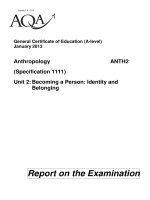
General Certificate of Education (A-level)
January 2013
Anthropology
ANTH2
(Specification 1111)
Unit 2: Becoming a Person: Identity and
Belonging
Report on the Examination
Further copies of this Report on the Examination are available from: aqa.org.uk
Copyright © 2012 AQA and its licensors. All rights reserved.
Copyright
AQA retains the copyright on all its publications. However, registered centres for AQA are permitted to copy material from this
booklet for their own internal use, with the following important exception: AQA cannot give permission to centres to photocopy
any material that is acknowledged to a third party even for internal use within the centre.
Set and published by the Assessment and Qualifications Alliance.
The Assessment and Qualifications Alliance (AQA) is a company limited by guarantee registered in England and Wales (company number 3644723) and a registered
charity (registered charity number 1073334).
Registered address: AQA, Devas Street, Manchester M15 6EX.
Anthropology ANTH2 - AQA A-level Report on the Examination 2013 January series
General
Overall, based on a small number of scripts, many students performed well, with some
performing particularly well. Students were able to manage the time effectively and to complete
all questions. Answers were largely of sufficient length, although some students still wrote a
disproportionately large amount for question 02 and 03. Students answered question 04 in
many different, but acceptable ways. The responses to this paper showed that schools/colleges
and students had responded to the feedback from the previous series, in this fifth Unit 2
examination.
Positive features
•
•
•
•
•
•
•
•
Almost all students attempted every question.
There was definitely greater awareness of the need to address theoretical interpretations
of the debates within responses.
An increased awareness of the need to use concepts, unpack them and interpret them
to the specific demands of the question.
An awareness of the specific demands of Unit 2, particularly the process of becoming a
person, which was referred to in many of the responses.
Use of detailed, well contextualised ethnographic studies (many students drew on
studies encountered in Unit 1 and applied them successfully to Unit 2).
Many different approaches to the same question and better interpretation of some
ethnographic studies to the specific demands of the question
A wide range of material was present, both between and within schools/colleges, and
students were confident enough to draw together different areas of the specification.
Anthropology is a broad subject and examiners saw considerable variation in the
ethnographic material presented. Better answers applied a range of perspectives and
concepts in order to develop analysis and discussion of the ethnographic examples.
Key Issues
•
•
•
•
•
•
•
•
In some cases theories were described in a list like way in a longer question answers
and were not interpreted to the demands of the question.
Many students were unable to define ‘liminal’ although they were less able to provide
some specific examples of the liminal stage in ethnographic research.
There was a disappointing lack of use of anthropological theories in some students’
work, especially in the longer essays.
There was a lack of analysis and evaluation in some work, with some answers being
overly descriptive and quasai commonsensical, especially relating to question 3.
There were too many references only to western societies and Britain, with the odd
reference to an unidentified ‘tribe’, especially in weaker answers.
There was a tendency for students to over-generalise rather than to point out the
complexities in cultural differences and similarities. A greater sensitivity in discussing
other cultures through ethnographic detail is required to achieve the very best marks.
Although the mark scheme does allow for examples that are not specifically
anthropological, some students relied on commonsense and on over-generalised
examples, possibly from other subjects. Where students did explain the concepts and
ideas in general terms, their answers were often lacking in ethnographic examples.
There was not enough explicit comparison – in many cases, answers were simply a
juxtaposition of descriptions of two cultures.
3
Anthropology ANTH2 - AQA A-level Report on the Examination 2013 January series
Question 01
Some students were successful in providing an explanation of ‘liminal’ and in providing an
example. Often, however, students failed to explain the term fully, or merely stated that the
liminal stage was simply part of a rite of passage.
Many students were able to identify a rite of passage. However, they often failed to develop the
example; for instance simply describing the rite of passage or the pre or post liminal stage
rather than pointing out the liminal stage specifically.
Therefore a significant number of
students failed to gain the full four marks available. Students who gained full marks tended to
use examples drawn from ethnographic studies. Students should be encouraged, where
possible, to use anthropological examples because their meaning will be clearer in relation to
anthropological concepts and issues. Most students wrote the right amount for this question
and the better answers generally received full marks in about 5-6 lines.
Question 02
This question continues to challenge students in terms of layout. Students are far more likely to
gain the full six marks if they set out their responses clearly, ie if their identifier is distinct from
the explanation. Some students used power asymmetry as the basis for both of their causes,
often not making their two causes different enough, which meant they were not able to gain full
marks. However, many students were able to come up with two separate causes of ethnic
conflicts. Some students referred to large scale ethnic conflict whilst others used smaller scale
examples such as the ethnic conflict relating to Kayapo and the Brazilian Government.
Students need to be aware of the marking structure: one for identifying and a further two for
unpacking and offering examples. Again, ethnographic studies, where used to support a
difference, often produced highly successful responses. Some students gave too much detail
for this answer, out of proportion to the marks available.
Question 03
This question prompted some strong responses, although there was a range in the quality
within and between schools/colleges. Students were generally able to discuss two or three
examples of puberty rites of passage. However some responses were focussed on general
discussions of western rites of passage at puberty. A worrying number of students stated that
there are no rites of passage in ‘the west’ or oversimplified/over homogenised rituals in the
west. There was a tendency to be descriptive rather than analytical, listing characteristics rites
of passage rather than show the ways that they
Stronger responses referred to different ways in which rituals are used to mark the transition
from childhood to adulthood. In stronger answers, this meant exploring religious rites, ordeal
rites as well as the differential nature of gendered rites. This question elicited some impressive
analytical and well-organised responses.
4
Anthropology ANTH2 - AQA A-level Report on the Examination 2013 January series
Question 04
It was clear that many students felt prepared for this question. Many students discussed a
range of cross cultural examples of alternative genders. Often these were descriptive, with only
a few students really drawing out the differences in what it means to be a gendered person in
different societies. Some students recycled the views put forward in the Item but did not go far
beyond them, which was disappointing.
There was a tendency for students to recount knowledge and understanding of general facts
about an cross cultural example of an example of an alternative gender, often linked vaguely to
roles for example, without exploring ethnographic and anthropological interpretations such as
Devereux. Weaker students simply listed different forms of gender alternatives in a vague way
such as cross dressing without any ethnographic study or anthropological concepts.
Very few students took the opportunity to highlight the ethnographic examples which have
focussed on gender alternatives such as Nanda. Students frequently understood the question
but did not have the ethnographic examples to support an informed discussion about what it
means to be a gendered person. However in some schools/colleges, students used different
gender roles as a basis for the discussion of what it means to be gendered, with some pleasing
results.
Question 05
Just under half of the total number of students chose this question and there was a very wide
range in the quality of responses, most answered well, and with a few students reaching very
high marks. Weaker students considered a range of resources that inform and shape identity;
however they lacked ethnographic detail. Alternatively, weaker students tended to limit their
discussion to a narrow range of ways in which a shared history informs identity, or drifted into
more general discussions about identity. Some students answered in a list-like way, describing
different concepts relating to identity without being discursive. This meant that the responses
were not sufficiently analytical or evaluative to meet the AO2 demands of an ‘assess’ question
satisfactorily.
Stronger responses discussed a number of different resources used to shape a person’s
identity, using referenced evidence and ethnographic detail, drawing out the differences and
similarities between these resources. For example, students discussed language, ethnicity,
place, social memories and symbols as alternative resources of identity societies backed up
with specific anthropological research such as Hall, Maalki, Gordillo and Demello.
Question 06
This question elicited varied responses, with many students clearly able to relate the concept of
personhood to how people relate to non-human entities. However, these responses tended to
over focus on the other entities without demonstrating depth of knowledge and understanding of
different concepts of personhood. For example, many students focussed on western
perspectives of personhood in a superficial way rather than considering a range of concepts of
personhood. However students did tend to address animals, spirits and cyborgs within their
answers, with some success.
Stronger responses focused on ethnographic studies of personhood then relate them to their
specific way of relating to other entities.
Some students effectively discussed
anthropomorphism in a range of societies for example Malawi (Morris). Alternatively, students
were able to demonstrate the differences between western and non-western concepts of
personhood in relation to spirits. Ethnographic studies were often very well linked to the
5
Anthropology ANTH2 - AQA A-level Report on the Examination 2013 January series
question, with clear interpretation to the demands of the question. Concepts were more
numerous and integrated, and explained and appropriately applied to the question.
Mark Ranges and Award of Grades
Grade boundaries and cumulative percentage grades are available on the Results Statistics
page of the AQA Website: />
Converting Marks into UMS marks
Convert raw marks into Uniform Mark Scale (UMS) marks by using the link below.
UMS conversion calculator />
6