Essential science 4 TESTS AND ASSESSMENT 4
Bạn đang xem bản rút gọn của tài liệu. Xem và tải ngay bản đầy đủ của tài liệu tại đây (1.52 MB, 36 trang )
19/9/08
08:53
Página 1
Tests and assessment
Essential Science
Science, Geography and History
4
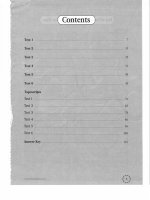
Contents
Page
Assessment Worksheets
11 Animals and plants ...................................
12 Food .........................................................
13 Breathing ..................................................
14 Men and women .......................................
15 Life cycles .................................................
16 The universe .............................................
17 Minerals ....................................................
18 Ecosystems ...............................................
19 Light .........................................................
10 Materials ...................................................
11 Where do we live? ......................................
12 Oceans and continents ..............................
13 Government and society ............................
14 The Romans .............................................
2
4
6
8
10
12
14
16
18
20
22
24
26
28
Term Assessment
• First Term. Units 1-5 ...................................
• Second Term. Units 6-10 .............................
• Third Term. Units 11-14 ..............................
30
32
34
Santillana
Primary
127484 _ 0001-0036.qxd
127484 _ 0001-0036.qxd
19/9/08
08:53
Página 2
1 Living things
Name
Date
1. What do animals need? Write three things.
Animals need
and the
,
.
2. Complete the sentences.
a. Herbivores eat
.
b. Carnivores eat
.
c. Omnivores eat
and
3. Tick the true sentences.
a. Aquatic animals live in water.
b. All animals eat plants.
c. Some animals look for food at night.
d. Some animals live in hot places.
e. In cold places, animals have thick fur or fat under their skins.
4. Write a word to match the definition.
a. A plant which needs very little water:
b. A plant which needs a lot of water:
c. A plant which lives in water:
d. A plant which needs very little light:
2
ESSENTIAL SCIENCE 4 PHOTOCOPIABLE MATERIAL © Richmond Publishing / Santillana Educación, S. L.
.
127484 _ 0001-0036.qxd
19/9/08
08:53
Página 3
5. Match the three columns.
Diplodocus
herbivore
9 metres long
Tyrannosaurus
carnivore
12 metres long
Triceratops
herbivore
27 metres long
6. Use the information and write about the dinosaurs. Add information if you can.
Dinosaurs were
Tyrannosaurus was
Triceratops
Diplodocus
ESSENTIAL SCIENCE 4 PHOTOCOPIABLE MATERIAL © Richmond Publishing / Santillana Educación, S. L.
3
127484 _ 0001-0036.qxd
22/9/08
13:05
Página 4
2 Food
Name
Date
1. Classify the foods.
tomatoes
apples
bread
olive oil
milk
meat
fish
chocolate
eggs
butter
They give us energy and calcium,
necessary for bones and muscles.
cheese
c™æeßæ,
They have proteins to help us grow.
They contain vitamins and minerals.
They give us energy.
2. True or false? Write T or F.
a. A balanced diet gives us the right quantity of each type of food.
b. Everybody needs the same quantity of food.
c. We need milk because it gives us energy.
d. If we do a lot of exercise, we need to eat more.
e. It is very important to have a good breakfast because
we need energy in the morning.
f. Meat and fish give us proteins.
4
ESSENTIAL SCIENCE 4 PHOTOCOPIABLE MATERIAL © Richmond Publishing / Santillana Educación, S. L.
127484 _ 0001-0036.qxd
19/9/08
08:53
Página 5
3. Label the picture.
stomach
oesophagus
mouth
small intestine
large intestine
anus
4. Complete the sentences using the words below.
digestion
anus
faeces
blood
a. Digestion begins in the
gastric juice
intestine
mouth
, where food is chewed
and mixed with saliva.
b. In the stomach, food is mixed with
. This mixture
passes into the small intestine.
c.
ends in the small intestine.
d. The useful parts of our food go from our small intestine into
the
.
e. The parts of food that we cannot use go into the large
f. They are transformed into
.
and expelled through the
.
ESSENTIAL SCIENCE 4 PHOTOCOPIABLE MATERIAL © Richmond Publishing / Santillana Educación, S. L.
5
127484 _ 0001-0036.qxd
19/9/08
08:53
Página 6
3 Breathing
Name
Date
1. Label the picture.
nostrils
left lung
bronchial tube
trachea
nose
right lung
2. Order the sequence. Write 1, 2, 3, 4 or 5.
a. Oxygen from the air passes through the walls of our lungs into our blood.
b. The air passes through the nostrils.
c. Then it goes into the lungs.
d. Air enters our body through the nose and mouth.
e. It goes down through the trachea and the bronchial tubes.
3. True or false? Write T or F.
a. Blood carries oxygen and the substances from digestion to different
parts of our body.
b. The respiratory system is responsible for blood circulation.
c. Each time our heart beats, it pushes blood to all the organs in our body.
d. Blood circulates around our body inside blood vessels.
e. Capillaries carry the blood from the heart to the rest of our body.
6
ESSENTIAL SCIENCE 4 PHOTOCOPIABLE MATERIAL © Richmond Publishing / Santillana Educación, S. L.
127484 _ 0001-0036.qxd
19/9/08
08:53
Página 7
4. Label the picture.
kidney
renal artery
bladder
renal vein
5. Match the two columns.
Kidneys
This organ pumps the blood around our body.
Arteries
This process moves blood through the body.
Urine
Blood leaves the heart through them.
Heart
This process cleans the blood and
eliminates waste substances.
Circulation
Excretion
Veins
These organs filter the blood.
Blood returns to the heart through them.
It is stored in the bladder.
ESSENTIAL SCIENCE 4 PHOTOCOPIABLE MATERIAL © Richmond Publishing / Santillana Educación, S. L.
7
127484 _ 0001-0036.qxd
19/9/08
08:53
Página 8
4 Men and women
Name
Date
1. Decide if the sentences refer to women or men. Write W or M.
a. They make eggs.
b. They have a penis and testicles.
c. They have a vagina, uterus and ovaries.
d. They make sperm.
e. They have a prostate gland.
f. They have a vulva.
2. Label the diagrams.
uterus
8
prostate
ovaries
vulva
penis
vagina
testicles
ESSENTIAL SCIENCE 4 PHOTOCOPIABLE MATERIAL © Richmond Publishing / Santillana Educación, S. L.
127484 _ 0001-0036.qxd
19/9/08
08:53
Página 9
3. Complete the sentences.
a. Pregnancy is the formation of a baby in its
mot™e®´fi womb
b. Pregnancy lasts for about
.
.
c. At three months, foetuses measure about
centimetres.
d. A baby is connected to the mother by the
.
e. When a baby is born, it is about
centimetres long.
4. Tick the true sentences.
a. Babies start to talk when they are three years old.
b. They start to crawl when they are a few months old.
c. They walk when they are about fourteen months old.
d. They start to eat solid food when they are about two months old.
5. Match the two columns.
Childhood
The body continues growing, and sex
characteristics develop.
Youth
The body is not as strong, but people
have a lot of experience.
Maturity
The body is completely developed
and ready to have children.
Old age
We grow and learn very quickly.
6. Number the living things from the shortest life to the longest life.
a
b
c
d
ESSENTIAL SCIENCE 4 PHOTOCOPIABLE MATERIAL © Richmond Publishing / Santillana Educación, S. L.
e
9
127484 _ 0001-0036.qxd
19/9/08
08:53
Página 10
5 Life cycles
Name
Date
1. Complete the paragraph.
oviparous
womb
Mammals are
viviparous
eggs
animals. They are born from their
mother’s
. Birds and other vertebrates are born
from
. They are
.
2. The life cycle of a butterfly. Order the sequence. Write 1, 2, 3 or 4.
a. The larva stays still while its skin becomes hard.
b. A larva comes out of each egg.
c. The pupa opens and a butterfly comes out.
d. The adult female butterfly lays eggs.
3. True or false? Write T or F.
a. Herbivores eat plants and animals.
b. Animals digest their food.
c. The waste is transformed into faeces.
d. Insects breathe through their lungs.
e. Fish collect oxygen from the water through their gills.
f. Dolphins breathe through their gills.
10
ESSENTIAL SCIENCE 4 PHOTOCOPIABLE MATERIAL © Richmond Publishing / Santillana Educación, S. L.
127484 _ 0001-0036.qxd
19/9/08
08:53
Página 11
4. Label the pictures.
stem
tuber
bulb
roots
flower
leaf
5. What do plants reproduce from?
6. Order the stages of plant nutrition. Write 1, 2, 3 or 4.
a. In the leaves, the raw sap is transformed into elaborated sap.
b. The roots absorb water and mineral salts from the soil, making raw sap.
c. The elaborated sap travels from the leaves to the other parts of the plant,
where it is used or stored.
d. The raw sap travels up the stem to the leaves.
ESSENTIAL SCIENCE 4 PHOTOCOPIABLE MATERIAL © Richmond Publishing / Santillana Educación, S. L.
11
127484 _ 0001-0036.qxd
19/9/08
08:53
Página 12
6 The Universe
Name
Date
1. Match the two columns.
A satellite
is the Earth’s only satellite.
A planet
is a luminous astronomical body.
The Sun
is an astronomical body that orbits
around the Sun.
The Moon
is an astronomical body that orbits
a planet.
A star
is a very big yellow star that gives off
light and heat.
A comet
is an astronomic body that orbits the
Sun and has a bright tail.
2. Name the planets. Then complete the sentence.
Mercur¥,
There are
planets that orbit the
in the Solar System.
3. Orbit or rotation? Read the sentences and decide.
a. The Earth spins on its own axis.
b. It takes about 365 days.
c. It causes the seasons.
d. It takes 24 hours.
e. It causes day and night.
f. The Earth moves around the Sun.
12
ESSENTIAL SCIENCE 4 PHOTOCOPIABLE MATERIAL © Richmond Publishing / Santillana Educación, S. L.
127484 _ 0001-0036.qxd
19/9/08
08:53
Página 13
4. Which celestial body? Read and guess.
a. A luminous astronomical body:
b. An astronomical body that orbits the Sun and has a tail:
c. An astronomical body that orbits a planet:
d. An astronomical body that orbits a star:
e. The planet nearest to the Sun:
f. The farthest planet from the Sun:
5. Identify the season. Then match the pictures and the seasons.
a. It begins in March and ends in June.
b. It begins in September and ends in December.
c. It begins in December and ends in March.
d. It begins in June and ends in September.
1
2
3
4
ESSENTIAL SCIENCE 4 PHOTOCOPIABLE MATERIAL © Richmond Publishing / Santillana Educación, S. L.
13
127484 _ 0001-0036.qxd
19/9/08
08:53
Página 14
7 Minerals
Name
Date
1. Write three places where we can find minerals.
2. Circle the minerals.
a
b
c
d
e
f
g
h
3. Complete the sentences with the words.
fuel
building
jewellery
sculptures
a. Slate, marble and granite are used for
b. We dig
mines
quarries
.
to obtain rocks that are under the ground.
c. We use minerals like diamonds to make
.
d. The Ancient Egyptians used granite to make
e. Coal is used for
f. We dig
14
.
.
to obtain rocks that are on the surface.
ESSENTIAL SCIENCE 4 PHOTOCOPIABLE MATERIAL © Richmond Publishing / Santillana Educación, S. L.
127484 _ 0001-0036.qxd
19/9/08
08:53
Página 15
4. Draw when needed and colour the following things in the layers of the ground.
dark blue
big rocks
light blue
rocks
dark brown
humus
red
grey
a mole
black
ants
sand and soil
purple
a snail
pink
flowers
light brown
green
plants
an earthworm
5. Tick the true sentences.
a. Humus is the remains of living things.
b. Very poor ground is mainly made up of rocks.
c. Fertile ground has little water, air and humus.
d. Only resistant plants can grow in poor ground.
ESSENTIAL SCIENCE 4 PHOTOCOPIABLE MATERIAL © Richmond Publishing / Santillana Educación, S. L.
15
127484 _ 0001-0036.qxd
19/9/08
08:53
Página 16
8 Ecosystems
Name
Date
1. True or false? Write T or F.
a. Plants need water and light to survive.
b. Beech trees grow in dry places.
c. An ecosystem is a place and the living things that live there.
d. All ecosystems are big.
2. Who eats what? Number the pictures, 1, 2 and 3. Then write sentences.
A
eagle
grass
rabbit
gazelle
bush
lion
B
a. Rabbits eat grass.
b. Eagles
.
c. Gazelles
.
d. Lions
.
3. Circle the odd one out.
a. trees / bushes / spiders / grass
b. spiders / owls / worms / ants
c. lions / rabbits / mice / worms
d. squirrels / deer / lizards / wolves
16
ESSENTIAL SCIENCE 4 PHOTOCOPIABLE MATERIAL © Richmond Publishing / Santillana Educación, S. L.
127484 _ 0001-0036.qxd
19/9/08
08:53
Página 17
4. Match the animals and their habitats.
Birds
Earthworms
Trees
Lizards
Bushes
Spiders
Grass
Bees
Under the ground
Squirrels
Ants
5. Write the names of things that live in the sea.
a. The most common plant:
b. An invertebrate:
c. A mammal:
d. A reptile:
6. Complete the sentences with the following expressions.
near the coast
on the high sea
in the deep sea
a. Crabs live
.
b. There are not many fish
.
c. Dolphins live
.
d. Jelly fish live
.
e. Mussels live
.
ESSENTIAL SCIENCE 4 PHOTOCOPIABLE MATERIAL © Richmond Publishing / Santillana Educación, S. L.
17
127484 _ 0001-0036.qxd
19/9/08
08:53
Página 18
9 Light
Name
Date
1. Write the missing colours of the rainbow.
red
yellow
green
blue
2. Tick the true sentences.
a. Light moves in a straight line.
b. Light moves very slowly.
c. All objects let light through.
d. The shadow of an object is always formed
on the opposite side to the source of light.
3. Transparent, translucent or opaque? Classify the objects.
white plastic bag
water
cardboard
wood
plastic cup
clear glass bottle
Transparent
18
Translucent
Opaque
ESSENTIAL SCIENCE 4 PHOTOCOPIABLE MATERIAL © Richmond Publishing / Santillana Educación, S. L.
127484 _ 0001-0036.qxd
19/9/08
08:53
Página 19
4. Match the photos with their descriptions.
a
A natural luminous body
b
An artificial luminous body
c
A non-luminous body
5. Answer the questions.
a. What happens when we touch a hot object?
b. Why does food cool on a plate?
6. Circle the conductors in red and the insulators in blue.
iron
plastic
aluminium
glass
wood
ESSENTIAL SCIENCE 4 PHOTOCOPIABLE MATERIAL © Richmond Publishing / Santillana Educación, S. L.
19
127484 _ 0001-0036.qxd
19/9/08
08:53
Página 20
10 Materials
Name
Date
1. Match.
A natural material that
comes from a plant
leather
A natural material that
is a mineral
wood
A natural material that
comes from an animal
glass
An artificial material
stone
2. Use the words to complete the sentences.
strong
flexible
fragile
a. Leather can be folded. It is
elastic
.
b. Rubber can be squashed but later recovers its shape. It is
c. Concrete can carry heavy weights. It is
d. Pottery breaks easily. It is
20
.
.
.
ESSENTIAL SCIENCE 4 PHOTOCOPIABLE MATERIAL © Richmond Publishing / Santillana Educación, S. L.
127484 _ 0001-0036.qxd
19/9/08
08:53
Página 21
3. Are they simple machines or complex machines? Write S or C.
a
b
c
d
e
f
4. Match the words with the definitions.
ramp
lever
pulley
a. This machine is used for moving objects up and down:
b. This machine is a wheel with a rope around it:
c. This machine is used for lifting heavy objects:
5. Write the names of four complex machines.
ESSENTIAL SCIENCE 4 PHOTOCOPIABLE MATERIAL © Richmond Publishing / Santillana Educación, S. L.
21
127484 _ 0001-0036.qxd
19/9/08
08:53
Página 22
11 Where do we live?
Name
Date
1. Number the following from smallest to biggest.
a. province
b. settlement
c. region
d. municipality
2. Match the two columns and then copy the sentences.
is a village, town or city.
A region
is made up of a settlement and the
land around it.
A settlement
A province
is made up of municipalities that are
near each other.
A municipality
is bigger than a region and made up
of many municipalities.
A region is
3. Complete the sentence.
My Autonomous Community / Autonomous City is called
and it has
province/s. The capital is
.
The municipality where I live is called
In my Autonomous Community we speak
22
.
language/s.
ESSENTIAL SCIENCE 4 PHOTOCOPIABLE MATERIAL © Richmond Publishing / Santillana Educación, S. L.
127484 _ 0001-0036.qxd
19/9/08
08:53
Página 23
4. Tick the true sentences.
a. Spain is organised into seventeen Autonomous Communities and
two Autonomous Cities.
b. Each Autonomous Community has its own government.
c. The Autonomous Communities each have one province.
d. Some Communities have more than one official language.
5. Label the following places and seas on the map.
Spain
Balearic Islands
France
Portugal
Canary Islands
Mediterranean Sea
Morocco
Ceuta
Melilla
Atlantic Ocean
ESSENTIAL SCIENCE 4 PHOTOCOPIABLE MATERIAL © Richmond Publishing / Santillana Educación, S. L.
23
127484 _ 0001-0036.qxd
22/9/08
12:40
Página 24
12 Oceans and continents
Name
Date
1. Write the names of the continents and oceans in the correct place on the map.
Asia
Pacific
Oceania
Africa
Arctic
Atlantic
Europe
America
Antarctic
Indian
Antarctica
2. Use the words to complete the sentences.
Seas
a.
oceans
continents
are huge extensions of salt water.
b. Very big seas are called
c. The solid part of the Earth is made up of the
of the oceans.
24
.
and the bottom
ESSENTIAL SCIENCE 4 PHOTOCOPIABLE MATERIAL © Richmond Publishing / Santillana Educación, S. L.
127484 _ 0001-0036.qxd
19/9/08
08:53
Página 25
3. Complete the sentences with the words below.
biggest
hottest
longest
smallest
a. America is the
continent.
b. Oceania is the
continent.
c. Africa is the
d. Asia is the
continent.
continent.
4. Complete the answers to the questions.
a. Where is the Arctic Ocean?
It is at the
.
b. Where is the Antarctic Ocean?
It is at the
.
5. Write the names of six European countries.
6. Tick the true sentences.
a. Europe is a small continent.
b. Europe is connected to America in the east.
c. Europe is very close to Africa.
d. Luxembourg is a very big country.
e. The landscape in most of Europe is made up of plains.
ESSENTIAL SCIENCE 4 PHOTOCOPIABLE MATERIAL © Richmond Publishing / Santillana Educación, S. L.
25