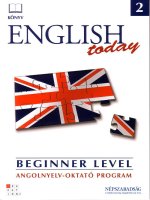
English Today Magazine
Bạn đang xem bản rút gọn của tài liệu. Xem và tải ngay bản đầy đủ của tài liệu tại đây (28.45 MB, 84 trang )
YEAR: 11
NO. 3
MARCH, 2016
PRICE:
20
Publisher & Editor
ALOK KUMAR GUPTA
Asstt. Editor
HS BHATIA
Editorial & Admn. Office:
12-H, New Daryaganj Road,
New Delhi-110002
Tel: 23261567, 23245124,
23275224
Website:
www.rameshpublishinghouse.com
E-mail:
Subscription Rates:
` 200/- (for One Year)
` 360/- (for Two Years)
To be paid through MO/
DD in favour of ‘English
Today’ and post it to our
Admn. office.
For more details
refer page no. 52
All rights reserved with the
Publisher. No part of this
publication may be printed in
whole or in part without written
permission of the Publisher.
Edited, Published, Printed
& Owned by:
ALOK KUMAR GUPTA
12-H, New Daryaganj Road,
New Delhi-110002
Printed at:
Amar Ujala Publications Ltd.
Noida
From The Editor’s Pen
Lecture Forum
Modern Grammatical Practices
Verbal Pyramid
In Simple Terms
Personal Questions
Day-To-Day Conversation
Formation of Words
One Word Substitution
Terminology
Book Review
Same Words Used As Different Parts of Speech
Prepositions
Vocabulary
Cloze Test
Finding Errors
Idioms & Their Usage
Pronunciation
Words Confused & Misused
Punctuation
Transformation
Prefixes & Suffixes
Quotations & Abbreviations
Language Games
Think it Over
Number, Gender, Conjugation
Spellings
Quiz Time
Quips
Verbal Niagra Fall
Talking to the Author
Potpourri
Chain Anagram Sets
Literature
Chain Words
What If ...
Can You Remember?
Answers Corner
....
....
....
....
....
....
....
....
....
....
....
....
....
....
....
....
....
....
....
....
....
....
....
....
....
....
....
....
....
....
....
....
....
....
....
....
....
....
5
7
9
12
13
15
17
19
21
23
25
27
29
31
34
35
37
41
43
45
50
51
53
55
57
58
59
61
62
63
64
65
66
67
69
70
71
73
�
�
�
�
�
�
�
�
�
�
�
�
Book Name
General English for Competitive Exams
Spoken English
The English Enhancement Book
Common Errors in English (English-Hindi)
Handbook of Idioms & Phrases
Handbook of Proverbs
Advance General English
Spoken & Communicative English
Idioms, Phrases & Proverbs (English-Hindi)
Writing Correct English
Write English Right
How to Write Correct English (Hindi-English)
�
�
�
�
�
Hindi-English Master (Senior)
Master English in Easy Way
All About English
Treasury of Synonyms & Antonyms
(Words with Hindi Meanings)
�
�
�
�
�
�
�
�
�
�
�
�
�
All Time English
Popular Phrasal Verbs
Prepositions and their Usage
Handbook of Abbreviations
Dealing with English Made Easy
Handbook of Quotations
Objective General English
General English (With MCQs)
Paragraph Writing
Art of Precis Writing
English Reading Comprehension
Gloria English Speaking Course (Hindi-English)
English Improvement Course
Code Price ( )
R-1762
90
R-1654
195
R-1720
180
R-1709
195
R-473
60
R-514
95
R-230
130
R-1801
295
R-353
65
R-541
95
R-578
110
R-451
120
R-657
60
R-418
80
R-189
240
R-1391
240
R-1348
R-1100
R-528
R-787
R-228
R-1042
R-190
R-229
R-311
R-304
R-191
R-303
R-218
R-358
180
120
85
95
80
70
120
140
150
95
80
160
280
240
���
R.Gupta's®
WITH HINDI EXPLANATIONS
978-93-5012-598-4
For Online Shopping Visit: www.rameshpublishinghouse.com
LECTURE FORUM
We have been studying for some months the use of Past Participles of some
verbs as Adjectives. We’ll continue our study in this issue also.
(i) Use the following Past Participles as Adjectives in sentences of your
own.
(ii) Only the first and last letter of each Past Participle is given.
(iii) After the Past Participle, the number of letters is given in brackets.
(iv) No word should be repeated.
E ______ D (8)
E ______ D (6)
D ______ D (11)
A ______ D (8)
E ______ D (7)
E ______ D (11)
E ______ D (11)
E ______ D (9)
E ______ D (10)
E ______ D (11)
E ______ D (9)
E ______ D (11)
E ______ D (11)
E ______ D (10)
E ______ D (9)
���
MODERN GRAMMATICAL
PRACTICES
chocolates / in the market / many varieties / are there / of
steadily / have been / over / gaining popularity / handmade chocolates / couple of years / the past
healthier / in the market / than / the homemade chocolates / are /
available / those
are / many / imported / the chocolate balls / equally / of which / are /
popular
installed / almost / in / all / schools / their premises / the / have /
private / CCTV cameras
to maintain / the / among / discipline / purpose / the students / is
to maintain discipline / the use of / is considered / technology / and
surveillance / good / teachers / most of the / and students / by
ahead / has / the / Diwali / beefed / police / security / up / of
it / at / besides / has organised / check posts / enhancing patrolling /
special / sensitive points / and surveillance / temporary
among residents / the move / of happiness / has brought / their / a
wave of happiness / visiting / night hours / friends and relatives /
during
night vigil / intensified / enhancing / patrolling / the / have /
throughout / the police / besides / the area
to beef up security / the police commissioner / the / decision /
meetings / was taken / during / chaired / by
Two of
trade seldom agree. (a/no preposition)
birds that had arrived at the wetland have disappeared.
(A few, The few)
There is only
I was
water in the jug. (little, a little, the little)
moved on hearing his tale. (deep, deeply)
As soon as the bell rang,
the students rushed out of their
classes. (then, no word)
I want to know
why you are late. (as to, nothing)
Since he is my friend,
I shall help him. (therefore, nothing)
We eat so that we
He
live. (may, might)
not call you names. (need, dare)
He has full command
He absented
English. (over, of)
from the class. (himself, nothing)
She resembles
her mother. (with, nothing)
There lies a
boat on the beach. (sunk, sunken)
Do not write
pencil. (in, with)
A man needs a house to
I can give no advice
Let’s invite him
? (to, nothing)
his words. (to, with)
Rama was married
None but
the moment. (at, in)
tea. (at, to)
Who were you talking
He stuck
. (live, live in)
Sita. (with, to)
came for the interview. (he, him)
But for you, I
have been ruined. (will, would)
Why are you afraid
He has too
Iron is
him? (of, from)
irons in the fire. (much, many)
useful metal. (a, an)
bird in hand is worth two in the bush. (a, the)
He is one of the ablest
in our area. (doctor, doctors)
You will have to carry
We must abide
my orders. (on, out)
the laws of our country. (by, with)
The hunter killed the lion
Are you
a gun. (by, with)
? (sick, ill)
My father gave me
. (much advice, many advices)
Never hit anybody
���
the belt. (below, under)
This series aims at developing a good handwriting in your children. Enough space
for writing and practice is provided in each book. An aid to good handwriting is
indeed a lifetime gift for your precious children
Book Code: S-153
Book Code: S-154
Book Code: S-155
Book Code: S-151
Book Code: S-152
ISBN: 978-93-81438-76-3 ISBN: 978-93-81438-77-0 ISBN: 978-93-81438-78-7 ISBN: 978-93-81438-73-2 ISBN: 978-93-81438-74-9
` 50
Book Code: S-158
Book Code: S-159
Book Code: S-160
Book Code: S-156
Book Code: S-157
ISBN: 978-93-81438-75-6 ISBN: 978-93-81438-79-4 ISBN: 978-93-81438-80-0 ISBN: 978-93-81438-81-7 ISBN: 978-93-81438-82-4
Size - 184 × 267 mm
Price - ` 70
Binding - Centre Pin
Distributed by:
12-H, New Daryaganj Road, New Delhi-110002
For Online Shopping Visit: www.rameshpublishinghouse.com
VERBAL PYRAMID
(a) Below is given a Pyramid with the letter
E
at the Apex.
(b) Below the Apex, there are blocks up to the base.
(c) Each block is divided into sub-blocks.
(d) In each block, one sub-block goes on increasing in the descending order
from Apex to Base.
(e) In block-2, you find the letters E D .
(f) Starting and ending should be with the letters given.
(g) You can use abbreviations, but the full word for each abbreviation should
be given as a note under the Pyramid.
(h) There can be more than one answer in some cases, but only one answer
is given in the Answers Corner for your convenience.
E
1
E D
E
E
E
E
V
V
V
V
V
V
2
T
3
N
4
R
5
Y
6
T
7
S
8
S
9
Y
10
B
R
11
12
���
IN SIMPLE TERMS
(a) Roads are being repaired.
(b) Nip the evil in the bud.
(c) Had you heard such a thing before?
(d) The matter can be discussed just now.
(a) The grandfather said to the child, “Do not play on the carpet.”
(b) He said to me, “Will you help me when I am in trouble”?
(c) She told me that she would surely return my books by Friday.
(d) I asked him if he had brought all his certificates.
(a) No .............. than twenty workers were absent.
(b) He sold .............. books he had.
(c) We must do .............. duty.
(d) .............. persons know the truth.
(a) She .............. speak three languages.
(b) You .............. know the result in a week’s time.
(c) He .............. not oppose me.
(d) .............. all your wishes come true!
(a) A (drown) man catches at a straw.
(b) This table is worth (buy).
(c) The news was difficult (believe).
(d) My friend is keen (join) the army.
“Sudie, some day I hope to paint the Bay of Naples,” said he.
“Even chances”, said the doctor, taking Sue’s thin, shaking hand in his. “With
good nursing you’ll win. And now I must see another case I have downstairs.
Behrman, his name is—some kind of an artist, I believe. Pneumonia, too. He
is an old, weak man, and the attack is acute. There is no hope for him; but he
goes to the hospital today to be made more comfortable”.
The next day the doctor said to Sue, “She’s out of danger. You’ve won.
Nutrition and care now—that’s all.”
���
PERSONAL QUESTIONS
(1) No answers to the personal questions will be provided.
(2) You can put these questions (and your answers which will remain with
you) to a number of uses, if you would so like, e.g. .....
(a) personal diary;
(b) to enhance memory;
(c) to sharpen your answering capability;
(d) to hone your general awareness, talents, intelligence, nature,
mood, temperament, etc.
(e) to gather experience, etc.
(3) Sometimes, some questions may be abstract or mysterious in nature,
but they are otherwise important in their own way. You should be careful
while answering them.
Why do you sometimes think you are different from others? (4-5 lines)
How do you identify a person to be special from a throng? (4-5 lines)
(i) Do you ever have the feeling of euphoria?
Yes
No
(Tick)
(ii) If yes, when, how, why?
When:
How:
Why:
(i) Do you sometimes have the feeling of depression?
Yes
No
(Tick)
(ii) If yes, when, how, why?
When:
How:
Why:
(i) There is hardly a man or woman who has never felt the bouts of
euphoria and depression. What in your opinion are the general
causes of this state of affairs? (8-10 lines)
(ii) Is the state mentioned above peculiar to the modern age or did it
exist more or less in the past ages too? What do you think? Please
throw some light on this aspect. (5-6 lines)
���
The two friends, Reena and Reema, have been discussing Non-finites and
other topics in the past some issues.
Let’s see what they discuss today.
Reema
: How are you, Reena?
Reena
: Fine, I hope you’re too.
Reema
: Yes, I am. Should we continue our study of “Present Participles
used as Adjectives”?
Reena
: I suppose so.
Reema
: Then exercise, please.
Reena
: Here it is.
(For Reema and ET Readers)
Was the decision taken on the basis of the
The workers are giving
There is a
The
persons.
vote?
touch to the renovation of the house.
discontent among people.
rates of interests are causing worry to the retired
The
fathers of the constitution never meant this.
She is my
daughter.
trees should be planted.
There is paucity of
water here.
The
beast ran away fast.
events cast their shadows before.
Remain within
The
distance.
leaves floated away in air.
children need much care.
Is there any
arrangement nearby?
What is the
feature of this painting?
The
mankind is at crossroads.
What is the
The
factor of his departure?
beast was suddenly struck down by the hunter.
Flood water caused much harm to the
It is hard to climb up the
hill.
This is one of the
Beware of this
crops.
dailies of this region.
dog/insect.
`
`
`
`
`
`
`
`
`
`
���
`
`
`
`
`
`
`
`
`
12-H, New Daryaganj Road, New Delhi-110002
For Online Shopping Visit: www.rameshpublishinghouse.com
FORMATION OF WORDS
(i) Given below is a starting word or part of a word.
(a)
N A US
(b) When we add to it, E A at the end, it becomes—
(c) N A U S E A
feeling of sickness.
(d)
(ii) Similarly, in each of the following cases,
(a) the starting word or the first part of the word is given; you are to—
(b) add one or more letters at the end;
(c) write the new word;
(d) convey the same meaning as given.
(a)
(b)
(c)
(d)
(a)
(b)
(c)
(d)
(a)
(b)
(c)
(d)
(a)
(b)
(c)
(d)
(a)
(b)
(c)
(d)
E N
entangle.
F R A
easily snapped or shattered.
C H O R
chorus singer.
D E P O S
storehouse.
F E R M
leaven.
(a)
L A U N
(b)
(c)
(d)
woman who washes linen.
(a)
M A N
(b)
(c)
(d)
of or done with the hands.
(a)
P A R E R G
(b)
(c)
(d)
by-work, work apart from one’s main employment.
(a)
P A R D
(b)
(c)
(d)
forgive.
(a)
P A R O C H
(b)
(c)
(d)
confined to a limited area.
(a)
P R O S
(b)
(c)
(d)
(a)
thrive.
P R O T A G
(b)
(c)
(d)
chief person in drama or plot of a story.
���
ONE WORD SUBSTITUTION
A person who wants to destroy all order.
A place where birds are kept.
An artificial tank for fishes and water-plants.
To do away with a rule.
A law that does not stand the test of judiciary.
To turn a friend into an enemy by one reason or the other.
To increase greatly the speed.
To make atonement for your sins.
Words inscribed on the tomb of a man.
A person not capable of being pleased easily.
A person who mends windowpanes.
A person residing in a country of which he is not a citizen.
A person having an irresistible tendency to steal.
A remedy for all ailments.
To preserve something for permanent existence.
One disposed to fight or quarrel.
Tendency to fight or quarrel.
A five-sided figure.
A six-sided figure.
An eight-sided figure.
���
®
Tricky
`
For Cash on Deliver (COD) E-mail your order to:
ISBN-978-93-5012-700-1
For Online Shopping Visit: www.rameshpublishinghouse.com
TERMINOLOGY
Ground rent is the
amount of rent that a leaseholder
pays periodically to the owner for
using a piece of land.
A party who agrees to be
responsible for the payment of
another party’s debts should that
party default.
The undertaking of
responsibility by one party for
another party’s debt or obligation
to perform some specific act or
duty. Although the original debtor
is responsible for the debt, the
guarantor becomes liable in the
event of a default.
The difference between the
market value of a security and its
collateral value. Haircuts are
taken by a lender of funds in order
to protect the lender, should the
need arise to liquidate the
collateral, from losses owing to
declines in the market value of
the security.
Hedge is a strategy that is
used to minimize the risk of a
particular investment and
maximize the returns of an
investment. A ‘hedge’ strategy is,
most of the times, implemented
with the help of a hedge fund.
This terms has been written from
the banker’s point of view and
may be interpreted differently in
the field of finance.
‘Hedge’ means to
reduce financial risk. A hedge
fund is an investment fund open
to a limited range of investors
and requires a very large initial
minimum investment. It is
important to note that hedging is
actually the practice of attempting
to reduce risk, but the goal of
most hedge funds is to maximize
return on investment.
When an item of
large capital value is bought over
time by paying a deposit and
fixing a period over which the
loan will run (usually between 12
and 60 months) and then paying
fixed and equal repayments over
this period.
A company
which controls another company,
usually by owing more than half
of its shares.
An economic system
based on the private ownership
of the means of production and
distribution in which the goal is to
produce profit.
Those who own
companies, or stocks and shares
in companies, and use them to
generate economic returns or
profits.
The number of a
species that a particular
ecosystem can support without
suffering irreversible deterioration.
Production
of crops for world markets rather
than for consumption by the local
population.
The defining of all
human relationships in terms of
monetary exchange.
A closed form of
stratification in which an
individual’s status is determined
by birth and cannot be changed.
George
Ritzer’s term for commercial
displays meant to inspire awe,
wonder, and enchantment in the
consumer—shopping centres,
casinos, and sports stadiums are
examples.
A relationship in which a
change in one variable (the
independent variable) induces
change in another (the dependent
variable). Causal factors in
sociology include individual
motivation and many external
influences on human behaviour
that often go unrecognized.
Power and authority
concentrated into a few offices.
A count of the population,
often including a detailed profile
of that population.
A personal quality
attributed to leaders who arouse
fervent popular support and
enthusiasm.
Weber’s term
for authority that rests on the
extraordinary characteristics of
leaders attributed to them by
followers.
Disease of long
duration, often not detected in its
early stages, from which the
patient will not recover. Examples
include high blood pressure and
diabetes.
A body of people belonging
to an established religious
organization.
A member of a state, having
both rights and duties associated
with that membership.
A US Supreme
Court decision in which five
conservative justices ruled that
corporations have the same First
Amendment free speech
protections as a real person.
Corporations, therefore, have a
right to unlimited spending in US
elections.
BOOK REVIEW
Published
by
LITTLE SCHOLARZ, 12-H, New Daryaganj
Road, Opp. Officers’ Mess, New Delhi-110002
ISBN No.: 978 – 93 – 83299 – 16 – 4
Book Code: S-196
Printed Pages: 400
Price: ` 145
The book comprises two most famous detective mystery novels—
and
by British author Sir Arthur Conan Doyle.
A Study in Scarlet is an 1887 detective novel which marks the first
appearance of Sherlock Holmes and Dr. Watson, who would become
among the most famous characters in literature. The book’s title derives
from a speech given by Holmes, an amateur detective, to his friend and
chronicler Watson on the nature of his work, in which he describes the
story’s murder investigation as his “study in scarlet”.
In the story, Scotland Yard calls Holmes in when they find themselves
stumped by a sensational case: a man is found dead in an empty house,
and there is no indication about cause of death. The leading detectives
also can't figure out how the man got there, what he was doing there: you
know, some of that important information needed to catch a killer. Holmes,
of course, immediately locates overlooked clues.
Because this mystery is less about a few rather simple clues and more
about the backstory that encompasses a good portion of the book. And
it’s a doozy of a backstory, complete with wagon trains, pioneers, and
Mormons. Yep, Mormons. Not especially flattering about Mormons either.
is first of the Holmes stories, it’s worth reading because
of its role in introducing characters and getting the canon started. It was
also the first story to use the magnifying glass as a tool of detection.
The Valley of Fear is the fourth and final Sherlock Holmes novel by Sir
Arthur Conan Doyle. It is loosely based on the Molly Maguires and Pinkerton