Real time embedded multithreading using threadx and MIPS p6
Bạn đang xem bản rút gọn của tài liệu. Xem và tải ngay bản đầy đủ của tài liệu tại đây (163.6 KB, 20 trang )
CHAPTE R 8
Mutual Exclusion Challenges and
Considerations
8.1 Introduction
On many occasions, we need to guarantee that a thread has exclusive access to a shared
resource or to a critical section. However, several threads may need to obtain these items,
so we need to synchronize their behavior to ensure that exclusive access can be provided.
In this chapter, we consider the properties of the mutex, which is designed solely to
provide mutual exclusion protection by avoiding conflict between threads and preventing
unwanted interactions between threads.
A mutex is a public resource that can be owned by, at most, one thread at any point in
time. Furthermore, a thread (and only that same thread) can repeatedly1 obtain the same
mutex 232–1 times, to be exact. However, that same thread (and only that thread) must
give up that mutex the same number of times before the mutex becomes available again.
8.2 Protecting a Critical Section
A critical section is a code segment in which instructions must be executed in sequence
without interruption. The mutex helps in achieving this goal. Consider Figure 8.1, which
shows a code segment that is a critical section. To enter this critical section, a thread must
first obtain ownership of a certain mutex that protects the critical section. Thus, when
the thread is ready to begin executing this code segment, it first attempts to acquire that
1
Some writers describe this type of mutex as a recursive mutex because of the same-thread,
multiple-ownership capability. However, we will not use that terminology here.
w w w.ne w nespress.com
Please purchase PDF Split-Merge on www.verypdf.com to remove this watermark.
100
Chapter 8
Thread
Mutex
Code segment
Mutex 1
Resource 1
Mutex 2
Figure 8.1: Mutex protecting a critical section
Resource 2
Thread
Figure 8.2: Mutexes providing exclusive access to multiple shared resources
mutex. After the thread has acquired the mutex, it executes the code segment, and then
relinquishes the mutex.
8.3 Providing Exclusive Access to Shared Resources
A mutex can provide exclusive access to one shared resource in the same manner that it
can protect a critical section. That is, a thread must first obtain the mutex before it can
access the shared resource. However, if a thread must have exclusive access to two (or
more) shared resources at the same time, then it must protect each shared resource with a
separate mutex. In this case, the thread must first obtain a particular mutex for each of the
shared resources before continuing. Figure 8.2 illustrates this process. When the thread is
ready to access these resources, it first gets the two mutexes that protect these resources.
After the thread has acquired both mutexes, it accesses the shared resources, and then
relinquishes both mutexes after it has finished with these resources.
w ww. n e w n e s p r e s s .c o m
Please purchase PDF Split-Merge on www.verypdf.com to remove this watermark.
Mutual Exclusion Challenges and Considerations
Field
101
Description
tx_mutex_id
Control block ID
tx_mutex_name
Pointer to mutex name
tx_mutex_ownership_count
Mutex ownership count
*tx_mutex_owner
tx_mutex_inherit
Mutex ownership pointer
Priority inheritance flag
tx_mutex_original_priority
Original priority of owning thread
tx_mutex_original_threshold
Original preemption-threshold of owning thread
*tx_mutex_suspension_list
tx_mutex_suspended_count
*tx_mutex_created_next
*tx_mutex_created_previous
Pointer to suspension list
Suspension list count
Pointer to the next mutex in the created list
Pointer to the previous mutex in the created list
Figure 8.3: Mutex Control Block
8.4 Mutex Control Block
The Mutex Control Block (MCB)2 is a structure used to maintain the state of a mutex
during run-time. It contains a variety of information, including the mutex owner, the
ownership count, the priority inheritance flag, the original priority of the owning thread,
the original preemption-threshold of the owning thread, the suspension count, and a pointer
to the suspension list. Figure 8.3 contains many of the fields that comprise the MCB.
In most cases, the developer can ignore the contents of the MCB. However, in some
situations, especially during debugging, inspecting certain members of the MCB is
useful. Note that although ThreadX allows inspection of an MCB, it strictly prohibits
modification of one.
8.5 Summary of Mutex Services
Appendix E contains detailed information about mutex services, providing the
information on the following: prototype, brief description of the service, parameters,
2
The characteristics of each mutex are contained in its MCB. This structure is defined in the
tx_api.h file.
w w w.ne w nespress.com
Please purchase PDF Split-Merge on www.verypdf.com to remove this watermark.
102
Chapter 8
Mutex Service
Description
tx_mutex_create
Create a mutex
tx_mutex_delete
Delete a mutex
Attempt to obtain ownership of a mutex
tx_mutex_get
tx_mutex_info_get
Retrieve information about a mutex
tx_mutex_performance_info_get
Get mutex performance information
tx_mutex_performance_system_info_get
tx_mutex_prioritize
Get mutex system performance information
Put highest priority suspended thread at
front of suspension list
Release ownership of mutex
tx_mutex_put
Figure 8.4: Mutex services
return values, notes and warnings, allowable invocation, preemption possibility, and an
example that illustrates how the service can be used. Figure 8.4 contains a listing of all
available mutex services. In the following sections of this chapter, you will study each of
these services. We will consider the many features of the services, and we will develop an
illustrative example of a sample system that uses them.
8.6 Creating a Mutex
A mutex is declared with the TX_MUTEX data type3 and is defined with the tx_mutex_
create service. When defining a mutex, you need to specify the MCB, the name of the
mutex, and the priority inheritance option. Figure 8.5 contains a list of these attributes. We
will develop one example of mutex creation to illustrate the use of this service. We will
give our mutex the name “my_mutex” and we will activate the priority inheritance feature.
Priority inheritance allows a lower-priority thread to temporarily assume the priority of
a higher-priority thread that is waiting for a mutex owned by the lower-priority thread.
This feature helps the application to avoid priority inversion by eliminating preemption of
intermediate thread priorities. Figure 8.6 contains an example of mutex creation.
If you wanted to create a mutex without the priority inheritance feature, you would use
the TX_NO_INHERIT parameter rather than the TX_INHERIT parameter.
3
When a mutex is declared, an MCB is created.
w ww. n e w n e s p r e s s .c o m
Please purchase PDF Split-Merge on www.verypdf.com to remove this watermark.
Mutual Exclusion Challenges and Considerations
103
Mutex control block
Mutex name
Priority inheritance option
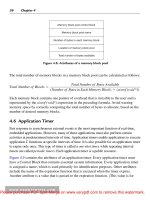
Figure 8.5: Attributes of a mutex
TX_MUTEX my_mutex;
UINT status;
/* Create a mutex to provide protection over a
shared resource. */
status = tx_mutex_create(&my_mutex,"my_mutex_name",
TX_INHERIT);
/* If status equals TX_SUCCESS, my_mutex is
ready for use. */
Figure 8.6: Creating a mutex with priority inheritance
TX_MUTEX my_mutex;
UINT status;
…
/* Delete a mutex. Assume that the mutex
has already been created. */
status = tx_mutex_delete(&my_mutex);
/* If status equals TX_SUCCESS, the mutex
has been deleted. */
Figure 8.7: Deleting a mutex
8.7 Deleting a Mutex
A mutex can be deleted with the tx_mutex_delete service. When a mutex is deleted, all
threads that have been suspended because they are waiting for that mutex are resumed
(that is, placed on the Ready list). Each of these threads will receive a TX_DELETED
return status from its call to tx_mutex_get. Figure 8.7 contains an example showing how
the mutex called “my_mutex” can be deleted.
w w w.ne w nespress.com
Please purchase PDF Split-Merge on www.verypdf.com to remove this watermark.
104
Chapter 8
8.8 Obtaining Ownership of a Mutex
The tx_mutex_get service enables a thread to attempt to obtain exclusive ownership
of a mutex. If no thread owns that mutex, then that thread acquires ownership of the
mutex. If the calling thread already owns the mutex, then tx_mutex_get increments
the ownership counter and returns a successful status. If another thread already owns
the mutex, the action taken depends on the calling option used with tx_mutex_get,
and whether the mutex has priority inheritance enabled. These actions are displayed in
Figure 8.8.
tx_mutex_get
Wait Option
Priority Inheritance
Enabled in Mutex
Priority Inheritance
Disabled in Mutex
TX_NO_WAIT
Immediate return
Immediate return
TX_WAIT_FOREVER
Timeout value
If the calling thread has a higher priority,
the owning thread's priority is raised to
that of the calling thread, then the calling
thread is placed on the suspension list,
and the calling thread waits indefinitely
Thread placed on
suspension list and
waits indefinitely
If the calling thread has a higher priority,
the owning thread's priority is raised to
that of the calling thread, then the calling
thread is placed on the suspension list,
and the calling thread waits until the
number of specified timer-ticks has expired
Thread placed on
suspension list and
waits until the number
of specified timer-ticks
has expired
Figure 8.8: Actions taken when mutex is already owned by another thread
TX_MUTEX my_mutex;
UINT status;
…
/* Obtain exclusive ownership of the mutex "my_mutex".
If the mutex called "my_mutex" is not available, suspend
until it becomes available. */
status = tx_mutex_get(&my_mutex, TX_WAIT_FOREVER);
Figure 8.9: Obtain ownership of a mutex
w ww. n e w n e s p r e s s .c o m
Please purchase PDF Split-Merge on www.verypdf.com to remove this watermark.
Mutual Exclusion Challenges and Considerations
105
If you use priority inheritance, make certain that you do not allow an external thread
to modify the priority of the thread that has inherited a higher priority during mutex
ownership. Figure 8.9 contains an example of a thread attempting to obtain ownership of
a mutex.
If the variable status contains the value TX_SUCCESS, then this was a successful get
operation. The TX_WAIT_FOREVER option was used in this example. Therefore, if the
mutex is already owned by another thread, the calling thread will wait indefinitely in the
suspension list.
8.9 Retrieving Mutex Information
There are three services that enable you to retrieve vital information about mutexes. The first
such service for mutexes—the tx_mutex_info_get service—retrieves a subset of information
from the Mutex Control Block. This information provides a “snapshot” at a particular
instant in time, i.e., when the service is invoked. The other two services provide summary
information that is based on the gathering of run-time performance data. One service—the
tx_mutex_performance_info_get service—provides an information summary for a particular
mutex up to the time the service is invoked. By contrast the tx_mutex_performance_system_
info_get retrieves an information summary for all mutexes in the system up to the time the
service is invoked. These services are useful in analyzing the behavior of the system and
determining whether there are potential problem areas. The tx_mutex_info_get4 service
obtains information that includes the ownership count, the location of the owning thread, the
location of the first thread on the suspension list, the number of suspended threads, and the
location of the next created mutex. Figure 8.10 shows how this service can be used.
If the variable status contains the value TX_SUCCESS, the information was successfully
retrieved.
8.10 Prioritizing the Mutex Suspension List
When a thread is suspended because it is waiting for a mutex, it is placed in the
suspension list in a FIFO manner. When the mutex becomes available, the first thread in
the suspension list (regardless of priority) will obtain ownership of that mutex. The
4
By default, only the tx_mutex_info_get service is enabled. The other two information-gathering
services must be enabled in order to use them.
w w w.ne w nespress.com
Please purchase PDF Split-Merge on www.verypdf.com to remove this watermark.
106
Chapter 8
TX_MUTEX my_mutex;
CHAR *name;
ULONG count;
TX_THREAD *owner;
TX_THREAD *first_suspended;
ULONG suspended_count;
TX_MUTEX *next_mutex;
UINT status;
…
/* Retrieve information about the previously
created mutex called "my_mutex." */
status = tx_mutex_info_get(&my_mutex, &name,
&count, &owner,
&first_suspended,
&suspended_count,
&next_mutex);
/* If status equals TX_SUCCESS, the information
requested is valid. */
Figure 8.10: Example showing how to retrieve mutex information
TX_MUTEX my_mutex;
UINT status;
…
/* Ensure that the highest priority thread will receive
ownership of the mutex when it becomes available. */
status = tx_mutex_prioritize(&my_mutex);
/* If status equals TX_SUCCESS, the
suspended thread has been placed
list. The next tx_mutex_put call
ownership of the mutex will give
thread and wake it up. */
highest priority
at the front of the
that releases
ownership to this
Figure 8.11: Prioritizing the mutex suspension list
tx_mutex_prioritize service places the highest-priority thread suspended for ownership
of a specific mutex at the front of the suspension list. All other threads remain in the
same FIFO order in which they were suspended. Figure 8.11 shows how this service can
be used.
w ww. n e w n e s p r e s s .c o m
Please purchase PDF Split-Merge on www.verypdf.com to remove this watermark.
Mutual Exclusion Challenges and Considerations
107
TX_MUTEX my_mutex;
UINT status;
…
/* Release ownership of "my_mutex." */
status = tx_mutex_put(&my_mutex);
/* If status equals TX_SUCCESS, the mutex ownership
count has been decremented and if zero, released. */
Figure 8.12: Releasing ownership of a mutex
If the variable status contains the value TX_SUCCESS, the highest-priority thread in the
suspension list that is waiting for the mutex called “my_mutex” has been placed at the
front of the suspension list. If no thread was waiting for this mutex, the return value is
also TX_SUCCESS and the suspension list remains unchanged.
8.11 Releasing Ownership of a Mutex
The tx_mutex_put service enables a thread to release ownership of a mutex. Assuming
that the thread owns the mutex, the ownership count is decremented. If the ownership
count becomes zero, the mutex becomes available. If the mutex becomes available and
if priority inheritance is enabled for this mutex, then the priority of the releasing thread
reverts to the priority it had when it originally obtained ownership of the mutex. Any
other priority changes made to the releasing thread during ownership of the mutex may be
undone also. Figure 8.12 shows how this service can be used.
If the variable status contains the value TX_SUCCESS, then the put operation was
successful, and the ownership count was decremented.
8.12 Avoiding the Deadly Embrace
One of the potential pitfalls in using mutexes5 is the so-called deadly embrace. This is
an undesirable situation in which two or more threads become suspended indefinitely
while attempting to get mutexes already owned by other threads. Figure 8.13 illustrates a
scenario that leads to a deadly embrace. Following is the sequence of events depicted in
this figure.
5
This problem is also associated with the use of semaphores, which we discuss in Chapter 11.
w w w.ne w nespress.com
Please purchase PDF Split-Merge on www.verypdf.com to remove this watermark.
108
Chapter 8
1. Thread 1 obtains ownership of Mutex 1
2. Thread 2 obtains ownership of Mutex 2
3. Thread 1 suspends because it attempts to obtain ownership of Mutex 2
4. Thread 2 suspends because it attempts to obtain ownership of Mutex 1
Thus, Thread 1 and Thread 2 have entered a deadly embrace because they have
suspended indefinitely, each waiting for the mutex that the other thread owns.
How can you avoid deadly embraces? Prevention at the application level is the only
method for real-time systems. The only way to guarantee the absence of deadly embraces
is to permit a thread to own at most one mutex at any time. If threads must own multiple
mutexes, you can generally avoid deadly embraces if you make the threads gather the
mutexes in the same order. For example, the deadly embrace in Figure 8.13 could be
prevented if the threads would always obtain the two mutexes in consecutive order, i.e.,
Thread 1 (or Thread 2) would attempt to acquire Mutex 1, and then would immediately
attempt to acquire Mutex 2. The other thread would attempt to acquire Mutex 1 and Mutex
2 in the same order.
One way to recover from a deadly embrace is to use the suspension time-out feature
associated with the tx_mutex_get service, which is one of the three available wait
Mutex 1
Mutex 2
1
2
3
Thread 1
4
Thread 2
Figure 8.13: Sequence of actions leading to a deadly embrace
w ww. n e w n e s p r e s s .c o m
Please purchase PDF Split-Merge on www.verypdf.com to remove this watermark.
Mutual Exclusion Challenges and Considerations
109
options. Another way to recover from a deadly embrace is for another thread to invoke
the tx_thread_wait_abort service to abort the suspension of a thread trapped in a deadly
embrace.
8.13 Sample System Using a Mutex to
Protect Critical Sections
We will create a sample system to illustrate how a mutex can be used to protect the
critical sections of two threads. This system was introduced in Chapter 2 where Speedy_
Thread and Slow_Thread each had four activities, two of which were critical sections.
Figure 8.14 and Figure 8.15 show the sequence of activities for each of these two threads,
where the shaded boxes represent the critical sections.
In order to develop this system, we will need to create two threads and one mutex. Each
thread must have its own stack, which we will implement as an array, rather than as a
memory byte pool. We will need to create the thread entry functions that will perform
the desired activities. Because we will create this system in its entirety, we outline this
process with Figure 8.16, which is a variation of the basic four-part system structure that
first appeared in Chapter 2.
Activity 1
Sleep 2 ticks
Activity 2
Get and keep mutex
for 5 ticks
Activity 3
Sleep 4 ticks
Activity 4
Get and keep mutex
for 3 ticks
Figure 8.14: Activities of the Speedy_Thread (priority ϭ 5)
Activity 5
Get and keep mutex
for 12 ticks
Activity 6
Sleep 8 ticks
Activity 7
Get and keep mutex
for 11 ticks
Activity 8
Sleep 9 ticks
Figure 8.15: Activities of the Slow_Thread (priority ϭ 15)
w w w.ne w nespress.com
Please purchase PDF Split-Merge on www.verypdf.com to remove this watermark.
110
Chapter 8
Declarations, definitions, and prototypes
Main entry point
Application definitions
Function definitions
Figure 8.16: Basic system structure
For the first part of the system, we declare as global entities the two threads, the one
mutex, and the two thread stacks as follows:
TX_THREAD Speedy_Thread, Slow_Thread;
TX_MUTEX my_mutex;
#DEFINE STACK_SIZE 1024;
CHAR stack_speedy [STACK_SIZE], stack_slow[STACK_SIZE];
The process of declaring the threads creates two Thread Control Blocks (TCBs), and
declaring the mutex creates its MCB as well. The thread stacks will be ready for use in
the tx_application_define function.
The second part of the system is where we define the main entry point, which is the call
to enter the ThreadX kernel.
The third part of the system is where we define the threads and the mutex. Following is
the definition of Speedy_Thread.
tx_thread_create (&Speedy_Thread, “Speedy_Thread”,
Speedy_Thread_entry, 0,
stack_speedy, STACK_SIZE,
5, 5, TX_NO_TIME_SLICE, TX_AUTO_START);
Speedy_Thread has a priority of 5, but does not have a preemption-threshold, nor does it
have a time-slice. Following is the definition of Slow_Thread.
tx_thread_create (&Slow_Thread, “Slow_Thread”,
Slow_Thread_entry, 1,
stack_slow, STACK_SIZE,
15, 15, TX_NO_TIME_SLICE, TX_AUTO_START);
w ww. n e w n e s p r e s s .c o m
Please purchase PDF Split-Merge on www.verypdf.com to remove this watermark.
Mutual Exclusion Challenges and Considerations
111
Slow_Thread has a priority of 15, but does not have a preemption-threshold, nor does
it have a time-slice. Both threads will start immediately. Following is the definition of
my_mutex.
tx_mutex_create(&my_mutex, “my_mutex”, TX_NO_INHERIT);
The mutex is given a name but does not have the priority inheritance feature.
The fourth part of our system is where we develop the thread entry functions. Following
is a portion of the entry function for the Speedy_Thread.
/* Activity 1: 2 timer-ticks. */
tx_thread_sleep(2);
/* Activity 2—critical section—5 timer-ticks
Get the mutex with suspension */
tx_mutex_get(&my_mutex, TX_WAIT_FOREVER);
tx_thread_sleep(5);
/* Release the mutex */
tx_mutex_put(&my_mutex);
The first two activities of Speedy_Thread are represented here. Activity 1 is not a critical
section, so we immediately sleep for two timer-ticks. Activity 2 is a critical section, so to
execute it we must first obtain ownership of the mutex. After we get the mutex, we sleep
for five timer-ticks. The other activities for both threads follow a similar pattern. When
we develop the complete system, we will check the status of the return values to make
certain the service calls have been performed correctly.
Figure 8.17 through Figure 8.21 contain a complete listing for this sample system,
separated into five parts, where the last two parts are the thread entry functions. The
complete program listing called 08_sample_system.c is located in a later section of this
chapter and on the enclosed CD.
The first part of the sample system contains all the necessary directives, declarations,
definitions, and prototypes.
w w w.ne w nespress.com
Please purchase PDF Split-Merge on www.verypdf.com to remove this watermark.
112
Chapter 8
/* 08_sample_system.c
Create two threads, and one mutex.
Use an array for the thread stacks.
The mutex protects the critical sections.
#include
#include
*/
"tx_api.h"
<stdio.h>
#define
STACK_SIZE
1024
CHAR stack_speedy[STACK_SIZE];
CHAR stack_slow[STACK_SIZE];
/* Define the ThreadX object control blocks...
TX_THREAD
TX_THREAD
Speedy_Thread;
Slow_Thread;
TX_MUTEX
my_mutex;
/* Define thread prototypes.
void
void
*/
*/
Speedy_Thread_entry(ULONG thread_input);
Slow_Thread_entry(ULONG thread_input);
Figure 8.17: Definitions, declarations, and prototypes
/* Define main entry point.
*/
int main()
{
/* Enter the ThreadX kernel.
tx_kernel_enter();
*/
}
Figure 8.18: The main entry point
The second part of the sample system contains the main entry point. This is the entry into
the ThreadX kernel. Note that the call to tx_kernel_enter does not return, so do not place
any processing after it.
The third part of the sample system consists of the application definition function called
tx_application_define. This function can be used to define all the application resources in
the system. This function has a single input parameter, which is the first available RAM
w ww. n e w n e s p r e s s .c o m
Please purchase PDF Split-Merge on www.verypdf.com to remove this watermark.
Mutual Exclusion Challenges and Considerations
/* Define what the initial system looks like.
void
{
113
*/
tx_application_define(void *first_unused_memory)
/* Put system definitions here,
e.g., thread and mutex creates */
/* Create the Speedy_Thread. */
tx_thread_create(&Speedy_Thread, "Speedy_Thread",
Speedy_Thread_entry, 0,
stack_speedy, STACK_SIZE,
5, 5, TX_NO_TIME_SLICE, TX_AUTO_START);
/* Create the Slow_Thread */
tx_thread_create(&Slow_Thread, "Slow_Thread",
Slow_Thread_entry, 1,
stack_slow, STACK_SIZE,
15, 15, TX_NO_TIME_SLICE, TX_AUTO_START);
/* Create the mutex used by both threads */
tx_mutex_create(&my_mutex, "my_mutex", TX_NO_INHERIT);
}
Figure 8.19: Application definitions
address. This is typically used as a starting point for initial run-time memory allocations
of thread stacks, queues, and memory pools.
The fourth part of the sample system consists of the entry function for the Speedy_
Thread. This function defines the four activities of the thread, and displays the current
time each time the thread finishes a complete cycle.
The fifth and final part of the sample system consists of the entry function for the Slow_
Thread. This function defines the four activities of the thread, and displays the current
time each time the thread finishes a complete cycle.
8.14 Output Produced by Sample System
Figure 8.22 contains some output produced by executing the sample system for a few
thread activity cycles. Your output should be similar, but not necessarily identical.
The minimum amount of time that the Speedy_Thread requires to complete its cycle of
activities is 14 timer-ticks. By contrast, the Slow_Thread requires at least 40 timer-ticks
w w w.ne w nespress.com
Please purchase PDF Split-Merge on www.verypdf.com to remove this watermark.
114
Chapter 8
/* Define the activities for the Speedy_Thread */
void
{
UINT
ULONG
Speedy_Thread_entry(ULONG thread_input)
status;
current_time;
while(1)
{
/* Activity 1: 2 timer-ticks. */
tx_thread_sleep(2);
/* Activity 2 – critical section – 5 timer-ticks
Get the mutex with suspension. */
status = tx_mutex_get(&my_mutex, TX_WAIT_FOREVER);
if (status != TX_SUCCESS) break; /* Check status */
tx_thread_sleep(5);
/* Release the mutex. */
status = tx_mutex_put(&my_mutex);
if (status != TX_SUCCESS) break;
/* Check status */
/* Activity 3: 4 timer-ticks. */
tx_thread_sleep(4);
/* Activity 4– critical section – 3 timer-ticks
Get the mutex with suspension. */
status = tx_mutex_get(&my_mutex, TX_WAIT_FOREVER);
if (status != TX_SUCCESS) break; /* Check status */
tx_thread_sleep(3);
/* Release the mutex. */
status = tx_mutex_put(&my_mutex);
if (status != TX_SUCCESS) break;
/* Check status */
current_time = tx_time_get();
printf("Current Time: %lu Speedy_Thread finished cycle...\n",
current_time);
}
}
Figure 8.20: Speedy_Thread entry function
w ww. n e w n e s p r e s s .c o m
Please purchase PDF Split-Merge on www.verypdf.com to remove this watermark.
Mutual Exclusion Challenges and Considerations
115
/* Define the activities for the Slow_Thread */
void
{
UINT
ULONG
Slow_Thread_entry(ULONG thread_input)
status;
current_time;
while(1)
{
/* Activity 5 – critical section – 12 timer-ticks
Get the mutex with suspension. */
status = tx_mutex_get(&my_mutex, TX_WAIT_FOREVER);
if (status != TX_SUCCESS) break; /* Check status */
tx_thread_sleep(12);
/* Release the mutex. */
status = tx_mutex_put(&my_mutex);
if (status != TX_SUCCESS) break;
/* Check status */
/* Activity 6: 8 timer-ticks. */
tx_thread_sleep(8);
/* Activity 7 – critical section – 11 timer-ticks
Get the mutex with suspension. */
status = tx_mutex_get(&my_mutex, TX_WAIT_FOREVER);
if (status != TX_SUCCESS) break; /* Check status */
tx_thread_sleep(11);
/* Release the mutex. */
status = tx_mutex_put(&my_mutex);
if (status != TX_SUCCESS) break;
/* Check status */
/* Activity 8: 9 timer-ticks. */
tx_thread_sleep(9);
current_time = tx_time_get();
printf("Current Time: %lu Slow_Thread finished cycle...\n",
current_time);
}
}
Figure 8.21: Slow_Thread entry function
w w w.ne w nespress.com
Please purchase PDF Split-Merge on www.verypdf.com to remove this watermark.
116
Chapter 8
Current
Current
Current
Current
Current
Current
Current
Current
Current
Current
Time:
Time:
Time:
Time:
Time:
Time:
Time:
Time:
Time:
Time:
34
40
56
77
83
99
120
126
142
163
Speedy_Thread finished cycle...
Slow_Thread finished cycle...
Speedy_Thread finished cycle...
Speedy_Thread finished cycle...
Slow_Thread finished cycle...
Speedy_Thread finished cycle...
Speedy_Thread finished cycle...
Slow_Thread finished cycle...
Speedy_Thread finished cycle...
Speedy_Thread finished cycle...
Figure 8.22: Some output produced by sample system
to complete one cycle of its activities. However, the critical sections of the Slow_Thread
will cause delays for the Speedy_Thread. Consider the sample output in Figure 8.22, in
which the Speedy_Thread finishes its first cycle at time 34, meaning that it encountered
a delay of 20 timer-ticks because of the Slow_Thread. The Speedy_Thread completes
subsequent cycles in a more timely fashion but it will always spend a lot of time waiting
for the Slow_Thread to complete its critical section.
To better understand what is happening with the sample system, let us trace a few actions
that occur. After initialization has been completed, both threads are on the Ready Thread
List and are ready to execute. The scheduler selects Speedy_Thread for execution
because it has a higher priority than Slow_Thread. Speedy_Thread begins Activity 1,
which causes it to sleep two timer-ticks, i.e., it is placed on the Suspend Thread List
during this time. Slow_Thread then gets to execute and it begins Activity 5, which is
a critical section. Slow_Thread takes ownership of the mutex and goes to sleep for 12
times timer-ticks, i.e., it is placed in the Suspend Thread List during this time. At time 2,
Speedy_Thread is removed from the Suspend Thread List, placed on the Ready Thread
List, and begins Activity 2, which is a critical section. Speedy_Thread attempts to obtain
ownership of the mutex, but it is already owned, so Speedy_Thread is placed in the
Suspend Thread List until the mutex is available. At time 12, Slow_Thread is placed back
in the Ready Thread List and gives up ownership of the mutex. Figure 8.23 contains a
partial trace of the actions for the sample system.
8.15 Listing for 08_sample_system.c
The sample system named 08_sample_system.c is located on the attached CD. The
complete listing appears below; line numbers have been added for easy reference.
w ww. n e w n e s p r e s s .c o m
Please purchase PDF Split-Merge on www.verypdf.com to remove this watermark.
Mutual Exclusion Challenges and Considerations
Time
Actions performed
Mutex
owner
Initial
Speedy and Slow on Thread Ready List (TRL),
Thread Suspension List (TSL) empty
none
0
Speedy sleeps 2, placed on TSL, Slow takes mutex,
sleeps 12, placed on TSL
Slow
2
Speedy wakes up, put on TRL, unable to get mutex,
placed on TSL
,
Slow
12
Slow wakes up, put on TRL, gives up mutex, Speedy
preempts Slow, Speedy takes mutex, sleeps 5, put on
TSL, Slow sleeps 8, put on TSL
Speedy
17
Speedy wakes up, put on TRL, gives up mutex, sleeps 4,
put on TSL
none
20
Slow wakes up, put on TRL, takes mutex, sleeps 11,
put on TSL
Slow
21
Speedy wakes up, put on TRL, unable to get mutex,
put on TSL
Slow
31
Slow wakes up, put on TRL, gives up mutex, Speedy
preempts Slow, Speedy takes mutex, sleeps 3, put on
TSL, Slow sleeps 9, put on TSL
Speedy
34
Speedy wakes up, put on TRL, gives up mutex, sleeps 3,
put on TSL
(this completes one full cycle for Speedy)
none
37
Speedy wakes up, put on TRL, sleeps 2, put on TSL
none
39
Speedy wakes up, put on TRL, takes mutex, sleeps 5,
put on TSL
Speedy
40
Slow wakes up, put on TRL, unable to get mutex,
put on TSL
(this completes one full cycle for Slow)
Speedy
117
Figure 8.23: Partial activity trace of sample system
001
002
003
004
005
006
/* 08_sample_system.c
Create two threads, and one mutex.
Use an array for the thread stacks.
The mutex protects the critical sections. */
w w w.ne w nespress.com
Please purchase PDF Split-Merge on www.verypdf.com to remove this watermark.
118
007
008
009
010
011
012
013
014
015
016
017
018
019
020
021
022
023
024
025
026
027
028
029
030
031
032
033
034
035
036
037
038
039
040
041
042
043
044
045
046
Chapter 8
/****************************************************/
/*
Declarations, Definitions, and Prototypes
*/
/****************************************************/
#include “tx_api.h”
#include Ͻstdio.h Ͼ
#define
STACK_SIZE
1024
CHAR stack_speedy[STACK_SIZE];
CHAR stack_slow[STACK_SIZE];
/* Define the ThreadX object control blocks... */
TX_THREAD
TX_THREAD
Speedy_Thread;
Slow_Thread;
TX_MUTEX
my_mutex;
/* Define thread prototypes. */
void
void
Speedy_Thread_entry(ULONG thread_input);
Slow_Thread_entry(ULONG thread_input);
/****************************************************/
/*
Main Entry Point
*/
/****************************************************/
/* Define main entry point. */
int main()
{
/* Enter the ThreadX kernel. */
tx_kernel_enter();
}
w ww. n e w n e s p r e s s .c o m
Please purchase PDF Split-Merge on www.verypdf.com to remove this watermark.