- Trang chủ >>
- THPT Quốc Gia >>
- Ngoại Ngữ
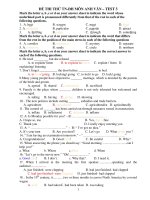
đề thi thử đại học môn anh của Đại học Vinh mã đề 357
Bạn đang xem bản rút gọn của tài liệu. Xem và tải ngay bản đầy đủ của tài liệu tại đây (123.09 KB, 5 trang )
TRƯỜNG ĐẠI HỌC VINH
TRƯỜNG THPT CHUYÊN
ĐỀ THI THỬ THPT QUỐC GIA, LẦN 3 NĂM 2015
MÔN TIẾNG ANH (Thời gian làm bài: 90 phút)
Mã đề thi 357
Họ, tên thí sinh: Số báo danh:
I. PHẦN TRẮC NGHIỆM : TỪ QUESTION 1 ĐẾN QUESTION 64 (8 điểm)
Mark the letter A, B, C, or D on your answer sheet to indicate the word or phrase that is CLOSEST
in meaning to the underlined part in each of the following questions.
Question 1: The expansion of public services has caused concern that the civil service branches are
becoming autonomous powers.
A. powerful B. advanced C. superior D. independent
Question 2: All organisms must obtain nutrients from the environment in order to sustain themselves.
A. isolate B. harvest C. acquire D. digest
Question 3: Some experts believe that the functions of the print media will be replaced by audio or
visual media.
A. influences B. popularity C. roles D. services
Question 4: A central issue in probability is foretelling the value of a future observation.
A. observing B. predicting C. recording D. interpreting
Mark the letter A, B, C, or D on your answer sheet to indicate the word whose underlined part is
pronounced differently from that of the rest in each of the following questions.
Question 5: A. attacks B. repeats C. trays D. roofs
Question 6: A. change B. stomach C. watch D. church
Read the following passage and mark the letter A, B, C, or D on your answer sheet to indicate the
correct answer to each of the questions.
Are you interested in seeing the beautiful fall foliage of New England but tired of traffic jams and
overbooked hotels? Then this year forget the crowds in New England and see the beautiful colors of
autumn in the Catskills.
These rugged mountains in New York State, just 90 miles northwest of New York City, are famous
for the legendary tales of Rip Van Winkle, and more recently for the summer hotels that sprang up in
the region during the 1940s, 1950s, and 1960s. Families trying to escape the heat of New York City
found the Catskills to be the perfect place to stay for a month or so each summer. By the late 1950s there
were over 500 resorts and hotels offering nighttime entertainment as well as all kinds of outdoor activities.
Famous comedians like Jackie Gleason, Joan Rivers, and Sid Caesar all got their start touring the hotel
clubs here. Since the introduction of air-conditioning and cheaper air travel, however, families have
stopped coming to the Catskills in such large numbers, choosing instead more distant locations at
different times of the year. Many of the Catskill hotels closed in the 1970s, but some remain and have
expanded and changed their facilities to meet the needs of today's visitors.
Currently, there are many activities available to the traveler besides witnessing the changing colors
of the leaves. There is an all-organic sheep farm where visitors can see how a traditional sheep farm
operates. There are also hundreds of miles of scenic drives in the area. Route 42, for instance, is an
excellent site for spotting bald eagles. For more information on vacations in the Catskills, call the Office
of Public Information.
Question 7: What is the author's main purpose in this passage?
A. to compare the Catskills to New England.
B. to promote the Catskills as a vacation destination.
C. to describe the history of the Catskills region.
D. to introduce visitors to famous Catskills entertainers.
Trang 1/5 - Mã đề thi 357
Question 8: The word "rugged" in paragraph 2 could be best replaced by which of the following?
A. tall B. lush C. rough D. barren
Question 9: According to the passage, which of the following caused the decline in the number of
resorts in the 1970s?
A. affordable air travel B. television
C. shorter vacations D. more traffic
Question 10: Which of the following is closest in meaning to the word "legendary" in paragraph 2?
A. mythical B. humorous C. foolish D. perplexing
Question 11: The phrase "sprang up" in paragraph 2 most probably refers to something that
has ______.
A. spread out B. operated vigorously C. burst forth D. joined together
Question 12: In what season would a tourist most likely have visited the Catskills in the 1950s?
A. spring B. fall C. summer D. winter
Question 13: Which of the following most reflects the author's tone in this passage?
A. light and encouraging B. humorous and skeptical
C. regretful and reminiscent D. informative and scientific
Question 14: What does the passage imply that a visitor might be lucky enough to do?
A. see a kind of bird B. work on a sheep farm
C. see fall leaves in color D. drive on scenic roads
Question 15: As used in paragraph 3, which of the following could best replace the word "spotting"?
A. seeing B. painting C. photographing D. shooting
Question 16: The author implies that in the Catskills, there are few _______ .
A. eagles B. people C. sheep D. leaves
Mark the letter A, B, C, or D on you answer sheet to indicate the word that differs from the rest in
the position of the main stress in each of the following questions.
Question 17: A. recognize B. architecture C. argument D. artificial
Question 18: A. relationship B. favourable C. democracy D. evaluate
Question 19: A. reception B. arrival C. prestigious D. literal
Mark the letter A, B, C, or D on your answer sheet to indicate the correct answer to each of the
following questions.
Question 20: Dick: “I enjoyed myself so much at your birthday party.” - Patrice: “ ____________.”
A. It’s a pleasure B. Oh, I’m glad to hear that
C. Oh, that’s kind of you D. Congratulations
Question 21: Don’t worry about trying to catch the last train home, as we can ___________ you up for
the night.
A. take B. put C. set D. keep
Question 22: The boys proposed that their group leader _______ a camping trip.
A. organizing B. organizes C. organized D. organize
Question 23: She _______ you that evening. You should have told her everything.
A. would help B. wished helping C. must have helped D. was there to help
Question 24: Without written evidence, we don’t have a ______ on.
A. foot to lean B. leg to stand C. foot to stand D. leg to lean
Question 25: Judo players are __________ to their opponents and bow to each other before and after a
contest.
A. respectfully B. respectable C. respect D. respectful
Question 26: She used to work here as a typist, __________ she?
A. didn’t B. did C. wouldn't D. use
Question 27: Everyone __________ what they have to do, don’t they?
A. do know B. know C. knows D. have known
Question 28: The rescuers ________ for their bravery and fortitude in locating the lost mountain
climbers.
A. were praised B. praising C. praised D. were praising
Trang 2/5 - Mã đề thi 357
Question 29: By the time we got home, we were _________ frozen and exhausted.
A. absolutely B. extremely C. exceedingly D. very
Question 30: __________ are often used for laboratory experiments.
A. They are small grey mice B. Small grey mice
C. That grey small mice D. Grey small mice
Question 31: The __________ at the football match became violent when their team lost.
A. observers B. spectators C. viewers D. customers
Question 32: The more you talk about the matter, __________ .
A. the situation seems the worse B. the worse seems the situation
C. the situation seems worse D. the worse the situation seems
Question 33: __________, the examinees knew it was time to stop.
A. Heard the bell B. To have been heard the bell
C. To hear the bell D. Hearing the bell
Question 34: You must always have a good breakfast every morning _______ late you are.
A. no matter B. however C. even if D. whatever
Question 35: Mike: “I have a favor to ask you.” -Tim: “__________.”
A. It’s a pleasure B. Go ahead C. Help yourself D. Ask, please
Question 36: I wish I _______ to him. Now it is too late.
A. would listen B. have listened
C. had listened D. listened
Question 37: What’s the point __________ here if you don’t have anything to tell them?
A. getting them all come B. in getting them all come
C. to get them all come D. in getting them all to come
Question 38: Are you the boy __________ bicycle was stolen?
A. who B. of which C. whose D. his
Question 39: I can't __________ what he's doing; it's so dark down here.
A. look into B. show up C. make out D. see through
Read the following passage and mark the letter A, B, C or D on your answer sheet to indicate the
best option for each of the blanks.
Beatrix Potter was a story writer whose books about animals have been translated into many
languages and read by both children and adults. (40) ________ being an author, she was also regarded
as a very successful farmer. Born in London in 1866, Beatrix was (41) ________ for at home by various
servants. Every year she (42) _______ the days to her annual holiday in the countryside. She would (43)
_______ to her London home small animals which she (44) ________ and drew. As she grew up, she
entertained other children with drawings and stories about these animals. In 1901, she printed a book at
her own (45) _______ called ‘The Tale of Peter Rabbit’. So many (46) _______ were sold that she
bought a farm, where over the next eight years she wrote many other stories. They all sold very well and
readers liked their detailed color drawings.
With her growing (47) _______ , Beatrix started buying more farmland, animals and property. After
her marriage, at the age of 47, Beatrix stopped writing, (48) _______ that she had run out of (49)
_______ . She became a farmer and spent the rest of her life working with her sheep and awarding
prizes at sheep fairs.
Question 40: A. Apart B. Otherwise C. Except D. Besides
Question 41: A. attended B. cared C. looked D. minded
Question 42: A. counted B. considered C. imagined D. numbered
Question 43: A. keep B. get C. give D. take
Question 44: A. saw B. remarked C. observed D. noticed
Question 45: A. spending B. expense C. charge D. earning
Question 46: A. copies B. prints C. images D. pages
Question 47: A. receipt B. wages C. income D. pay
Question 48: A. telling B. talking C. saying D. speaking
Question 49: A. opinions B. views C. ideas D. beliefs
Trang 3/5 - Mã đề thi 357
Mark the letter A, B, C, or D on your answer sheet to show the underlined part that needs
correction in each of the following questions.
Question 50: Some insects bear a remarkable resemblance to dead twigs, being long, slenderness,
A B C
wingless, and brownish in color.
D
Question 51: Not longer are contributions to the advancement of industry made primarily by individuals.
A B C D
Question 52: Georgia has too many types of soil that virtually any plants can be grown there.
A B C D
Question 53: On the way back home from the library, we saw two of our classmates to cycle
A B C
side by side.
D
Question 54: Although they reflect a strong social conscience, Arthur Miller’s stage works are typical
A B
more concerned with individuals than with systems.
C D
Read the following passage and mark the letter A, B, C, or D on your answer sheet to indicate the
correct answer to each of the questions.
There are many theories of aging, but virtually all fall into the category of hypotheses with a
minimum of supporting evidence. One viewpoint is that aging occurs as the body's organ systems
become less efficient. Thus failures in the immune system, hormonal system, and nervous system could
all produce characteristics that we associate with aging. Following a different vein, many current
researchers are looking for evidence at the cellular and sub cellular level. It has been shown that cells
such as human fibroblasts (generalized tissue cells) grown in culture divide only a limited number of
times and then die. Only cancer cells seem immortal in this respect. Fibroblast cells from an embryo
divide more times than those taken from an adult. Thus some researchers believe that aging occurs at
the cellular level and is part of the cell's genetic makeup. Any event that disturbs the cell's genetic
machinery such as mutation, damaging chemicals in the cell's environment, or loss of genetic material,
could cause cells to lose their ability to divide and thus bring on aging. Other theories of aging look at
different processes.
Chronological aging refers to the passage of time since birth and is usually measured in years.
While chronological age can be useful in estimating the average status of a large group of people, it is a
poor indicator of an individual person's status because there is a tremendous amount of variation from
one individual to the next in regard to the rate at which biological age changes occur. For example, on the
average, aging results in people losing much of their ability to perform strenuous activities, yet some
elderly individuals are excellent marathon runners.
Another type of aging is cosmetic aging, which consists of changes in outward appearance with
advancing age. This includes changes in the body and changes in other aspects of a person's
appearance, such as the style of hair and clothing, the type of eyeglasses, and the use of a hearing aid.
Like chronological aging, it is frequently used to estimate the degree to which other types of aging have
occurred. However, it is an inaccurate indicator for either purpose because of variation among individuals
and because a person's appearance is affected by many factors that are not part of aging, including
illness, poor nutrition, and exposure to sunlight.
Question 55: The author believes the theories of aging are _______.
A. interesting ideas B. poorly supported hypotheses
C. well-supported hypotheses D. proven theories
Question 56: In paragraph 1, the word "evidence" refers to _______.
A. evidence of aging B. evidence of cell division
C. evidence of human fibroblasts D. evidence of cancer
Question 57: The word "vein" in paragraph 1 is closest in meaning to _______ .
A. cellular level B. part of the body C. blood vessel D. point of view
Trang 4/5 - Mã đề thi 357
Question 58: The author of the article points out that cancer cells _______.
A. divide more in adults than in embryos B. bring on aging
C. divide and then die D. divide infinitely
Question 59: The word "culture" in paragraph 1 is closest in meaning to _______ .
A. a society's traditions and values B. a toxic substance
C. a special environment D. libraries
Question 60: It can be inferred from the passage that fibroblast cells ________.
A. are not a focus in cellular research on aging
B. are similar to cancer cells in rate of division
C. divide fewer times at later stages in human life
D. disfunction in the aging process of the body's immune system
Question 61: As explained in this passage, the theory of aging which examines the cellular level would
NOT assign which of the following as a cause of aging?
A. Loss of genetic material B. Chemical damage from the environment
C. Mutation D. Failure of the body's organ system
Question 62: According to the passage, chronological aging is not a good indicator of an individual's
status regarding aging because ______.
A. it is difficult to get accurate records of birth dates
B. there is individual variation in the rate of biological aging
C. elderly people are often athletic
D. strenuous activities are not good measures of age
Question 63: The author implies all of the following about cosmetic aging EXCEPT _______.
A. It is described by changes in outward appearance
B. It does not occur at the same rate for all people
C. It is a poor indicator of chronological age
D. Illness, poor nutrition, and exposure to sunlight cause aging to occur
Question 64: This article can be extracted from ______.
A. a travel brochure B. a cookbook
C. a fashion magazine D. a health journal
II. PHẦN TỰ LUẬN (2 điểm)
Thí sinh làm phần tự luận vào tờ sau.
THE END
Trang 5/5 - Mã đề thi 357