GWT in Practice phần 8 doc
Bạn đang xem bản rút gọn của tài liệu. Xem và tải ngay bản đầy đủ của tài liệu tại đây (608.25 KB, 37 trang )
242 CHAPTER 8 Testing and Continuous Integration
In figure 8.8 we’re using Subversion (SVN) for source control management, and we’ve
provided the repository
URL. Then, in the bottom half of the configuration page,
shown in figure 8.9, we set up the remaining options.
In figure 8.9 we have set our
CI server to poll our SCM system every five minutes
past the hour. This means Hudson will use
SVN to check out anything that has
changed. If there are changes, then, as the Build information shows, a build will
take place using Maven 2, executing the
clean
test
site
goals. After the build sec-
tion, we also have set up the email configuration. Through email, we send a notifica-
tion message to a mailing list that project developers can subscribe to, and we send
a note specifically to the person who “broke the build.” Using a
CI system like this
can help motivate developers to keep things in order, in addition to the other bene-
fits it offers.
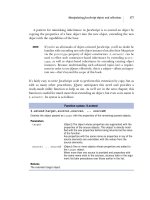
As you can see, no detailed explanation is required for setting up Hudson itself, or
for adding projects, because it’s beautifully simple. Once a project is in Hudson, you
then use the Hudson Dashboard to view project information and build results.
Figure 8.9 The bottom half of the Hudson job configuration page
243Continuous integration
DISCUSSION
Hudson is not only very easy to set up, it’s also quite intuitive to use. From the main
Dashboard page, shown in figure 8.10, you can see and select the main items. The build
queue and current execution status are shown, as is each configured job or project.
From the Dashboard you can quickly get an idea of the status of all of the projects
you have configured. The status of each project is displayed, along with an overall
barometer that shows trends—stormy, cloudy, or sunny weather based on the ratio of
successful to failed builds. If you click on a project, you can pull up the project details
page, as shown in figure 8.11 on page 244.
From the Hudson project details page, you can access all sorts of project informa-
tion, down to the level of console output as the build runs if you need it. Included
here are project status, build history, configuration, change-log, a test results graph,
RSS feed links, a Workspace, and more. The project workspace (which by default is the
hudson subdirectory of the Hudson user’s home directory), contains the files checked
out to run the project, and any build artifacts. In the case of Maven, the target direc-
tory portion of the workspace, shown in figure 8.12 on page 245, is where the build
output, including the site, is located.
With our
CI-managed build for the GWTTestMe project, we can see that our pro-
cess is working, running the tests—both standard and
GWTTestCase
-based—and it’s
producing metrics. The same reports and artifacts that we saw in section 8.2, when
using Maven manually are present in our automated
CI build. CI provides a lot of bang
Figure 8.10 The Hudson Dashboard
244 CHAPTER 8 Testing and Continuous Integration
for the buck through a seamless continuous process that will gauge the state of the
project and alert developers automatically (and maybe more importantly, pester them
repeatedly, if needed) when things get out of whack.
There are many more useful aspects of
CI in general, and features in Hudson, than
we have addressed here, but we have demonstrated the basics of using a
CI server with
a
GWT project. Regardless of whether you use Hudson or other products, such as
CruiseControl, Continuum, DamageControl, Bamboo, and the like, you’re continu-
ally keeping up with changes to your application. Individual components are being
integrated in the larger build, and metrics on testing, code coverage, and other
aspects of your project are being automatically gathered. This process helps to reduce
the effort needed to integrate components later, and it improves overall project qual-
ity by keeping the focus on a working, tested build.
8.4 Summary
CI, testing, benchmarks, and related concepts such as capturing project metrics, all
revolve around building the best possible software. Testing provides concrete results
of what the software does, and it helps you manage change when it inevitably occurs.
Figure 8.11 The Hudson project details page
245Summary
Benchmarking helps to capture detailed timing metrics across different scenarios.
CI overcomes the hurdle of a separate integration phase and ensures that tests,
reports, and other metrics such as those obtained with static analysis tools, are present
all the time as a sort of thermostat for the overall health of an application. None of
these concepts themselves are specific to
GWT, but each requires some special treat-
ment and understanding when used with the toolkit.
In this chapter, we have addressed what
GWT tests are really meant to do and how
they do it. We have covered basic and more involved tests. We have highlighted some
undocumented testing aspects, such as how to obtain code-coverage information and
how to perform remote testing. Additionally, we have covered how to benchmark a run-
ning
GWT application. We also put all of these concepts together with an automated,
continuously integrated build. In each of these areas, we highlighted where
GWT spe-
cializations come into play, where
GWT is strong, and where it has some failings.
Next, in part 3 of the book, we’ll go into some in-depth, code-heavy samples and a
larger running application. In this final part of the book, we’ll tie together concepts
we have already seen, address some common scenarios, and encounter some more
advanced
GWT concepts.
Figure 8.12 The Hudson project Workspace showing the Maven target directory
Part 3
Fully Formed Applications
And now for something completely different. If you are like us, sometimes
technology books can seem narrow in focus and lacking in big picture applica-
tion issues. In this final part, we plan to rectify this. Rather than small code exam-
ples, we are going to work with a couple of fully formed applications that will let
you see a larger
GWT application in practice. It is our intent that you read
through these chapters with the project source code available on your computer.
We aren’t going to cover everything about these applications, but give you a tour
of the moving parts so you can see how they fit together.
We aren’t skimping on new information here, though. First we will look at a
new pattern for working with
JPA and using Data Transfer Objects (DTOs) to
move from client to server. You will also get some tricks for making your
GWT
app work in Single Sign-on (SSO) environments, dealing with cookies when
communicating with the server, and handling state all through your application.
249
Java Enterprise
Reinvented
The sciences do not try to explain, they hardly even try to interpret, they mainly
make models. By a model is meant a mathematical construct which, with the
addition of certain verbal interpretations, describes observed phenomena. The
justification of such a mathematical construct is solely and precisely that it is
expected to work.
—John von Neumann
To this point you have encountered the details of working with the
GWT tools and
have seen various techniques for solving engineering problems in your applica-
tions. In this final part of the book, we want to do something different. We’re going
This chapter covers
■
Working with annotation-based JPA models
■
Using DTOs for RPC transfer
■
Synchronizing between client models and
JPA models
■
Binding states for complex widgets
■
Handling file uploads from the browser
250 CHAPTER 9 Java Enterprise Reinvented
to tour two larger GWT projects—a bookstore application and a screen-sharing appli-
cation—and look at the techniques, tools, and decisions we made in building them so
that you can see more clearly how
GWT fits into a larger project scope. As we look at
these projects using these applications we will to highlight the important aspects of
working with
GWT in a Java EE environment.
The first application we’re going to create is a basic
CRUD application for a book-
store. A screenshot of this application is shown in figure 9.1.
In some ways, this application revisits the concepts we saw in chapter 4, but in a
more complete and robust form. If you recall, in chapter 4 we used Hibernate and
JPA
to insert data into a database. In that instance we were using the most basic configura-
tion: our
JPA beans were the same beans we were sending back and forth to the client.
While that can be a workable solution in simple scenarios, it also has several draw-
backs, which we’ll come to in a moment.
Figure 9.1 The Create-Read-Update-Delete application for our bookstore. Many-to-many relationships
between the authors and categories are maintained with select boxes and options to create new entries.
251Constructing two models
In the next section, we’ll extend the JPA and GWT approach we introduced in chap-
ter 4 to include a
DTO layer, and we’ll use that technique to create our bookstore
CRUD application. This, coupled with MVC and the
PropertyChangeSupport
class we
saw in other examples is the pattern we have found to be most useful in building
GWT applications.
9.1 Constructing two models
In order to directly use JPA entities with GWT, as we did in chapter 4, you have to main-
tain a potentially unwieldy
XML configuration (orm.xml), because GWT does not yet
support annotations. And even in the future, when
GWT does support Java 5 syntax
and annotations (which is the plan for
GWT 1.5), JPA entities will still not always serial-
ize. This is the killer: regardless of the metadata approach that is used, annotations or
not, serialization of
JPA entities to the GWT client will break down in some scenarios.
Specifically, entities that have lazy loaded properties on objects, or lazy loaded collec-
tions, are often instrumented in one manner or another under the covers by the vari-
ous
ORM (Object-Relational Mapping) frameworks. You can’t tell that these objects
are not
POJOs at build time, but when GWT inspects them at runtime and tries to seri-
alize them, it gets ugly and does not work.
To address these issues, we’ll construct an ordinary
JPA-annotated model for our
application, one that we’ll use to store and retrieve information from the database.
Then we’ll mirror our
JPA model with a DTO layer for use with GWT. Listing 9.1 shows
our
Book
class with the appropriate annotations.
@Entity
@NamedQueries( {
@NamedQuery(
name = "Book.findBookById",
query = "SELECT b FROM Book b " +
"WHERE " +
" b.id = :id"),
@NamedQuery(
name = "Book.findBooksByCategory",
query = "SELECT b FROM Book b, IN(b.categories) c " +
"WHERE " +
" c.name = :name"),
@NamedQuery(
name = "Book.findBooksByAuthor",
query = "SELECT b FROM Book b, IN(b.authors) a " +
"WHERE " +
" a.id = :id"),
@NamedQuery(
name = "Book.findAllBooks",
query = "SELECT b FROM Book b ORDER BY b.title")
})
public class Book extends AbstractModelBean {
Listing 9.1 The Book server-side class with JPA annotations
Define named queries
to use in DAO
b
252 CHAPTER 9 Java Enterprise Reinvented
private Integer id;
private String title;
private List<Author> authors;
private String description;
private String image;
private List<Review> reviews;
private List<Category> categories;
public Book() {
super();
}
@Id
@GeneratedValue(strategy=GenerationType.AUTO)
public Integer getId() {
return id;
}
public void setId(Integer id) {
this.id = id;
}
public String getTitle() {
return title;
}
public void setTitle(String title) {
this.title = title;
}
@ManyToMany(cascade=CascadeType.ALL)
public List<Author> getAuthors() {
return authors;
}
public void setAuthors(List<Author> authors) {
this.authors = authors;
}
@Lob
public String getDescription() {
return description;
}
public void setDescription(String description) {
this.description = description;
}
public String getImage() {
return image;
}
public void setImage(String image) {
this.image = image;
}
public List<Review> getReviews() {
return reviews;
}
Use annotations
this time!
253Constructing two models
public void setReviews(List<Review> reviews) {
this.reviews = reviews;
}
public float calculateRating() {
float total = 0;
for (Review r : this.getReviews()){
total += (float) r.getRating();
}
return this.getReviews() == null ||
this.getReviews().isEmpty() ? 0 :
(float) Math.round(
total * 10f / (float) this.getReviews().size() )
/ 10f;
}
@ManyToMany(cascade=CascadeType.ALL)
public List<Category> getCategories() {
return categories;
}
public void setCategories(List<Category> categories) {
this.categories = categories;
}
This is all pretty standard JPA stuff. We have all our JPA information in the beans,
rather than in the mappings file we used in chapter 4. We’re creating a set of
Named-
Queries
for the common lookups we’ll need for our beans
b
, and we’re creating one
smart method on our bean for calculating the rating. We won’t worry about that right
now. You’ll see where it comes into play in the next chapter.
This bean obviously can’t be used by the
GWT service interface because it doesn’t
implement one of the
GWT serialization interfaces and it uses annotations, which
means it isn’t compatible with the
GWT serialization mechanism. Moreover, it doesn’t
support the
PropertyChangeEvent
s we’ll want to wire up to the user interface on the
client side. So, we’ll create a new bean that maps directly to the
Book
class in listing 9.1,
but it will be
GWT-enabled and will be copied into our client package structure. List-
ing 9.2 shows the client-side version of the
Book
class.
public class Book implements IsSerializable {
/**
* @gwt.typeArgs
* <com.manning.gwtip.bookstore.client.model.Author>
*/
private List authors;
/**
* @gwt.typeArgs <com.manning.gwtip.bookstore.client.model.Category>
*/
private List categories;
private String description = "";
private Integer id;
Listing 9.2 The client-side Book class with property-change support
Create business
method
Make wire
transferable
Provide typeArgs
hints for
serialization
254 CHAPTER 9 Java Enterprise Reinvented
private String image;
/**
* @gwt.typeArgs <com.manning.gwtip.bookstore.client.model.Review>
*/
private List reviews;
private String title = "";
private transient PropertyChangeSupport changes =
new
PropertyChangeSupport(
this);
/**
* @gwt.typeArgs newValue
* <com.manning.gwtip.bookstore.client.model.Author>
*/
public void setAuthors(List newValue) {
List oldValue = this.authors;
this.authors = newValue;
this.changes.firePropertyChange(
"authors", oldValue, newValue);
}
/**
* @gwt.typeArgs <com.manning.gwtip.bookstore.client.model.Author>
*/
public List getAuthors() {
return this.authors;
}
/**
* @gwt.typeArgs newValue
* <com.manning.gwtip.bookstore.client.model.Category>
*/
public void setCategories(java.util.List newValue) {
List oldValue = this.categories;
this.categories = newValue;
this.changes.firePropertyChange(
"categories", oldValue, newValue);
}
/**
* @gwt.typeArgs <com.manning.gwtip.bookstore.client.model.Category>
*/
public List getCategories() {
return this.categories;
}
public void setDescription(String newValue) {
String oldValue = this.description;
this.description = newValue;
this.changes.firePropertyChange(
"description", oldValue, newValue);
}
public String getDescription() {
return this.description;
}
Define transient
PropertyChangeSupport
255Constructing two models
public void setId(Integer newValue) {
Integer oldValue = this.id;
this.id = newValue;
this.changes.firePropertyChange("id", oldValue, newValue);
}
public Integer getId() {
return this.id;
}
public void setImage(String newValue) {
String oldValue = this.image;
this.image = newValue;
this.changes.firePropertyChange(
"image", oldValue, newValue);
}
public String getImage() {
return this.image;
}
public PropertyChangeListener[] allPropertyChangeListeners() {
return changes.getPropertyChangeListeners();
}
/**
* @gwt.typeArgs newValue
* <com.manning.gwtip.bookstore.client.model.Review>
*/
public void setReviews(List newValue) {
List oldValue = this.reviews;
this.reviews = newValue;
this.changes.firePropertyChange(
"reviews", oldValue, newValue);
}
/**
* @gwt.typeArgs <com.manning.gwtip.bookstore.client.model.Review>
*/
public List getReviews() {
return this.reviews;
}
public void setTitle(String newValue) {
String oldValue = this.title;
this.title = newValue;
this.changes.firePropertyChange(
"title", oldValue, newValue);
}
public String getTitle() {
return this.title;
}
public void addPropertyChangeListener(
PropertyChangeListener l) {
changes.addPropertyChangeListener(l);
}
Create listener
methods needed
256 CHAPTER 9 Java Enterprise Reinvented
public void addPropertyChangeListener(
String propertyName, PropertyChangeListener l) {
changes.addPropertyChangeListener(propertyName, l);
}
public void removePropertyChangeListener(PropertyChangeListener l) {
changes.removePropertyChangeListener(l);
}
public void removePropertyChangeListener(
String propertyName, PropertyChangeListener l) {
changes.removePropertyChangeListener(propertyName, l);
}
}
Now we have a set of JPA beans we can share with other projects, and a set of client
DTO beans for use in our GWT application. But that’s a lot of code to create, and a lot
of places fat-finger errors can introduce bugs.
Is there a great solution to this? Well, not really. Yet one good solution is to gener-
ate the
DTOs from a core set of beans, which is the approach we have taken for the
applications we developed in our
GWT work. The GWT-Maven plugin includes a goal
that will generate your client-side beans for you using reflection to traverse a graph of
beans. In either the Maven 1 or Maven 2 plugin, this can be invoked with the
gwt:generateClientBeans
goal. If you choose to generate GWT client beans using
GWT-Maven, there are a set of options you need to configure, as shown in table 9.1.
Like in chapter 4, the use of
PropertyChangeSupport
requires a third-party imple-
mentation, such as that from
GWTx ( The Maven
goals depend on two things. First, you’re using Java 5 generics for collection mapping.
These will be converted properly to
gwt.typeArgs
notation for child classes. Second,
that there is a compiled version of the classes available in your project when you run.
This means you should run
maven
java:compile
or
mvn
compile
before calling the
gwt:generateClientBeans
goal.
Table 9.1 Settings for generateClientBeans in Maven 1 and Maven 2. Analogs are supported in
each version to control the code that’s generated.
Maven 1 properties
Maven 2 plugin
configuration
Description
google.webtoolkit.
generateGettersAndSetters
generateGetters-
AndSetters
Toggles generation of getters
and setters.
google.webtoolkit.
generateProperty-
ChangeSupport
generate-
Property-
ChangeSupport
Adds PropertyChange-
Support
to the beans; implies
generateGettersAndSetters.
google.webtoolkit.
generatorRootClasses
generator-
RootClasses
Specifies a comma-separated list of
classes to begin graph examination.
google.webtoolkit.
generatorDestination-
Package
generator-
Destination-
Package
Specifies the destination package
for the generated beans.
257Mapping to DTOs
Why do all this? Well, here we’re using JPA beans, but these beans might be gener-
ated classes from
JAX-WS, JAX-RPC, or Axis for talking to backend web services. These
could be shared objects from a larger server application that don’t support change
events or require constructs that are not supported by the
GWT JRE emulation library.
Also, it’s often a fact of life that a persistence model does not map directly to what a
client application needs. By using a
DTO layer, you can control what is sent to the cli-
ent. (Having different models can cut back on the usefulness of generating the
DTO
classes, but it’s another option that allows you finer-grained control.)
In general, this approach provides a clean isolation between your
GWT code and
the backend code for your application. While it does bloat your code base, the gener-
ation of
DTOs can generally be automated. Since the JPA model can only be used in
the scope of the server, we’ll need a way to map the
DTO model objects to the JPA
model. This can be automated as well.
9.2 Mapping to DTOs
The next class we need to examine is the RPC service itself. GWT RPC services should
be old hat for you by now, but we’re going to add a couple of new elements to the mix
to support conversion between the local model and the remote
DTO model.
First, we need to map between the beans our local service implementation knows
and the client beans we use in the
GWT application. This will allow us to send the
information from the database to our client application. To handle this in the Book-
store application, we’re using another custom class called
BeanMapping
, which is avail-
able from the
GWT-Maven site ( This class is a
simple recursive mapper that will map between similarly named properties or attri-
butes on Java classes. Listing 9.3 shows its use in the
BookstoreServiceServlet
class.
public class BookstoreServiceServlet
extends RemoteServiceServlet
implements com.manning.gwtip.bookstore.client.remote.BookstoreService {
private BookstoreService service;
private Properties mappingProperties = new Properties();
public BookstoreServiceServlet() {
super();
mappingProperties.setProperty(
"com.manning.gwtip.bookstore.model.*",
"com.manning.gwtip.bookstore.client.model.*");
}
public void init(ServletConfig config) throws ServletException {
super.init(config);
BeanFactory factory =
WebApplicationContextUtils.getWebApplicationContext(
config.getServletContext());
Listing 9.3 BookstoreServiceServlet with server-side GWT-RPC communication
Specify mappings
between the
model packages
b
Retrieve Spring
application context
258 CHAPTER 9 Java Enterprise Reinvented
this.service =
(BookstoreService)
factory.getBean("BookstoreService");
}
public void deleteBook(Book book) throws BookstoreRemoteException {
try {
service.deleteBook(
(com.manning.gwtip.bookstore.model.Book)
BeanMapping
.convert(mappingProperties, book)
);
} catch(Exception e) {
throw new BookstoreRemoteException(e.toString());
}
}
public List findAllBooks() throws BookstoreRemoteException {
try {
List serverBooks = service.findAllBooks();
List clientBooks = new ArrayList();
for (Object o : serverBooks) {
clientBooks.add(
BeanMapping.convert(
mappingProperties,
o)
);
}
return clientBooks;
} catch(Exception e) {
throw new BookstoreRemoteException(e.toString());
}
}
public Book findBookById(int bookId)
throws BookstoreRemoteException {
try {
return (Book)
BeanMapping.convert(mappingProperties,
service.findBookById(bookId)
);
} catch(Exception e) {
throw new BookstoreRemoteException(e.toString());
}
}
public List findBooksByCategory(String categoryName)
throws BookstoreRemoteException {
try {
List serverBooks = service.findBooksByCategory(categoryName);
List clientBooks = new ArrayList();
for (Object o : serverBooks) {
clientBooks.add(BeanMapping
.convert(mappingProperties, o));
}
Retrieve service
implementation
Convert DTOs
and JPA beans
Map between
objects in
collections
259Mapping to DTOs
return clientBooks;
} catch(Exception e) {
throw new BookstoreRemoteException(e.toString());
}
}
public Book storeBook(Book book) throws BookstoreRemoteException {
try {
return (Book) BeanMapping.convert(mappingProperties,
service.storeBook(
(com.manning.gwtip.bookstore.model.Book)
BeanMapping.convert(
mappingProperties, book)));
} catch(Exception e) {
e.printStackTrace();
throw new BookstoreRemoteException(e.toString());
}
}
/* Some methods omitted for brevity */
}
Compared to what you might have expected would be required to map between the
two object packages, this isn’t that bad. First, we create the mapping properties. Using
the wildcard notation, this says “map all the classes in
com.manning.gwtip.book-
store.model
to the similarly named classes in
com.manning.gwtip.bookstore.client.
model
”
b
. You could also specify individual classes if you wanted multiple representa-
tions or summary or short form representations of your classes mapped. The
Bean-
Mapping
class won’t complain about properties on one object that are not present on
the other. If you want to specify an alternative mapping for a specific class, you can
simply map the class explicitly, like this:
mappingProperties.setProperty(
"com.manning.gwtip.bookstore.model.ClassA",
"com.manning.gwtip.bookstore.client.model.ClassB");
We find that the simple
BeanMapping
class does the job 90 percent of the time. Never-
theless, if you need more advanced mapping—for instance, if you’re using different
nongenerated
DTO classes for more control—one option is the Dozer library (http://
dozer.sourceforge.net). Dozer provides a much more sophisticated bean-mapping sys-
tem, but it also requires more setup to use. When using Dozer, you need to create an
XML config file that explicitly maps each bean to its counterpart. Here’s an example:
<?xml version="1.0" encoding="UTF-8"?>
<!DOCTYPE mappings PUBLIC "-//DOZER//DTD MAPPINGS//EN"
" /><mappings>
<mapping wildcard="true">
<class-a>com.manning.gwtip.bookstore.model.Book</class-a>
<class-b>com.manning.gwtip.bookstore.model.client.Book</class-b>
</mapping>
<mapping wildcard="true">
<class-a>com.manning.gwtip.bookstore.model.Category</class-a>
260 CHAPTER 9 Java Enterprise Reinvented
<class-b>com.manning.gwtip.bookstore.model.client.Category</class-b>
</mapping>
<! >
</mappings>
While this seems like a lot of work just to get going, Dozer’s advantages stand out if
you need to map a complex graph of objects to a more simple one. For instance,
if you’re flattening a complex internal model to simple
DTO objects, you can use the
dot notation to map deep properties to shallow ones:
<mapping>
<class-a
map-null="false">com.manning.gwtip.bookstore.model.Book</class-a>
<class-b>com.manning.gwtip.bookstore.model.Book</class-b>
<field>
<a>author.name</a>
<b>authorName</b>
</field>
</mapping>
The dot notation specifying
<a>author.name</a>
will extract the
name
property of the
author
property of the root bean and map it to the
authorName
property on the sec-
ondary bean. Specifying
map-null="false"
simply causes the mapping to be skipped
if the author property of
com.manning.gwtip.model.Book
is
null
.
Dozer has a great deal more functionality including, but not limited to, type map-
ping (between strings and dates, number types, and so on), customizable factory set-
tings,
XMLBeans and JAXB object support, and Spring integration. If you’re working
with a complex legacy
API, it can be a great tool for keeping your GWT DTOs clean
and minimalist.
Speaking of Spring integration, this is what we’ll look at next.
9.3 Wiring applications with Spring
Spring is all the rage. While Java EE 5 is, in our opinion, also very capable on its own
for most tasks, it’s still a new kid on the block in terms of Java application frameworks.
You may have a large investment in Spring technologies in your enterprise or applica-
tion, so understanding how Spring relates to your
GWT application is important. We’ll
backtrack a bit and start by looking at the
DAO classes for our Bookstore model, then
how they are wired into the local service implementation with Spring.
Listing 9.4 shows a sample from the
BookDAO
class. This is really a utility class that
wraps the
JPA calls and the named queries we added to the
Book
object in section 9.1.
public class BookDAO extends AbstractDAO {
public BookDAO() {
super();
}
Listing 9.4 The BookDAO class wraps JPA calls used for retrieving and persisting books
261Wiring applications with Spring
public Book store(Book book){
EntityManager em =
this.getEntityManagerFactory()
.createEntityManager();
try {
em.getTransaction().begin();
for (int i=0;
book.getCategories() != null &&
i < book.getCategories().size();
i++) {
try {
book.getCategories().set(i,
em.merge(
book.getCategories()
.get(i))
);
} catch (Exception e) {
e.printStackTrace();
em.persist(book.getCategories().get(i));
}
}
if (book.getId() == null) {
em.persist( book );
} else {
book = em.merge(book);
}
em.getTransaction().commit();
} finally {
if (em != null) {
em.close();
}
}
return book;
}
public Book findBookById(int bookId){
EntityManager em = this.getEntityManagerFactory()
.createEntityManager();
try {
em.getTransaction().begin();
Query q = em.createNamedQuery("Book.findBookById");
q.setParameter("id", bookId);
return (Book) q.getSingleResult();
} catch (NoResultException e) {
return null;
} finally {
if (em != null) {
em.getTransaction().commit();
em.close();
}
}
}
public List<Book> findAllBooks(){
EntityManager em = this.getEntityManagerFactory()
Defined in
AbstractDAO object
b
Loop categories
and merged
objects
c
Check whether creating
or updating book
262 CHAPTER 9 Java Enterprise Reinvented
.createEntityManager();
try {
em.getTransaction().begin();
Query q = em.createNamedQuery("Book.findAllBooks");
return q.getResultList();
} finally {
if (em != null) {
em.getTransaction().commit();
em.close();
}
}
}
public List<Book> findBooksByCategory(String categoryName) {
EntityManager em = this.getEntityManagerFactory()
.createEntityManager();
try {
em.getTransaction().begin();
Query q = em.createNamedQuery("Book.findBooksByCategory");
q.setParameter("name", categoryName);
return q.getResultList();
} finally {
if (em != null) {
em.getTransaction().commit();
em.close();
}
}
}
// Some methods omitted
public void delete(Book book){
EntityManager em = this.getEntityManagerFactory()
.createEntityManager();
try {
em.getTransaction().begin();
book.setCategories(null);
book = em.merge(book);
em.remove(book);
} finally {
if (em != null) {
em.getTransaction().commit();
em.close();
}
}
}
}
This is a fairly standard DAO approach. The one special case we’re dealing with is cat-
egories. Here we want cascading categories, but we don’t want to remove the 1 n rela-
tionships or end up with duplicates. To ensure this, we look through them and merge
or create categories during the store action
c
, and we remove the relationship but not
the categories on deletion
d
. The calls to
getEntityManagerFactory()
are referencing
Clear categories
for deletion
d
263Wiring applications with Spring
the parent
AbstractDAO
class
b
. The
EntityManagerFactory
could be injected by Java
EE 5, or Spring, to make the example code simpler, but we’re getting it the old-fashioned
way by referencing the persistence unit. The rest of the service infrastructure we’ll wire
up with Spring.
Now that we have our
DAO layer for the server-side model, we need to create the
service and inject the appropriate
DAOs into it. Listing 9.5 shows the applicationCon-
text.xml file we’ll use.
<?xml version="1.0" encoding="UTF-8"?>
<beans xmlns=" /> xmlns:xsi=" /> xsi:schemaLocation=" /> /> <bean id="authorDAO"
class="com.manning.gwtip.bookstore.model.dao.AuthorDAO"/>
<bean id="bookDAO"
class="com.manning.gwtip.bookstore.model.dao.BookDAO"/>
<bean id="categoryDAO"
class="com.manning.gwtip.bookstore.model.dao.CategoryDAO"/>
<bean id="bookstoreService"
class="com.manning.gwtip.bookstore.service.BookstoreServiceImpl">
<constructor-arg>
<ref bean="authorDAO" />
</constructor-arg>
<constructor-arg>
<ref bean="bookDAO" />
</constructor-arg>
<constructor-arg>
<ref bean="categoryDAO" />
</constructor-arg>
</bean>
</beans>
Once the service instance is wired up, we initialize the Spring context using the
ContextListener
declaration in the web.xml file in listing 9.6.
<?xml version="1.0" encoding="UTF-8"?>
<web-app xmlns="
xmlns:xsi="
version="2.4"
xsi:schemaLocation="
/> <description>GWTIP JPA Example</description>
<display-name>GWT Bookstore</display-name>
<distributable />
<context-param>
<param-name>contextConfigLocation</param-name>
<param-value>
Listing 9.5 The Spring configuration file wiring the DAOs to the service bean
Listing 9.6 The web.xml file loads the Spring context
Inject DAOs into
service bean
264 CHAPTER 9 Java Enterprise Reinvented
/WEB-INF/applicationContext.xml
</param-value>
</context-param>
<listener>
<listener-class>
org.springframework.web.context.ContextLoaderListener
</listener-class>
</listener>
</web-app>
There are several things you likely noticed here. First, we get the service reference into
the
RemoteServiceServlet
. At the top of listing 9.3, we retrieve the Spring context fac-
tory manually from the
ServletContext
as the servlet is initialized. While it’s possible
to use Spring to configure your
GWT servlet instances into the web context, you’ll lose
the implicit mapping and packaging advantages. Of course, the
GWT
RemoteService-
Servlet
is still not declared in the web.xml, which brings us to the second point.
We once again need to merge our configuration for a deployable
WAR file. This can
be done manually or, as was discussed in chapter 7, we can take advantage of
GWT-
Maven, which includes goals that can automatically merge the servlet declarations from
the module descriptor into the web.xml file while the
WAR deliverable is being built.
For the Spring purist, this might seem less than desirable: having a Spring and
non-Spring portion of your application deployment. Another option is to use the
GWT-SL Spring wrappers (available from ). These
provide two different options for wrapping
GWT servlets. The first is the
GWTRPCSer-
viceExporter
, an example of which is shown in listing 9.7.
<bean id="MyPOJO"
class="org.gwtwidgets.server.spring.GWTRPCServiceExporter">
<property name="service" ref="MyPOJO" />
<property name="serviceInterfaces">
<value>
com.me.my.service.MyInterface
</value>
</property>
</bean>
<bean
class="org.springframework.web.servlet.handler.SimpleUrlHandlerMapping">
<property name="mappings">
<map>
<entry key="/MyService"
value-ref="MyPOJOService" />
</map>
</property>
</bean>
This will take your POJO and use CGLIB to generate a wrapper servlet for it
b
. You can
then use the Spring
SimpleUrlHandlerMapping
to map it to a URL
c
.
Listing 9.7 GWTRPCServiceExporter in an applicationContext.xml file
Specify
applicationContext.xml
file (listing 9.5)
Register standard
Spring context
loader
Use serviceInterfaces
if it’s a POJO
b
Map service
to a URL
c
265Constructing the client application
You can, alternatively, use the
GWTHandler
to wrap and deploy your beans in a sin-
gle step. Listing 9.8 demonstrates doing this in the applicationContext.xml file.
<bean id="urlMapping" class="org.gwtwidgets.server.spring.GWTHandler">
<property name="mappings">
<map>
<entry key="/MyService" value-ref="MyPOJO" />
</map>
</property>
</bean>
This simply does in a single step what we did in two in listing 9.7. This method comes
with a caveat, however. Because of the wrapping in this step, all exceptions thrown will
become
InvocationException
s. You’ll lose your custom service exceptions.
It’s important to remember that even when using this Spring-configured service,
you still will want an internal and external service that maps between different object
models, so this doesn’t save you much time. Because, in the end, the
RPC servlet is usu-
ally a thin veneer over a completely configured Spring service, we find simply using
the integrated
GWT-Maven deployment process to be easier in many cases. Figure 9.2
shows the relationship between the server-side model objects and service and the
client-side model. Notice that there are almost two mirror-image groupings, which
reflect this translation through the
RPC servlet layer.
Now we have toured the backend of our
CRUD application: the two backend models,
the service-exposure mapping between the two, and the Spring-configured service
layer. We need a front end for all of this, which we’ll look at next.
9.4 Constructing the client application
As we have demonstrated in earlier examples, the client application will represent its
own
MVC pattern. In the first section of this chapter, we constructed the DTOs that will
Listing 9.8 Using the GWTHandler to export services
Server side core service
<<interface>>
BookstoreService
model.Category
model.Author
Analogue GWT-RPC classes
client.model.Author
client.model.Category
<<interface>>
client.remote.BookstoreService
client.model.Book
<<realize>>
BookstoreServiceServlet
model.BookBookstoreServiceImpl
<<realize>>
Figure 9.2 The local service and local model matches the remote model, with the
BookstoreServiceServlet translating between the two using the BeanMapping class
266 CHAPTER 9 Java Enterprise Reinvented
make up the backbone of the model. In this section, we’ll take a look at the classes
that make up the rest of the application.
First we need to create our core model and the controller, which calls into
the service.
9.4.1 The controller and global model
The controller and model likely seem pretty familiar to you by now, so we’ll move
through them quickly and look at some of the techniques we used for building the
editor
UI.
First we need a model that can hold the global level information. Since we have
three major types that we want to keep track of independently, we’ll make each of
them an observable property on the
ModelState
singleton in listing 9.9.
public class ModelState {
private PropertyChangeSupport changes =
new PropertyChangeSupport(this);
private List books;
private List authors;
private List categories;
private static ModelState instance;
private ModelState() {
super();
}
public static ModelState getInstance() {
return (instance == null) ?
instance = new ModelState() : instance;
}
public void addPropertyChangeListener(PropertyChangeListener l) {
changes.addPropertyChangeListener(l);
}
public void addPropertyChangeListener(String property,
PropertyChangeListener l){
changes.addPropertyChangeListener(property, l);
}
public void removePropertyChangeListener(PropertyChangeListener l) {
changes.removePropertyChangeListener(l);
}
public void removePropertyChangeListener(String property,
PropertyChangeListener l) {
changes.removePropertyChangeListener(property, l);
}
public void clearPropertyChangeListeners() {
PropertyChangeListener[] listeners =
changes.getPropertyChangeListeners();
for (int i=0; listeners != null && i < listeners.length; i++) {
this.removePropertyChangeListener(listeners[i]);
Listing 9.9 The ModelState singleton class holds the global model object