101 Helpful Hints for IELTS phần 3 ppsx
Bạn đang xem bản rút gọn của tài liệu. Xem và tải ngay bản đầy đủ của tài liệu tại đây (174.94 KB, 17 trang )
Reading Test Hints
Paragraph (v)
Australia and New Zealand have roughly the same percentage of Asian students in their
language classrooms, but not all students of English who choose these countries are from
Asia. The emerging global consciousness of the late twentieth century has meant that
students from as far as Sweden and Brazil are choosing to combine a taste for exotic travel
with the study of English 'down under' and in 'the land of the long white cloud'. But even
the Asian economic downturn in the 1990s has not significantly altered the demographic
composition of the majority of English language classrooms within the region.
Question 8 asks for the heading of Paragraph (v). The topic of the paragraph deals with
the nationality profile of overseas students attending English classes in Australia and New
Zealand. Therefore, the two most likely headings that will match with this paragraph are,
"A" - (Heterogeneity in the language classroom) and "D" - (Additional student sources).
If you do not consider both likely choices, you might not choose answer "D", which is the
correct answer.
Matching Task Method - Type 1 only
Step 5. Leave the most difficult match to last. Sometimes, one of the matching items is more
difficult than the others. In a matching task Type 1, you can leave the most difficult match
to last because the unmatched item left over at the end will be the answer (provided, of
course, your other answers are correct). Do not waste too much time searching for the
answer to a difficult matching question in a matching task Type 1 - it is wiser to solve the
easiest matches first.
Step 6. Check your answers carefully because if you make an error with one match in a matching
task Type 1, you will cause an error to occur with another match.
With both matching task Types 1 and 2, when the task asks you to match a heading with a single
paragraph, you must be sure of the main topic of the paragraph before you make your match.
Similarly, when you are asked to match a heading with a particular part of the passage (which might
contain more than one paragraph), you must be sure that every paragraph within that portion of the
passage relates in some way to the topic idea of the heading you are considering.
• Look at Section (v) in Reading Passage 1 of Reading Test Four:
Section (v)
Monorail systems are not new, but they have so far been built as adjuncts to existing city
road systems. They usually provide a limited service, which is often costly and fails to
address the major concern of traffic choking the city.
The Beam-Operated Traffic System, on the other hand, provides a complete solution to city
transportation. Included in its scope is provision for the movement of pedestrians at any
point and to any point within the system. A city relieved of roads carrying fast moving cars
and trucks can be given over to pedestrians and cyclists who can walk or pedal as far as they
wish before hailing a quickly approaching beam-operated car. Cyclists could use fold-up
bicycles for this purpose.
It is not immediately clear from the first paragraph whether the main topic of the section is
answer e) "The monorail system" or h) "The complete answer to the traffic problem". By
reading carefully, it can be seen that only answer h) relates to both paragraphs in the section.
Matched headings need to refer to all parts of the indicated portion of the passage
37
101 Helpful Hints for ELTS
CHECK YOUR ANSWERS ARE CORRECT
Besides matching headings with paragraphs or portions of a passage, you might need to match
beginnings with endings of sentences by referring to a reading passage, or match labels with parts
of a diagram, table or chart. Your answer must agree with all the information in the other half of
the match. It is sometimes useful to match at least 3 areas of information in a possible answer
before choosing that answer.
• Look again at the headings for Questions 4 - 9 in Reading Test One:
A. Heterogeneity in the language classroom
B. Major influence on existing student source
C. Reasons for the choice of destination
D. Additional student sources
E. Conclusion
F. The attractions of studying in the antipodes
G. Student destinations
The first heading can be divided into 3 parts- "Heterogeneity", "language" and "classroom".
Similarly, the second heading can be divided into 3 parts - "Major influence", "existing" and
"student source ". The third heading can be divided into 3 parts as well - "Reasons ", "for the
choice of and "destination". When searching for the answer in a paragraph in the passage,
make sure that each of the 3 parts of the heading relates to what is stated in the passage.
Not only matching task headings can be divided into 3 parts. Many, but not all, statements and
questions in other reading task types contain 3 (or more) areas of information to search for in a
passage. The point to remember is that if at least three matching areas of information agree with
what you read in the passage, you can be fairly certain that the answer you have chosen is correct.
• Look at Question 12 in Reading Test One:
Q12. Students of the same nationality usually make similar study choices.
T F N
This question is part of a True/False/Not Given reading task, but the question statement can
be divided into (at least) 3 areas of information to check for in the reading passage - "Students
of the same nationality", "usually make", and "similar study choices".
Each of these 3 areas of information can be matched with what is in the reading passage, and
therefore the answer is "T" for True.
Check that all parts of the answer agree with what is stated in the reading passage
"PLACE" THE TASK ACROSS THE PASSAGE
If you look at the example and the last question of a particular set of questions in a reading task,
and then locate the topic of the example and the topic of the last question within the passage, the
answers to the task questions will generally lie within the area between those two locations. This
placing technique shortens the area of the passage in which to search for the answers.
The technique is particularly useful in reading gapfill tasks where you must refer to a reading passage
for the missing words. The summary gapfill text can sometimes be divided into sections that
correspond to the various paragraphs of the reading passage. It should then be quicker to find the
correct paragraph within which to find the answer. This technique is not limited to gapfill tasks.
38
Reading Test Hints
• Look at the Example and Questions 16 - 18 in Reading Test One:
Example: What is the name of the Association which commissioned the survey?
Q16. Which regional group had the largest percentage of students in the survey?
Ql8. For what purpose did most students intend to use their English learning?
The topic of the example is given by the keyword/phrase "name of the Association ". The topic
of the last question (Question 18) is given by the keyword/phrase "use their English learning ".
Therefore, the answers to the task questions will most likely be found in the area of the passage
beginning with the paragraph giving the answer to the example (the first paragraph), and ending
with the paragraph discussing how the students planned to use their English (the second last
paragraph on the same page).
The example above is a simple example of how to apply the placing technique to a question task.
In more difficult cases the technique can often prevent much wasted time searching for an answer
in the wrong part of the passage.
Know where to look for answers in the reading passage by restricting the search area
LOOK FOR CHANGES IN THE SENTENCE ORDER
The information contained in a question sentence (or part sentence) is sometimes written in a
different order to that in the equivalent sentence in the passage. This switching of information can
be confusing in a difficult question. A simple example is given below.
Look at Question 14 in Reading Test One:
Q14. Standards at Australian and New Zealand tertiary institutions are improving.
T F N
In the passage it says:
" and, perhaps of most importance to many Asian students whose English
study is a prelude to tertiary study, the growing awareness that courses at
antipodean universities and colleges are of an exceptionally high standard."
The "standards" and "tertiary" keywords in the question are found in reverse order in the
reading passage.
Sometimes not all the keywords/phrases within a particular question can be found close together in
the passage, or within a single sentence. In fact, there may be a good deal of interesting but irrelevant
information between the keywords/phrases in the passage. This may prevent you from finding all
you need to know to answer the question. (See also Reading Hint 56.)
39
101 Helpful Hints for IELTS
LOOK FOR PATTERNS OF WORDS AND PHRASES
Finding the answers to questions in the Reading Test largely depends on your ability to recognise
the shapes and patterns in groups of words. There are basically 3 kinds of "patterns" to recognise:
Pattern Type 1: corresponding words with exactly the same pattern
Pattern Type 2: corresponding words with a similar pattern
Pattern Type 3: corresponding words, but with a less recognisable pattern
The best way to explain is by illustration and analysis.
• Look at Question 36 in Reading Test One:
Q36. Permanent damage to the body may result if Ecstasy is taken simultaneously with
Question Phrase Passage Phrase
a) may result -» may result (Pattern Type 1)
b) taken simultaneously -» taken at the same time (Pattern Type 2)
c) damage to the body -» harm to bodily organs (Pattern Type 3)
The verb phrase "may result" in the question matches exactly the verb phrase "may result" in
the passage (Pattern Type 1).
The phrase "taken simultaneously" in the question has a similar pattern to the phrase "taken
at the same time " in the passage (Pattern Type 2). The words "at the same time " in the passage
have been substituted in the question with the similar meaning word (synonym) "simultaneously ".
The phrase "damage to the body" in the question is similar in meaning to the phrase given in
the passage, but the pattern is less recognisable (Pattern Type 3).
Note that single words, too, may be substituted in the question for a word (or phrase) in the passage.
In Question 36, the word "permanent" is a substitute for the adjective "lasting" in the passage.
Now refer to the reading passage starting on page 101, and find the corresponding phrases for those
in Question 37 below. To which pattern type does each phrase belong?
• Look at Question 37 in Reading Test One:
Q37. Cellular damage to the brain is detected by measuring the amount of
Question Phrase Passage Phrase
a) cellular damage to the brain -> (Pattern Type )
b) the amount of -> (Pattern Type )
c) is detected by -» (Pattern Type )
(Answers are given upside-down at the bottom of page 43).
Note that not all questions will contain all three pattern types; nor will all substitutions fall neatly
into the three patterns. Nevertheless, being able to recognise and match the patterns when they occur
will help greatly with your reading comprehension.
40
Reading Test Hints
FIVE QUICK HINTS
Read the Glossary
Occasionally a reading passage comes with a glossary of words in the passage that may be technical
or not easily understood. Do not forget to check a glossary for the meaning of a word.
Also, the IELTS Academic Module, being a formal academic test, contains a number of words often
found in such tests, that is, vocabulary commonly used when studying at post-secondary (tertiary)
level. The Glossary on page 172 contains a number of such words taken from this book. Check the
meanings of the words it contains in a good dictionary and learn them. They are words that you are
likely to encounter many times in practice IELTS tests, and probably in the IELTS test itself.
Check Difficult Vocabulary
You may not understand every word in the reading passages. Even native English-speaking people
might have difficulty fully understanding all the vocabulary presented in an IELTS test. You are not
allowed to use a dictionary in the examination room, nor is it a good idea to use a dictionary during
the first attempt at the tests in this book (or any other practice IELTS test book). Later, of course,
it is useful to study the passages carefully and check unknown vocabulary.
The best approach is to guess the meaning of the word from the context, that is, from the words that
surround it. However, this is not always an easy task. If you still have no idea what the word means,
ask yourself if it contributes a positive (+) or negative (-) meaning to the sentence. This is usually
enough to assist you to work out the meaning or intention of the writer. (See also Reading Hint 55.)
Search for Numbers First
Numbers are easier than words to locate within a reading passage. If a number is mentioned in the
question, use the keyword approach outlined in Reading Hint 44, and search for the key "number"
in the passage. Check around each use of the number to see if the answer you need is located nearby.
Remember though, that numbers can also be expressed in word form in a reading passage.
Remember Maximum Word Requirements
If the instructions inform you that the maximum number of words to give as an answer is, say, three,
you can assume that at least one answer, and probably more, will contain three words exactly.
Therefore, look for phrases that contain the maximum number of words allowed. Remember the
Golden Rule, and do not give more words than instructed. (See IELTS Test - Basic Hint 7.)
• Look at Questions 24 - 28 in Reading Test Two and the Answer Key.
In this task, 2 out of 5 of the answers are three words long:
Q25. - "six quality bands" Q28. - "lack communication skills"
Check Figures and Diagrams for Answers
Do not forget that the answers you are looking for may be given in a figure, diagram, illustration,
graph, table or chart that accompanies the reading passage. Always check footnotes, too.
• Look at Question 29 in Reading Test Four:
Q29. Children with A.D.D.:
c) may be slightly affected by sugar intake
The answer c) is given only in Figure 1 - Evaluations of Controversial Treatments for A.D.D.
41
101 Helpful Hints for IELTS
READING GAPFILLS - METHOD
If the first task in a reading passage is to complete the reading passage itself by asking you, for
instance, to add headings for various paragraphs or sections, then it is probably best to complete that
task first. However, if there is a gapfill task which is a summary of the whole passage, or even part
of the passage, consider completing the gapfill first. Summary gapfills help to predict information
about the passage, even with some words missing. They may also help to answer questions in other
tasks connected to that passage.
There are 2 types of gapfill tasks in the IELTS Reading Test:
Type 1 - those with a given list of words or phrases to choose from to fill in the gaps.
Type 2 - those where you fill the gaps with words or phrases from the reading passage.
Gapfill tasks Type 2 are, naturally, more difficult than gapfill tasks Type 1. The text of a gapfill task
Type 2 is always a summary of part or the whole of a reading passage. On the other hand, a gapfill
task Type 1 may or may not be a summary of part or the whole of a reading passage. Both task types,
however, require a good knowledge of grammar.
Reading Gapfill Method - for Type 1
Step 1. First, read the instructions. You need to know if the gapfill is a summary of part or of the
whole of the reading passage; if so, you will need to refer to the passage. You also need to
know if you can use a word from the list of words more than once.
Step 2. Next, read the example and cross the answer to the example off the list, but only if you
cannot use a word from the list more than once.
Step 3. Then, scan or skim the gapfill text quickly for a general understanding of the text.
Step 4. Now work out the parts of speech for each of the words in the given list. Place a letter
standing for the part of speech next to each word in the list. If the item in the list is a phrase,
you should determine the kind of phrase (noun, adjectival, adverbial, prepositional etc.).
If a word can function as two parts of speech, e.g. as a noun and a verb, write down both.
n - noun v - verb a - adjective adv - adverb
p - preposition pp - past participle '-ing' words c - conjunction
By distinguishing the words or phrases according to their function as parts of speech, you
need only search through similar functioning words when considering a word or phrase
for a gap. In this way, you considerably shorten the time required to find the words or
phrases that are possible correct answers.
Remember, if the word either side of the gap:
is a noun, the answer could be an adjective (usually before the gap)
is a verb, the answer could be an adverb.
is an adjective, the answer could be a noun (or an adverb if after the gap)
Do not forget this structure: (pro)noun + (be) + adjective, e.g. She is happy.
Note that an adverb may precede the adjective in the above structure.
Step 5. Now turn to the first gap in the task, and try to work out the full meaning of the sentence
it is within. You may need to read the sentence before and after, too.
42
Reading Test Hints
Step 6. Next, work out the part of speech for the gap. Do so, by closely examining the words that
come both before and after the gap.
Step 7. Then search only through the words in the list that can function as the same part
of speech as the missing gap word. Look for all the possible answers that you think
could fit in the gap. Make no final choices just yet. There are usually two or three
similar words that could be correct. Write them all above the gap.
Step 8. Refer to the reading passage to help you choose possible answers for the gap if the
gapfill text is a summary of part or all of the passage.
Step 9. Complete steps 5 to 8 for each gap in the task.
Step 10. Choose a final answer from the words chosen for each gap. Cross off the incorrect
answers, do not write them on the Answer Sheet, for you will not be correct if you give
more than one answer.
Reading Gapfill Method - for Type 2
Step 1. First, read the instructions. You need to know if the gapfill text is a summary of part or of
the whole of the reading passage.
Step 2. Next, read the example for information about the topic of the summary.
Step 3. Then, scan or skim the gapfill text quickly for a general understanding of the text.
Step 4. Now locate the answer to the example in the reading passage.
Step 5. "Place" the summary across the passage to find out where the answers to questions
may be found. It is often possible to divide the summary into parts that correspond to
various paragraphs or sections of the passage. In this way, it is possible to shorten the area
of the passage in which to look for particular answers. (See also Reading Hint 47.)
Step 6. Now turn to the first gap in the task, and try to work out the full meaning of the sentence
it is within. You may need to read the sentence before and after, too.
Step 7. Next, work out the part of speech for that gap. Do so, by closely examining the words that
come both before and after the gap.
Step 8. Then, examine the keywords/phrases to look for in the passage, and locate them in the
passage. (See also IELTS Test - Basic Hint 10 and Reading Hint 57.)
Step 9. Choose the word that best suits the gap, remembering that the words you find in the
passage may not be in the word form you require. You may need a noun, but the word
given in the passage might be an adjective. In which case, you must change the form of the
word to the word form required in the gapfill text.
Step 10. Complete steps 6 to 9 for each gap in the task.
Turn the page upside down to see the answers to the exercise given on page 40:
Reading Test Hints
FIND SHORT SENTENCES WITHIN PARAGRAPHS
It is important to develop the ability to "see" a short question sentence within a longer sentence or
within a paragraph. The sentences forming the questions usually contain summarised information,
and are, therefore, almost always shorter than the sentence or sentences in the reading passage which
contain the corresponding information.
O Look at Question 2 in Reading Test Two:
It takes practice to "see" the information contained in the sentence of a question within the extra
wording in the reading passage, but it is an important skill. Note that sometimes the information in
the sentence forming the question is not given in the same order as the same information in the
passage. Nonetheless, the ability to "see" a shorter sentence within longer sentences is essential
when trying to locate the correct answer within a large piece of text. (See also Reading Hint 48.)
CONSIDER THE LOCATION OF THE ANSWER
You must be willing to search both before and after the keywords/phrases. The distance of an answer
from the keyword/phrase can vary considerably in the Reading Test, but the answer is usually found
in the same paragraph as the keyword/phrase with which it is connected.
In this book, certain keywords and phrases in the questions (and passages) are referred to as signpost
keywords/phrases because they point to paragraphs in the passage where answers are likely to be
found. Keywords more closely connected with the answer are referred to as destination keywords/
phrases. (See also IELTS Test - Basic Hint 10.)
D Look at Question 22 in Reading Test Three:
45
101 Helpful Hints for IELTS
Notice that sometimes the signpost keyword/phrase can be found long before the answer in a
passage. It can also come after the answer.
Note also that when the keywords/phrases in the question are found in the passage they may not be
written exactly in the same way. The corresponding keywords/phrases in the passage may contain
substituted words, or they may be phrases with a similar meaning. (See also Reading Hint 49.)
Nevertheless, reference to the keywords/phrases in a question can always be found somewhere in
the reading passage, and most often in the same paragraph. (See also Reading Hints 46 and 56.)
CHARTS AND TABLES IN QUESTION TASKS
Keywords, keyphrases, and examples are also features of questions within charts and tables. Do not
overlook the words already contained in a chart or table in your hurry to find the answer in the reading
passage. These words can also be considered as 'examples'.
• Look at Questions 1 - 3 in Reading Test One:
The keywords/phrases for Question 1 are the headings for the row and column in which the question
is found {"type of English in course books used in this country" in "Britain" ). Similarly, the
keywords/phrases for Questions 2 and 3 are the appropriate row and column headings.
The particular examples for Question 1 are "American " and "not given " because they are in the
same row as the question. Similarly, the example words for Questions 2 and 3 are found in the same
row as the questions.
Remember that in charts and tables, the example words in a row not only help you answer the
question, they may also be words or phrases within a particular word set.
e.g. The type of English in course books used in the U.S. is given as "American".
Question 1 asks for the type of English in course books used in Britain. Referring
to the passage, the answer is found to be "British", which is within the word set
"nationality".
Be aware that it is possible for the answer to a question in a chart or table to be a word already given
somewhere in the same row or column.
Remember to examine all the words and phrases contained in a chart or table
46
Writing Test Hints
WRITING TEST HINTS
A BASIC UNDERSTANDING
PAY ATTENTION TO THE PRESENTATION
// ^
identati >n.s—
While it is true that the IELTS Writing Test is not marked for neatness, there is the psychological
aspect to consider when you are trying to impress an examiner. You are not there in person to present
your work, so always aim to make your writing look presentable on the page.
10 Point Guide to Presentation and Layout
i. There is no need for a title in the IELTS test task writings, and do not rewrite the question task,
ii. Use left and right margins as in the two good examples above.
iii. Use either indentations for the, first line of each paragraph (traditional method) or a blank line
between paragraphs (modern method), but do not mix both methods.
iv. Do not use double spacing, that is, do not leave a blank line between each line of writing.
v. Use all the line - write from the very edge of the left margin all the way to the very edge of the
right margin. This is true for every line, except where the line is short, or where the last word
will not fit between the margins. In the latter case, do not continue into the margin area. Start
on a new line with the word that is too large.
vi. Do not split words. Rather than memorise complex rules for splitting words, do not split them.
vii. Write between 10-12 words per line. This will prevent you writing words too large and with
gaps larger than a single letter or two between words. It will also make it simpler for you to
quickly estimate how many words you have written in the test.
viii. 7iu cuMive mttOtfy, t&at U, mti the letter jowed toqd&vi.
Cursive writing makes your work look more mature, if it can be read easily. The non-cursive
writing of some candidates can look immature. Since first impressions are important, impress
the examiner by writing the way educated English-speaking adults usually write in English.
ix. Write in a thick, not fine, pen, and consider writing in blue ink. Why? From a psychological
point of view, a thick pen makes a stronger impression. Similarly, written work in pencil looks
weak and impermanent. Pencil users waste time erasing, and sharpening or pumping the lead.
Blue ink, is more soothing and pleasant to look at than black. Leave behind a positive impression.
x. If you make a mistake, simply cross out the errer error with one line. There is no penalty for
crossing out. Besides, it shows the examiner that you are capable of error correction.
47
101 Helpful Hints for IELTS
UNDERSTAND THE QUESTION TASK
It is important to fully understand the task you must perform in the IELTS Writing Test. The Golden
Rule is that you must be sure of the type of answer you are required to give to the examiners, and
what you must do with that information to give the answer accurately. (See IELTS Test - Basic Hint 7.)
You will probably receive a lower Writing Test Band Score if you fail to
write what you are required to write, and with at least the minimum number of
words requested per task. You may be asked to write an essay, report, or description
etc. There is no maximum word limit, but there is a limit to the amount of space in which
to write your answers.
48
Quick Punctuation Guide
1. Use full-stops only at the end of a
sentence. Begin sentences with a
capital letter. Proper nouns also
require capital letters.
2. Use commas to separate parts of a
sentence to avoid any confusion with
meaning. Additional information is
enclosed within commas.
A comma is used after most
connectives (linking words), and
usually before and after a connective
in mid-sentence. Commas separate
clauses in most conditional sentences.
3. Semi-colons are used to separate sub-
groups within lists, but more often to
join two independent clauses that are
grammatically complete but closely
related. However, in the latter case,
you can always use a full-stop instead.
4. You may use a colon if you need to
draw attention to what is to follow.
5. Use quotation marks for quotes and
titles. Apostrophes show possession
or contraction.
6. Do not use contractions in formal
writing. Use the full form instead.
7. Do not use exclamation marks in
the IELTS Writing Test, and avoid
asking questions.
8. Brackets are useful, especially for
quoting statistics in Writing Task 1,
but do not overuse.
e.g. the Eiffel Tower
the University of North London
e.g. The pollution of rivers, which is
often caused by chemical waste and
fertiliser, is causing enormous
problems for fishermen, especially
in Britain.
(The comma after 'fishermen'
ensures that 'especially' connects
with 'Britain' not 'fishermen'.)
e.g. Therefore, the use of chemicals on
farms should be better controlled.
However, even if such laws were
passed tomorrow, most rivers would
take years to recover.
e.g. Chemical waste from factories is
still drained into river systems; it is
hard to believe that this practice is
still allowed by law in some areas.
e.g. The environment is important for
the following reasons:
e.g. The Daily Express
farmers' profits
there's
e.g. don't, shouldn't, can't, it's
etc.
e.g. the total number of cars (10)
Writing Test Hints
write directly on the given topic. Once you have accurately determined what the
topic and the topic question is, keep to the topic throughout the entire piece of writing.
write for the intended reader. This means you should write your answer in a formal
academic style. For instance, if you are asked to write for a university lecturer, your
answer must be written in the formal style expected.
It is inappropriate to write in note form in the IELTS test (unless specifically requested).
It is inappropriate to use colloquial or slang words or expressions in formal writing.
Also, you should avoid using the word "thing ", or words containing the word "thing ",
such as "something" or "anything". Use more descriptive words instead.
It is not generally acceptable to use "etc." or "and so on" in formal writing. Instead,
make a list of at least 3 examples of what you wish to say, and punctuate as follows:
e.g. " in the water, air and soil " but " they sat for the test, passed, and
failed to use their qualifications. "
Note that the comma after the second last item is usually included only if there might
otherwise be an unintended confusion of meaning, as in the second example above.
write what is expected. If the task includes the words "(write from) your own
experience", it means from the knowledge you have of a particular topic, and does not
usually mean writing about your personal experiences (unless specifically requested).
e.g. "Language-learning overseas is an extremely difficult process."
not "When I was in England, I found learning a language to be very difficult."
write all that is requested in the task. For instance, if you are asked to give
recommendations or advice, make sure that you do. Also, avoid making statements that
are too general, too simple, and too obvious. Your answer should be written in some detail.
The Topic and The Topic Question
It is important to know precisely what the topic is, and what the question is concerning that topic.
Look at the circled topics of Task 2 in Writing Tests One and Two:
TEST
(Studying the English language in an English-speaking country) is the best but not the only
0NE
way to learn the language.
Do you agree or disagree with this statement?
TEST
The world is experiencing a dramatic increase in population. This is causing problems not
TW0
only for poor, undeveloped countries, but also for industrialised and developing nations.
Describe some of the problems that (overpopulation) causes, and suggest at least one
possible solution.
The Test One topic is "studying the English language in an English-speaking country". The
question asks you to consider the alternative: studying English in a non-English-speaking country.
Failure to compare the advantages and disadvantages of both ways will most likely mean a lower score.
The topic in Test Two is "overpopulation". If you wrote at length about overpopulation not being
a problem, it would be irrelevant. In addition, you would score less if you failed to offer a solution.
49
101 Helpful Hints for IELTS
USE THE "THREE-PART" WRITING APPROACH
Model sentences, paragraphs, essays and reports each consist of 3 basic parts. Even words can
consist of three parts:
A Word:
A Basic Sentence:
• (prefix)
subject
+
+ stem
verb +
+ (suffix)
complement
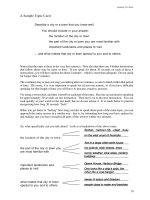
A Typical Paragraph:
Topic sentence - states or refers to the main idea behind the paragraph
- Explanation - to make the topic sentence (or key vocabulary
within the topic sentence) clearly understood
- Evidence - to offer proof of what you are saying as part
of an argument
- Example(s) - to further illustrate the point you are making
- Extra detail - to substantiate the main point of the paragraph
Summary sentence - concludes the paragraph (optional)
The topic sentence is usually, but not always, the first sentence of the paragraph. (See Reading Hint 42.)
Note also that the "body" of the paragraph consists of one or more, but not necessarily all, of the 4
"E"s (explanation, evidence, example(s), and extra detail).
A Typical Essay:
Introduction
Body
Conclusion
Introduction
Body
Conclusion
You might like to think of an essay, a report or any formal piece of writing, as being written with the
3-part shape of a cat in the writer's mind. Note the relative sizes of the parts of the cat.
Note that you do not need to place "ears" on the "cat" in the IELTS Writing Tasks. In other words
you do not need a title. This is true of the IELTS test, but not of most essays at tertiary level.
50
Writing Test Hints
WRITE INTERESTING SENTENCES
Beware of sentences that are too simple and too obvious. Good sentences inform the reader, and are,
therefore, interesting to read. However, do not write unnecessarily complex sentences, and do not
use a word unless you are quite sure of what it means. It is better to use simple words correctly than
complex words incorrectly. Consider the following topic sentence:
"There are many rich and poor countries in the world".
It makes a statement that is much too general in content and is obviously true. Although no-one
would argue with the truth of the statement, it is not an informative or interesting sentence to read.
"There' are many more poor countries than rich countries, yet the latter are in
possession of almost all of the world's economic wealth".
Note that the second sentence answers at least 3 wh/how questions:
Which countries? rich and poor
How many (rich and poor) countries? many more poor countries than rich
How much (do the rich countries own)? almost all of the world's economic wealth.
Who? What? Where? When? Why? Which? How many? How much? How often?
'Answers' to wh/how questions add interest to your sentences.
Try to include the answer to at least 3 wh/how questions in your sentences
IMPROVE YOUR WRITING
It is not the aim of this book to provide a detailed course in writing. However, there is a 3-part method
you can use to increase your writing power gradually. It might seem simple, but it was the method
you used to learn to write in your own language.
1. Read
Yes! Read other people's well-written English. That is why people write in the first place - to be
read. The more you read, the more you will understand of the structure of English sentences. (See
also IELTS Test - Basic Hints 2 and 4.)
2. Copy
If you should do more reading in English, / why not assist your writing / at the same time? / Simply
copy / passages of well-written English / onto paper. / Concentrate as you copy, / thinking about the
structure of the sentences / as you write. / Try to remember / the groups of words you copy / in natural
phrases / as shown in this paragraph. / Try to remember / more and more words at a time / before
checking / to make sure you have copied accurately. / (See IELTS Test - Basic Hint 5.)
3. Write
There is no substitute for practice. The more you write in English, the easier it will become, and the
more accurate your sentences will be. Naturally, it is useful to have your sentences checked by a
trained English language teacher, but if that cannot be done, do not worry. If you copy well-written
English paragraphs while you are also trying to improve your own sentences, your sentence
structures will certainly improve. A large number of exercises designed to improve your writing
skills for the IELTS test is included in the companion book '202 Useful Exercises for IELTS'.
51
101 Helpful Hints for IELTS
6 COMMON QUESTIONS ABOUT THE WRITING TEST
"What happens if I don't finish the writing tasks in the given time?"
You will be penalised because you will not have fulfilled the requirements of each task. It is,
therefore, most important to practise writing for speed a long time before the day of the test, so that
you can be sure of finishing in the required time. It is wise to spend only the advised amount of time
suggested for each task (20 minutes on Writing Task 1 and 40 minutes on Writing Task 2).
"If I complete only one task, is that better than two unfinished tasks?"
No. You will score very badly. Even if you write an extremely good piece of writing for, say, Task
2, by not attempting Task 1 at all, you will score badly. You must at least attempt both tasks. In
addition, Task 2 is worth more marks than Task 1, which is one reason for the longer amount of time
advised for Task 2. Another reason is, of course, the greater number of words required,
"How can I improve my writing speed so that I can finish both tasks ? "
Practise with a clock. Copy paragraphs of well-written English as quickly as you can, and try to
increase your speed gradually. This will help to boost the physical speed at which you write.
Also, use a pen which writes well. It is often faster to write with a pen than with a pencil. It is worth
buying a pen with which you are personally able to write smoothly and easily.
It might be wise to look at the way you hold your pen. Do you grasp it too tightly, as if trying to
squeeze out the ink with your fingers? Writing is a physical act, but it should not cause too much
physical stress. Your hand should flow easily across the page.
Practise writing smoothly and quickly. Cursive or "running" writing causes less stress than non-
cursive writing, and enables the hand to move faster across the page. (See also Writing Hint 59.)
"Do I have to show my writing plans? "
No. Any plans you write are not taken into account when an assessment is made of your work.
Therefore, you need not worry about how your plans look. However, you have to be able to
understand what you have written. It is always preferable to be neat and tidy than messy.
"What should I do if I have no ideas about the topic? "
You should ask yourself "why not?" Both writing tasks are of general interest, and no special
knowledge is required. It is essential that you read about current affairs in your own language as well
as in English in order to keep up with what is happening in the world. Join your local library, read
English language newspapers and magazines. Watch current affairs programmes on TV, and listen
to current affairs programmes on the radio. Do everything you can to become well-informed,
especially about the topics that people talk about in English-speaking countries.
"Does spelling count towards the IELTS Writing Band Score?" ,
Yes, and so does punctuation. All the requirements of good writing are taken into account. However,
you should not worry greatly if you make a few spelling errors. Naturally, you should try hard to
avoid all errors by leaving time at the end of the Writing Test to check your work for grammatical
mistakes, spelling, and punctuation. (See also Writing Hints 59 and 65.)
It is encouraging to remember that your work does not have to be perfect. A non-English-speaking
person is not expected to write an essay, or describe a chart or table as well as a native-writer, unless
he or she has been speaking, listening, reading, and writing in English for many years.
52
Writing Test Hints
10 POINT GRAMMAR CHECKLIST
1. Check for missing or incorrect articles:
"5% of population of the UK is "
"5% of the population of the UK is "
2. Check the 3rd person singular 's' agreement in the present tense:
" she want to go to university "
" she wants to go to university "
3. Check that your verbs are correct (in the active tense and passive voice):
"In 1945 the war end "
"In 1945 the war ended "
4. Check that your verb forms are correct:
"They have been tried to "
"They have been trying to. ."
5. Check all your subject-verb agreements:
" poor countries has suffered."
"poor countries have suffered "
6. Check your countable and uncountable nouns:
"Most student do not wish to "
but "Mostpeoples in the world "
"Most students do not wish to "
"Mostpeople in the world.,"
7. Check that your pronouns refer to (previously mentioned) nouns:
"He wants to go to university "
(it "a student" is not mentioned before)
"He wants to go to university ."
(if "a student" is previously mentioned)
Note that pronouns can come before the nouns they substitute for, but this is not as common.
8. Check that your prepositions are correct:
"The company was interested at "
"The company was interested in "
9. Check that your parts of speech are correct:
" it was a destruction act,,," (noun)
" if was a destructive act." (adj.)
10. Check that your conditional forms are correct:
Zero: If + present tense , + present tense + infinitive
1st: If+present tense , + will (may, might, could etc.) + infinitive
2nd If + past simple tense
+
would (may,might,could + infinitive)
continuous
3rd If + past perfect tense , + would have (may have etc.) + past participle
Leave up to 5 minutes at the end of the test to read your work again with this checklist in mind.
Whenever you write, in the IELTS test and for practice, you should always check for errors.
53
always
maybe
maybe not
did not occur
TABLE OF SOME OF THE MOST COMMONLY USED CONNECTIVE WORDS AND PHRASES
(Refer to an academic writing textbook or teacher for a detailed discussion of appropriate use. See the Further Reading List on page 171,)
First of all, In the first place,.,.
Tobegin with,
Firstly,,Second(ly), Third{ly)
First,.,, Next, .Then. - After that,
Finally, ,
Also,
Besides,,
Furthermore,
In addition,
Moreover,
In the sane way, ,
Likewise, ,
Similarly,,.,
In conclusion,,.»*
In summary, *
To conclude, *
To sum up,.,.*
For example,
For instance,,.,
In particular,,,
particularly,,,.
such as,.,
that ,/.„, that is to say ,,
.,„ namely,,,,
As a result,,,.
Consequently,,,.
Hence,,
So
Therefore, ,„
Thus,,
Group 1, Sequencing/Listing
Use to catalogue (make a list
of items or sequence (place
in order) what you say.
Group 2, Reinforcing
Use to add to and strengthen
what you have said.
Group 3. Equating
Use to indicate similarity
with what has been said.
Group 4 Summarising
Use to introduce a gen-
eralisation of or conclusion
to what you have said,
Group 5. Referring
(e.g.) Use to indicate you will
give (or have given) one or
more examples of what you
have said.
(i.e.) Use to indicate an
explanation of what you have
said.
Group 6, Showing Results
Use to express the
consequence of what you
have said.
In other words,
In that case,
Then
(Or) else,
Otherwise,.,,
Alternatively,.,
On the otto hand,.,,
Then again,
: In other words,.,.
That is to say.,,,
To put it simply,,,,
Conversely,,.
In compat is a,
In contrast to this,,,,
Instead,.,,
On the contrary ,,
,„, whereas,
.,,,while.,./ ,,whilst.
After all
All the same
Although,,.Though,,.,Everthough
Even if,
In spite of,.,, despite this that,.
Nvertheless
Nonetheless,.,.
Still,.
Yet,.,,
Group 7. Inferring
Use to deduce from what you
lave said.
(Either what might or might
not have happened,
is happening, or will happen.)
Group 8. Giving Alternatives
Use to refer to an alternative
to what you have said,
Group 9. Restating
Use to express what you have
said in another way (usually
more simply.)
Group 10. Contrasting
Use to compare or contrast
with what you have said.
Group 11. Conceding
Use to indicate other ways
of considering what you
have said.
Key:
Basic Connectives
, of the "and" type
,,. of the "or" type
of the "but" type