Humanoid Robots Human-like Machines Part 2 docx
Bạn đang xem bản rút gọn của tài liệu. Xem và tải ngay bản đầy đủ của tài liệu tại đây (948.01 KB, 40 trang )
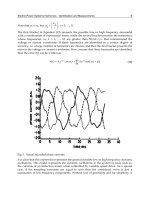
A Novel Anthropomorphic Robot Hand and it s Master Slave System
31
29.029.062.5
11.2
56.7
188.4
φ16
1st joint
2nd joint 3rd joint 4th joint
1st link
2nd link
3rd link
Planner four-bar linkage mechanism
29.029.062.5
11.2
56.7
188.4
φ16
1st joint
2nd joint 3rd joint 4th joint
1st link
2nd link
3rd link
Planner four-bar linkage mechanism
Figure 2. Design of fingers
220.5Total
188.4Finger
Length
[mm]
3rd
2nd
1st
4th
3rd
2nd
1st
Total
Finger
-10 ~ 90
614.1 : 1
Gear ratio
307.2 : 1
134.4 : 1
0.86Fingertip force [N]
-10 ~ 90
-10 ~ 90
-20 ~ 20
Operating
angle of
joints [deg]
0.619
0.097
Weight [kg]
220.5Total
188.4Finger
Length
[mm]
3rd
2nd
1st
4th
3rd
2nd
1st
Total
Finger
-10 ~ 90
614.1 : 1
Gear ratio
307.2 : 1
134.4 : 1
0.86Fingertip force [N]
-10 ~ 90
-10 ~ 90
-20 ~ 20
Operating
angle of
joints [deg]
0.619
0.097
Weight [kg]
Table 1. Specifications
2.1 Characteristics
An overview of the developed KH Hand type S is shown in Figure 1. The hand has five
fingers. The finger mechanism is shown in Figure 2. The servomotors and the joints are
numbered from the palm to the fingertip. Each of the fingers has 4 joints, each with 3 DOF.
The movement of the first finger joint allows adduction and abduction; the movement of the
second to the fourth joints allows anteflexion and retroflexion. The third servomotor
actuates the fourth joint of the finger through a planar four-bar linkage mechanism. The
fourth joint of the robot finger can engage the third joint almost linearly in the manner of a
human finger. All five fingers are used as common fingers because the hand is developed
for the purpose of expressing sign language. Thus, the hand has 20 joints with 15 DOF.
Table 1 summarizes the characteristics of KH Hand type S. The weight of the hand is 0.656
kg, and the bandwidth for the velocity control of the fingers is more than 15 Hz, which gives
them a faster response than human fingers. The dexterity of the robot hand in manipulating
an object is based on thumb opposability. The thumb opposability (Mouri et al., 2002) of the
robot hand is 3.6 times better than that of the Gifu Hand III. To enable compliant pinching,
we designed each finger to be equipped with a six-axes force sensor, a commercial item.
Tactile sensors (distributed tactile sensors made by NITTA Corporation) are distributed on
Humanoid Robots, Human-like Machines
32
the surface of the fingers and palm. The hand is compact, lightweight, and anthropomorphic
in terms of geometry and size so that it is able to grasp and manipulate like the human
hand. The mechanism of KH Hand type S is improved over that of the kinetic humanoid
hand, as described in the next section.
Face gear
1st Motor
Elastic body
Spur gear B
Spur gear A
Set collar
Face gear
1st Motor
Elastic body
Spur gear B
Spur gear A
Set collar
Figure 3. Reduction of backlash
0.0
0.1
0.2
0.0 2.0 4.0
Time (sec)
Joint angle (rad)
-2.0
0.0
2.0
Torque (Nm)
q_
d
q tau
(a) With elastic body
0.0
0.1
0.2
0.0 2.0 4.0
Time (sec)
Joint angle (rad)
-2.0
0.0
2.0
Torque (Nm)
q_d q tau
(b) Without elastic body
Figure 4. Effects of elastic body
2.2 Weight Saving
The weight of Gifu Hand III and the kinetic humanoid hand are 1.4 and 1.09 kg,
respectively. The major part of the weight of Gifu Hand III is the titanium frame of the
fingers. Therefore, the new KH Hand type S uses a plastic frame for the fingers and palm,
and its weight is 0.61 times lighter than that of the older kinetic humanoid hand.
2.3 Motors
The Gifu Hand III has been developed with an emphasis on fingertip forces. High output
motors have been used, with the hand’s size being rather larger than that of the human
hand. In order to miniaturize the robot hand, compact DC motors (the Maxson DC motor,
by Interelectric AG), which have a magnetic encoder with 12 pulses per revolution, are used
in the new robot hand. The diameter of servomotors was changed from 13 to 10 mm. The
fingertip force of KH Hand type S is 0.48 times lower than that of the Gifu Hand III and has
a value of 0.86 N. At the same time, its fingertip velocity is higher.
A Novel Anthropomorphic Robot Hand and it s Master Slave System
33
Motor
Counter board
Motor driver
Counter board
Old New
Motor driver
Motor
Counter board
Motor driver
Counter board
Old New
Motor driver
(a) Foreside
Motor
(b) Backside
Figure 5. Transfer substrate
(a) Old
(b) New
Figure 6. Over view with transfer substrate
2.4 Reduction of Backlash in the Transmission
The rotation of the first and second joints is controlled independently through an
asymmetrical differential gear by the first and second servomotors. The backlash of the first
and second joints depends on the adjustment of the gears shown in Figure 3. The lower the
backlash we achieve, the higher becomes the friction of the gears transmission. An elastic
body, which keeps a constant contact pressure, was introduced between the face gear and
spur gears to guarantee a low friction. The effects of the elastic body were previously tested
in Gifu Hand III, with the experimental results shown in Figure 4. Both the transmissions
with and without the elastic body were accommodated at the same level. A desired
trajectory is a sine wave, and for that the joint torque is measured. Figure 4 shows that the
root mean joint torques without and with the elastic bodies were 0.72 and 0.49 Nm,
respectively. Hence, the elastic body helps to reduce the friction between the gears.
2.5 Transfer Substrate
The robot hand has many cables, which are motors and encoders. The transfer substrate
works the cables of counter boards and a power amp of the driving motors that are
connected to the motors that are built in the fingers. Therefore, a new transfer substrate was
Humanoid Robots, Human-like Machines
34
developed for downsizing. Figure 5 shows the foreside and backside of the developed
transfer substrate, which is a double-sided printed wiring board. The pitch of the connectors
was changed from 2.5 to 1.0 mm. Compared with the previous transfer substrate, the weight
is 0.117 times lighter and the occupied volume is 0.173 times smaller. Figure 6 shows an
overview of a KH Hand type S equipped with each transfer substrate. As a result of the
change, the backside of the robot hand became neat and clean, and the hand can now be
used for the dexterous grasping and manipulation of objects, such as an insertion into a gap
in objects.
Figure 7. Distributed tactile sensor
4.20Row pitch [mm]
3.40Column pitch [mm]
3.35Electrode row width [mm]
2.55Electrode column width [mm]
2.2x10
5
Maximum load [N/m
2
]
895
321
126
112
Number of detecting points
Total
Palm
Thumb
Finger
4.20Row pitch [mm]
3.40Column pitch [mm]
3.35Electrode row width [mm]
2.55Electrode column width [mm]
2.2x10
5
Maximum load [N/m
2
]
895
321
126
112
Number of detecting points
Total
Palm
Thumb
Finger
Table 2. Characteristic of distributed tactile sensor
2.6 Distributed Tactile Sensor
Tactile sensors for the kinetic humanoid hand to detect contact positions and forces are
mounted on the surfaces of the fingers and palm. The sensor is composed of grid-pattern
electrodes and uses conductive ink in which the electric resistance changes in proportion to
the pressure on the top and bottom of a thin film. A sensor developed in cooperation with
the Nitta Corporation for the KH Hand is shown in Figure 7, and its characteristics are
shown in Table 2. The numbers of sensing points on the palm, thumb, and fingers are 321,
A Novel Anthropomorphic Robot Hand and it s Master Slave System
35
126 and 112, respectively, with a total number of 895. Because the KH Hand has 36 tactile
sensor points more than the Gifu Hand III, it can identify tactile information more
accurately.
0.0 1.0 2.0 3.0 4.0 5.0
-0.4
-0.2
0.0
0.2
0.4
Joint angle (rad)
Time (sec)
1st desired
1st actual
(a) 1st joint
0.0 1.0 2.0 3.0
0.0
0.5
1.0
1.5
Join angle (rad)
Time (sec)
2nd desired
2nd actural
(2) 2nd joint
0.0 1.0 2.0
0.0
0.5
1.0
1.5
Joint angle (rad)
Time (sec)
3rd desired
3rd actual
(c) 3rd joint
Figure 8. Trajectory control
2.7 Sign Language
To evaluate the new robot hand, we examined control from branching to clenching. Figure 8
shows the experiment results. The result means that the angle velocity of the robot hand is
sufficient for a sign language.
Sign language differs from country to country. Japanese vocals of the finger alphabet using
the KH Hand type S are shown in Figure 9. The switching time from one finger alphabet
sign to another one is less than 0.5 sec, a speed which indicates a high hand shape display
performance for the robot hand.
3. Master Slave System
In order to demonstrate effectiveness in grasping and manipulating objects, we constructed
a PC-based master slave system, shown in Figure 10. An operator and a robot are the master
and slave, respectively. The operator controls the robot by using a finger joint angle, hand
position and orientation. The fingertip force of the robot is returned to the operator, as
shown in Figure 11. This is a traditional bilateral controller for teleoperations, but to the best
of our knowledge no one has previously presented a bilateral controller applied to a five
Humanoid Robots, Human-like Machines
36
fingers anthropomorphic robot hand. In general, in a master slave system, a time delay in
communications must be considered (Leung et al., 1995), but since our system is installed in
a single room, this paper takes no account of the time delay.
(a) "A" (b) "I"
(c) "U"
(d) "E"
(e) "O"
Figure 9. Japanese finger alphabet
3.1 Master System
The master system to measure the movement of the operator and to display the force feeling
is composed of four elements. The first element, a force feedback device called a FFG,
displays the force feeling, as will be described in detail hereinafter. The second is a data
glove (CyberGlove, Immersion Co.) for measuring the joint angle of the finger. The third is a
3-D position measurement device (OPTOTRAK, Northern Digital Inc.) for the hand position
of operator and has a resolution of 0.1 mm and a maximum sampling frequency of 1500 Hz.
The fourth element is an orientation tracking system (InertiaCube2, InterSense Inc.) for the
operator's hand posture; the resolution of this device is 3 deg RMS, and its maximum
sampling frequency is 180 Hz. The operating system of the PCs for the master system is
Windows XP. The sampling cycle of the FFG controller is 1 ms. The measured data is
transported through a shared memory (Memolink, Interface Co.). The hand position is
measured by a PC with a 1 ms period. The sampling cycle of the hand orientation and the
joint angle is 15 ms. The FFG is controlled by a PI force control. Since sampling cycles for
each element are different, the measured data are run through a linear filter.
The developed robot hand differs geometrically and functionally from a human hand. A
method of mapping from a human movement to the command of the robot is required, but
our research considers that the operator manipulates the system in a visceral manner. The
joint angle can be measured by the data glove, so that this system directly transmits the joint
data and the hand position to the slave system, as we next describe.
A Novel Anthropomorphic Robot Hand and it s Master Slave System
37
Robot
Motor (15)
Encoder (15)
6-axis Force
Sensor (5)
Hand
Motor (6)
Encoder (6)
Arm
Amp
D/A
Motor
Driver
CNT
A/D
PC (ART-Linux)
D/A
CNT
PC (ART-Linux)
Tactile
Sensor
PC (ART-Linux)
I/F
PC (MS Windows)
PC (MS Windows)
Shared Memory
Orientation
Position
Joint Angle
Motor
D/A
A/D
Fingertip
Force
FFG
Operators
Hand
I/F
TCP/IP
Robot
Motor (15)
Encoder (15)
6-axis Force
Sensor (5)
Hand
Motor (6)
Encoder (6)
Arm
Amp
D/A
Motor
Driver
CNT
A/D
PC (ART-Linux)
D/A
CNT
PC (ART-Linux)
Tactile
Sensor
PC (ART-Linux)
I/F
PC (MS Windows)
PC (MS Windows)
Shared Memory
Orientation
Position
Joint Angle
Motor
D/A
A/D
Fingertip
Force
FFG
Operators
Hand
I/F
TCP/IP
Figure 10. Control system
Operators
Master
Position
Controller
Robot
Slave
x
m
x
s
+-
Joint Angle
Position
Orientation
Force
Controller
Fingertip Force
+-
f
s
f
m
Tactile
Operators
Master
Position
Controller
Robot
Slave
x
m
x
s
+-
Joint Angle
Position
Orientation
Force
Controller
Fingertip Force
+-
f
s
f
m
Tactile
Figure 11. Master slave system
3.2 Slave System
The slave system consists of a hand and an arm. The robot hand is the developed KH Hand
type S equipped with the 6-axes force sensor (NANO 5/4, BL. AUTOTEC Co.) at each
fingertip and the developed tactile sensor. The robot arm is the 6-DOF robot arm (VS6354B,
DENSO Co.). The operating system of the PCs for the slave system is ART-Linux, a real-time
operating system (Movingeye, 2001). The tactile sensor output is processed by a PC with a
10 ms period. The measured tactile data is transported to a FFG control PC through TCP/IP.
The sampling cycle of the hand and arm controller is 1 ms. Both the robot arm and hand are
controlled by a PD position control.
3.3 Force Feed Back Glove
The forces generated from grasping an object are displayed to the human hand using the
force feedback glove (FFG), as shown in Figure 12 (Kawasaki et al., 2003). The operator
attaches the FFG on the backside of the hand, where a force feedback mechanism has 5
servomotors. Then the torque produced by the servomotor is transmitted to the human
fingertips through a wire rope. The fingertip force is measured by a pressure sensitive
conductive elastomer sensor (Inaba Co). A human can feel the forces at a single point on
Humanoid Robots, Human-like Machines
38
each finger, or on a total of 5 points on each hand. The resolution of the grasping force
generated by the FFG is about 0.2 N. The force mechanism also has 11 vibrating motors
located in finger surfaces and on the palm to present the feeling at the moment that objects
are contacted. A person can feel the touch sense exactly at two points on each finger and at
one point on the palm, or at a total of 11 points on each hand.
(a) Overview
Force sensor
Wire rope Spiral tube
Flexible tube
Servomotor
Pulley
Band
Vibrating
motor
Hinge
Force sensor
Wire rope Spiral tube
Flexible tube
Servomotor
Pulley
Band
Vibrating
motor
Hinge
(b) Mechanism
Figure 12. Force feedback glove
φ
40
φ
41
Object A
Object B
φ
40
φ
41
Object A
Object B
Figure 13. Peg-in-hole task
4. Experiment
4.1 Peg-in-hole task
As shown in Figure 13, a peg-in-hole task was conducted because it is the most fundamental
assembly operation. We used two objects: a disk with a hole (A) and a cylinder (B). The
weight of object A is 0.253 kg, the outer diameter is 0.13 m, and the hole’s diameter is 0.041
m. The weight of object B is 0.198 kg, and the diameter is 0.040 m. The clearance between
object A and B is 0.001 m.
The peg-in-hole task sequence is as follows. The robot (operator) approaches an object A,
grasps the object, translates it closely to object B, and inserts it into object B.
A Novel Anthropomorphic Robot Hand and it s Master Slave System
39
(a) Approach
(b) Grasp
(c) Translate
(d) Insert
(e) Completion
Figure 14. Sequence of peg-in-hole task
4.2 Experimental Result
Experimental results of the peg-in-hole task controlled by the master slave system are
shown in Figure 14. Figures 15 and 16 show the joint angles and the position and orientation
of the robot hand. We used the KH Hand types with the previous transfer substrate in this
experiment. They indicate that the controlled variables are close to the desired ones. These
results show that the KH Hand type S can perform dexterous object grasping and
manipulation like the human hand.
Humanoid Robots, Human-like Machines
40
0 10203040
-0.5
0.0
0.5
1.0
1.5
Joint angle (rad)
Time (sec)
1st desired
1st actual
2nd desired
2nd actual
3rd desired
3rd actual
(a) Index
0 10203040
-0.5
0.0
0.5
1.0
1.5
Joint angle (rad)
Time (sec)
1st desired
1st actual
2nd desired
2nd actual
3rd desired
3rd actual
(b) Middle
0 10203040
-0.5
0.0
0.5
1.0
1.5
Joint angle (rad)
Time (sec)
1st desired
1st actual
2nd desired
2nd actual
3rd desired
3rd actual
(c) Ring
0 10203040
-0.5
0.0
0.5
1.0
1.5
Joint angle (rad)
Time (sec)
1st desired
1st actual
2nd desired
2nd actual
3rd desired
3rd actual
(d) Little
0 10203040
-0.5
0.0
0.5
1.0
1.5
Joint angle (rad)
Time (sec)
1st desired
1st actual
2nd desired
2nd actual
3rd desired
3rd actual
(e) Thumb
Figure 15. Joint angle of robot hand
5. Conclusion
We have presented the newly developed anthropomorphic robot hand named the KH Hand
type S and its master slave system using the bilateral controller. The use of an elastic body
has improved the robot hand in terms of weight, the backlash of the transmission, and
friction between the gears. We have demonstrated the expression of the Japanese finger
alphabet. We have also shown an experiment of a peg-in-hole task controlled by the bilateral
controller. These results indicate that the KH Hand type S has a higher potential than
previous robot hands in performing not only hand shape display tasks but also in grasping
and manipulating objects in a manner like that of the human hand. In our future work, we
are planning to study dexterous grasping and manipulation by the robot.
A Novel Anthropomorphic Robot Hand and it s Master Slave System
41
010203040
0.0
0.2
0.4
0.6
Position (m)
Time (sec)
x_d x
y_d y
z_d z
(a) Position
0 10203040
-2.0
0.0
2
.
0
Orientation (rad)
Time (sec)
phi_d phi
theta_d theta
psi_d psi
(b) Orientation
Figure 16. Joint angle of robot arm
6. Acknowledgment
We would like to express our thanks to the Gifu Robot Hand Group for their support and
offer special thanks to Mr. Umebayashi for his helpful comments.
7. References
Salisbury, J. K. & Craig, J. J. (1982). Articulated Hands: Force Control and Kinematic Issues,
International Journal Robotics Research, Vol. 1, No. 1, pp. 4-17.
Jacobsen, S. C.; Wood, J. E.; Knutti, D. F. & Biggers, K. B. (1984). The Utah/MIT dexterous
hand: Work in progress, International Journal of Robotics Research, Vol. 3, No. 4, pp.
21-50.
Jau, B. M. (1995). Dexterous Telemanipulation with Four Fingered Hand System, Proceedings
of IEEE Robotics and Automation, pp. 338-343.
Kyriakopoulos, K. J.; Zink, A. & Stephanou, H. E. (1997). Kinematic Analysis and
Position/Force Control of the Anthrobot Dextrous Hand, Transaction on System,
Man, and Cybernetics-Part B: cybernetics, Vol. 27, No. 1, pp. 95-104.
Bekey, G. A.; Tomovic, R. & Zeljkovic, I. (1990). Control Archtecture for the Bergrade/USC
hand, In S. T. Venkataraman and T. Iberall(Editors), Dexterous Robot Hand, Springer
Verlay, pp.136-149.
Rosheim, M. (1994). Robot Evolution, John Wiley & Sons Inc., pp. 216-224.
Lin, L. R. & Huang, H. P. (1996). Integrating Fuzzy Control of the Dexterous National
Taiwan University (NTU) Hand, IEEE/ASME Transaction on Mechatronics, Vol. 1,
No. 3, pp. 216-229.
Butterfass, J.; Grebenstein, M.; Liu, H. & Hirzinger, G. (2001). DLR-Hand II: Next Generation
of a Dextrous Robot Hand, Proceedings of IEEE International Conference on Robotics
and Automation, pp. 109-114.
Namiki, A.; Imai, Y.; Ishikawa, M. & Kanneko, M. (2003). Development of a High-speed
Multifingered Hand System and Its Application to Catching, Proceedings of the 2003
IEEE/RSJ International Conference on Intelligent Robots and Systems, pp. 2666-2671.
Yamano, I.; Takemura, K. & Maeno, T. (2003). Development of a Robot Finger for Five-
fingered Hand using Ultrasonic Motors, Proceedings of the 2003 IEEE/RSJ
International Conference on Intelligent Robots and Systems, pp. 2648-2653.
Humanoid Robots, Human-like Machines
42
Fearing, R. S. (1990). Tactile Sensing Mechanisms, International Journal of Robotics Research,
Vol. 9, No. 3, pp. 3-23.
Howe, R. D. (1994). Tactile Sensing and control of robotic manipulation, Advanced Robotics,
Vol. 8, No. 3, pp. 245-261.
Shimojo, M.; Sato, S.; Seki, Y. & Takahashi, A. (1995). A System for Simulating Measuring
Grasping Posture and Pressure Distribution, Proceedings of IEEE International
Conference on Robotics and Automation, pp. 831-836.
Johnston, D.; Zhang, P.; Hollerbach, J. & Jacobsen, S. (1996). A Full Tactile Sensing Suite for
Dextrous Robot Hands and Use In Contact Force Control, Proceedings of IEEE
International Conference on Robotics and Automation, pp. 3222-3227.
Jockusch, J.; Walter, J. & Ritter, H. (1997). A Tactile Sensor System for a Three-Fingered
Robot Manipulator, Proceedings of IEEE International Conference on Robotics and
Automation, pp. 3080-3086.
Kawasaki, H. & Komatsu, T. (1998). Development of an Anthropomorphic Robot Hand
Driven by Built-in Servo-motors, Proceedings of the 3rd International Conference on
ICAM, Vol. 1, pp. 215-220.
Kawasaki, H. & Komatsu, T. (1999). Mechanism Design of Anthropomorphic Robot Hand:
Gifu Hand I, Journal of Robotics and Mechatronics, Vol. 11, No.4, pp. 269-273.
Kawasaki, H.; Komatsu, T.; Uchiyama, K. & Kurimoto, T. (1999). Dexterous
Anthropomorphic Robot Hand with Distributed tactile Sensor: Gifu Hand II,
Proceedings of 1999 IEEE ICSMC, Vol. II, pp. 11782-11787.
Mouri, T.; Kawasaki, H.; Yoshikawa, K.; Takai, J. & Ito, S. (2002). Anthropomorphic Robot
Hand: Gifu Hand III, Proceedings of 2002 International Conference on Control,
Automation and Systems, pp. 1288-1293.
Kawasaki, H.; Mouri, T. & Ito, S. (2004). Toward Next Stage of Kinetic Humanoid Hand, CD-
ROM of World Automation Congress 10th International Symposium on Robotics with
Applications.
Leung, G. M. H.; Francis, B. A. & Apkarian, J. (1995). Bilateral Controller for Teleoperators
with Time Delay via μ-Synthesis, IEEE Transaction on Robotics and Automation, Vol.
11, No. 1, pp. 105-116.
Movingeye Inc. (2001).
Kawasaki, H.; Mouri, T.; Abe, T. & Ito, S. (2003). Virtual Teaching Based on Hand
Manipulability for Multi-Fingered Robots, Journal of the Robotics Society of Japan, Vol.
21, No.2, pp. 194-200 (in Japanese).
3
Development of Biped Humanoid Robots at the
Humanoid Robot Research Center,
Korea Advanced Institute of Science and
Technology (KAIST)
Ill-Woo Park, Jung-Yup Kim, Jungho Lee, Min-Su Kim, Baek-Kyu Cho
and Jun-Ho Oh
Korea Advanced Institute of Science and Technology (KAIST)
Korea
1. Introduction
Recently, many studies have focused on the development of humanoid biped robot
platforms. Some of the well-known humanoid robots are Honda’s humanoid robots, the
WABIAN series of robots from Waseda University, Partner, QRIO, H6 and H7, HRP and
JOHNNIE. Given that humanoids are complex, expensive and unstable, designers face
difficulties in constructing the mechanical body, integrating the hardware system, and
realizing real-time motion and stability control based on human-like sensory feedback.
Among the robots, HRP and ASIMO are the most well known humanoid robot platforms.
HRP-3P is a humanoid robot developed jointly by the National Institute of Advanced
Industrial Science and Technology and Kawada Industries, Inc in Japan. It stands 1.6 m tall,
weighs 65 kg, and has 36 degrees of freedom (DOF). Upgraded from HRP-2, the new
platform is protected against dust and water. In addition, Honda has unveiled a new type of
ASIMO, termed the ASIMO Type-R, which stands 1.3 m tall, weighs 54 kg, and has 34 DOF.
With the i-WALK technology, this robot has an impressive walking feature: it can walk at
2.7 km/h, and run at 6 km/h.
HUBO is essentially an upgraded version of KHR-2. The objective of the development of
HUBO was to develop a reliable and handsome humanoid platform that enables the
implementation of various theories and algorithms such as dynamic walking, navigation,
human interaction, and visual and image recognition. With the focus on developing a
human-friendly robot that looks and moves like humans, one focus was on closely aligning
the mechanical design with an artistic exterior design. This chapter also discusses the
development of control hardware and the system integration of the HUBO platform.
Numerous electrical components for controlling the robot have been developed and
integrated into the robot. Servo controllers, sensors, and interface hardware in the robot
have been explained. Electrical hardware, mechanical design, sensor technology and the
walking algorithm are integrated in this robot for the realization of biped walking. This
system integration technology is very important for the realization of this biped humanoid.
Humanoid Robots, Human-like Machines
44
The technologies utilized in HUBO are the basis of the development of other HUBO series
robot such as Albert HUBO and HUBO FX-1.
Albert HUBO is the only humanoid robot that has an android head and is able to walk with
two legs. The face, which resembles Albert Einstein, can imitate human facial expressions
such as surprise, disgust, laughter, anger, and sadness. The body, comprising the arms,
hands, torso, and legs, is that of HUBO. The body of HUBO was modified to have the
natural appearance despite the disproportionate sizes of the head and the body. It can be
described as Albert Einstein in a space suit. The realization of a biped walking robot with an
android head is a first-in-the-world achievement. The design and system integration
between the head and the body are discussed. RC motors are used for the head mechanism,
enabling facial expressions. The head and body are controlled by different controllers. The
head controller generates facial motions and recognizes voices and images using a
microphone and CCD cameras.
HUBO FX-1 is human-riding biped robot. There are a few research results on the subject of
practical uses for human-like biped robots. HUBO FX-1 was developed for carrying humans
or luggage. This is very useful in the construction or entertainment industries. As HUBO
FX-1 uses two legs as transportation method, it offsets the limitations in the use of a wheel
and caterpillar. The robot uses AC motors and harmonic drives for joints. As it should
sustain heavy weight in the region of 100kg, it requires high power actuators and
transmissible high-torque reduction gears.
2. HUBO
2.1 Overall Description
HUBO (Project name: KHR-3) is a biped walking humanoid robot developed by the
Humanoid Robot Research Center at KAIST. It is 125cm tall and weights 55kg. The inside
frame is composed of aluminum alloy and its exterior is composite plastic. A lithium-
polymer battery located inside of HUBO allows the robot to be run for nearly 90 minutes
without external power source. All electrical and mechanical parts are located in the body,
and the operator can access HUBO using wireless communications. HUBO can walk
forward, backward, sideways, and it can turn around. Its maximum walking speed is
1.25km/h and it can walk on even ground or on slightly slanted ground. HUBO has enough
degrees of freedom (DOF) to imitate human motions. In particular, with five independently
moving fingers, it can imitate difficult human motions such as sign language for deaf
people. Additionally, with its many sensors HUBO can dance with humans. It has two CCD
cameras in its head that approximate human eyes, giving it the ability to recognize human
facial expressions and objects. It can also understand human conversation, allowing it to talk
with humans.
HUBO is an upgraded version of KHR-2. The mechanical stiffness in the links was improved
through modifications and the gear capacity of the joints was readjusted. The increased
stiffness improves the stability of the robot by minimizing the uncertainty of the joint
positions and the link vibration control. In the design stage, features of the exterior, such as
the wiring path, the exterior case design and assembly, and the movable joint range were
critically reconsidered, all of which are shown in Fig. 1. In particular, strong efforts were
made to match the shape of the joints and links with the art design concept, and the joint
controller, the motor drive, the battery, the sensors, and the main controller (PC) were
designed in such a way that they could be installed in the robot itself. Table 1 lists the
Development of Biped Humanoid Robots at the Humanoid Robot Research Center,
Korea Advanced Institute of Science and Technology (KAIST)
45
specifications of the robot. The following are the design concepts and their strategies in the
design of the HUBO platform.
1. Low development cost
• Rather than using custom-made mechanical parts, commercially available components
such as motors and harmonic gears were used in the joints.
2. Light weight and compact joints
• The power capacity of the motors and reduction gears enables short periods of
overdrive due to the weight and size problem of the actuators.
3. Simple kinematics
• For kinematic simplicity, the joint axis was designed to coincide at one point or at one axis.
4. High rigidity
• To maintain rigidity, the cantilever-type joint design was avoided.
5. Slight uncertainty of the joints
• Harmonic drive reduction gears were used at the output side of the joints, as they do
not have backlash.
6. Self-contained system
• All of the components, including the battery, controllers and sensors, are enclosed
inside the robot. There are no external power cables or cables for operating the robot.
Figure 1. Humanoid Robot, HUBO
X
Y
Z
Roll
Pitch
Yaw
X
Y
Z
X
Y
Z
Roll
Pitch
Yaw
Figure 2. Schematic of the joints and links
Humanoid Robots, Human-like Machines
46
Research period January 2004 up to the present
Weight 55 kg
Height 1.25 m
Walking speed 0 ~ 1.25 km/h
Walking cycle, stride 0.7 ~ 0.95 s, 0 ~ 64 cm
Grasping force 0.5 kg/finger
Actuator Servomotor + harmonic reduction gear
Control unit
Walking control unit, servo control unit, sensor unit,
power unit, and etc.
Foot 3-axis force torque sensor; accelerometer
Sensors
Torso Inertial sensor system
Battery 24 V - 20 Ah (Lithium polymer)
Power
section
External power 24 V (battery and external power changeable)
Operation section Laptop computer with wireless LAN
Operating system Windows XP and RTX
Degree of Freedom 41 DOF
Table 1. Overall Specifications of HUBO
2.2 Mechanical Design
Degrees of Freedom and Movable Joint Angles
Table 2 shows the degrees of freedom of HUBO. Attempts were made to ensure that HUBO
had enough degrees of freedom to imitate various forms of human motion, such as walking,
hand shaking, and bowing. It has 12 DOF in the legs and 8 DOF in the arms. Furthermore, it
can independently move its fingers and eyeballs as it has 2 DOF for each eye (for panning
and tilting of the cameras), 1 DOF for the torso yaw, and 7 DOF for each hand (specifically, 2
DOF for the wrist and 1 DOF for each finger). As shown in Fig. 2, the joint axis of the
shoulder (3 DOF/arm), hip (3 DOF/leg), wrist (2 DOF/wrist), neck (2 DOF) and ankle
(2 DOF/ankle) cross each other for kinematic simplicity and for a dynamic equation of
motion.
Head Torso Arm Hand Leg Total
2 neck
2/eye (pan-tilt)
1/torso (yaw)
3/shoulder
1/elbow
5/hand
2/wrist
3/hip
1/knee
2/ankle
6 DOF 1 DOF 8 DOF 14 DOF 12 DOF 41 DOF
Table 2. Degrees of Freedom of HUBO
Table 3 shows the movable angle range of the lower body joints. The ranges are from the
kinematic analysis of the walking. The maximum and normal moving angle ranges of the
joints are related to the exterior artistic design in Fig. 3. While determining the ranges, a
compromise was reached in terms of the angle range and the appearance of the robot.
Development of Biped Humanoid Robots at the Humanoid Robot Research Center,
Korea Advanced Institute of Science and Technology (KAIST)
47
Joint Angle range
Yaw 0 ~ +45°
Roll -31° ~ +28°
Hip
Pitch -90° ~ +90°
Knee Pitch -10° ~ +150°
Pitch -90° ~ +90°
Ankle
Roll -23° ~ +23°
Table 3. Movable lower body joint angle ranges of HUBO
Figure 3. Artistic design of HUBO
Actuator (Reduction Gear and DC Motor)
Two types of reduction gears are used: a planetary gear and a harmonic gear. A planetary
gear is used for joints such as finger joints, wrist-pan joints, neck-pan joints and eyeball
joints, where small errors (such as backlash) are allowable. Errors in the finger and wrist-
pan joints do not affect the stability of the entire body or the overall motion of the arms and
legs. Harmonic gears are used for the leg and arm, as well as for neck tilt and wrist tilt joints.
As a harmonic gear has little backlash on its output side and only a small amount of friction
on its input side, it is particularly useful for leg joints, where errors can affect the stability of
the entire system and the repeatability of the joint position. This harmonic type of reduction
gear is connected to the motor in two ways: through a direct connection and through an
indirect connection. The indirect connection requires various power transmission
mechanisms (such as a pulley belt or a gear mechanism) between the reduction gear unit
and the motor. HUBO has an indirect type of connection for the neck tilt, the shoulder pitch,
the hip, the knee, and the ankle joints.
Humanoid Robots, Human-like Machines
48
Joint
Reduction gear
type
Input gear ratio Motor power
Finger
Planetary gear
(256:1)
1.56:1 (pulley belt) 2.64 W
Pan
Planetary gear
(104:1)
None
Hand
Wrist
Tilt
Harmonic drive
(100:1)
2:1 (pulley belt)
Pan
Planetary gear
(104:1)
None
Neck
Tilt
Harmonic drive
(100:1)
2:1 (pulley belt)
11 W
Pan None
Head
Eye
Tilt
Planetary gear
(256:1)
1.56:1(pulley belt)
2.64 W
Elbow Pitch
Roll
None
Pitch 1:1
Arm
Shoulder
Yaw
Trunk Yaw
Harmonic drive
(100:1)
None
90 W
Table 4. Upper body actuators of HUBO
Joint Harmonic drive reduction ratio Input gear ratio Motor power
Roll 120:1 Gear (2.5:1) 150 W
Pitch 160:1 Pulley belt (1.78:1) 150 W
Hip
Yaw 120:1 Pulley belt (2:1) 90 W
Knee Pitch 120:1 Pulley belt (1:1) 150 W*2
Roll 100:1 Pulley belt (2:1)
Ankle
Pitch 100:1 Pulley belt (1.93:1)
90 W
Table 5. Lower body actuators of HUBO
The choice of gear types and harmonic drive types was limited by specific design constraints
(such as the space, shape, permissible power, and weight). With flexibility in designing the
size, shape and wiring, it was easier to develop brushed DC motor drivers compared to
other types of motors (such as brushless DC motors or AC motors). The brushed DC motors
also have a suitable thermal property. When they are driven in harsh conditions, for
example at a high speed and severe torque, the generated heat is less than if brushless DC
motors were used. Hence, there is less of a chance that heat will be transferred from the
motors to devices such as the sensors or the controller.
There are trade-offs in terms of the voltage of the motor. If the motor has a high voltage, it
cannot drive a high current, and vice versa. The voltage of the motors is related to the size
and weight of the battery. A high-voltage source requires more battery cells to be connected
serially. The number of battery cells is directly related to the weight of the battery system
and the weight distribution of the robot.
Development of Biped Humanoid Robots at the Humanoid Robot Research Center,
Korea Advanced Institute of Science and Technology (KAIST)
49
Weight Distribution
The main controller (PC), the battery, and the servo controller and drivers for the upper
body are in the torso. The mass, except for the actuators, was concentrated in the torso due
to the need to reduce the load of the actuators in frequently moving parts such as the arms
and legs; in addition, it was desired that the torso have sufficiently large inertia for a small
amplitude fluctuation. With this approach, the robot achieves low power consumption
while swinging its arms and legs; moreover, the control input command ensured a zero
moment point with a small positioning of the torso. When the inverted pendulum model is
used for gait generation and control, making the legs lighter is important for the realization
of biped walking because the model does not consider the weight and the moment of inertia
of the lifting leg.
Mechanical Component of Force Torque Sensor (F/T Sensor)
Shaped like a Maltese cross, the F/T sensors can detect 1-force and 2-moment. As shown in
Fig. 4, the sensors are attached the wrist (Ʒ50) and ankle (80 mm x 80 mm). To sense the
magnitude of a beam deflection, strain gages are glued onto the points where the load
causes the largest strain. These points were located at the ends of the beam but the gages
were glued 5 mm apart to minimize the problems of stress concentration and physical space.
The ankle sensor was designed for a maximum normal force (F
Z
) of 100 kg and maximum
moments (M
X
, M
Y
) of 50 Nm.
Figure 4. Three-axis F/T sensor
It can be physically assumed that the distance between the sole and the sensor is negligible
and that the transversal forces in the x-y plane are small. From the principle of equivalent
force-torque, the sensor-detected moment is then
Sensor ZMP ZMP
MMrF=+×
(1)
where
x
Z
MP y
z
F
FF
F
ªº
«»
=
«»
«»
¬¼
,
,
,
,
s
x
Sensor s y
s
z
M
MM
M
ªº
«»
=
«»
«»
¬¼
,
x
y
z
r
rr
r
ªº
«»
=
«»
«»
¬¼
.
This 3-axis F/T sensor can only sense F
z
, M
s,x
, M
s,y
. By the definition of ZMP, the moment at
ZMP is
0
ZMP
M =
. It can be assumed that the F/T sensor is on the sole and that the transversal
Humanoid Robots, Human-like Machines
50
forces in the x-y plain are small. In this case,
z
x
rF
and
z
y
rF
are negligible. Through a simple
calculation, the relationship between the ZMP and the detected force/moment are
y
x
z
M
r
F
≈−
,
x
y
z
M
r
F
≈
(2)
2.3 Control Hardware System
The hardware architecture of the control system is shown in Fig. 5, and the location of the
hardware components is displayed in Fig. 6. A Pentium III-933MHz embedded PC with the
Windows XP operating system (OS) is used as the main computer. Other devices such as
servo controllers (joint motor controller) and sensors are connected to the controller area
network (CAN) communication lines to the main computer. The robot can be operated via a
PC through a wireless LAN communications network. The main computer serves as the
master controller. The master controller calculates the feedback control algorithm after
receiving the sensor data, generates trajectories of the joints, and sends the control command
of the robot to the servo controller of the joints via CAN communication.
Figure 5. Control System Hardware of HUBO
The software architecture of the OS is shown in Fig. 7. Windows XP operates the main
controller for the convenience of software development and for system management.
Windows XP is a common OS, which is easy for the developer to access and handle. This
widespread OS made it possible to develop the robot control algorithm more effectively, as
it is easy to use with free or commercial software and with hardware and drivers. A
graphical user interface (GUI) programming environment shortened and clarified the
development time of the control software. However, the OS is not feasible for real-time
control. Real-time extension (RTX) software is the solution for this situation. The operational
environment and the GUI of the robot software were developed in the familiar Windows
XP, and a real-time control algorithm including the CAN communications was programmed
in RTX.
Development of Biped Humanoid Robots at the Humanoid Robot Research Center,
Korea Advanced Institute of Science and Technology (KAIST)
51
F/T Sensor
Inclination Sensor
(Accelerometer)
Servo Controller
Actuators
(DC motor / Harmonic Drive
)
Inertial Sensor
Battery
Main Controller (PC)
CCD Camera
F/T Sensor
Inclination Sensor
(Accelerometer)
Servo Controller
Actuators
(DC motor / Harmonic Drive
)
Inertial Sensor
Battery
Main Controller (PC)
CCD Camera
Figure 6. Hardware System Structure of HUBO
Figure 7. Software Architecture of the OS
Brushed DC motors were used for joint actuators. The motors, as used in this robot, are
divided by their power capacity. High-power motors are used for joints such as the hip,
knee, ankle, shoulder, elbow and torso. These joint actuators require high levels of torque,
speed and reliability. For example, the motors used in the lower limb are directly related to
the walking performance and stability of the robot. In addition, the arm joint motors also
require high power as it was desired that the robot could imitate human motions such as
bowing, sign language, and simple dancing. Low-power motors are used for joints such as
the fingers, wrists, neck, and eyes. These motors have little connection to the overall
walking stability of the robot; they were added for the decoration of motion. Two types of
servo controllers were developed: a low-power controller and a high- power controller.
Humanoid Robots, Human-like Machines
52
Figure 8. Hardware Configuration of the Servo controller
Figure 9. Servomotor Controllers
The controllers operate at 1000Hz, which interpolates linearly the position command issued
by the main controller at a frequency of 100Hz. The detailed hardware configuration and the
features of the controllers are shown in Figs. 8 and 9. As mentioned above, two types of
servo controllers were used; these are shown in Fig. 9. Both are composed of a
microcontroller module and power amplifier module. The microprocessor module receives
the joint position commands, controls a real DC motor using given commands and encoder
counting, and sends the actual position or current data of the motors. Fig. 9a shows low-
power servo controllers that control the low-powered joints. These controllers can control 7-
channel motors. There is also a 5-channel A/D port for additional sensors such as the
pressure sensors in the fingertips. The power capacity is 40W/ch for the head and hand
joints, which requires low power, a small space, and multiple motors. The other type of
servomotor, as shown in Fig. 9, controls the high-power DC motors. It can handle 2-channel
motors and a 2-channel A/D port for additional sensors such as accelerometers. It has a
channel power capacity of 480W, allowing it to control the high-power motors.
Development of Biped Humanoid Robots at the Humanoid Robot Research Center,
Korea Advanced Institute of Science and Technology (KAIST)
53
Figure 10. Inertia Sensor System
Figure 11. Signal Processing Block Diagram of the Inertia Sensor System
HUBO has an inertia sensor system enclosed in its chest. The walking control algorithm of
the robot uses the attitude sensor actively. The inertia sensor system is composed of a 2-
channel accelerometer, a 2-channel rate gyro and a signal-condition processor board, as
shown in Fig. 10. In practice, the accelerometer can sense the robot’s inclination using an
arcsine function. However, it is very sensitive to unwanted acceleration resulting from a
shock or a jerk. The rate gyro is good for sensing the angular velocity, but it drifts under a
low frequency. Therefore, it is necessary to utilize signal-processing methods. As shown
above in Fig. 11, the robot’s attitude and its rate of change can be used instead. The sensor
measures the inclination of the torso; the angle control is very important for the robot’s
stability and in terms of repeatability.
3. Albert HUBO
The design concept of the android-type humanoid robot Albert HUBO is described as
follows:
1. A human-like head with a famous face
2. Can hear, see, speak, and express various facial expressions.
Humanoid Robots, Human-like Machines
54
3. Can walk dynamically
4. Spacesuit-type exterior
5. Long battery life per single charge
6. Self-contained system
7. Two independent robotic systems of a head and a body
Albert HUBO is an android-type humanoid robot with a human face, as shown in Fig. 12. It
has a height of 137 cm, a weight of 57 Kg, and 66 degrees of freedom. Essentially, its frame
structures and systems are based on HUBO, which is a biped humanoid robot explained in a
previous section. Based on HUBO, the control system architecture, battery capacity, and
head system were upgraded. The head and body are independent robotic systems;
accordingly, they have different roles. The head system manages intelligent human-robot
interactions while the body system performs movements such as biped walking. Hence, the
battery capacity was enlarged in order to power these two robotic systems sufficiently.
Figure 12. Albert HUBO
Albert HUBO HUBO
Height 137 cm 125 cm
Weight 57 kg 55 kg
DOF 66 41
Actuator
Brushed DC motor
+ RC servomotor
Brushed DC motor
Table 6. Mechanical Specifications of Albert HUBO and HUBO
Development of Biped Humanoid Robots at the Humanoid Robot Research Center,
Korea Advanced Institute of Science and Technology (KAIST)
55
Main computer 1 Pentium III 1.1GHz
Computer
Main computer 2 Pentium III 933MHz
General OS Windows XP
Operating System
Real time OS RTX
Internal CAN
Communication
External IEEE 802.11g
Vision Vision system using CCD Cameras
Voice Voice recognition and voice synthesis
Table 7. System Specifications of Albert HUBO
Table 6 and 7 present the simple and overall specifications of Albert HUBO. The robot uses
two PCs. The first of these is termed main computer 1, which mainly handles the role of
head motion control. The controller generates head motions such as the facial expressions. It
also processes vocal expression data and CCD camera image data from the microphone and
CCD camera, respectively. The second PC is termed main computer 2, which mainly
handles motions and the walking control of the entire robot system apart from the head. It
controls walking and motions analogous to the main computer of HUBO.
Android Head Design
Historically, the entertainment industry has most aggressively explored realistic and nearly
realistic robotic hardware for use in movies and theme parks. The field of such
entertainment devices is known as “animatronics.” These machines have taken a wide
diversity of form, from the realistic “Abe” Lincoln of Disneyland, to the bizarre aliens of the
“Men in Black” movies.
In the field of animatronics, problems of costliness, low expressivity, and power
consumption all result from the physical dissimilarity of the simulated facial soft tissues of
animatronics relative to real human tissues. Human facial soft tissues are mostly liquid,
filling cellular membranes approximating billions of tiny water balloons. The liquid
molecules will slide into any geometry that the membranes can tolerate. In this way, the
human face is like a sealed wet sponge. Animatronic facial tissue on the other hand, is made
of solid elastomers (e.g. rubber), which are typically composed of tangled, spring-like
polymer molecules that unwind when elongated but are geometrically interlocked. Thus,
these molecules are fundamentally restricted from reproducing the geometric plasticity of
human facial tissues. In effect, the force required to move animatronics materials
expressively are orders of magnitude above that required by facial soft tissues.
To resolve these issues, Hanson Robotics developed a series of methods for creating sponge-
like elastomer materials that move more like facial soft-tissues. These materials, known
collectively as “Frubber” (a contraction of “flesh” and “rubber”), wrinkle, crease, and amass
much more like skin than do animatronics materials. They also consume very little power —
less than 10W — while affecting a full range of facial expressions and speech-related mouth
motions. In tests, the material requires less than 1/22
nd
the force and energy to move into
facial expressions relative to animatronics materials.
The reduced energy consumption enables battery-powered biped walking. Being porous,
Frubber also weighs much less, which is also a benefit for untethered walking robots. Such
integration with a walking gesture-capable body is significant as it allows an exploration of
the aesthetics of the entire, integrated humanoid figure as an autonomous social being.