POLICE ENGLISH - PART 6 docx
Bạn đang xem bản rút gọn của tài liệu. Xem và tải ngay bản đầy đủ của tài liệu tại đây (362.1 KB, 10 trang )
Corruption
Copyright Free Haapsalu Writing Team 2003
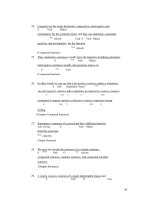
B: Answer the questions
1.What does TI's survey say about corruption?
2.What were the complaints about corruption in 1999? Where did this lead to?
3.What does the report by the European Commission s anti-fraud unit say?
4.Why was the EU s chief accountant sacked?
5.What is the difference between attitudes towards corruption in northern and southern
countries?
C: Vocabulary
Find the words in the text which match the following definitions:
1.to fight/combat
2.to move into or through (something)
3.giving your friends a job
4.wrong use of power
5.accusing somebody of doing something that is wrong or illegal
6.a person who informs people in authority or the public that the company they work for
is doing something wrong or illegal
7.a mistake which people can take advantage of
8.to ally with
D: Write an essay: 'Police are losing the fight against corruption' Discuss.
_______________________________________________________________________________
Rank Country CPI 2002
score
Rank Country CPI 2002
score
1 Finland 9.7 33 Hungary 4.9
2 Denmark 9.5 Belarus 4.8
5 Sweden 9.3
36
Lithuania 4.8
Luxembourg 9.0 44 Greece 4.2
7
Netherlands 9.0 Bulgaria 4.0
10 United Kingdom 8.7
45
Poland 4.0
Norway 8.5 51 Croatia 3.8
12
Switzerland 8.5 Czech Republic 3.7
15 Austria 7.8 Latvia 3.7
18 Germany 7.3
52
Slovak Republic 3.7
Belgium 7.1 68 Uzbekistan 2.9
20
Spain 7.1 71 Russia 2.7
23 Ireland 6.9 77 Romania 2.6
France 6.3 81 Albania 2.5
25
Portugal 6.3 Georgia 2.4
27 Slovenia 6.0
85
Ukraine 2.4
29 Estonia 5.6 93 Moldova 2.1
31 Italy 5.2 95 Azerbaijan 2.0
(Information from Transparency International CPI 2002)
PDF created with pdfFactory Pro trial version www.pdffactory.com
Corruption
Copyright Free Haapsalu Writing Team 2003
Teacher s Notes
Procedure:
1.Ask the students: Is corruption a problem in your country?
Discuss with students.
2. Further discussion
a)Write a list of countries on the board. Estonia, Italy, Finland, Latvia, Russia, Germany,
Norway, Lithuania, Azerbaijan, France
b)Ask the students to put them in order starting with the least corrupted country, the
students compare their lists
c) Give the students the CPI 2002 score list, the students compare their lists with the CPI
list.
3.Follow -up questions:
Is your country corrupt?
Which countries are more corrupt, northern or southern countries?
What could be the reasons?
4.Ask students to discuss A on the worksheet before reading the text.
Check answers to question after reading.
5. Discuss final question in the text.
6. Check questions in B.
7. Vocabulary Key
1.to clamp down on
2.to penetrate
3.cronyism
4.abuse of power
5.allegations
6.whistleblower
7.a loophole
8.to align with
PDF created with pdfFactory Pro trial version www.pdffactory.com
Criminal Justice System
___________________________________________________________________________________________________
__________________________________________________________________
Copyright Free Haapsalu Writing Team 2003
Teacher 's notes
Summary: This worksheet practices the skill of preparing and delivering a short
presentation.
Preparation:
Prepare a transparency with the structure of the Criminal Justice System in England and
Wales which was taken from a UK Home Office report.
Procedure:
1.Ask Sts to make notes while they are listening to the teacher's presentation.
2. Read the following presentation.
Can everyone see? Well, good morning ladies and gentlemen. Thank you for coming. Before we
start, I'd like to introduce myself.
My name is . and I am the (position) of (agency/ unit).
I'm here today to talk about the structure of the Criminal Justice System in England and Wales.
I'm going to look at three main areas.
First, I'll talk about the Home Office.
After that I will describethe responsibilities of the Lord Chancellor's Department.
And finally, I will move to the Attorney General's Office.
My presentation will take around minutes. There will be time for questions at the end.
As you can see from the diagram, the English Criminal Justice System is very complicated. It
consists of three elements. The Home Office, Lord Chancellor's Department and Attorney General's
Office are the three main government departments with responsibility for the CJS, providing the
policy framework, objectives and targets, funding development and support functions.
First of all, I'd like to talk about the Home Office, which is the equivalent of the Ministry of the
Interior in many other countries, deals with matters relating to criminal law, the police, prisons and
probation. The Home Secretary also has general responsibility for internal security. The police
service is organised into 43 local forces which are overseen by Local Police Authorities. These
bodies are responsible to the local authorities and the Home Office. The Home Office is also in
charge of various prison institutions ranging from open prisons to high security establishments.
Secondly, I'd like to look at the Lord Chancellor's Department which deals with matters relating to
the judiciary and administers the Higher Courts by means of the Court Service. The Lord Chancellor
is the head of the Judiciary. Magistrates' Courts are administered through local Committees within a
national framework set by the LCD. Crown Courts hear major criminal case, where the defendant is
tried by a judge and jury. The Magistrates' Courts hear cases of petty crime, such as domestic
violence and traffic offences. Magistrates are unpaid officials who have no legal qualifications.
Finally, moving to the Attorney General's Office. This body supervises the Crown Prosecution
Service, which is responsible for the prosecution of criminal cases. It is headed by the Director of
Public Prosecutions, and the CPS decides whether to prosecute a case or not.
In conclusion, I'd like to highlight the fact that there are three main bodies which control the Criminal
Justice System: the Home Office, Lord Chancellor's Department and Attorney General's Office.
Right, I think that's everything. Let me finish by thanking you very much for your attention. And now,
if you have any questions, I'll be happy to answer them.
PDF created with pdfFactory Pro trial version www.pdffactory.com
Criminal Justice System
___________________________________________________________________________________________________
__________________________________________________________________
Copyright Free Haapsalu Writing Team 2003
3.Check the Sts' notes.
4.Distribute gapped copies of the presentation and ask Sts to fill them in while listening
to the presentation for the second time.
5.Check the answers.
6.Depending on how much time you have and what your Sts know about the topic, either
ask them to prepare similar presentations on their CJS in class, or assign it as
homework. It would be a good idea to encourage the Ss to give the presentation using
only notes prepared from a script.
Optional exercise:
You may ask your Ss to prepare a similar presentation on CJS of other countries.
PDF created with pdfFactory Pro trial version www.pdffactory.com
Criminal Justice System
___________________________________________________________________________________________________
__________________________________________________________________
Copyright Free Haapsalu Writing Team 2003
Can everyone see? Well, good morning ladies and gentlemen. Thank you for coming.
__________ we start, I'd like to introduce myself.
My name is . and I am the (position) of (agency/
unit).
I'm here today to talk about the structure of the Criminal Justice System in England and
Wales.
I'm going to look at three main areas.
First, I'll talk about the Home Office.
__________ I will describe the responsibilities of the Lord Chancellor's Department.
And finally, I will move to the Attorney General's Office.
My presentation will take around minutes. There will be time for questions at the
end.
__________ from the diagram, the English Criminal Justice System is very complicated. It
consists of three elements. The Home Office, Lord Chancellor's Department and Attorney
General's Office are the __________ main government departments with responsibility for
the CJS, providing the policy framework, objectives and targets, funding development and
support functions.
__________, I'd like to talk about the Home Office, which is the equivalent of the Ministry
of the Interior in many other countries, deals with matters relating to criminal law, the
police, prisons and probation. The Home Secretary also has general responsibility for
internal security. The police service is organised into 43 local forces, which are _________
by Local Police Authorities. These bodies are responsible to the local authorities and the
Home Office. The Home Office is also in charge of various prison institutions ranging from
open prisons to high __________ establishments.
__________, I'd like to look at the Lord Chancellor's Department which deals with matters
relating to the judiciary and administers the Higher Courts by means of the Court Service.
The Lord Chancellor is the head of the Judiciary. __________ Courts are administered
through local Committees within a national framework set by the LCD. Crown Courts hear
major criminal case, where the defendant is tried by a judge and jury. The Magistrates'
Courts hear cases of petty crime, __________ domestic violence and traffic offences.
Magistrates are unpaid officials who have no legal qualifications.
__________, moving to the Attorney General's Office. This body supervises the Crown
Prosecution Service, which is responsible for the prosecution of __________ cases. It is
headed by the Director of Public Prosecutions, and the CPS decides whether to prosecute
a case or not.
__________, I'd like to highlight the fact that there are three main bodies which control the
Criminal Justice System: the Home Office, Lord Chancellor's Department and Attorney
General's Office.
Right, I think that's everything. __________ by thanking you very much for your attention.
And now, if you have any questions, I'll be happy to answer them.
PDF created with pdfFactory Pro trial version www.pdffactory.com
PDF created with pdfFactory Pro trial version www.pdffactory.com
Police and Criminal Slang
___________________________________________________________________________________________________________
______________________________________________________________________________________
Copyright Free Haapsalu Writing Team 2003
These slang words and phrases are used by criminals and police officers in the
UK. Are there similar slang words and phrases for these things in your language?
Angler: a thief who uses a rod or pole to steal from ground-floor windows.
Bamber, to do a: UK police expression which means to make a mistake.
Blag: a violent robbery or raid; the act of using clever talk or lying to get something
Brief: a solicitor or barrister
C.P.S.: Crown Prosecution Service
Con: convict, confidence trick
Cush: savings to fall back on. From cushion.
Datastreaming: a growing crime where a hacker obtains credit card details to create counterfeit
cards.
Down, going: to be sent to prison
End: share proceeds from a crime.
Front: a person with a clean criminal record who provides an acceptable face for a known
criminal who is the real owner of a club or business.
Gate fever: the emotion shown by a prisoner nearing the end of his sentence.
Grass: an informer
Hobbit: a prisoner who complies with the system.
Icecream: a narcotic.
Jumper: a thief who steals from offices.
Kremlin: New Scotland Yard.
Lag: a person who has been frequently convicted and sent to prison. Often 'old lag'.
Local nick: police station
Lump, The: building site fraud to avoid payment of income tax.
M.O.: modus operandi. The way in which a criminal commits a crime.
Nick: to arrest someone
Nut: the expenses incurred by a thief setting up a robbery or theft.
Obbo: police observation on criminals.
Padding: unscrupulous police practice of adding to a drugs haul to upgrade an arrest and ensure
a conviction.
Q.E.: Queen's evidence. An accomplice in a crime giving evidence in the hope of a lighter
sentences.
Ramp: a police search or a criminal swindle.
Shoulder-surfing: stealing pin numbers at cashpoints for use later with copied cards.
Slammer, the: prison.
Snitch: informer
Sorted: everything is organised eg: 'It's sorted.'
Supergrass: a very important Mafia informer
Time, to do: to serve a prison sentence
TWOC: to take without the owners consent. A Twocer is someone who steals vehicles etc.
Upstairs: to be convicted at the crown court. The dock is reached by climbing the stairs form the
cells.
VPU: Vulnerable prisoner unit, used to keep prisoners likely to be victimised away form other
prisoners.
Window warrior: a prisoner who constantly shouts from his cell window.
YOIs: Young offenders institute.
Zombie: a particularly nasty prison officer - more dead than alive.
PDF created with pdfFactory Pro trial version www.pdffactory.com
Professional English for International Communication (Police)
Haapsalu 2003
Introduction
These materials are the product of the Police Materials and Professional Development
Course which was held in Haapsalu and Tallinn, Estonia in June 2003. The course was
part of the Peacekeeping English Project which is funded by the British government and
managed by the British Council.
The course was aimed at training the teachers in materials development by engaging
them in a constructive and reflective dialogue during the actual professional practice of
materials development.
The Writing Team
Dzintra bola teaches English to Public law students and police college students at the
Police Academy of Latvia. She studied at the University of Latvia and specialised in -
English language and literature.
Galina Afenko is a qualified teacher of English and Master of Methodology and works at
the Police Academy of Latvia, in Riga.
Epp Leibur studied at Tartu State University for a Diploma in English teaching and now
teaches secondary school graduates in police, rescue, customs, corrections, public
administration specialisations at Public Service Academy, Tallinn, Estonia.
Jake McClure is the PEP Justice and Home Affairs (JHA) Consultant in Poland. He has
taught in the UK, Finland, Slovenia, Malaysia and Poland.
Külli Saluste studied English at Tallinn Pedagogical University and did postgraduate
studies in andragogy. She also teaches at the Public Service Academy in Tallinn,
Estonia.
Ewa Zabiegly has a university degree in ELT and teaches future commissioned officers
at the Higher Police School in Szcytno in Poland. She also teaches participants of
professional development courses.
Iraida Vlasova is a teacher of English at the Lithuanian State Border Guard Service,
Visaginas Border Guard School, English Training Centre.
anna Hansone studied English language & literature at the state University of Latvia.
She works for the Ministry of the Interior of Latvia and teaches civil servants, minister,
state secretary, lawyers, accountants, journalists and secretaries.
Course Consultants
Robert Buckmaster is the PEP JHA Consultant in Tallinn, Estonia and has taught and
trained in Poland, the UK, Uzbekistan, Latvia, Romania and Estonia.
Roma Valiukiene is the PEP JHA Consultant in Lithuania and has taught and trained in
too many countries to mention.
PDF created with pdfFactory Pro trial version www.pdffactory.com
Professional English for International Communication (Police)
Haapsalu 2003
Professional English for International Co-operation (Police)
Professional English for International Co-operation (Police) can be characterised as the
English and skills that serving Police Officers and Police Department personnel need in
order to engage with counterparts and counterpart institutions in other countries. The
topic areas and language focus is on policework and the criminal justice system but
similar registers could be devised for other Ministry of Internal Affairs personnel eg
Border Guards and civil servants engaged in EU accession and co-operation.
Target Audience:
Serving police officers (including specialists involved in Forensics) involved
in co-operation with counterpart institutions from other countries and
multinational institutions like Interpol.
They will be engaged in formal and informal communication with these
counterparts.
These police officers are likely to have to:
communicate by telephone, fax, e-mail and formal letter on a routine basis
attend and actively participate in conferences on general law enforcement
matters
attend and actively participate in conferences on their areas of specialisation
present at above conferences
attend and actively participate in training session in their own country given
by outside agencies
attend and actively participate in training sessions held outside their country
by outside agencies
attend and participate in meetings with counterparts
participate in social events and maintain relationships with contacts using
English
make and respond to queries for specific information and help
respond to questionnaires
read and understand complex reports and academic articles in their field in
English
negotiate on a variety of issues
explain complex procedures and legal requirements
give and support their opinion and express their personal and professional
attitude towards issues of interest
They will need to talk about
themselves and their family
their interests etc
their work
their country
PDF created with pdfFactory Pro trial version www.pdffactory.com
Professional English for International Communication (Police)
Haapsalu 2003
their institution in general and their department in particular
the criminal justice system in their own country
regional security issues such as cross-border crime, drug-smuggling, people
trafficking, illegal migration, international co-operation in the region
human rights
past events and the current situation
arrangements and future meetings and co-operation
They will need to:
expand their knowledge of criminal justice system vocabulary
expand their knowledge of the criminal justice systems in other countries
develop their general grammatical and vocabulary knowledge (on top of
their already existing General English knowledge)
develop their speaking and listening skills for a variety of domains (as
suggested above)
develop their reading and writing skills
Students for this type of course should be of at least intermediate level (Council of
Europe Level B1) because in their work they will need a sound basis of General English
in addition to this specialised English. Their General English is best developed by an
outside agency, eg a private language school, if such general courses are not already
available in-house.
The Approach of the Materials
The basic approach of the materials is to provide an interesting text on a relevant topic
on which to base language and skills work. One noticeable feature of the worksheets is
that there are no grammar exercises. This was not a deliberate policy and the writing
team decided this themselves. Obviously for a balanced course additional texts and
topics and grammar work will need to be added.
The aim was to produce texts which could either act as a core of a course or be used to
supplement other courses.
The Attitude of the Texts
The texts were written from multiple sources to avoid copyright problems. Most of the
texts try to present an unusual slant on a topic eg human rights, to avoid the situation of
everyone agreeing with the text.
The Level
Level is a difficult thing to define as so you, as teacher, should work through the material
and decide if it is suitable for your students. As a rough guide upper-intermediate
students should be able to cope with the materials.
PDF created with pdfFactory Pro trial version www.pdffactory.com