Arithmatic english 7 pps
Bạn đang xem bản rút gọn của tài liệu. Xem và tải ngay bản đầy đủ của tài liệu tại đây (103.36 KB, 6 trang )
■
When given algebraic expressions in fraction form, try to cancel out any common factors in order to
simplify the fraction.
■
When multiplying like bases, add the exponents. When dividing like bases, subtract the exponents.
■
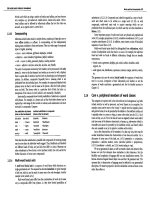
Know how to factor the difference between two squares: x
2
– y
2
= (x + y)(x – y).
■
Use FOIL to help multiply and factor polynomials. For example, (x + y)
2
= (x + y)(x + y) = x
2
+ xy +
xy + y
2
= x
2
+ 2xy + y
2
.
■
When squaring a number, two possible choices result in the same square (i.e., 2
2
= 4 and [–2]
2
= 4).
■
Even though the total interior degree measure increases with the number of sides of a polygon, the sum
of the exterior angles is always 360 degrees.
■
Know the rule for 45
—
45
—
90 right triangles: The length of a leg multiplied by ͙
ෆ
2 is the length of the
hypotenuse.
■
Know the rule for 30
—
60
—
90 right triangles: The shortest side doubled is the hypotenuse and the short-
est side times ͙
ෆ
3 is the side across from the 60-degree angle.
■
The incorrect answer choices for problem solving questions will often be the result of making common
errors. Be aware of these traps.
■
To solve the data-sufficiency questions, try to solve the problem first using only statement (1). If that
works, the correct answer will be either a or d. If statement (1) is not sufficient, the correct answer will
be b, c, or e.
■
To save time on the test, memorize the directions and possible answer choices for the data-sufficiency
questions.
■
With the data-sufficiency questions, stop as soon as you know if you have enough information. You do
not actually have to complete the problem.
■
Although any figures used will be drawn to scale, be wary of any diagrams in data-sufficiency prob-
lems. The diagram may or may not conform with statements (1) and (2).
■
Familiarize yourself with the monitor screen and mouse of your test-taking station before beginning
the actual exam. Practice basic computer skills by taking the tutorial before the actual test begins.
■
Use the available scrap paper to work out problems. You can also use it as a ruler on the computer
screen, if necessary. Remember, no calculators are allowed.
■
The HELP feature will use up time if it is used during the exam.
■
A time icon appears on the screen, so find this before the test starts and use it during the test to help
pace yourself. Remember, you have on average about two minutes per question.
■
Since each question must be answered before you can advance to the next question, on problems you
are unsure about, try to eliminate impossible answer choices before making an educated guess from the
remaining selections.
■
Only confirm an answer selection when you are sure about it
—
you cannot go back to any previous
questions. Reread the question a final time before selecting your answer.
■
Spend a bit more time on the first few questions
—
by getting these questions correct, you will be given
more difficult questions. More difficult questions score more points.
– TIPS AND STRATEGIES FOR THE QUANTITATIVE SECTION–
368
The following Quantitative section practice test contains 80 multiple-choice questions that are similar to the
questions you will encounter on the GMAT
®
exam. These questions are designed to give you a chance to prac-
tice the skills you have learned in a format that simulates the actual exam. Answer these practice questions
carefully. Use the results to assess your strengths and weaknesses and determine which areas, if any, you need
to study further.
With 80 questions, this practice section has more than twice the number of questions you will see on
the actual exam. To practice the timing of the GMAT exam, complete the entire practice section in 162 min-
utes (2 hours and 42 minutes).
Record your answers on the answer sheet provided. Make sure you mark your answer clearly in the cir-
cle that corresponds to the question.
Remember that the GMAT exam is a CAT, and you will not be able to write anywhere on the exam. To
mimic the exam environment, do not write on the test pages. Make any notes or calculations on a separate
sheet of paper.
CHAPTER
Quantitative
Practice Test
24
369
Directions: Solve the problem and choose the letter indicating the best answer choice. The numbers used in
this section are real numbers. The figures used are drawn to scale and lie in a plane unless otherwise noted.
1. If the least common multiple of two prime numbers x and y is 10, where x Ͼ y, then the value of 2x +
y is
a. 7
b. 9
c. 11
d. 12
e. 21
2. What is the product of 6% and 14%?
a. 0.00084
b. 0.0084
c. 0.084
d. 0.84
e. 8.4
– QUANTITATIVE PRACTICE TEST–
370
1.abcde
2.abcde
3.abcde
4.abcde
5.abcde
6.abcde
7.abcde
8.abcde
9.abcde
10. a b c d e
11. a b c d e
12. a b c d e
13. a b c d e
14. a b c d e
15. a b c d e
16. a b c d e
17. a b c d e
18. a b c d e
19. a b c d e
20. a b c d e
21. a b c d e
22. a b c d e
23. a b c d e
24. a b c d e
25. a b c d e
26. a b c d e
27. a b c d e
28. a b c d e
29. a b c d e
30. a b c d e
31. a b c d e
32. a b c d e
33. a b c d e
34. a b c d e
35. a b c d e
36. a b c d e
37. a b c d e
38. a b c d e
39. a b c d e
40. a b c d e
41. a b c d e
42. a b c d e
43. a b c d e
44. a b c d e
45. a b c d e
46. a b c d e
47. a b c d e
48. a b c d e
49. a b c d e
50. a b c d e
51. a b c d e
52. a b c d e
53. a b c d e
54. a b c d e
55. a b c d e
56. a b c d e
57. a b c d e
58abcde
59. a b c d e
60. a b c d e
61. a b c d e
62. a b c d e
63. a b c d e
64abcde
65. a b c d e
66. a b c d e
67. a b c d e
68. a b c d e
69. a b c d e
70. a b c d e
71. a b c d e
72. a b c d e
73. a b c d e
74. a b c d e
75. a b c d e
76. a b c d e
77. a b c d e
78. a b c d e
79. a b c d e
80. a b c d e
ANSWER SHEET
3. A taxicab fare costs x dollars for the first quarter of a mile and
ᎏ
1
4
ᎏ
x dollars for each quarter of a mile
after that. How much will the total cost be for a 2
ᎏ
1
2
ᎏ
mile ride?
a.
b.
c.
d.
e.
4. Which of the following measures could form the sides of a triangle?
I. 3, 3, 5
II. 6, 6, 12
III. 1, 2, 3
a. I only
b. II only
c. III only
d. I and II only
e. II and III only
5. Scott’s average (arithmetic mean) golf score on his first four rounds was 78. What score does he need
on his fifth round to drop his average score by 2 points?
a. 68
b. 72
c. 78
d. 88
e. 312
6. Celeste worked for h hours each day for d consecutive days. If she earns $9.50 per hour, what is the
total amount she earned?
a.
b. 9.50 + d + h
c. 9.50 + dh
d. 9.50h + d
e. 9.50dh
9.50
d
ϩ h
2.5x
5
4
x
10x
13
4
x
3x
– QUANTITATIVE PRACTICE TEST–
371
7. A certain jacket was marked down 20% the first week and another 20% the next week. What percent of
the regular price was the final cost of the jacket after the two markdowns?
a. 30%
b. 36%
c. 40%
d. 60%
e. 64%
8. If 20 typists can type 48 letters in 20 minutes, then how many letters will 30 typists working at the
same rate complete in 1 hour?
a. 63
b. 72
c. 144
d. 216
e. 400
9. What is the final balance of a bank account after two years if the starting balance is $1,000 at an annual
rate of 5%, using simple interest? Assume no other money was withdrawn or deposited.
a. $50
b. $100
c. $1,050
d. $1,100
e. $1,150
10. Which of the following has the smallest numerical value?
a. 2
3
× 2
2
b. 2
6
c. 2
5
× 2
1
d. (2
2
)
3
e. 2
3
× 3
3
11. How many liters of a 40% iodine solution need to be mixed with 35 liters of a 20% iodine solution to
create a 35% iodine solution?
a. 35
b. 49
c. 100
d. 105
e. 140
– QUANTITATIVE PRACTICE TEST–
372
12. If it takes Steve 6 hours to tile a floor and Cheryl 4 hours to tile the same floor, how long would it take
both Steve and Cheryl to tile the floor if they worked together?
a. 2 hours 12 minutes
b. 2 hours 24 minutes
c. 3 hours
d. 3 hours 12 minutes
e. 10 hours
13. Given the area of the three squares, find the perimeter of ᭝ABC.
a. 12
b. 12.5
c. 19.5
d. 20
e. 25
14. During a sale, the price of a pair of shoes is marked down 10% from the regular price. After the sale
ends, the price goes back to the original price. What is the percent of increase to the nearest percent
from the sale price back to the regular price for the shoes?
a. 9%
b. 10%
c. 11%
d. 15%
e. 90%
9
16
25
A
B
C
– QUANTITATIVE PRACTICE TEST–
373