THE SUPERSTOCK INVESTOR PHẦN 8 pot
Bạn đang xem bản rút gọn của tài liệu. Xem và tải ngay bản đầy đủ của tài liệu tại đây (272.95 KB, 30 trang )
International Game Technology. WMS was now on the radar screen
of Wall Street analysts and institutional investors who monitored
their recommendations. The report made it more likely that any bull-
ish development for the VLT market would have a positive impact on
WMS. In August 1991 our recommendation was:
In the final analysis what will drive WMS stock higher will be the
perception that state legislatures which face mounting budget deficits
will see the legalization of VLTs as a politically painless way to gen-
erate desperately needed revenues each time another state decides
to legalize VLTs we think the handful of stocks involved in VLTs will
get a boost.
WMS was unveiling its first video lottery terminal on September
12, 1991. In an interview with a confident WMS president Neil
Nicastro, he said he believed WMS would do very well competing
180 PART THREE Takeover Clues
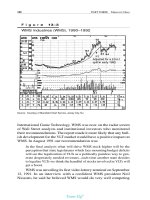
Figure 13–3
WMS Industries (WMS), 1990–1992
Source: Courtesy of Mansfield Chart Service, Jersey City, NJ.
Chap 13 7/9/01 8:58 AM Page 180
TEAMFLY
Team-Fly
®
with International Game Technologies and others in terms of placing
its machines into any state that legalized VLTs. Nicastro confirmed that
WMS had strong distributor relationships in both Louisiana and
Oregon, the two states that had already legalized VLTs, and that the
same people who were placing WMS pinball and video games in
bars and restaurants would also be representing WMS’s new VLT.
He told me that “Williams Electronics is the strongest name in the
coin operated amusement game business, and our distributors know
that we will be able to satisfy demand quickly and with a reliable
product.” Nicastro also confirmed that “if this business develops as
we hope it will, and if we can be an effective competitor, the additional
VLT revenues will mean a dramatic spike in income for WMS.”
Meanwhile, back on the chart, WMS was sketching out that
familiar superstock chart pattern once again. A short-term resistance
area near $15 to $15
1
⁄2
was being attacked over and over again by
buyers, with demand coming in at progressively higher levels—a
strong signal that WMS stock would be moving higher.
By late September 1991, WMS had broken out above its resistance
area at $15 to $15
3
⁄8 to a clear new high in the $18 to $19 area. In the
superstock concept, a stock like WMS Industries should do very well
regardless of what the overall economy and the stock market were
doing. Our recommendation suggested “concentrating on stocks
which will not depend entirely on an economic recovery to do well.
Such stocks would include takeover candidates and companies which
may be involved in an industry which could actually benefit from a
sluggish economy. An example would be WMS Industries, which
reached another new high and which is up an astonishing 85 percent
since late June!”
In October–November 1991 the news started coming fast and
furious. WMS reported that revenues and earnings were rising
sharply; a judge in Oregon threw out a lawsuit designed to block the
introduction of video lottery terminals in that state, which was viewed
as a strong signal that anti-VLT forces in other states would have a dif-
ficult time as well. Other state governments, strapped for cash, were
announcing that they too would consider video lottery terminals as
a new source of badly needed revenues. Landenburg Thalmann, the
only brokerage firm willing to stick out its neck in recommending
WMS, offered the view that a burgeoning market for WMS’s pinball
games could be developing in Eastern Europe, where communism
CHAPTER THIRTEEN “Beneficial Owner” Buying 181
Chap 13 7/9/01 8:58 AM Page 181
was giving way to democracy, and also in South America, where pin-
ball games were catching on with young people.
Only on Wall Street does the demand for an item increase as
the price rises. As WMS stock price moved higher, analytical cover-
age increased and the WMS story suddenly became interesting to
institutional investors and the analysts who provide the research
that influences their investment decisions. Proving that to some peo-
ple there is nothing that makes as much investment sense as a rising
stock, suddenly there were lots of reasons to love WMS Industries.
All of the Telltale Signs that had suddenly turned WMS into a Wall
Street darling had been in plain sight for months. But now WMS
was moving in a more “respectable” price range and the stock had
morphed into a “momentum” stock.
Wall Street research departments jumped onboard, mainly
because WMS had moved into the price range that would interest
their institutional clients.
I had been speaking on a regular basis to one analyst who cov-
ered the “leisure” industry, which included gaming stocks. He had
loved WMS all along and had actually provided some guidance to me
along the way based on his view that video lottery terminals would
soon be proliferating. But when I asked him why he wouldn’t officially
recommend WMS, he told me it was “not an institutional sort of
stock,” whatever that meant.
Finally, one day I heard that my friend had officially recom-
mended WMS. I called him to find out what thrilling new piece of
information he had uncovered that had finally tipped the scales.
“Now that it’s a $20 stock, I can get our institutional clients inter-
ested,” the analyst said.
“Excuse me?”
“Look,” he said, “these guys aren’t going to buy a $7 stock with
no research coverage that nobody’s ever heard of. It’s too risky. If it
goes down you’ll get all sorts of heat, and who needs that? Now that
WMS is a $20 stock and it’s moving, and it’s a relative strength
leader—see, I can sell that story. They’ll listen to me at this price level.
The stock is more recommendable at these levels.”
“Are you telling me,” I said, “that even though you knew the
same things about WMS at $7 or $10 that you know now that you
didn’t recommend the stock simply because it was too cheap?”
“Yes.”
182 PART THREE Takeover Clues
Chap 13 7/9/01 8:58 AM Page 182
“And now that WMS is more expensive you are willing to stick
your neck out because you won’t get criticized as much as if it doesn’t
work out?”
The analyst sighed. “I know it sounds ridiculous,” he said. “But
yes, that is what I’m telling you.”
Do you think things have changed since then?
On November 19, 1998, a mutual fund portfolio manager
appeared on CNBC. In response to a viewer question, the fund man-
ager launched into an informed and enthusiastic analysis of what you
would call a “value stock,” which carried a rich dividend yield, sold
at a low price/earnings ratio, and seemed like an undiscovered gem.
“Would you buy the stock here?” the host asked.
“Well,” the portfolio manager said, “I would if I didn’t have so
much short-term performance pressure on me. It would be a great
stock to buy and tuck away. But, you know, I can’t do that . . . it’s
tough.”
The portfolio manager’s voice trailed away and the host went on
to the next question. But his comments spoke volumes about the “lem-
ming” instinct of mainstream portfolio management and the analysts
who provide their research. More often than not there is safety in num-
bers. It is better to be wrong betting on a stock that everybody else
owns than to go off the beaten path and take a chance on losing money
on something that nobody has ever heard of. Thus, the trendy momen-
tum stocks are overbought and overpriced, and the neglected gems
are unloved and underpriced—until something happens to pluck them
out of obscurity and thrust them into the limelight. This portfolio man-
ager had made a sound and bullish case for an undervalued stock that
he would have loved to buy and “tuck away” in his fund’s portfolio, but
he didn’t have the nerve to do it because short-term performance pres-
sure made it necessary for him to stick with the stocks his peers were
buying, just so he could keep up with the lemmings.
On December 31, 1991, WMS Industries closed at $27
7
⁄8, up 669 per-
cent from its 1990 closing price of $3
1
⁄4. That performance made WMS the
best-performing stock on the New York Stock Exchange for 1991.
By the time WMS received its first order for video lottery ter-
minals from the Oregon Lottery Commission in January 1992, WMS
had soared to $41 a share—an incredible gain of 1161 percent from
its closing level at year-end 1990!
What is the lesson to be learned from the WMS story?
CHAPTER THIRTEEN “Beneficial Owner” Buying 183
Chap 13 7/9/01 8:58 AM Page 183
Actually, there are several.
WMS Industries had three of the Telltale Signs for identifying
future superstocks: (1) a potential superstock chart pattern, with a
well-defined long-term resistance level being penetrated; (2) an out-
side beneficial owner (Sumner Redstone) who was buying stock on
the open market and who had demonstrated the ability in the past
to identify winning investments ahead of the crowd; and (3) man-
agement that seemed convinced there was an unrecognized under-
lying value within the company and appeared determined to take
steps to “unlock” that value.
These were the three elements that made WMS attractive and
provided the willpower to hang on even though WMS performed
poorly at first. Before the evidence emerged and it became apparent
what all the excitement was about, the Telltale Signs of a potential
superstock were apparent. In retrospect, it seems WMS’s bullish
chart pattern was created by persistent buying among those who
were becoming aware of the company’s impending entry into the
video lottery terminal industry. It’s possible that Sumner Redstone’s
buying was related to this insight as well—or perhaps Sumner
Redstone was buying because he knew that the WMS hotel/casinos
were worth far more than WMS’s stock price was reflecting.
Who knows?
The point is this: The signs were there, even if the information
that created those Telltale Signs did not emerge until later.
WMS Industries is a textbook example of how a superstock
chart pattern, together with outside beneficial owner buying, can
lead you to a huge winner—even if you don’t know why that stock
is going to be a winner!
Postscript to the WMS Story:
Eventually, WMS Industries got around to spinning off its
hotel/casino properties. In early 1997, WMS created a new compa-
ny, WHG Resorts, which was spun off from WMS and began trad-
ing on the NYSE in the $5 to $6 range (adjusted for a 2-for-1 split in
WMS stock). Within 6 months WHG Resorts received a takeover bid
that valued WHG at more than $20 per share.
The takeover bid for WHG Resorts valued the company at
around $130 million. Based on the fact that WMS Industries had
around 10.4 million shares outstanding when the company first
184 PART THREE Takeover Clues
Chap 13 7/9/01 8:58 AM Page 184
announced that it was seeking to “unlock the value” of its hotel/casi-
nos, WMS’s hotels/casino properties turned out to be worth nearly
$13 per share on the presplit WMS share.
No wonder WMS management was looking for ways to unlock
the value of these properties.
Which is why you should always take a close look at “spinoffs”
as potential superstock candidates.
CHAPTER THIRTEEN “Beneficial Owner” Buying 185
Chap 13 7/9/01 8:58 AM Page 185
This page intentionally left blank.
CHAPTER FOURTEEN
The “Pure Play” and the
Drugstore Industry
There is always a disposition in people’s minds to think that existing
conditions will be permanent. While the market is down and dull, it is
hard to make people believe that this is the prelude to a period of activity and
advance. When prices are up and the country is prosperous, it is always said that
while preceding booms have not lasted, there are circumstances connected with
this which make it unlike its predecessors and
give assurance of permanency.
Charles H. Dow, Journalist
June 8, 1901, The Wall Street Journal
Things change.
Don Ameche, Actor
Things Change
Charles Dow, founder of Dow Jones & Company, and Don Ameche,
a great actor, were both saying pretty much the same thing when they
uttered these words, only Don Ameche put it more succinctly. In the
stock market, as in life, you should never extrapolate current circum-
stances too far into the future because—well, because things change.
On Wall Street the tendency to assume that current conditions
will remain in force indefinitely, if not forever, is a common form of
mass delusion that must be experienced the hard way by every gen-
eration of investors that comes down the pike. What these investors
do not understand about Wall Street is that trends come and go, fads
187
Chap 14 7/9/01 8:58 AM Page 187
Copyright 2001 The McGraw-Hill Companies, Inc. Click Here for Terms of Use.
appear and disappear, and the pendulum swings from one extreme
to the other, over and over and again, inevitably and without fail. And
as difficult as it is to believe that the pendulum can ever swing the
other way when you’re riding the final, glorious upward arc—it
always reverses course, and you had better learn to either get off or
turn around and prepare yourself for the return trip because riding
a pendulum backwards is no fun, financially or otherwise.
In this chapter you will learn about “pure plays” and spinoffs
and how they can lead you to superstocks and superstock takeovers.
But first let’s go back to the 1960s, when “conglomerates” were all
the rage and Wall Street was discovering the meaning of the latest
buzzword—a fad called “synergy.”
The technical definition of synergy is “the joint action of agents,
such as drugs, that when taken together increase each other’s effec-
tiveness.” Two people, for example, can create synergy. Or two mus-
cles. Or, in the case of Wall Street, two businesses. Or three, or maybe
five, or ten.
In the 1960s, the concept of “synergy” took hold as the key of
conquering business cycles and creating stocks that could continue
to go up, in good markets and bad, in recessions and in boom times.
The idea was to create multi-industry companies through acquisitions
so that when one industry was in the doldrums, the slack would be
taken up by another. If the synergist were clever and calculating
enough, the resulting company—called a “conglomerate”—would
report ever-rising earnings through any and all economic cycles. If
the homebuilding division was going bad, for example, this would
be offset by a very good year in the rocket fuel business, the bowl-
ing alleys, the funeral homes—or whatever else you owned that
might be doing well while something else was performing poorly.
That was the theory, at least, and for a while conglomerates were
all the rage, until the inflationary recession spirals of the 1970s hit
and all of the businesses went bad at the same time. To make matters
worse, it became apparent that it was a lot harder than it looked to
oversee a company with 27 different divisions, all operating in total-
ly unrelated industries, not to mention how difficult it was for Wall
Street analysts to cover these companies in any coherent manner.
So synergy and the conglomerate craze slowly petered out—
proving once again that Charles Dow and Don Ameche knew what
they were talking about. (Of course, some “synergies” are too powerful
188 PART THREE Takeover Clues
Chap 14 7/9/01 8:58 AM Page 188
and obvious to be denied. In an obviously well-thought-out strategy,
Netherlands-based Unilever PLC announced two takeovers on the
same day in April 2000. First, Unilever said it would buy ice cream
maker Ben & Jerry’s Homemade, whose products include the notori-
ously calorie-laden “Chubby Hubby” brand for $326 million. Also on
that day, Unilever announced the $2.3 billion acquisition of diet prod-
ucts company Slim Fast Foods, thus putting Unilever in the business
of both causing and curing obesity—a synergistic win-win situation
if ever there was one.)
Interestingly, however, there are some vestiges around of the
trend toward synergy even today—and when these vestiges begin
to jettison operations that do not fit their core businesses—in other
words, when a company decides it wants to be more of a “pure play”
in a well-defined industry—it can lead you to potential superstocks.
In recent years a growing number of companies have decided
that they—and their stockholders—would be better off as “pure
plays”—i.e., companies that operate in a single, well-defined indus-
try. The major reason is because Wall Street analysts are industry
specialists, and since analytical coverage is the key to a widely held
and fairly priced stock, many companies have come to the conclu-
sion that an easily understood corporate identity is crucial for a
strong stock price. For example, a mutual fund looking for exposure
in the auto parts industry would be more likely to buy shares in a
company with 100 percent of its revenues coming from auto parts
than it would a company with, say, 60 percent of its revenues com-
ing from auto parts and the other 40 percent from radio stations.
In order to become a pure play, a company needs to remove
noncore businesses from the mix. There are two ways to do this: sell
the businesses outright, or spin them off to shareholders as a sepa-
rate company.
In a pure spinoff, 100 percent of the stock of the noncore business
is distributed to shareholders of the parent company, and the spinoff
starts a new life as an independent, publicly traded company. There
are a number of theoretical benefits to spinoffs, including the proba-
bility that the management of the new company will be better able to
manage the spinoff’s business once it is separated from the parent.
Another theoretical advantage to owning shares in a spinoff is
that the value of a fast-growing subsidiary hidden within a larger cor-
porate structure may have been overlooked by Wall Street. By sep-
CHAPTER FOURTEEN The “Pure Play” and the Drugstore Industry 189
Chap 14 7/9/01 8:58 AM Page 189
arating the fast-growing subsidiary and turning it into a separately
trading company, the growth rate that had been previously obscured
will become more apparent, which could lead to a higher price/earn-
ings multiple for the spinoff’s stock.
A third possibility is that by spinning off a company in an indus-
try where there is a lot of takeover activity, the spinoff could become
a takeover target. This is what happened to WHG Resorts, the
hotel/casino spinoff of WMS Industries which, following its sepa-
ration from the parent company in 1997, more than doubled in price
within 6 months.
Most Wall Street analysts recommend investing in spinoffs for
all of these reasons, but there is a different way to look at spinoffs.
As a superstock investor, you should look at every announced spin-
off and ask yourself : Which company operates in an industry where
there is a great deal of takeover activity, the parent company or the
company being spun off?
The answer to that question may surprise you. In fact, in many
cases you would be better off buying the parent company—espe-
cially if that company operates in a takeover-lively industry. The
reason is because a number of instances have occurred over the years
where a company in a takeover-lively industry decides to sell or spin
off noncore businesses as the initial step in ultimately putting itself
up for sale.
A rule of thumb, therefore: Whenever you see an announcement
involving a spinoff, analyze the parent company. Check to see if there has
been any recent takeover activity in the parent company’s industry.
If the answer is yes, and if the parent company is a mid-size or
smaller company within that consolidating industry, you should seri-
ously consider the possibility that the parent company is turning itself
into a pure play as a prelude to selling itself to the highest bidder.
CASE STUDY: FAY’S AND GENOVESE
In fall 1995, I noticed an interview with the chairman of Rite Aid, a
drugstore company that had just made a takeover bid for Revco, one
of its largest competitors. That merger, which would have created the
nation’s largest drugstore company, was never consummated because
of regulatory opposition. But in commenting on the reasoning for
190 PART THREE Takeover Clues
Chap 14 7/9/01 8:58 AM Page 190
TEAMFLY
Team-Fly
®
Rite Aid’s bid for Revco, Rite Aid’s chairman, Martin Grass, com-
pared the fragmented drugstore industry to the banking industry,
which was then undergoing a frantic wave of consolidation. The
drugstore industry, said the Rite Aid executive, was very similar to
the banking industry in that significant cost savings through econ-
omies of scale were possible by combining companies. He went on
to predict that the same reasoning being applied to the wave of bank
mergers could be applied to the drugstore industry, and that this
was the driving rationale behind his company’s bid for Revco.
Although the Rite Aid–Revco merger never took place, this inter-
view was the “road map” for finding superstock takeover candidates.
As a starting point, I compiled a list of the 15 publicly traded
drugstore companies and ranked them from top to bottom, based
on the value of their outstanding stock, or market capitalization:
1. Rite Aid (see Chapter 17)
2. Revco
3. Walgreens
4. Eckerd
5. Melville Corp. (which owned CVS Drugs, which was
eventually spun off and acquired)
6. Cardinal Health (which owned Medicine Shoppes)
7. Thrifty-Payless
8. American Stores (which owned Osco and Sav-On Drugs)
9. JCPenney (which owned Thrift Drugs) (see Chapter 17)
10. Longs Drug Stores
11. Big B
12. Fay’s
13. Drug Emporium
14. Arbor Drugs
15. Genovese Drug Stores
If you eliminated JCPenney, which was far too large to be
acquired and was more likely to be an acquirer itself, 14 drugstore
companies were on this list. Amazingly, in less than 2 years, 9 of these
14 companies were taken over! And it all started because of an inter-
view with the chairman of Rite Aid, who described the reasoning
CHAPTER FOURTEEN The “Pure Play” and the Drugstore Industry 191
Chap 14 7/9/01 8:58 AM Page 191
behind his bid for Revco—which only goes to prove that Yogi Berra
knew what he was talking about when he said: “You can observe a
lot just by watching.” Or, in this case, browsing.
The takeover wave in the drugstore industry ran its course
breathtakingly quickly. One by one the mid-size and smaller drug-
store chains were acquired by their larger competitors. Along the
way, this takeover wave served as a case study on how to spot var-
ious telltale signs of impending superstock takeovers.
My first successful drugstore takeover candidate recommen-
dation was Fay’s Inc., and it was recommended for one reason—this
small drugstore company was selling off noncore assets, making
itself a “pure play” drugstore company. By December 1995, Fay’s
had just sold its Wheel’s Discount Auto Supply stores for $37 million
in cash and announced that its Paper Cutter retail stores would also
be put up for sale. These announcements, combined with the view
that a takeover trend was about to engulf the drugstore industry,
made Fay’s an obvious takeover candidate. Fay’s was readying itself
for sale by getting rid of “noncore” operations, a move that would
make it more attractive to a larger drugstore company seeking acqui-
sitions. At the time, Fay’s was trading at $6
3
⁄4.
In January 1996 another small drugstore company was added
to my list of takeover recommendations. Genovese, the nineteenth
largest drugstore company—with 113 stores in the New York City/
Long Island area—had also recently become a pure play by selling
off its nondrugstore operations.
I quoted Rite Aid chairman Martin Grass on the rationale of
potential drugstore industry mergers being “very analogous to
what’s going on in the banking industry. We’re able to absorb stores,
eliminate tremendous overhead, and take costs off the system.”
Our view was that the managements of Fay’s and Genovese, by
deciding to become pure drugstore companies through the sale of
noncore businesses, already saw the handwriting on the wall and
were preparing themselves to be acquired.
In March 1996, I reported another Telltale Sign appeared, indi-
cating that Fay’s management might be preparing to sell the com-
pany:
“As I previously reported, Fay’s has been selling off its nondrugstore
retail operations. Now, Fay’s has announced the elimination of 90
administrative jobs, which would save $3 million per year, or about
192 PART THREE Takeover Clues
Chap 14 7/9/01 8:58 AM Page 192
$0.14 per share. These are the moves you should expect to see from a compa-
ny that might be readying itself for sale in a rapidly consolidating industry.
Fay’s stock continued to languish at $7
3
⁄4. As part of its cost-cut-
ting move, Fay’s had taken a “restructuring” charge, and the stock
market reacted by pushing Fay’s shares briefly down to the $6
1
⁄2 area.
Here was another situation where a complete lack of analytical coverage
resulted in the stock market putting the wrong interpretation on this news.
Experience in noticing the Telltale Signs of an impending superstock
takeover target—i.e., any company selling off noncore assets and
cutting costs in an industry where a takeover trend was in force—
was practically hanging a “For Sale” sign on the front door. But when
Fay’s took its restructuring charge—which would yield future ben-
efits to cash flow and earnings—all the stock market saw was a loss
for the quarter. There was no room for nuance: A low-priced stock
with no analytical following had reported a loss, and down went
the stock. But to the trained eye of a superstock analyst, the very
news that was sending Fay’s shares lower was another clue that
Fay’s would soon become a takeover target.
In April 1996 the Rite Aid–Revco merger agreement fell apart
when the Federal Trade Commission decided that the resulting com-
bination would be anticompetitive and would dominate the drug-
store industry in a way that would be detrimental to consumers.
However, the FTC left the door open for other drugstore industry
mergers, which would be smaller in scale. By May 1996, Fay’s stock
was moving higher—ever since the Rite Aid–Revco deal was ter-
minated.
By July 1996, Fay’s had finally sold its Paper Cutter office sup-
ply stores for $14 million, which meant it was now a pure drugstore
company.
Anyone concentrating on the “pure play” concept and the fact
that Fay’s was operating in an industry which was about to experi-
ence a takeover wave would by this time have seen crystal-clear sig-
nals that Fay’s was a genuine takeover candidate. And yet, despite
the fact that Fay’s had finally sold off its last nondrugstore operation
and taken a “clear the decks” restructuring charge—and despite the
fact that the Federal Trade Commission had pretty much publicly
stated that it would encourage smaller drugstore mergers—despite
all of this, Fay’s shares were trading at $7
5
⁄8, only slightly higher than
the original recommended price of $6
3
⁄4 six months earlier.
CHAPTER FOURTEEN The “Pure Play” and the Drugstore Industry 193
Chap 14 7/9/01 8:58 AM Page 193
Suddenly, just 8 days later, on July 11, 1996, Fay’s announced
that it had received a takeover bid from JCPenney, which owned the
Thrift Drug Store chain. The stock market reacted as though it was
shocked—shocked—at the news. Fay’s shares jumped to $10
7
⁄8 on
this news. Fay’s did not specify a takeover price, saying only that it
had received a proposal from JCPenney and that it would have no
further comment until a deal was consummated or the talks ended.
In July 1996, discussing the Fay’s takeover proposal, I again
raised the possibility that Genovese Drug Stores could become a
takeover target for precisely the same reason that Fay’s had. Genovese
had sold off its nursing home division in the previous year, a move
similar to Fay’s selling off its nondrugstore operations in 1995–1996
prior to selling itself to JCPenney.
Also, the Genovese chain of drugstores was located almost pre-
cisely in the middle of the geographic areas that would be served
by Penney’s Thrift Drugs chain and a newly acquired Fay’s chain. At
that time, Genovese Drug Stores was trading near $8, adjusted for
two subsequent 10 percent stock dividends.
Within two weeks Fay’s announced that it had agreed to be
acquired by JCPenney for $12.75 per share—an 85 percent gain from
the recommended price of $6
3
⁄4 in just 7 months, and all because Fay’s
had tipped its hand by selling off its noncore operations and becoming a
pure play in an industry where a takeover wave was under way.
The Fay’s recommendation had turned out to be on target, so
we next turned our attention to Genovese, a very similar company.
In addition to operating in the same general area of the country as
Fay’s and, like Fay’s, recently becoming a pure play by selling off
noncore assets—in its case, a nursing home division—Genovese had
something else going for it: a potential superstock chart pattern. The
chart showed a well-defined, multiyear resistance area at $11 to $12—
precisely the sort of major, long-term resistance level that if broken
to the upside, can create a superstock. This chart pattern, together
with the fact that Genovese was becoming a pure play in a consoli-
dating industry, were strong clues that Genovese Drug Stores was
probably on its way to superstock status.
Research showed that 43 percent of Genovese’s stock was
owned by the family who founded the company. Now, you might
logically think that would be a roadblock to a takeover. But in fact,
194 PART THREE Takeover Clues
Chap 14 7/9/01 8:59 AM Page 194
the opposite is true. Around a third of Fay’s outstanding stock was
owned by the founding family, yet Fay’s decided to sell itself to
JCPenney. Why? Because when you have a large block of stock in a small
company in a consolidating industry controlled by the founders of the com-
pany, you will very often find that these stockholders recognize the proper
moment to “cash out” and become part of a larger company.
Look at it from this point of view: You start a small company,
build it up over the years, compete and prosper, and wind up with
a large chunk of a small, profitable company. Suddenly, you find
that the industry you operate in is consolidating rapidly, and you
begin to realize that it will soon be dominated by a handful of giant
companies that will be consolidating operations, cutting costs, and
squeezing the profit margins of its smaller competitors.
What do you do? Do you stubbornly hold on to your indepen-
dence and take the risk that your company’s profits will be squeezed
by increasingly large competitors, leaving you on the outside look-
ing in when the takeover wave finally runs its course? Or do you
recognize the handwriting on the wall and take this opportunity to
cash out at a huge premium to your stock’s recent market price?
In such situations, there are tax ramifications to consider and we
reported in Superstock Investor:
When a public company is so heavily owned by a founding family,
tax considerations come into play. Take a look at the JCPenney–Fay’s
deal: this buyout was structured as a tax-free transaction under which
Fay’s shareholders receive $12.75 worth of JCPenney stock. For the
Panasci family, which founded Fay’s, they were sitting with a $7 stock
with the realization that the company they founded was worth almost
twice that amount. A cash buyout would result in a huge tax liability;
but in this tax-free swap with JCPenney, they receive a huge premium
for their shares, they have no tax liability unless and until they sell
their JCPenney shares, and they have received a far more liquid secu-
rity to boot. The Genovese family is in virtually the same position.
So, here is another superstock clue to keep in mind: When a
takeover trend engulfs a certain industry, take a close look at small-
er companies in that industry in which the founding family still
owns a large stake. More often than you might think, these major
stockholders recognize the optimal moment to cash out—and you
will find that many of these family-controlled companies will become
CHAPTER FOURTEEN The “Pure Play” and the Drugstore Industry 195
Chap 14 7/9/01 8:59 AM Page 195
willing takeover targets rather than run the risk of being left by the
wayside as minor players in an industry dominated by a handful of
giant competitors.
On July 2, 1997, a news item appeared on the Dow Jones
Newswire that reported that two Genovese family members had
agreed to act in concert in terms of their stock holdings.
According to SEC regulations, when two or more stockholders
who own 5 percent or more of a public company agree to act in con-
cert, they must notify the SEC that they are acting together. This
agreement by Leonard Genovese, chairman and CEO of Genovese
Drug Stores, and his sister Frances Genovese Wangberg, a director
of Genovese, was characterized in the press as an “anti-takeover”
agreement.
But our view was that the press had it all wrong, and it was
misleading to characterize this as an “anti-takeover pact.” The
Genovese family members had made an agreement that required
mutual consent before either of these two Genovese stockholders
could sell. You could look at this agreement this way: these two
majority Genovese shareholders—who control 57.4 percent of
Genovese stock—recognized that they owned a very attractive prop-
erty in an environment of rapid consolidation in the drugstore indus-
try and had discussed how they would deal with any potential
takeover bid that might take place in the future.
As a rule of thumb: Whenever you see any indication that two
or more large stockholders of a company have made any sort of pact
to act in concert, to require mutual approval, or in any way have
indicated that they have discussed how they will sell their shares, you
should take this as an indication that these stockholders are at least
considering the possibility that the company will be sold at some
point in the future.
In the case of Genovese Drug Stores, this pact between the two
largest shareholders of the company indicated—in no uncertain
terms—that they were discussing what they would do in the event
of a takeover bid.
In November 1998, Genovese agreed to be acquired for $30 per
share by none other than JCPenney—precisely the company target-
ed as the logical buyer. That $30 takeover price represented a 229
percent gain from my original recommended price, adjusted for stock
dividends, of $9.11/share.
196 PART THREE Takeover Clues
Chap 14 7/9/01 8:59 AM Page 196
So, Genovese Drug Stores went from $9 to $30 in just over 2
years and the company received a takeover bid from JCPenney, just
as predicted. Except that it wasn’t quite that easy to hang in there with
Genovese over that 2-year period, and therein lies another lesson in
terms of what it takes to stick to your guns during periods in which
the stock market completely ignores what might be blindingly obvi-
ous to a superstock investor.
When it comes to stocks that are not widely followed by ana-
lysts, or sometimes not followed by any analyst, news items and
industry trends that seem to have clearly bullish implications for a
smaller, off-the-beaten-path company have no effect on the stock.
You see news, you make the connection, you buy the stock, and—
nothing happens. The stock just sits there, or even moves lower, as
if nothing significant has occurred. During periods like this (as with
the WMS situation discussed in the previous chapter) there is no
alternative to keeping your eye on the “road map”—i.e., remem-
bering why you bought the stock, making certain that the initial rea-
soning remains in force, and, if you have the means, buying more at
a lower price so that your ultimate profit will be greater once Wall
Street catches on to what you have already deduced.
Take a look at the chart of Genovese Drug Stores (Figure 14–1).
Within seven weeks of this chart being published, Genovese soared
to $30 a share on the JCPenney takeover bid yet, between April and
August 1998, as the ultimate takeover bid was fast approaching,
Genovese stock plunged from $25
1
⁄2 to $15!
Genovese had also had a sinking spell a year earlier, after the
company announced a “strategic restructuring” in which it cut costs
and closed underperforming stores—precisely the sort of moves
Fay’s implemented prior to its takeover, and exactly what you would
expect from a company preparing to sell itself. It was a classic Telltale
Sign. And yet, the stock market did not react to this restructuring
announcement positively and as a harbinger of a potential takeover.
Instead, Genovese was punished.
In September 1996 a subscriber informed me that while my
Genovese takeover recommendation obviously made sense, I was
obviously wrong. Why? Because if Genovese were truly a takeover
candidate in light of the Fay’s acquisition the stock should be doing
better—and it wasn’t.
Here was my response:
CHAPTER FOURTEEN The “Pure Play” and the Drugstore Industry 197
Chap 14 7/9/01 8:59 AM Page 197
This is a fact of life on Wall Street: Unless a widely followed estab-
lishment analyst with a connection to a strong retail sales force (i.e.,
lots of stockbrokers) is delivering a certain story, that story—no mat-
ter how logical—will not be fully reflected in the stock price. This is
a major problem with small-cap and microcap stocks, and I can’t tell
you how many times I have heard this refrain from a frustrated CEO
of a small company who cannot understand why Wall Street does not
properly value his or her company.
When I first recommended Rehabcare Group, I asked an officer
of the company why his stock was trading at a measily 11 times earn-
ings while most specialty health care stocks were trading at 25 times
earnings or more. The answer, of course, was that other than a cou-
ple of regional brokerage firms, no major analyst was following the
company. Rehabcare was politely informed that research coverage
might be forthcoming if Rehabcare were to do a stock or bond offer-
ing; i.e., generate fees as an investment banking client.
198 PART THREE Takeover Clues
Figure 14–1
Genovese Drug Stores (GDXA), 1996–1998
Source: Courtesy of Mansfield Chart Service, Jersey City, NJ.
Chap 14 7/9/01 8:59 AM Page 198
It used to bother me when I saw something that seemed obvi-
ously bullish to me which was not reflected in the stock price, because
I felt I must be missing something. But not anymore. Today, with giant
mutual funds and other institutional investors calling the shots on
Wall Street, most research is directed toward servicing these mam-
moth clients. Since most of these large funds cannot traffic in small and
microcap stocks, there is no mileage for most research departments in
following the smaller companies—therefore, some terrific stories go
unreported.
When Fay’s was selling off its nondrugstore operations, closing
unprofitable stores, taking write-offs, and reducing expenses, these
were the classic moves of a company that might be preparing itself for
sale—especially in view of the fact that the drugstore industry was
rapidly consolidating. But Fay’s stock did nothing for a long time,
despite the fact that it was trading far below its takeover value, until
the company finally announced that it was talking to JCPenney about
a possible buyout.
Getting back to Genovese Drug Stores, after a smattering of
drugstore takeovers over the past year and a half, the drugstore
takeover bell was rung earlier this year when Rite Aid announced
that it would acquire Revco, a merger that would create the largest
drugstore company in the United States. In an interview shortly after
announcing the agreement, Rite Aid’s chairman carefully spelled out
the reasoning behind the agreement, noting that competition and
economies of scale would create a powerful incentive for drugstore
companies to merge. He compared the coming drugstore merger wave
to what was already happening in the banking industry, and said that
costs and overhead could be dramatically reduced through mergers.
Although the Rite Aid–Revco merger was not consummated
because the Federal Trade Commission believed it was too big a merg-
er, the handwriting was on the wall. Even the FTC said it would look
favorably on smaller drugstore mergers because they would theoret-
ically reduce health care costs by reducing overall costs. Therefore, it
seemed reasonable to assume that some of the smaller drugstore com-
panies could become buyout targets, and Fay’s turned out to be a
major winner for us.
In my last letter, I noted that there were a number of drugstore
companies who are believed to be shopping for acquisitions. Rite Aid has
to be on the list, since they tried to acquire Revco. JCPenney is probably
also on the list, since the takeover of Fay’s indicates that JCPenney is
looking to build its Thrift Drug unit into a major player. Arecent Tucker
Anthony research report on Arbor Drugs suggests that Arbor has the cash
CHAPTER FOURTEEN The “Pure Play” and the Drugstore Industry 199
Chap 14 7/9/01 8:59 AM Page 199
and the infrastructure to handle an acquisition. Melville Corp. will soon
be spinning off its CVS Drug Store chain as a separate company, and analysts
believe CVS will attempt to get bigger through acquisitions. Other potential
buyers include Walgreens, Eckerd, and Longs.
Also, in another interesting development, the chairman of Revco
recently told Dow Jones that he expects drugstore industry consoli-
dation to continue. Now that the Rite Aid–Revco merger is off, Revco’s
chairman told Dow Jones that Revco now plans to be an aggressive buyer itself
of smaller drugstore chains.
So, we have a very large list of potential buyers out there, and
it seems obvious that some of the smaller drugstore companies will
be receiving takeover bids. Other than Genovese Drug Stores, who
are some of the other candidates?
If you want to look further afield, consider Big B, a 383-store
chain. After the Fay’s takeover, Big B’s executive vice president said
that Big B has “no interest in entertaining acquisition offers” and that
the company is trying to expand on its own. That could mean that
Big B is also on the list of possible buyers of smaller chains, but ana-
lysts still consider Big B to be a potential target itself.
This lengthy quote illustrates what is meant by the term “road
map.” Here was the analysis, from beginning to end. Any investor
who read this analysis had two choices: It either made sense or it
didn’t. If it made sense, the logical move was to buy Genovese and
some of the smaller drugstore chains. If it did not make sense, the log-
ical move was to take a pass on the whole idea.
Genovese stock languished for 2 years after this report before
tripling on the JCPenney takeover bid. And it is not as though the
Genovese story did not receive any public attention. During 1996,
BusinessWeek’s “Inside Wall Street” column had two articles on the
prospects of a buyout of Genovese Drug Stores by JCPenney and
the takeover of Fay’s. Here was the complete story on Genovese
Drug Stores—the road map, if you will—in an international maga-
zine read by millions of people, brought to you by an analyst who
had just predicted the takeover of Fay’s in the very same publica-
tion—and yet, Genovese stock continued to languish for 2 years,
right up until the takeover bid forced the stock to triple.
It once again proves that you can be 100 percent correct and the
stock market can be 100 percent wrong when it comes to analyzing
the prospects of small-cap and microcap stock with no analytical
200 PART THREE Takeover Clues
Chap 14 7/9/01 8:59 AM Page 200
TEAMFLY
Team-Fly
®
coverage. If you are going to operate in this sector of the stock mar-
ket, you will have to learn to trust your instincts, learn to maintain the
courage of your convictions, and believe that in this sector of the mar-
ket there is no such thing as an “efficient stock market,” which means
you’ll be able to see things that the Wall Street pros are completely
overlooking.
As I’ve noted more than once, though it is worth repeating: It’s
difficult to sit with a stock doing nothing or drifting lower—especially
when you see evidence that this stock should be selling at a sub-
stantially higher price. But when this happens, you have to stick to
your guns—as long as the original “road map” is intact.
There is no other way to do it.
A few weeks later Big B—the drugstore company that had publicly
stated that it would remain independent—accepted a takeover bid from
none other than Revco, the company that had publicly stated that it would
start shopping for smaller drugstore companies.
Big B was still controlled by the founding Bruno family, a sign to
look around for another small drugstore company with a large block
of stock owned by the founding family. If the founders of Fay’s and Big
B were willing to sell the companies they had built, the same reason-
ing should apply to other small drugstore companies with large blocks
of stock still owned by their founders. Genovese was definitely in this
category, which only served to flesh out the Genovese road map. A
brokerage firm report had mentioned Arbor Drugs, a Michigan-based
drugstore chain, as a potential buyer of other companies. But based on
Arbor’s small size and on the fact that the founding family controlled a large
stake in this company, Arbor Drugs was likely to be acquired itself.
In September 1996, following the Big B takeover, Arbor Drugs
was added to my recommended list at $8
3
⁄4. And in February 1998,
Arbor Drugs accepted a $23 per share takeover bid from CVS.
CASE STUDY: SMITH FOOD & DRUG CENTERS
In November 1996, browsing through a list of 13-D “beneficial
owner” filings in Barron’s revealed that Transamerica Corp., the giant
insurance company, was accumulating shares of Smith Food & Drug
Centers (SFD) on the open market. Research indicated that SFD was
a potential superstock takeover candidate.
CHAPTER FOURTEEN The “Pure Play” and the Drugstore Industry 201
Chap 14 7/9/01 8:59 AM Page 201
SFD operated in two industries where takeover activity was
rampant: supermarkets and drugstores. The company operated 147
food and drug centers mostly in the southwestern United States.
Interestingly, SFD had just closed down its 34-store California oper-
ations, which resulted in a large restructuring charge. Does that
sound familiar? Here was a company that looked like it might be
getting its house in order in preparation for selling itself. At the same
time, SFD was buying back large chunks of its own stock on the open
market—another Telltale Sign, and a strong signal that a company
believes its stock is undervalued.
What initially drew my attention to SFD was the open market
buying by Transamerica, which had recently raised its stake to 16.42
percent of the company, paying as high as $28.25 for SFD shares. But
further research revealed something far more interesting. About 14
percent of SFD was owned by the investment/buyout firm of Yucaipa
Cos., which had already been involved in several supermarket deals.
Yucaipa owned a controlling interest in supermarket giant Fred
Meyer Inc. and also owned stakes in publicly traded Dominick’s
Foods, a Chicago-based supermarket chain, and Ralph’s, a private
supermarket company. Clearly, Yucaipa was the sort of sophisticat-
ed outside investor who would have the ability to “cash out” of its
stake in SFD at the right time and the right price if it chose to do so.
Since SFD was operating in two takeover-lively industries, Yucaipa
Cos. would certainly be aware of the fact that SFD might be sold at
a very rich price should the company be put up for sale.
A look at SFD’s long-term chart was also encouraging: SFD had
been locked in a fairly well-defined price range with an upper resis-
tance level of $30 for nearly 2 years. Now, with takeover activity
picking up in both the supermarket and drugstore industries, SFD
looked like it was about to finally break out above that $30 resis-
tance area. In other words, SFD’s chart had the look of a pending
superstock breakout. This fact, combined with the open market buy-
ing by Transamerica, the 14 percent ownership of Yucaipa Cos., and
the recent restructuring and elimination of unprofitable operations,
all indicated that SFD was a takeover candidate.
In November 1996, SFD was added to my recommended list at
$29
1
⁄2.
Less than 6 months later, in May 1997, SFD soared to $49 per
share, following a takeover bid from none other than Fred Meyer
Inc., which was controlled by Yucaipa Cos.
202 PART THREE Takeover Clues
Chap 14 7/9/01 8:59 AM Page 202
Ultimately, Dominick’s Foods—the other publicly traded super-
market company, which was partially owned by Yucaipa Cos.—also
received a takeover bid. Remember, I began browsing through those
13-D filings in Barron’s, which resulted in a single piece of informa-
tion involving Transamerica’s purchases, and that touched off some
research. That research yielded additional clues, which eventually led
to information about Yucaipa Cos.
That’s an example of why it pays to browse.
LESSONS LEARNED
Lesson number one is this: If you believe a takeover wave is about
to strike a particular industry, and if you’re on the lookout for poten-
tial takeover targets, you should concentrate on smaller to mid-sized
companies because they will be the most vulnerable to takeovers.
This stands to reason because the economies of scale being achieved
through takeovers will tend to make it more difficult for smaller
companies to compete—and this is one reason why these small com-
panies may decide to link up with a larger company.
The second lesson is to look for companies in a takeover-lively
industry that appear to be transforming themselves into “pure plays.”
Fay’s was a perfect example of this approach; so was Genovese Drug
Stores. You should pay particular attention to companies that are sell-
ing off noncore assets, since this is often a sign that a company is
preparing to sell itself.
The third lesson is that any company that operates in a takeover-
lively industry and is taking restructuring charges or implementing
cost-cutting measures or closing down marginal or unprofitable
operations is also a candidate for putting a “For Sale” sign on the
door. Think of restructuring, cost-cutting, and other measures in the
same way you would think of a property owner doing some cos-
metic work on a home or building that is about to go on the market.
The fourth lesson, all things being equal, is that you should
take special note of companies in which a large block of stock (say,
10 percent or more) is held by a single shareholder—especially an out-
side shareholder who would recognize when the time is right to
maximize the value of an investment. Try to put yourself in the place
of the large shareholder—try to think as that shareholder would
think. If that shareholder, even if he or she is a founder of the com-
pany, has been sitting with a stagnant stock for a long period of time
CHAPTER FOURTEEN The “Pure Play” and the Drugstore Industry 203
Chap 14 7/9/01 8:59 AM Page 203
and suddenly finds that a takeover wave is sweeping the industry
and large premiums are being paid for buyout candidates, there will
be a strong temptation for that large shareholder to “seize the
moment” by cashing out.
Finally, look for superstock chart patterns. Pay particular atten-
tion to smaller companies that are bumping up against well-defined,
multiyear resistance levels. Any stock that is about to break out above
a resistance level that has contained the price for 1 year or more is
trying to tell you that circumstances have changed for the better.
When you see a chart pattern like this, combined with one or more
of these other characteristics in a stock whose industry is undergo-
ing consolidation through takeovers, chances are you have a live
superstock candidate on your hands.
Keep in mind that it may be one isolated observation that leads
you into a treasure trove of superstocks. In the case of the drugstore
industry, the single catalyst was noticing comments of the Rite Aid
chairman when he explained why he was making a bid for Revco.
After considering his reasoning, the conclusion was that more drug-
store takeovers were likely. That observation led to Fay’s, a pure
play in the making, which led to Genovese Drug Stores—and so on.
One observation will lead you to the next; one clue will lead
you to another. As long as you know what characteristics to look
for, you will find that this sort of new paradigm thinking will open
new doors and lead you down paths where you will encounter your
share of superstocks and takeover candidates.
204 PART THREE Takeover Clues
Chap 14 7/9/01 8:59 AM Page 204