Intelligent Vehicle Technology And Trends Episode 1 Part 1 potx
Bạn đang xem bản rút gọn của tài liệu. Xem và tải ngay bản đầy đủ của tài liệu tại đây (205.3 KB, 20 trang )
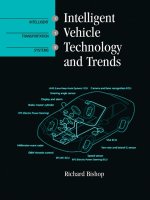
Intelligent Vehicle Technology
and Trends
For a listing of recent titles in the Artech House ITS Library,
turn to the back of this book
Intelligent Vehicle Technology
and Trends
Richard Bishop
a
r
tec
hh
ouse
.
co
m
Library of Congress Cataloging-in-Publication Data
Bishop, Richard.
Intelligent vehicle technology and trends/Richard Bishop.
p. cm. —(Artech House ITS library)
Includes bibliographical references and index.
ISBN 1-58053-911-4 (alk. paper)
1. Intelligent Vehicle Highway Systems. I. Title. II. Series.
TE228.3.B57 2005 2005041095
388.3′12—dc22
British Library Cataloguing in Publication Data
Bishop, Richard
Intelligent vehicle technology and trends. —(Artech House intelligent transportation
systems library)
1. Intelligent Vehicle Highway Systems 2. Automotive computers 3. Motor vehicles—
Automatic location systems
I. Title
629.2’7
ISBN 1-58053-911-4
Cover design by Yekaterina Ratner
© 2005 ARTECH HOUSE, INC.
685 Canton Street
Norwood, MA 02062
All rights reserved. Printed and bound in the United States of America. No part of this book
may be reproduced or utilized in any form or by any means, electronic or mechanical, includ
-
ing photocopying, recording, or by any information storage and retrieval system, without
permission in writing from the publisher.
All terms mentioned in this book that are known to be trademarks or service marks have
been appropriately capitalized. Artech House cannot attest to the accuracy of this informa
-
tion. Use of a term in this book should not be regarded as affecting the validity of any trade
-
mark or service mark.
International Standard Book Number: 1-58053-911-4
10 9 8 7 6 5 4 3 2 1
Dedicated to James R. Bishop, Sr.
Who cultivated within me an active and inquiring mind.
Contents
Preface and Acknowledgments xv
Forward xvii
CHAPTER 1
Introduction 1
1.1 Machine Intelligence on the Road 1
1.2 Definition of Intelligent Vehicles 3
1.3 Overview of Chapters 3
References 6
CHAPTER 2
Goals and Visions for the Future 7
2.1 Government Safety Goals 8
2.1.1 Asia-Pacific Region 8
2.1.2 Europe 10
2.1.3 North America 10
2.2 Visions for the Future 11
2.2.1 Europe’s eSafety Vision 12
2.2.2 Sweden’s Vision Zero 13
2.2.3 ITS America’s Zero Fatalities Vision 13
2.2.4 ITS Evolution in Japan 14
2.2.5 The Netherlands Organization for Scientific Research (TNO) 15
2.2.6 France 18
2.2.7 The Cybercar Approach 21
2.2.8 Vision 2030 21
2.3 Summary 22
References 23
CHAPTER 3
IV Application Areas 25
3.1 Convenience Systems 25
3.1.1 Parking Assist 26
3.1.2 Adaptive Cruise Control (ACC) 26
3.1.3 Low-Speed ACC 27
3.1.4 Lane-Keeping Assistance (LKA) 27
3.1.5 Automated Vehicle Control 28
vii
3.2 Safety Systems 28
3.2.1 Assisting Driver Perception 29
3.2.2 Crash Prevention 30
3.2.3 Degraded Driving 32
3.2.4 Precrash 33
3.2.5 External Vehicle Speed Control (EVSC) 33
3.3 Productivity Systems 34
3.3.1 Truck Applications 34
3.3.2 Transit Bus Applications 34
3.4 Traffic-Assist Systems 35
3.4.1 Vehicle Flow Management (VFM) 36
3.4.2 Traffic-Responsive Adaptation 36
3.4.3 Traffic Jam Dissipation 36
3.4.4 Start-Up Assist 37
3.4.5 Cooperative ACC (C-ACC) 37
3.4.6 Platooning 37
References 37
CHAPTER 4
Government-Industry R&D Programs and Strategies 39
4.1 Asia-Pacific 39
4.1.1 Australia 39
4.1.2 China 40
4.1.3 Japan 42
4.1.4 South Korea 44
4.2 European Programs 45
4.2.1 Pan-European Activities Conducted Through the EC 45
4.2.2 The DeuFrako Program 51
4.2.3 French Programs 52
4.2.4 IV Research in Germany 53
4.2.5 Activities in the Netherlands 55
4.2.6 IVSS in Sweden 57
4.2.7 United Kingdom 58
4.3 United States 59
4.3.1 U.S. DOT 59
4.3.2 IV R&D at the State Level 63
4.3.3 IV R&D Under Way by the U.S. Department of Defense 65
4.4 Contrasts Across IV Programs Worldwide 65
References 66
CHAPTER 5
IV Priorities and Strategies for the Vehicle Industry 69
5.1 Automobile Manufacturers 70
5.1.1 BMW 70
5.1.2 DaimlerChrysler 70
5.1.3 Fiat 73
5.1.4 Ford 73
viii Contents
5.1.50 General Motors 74
5.1.60 Honda 76
5.1.70 Mitsubishi 77
5.1.80 Nissan 77
5.1.90 PSA Peugeot Citroën 78
5.1.10 Renault 78
5.1.11 Subaru 79
5.1.12 Toyota 79
5.1.13 Volkswagen (VW) 81
5.1.14 Volvo Global Trucks 81
5.2 Automotive Industry Suppliers 81
5.2.10 Aisin Group 82
5.2.20 Bosch 82
5.2.30 Continental 83
5.2.40 Delphi 83
5.2.50 Denso 86
5.2.60 Hella 87
5.2.70 IBEO Automobile Sensor 87
5.2.80 MobilEye 88
5.2.90 Siemens VDO Automotive 89
5.2.10 TRW’s Three-Phase Roadmap 89
5.2.11 Valeo: Seeing and Being Seen 90
5.2.12 Visteon 91
5.3 Automotive Industry Summary 92
References 93
CHAPTER 6
Lateral/Side Sensing and Control Systems 97
6.1 Lane Departure Warning System (LDWS) 98
6.1.1 LDWS Approaches 98
6.1.2 LDWS on the Market 101
6.1.3 LDWS Evaluations 104
6.2 Road Departure Warning Systems (RDWS) 106
6.2.1 Curve Speed Warning 106
6.2.2 U.S. DOT Road Departure Warning Field Operational
Testing 107
6.3 Lane Keeping Assist Systems (LKA) 109
6.3.1 System Approaches 109
6.3.2 LKA Systems on the Market 111
6.4 Parallel Parking Assist 112
6.5 Side Sensing: Blind Spot Monitoring and Lane Change
Assistance (LCA) 113
6.5.1 Radar-Based Systems 113
6.5.2 Vision-Based Systems 114
6.5.3 Ultrasonic-Based Side Object Sensing For Transit Buses 115
6.6 Comprehensive Lateral Control Assistance (LCA) 115
6.6.1 INVENT: LCA 115
Contents ix
6.6.2 PReVENT 116
6.7 Rollover Collision Avoidance (RCA) for Heavy Trucks 116
6.8 Summary 118
References 119
CHAPTER 7
Longitudinal Sensing and Control Systems 121
7.1 Rear Sensing for Parking 122
7.1.1 System Description 122
7.1.2 Market Aspects 123
7.2 Night Vision 123
7.2.1 System Description 123
7.2.2 Night Vision Systems 124
7.2.3 Market Aspects 125
7.3 Adaptive Front Lighting (AFS) 125
7.3.1 System Description 125
7.3.2 System Descriptions 126
7.3.3 Market Aspects 126
7.4 Adaptive Cruise Control (ACC) 127
7.4.1 ACC Sensor Technologies and Trade-offs 127
7.4.2 High-Speed ACC 129
7.4.3 Low-Speed ACC 132
7.4.4 Full-Speed Range ACC 134
7.5 Safe Gap Advisory 134
7.5.1 System Description 134
7.5.2 Research and Evaluation 134
7.6 Forward Collision Warning 135
7.6.1 System Description 135
7.6.2 Market Aspects 136
7.6.3 Evaluation of FCW: The ACAS Field Operational Test 137
7.7 Rear Impact Countermeasures 140
7.8 Precrash Brake Assist 140
7.8.1 System Description 140
7.8.2 Market Aspects 141
7.9 Forward Crash Mitigation (FCM) and Avoidance—Active Braking 141
7.9.1 System Description 141
7.9.2 Market Aspects 141
7.9.3 FCM Research 143
7.9.4 Forward Collision Avoidance 143
7.10 Pedestrian Detection and Avoidance 144
7.10.1 System Description 144
7.10.2 Market Aspects 144
7.10.3 Ongoing R&D 145
7.11 Next Generation Sensors 151
7.11.1 Next Generation Sensors—Radar 151
7.11.2 Next Generation Sensors—Laser Scanners 153
7.12 Summary and Observations 155
x Contents
References 156
CHAPTER 8
Integrated Lateral and Longitudinal Control and Sensing Systems 159
8.1 Sensor Fusion 160
8.1.1 CARSENSE for Urban Environments 160
8.1.2 Data Fusion Approach in INVENT 163
8.1.3 ProFusion 165
8.2 Applications 167
8.2.1 Autonomous Intersection Collision Avoidance (ICA) 168
8.2.2 Bus Transit Integrated Collision Warning System 169
8.2.3 Integrated Vehicle-Based Safety System (IVBSS) Program 170
8.2.4 PReVENT Integrated Systems 172
8.3 User and Societal Assessments of Integrated Systems 173
8.4 Summary 174
References 174
CHAPTER 9
Cooperative Vehicle-Highway Systems (CVHS) 177
9.1 Wireless Communications as a Foundation for Cooperative Systems 178
9.1.1 Dedicated Short Range Communications (DSRC) 180
9.1.2 Transceiver Development for North American DSRC 185
9.1.3 Wireless Access Vehicular Environment (WAVE) 186
9.1.4 Continuous Air-Interface for Long and Medium (CALM)
Distance Communications 186
9.1.5 Intervehicle Communications Using Ad Hoc Network
Techniques 186
9.1.6 Radar-Based Intervehicle Communications 189
9.1.7 Millimeter-Wave (MMW)–Based Intervehicle Communications 190
9.2 Digital Maps and Satellite Positioning in Support of CVHS 191
9.2.1 Map-Enabled Safety Applications 192
9.2.2 ActMAP: Real-Time Map Updating 193
9.3 Cooperative Applications: Longitudinal Advisories 194
9.3.1 Japanese Operational Testing 194
9.3.2 Wireless Local Danger Warnings 195
9.4 Intelligent Speed Adaptation (ISA) 195
9.4.1 ISA in Sweden 196
9.4.2 LAVIA: The French Project of Adaptive Speed Limiter 196
9.4.3 ISA-UK 197
9.4.4 PROSPER 198
9.4.5 Australian ISA Research 199
9.5 Cooperative Intersection Collision Avoidance (ICA) 199
9.5.1 ICA Research in Japan 199
9.5.2 ICA Work in the United States 200
9.5.3 Cooperative ICA R&D in Europe 202
9.6 Cooperative Approaches for Vulnerable Road Users 203
9.7 CVHS as an Enabler for Traffic Flow Improvement 204
Contents xi
9.7.1 Traffic Assistance Strategies for Improving Stable Flow 205
9.7.2 Traffic Assistance Strategies To Prevent Flow Breakdown 208
9.7.3 Traffic Assistance Strategies Within Congestion 209
9.7.4 STARDUST Analyses 211
9.8 Business Case and Deployment Projects 212
9.8.1 Automotive Deployment for Cooperative Systems 212
9.8.2 Commercial Telematics CVHS Activities 213
9.8.3 Public-Sector CVHS Deployment Initiatives 214
9.8.4 U.K. CVHS Study 217
9.8.5 CVHS Deployment Research Initiatives 218
9.9 Summary 220
References 220
CHAPTER 10
Fully Automated Vehicles 225
10.1 Passenger Car Automation 226
10.1.1 Highway Automation 226
10.1.2 Low-Speed Automation 230
10.1.3 Ongoing Work in Vehicle-Highway Automation 231
10.1.4 User Attitudes Toward Automated Vehicle Operations 232
10.2 Truck Automation 233
10.2.1 Electronic Tow-Bar Operations and Driver Assistance 233
10.2.2 Truck Automation for Long-Haul Application:
Deployment Studies 235
10.2.3 Automation in Short-Haul Drayage Operations 238
10.2.4 Insertion of Automated Truck Lanes in Urban Areas 239
10.3 Automated Public Transport 240
10.3.1 ParkShuttle 240
10.3.2 Intelligent Multimode Transit System (IMTS) 241
10.3.3 Phileas 242
10.3.4 Bus Platooning R&D at PATH 243
10.4 CyberCars 244
10.5 Automated Vehicle for Military Operations 248
10.6 Deployment Options 249
References 251
CHAPTER 11
Extending the Information Horizon Through Floating Car Data Systems 253
11.1 FCD Applications 254
11.2 Policy Issues Relating to FCD Techniques 254
11.3 Technical Issues 256
11.3.1 Data Reporting 256
11.3.2 Data Dissemination 257
11.3.3 Data Cleansing 257
11.4 FCD Activity in Japan 257
11.4.1 Road Performance Assessments 257
11.4.2 Taxi-Based Probe Experiments 257
xii Contents
11.4.3 Traffic Condition Detection Using Efficient Data Reporting
11.4.3 Techniques 258
11.5 European FCD Activity 258
11.5.1 Commercial FCD Services 259
11.5.2 Research and Development Toward Next Generation
FCD Services 261
11.6 FCD Projects in the United States 265
11.6.1 U.S. DOT VII 265
11.6.2 I-Florida 265
11.6.3 Ford FCD Experiments 265
11.6.4 Indiana Real-Time Transportation Infrastructure Information
System 267
11.7 Overall FCD Processing Picture 267
11.8 Looking Forward 268
References 269
CHAPTER 12
IVs as Human-Centered Systems 271
12.1 Driver Perception and Acceptance 272
12.1.1 Perceived Positives and Negatives of ADAS Systems 273
12.1.2 User Perceptions Assessed in STARDUST 274
12.1.3 User Perceptions of ACC Users 275
12.2 Driverology 275
12.2.1 Driving Simulators 275
12.2.2 Test Track Evaluations 276
12.2.3 U.S. DOT Naturalistic Driving Study 276
12.2.4 Driver Performance in Traffic 277
12.3 Driver-Vehicle Interfacing 277
12.3.1 Driver Warning Modes 277
12.3.2 Key Factors in Successful DVI 278
12.3.3 Learnability of ADAS 278
12.4 Driver-Vehicle Symbiosis 280
12.4.1 ACC Systems 281
12.4.2 Levels of Human-Machine Cooperation 281
12.4.3 Driver Vigilance with Advanced Assistance Systems 281
12.5 Driver Monitoring and Support 283
12.5.1 Drowsy Driver Detection and Countermeasures 284
12.5.2 Driver Workload Support 286
12.5.3 Older Driver Support 287
12.6 Summary 287
References 288
CHAPTER 13
IV Systems Interacting with Society and the Market 291
13.1 Societal Considerations 292
13.2 Market Issues 294
13.2.1 “Safety Sells” 296
Contents xiii
13.2.2 Market Introduction Factors 296
13.2.3 Promoting Product Awareness 297
13.2.4 Incentives to Accelerate Market Uptake 298
13.3 Legal Issues 300
13.3.1 Tort Liability in the United States 301
13.3.2 Legal Issues in Europe 302
13.4 Government Policy and Regulation 303
13.4.1 Vehicle Systems Regulation 304
13.4.2 Frequency Spectrum Regulation 305
13.5 Addressing Nontechnical Market Barriers 305
13.5.1 European RESPONSE Program 306
13.5.2 INVENT 307
13.5.3 ITS America Effort 308
13.6 Code of Practice (COP) for ADAS Design and Testing 309
13.6.1 Defining Requirements 309
13.6.2 Processes 310
13.6.3 Human Factors in the CoP 310
13.7 International Standards 311
13.8 Summary 312
References 313
CHAPTER 14
Looking Forward: Enabling Technologies and Future Trends 315
14.1 Enabling Technologies 315
14.2 Looking Forward 317
References 318
CHAPTER 15
Conclusion 321
Appendix: Web Site Resources 323
Acronyms 327
About the Author 331
Index 333
xiv Contents
Preface and Acknowledgments
In 2003, I was asked by Dr. Ümit Özgüner, Ohio State University professor and
then chairman of the IEEE Intelligent Transportation Systems Council, to present a
tutorial on intelligent vehicle systems as part of that year’s IEEE Intelligent Vehicles
Conference. As one who makes a point of staying abreast of goings-on in the IV
industry, I was happy to accept.
A few months later I received a call from Mark Walsh, Acquisitions Editor at
Artech House Publishers. He suggested that this material could be converted into
book form. Blissfully unaware of the amount of work this would entail, I accepted.
In fact, I plunged into this project because I have long felt that the tantalizing
field of intelligent vehicles is known only to a relatively small band of engineers, sci
-
entists, and government policy makers. IV systems are not well known in the
broader engineering realm and for that matter are only beginning to get attention
within the larger automotive industry.
And yet, these systems draw together one of the most interdisciplinary mixes of
experts to tackle some very challenging technical tasks. So, with this book, it is my
hope to introduce a broader swath of the technical community to this field and also
provide a doorway for new contributors to enter it. Furthermore, I hope to intro-
duce a wider range of government policy makers to the significant societal benefits
offered by intelligent vehicle systems.
Information is everywhere. A recent Google search on “intelligent vehicles”
produced over two million hits. Some of the information that is on the web will be
more up to date than this book shortly after it is published. So, why a book?
Every industry can benefit from a horizontal cut across its myriad technical and
business activity. The role I seek to fulfill in the IV world is focused in this way. A
senior technology manager once observed that three ingredients are needed for the
kind of innovation that keeps an industry (or a technology company) vibrant. The
first two are obvious—there must be domain knowledge and expertise. The third
and last ingredient is key: for innovation to occur, there must also be perspective.
For the most part, I do not design or build the systems you will read about in this
book. Instead, from keeping an eye on the key activities worldwide, I can offer
breadth and hopefully some useful insight, leading to perspective.
Further, many readers familiar with specific IV systems will doubtless read
some things they already know in this book. Hopefully, new knowledge from other
sectors of the industry will prove to be valuable.
In bringing this material together, I paused more than once in complete awe and
respect at the amazing functional capabilities brought forth by the designers of these
intelligent vehicle systems, as well as those who somehow manage to bring them to
xv
market as affordable and user-friendly products. My hat is off to the genius and cre
-
ativity of these scientists, engineers, software developers, and business managers,
whom I am also glad to count as my colleagues and friends.
In particular, I am very appreciative of the generosity of the organizations and
individuals who so willingly shared of graphics and photos, as well as back
-
ground information, to enhance this book. Thanks to Walter Hagleitner of ADAS
Management Consulting; Jos Jansen of Advanced Public Transport Systems bv; Phil
Kithil of Advanced Safety Concepts; Martin Lowson and Richard Teychenné of
Advanced Transport Systems; Teruo Yamauchi of AHSRA; Dean Pomerleau of
AssistWare Technology; Kevin Romanchok of Bendix Commercial Vehicle Systems
LLC; Susanne Breitenberger of BMW AG; Dietrich Manstetten of Bosch; Jim Misener,
Steve Shladover, Bill Stone, and Wei-Bin Zhang of California PATH; Li Bin, Chinese
National Center of ITS Engineering and Technology; Dave Duggins, Jay Gowdy, and
Aaron Steinfeld of CMU; Hanne Umlauf of Continental Teves AG & Co.; Kim Fowler
of Coolstream Consulting; Christophe Bonnet, Uwe Franke, Dariu Gavrila, Frank
Linder, Hubert Rehborn, Gerhard Rollman, Matthias Schulze, and Berthold Ulmer of
DaimlerChrysler AG; Milton Beach of Delphi; Miyoko Honma of Denso; Tom
Mattox of Eaton VORAD Technologies; General Motors Corporation; Ralf-Peter
Schafer, Institute of Transport Research, German Aerospace Center; Peter Hendrickx
of Groeneveld Transport Efficiency, B.V.; Bernd Lichte of Hella KG Hueck and
Co.; Jim Keller of Honda R&D Americas; Ulrich Lages of IBEO Automobile
Sensor GmbH; Michel Parent of INRIA; Walter Scholl and the partners of the
INVENT program; Jean Marc Boucheret of Irisbus; Chris van dan Elzen of Iteris,
Inc.; Edwin Bastiaensen of LINC Innovations bvba; Jean-Marc Blosseville of LIVIC;
Sadayuki Tsugawa of Meijo University; Michael Lambie of Meritor-WABCO; Hiroshi
Makino and Takashi Nishio of MLIT in Japan; Meny Benady of Mobileye; the
National Highway Traffic Safety Administration; Kenichi Egawa, Hiroshi Kawazoe,
and Hiroshi Tsuda of Nissan Technical Center North America; Claudio Hartzstein of
RoadEye;Tom Schaffnit of Schaffnit Consulting; Martin Hummel and Alfred Hoess of
Siemens VDO Automotive AG; Bart van Arem and Marjolein Baart of TNO; Etsuo
Hashino, Kevin Webber and Mike Wolterman of Toyota Motor Corporation; Alastair
Buchanan of TRW; Bob Sweet of UMTRI; Brian Cronin and Ray Resendes of USDOT;
Scott Pyles of Valeo-Raytheon; Tom Dingus and Vicki Neale of the Virginia Tech
Transportation Institute; Tim Tiernan of Visteon; Tim Meisner of Yamaha Motor
Europe n.v.; and Rick Weiland, now of Ygomi LLC.
A hearty thanks also to my comrades at the Classic Cup Café, whose soft chairs
and stirring latte’s kept me going through many a long morning. As well, I’m deeply
grateful to my fellow students and teachers at the TAI-SOPHIA Institute for cheer
-
ing me on. You provided the “infrastructure” upon which this vehicle traveled!
Lastly, my most heartfelt appreciation to my wife Harriet and son Jimmy for
their support and patience in this endeavor, which has been invaluable. You guys
are awesome!
Richard Bishop
Granite, Maryland, USA
February 14, 2005
xvi Preface and Acknowledgments
Foreword
My view of modern day Intelligent Vehicles began with ERGS (Electronic Route
Guidance System), which was studied by the US DOT (United States Department of
Transportation) and their partners in the late 1960’s to early 1970’s. I see its signifi
-
cance to this new book in the close cooperation of intelligent vehicles with the infra
-
structure to sense traffic patterns, compose strategies, and provide route guidance
information via communication. This would allow the driver to have more security
in driving. Maybe being too advanced for its time, activities started to wane, but in
the 1980’s a group of visionaries called “Mobility 2000” proposed a National Ini
-
tiative and set the stage for what was then named IVHS (Intelligent Vehicle High
-
way Systems).
One of the early goals of IVHS was to show the world that it was in fact possible
to greatly enhance safety and efficiency of land transportation using advanced tech-
nology. A large-scale demonstration of this technology was presented to experts
and the public in 1997 along the I-15 corridor in San Diego.The systems presented
were collectively called AHS (Automated Highway Systems), and included concepts
from partial to fully automated intelligent vehicles. Even though it rained during the
opening ceremony (highly unusual in San Diego in summer) I was one of the many
fortunate people that were pleasantly surprised at the security felt in being in an
“automated” vehicle. I wondered whether we would in the future ask friends,
“What’s the best car you’ve never driven?”
Again, I should mention that AHS was not only about total automation, but to
show the feasibility of a suite of technologies that may collectively lead to total
automation. Elements of the this program continue to have significant meaning just
as sending a man to the moon and back in the 1960’s had meaning in stimulating
technological development in following decades. The AHS program was conducted
by the National AHS Consortium and managed by the U.S. Federal Highway
Administration, with the author being the Program Manager. This suite of technol
-
ogies needed for realizing Intelligent Vehicles are addressed in this book.
Even as close as a decade ago, many such systems had been talked about as “sci
-
ence fiction”, but it is telling to look at what is available today. As is covered exten
-
sively in this book, there are cars that keep a constant time gap to the car in front,
cars with night vision, systems that help you to keep from drifting off the road, etc.
In recent years, the interest has been increasing at greater speed than ever before,
and the U.S. Department of Transportation has identified accident prevention using
such technologies as one of the major keys to enhancing future safety. Their very
active program is complemented by similar R&D activities in Europe and Asia.
xvii
I first met the author at the National Academy of Science in Washington, D.C. in
1996, and since then have recognized him as one of the most well known people in
the field of intelligent vehicles, not only in the US, but also in Asia and Europe.Stim
-
ulating new ideas in an open, creative environment is crucial in the early stages of
innovation, as new ideas seldom stem from a critical environment. Also, I believe
that a continuing interaction between experts is very important in highly interdisci
-
plinary worlds such as the Intelligent Vehicles arena. Mr. Bishop is quite active both
in stimulating ideas and in providing such interactive environments. As a key exam
-
ple, he established and still chairs the ITFVHA (International Task Force on Vehicle
Highway Automation), which began in 1997 and meets annually. At ITFVHA, you
will see attendance of a who’s who in the world of intelligent vehicles.Furthermore,
his involvement extends beyond his base in the U.S. – he is depended upon in Asia
and Europe to promote intelligent vehicles. This also provides him an excellent
viewpoint from which to write such a comprehensive overview of intelligent vehicle
activities.
Intelligent Vehicle Technology and Trends covers the topic from various angles.
Starting with major goals and visions, the book gives a perspective as to how Intelli
-
gent Vehicles fit into the picture.This is followed by a categorical explanation of var
-
ious systems. Since Intelligent Vehicles in many cases require involvement with the
Government, many new initiatives are first conducted as a Government-Industry
partnership. Therefore, two chapters are devoted to understanding priorities that
this cooperation had focused upon, for both government and industry.After describ-
ing technical and human factor aspects of various functions, Mr. Bishop again
returns to the theme of public-private partnership by addressing the heart of IVHS,
or Cooperative (meaning cooperation with Infrastructure) Systems and leads on to
what a decade ago seemed impossible to imagine for many, and that is automated
vehicles. The book concludes with chapters addressing what is needed other than
technology itself to make Intelligent Vehicles a reality.
Knowing the past and present will provide a better understanding of the “trajec
-
tory” of events into the future.This book presents this trajectory from Richard
Bishop’s long and continuing experience and active involvement in this very impor
-
tant arena: Intelligent Vehicles.
Hiroshi Tsuda
Director, Intelligent Transportation Systems Research
Nissan Technical Center North America, Inc.
xviii Foreword
CHAPTER 1
Introduction
1.1 Machine Intelligence on the Road
Our society is awash in “machine intelligence” of various kinds, from smart ther
-
mostats in our homes, to expert systems and design aids in our workplaces, to jet
aircraft landing safely in treacherous weather under computer control. Over the last
century, we have witnessed more and more of the “drudgery” of daily living being
replaced by devices such as washing machines, microwave ovens, motorized trans
-
port, and the enhanced productivity and convenience offered by personal comput
-
ers and information technology.
Over this period the hazards to our well-being have been greatly reduced, as
well—medical technology can detect cancers and other diseases earlier and treat
them better; buildings have become less susceptible to fire; floods are much less fre-
quent; and travel is safer in general.
In essence, therefore, much of our technological progress has been focused on
lessening the occurrence of unexpected and traumatic death and injury and protect-
ing our physical assets.
One remaining area of both drudgery and danger, however, is the daily act of
driving automobiles. Every moment of our time traveling the roads, we are exposed
to the dangers of poor road conditions, other drivers whose skill or judgment we
may question (!), and even our own fatigue or lapses of attention. In fact, the drudg-
ery of the typical driving experience is liable to lead to these lapses of attention, as
the act of driving in normal conditions places only a very modest cognitive load on
the brain—leading us to be less responsive to the unexpected conditions that cause
crashes. Driver error is the main cause of the vast majority of crashes, with roughly
half of these instances due to delays in recognition. Thankfully, we are better pro
-
tected when a crash occurs due to advances in vehicle crashworthiness and occupant
protection—yet any crash is a traumatic experience, and we would certainly prefer
to avoid them completely.
While the likelihood of having a road crash for a single individual, on average,
is in the range of once every 25 years (in developed countries), society as a whole
pays a crushing price for the cumulative effects of crashes—over 40,000 deaths per
year for Europe and the United States [1], with over 8,000 deaths annually in Japan
[2]. The per-capita crash rate is quite similar in all three regions. Worldwide, 1.2
million people were killed in traffic crashes in 2002, which was 2.1% of all global
deaths and the 11th ranked cause of death [3]. If this trend continues, an estimated
8.5 million people will be dying every year in road crashes by 2020. Further figures
for the United States are illustrative for the developed countries: over two million
1