Cú pháp tiếng anh part 18 pptx
Bạn đang xem bản rút gọn của tài liệu. Xem và tải ngay bản đầy đủ của tài liệu tại đây (91.34 KB, 10 trang )
171
This suggests that there must be more than one type of CP projection ‘above’ TP in clauses: more
specifically, there must be one type of projection which hosts preposed focused constituents, and another
type of projection which hosts complementisers. Reasoning along these lines, Luigi Rizzi (1997, 2001b,
2003) suggests that CP should be split into a number of different projections – an analysis widely referred
to as the split CP hypothesis. More specifically, he suggests that complementisers (by virtue of their role
in specifying whether a given clause is declarative, interrogative, imperative, or exclamative in force)
should be analysed as Force markers heading a ForceP (= Force Phrase) projection, and that focused
constituents should be analysed as contained within a separate FocP (= Focus Phrase) headed by a Foc
constituent (= Focus marker).
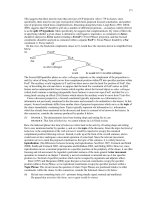
On this view, the bracketed complement clause in (3) would have the structure shown in simplified form
below:
(4) ForceP
Force FocP
that
QP Foc '
no other colleague
Foc TP
would he would turn to no other colleague
The focused QP/quantifier phrase no other colleague originates as the complement of the preposition to
and (by virtue of being focused) moves from complement position within PP into specifier position within
FocP. The auxiliary would originates in T and from there moves into the head Foc position of FocP. One
way of describing the relevant data is to suppose that the head Foc constituent of FocP carries an [EPP]
feature and an uninterpretable focus feature which together attract the focused object no other colleague
(which itself contains a matching interpretable focus feature) to move into spec-FocP, and that Foc is a
strong head carrying an affixal [TNS] feature which attracts the auxiliary would to move from T into Foc.
From a discourse perspective, a focused constituent typically represents new information (i.e.
information not previously mentioned in the discourse and assumed to be unfamiliar to the hearer). In this
respect, focused constituents differ from another class of preposed expressions which serve as the topic of
the clause immediately containing them. Topics typically represent old information (i.e. information
which has already been mentioned in the discourse and hence is assumed to be known to the hearer). In
this connection, consider the sentence produced by speaker B below:
(5) SPEAKER A: The demonstrators have been looting shops and setting fire to cars
SPEAKER B: That kind of behaviour, we cannot tolerate in a civilised society
Here, the italicised phrase that kind of behaviour refers back to the activity of looting shops and setting
fire to cars mentioned earlier by speaker A, and so is the topic of the discourse. Since the topic that kind of
behaviour is the complement of the verb tolerate it would be expected to occupy the canonical
complement position following tolerate. Instead, it ends up at the front of the overall sentence, and so
would seem to have undergone a movement operation of some kind. Since the relevant movement
operation serves to mark the preposed constituent as the topic of the sentence, it is widely known as
topicalisation. (On differences between focusing and topicalisation, See Rizzi 1997, Cormack and Smith
2000b, Smith and Cormack 2002, Alexopoulou and Kolliakou 2002, and Drubig 2003.) However, since
topicalisation moves a maximal projection to a specifier position on the periphery of the clause, it can (like
focusing and wh-movement) be regarded a particular instance of the more general A-bar movement
operation we looked at in chapter 7 whereby a moved constituent is attracted into an A-bar specifier
position (i.e. the kind of specifier position which can be occupied by arguments and adjuncts alike).
Rizzi (1997) and Haegeman (2000) argue that just as focused constituents occupy the specifier
position within a Focus Phrase, so too topicalised constituents occupy the specifier position within a
Topic Phrase. This in turn raises the question of where Topic Phrases are positioned relative to other
constituents within the clause. In this connection, consider the italicised clause in (6) below:
(6) He had seen something truly evil – prisoners being ritually raped, tortured and mutiliated.
He prayed that atrocities like those, never again would he witness
172
In the italicised clause in (6), that marks the declarative force of the clause; atrocities like those is the
object of the verb witness and has been preposed in order to mark it as the topic of the sentence (since it
refers back to the acts of rape, torture and mutilation mentioned in the previous sentence); the preposed
negative adverbial phrase never again is a focused constituent, and hence requires auxiliary inversion.
Thus, the italicised that-clause in (6) will have the simplified structure shown below:
(7) ForceP
Force TopP
that
DP Top '
ø atrocities
like those Top FocP
ø
AdvP Foc '
never again
Foc TP
would he would never again witness
ø atrocities like those
We can assume that the head Top constituent of the Topic Phrase contains an [EPP] feature and an
uninterpretable topic feature, and that these attract a maximal projection which carries a matching
interpretable topic feature to move to the specifier position within the Topic Phrase. If we further assume
that Top is not a strong head (and so does not carry an affixal [TNS] feature), we can account for the fact
that the auxiliary would remains in the strong Foc position and does not raise to the weak Top position.
Rizzi’s split CP analysis raises interesting questions about the syntax of the kind of wh-movement
operation which we find (inter alia) in interrogatives, relatives, and exclamatives. Within the unitary
(unsplit) CP analysis outlined in chapter 7, it was clear that wh-phrases moved into spec-CP; but if CP can
be split into a number of distinct projections (including a Force Phrase, a Topic Phrase, and a Focus
Phrase), the question arises as to which of these projections serves as the landing-site for wh-movement.
Rizzi (1997, p.289) suggests that ‘relative operators occupy the highest specifier position, the spec of
Force’. In this connection, consider the syntax of the bracketed relative clauses in (8) below:
(8)(a) A university is the kind of place [in which, that kind of behaviour, we cannot tolerate]
(b) Syntax is the kind of subject [which only very rarely will students enjoy]
In (8a), the preposed wh-expression in which precedes the preposed topic that kind of behaviour; in (8b)
the preposed relative pronoun which precedes the preposed focused expression only very rarely. If Rizzi is
right in suggesting that preposed relative operator expressions occupy specifier position within the Force
Phrase, the bracketed relative clauses in (8a/b) above will have the simplified structures shown below:
(9)(a) [
ForceP
in which [
Force
ø] [
TopP
that kind of behaviour [
Top
ø] [
TP
we cannot tolerate t t]]]
(b) [
ForceP
which [
Force
ø] [
FocP
only very rarely [
Foc
will] [
TP
students t enjoy t t]]]
(Trace copies of moved constituents are shown as t and printed in the same type-face as their antecedent.)
By contrast, Rizzi argues (1997, p.299) that a preposed wh-operator expression ‘ends up in Spec of Foc
in main questions’. If (as he claims) clauses may contain only a single Focus Phrase constituent, such an
assumption will provide a straightforward account of the ungrammaticality of main clause questions such
as (10) below:
(10)(a) *What never again will you do? (b) *What will never again you do?
173
If both what and never again (when preposed) move into the specifier position within FocP, if Foc allows
only one focused constituent as its specifier, and if no clause may contain more than one FocP constituent,
it follows that (10a) will be ruled out by virtue of Foc having two specifiers (what and never again) and
that (10b) will be ruled out by virtue of requiring two Focus Phrase constituents (one hosting what and
another hosting never again). Likewise, multiple wh-movement questions (i.e. questions in which more
than one wh-expression is preposed) like (11) below will be ruled out in a similar fashion:
(11)(a) *Who where did he send? (b) *Who did where he send?
The assumption that preposed wh-phrases occupy spec-FocP has interesting implications for our claim
in §6.8 that yes-no questions contain an interrogative operator whether (a null counterpart of whether). If
this null operator (like other interrogative expressions) occupies spec-FocP, and if Foc is a strong head, it
follows that inverted auxiliaries in main-clause yes-no questions like Has he left? will involve movement
of the inverted auxiliary has into the head Foc position within FocP, with the specifier position in FocP
being filled by a null counterpart of whether. This assumption would account for the ungrammaticality of
sentences such as the following:
(12)(a) *Will never again things be the same?
(b) *Can that kind of behaviour we tolerate in a civilised society?
If never again is the specifier of a FocP constituent in (12a), the inverted auxiliary must be in a higher
FocP projection whose specifier is whether. However, we have already seen in relation to sentences like
(10/11) above that clauses may only contain one FocP constituent, so the ungrammaticality of (12a) can be
attributed to the impossibility of stacking one FocP on top of another. Likewise, if that kind of behaviour
is a topicalised constituent occupying the specifier position within a Topic Phrase in (12b) and if an
inverted auxiliary like did in a yes-no question occupies the head Foc position of a FocP containing
whether as its specifier, this means that FocP is positioned above TopP in (12b). Given the Head
Movement Constraint, can will have to move through Top to get into Foc; but since Top is a weak head,
can is prevented from moving through Top into Foc; and since Foc is a strong affixal head, the affix in
Foc ends up being stranded without any verb to attach to. If we reverse the order of the two projections
and position TopP above FocP, the resulting structure is fine, as we see from (13) below:
(13) That kind of behaviour, can we tolerate in a civilised society?
In (13), the topic that kind of behaviour occupies the specifier position of a TopP which has a weak head,
while the inverted auxiliary can occupies the strong head Foc position in a FocP which has the null
operator whether as its specifier.
Although Rizzi argues that a preposed interrogative wh-expression moves into spec-FocP in main
clauses, he maintains that a preposed wh-expression moves into a different position (spec-ForceP) in
complement-clause questions. Some evidence in support of this claim comes from sentences such as the
following (from Culicover 1991):
(14)(a) Lee wonders [whether under no circumstances at all would Robin volunteer]
(b) Lee wonders [why under no circumstances at all would Robin volunteer]
Here, the wh-expressions whether/why occur to the left of the focused negative phrase under no
circumstances, suggesting that whether/why do not occupy specifier position within FocP but rather some
higher position – and since ForceP is the highest projection within the clause, it is plausible to suppose
that whether/why occupy spec-ForceP in structures like (14).
A question raised by Rizzi’s analysis of relative and interrogative wh-clauses is where preposed
wh-expressions move in exclamative clauses. In this connection, consider (15) below:
(15)(a) How many of their policies only rarely do politicians get around to implementing!
(b) In how many countries, that kind of behaviour, autocratic leaders would simply not tolerate!
In (15a), the italicised exclamative wh-expression how many of their policies precedes the bold-printed
focused constituent only rarely, while in (15b) the exclamative wh-phrase in how many countries
precedes the underlined topic that kind of behaviour. And in (16) below:
(16) In how many countries of the world, such behaviour, under no circumstances would autocratic
leaders tolerate!
174
an italicised exclamative expression precedes both an underlined topicalised expression and a bold-printed
focused expression – though the resulting sentence is clearly highly contrived. All of this suggests that
exclamative wh-expressions (like relative wh-expressions) move into the specifier position within ForceP.
9.3 Split CP: Finiteness projection
In the previous section, we argued that above TP there may be not just a single CP projection
but rather at least three different types of projection – namely a Force Phrase, a Topic Phrase and a Focus
Phrase (the latter two being found only in clauses containing focused or topicalised constituents).
However, Rizzi argues that below FocP (and above TP) there is a fourth functional projection which he
terms FinP/Finiteness Phrase, whose head Fin constituent serves the function of marking a clause as
finite or nonfinite. He argues that Fin is the position occupied by prepositional particles like di ‘of’ which
introduce infinitival control clauses in languages like Italian in structures such as (17) below:
(17) Gianni pensa, il tuo libro, di PRO cononscerlo bene
Gianni thinks, the your book, of PRO know.it well
‘Gianni thinks that your book, he knows well’
Rizzi maintains that the italicised clause which is the complement of pensa ‘thinks’ in (17) has the
simplified structure (18) below:
(18) ForceP
Force TopP
ø
DP Top '
il tuo libro
your book Top FinP
ø
Fin TP
di PRO concoscerlo bene
of PRO know.it well
Under his analysis, il tuo libro ‘the your book’ is a topic and di ‘of’ is a Fin head which marks its clause as
nonfinite (more specifically, as infinitival). Moreover, Rizzi maintains that the Fin head di ‘of’ assigns
null case to the PRO subject of its clause (an account of null case assignment in keeping with our account
in §4.9, but not with the Chomskyan account given in §8.8).
While present-day English has no overt counterpart of infinitival particles like Italian di in control
clauses, it may be that for served essentially the same function in Middle English control infinitives such
as those bracketed below:
(19)(a) Al were it good [no womman for to touche] (Chaucer, Wife of Bath’s Tale, line 85)
Although it would be good to touch no woman
(b) I wol renne out, [my borel for to shewe] (Chaucer, Wife of Bath’s Tale, line 356)
I will run out, in order to show my clothing
In (19a/b) the italicised expression is the direct object of the verb at the end of the line, but has been
focalised/topicalised and thereby ends up positioned in front of for. This is consistent with the possibility
that for occupies the same Fin position in Middle English as di in Modern Italian, and that the italicised
complements in (19a/b) move into specifier position within a higher Focus Phrase/Topic Phrase
projection. Since the for infinitive complement in (19) has a null subject rather than an overt accusative
subject, we can suppose that it is intransitive in the relevant use.
An interesting possibility raised by this analysis is that for in overt-subject infinitives in present-day
English also functions as a nonfinite Fin head – though an obligatorily transitive one. In this regard,
consider the two different replies given by speaker B below:
(20) SPEAKER A: What was the advice given by the police to the general public?
SPEAKER B: (i) Under no circumstances for anyone to approach the escaped convicts
(ii) That under no circumstances should anyone approach the escaped convicts
175
What is particularly interesting about speaker B’s replies in (20) is that the focused prepositional phrase
under no circumstances precedes the complementiser for in (20Bi), but follows the complementiser that in
(20Bii). This suggests that for occupies the head Fin position of FinP, but that occupies the head Force
position of ForceP. On this view, the two answers given by speaker B would have the respective skeletal
structures shown in (21a/b) below:
(21)(a) ForceP
Force FocP
ø
PP Foc '
under no circumstances
Foc FinP
ø
Fin TP
for anyone to approach the escaped convicts
(b) ForceP
Force FocP
that
PP Foc '
under no circumstances
Foc FinP
should
Fin TP
should anyone should approach the
escaped convicts
If Foc is a strong head in finite (though not infinitival) clauses, it follows that the auxiliary should in (21b)
will raise from the head T position of TP into the head Foc position of FocP; and if we assume the Head
Movement Constraint, it also follows that should must move first to Fin before moving into Foc. We can
suppose that the reply given by speaker B in (22) below:
(22) SPEAKER A: What was the advice given by the police to the general public?
SPEAKER B: Under no circumstances to approach the escaped convicts
has essentially the same structure as that shown in (21a), save that in place of the overt Fin head for we
have a null Fin head, and that in place of the overt subject anyone we have a null PRO subject. In addition,
if Foc is only a strong head in finite clauses, the Fin head remains in situ rather than raising to Foc.
The overall gist of Rizzi’s split CP hypothesis is that in structures containing a topicalised and/or
focalised constituent, CP splits into a number of different projections. In a clause containing both a
topicalised and a focalised constituent, CP splits into four separate projections – namely a Force Phrase,
Topic Phrase, Focus Phrase, and Finiteness Phrase. In a sentence containing a topicalised but no focalised
constituent, CP splits into three separate projections – namely into a Force Phrase, Topic Phrase and
Finiteness Phrase. In a sentence containing a focalised but no topicalised constituent, CP again splits into
three projections – namely into a Force Phrase, Focus Phrase and Finiteness Phrase. However, in a
176
structure containing no focalised or topicalised constituents, Rizzi posits that Force and Finiteness features
are syncretised (i.e. collapsed) onto a single head, with the result that CP does not split in this case: in
other words, rather than being realised on two different heads, the relevant force and finiteness features are
realised on a single head corresponding to the traditional C constituent (so that C is in effect a composite
force/finiteness head). In simple terms, what this means is that C only splits into multiple projections in
structures containing a topicalised and/or focalised constituent.
We can illustrate the conditions under which CP does (or does not) split in terms of the syntax of the
that-clauses in (23) below:
(23)(a) You must know that this kind of behavior we cannot tolerate
(b) You must know that we cannot tolerate this kind of behaviour
In (23a) the object this kind of behaviour has been topicalised, so forcing CP to split into three projections
(ForceP, TopP and FinP) as shown in simplified form in (24) below:
(24) [
ForceP
[
Force
that] [
TopP
this kind of behaviour [
Top
ø] [
FinP
[
Fin
ø] [
TP
we [
T
cannot] tolerate t]]]]
By contrast, in (23b) there is no topicalised or focalised constituent, hence CP does not split into multiple
projections. Accordingly, only a single C constituent is projected which carries both finiteness and force
features, as in (25) below (where DEC is a declarative force feature and FIN is a finiteness feature):
(25) [
CP
[
C
that
DEC, FIN
] [
TP
we [
T
cannot] tolerate this kind of behaviour]]
Rizzi posits that (in finite clauses) the relevant types of head are spelled out in the manner shown
informally in (26) below:
(26) A head in a split CP projection can be spelled out in English as:
(i) that in a complement clause if it carries a declarative force feature (with or without
a finiteness feature)
(ii) ø if it carries a finiteness feature (with or without a declarative force feature)
It follows from (26) that the Force head in (24) can be spelled out as that but not as ø, and that Fin can be
spelled out as ø but not as that, so accounting for the ungrammaticality of :
(27)(a) *You must know ø this kind of behaviour that we cannot tolerate
(b) *You must know that this kind of behaviour that we cannot tolerate
(c) *You must know ø this kind of behaviour ø we cannot tolerate
(Irrelevantly, (27c) is grammatical if written with a colon between know and this kind of behaviour and
read as two separate sentences.) It also means that the syncretised (force/finiteness) C constituent in (25)
can either be spelled out as that in accordance with (26i), or be given a null spellout in accordance with
(26ii) as in (28) below:
(28) You must know [
C
ø
DEC, FIN
] we cannot tolerate this kind of behaviour
In other words, Rizzi’s analysis provides a principled account of the (overt/null) spellout of finite
declarative complementisers in English (though see Sobin 2002 for complications. Complementiser
spellout may be different in other languages – see e.g. Alexopoulou and Kolliakou 2002 on Greek.)
9.4 Split VPs: VP shells in ergative structures
Having looked at evidence that CP can be split into a number of different projections, we now
turn to look at evidence arguing that VPs should be split into two distinct projections – an outer VP shell
and an inner VP core. For obvious reasons, this has become known as the VP shell analysis.
The sentences we have analysed throughout this book so far have generally contained simple verb
phrases headed by a verb with a single complement. Such single-complement structures can easily be
accommodated within the binary-branching framework adopted here, since all we need say is that a verb
merges with its complement to form a (binary-branching) V-bar constituent. However, a particular
problem for the binary-branching framework is posed by three-place predicates like those italicised in (29)
below which have a (bold-printed) subject and two (bracketed) complements:
(29)(a) He rolled [the ball] [down the hill] (b) He filled [the bath] [with water]
177
(c) He broke [the vase] [into pieces] (d) They withdrew [the troops] [from Ruritania]
If we assume that complements are sisters to heads, it might seem as if the V-bar constituent headed by
rolled in (29a) has the structure (30) below:
(30) V '
V DP PP
rolled the ball down the hill
However, a structure such as (30) is problematic within the framework adopted here. After all, it is a
ternary-branching structure (V-bar branches into the three separate constituents, namely the V rolled, the
DP the ball and the PP down the hill), and this poses an obvious problem within a framework which
assumes that the merger operation which forms phrases is an inherently binary operation which can only
combine constituents in a pairwise fashion. Moreover, a ternary-branching structure such as (30) would
wrongly predict that the string the ball down the hill does not form a constituent, and so cannot be
coordinated with another similar string (given the traditional assumption that only identical constituents
can be conjoined) – yet this prediction is falsified by sentences such as:
(31) He rolled the ball down the hill and the acorn up the mountain
How can we overcome these problems?
One answer is to suppose that transitive structures like He rolled the ball down the hill have a complex
internal structure which is parallel in some respects to causative structures like He made the ball roll down
the hill (where MAKE has roughly the same meaning as CAUSE). On this view the ball roll down the hill
would serve as a VP complement of a null causative verb (which can be thought of informally an invisible
counterpart of MAKE). We can further suppose that the null causative verb is affixal in nature and so
triggers raising of the verb roll to adjoin to the causative verb, deriving a structure loosely paraphraseable
as He made+roll [the ball roll down the hill], where roll is a trace copy of the moved verb roll. We could
then say that the string the ball down the hill in (31) is a VP remnant headed by a trace copy of the moved
verb roll. Since this string is a VP constituent, we correctly predict that it can be co-ordinated with another
VP remnant like the acorn up the mountain – as is indeed the case in (31).
Analysing structures like roll the ball down the hill as transitive counterparts of intransitive structures
is by no means implausible, since many three-place transitive predicates like roll can also be used as
two-place intransitive predicates in which the (italicised) DP which immediately follows the (bold-printed)
verb in the three-place structure functions as the subject in the two-place structure – as we see from
sentence-pairs such as the following:
(32)(a) They will roll the ball down the hill (b) The ball will roll down the hill
(33)(a) He filled the bath with water (b) The bath filled with water
(34)(a) He broke the vase into pieces (b) The vase broke into pieces
(35)(a) They withdrew the troops from Ruritania (b) The troops withdrew from Ruritania
(36)(a) They closed the store down (b) The store closed down
(37)(a) They moved the headquarters to Brooklyn (b) The headquarters moved to Brooklyn
(Verbs which allow this dual use as either three-place or two-place predicates are sometimes referred to as
ergative predicates.) Moreover, the italicised DP seems to play the same thematic role with respect to the
bold-printed verb in each pair of examples: for example, the ball is the THEME argument of roll (i.e. the
entity which undergoes a rolling motion) both in (32a) They will roll the ball down the hill and in (32b)
The ball will roll down the hill. Evidence that the ball plays the same semantic role in both sentences
comes from the fact that the italicised argument is subject to the same pragmatic restrictions on the choice
of expression which can fulfil the relevant argument function in each type of sentence: cf.
(38)(a) The ball/the rock/!the theory/!sincerity will roll down the hill
(b) They will roll the ball/the rock/!the theory/!sincerity down the hill
If principles of UG correlate thematic structure with syntactic structure in a uniform fashion (in
accordance with Baker’s 1988 Uniform Theta Assignment Hypothesis/UTAH), then it follows that two
arguments which fulfil the same thematic function with respect to a given predicate must be merged in the
178
same position in the syntax.
An analysis within the spirit of UTAH would be to assume that since the ball is clearly the subject of
roll in (32b) The ball will roll down the hill, then it must also be the case that the ball originates as the
subject of roll in (32a) They will roll the ball down the hill. But if this is so, how come the ball is
positioned after the verb roll in (32b), when subjects are normally positioned before their verbs? A
plausible answer to this question within the framework we are adopting here is to suppose that the verb
roll moves from its initial (post-subject) position after the ball into a higher verb position to the left of the
ball. More specifically, adapting ideas put forward by Larson (1988, 1990), Hale and Keyser (1991, 1993,
1994) and Chomsky (1995), let’s suppose that the (b) examples in sentences like (32-37) are simple VPs,
but that the (a) examples are split VP structures which comprise an outer shell and an inner core.
More concretely, let’s make the following assumptions. In (32b) The ball will roll down the hill, the V
roll is merged with its PP complement down the hill to form the V-bar roll down the hill, and this is then
merged with the DP the ball to form the VP structure (39) below:
(39) VP
DP V '
the ball
V PP
roll down the hill
In the case of (32b), the resulting VP will then be merged with the T constituent will to form the T-bar
will roll down the hill; the [EPP] and f-features of [
T
will] trigger raising of the subject the ball into
spec-TP to become subject of will (in the manner shown by the dotted arrow below), deriving:
(40) TP
DP T '
the ball
T VP
will
DP V '
the ball
V PP
roll down the hill
The resulting TP is subsequently merged with a null declarative C constituent. (Throughout this chapter,
we simplify exposition by omitting details like this which are not directly relevant to the point at hand.)
Now consider how we derive (32a) They will roll the ball down the hill. Let’s suppose that the
derivation proceeds as before, until we reach the stage where the VP structure (39) the ball roll down the
hill has been formed. But this time, let’s assume that the VP in (39) is then merged as the complement of
an abstract causative light verb (v) – i.e. a null verb with much the same causative interpretation as the
verb MAKE (so that They will roll the ball down the hill has a similar interpretation to They will make the
ball roll down the hill). Let’s also suppose that this causative light verb is affixal in nature (or has a strong
V-feature), and that the verb roll adjoins to it, forming a structure which can be paraphrased literally as
‘make+roll the ball down the hill’ – a structure which has an overt counterpart in French structures like
faire rouler la balle en bas de la colline, literally ‘make roll the ball into bottom of the hill’). The resulting
v-bar structure is then merged with the subject they (which is assigned the q-role of AGENT argument of
the causative light verb), to form the complex vP (41) below (lower-case letters being used to denote the
light verb, and the dotted arrow showing movement of the verb roll to adjoin to the null light-verb ø):
(41) vP
PRN v '
they
v VP
ø+roll
179
DP V '
the ball
V PP
roll down the hill
Subsequently, the vP in (41) merges with the T constituent will, the subject we raises into spec-TP, and the
resulting TP is merged with a null declarative complementiser, forming the structure (42) below (where
the dotted arrows show movements which have taken place in the course of the derivation):
(42) CP
C TP
ø
PRN T '
They
T vP
will
PRN v '
they
v VP
ø+roll
DP V '
the ball
V PP
roll down the hill
The analysis in (42) correctly specifies the word-order in (32a) They will roll the ball down the hill. (See
Stroik 2001 for arguments that do is used to support a null light-verb in elliptical structures such as John
will roll a ball down the hill and Paul will do so as well.)
The VP-shell analysis in (42) provides an interesting account of an otherwise puzzling aspect of the
syntax of sentences like (32a) – namely the fact that adverbs like gently can be positioned either before
roll or after the ball, as we see from:
(43)(a) They will gently roll the ball down the hill (b) They will roll the ball gently down the hill
Let’s suppose that adverbs like gently are adjuncts, and that adjunction is a different kind of operation
from merger. Merger extends a constituent into a larger type of projection, so that (e.g.) merging T with
an appropriate complement extends T into T-bar, and merging T-bar with an appropriate specifier extends
T-bar into TP. By contrast, adjunction extends a constituent into a larger projection of the same type (e.g.
merging a moved V with a minimal projection like T forms a larger T constituent; merging an adjunct
with an intermediate projection like T-bar extends T-bar into another T-bar constituent; merging an
adjunct with a maximal projection like TP forms an even larger TP – and so on. (See Stepanov 2001 and
Chomsky 2001 for technical accounts of differences between adjunction and merger.) Let’s suppose that
gently is the kind of adverb which can adjoin to an intermediate verbal projection. Given this assumption
and the light-verb analysis in (42), we can then propose the following derivations for (43a-b).
In (43a), the verb roll merges with the PP down the hill to form the V-bar roll down the hill, and this
V-bar in turn merges with the DP the ball to form the VP the ball roll down the hill, with the structure
shown in (39) above. This VP then merges with a null causative light-verb ø to which the verb roll
adjoins, forming the v-bar ø+roll the ball roll down the hill. The resulting v-bar merges with the adverb
gently to form the larger v-bar gently ø+roll the ball roll down the hill; and this v-bar in turn merges with
the subject they to form the vP they gently ø+roll the ball roll down the hill. The vP thereby formed
merges with the T constituent will, forming the T-bar will they gently ø+roll the ball roll down the hill.
The subject they raises to spec-TP forming the TP they will they gently ø+roll the ball roll down the hill.
180
The resulting TP is then merged with a null declarative complementiser to derive the structure shown in
simplified form in (44) below (with arrows showing movements which have taken place):
(44) CP
C TP
ø
PRN T '
They
T vP
will
PRN v '
they
ADV v '
gently
v VP
ø+roll
DP V '
the ball
V PP
roll down the hill
The analysis in (44) correctly specifies the word order in (43a) They will gently roll the ball down the hill.
Now consider how (43b) They will roll the ball gently down the hill is derived. As before, the verb roll
merges with the PP down the hill, forming the V-bar roll down the hill. The adverb gently then merges
with this V-bar to form the larger V-bar gently roll down the hill. This V-bar in turn merges with the DP
the ball to form the VP the ball gently roll down the hill. The resulting VP is merged with a causative
light-verb [
v
ø] to which the verb roll adjoins, so forming the v-bar ø+roll the ball gently roll down the
hill. This v-bar is then merged with the subject we to form the vP we ø+roll the ball gently roll down the
hill. The vP thereby formed merges with [
T
will], forming the T-bar will we ø+roll the ball gently roll
down the hill. The subject we raises to spec-TP, and the resulting TP is merged with a null declarative C to
form the CP (45) below (with arrows showing movements which have taken place):
(45) CP
C TP
ø
PRN T '
They
T vP
will
PRN v '
they
v VP
ø+roll
DP V '