Gale Encyclopedia Of American Law 3Rd Edition Volume 6 P16 ppsx
Bạn đang xem bản rút gọn của tài liệu. Xem và tải ngay bản đầy đủ của tài liệu tại đây (715.13 KB, 10 trang )
legitimate means of interpretation. Kennedy
testified that
ORIGINAL INTENT was only a starting
point in interpreting the Constitution. In his
Senate testimony, Kennedy stated his commit-
ment to the principle of
STARE DECISIS. This
principle refers to the respect for legal precedent
created by prior cases and the need to maintain
precedent even if the current judges do not
agree with the original ruling.
Kennedy was confirmed in February 1988,
with many liberal members of Congress feeling
that he was too conservative, and some con-
servatives believing he was moderate, a com-
promise candidate who could survive the
confirmation process.
Since taking office as associate justice,
Kennedy has proved to be bo th conservative
and moderate, depending on the case. He has
usually sided wit h the conservative m embers of the
Court, but he has gained attention by departing
from them in two important cases. In Planned
Parenthood of Southeastern Pennsylvania v. Casey,
505 U.S. 833, 112 S. Ct. 2791, 120 L. Ed. 2d 674
(1992), watchers had expected the Court to
overrule explicitly
ROE V. WADE, 410 U.S. 113, 93 S.
Ct. 705, 35 L. Ed. 2d 147, the 1973 decision that
defined the right to choose abortion as a
fundamental constitutional right. Kennedy joined
with Justices Sandra Day O’Connor and
DAVID H.
SOUTER in an opinion that defended the reasoning
of Roe and the line of cases that followed it.
In 1996 Kennedy wrote a landmark and
controversial decision concerning gay rights. In
ROMER V. EVANS, 517 U.S. 620, 116 S. Ct. 1620, 134
L. Ed. 2d 855, Kennedy declared unconstitu-
tional an amendment to the Colorado state
constitution (West’s C.R.S.A. Const. Art. 2,
§ 30b) that prohibited state and local govern-
ments from enacting any law, regulation, or
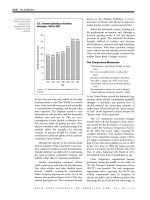
Anthony M.
Kennedy.
ROBIN REID,
COLLECTION OF THE
SUPREME COURT OF
THE UNITED STATES
▼▼
▼▼
◆
1939–45
World War II
1950–53
Korean War
1961–73
Vietnam War
2000 Presidential election result uncertain due
to disputed Fla. vote count; recount halted by
U.S. Supreme Court with 5–4 vote in Bush v. Gore
◆◆
◆
❖
◆
◆
◆
1936 Born,
Sacramento,
Calif.
1975–88 Sat on
Ninth Circuit Court
of Appeals
1979–90 Served on Committee on
Pacific Territories of the U.S.
Judicial Conference; elected chair
in 1982
1979–87 Served on Admisory Committee on Codes of Conduct of the U.S. Judicial Conference
1988 Appointed associate justice of U.S. Supreme Court by President Reagan
1992 Joined
majority in
Planned
Parenthood of
Southeastern
Pennsylvania v.
Casey, which
affirmed basic
reasoning of
Roe v. Wade
2000 Wrote unanimous opinion in U.S. v. Locke, limiting state power to regulate
environmental standards for oil tankers; voted with majority in Bush v. Gore
1996 Wrote Romer v. Evans decision, which struck down Colorado’s Amendment 2
◆
◆
◆◆
1958 Graduated
from Stanford University
1961 Earned LL.B. from Harvard Law School
1965 Began teaching constitutional law at
McGeorge School of Law, University of the Pacific
2003 Wrote majority opinion in Lawrence v. Texas
1930
1975
2000
1950
2007 Wrote majority opinion in Gonzales v. Carhart, upholding federal law criminalizing partial birth abortions
2008 Wrote majority opinion in Boumediene v. Bush, giving habeas corpus rights to Guantanamo Bay prisoners
Anthony McLeod Kennedy 1936–
GALE ENCYCLOPEDIA OF AMERICAN LAW, 3RD E DITION
138 KENNEDY, ANTHONY MCLEOD
policy that would, in effect, protect the CIVIL
RIGHTS
of gay men, lesbians, and bisexuals.
Kennedy ruled that the amendment violated the
EQUAL PROTECTION Clause of the FOURTEENTH
AMENDMENT
, noting that the amendment classi-
fied gay men and lesbians “not to further a prop er
legislative end but to make them unequal to
everyone else,” and adding, “This Colorado
cannot do.”
Although considered a swing vote on closely
divided court, Kennedy has authored opinions
that enhance states’ police powers. In Kansas v.
Hendricks, 521 U.S. 346, 117 S. Ct. 2072, 138 L.
Ed.2d 501 (1997), Kennedy upheld a state law
that permitted the indefinite civil commitment of
“sexual psychopath” prisoners who had complet-
ed their prison terms. In McKune v. Lile, 536 U.S.
24, 122 S. Ct. 2017, 153 L. Ed. 2d 47 (2002),
Kennedy concluded that that states can limit the
privileges of prisoners who refuse to divulge their
past crimes as part of a therapy program. In
addition, he has supported the constitutionality
of sex-offender registry lists, compulsory drug
testing of public-school students who wish to
participate in extracurricular activities, and “three
strikes” mandatory-sentencing schemes. In
BUSH
V
. GORE, 531 U.S. 98, 121 S. Ct. 525, 148 L.Ed.2d
388 (2000), Kennedy voted with the majority to
bar Florida from conducting a recount of
presidential ballots, thereby ensuring the election
of
GEORGE W. BUSH.
In
LAWRENCE V. TEXAS, the Supreme Court, in
a6–3 decision in 2003, declared a Texas law that
prohibited sexual acts between same sex couples
unconstitutional. Justice
ANTHONY KENNEDY, writ-
ing for the majority, held that the right to
privacy protects a right for adults to engage in
private, consensual homosexu al activity. Justice
Kennedy’s opinion expressly overruled the
Court’s decision in Bowers v. Hardwick (1986),
which had come to an opposite conclusion.
In March 2005 Kennedy wrote the major-
ity opinion in a 5–4 U.S . Supreme Court
ruling that said executing killers who were
under 18 when they committed their crimes
was unconstitutional.
Some U.S. Supreme Court analysts suggested
that Kennedy might be appointed chief justice
when
WILLIAM REHNQUIST chose to retire. But
when Rehnquist died, Kennedy was not given the
chief justice position. Whereas some argue that
Kennedy is not liberal enough for liberals, or
conservative enough for conservatives, others
point out that the centrist views that often make
him the swing vote in cases dividing the Court
might have made him attractive enough to
survive the Senate nomination procedure w ith-
out a major confirmation fight.
FURTHER READINGS
Amar, Akhil Reed. 1997. “Justice Kennedy and the Idea of
Equality.” Pacific Law Journal 28 (spring).
Freiwald. Aaron. 1987. “Portrait of the Nominee as a Young
Man: As Lobbyist and Lawyer, Anthony Kennedy
Thrived in Reagan’s California.” Legal Times 23
(November).
Friedman, Lawrence M. 1993. “The Limitations of Labeling:
Justice Anthony M. Kennedy and the First Amend-
ment.” Ohio Northern University Law Review 20
(winter).
Knowles, Helen J. 2009. The Tie Goes to Freedom: Justice
Anthony M. Kennedy on Liberty. Lanham, MD: Row-
man & Littlefield Publishers.
Lane, Charles. 2002. “Justice Kennedy’s Future Role
Pondered.” Washington Post (June 17).
Maltz, Earl M. 2000. “Justice Kennedy’s Vision of Federal-
ism.” Rutgers Law Journal 31 (spring).
CROSS REFERENCE
Gay and Lesbian Rights.
v
KENNEDY, EDWARD MOORE
TED KENNEDY served as a U.S. senator from
Massachusetts for 47 years, from 1962 to 2009.
The brother of President
JOHN F. KENNEDY and
Senator
ROBERT F. KENNEDY, who were both assa-
ssinated, he championed many liberal social
programs, including
NATIONAL HEALTH CARE, and
was a major figure in the
DEMOCRATIC PARTY.His
presidential aspirations were damaged because
of personal scandal.
Edward Moore “Ted” Kennedy, the youn-
gest of nine children of Joseph P. Kennedy and
Rose Fitzgerald Kennedy, was born February 22,
1932, in Brookline, Massachusetts. He started at
Harvard University in 1950, then left in 1951 to
serve in the U.S. Army. He returned to college
in 1953 and graduated in 1956. He next
attended the University of Virginia Law School,
where he graduated in 1959. He married
Virginia Joan Bennett in 1958. The couple had
three children, Kara A., Edward M., Jr., and
Patrick J. They were divorced in 1983 .
In 1960 Kennedy became an assistant
district attorney in Suffolk County, Massachu-
setts. He soon turned his eye toward politics.
After his brother John was elected president in
1960 and had to resign from the U.S. Senate,
Kennedy filed in the 1962 election to fill out
GALE ENCYCLOPEDIA OF AMERICAN LAW, 3RD E DITION
KENNEDY, EDWARD MOORE 139
John’s term. His announcement led opponents
to criticize him for trading on the Kennedy
name. He was only 30 years old, the minimum
age for a U.S. senator set by the U.S. Constitu-
tion, and had little experience in politics or the
workplace. Nevertheless, Kennedy easily won the
election. He won a full six-year term in 1964 and
was re-elected eight times until his death in 2009.
Despite his youth, Kennedy soon emerged
as a forceful advocate of social-welfare legisla-
tion and a respected member of the Senate.
He was elected Senate majority whip in 1969,
which was highly unusual for a person with
little seniority. Kennedy appeared ready to make
a presidential bid in 1972. But any hopes in that
direction were dashed in the summer of 1969,
when his personal conduct became a national
scandal.
On July 18, 1969, Kennedy attended a party
with friends and staff members on Chappa-
quiddick Island, Massachusetts. That evening,
Kennedy drove his car off a narrow bridge on
the island. Mary Jo Kopechne, a passenger in
the car and former member of his brother
Robert’s staff, drowned. Kennedy’s actions
following the accident were disturbing. He did
not immediately report what had happened,
and he remained in seclusion for days. He
pleaded guilty to the
MISDEMEANOR charge of
leaving the scene of an accident. This
PLEA,
coupled with the revelation that he, a married
man, had been in the company of a young,
unmarried woman, devastated Kennedy’s image
and political standing. He lost his majority whip
position in 1971 and refused to become
involved in the 1972 presidential race.
During the 1970s Kennedy concentrated
his energies on his senatorial duties. He became
the leading advocate of a national health care
system that would provide coverage to every
citizen without regard to income. He also
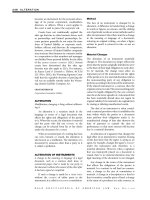
Ted Kennedy.
AP IMAGES
Edward Moore Kennedy 1932–2009
▼▼
▼▼
1925
2000
1975
1950
◆
❖
◆
◆
◆◆
1932 Born,
Brookline,
Mass.
1939–45
World War II
1950–53
Korean War
1961–73
Vietnam War
◆◆
◆
1951–53
Served in
U.S. Army
1959 Earned
LL.B. from
University of
Virginia Law
School
1960 Became asst. district attorney in Suffolk County,
Mass.; brother John F. Kennedy elected U.S. president
1962 Elected to John F. Kennedy’s U.S. Senate seat
1963 John
F. Kennedy
assassinated
1968 Robert
F. Kennedy
assassinated
1969 Elected
Senate majority
whip; involved in
controversial
car accident at
Chappaquiddick
(Mass.)
1979–80 Ran
unsuccessful
campaign for
president
1979–81 Chaired
Senate Judiciary
Committee
2006 Elected to
eighth Senate term
2002 Inducted into
American Academy
of Arts & Sciences
◆◆
◆❖
2009 Awarded Presidential
Medal of Freedom
2006 Received National Association of Public Hospitals
and Health Systems Lifetime Achievement Award
2008 Helped break Republican
filibuster of Medicare bill
2009 Died, Hyannis Port, Mass.
GALE ENCYCLOPEDIA OF AMERICAN LAW, 3RD E DITION
140 KENNEDY, EDWARD MOORE
argued for tax reform, arms control, and
stronger antitrust laws. From 1979 to 1981, he
chaired the
SENATE JUDICIARY COMMITTEE.He
initially supported the administration of Demo-
cratic president
JIMMY CARTER, but soon criticized
Carter’s economic policies and leadership style.
His dissatisfaction led him to seek the
presidential nomination in 1980. Running
against an incumbent of his own party,
Kennedy drew the support of liberals and won
primaries in ten states. Carter nevertheless won
the nomination. However, already weakened by
Kennedy’s criticisms, Carter lost the general
election to
RONALD REAGAN.
During the administrations of Reagan and
his successor,
GEORGE H.W. BUSH, Kennedy
became the leading liberal critic of Republican
policies and politics.
Kennedy’s personal life co ntinued to attract
attention in the 1990s. In March 1991, Kennedy’s
nephew, William Kennedy Smith, was charged
with
RAPE in Palm Beach, Florida. The alleged
ASSAULT took place at the Kennedy family
compound. Palm Beach police asserted that
Kennedy had obstructed justice by misleading
police early in their investigation. When police
arrived to investigate, they were told that
Kennedy and Smith had already left the area.
Later investigation of travel records indicated
that Kennedy probably was still in the mansion
at the time. Although Smith was acquitted of the
charge in December 1991, the nationally tele-
vised trial again tarnished Kennedy’s reputation.
In July 1992 Kennedy married Victoria Reggie,
a Washington, D.C., lawyer.
Despite differing public opinions, Kennedy
remained a powerful member of the U.S.
Senate. In 1996 he sponsored legislation with
Republican Senator Nancy Kassebaum of Kan-
sas that made
HEALTH INSURANCE portable, so that
families would not lose their health insurance
coverage if they lost or changed jobs.
In 1999 Kennedy and his family suffered a
further tragic loss when a small airplane piloted
by his nephew John Kennedy, Jr. went down in
the Atlantic Ocean near Martha’s Vineyard,
Massachusetts, killing John Kennedy, his wife,
and his sister-in-law. Once again, Ted Kennedy
found himself playing the role of family
patriarch as he oversaw funeral arrangements
and consoled family members. In the new
millennium, Kennedy continued his role as
senior senator, serving as the senior Democrat
on the
IMMIGRATION Subcommittee of the
Judiciary Committee and as a member of the
Senate Arms Control Observer Group, a part of
the Armed Services Committee.
Kennedy’s persistence, collegiality, and long
service won him friends on both sides of the
aisle. While on the Senate, he advocated for
numerous causes, including raising the
MINIMUM
WAGE
, strengthening CIVIL RIGHTS laws and laws
aimed at protecting senior citizens and persons
with disabilities, and tightening environmental
and worker-safety laws.
In 2007 Kennedy began suffering from
health problems and underwent surgery to
remove a blocked artery. In May 2008 he suffered
a seizure and was diagnosed with a brain tumor,
undergoing surgery that June. Kennedy returned
to the Senate in July and helped break a
Republican filibuster of a
MEDICARE bill. The
determined senator left his hospital bed to be
a featured speaker on the opening night of the
Democratic National Convention that August.
In 2009, at an Inauguration Day luncheon for
President
BARACK OBAMA,whomhehadendorsed
and supported, Kennedy suffered another seizure,
and was later stabalized.
2009 continued to be an important year, as
Kennedy was awarded by President Barack
Obama the Presidential Medal of Freedom,
the highest civilian honor in the United States.
That same month, his sister, Eunice Kennedy
Shriver, known worldwide for her efforts with
the mentally disabled, and for founding the
Special Olympics, died at the age of 88. Kennedy
also published a memoir, True Compass,in
2009.
Before his death on August 25, 2009, only a
few weeks after his sister’s death, the Senator,
who had been re-elected to eight full terms,
continued to be an advocate for health care,
education, civil rights, immigration reform,
raising the minimum wage, defending the rights
of workers and their families, assisting indivi-
duals with disabilities, protecting the environ-
ment, and safeguarding and strengthening
SOCIAL SECURITY and Medicare. He was also a
strong opponent of the war in Iraq. He was
chair of the Senate Health, Education, Labor
and Pensions Committee, and also served on
the Senate Armed Services Committee, where
he was Chairman of the Seapower Subcommit-
tee. At the time of his death, the debates about
health care reform in the U.S. continued to heat
AMERICA WAS AN
IDEA SHAPED IN THE
TURBULENCE OF
REVOLUTION
, THEN
GIVEN FORMAL
STRUCTURE IN A
CONSTITUTION
.
—TED KENNEDY
GALE ENCYCLOPEDIA OF AMERICAN LAW, 3RD E DITION
KENNEDY, EDWARD MOORE 141
up, which was an issue near and dear to his
heart, and one that he always strived to solve.
His death signified, according to the media
as well as family and friends, the end of an era
for the Kenn edy clan.
FURTHER READINGS
Kennedy, Edward M. 2009. True Compass: A Memoir. New
York: Hachette Book Group.
“A Private Return to the Sea.” 1999. Minneapolis Star
Tribune. (July 23).
Senator Edward Kennedy Senate site. Available online at
kennedy.senate.gov (accessed on August 18, 2009).
CROSS REFERENCE
Health Care Law.
v
KENNEDY, JOHN FITZGERALD
John Fitzgerald Kennedy was the 35th PRESIDENT
OF THE UNITED STATES
, serving from 1961 until
his
ASSASSINATION in 1963. Although his admin-
istration had few legislative accomplishments,
Kennedy energized the United States by pro-
jecting idealism, youth, and vigor.
Kennedy was born May 29, 1917, in
Brookline, Massachusetts. His father, Joseph P.
Kennedy, was a self-made millionaire and the
son of a Boston politician. His mother, Rose
Fitzgerald Kennedy, was the daughter of John F.
(“Honey Fitz”) Fitzgerald, who served as a
Representative and a mayor of Boston.
Kennedy, one of nine children, graduated
from Harvard University in 1940. His senior
thesis, “Why England Slept,” which addressed
the reasons why Great Britain had been
unprepared for
WORLD WAR II, was published in
1940 to great acclaim. His father thought that
Kennedy would become a writer or teacher, and
that Kennedy’s older brother, Joseph P. Ken-
nedy, Jr., would go into politics. World War II
changed those plans.
Kennedy joined the Navy in 1941 and
commanded a PT boat in the Pacific Ocean.
In 1943, the boat was attacked and destroyed,
and Kennedy emerged a as hero, owing to his
valiant efforts to save his crew. His older
brother Joseph was killed in action in 1944.
Kennedy’s father then transferred his political
goals to Kennedy.
In 1946 Kennedy was elected to the U.S.
House of Representatives from the solidly
Democratic Eleventh District of Massachusetts.
He was re-elected in 1948 and 1950.
In 1952 he was elected to the Senate,
defeating the incumbent, Republican
HENRY
CABOT LODGE
Jr. Kennedy kept a low profile
at first, working on legislation that benefited
Massachusetts. Back problems and other phy-
sical maladies bedeviled Kennedy during
this period. He underwent two operations on
his back, to alleviate chronic pain. During his
convalescence, he wrote Profiles in Courage
(1956), a series of essays on courageous stands
taken by U.S. senators throughout U.S. history.
It won the 1957 Pulitzer Prize for biography.
In 1956 Kennedy sought the Democratic
vice presidential nominat ion. He made the
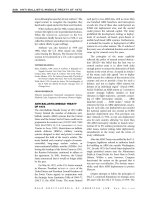
John Fitzgerald Kennedy 1917–1963
▼▼
▼▼
19001900
19751975
19501950
19251925
❖
❖
1917 Born,
Brookline, Mass.
1914–18
World War I
◆
1940 Graduated from
Harvard University
1943 PT boat attacked and destroyed in Pacific Ocean
1939–45
World War II
1941–45 Served in U.S Navy
1946–52 Served in U.S. House
1950–53
Korean War
1956 Profiles in
Courage
published; won
Pulitzer Prize for
biography
◆
1952–60 Served
in U.S. Senate
◆
1960 Elected president of the United States;
appointed his brother Robert U.S.
attorney general
◆
1961 Failed Bay of Pigs invasion;
summit meeting with Nikita Khrushchev
◆
1961–73
Vietnam War
◆
1968 Brother Robert Kennedy
assassinated during campaign
for president
◆
1964 Civil Rights Act
of 1964 passed
1963 Assassinated by Lee
Harvey Oswald in Dallas, Tex.
1962 Cuban Missile Crisis
◆
GALE ENCYCLOPEDIA OF AMERICAN LAW, 3RD E DITION
142 KENNEDY, JOHN FITZGERALD
presidential nominating speech for ADLAI STE-
VENSON
, of Illinois, who was nominated for a
second time to run against
DWIGHT D. EISEN-
HOWER
. Despite a vigorous effort, Kennedy lost
the vice presidential nomination to Senator
Estes Kefauver, of Tennessee.
In 1957 Kennedy was appointed to the
Senate Foreign Relations Committee, where he
became a critic of the Eisenhower administra-
tion’s foreign policy and a champion for
increased aid to underdeveloped countries. He
also served on the committee that investigated
corruption and
RACKETEERING in labor unions
and the head of the Teamsters Union,
JAMES R.
HOFFA.
In 1960 Kennedy won the Democratic
presidential nomination. He selected Senator
LYNDON B. JOHNSON, of Texas, to be his running
mate. After a vigorous campaign that included
television debates with Republican
RICHARD M.
NIXON, Kennedy won the election by fewer than
120,000 popular votes. He was the youngest
American ever to be elected president, as well
as the first Roman Catholic to hold the office.
His impressive inaugural speech contained the
popular phrase “Ask not what your country
can do for you—ask what y ou can do for your
country.”
Once in office, Kennedy drafted a series of
ambitious measures that were co llectively enti-
tled the New Frontier. These policies included
expanding the space program, instituting
CIVIL
RIGHTS
legislation, aiding education, improving
the tax system, and providing medical care for
older citizens through the
SOCIAL SECURITY
program. Most of the New Frontier programs
failed to progress through a Congress that was
dominated by southern Democratic leadership,
but many were enacted by President Johnson
following Kennedy’s assassination.
The Kennedy administration was enmeshed
in a series of foreign crises almost immediately.
In April 1961 Kenn edy was severely criticized
for approving an ill-fated invasion of the Bay
of Pigs, in Cuba. This clandestine operation,
conceived during the Eisenhower administra-
tion, was conducted by anti-Communist Cuban
exiles who had been trained in the United
States, and it was directed by the
CENTRAL
INTELLIGENCE AGENCY
. The invasion achieved
public notoriety when it failed and created
international tension.
In June 1961 Kennedy and Premier Nikita
Khrushchev, of the Soviet Union, met in Vienna
to discuss ways of improving Soviet-U.S.
relations. Instead of proceeding with those
discussions, Khrushchev announced an in-
creased alliance with East Germany. Later, the
Berlin Wall was constructed to prohibit West-
ern influence and to prevent persons from
fleeing East Germany. In response, the United
States added to its military forces in Germany.
The most serious crisis occurred in O ctober
1962, when the U.S. learned that Soviet missiles
were about to be placed in Cuba. Kennedy
issued a forceful statement demanding the
dismantling of the missile sites and ordered a
blockade to prevent the delivery of the missiles
to Cuba. The world was poised for nuclear war
until Khrushchev backed down and agreed to
Kennedy’s demands. Kennedy’s handling of the
crisis led to national acclaim.
U.S. involvement in Southeast Asia began to
increase during the Kennedy administration.
Kennedy agreed to send U.S. advisers to help
the South Vietnamese government fight Com-
munist rebels. In 1963 the United States be came
involved in overthro wing the corrupt and
unscrupulous South Vietnames e government
of President Ngo Dinh Diem.
On the domestic front, Kennedy interacted
with a newly invigorated
CIVIL RIGHTS MOVEMENT
John F. Kennedy.
LIBRARY OF CONGRESS
GALE ENCYCLOPEDIA OF AMERICAN LAW, 3RD E DITION
KENNEDY, JOHN FITZGERALD 143
that was seeking to integrate the South . In 1961
federal marshals were sent to Montgomery,
Alabama, to help restore order after race riots
had erupted. In 1962 Kennedy sent 3,000 federal
troops into Oxford, Mississippi, to restore order
after whites rioted against the University of
Mississippi’s admission of
JAMES MEREDITH, its
first African American student. In 1963 Ken-
nedy was forced to federalize the Alabama
NATIONAL GUARD in order to integrate the Univer-
sity of Alabama. Later that year, he federalized
the Guard again, in order to integrate the public
schools in three Alabama cities.
Faced with these problems, Kennedy pro-
posed legislation requiring that hotels, motels,
and restaurants admit customers regardless of
race. He also asked that the U.S. attorney
general be given authority to file lawsuits
demanding the desegregation of public schools.
Most of these proposals were passed in the Civil
Rights Act of 1964 (42 U.S.C.A. § 2000a et seq.).
Kennedy’s achievements during his brief
term as chief executive included an agreement
with the Soviet Union to restrict nuclear testing
to underground facilities; the creation of the
Alliance for Progress, to establish economic
programs to aid Latin America; and the creation
of the Peace Corps program, which provides U.S.
volunteers to work in underdeveloped countries.
On November 22, 1963, Kennedy’s term
was end ed by an assassin’s bullets in Dallas, and
Johnson was sworn in as president. Lee Harvey
Oswald was charged with the
MURDER. Oswald
was killed two days later by Dallas nightclub
owner
JACK RUBY, while being moved from the
city jail to the county jail. Johnson appointed
a commission headed by Chief Justice
EARL
WARREN
to investigate the Kennedy assassination.
In its report, issued in September 1964, the
commission concluded that Oswald had acted
alone in murdering Kennedy.
Kennedy’s assassination has remained one
of the nation’s most heated controversies. Many
people were initially doubtful of the report’s
conclusions, and the skepticism has grown over
time. Thousands of articles and books have
been written that challenge the commisssion’s
findings and allege that agencies of the federal
government withheld information from the
commission and that the commission itself
concealed evidence that contradicted its con-
clusions. In 1978 and 1979, the House Select
Committee on Assassinations re-examined the
evidence and concluded that Kennedy “was
probably assassinated as a result of a conspiracy.”
Nevertheless, critics charged that vital informa-
tion remained withheld from the public. In
an effort to restore government credibility,
Congress enacted the President
JOHN F. KENNEDY
Assassination Records Collection Act of 1992,
44 U.S.C.A. § 2107, which established the
Assassination Records Review Board, an inde-
pendent federal agency whose mission was to
identify and release as many records relating to
the assassination as possible. The board com-
pleted its work in 1998, releasing thousands of
documents relating to the events on, and
leading to, November 22, 1963. However, no
conclusive evidence has surfaced to indicate
the true assassin or any other individuals who
participated in the assassination.
Kennedy married Jacqueline Bouvier in
1953. They had two surviving children, Caroline
and John F. Kennedy Jr. Following Kennedy’s
death, the activities of Jacqueline and the two
children remained part of the American con-
sciousness. In 1968 Jacqueline married wealthy
Greek businessman Aristotle Onassis, who died
in 1975. She worked as an editor with Double-
day until her death in 1994. John F. Kennedy Jr.
emerged as a popular media figure, and in 1995
he founded the now-defunct political magazine
George. However, like his father, the junior
Kennedy died an early, tragic death when he
was killed in a plane crash along with his wife
and sister-in-law in 1999.
FURTHER READINGS
Anderson, Catherine Corley. 2004. John F. Kennedy.
Minneapolis: Lerner.
Kovaleff, Theodore P. 1992. “The Two Sides of the Kennedy
Antitrust Policy.” Antitrust Bulletin 37 (spring).
Raatma, Lucia. 2002. John F. Kennedy. Minneapolis, MN:
Compass Point.
Schlesinger, Arthur M. 2000. John F. Kennedy, Commander
In Chief: A Profile In Leadership. New York: Gramercy.
CROSS REFERENCES
Cuban Missile Crisis; “Inaugural Address” (Appendix,
Primary Document); Limited Test Ban Treaty; Warren
Commission.
v
KENNEDY, ROBERT FRANCIS
For more than 25 years in public service,
ROBERT FRANCIS KENNEDY was at the center of the
most important political and legal develop-
ments of his time. The younger b rother, by
five years, of President
JOHN F. KENNEDY,in
THE RIGHTS OF EVERY
MAN ARE DIMINISHED
WHEN THE RIGHTS OF
ONE MAN ARE
THREATENED
.
—JOHN F. KENNEDY
GALE ENCYCLOPEDIA OF AMERICAN LAW, 3RD E DITION
144 KENNEDY, ROBERT FRANCIS
whose cabinet he served, Bobby Kennedy held
a number of roles in gove rnment: assistant
counsel (1953–55) and chief counsel (1955–57)
to the Senate Permanent Subcommittee on
Investigations, chief counsel of the Senate
Rackets Committee (1957–59), U.S. attorney
general (1960–63), and finally U.S. senator from
New York (1965–68). His major endeavors
included probing union corruption in the 1950s
and implementing White House policy on the
CIVIL RIGHTS MOVEMENT in the early 1960s. He was
assassinated in 1968, like his brother before
him, while campaigning for the presidency.
Born into one of the United States’ most
powerful political dynasties, on November 20,
1925, in Brookline, Massachusetts, Kennedy was
the third son of Joseph P. Kennedy and Rose
Fitzgerald Kennedy. Great things were expected
of the Kennedy sons, and the means were
provided: $1-million trust funds, entrance to
the Ivy League, and later, leverage to see that they
held government positions. Kennedy’sfather,a
business magnate and former U.S. ambassador to
Great Britain, doted on the shy, bookish, and
devoutly Catholic young man. His father thought
Kennedy was most like himself: tough.
Kennedy was educated at Harvard College,
interrupting his studies to serve in
WORLD WAR II
as a Navy lieutenant, following the death of his
eldest brother, Joseph Patrick Kennedy, Jr.,
in the war. He served aboard the destroyer
Joseph P. Kennedy until being discharged in
1946, then returned to Harvard, where he
played football and earned his bachelor of arts
degree in 1948. He next traveled briefly to
Palestine as a war correspondent.
MARRIAGE
to Ethel Skakel followed in 1950, and a law
degree from the University of Virginia in 1951.
Kennedy and his wife had eleven children over
the next eighteen years.
Kennedy’s rapid ascent in national politics
began immediately upon his admission to the
Massachusetts bar in 1951. He first joined the
Criminal Division of the U.S.
JUSTICE DEPARTMENT
as a prosecutor. The next year he managed his
brother John’s senatorial campaign, and in early
1953 he was appointed an assistant counsel to
the Senate Permanent Subcommittee on Inves-
tigations, which became the bully pulpit for the
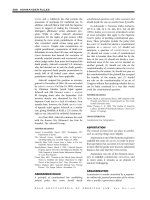
Robert Francis Kennedy 1925–1968
▼▼
▼▼
19251925
19751975
19501950
❖
1925 Born,
Brookline, Mass.
1939–45
World War II
1944–46 Served
in U.S. Navy
◆
1948 Earned A.B. from Harvard University
◆
1951 Earned LL.B.; joined Justice Department's Criminal Division
◆
1952 Ran brother John's first Senate campaign
1950–53
Korean War
1953–56
Served as
counsel to the
Senate
Permanent
Subcommittee
on
Investigations
1957–60 Served as chief counsel of Senate
Select Committee on Improper Activities
1961–73
Vietnam War
1965–68
Served as
U.S. senator
from N.Y.
❖
1968 Assassinated after
campaign rally in Los
Angeles, Calif.
1964 Pursuit of Justice published
◆
◆
1960–64 Served as U.S. attorney under JFK and
beginning of Lyndon Johnson's term
1960 Ran brother John's successful presidential
campaign; The Enemy Within published
◆
1964 Civil Rights Act
of 1964 passed
Robert Kennedy.
LIBRARY OF CONGRESS
GALE ENCYCLOPEDIA OF AMERICAN LAW, 3RD E DITION
KENNEDY, ROBERT FRANCIS 145
anti-Communist witch-hunts of its chairman,
Senator JOSEPH R. MCCARTHY. Kennedy worked
under McCarthy’s foremost ally, Chief Counsel
ROY COHN, and investigated international ship-
ping to Communist China, before resigning
over disgust with McCarthy in mid-1953.
Historians view his role in the
RED SCARE created
by the proceedings to have been very limited,
although some have argued that Kennedy was
initially blind to Senator McCarthy’s agenda.
Kennedy rejo ined the subcommittee in 1954,
and be came it s chief counsel and staff director
in 1955.
Under the new leadership of Senator
JOHN
MCCLELLAN
, the subcommittee turned its atten-
tion to labor
RACKETEERING. Kennedy focused
on corruption in the International Brotherhood
of Teamsters. Heading a staff of 65 investi-
gators, he squared off against the union’s
presidents, David Beck and
JAMES R. HOFFA,in
dramatic public hearings at which he often was
accompanied by his brother John. Kennedy and
the subcommittee believed the union had con-
nections to
ORGANIZED CRIME; the union viewed
Kennedy as a show-off who was persecuting it
for his own political benefit. The union leaders
frequently took the
FIFTH AMENDMENT, refusing to
answer questions under Kennedy’s relentless
grilling. Beck resigned and was later convicted;
Kennedy became a national figure. The hearings
began a long-running feud between Kennedy
and Hoffa that would continue into the 1960s.
Kennedy later devoted considerable resources
of the Justice Department to prosecuting Hoffa,
ultimately convicted in 1964 for jury tampering,
FRAUD, and conspiracy in the handling of a
Teamster benefit fund.
In 1960 Kennedy managed his brother
John’s presidential campaign. His reward was
the position of attorney general, an appoint-
ment that brought widespread criticism of the
president-elect for nepotism. But Kennedy’s
brother stood behind his decision, and thus
began a relationship unique in presidential
history: Throughout foreign policy crises in
Cuba and Vietnam, domestic unrest over
CIVIL
RIGHTS
, and especially the day-to-day function-
ing of the White House, Kennedy served as his
brother’s closest adviser. The two also shared a
common problem in the person of Director
J. Edgar Hoover, of the
FEDERAL BUREAU OF
INVESTIGATION
(FBI), who secretly kept tabs on
them while intensifying the FBI’s domestic
spying during the Kennedy administration.
The greatest crisis facing Attorney General
Kennedy was the civil rights movement. The
slow pace of change had frustrated civil rights
leaders and mounting violence—from beatings
to murder—brought pleas to the White House
for intercession to protect demonstrators. During
the Freedom Rides of 1961, for example, when
busloads of black activists sought to integrate bus
stations in the South, the movement’sleaders
appealed for help. Kennedy dispatched Justice
Department representatives to Alabama; asked
for assurances of protection from Governor John
Patterson, of that state; and brought suit to win
a court order on behalf of the riders. The
administration was reluctant to do more because
of concerns about limitations on federal power.
Then in May 1961, after more terrible assaults
on the activists in Montgomery, Alabama, the
attorney general dispatched 500 federal marshals
to Alabama. Yet the protection rendered did not
stop local authorities from arresting, jailing, and
beating activists.
The reluctance of the White House to
intercede more forcefully had a political rationale
as well: the new Kennedy administration had
won election by a small margin that included
southern support. As critics have noted, concerns
about federal authority did not stop the attorney
general from later authorizing Director Hoover
to place wiretaps on the Reverend
MARTIN LUTHER
KING
, JR., whom the pro-civil rights White House
treated as an ally. Hoover’s concerns about
King’s alleged Communist ties affected the
Kennedys. As Kennedy later told an interviewer,
“We never wanted to get very close to him just
because of these contacts and connections that
he had, which we felt were damaging to the civil
rights movement.” Nor did Kennedy balk at
approving the appointment of William Harold
Cox, an outspoken racist, as a district judge in
Mississippi, for reasons of political expediency,
although he later regretted having done so. In
time, Kennedy and the president took bolder
steps—in 1962, sending five thousand federal
marshals to quell rioting in Mississippi, after
JAMES H. MEREDITH became the first black man to
enter the state’s university, and later, securing
King’s release from jail in Birmingham, Alabama.
The ASSASSINATION of his brother John in
1963 changed the course of Kennedy’s life.
Besides grieving the loss of his brother, he
found he worked uncomfortably under Presi-
dent
LYNDON B. JOHNSON, and he soon left the
Justice Department. In 1964 he won election in
SOME MEN SEE
THINGS THAT ARE
,
AND ASK ‘WHY?’ I
SEE THINGS THAT
NEVER WERE
, AND
ASK
‘WHY NOT?’
—ROBERT F. KENNEDY
GALE ENCYCLOPEDIA OF AMERICAN LAW, 3RD E DITION
146 KENNEDY, ROBERT FRANCIS
New York to the U.S. Senate, where he served as
a liberal voice until announcing his own bid for
the presidency in 1968.
Emphasizing a commitment to the concerns
of young people, black citizens, and the nation’s
poor, the Kennedy campaign inspired radicals,
the working class, and the dispossessed. Kenne-
dy’s opposition to the war in Vietnam was
passionate. On a television broadcast, he said:
Do we have a right here in the United States to
say that we’re going to kill tens of thousands,
make millions of people, as we have
refugees, kill women and children? Ivery
seriously question th at right Weloveour
country for what it can be and for the justice it
stands for.
Kennedy’s candidacy sharply divided the
DEMOCRATIC PARTY between him and his opponent
for the nomination,
EUGENE MCCARTHY.Kennedy
had won primaries in Indiana, Nebraska, and
finally California, when he was shot at a
campaign function on June 4, 1968, by Sirhan
Sirhan, a Palestinian immigrant who said his
motive was the candidate’ssupportforIsrael.
The second
MURDER of a Kennedy, following hard
on the April 1968 assassination of King, was an
immeasurable shock to the nation. It seemed to
many to sound the death knell of an era.
Kennedy’s contribution to U.S. law is
complex. In the 1950s he helped expose
corruption in the nation’s unions, but critics
have subsequently treated his very personal
pursuit of Hoffa as an exercise not only in
justice but in vendetta. When he headed the
Justice Department in the early 1960s, his
advocacy of civil rights had practical limitations
imposed by political necessities and legitimate
concerns about the balance of state and federal
authority; groundbreaking civil rights legislation
would, of course, follow in the years after his
tenure. It was as a candidate for president that
he may have been his most memorable, an
ardent and inspirational voice. Through his
opposition to the
VIETNAM WAR and his support
for the disadvantaged, he offered the promise of
a new idealism in politics.
FURTHER READINGS
Edwards, Owen Dudley. 1984. “Remembering the Kenne-
dys.” Journal of American Studies 18, no. 3 (December).
Guthman, Edwin O., and Jeffrey Shulman, eds. 1991. Robert
Kennedy in His Own Words: The Unpublished Recollec-
tions of the Kennedy Years. New York: BDD Promo-
tional Books.
Mills, Judie. 1998. Robert Kennedy: His Life. Brookfield, CT:
Millbrook.
Schlesinger, Arthur M., Jr. 2002. Robert Kennedy and His
Times. Boston: Mariner.
Thomas, Evan. 2002. Robert Kennedy: His Life. New York:
Simon & Schuster.
v
KENT, JAMES
James Kent was a U.S. attorney, judge, and
scholar who played a central role in adapting
the common law of England into the common
law of the United States. As a justice and later
chief justice of the New York Supreme Court
and a chancellor of the New York Court of
Chancery (then the highest judicial officer in
New York), Kent wrote many decisions that
became foundations of nineteenth -century law.
Kent’s great legal treatise Commentaries on
American Law (1826–30) offered the first
comprehensive analysis of U.S. law.
Kent was born July 31, 1763, in Putnam
County, New York. In 1777 he entered Yale
University. The Revolutionary War periodically
▼▼
▼▼
James Kent 1763–1847
17501750
18001800
18251825
18501850
17751775
❖
1763 Born,
Putnam County,
New York
1765–69 Blackstone's Commentaries
on the Laws of England published
1775–83
American Revolution
1777–81
Attended
Yale
University
1790–93
Served in
New York
state
legislature
◆
1785 Admitted to New
York bar; began law
practice in Poughkeepsie
◆ ◆
1798 Joined
bench of New
York Supreme
Court
◆
1806 Became
chief
justice of
New York
Supreme
Court
1814 Appointed
chancellor of the
New York Court
of Chancery
◆
1793 Moved law practice to New York City; appointed
first professor of law at Columbia University
◆
1826–30
Commentaries
on American
Law published
1823 Forced to retire from bench at age 60; returned to
private practice and professorship at Columbia
❖
1847
Died,
New York
City
THE DIGNITY OR
INDEPENDENCE OF
OUR
COURTS IS NO
MORE AFFECTED BY
ADOPTING
[ENGLISH
JUDICIAL
PRECEDENTS]
, THAN
IN ADOPTING THE
ENGLISH LANGUAGE.
—JAMES KENT
GALE ENCYCLOPEDIA OF AMERICAN LAW, 3RD E DITION
KENT, JAMES 147