Thinking in C plus plus (P7) doc
Bạn đang xem bản rút gọn của tài liệu. Xem và tải ngay bản đầy đủ của tài liệu tại đây (166.72 KB, 50 trang )
280 Thinking in C++ www.BruceEckel.com
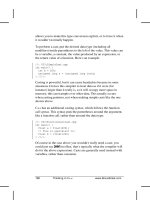
int i;
char j;
float f;
void func();
};
void B::func() {}
int main() {
A a; B b;
a.i = b.i = 1;
a.j = b.j = 'c';
a.f = b.f = 3.14159;
a.func();
b.func();
} ///:~
The
private
keyword, on the other hand, means that no one can
access that member except you, the creator of the type, inside
function members of that type.
private
is a brick wall between you
and the client programmer; if someone tries to access a
private
member, they’ll get a compile-time error. In
struct B
in the example
above, you may want to make portions of the representation (that
is, the data members) hidden, accessible only to you:
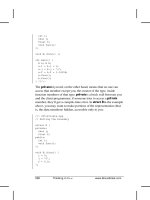
//: C05:Private.cpp
// Setting the boundary
struct B {
private:
char j;
float f;
public:
int i;
void func();
};
void B::func() {
i = 0;
j = '0';
f = 0.0;
};
5: Hiding the Implementation 281
int main() {
B b;
b.i = 1; // OK, public
//! b.j = '1'; // Illegal, private
//! b.f = 1.0; // Illegal, private
} ///:~
Although
func( )
can access any member of
B
(because
func( )
is a
member of
B
, thus automatically granting it permission), an
ordinary global function like
main( )
cannot. Of course, neither can
member functions of other structures. Only the functions that are
clearly stated in the structure declaration (the “contract”) can have
access to
private
members.
There is no required order for access specifiers, and they may
appear more than once. They affect all the members declared after
them and before the next access specifier.
protected
The last access specifier is
protected
.
protected
acts just like
private
, with one exception that we can’t really talk about right
now: “Inherited” structures (which cannot access
private
members)
are granted access to
protected
members. This will become clearer
in Chapter 14 when inheritance is introduced. For current
purposes, consider
protected
to be just like
private
.
Friends
What if you want to explicitly grant access to a function that isn’t a
member of the current structure? This is accomplished by declaring
that function a
friend
inside
the structure declaration. It’s important
that the
friend
declaration occurs inside the structure declaration
because you (and the compiler) must be able to read the structure
declaration and see every rule about the size and behavior of that
data type. And a very important rule in any relationship is, “Who
can access my private implementation?”
282 Thinking in C++ www.BruceEckel.com
The class controls which code has access to its members. There’s no
magic way to “break in” from the outside if you aren’t a
friend
;
you can’t declare a new class and say, “Hi, I’m a friend of
Bob
!”
and expect to see the
private
and
protected
members of
Bob
.
You can declare a global function as a
friend
, and you can also
declare a member function of another structure, or even an entire
structure, as a
friend
. Here’s an example :
//: C05:Friend.cpp
// Friend allows special access
// Declaration (incomplete type specification):
struct X;
struct Y {
void f(X*);
};
struct X { // Definition
private:
int i;
public:
void initialize();
friend void g(X*, int); // Global friend
friend void Y::f(X*); // Struct member friend
friend struct Z; // Entire struct is a friend
friend void h();
};
void X::initialize() {
i = 0;
}
void g(X* x, int i) {
x->i = i;
}
void Y::f(X* x) {
x->i = 47;
}
struct Z {
5: Hiding the Implementation 283
private:
int j;
public:
void initialize();
void g(X* x);
};
void Z::initialize() {
j = 99;
}
void Z::g(X* x) {
x->i += j;
}
void h() {
X x;
x.i = 100; // Direct data manipulation
}
int main() {
X x;
Z z;
z.g(&x);
} ///:~
struct Y
has a member function
f( )
that will modify an object of
type
X
. This is a bit of a conundrum because the C++ compiler
requires you to declare everything before you can refer to it, so
struct Y
must be declared before its member
Y::f(X*)
can be
declared as a friend in
struct X
. But for
Y::f(X*)
to be declared,
struct X
must be declared first!
Here’s the solution. Notice that
Y::f(X*)
takes the
address
of an
X
object. This is critical because the compiler always knows how to
pass an address, which is of a fixed size regardless of the object
being passed, even if it doesn’t have full information about the size
of the type. If you try to pass the whole object, however, the
compiler must see the entire structure definition of
X
, to know the
size and how to pass it, before it allows you to declare a function
such as
Y::g(X)
.
284 Thinking in C++ www.BruceEckel.com
By passing the address of an
X
, the compiler allows you to make an
incomplete type specification
of
X
prior to declaring
Y::f(X*)
. This is
accomplished in the declaration:
struct X;
This declaration simply tells the compiler there’s a
struct
by that
name, so it’s OK to refer to it as long as you don’t require any more
knowledge than the name.
Now, in
struct X
, the function
Y::f(X*)
can be declared as a
friend
with no problem. If you tried to declare it before the compiler had
seen the full specification for
Y
, it would have given you an error.
This is a safety feature to ensure consistency and eliminate bugs.
Notice the two other
friend
functions. The first declares an
ordinary global function
g( )
as a
friend
. But
g( )
has not been
previously declared at the global scope! It turns out that
friend
can
be used this way to simultaneously declare the function
and
give it
friend
status. This extends to entire structures:
friend struct Z;
is an incomplete type specification for
Z
, and it gives the entire
structure
friend
status.
Nested friends
Making a structure nested doesn’t automatically give it access to
private
members. To accomplish this, you must follow a particular
form: first, declare (without defining) the nested structure, then
declare it as a
friend
, and finally define the structure. The structure
definition must be separate from the
friend
declaration, otherwise
it would be seen by the compiler as a non-member. Here’s an
example:
//: C05:NestFriend.cpp
// Nested friends
#include <iostream>
5: Hiding the Implementation 285
#include <cstring> // memset()
using namespace std;
const int sz = 20;
struct Holder {
private:
int a[sz];
public:
void initialize();
struct Pointer;
friend Pointer;
struct Pointer {
private:
Holder* h;
int* p;
public:
void initialize(Holder* h);
// Move around in the array:
void next();
void previous();
void top();
void end();
// Access values:
int read();
void set(int i);
};
};
void Holder::initialize() {
memset(a, 0, sz * sizeof(int));
}
void Holder::Pointer::initialize(Holder* rv) {
h = rv;
p = rv->a;
}
void Holder::Pointer::next() {
if(p < &(h->a[sz - 1])) p++;
}
void Holder::Pointer::previous() {
if(p > &(h->a[0])) p ;
}
286 Thinking in C++ www.BruceEckel.com
void Holder::Pointer::top() {
p = &(h->a[0]);
}
void Holder::Pointer::end() {
p = &(h->a[sz - 1]);
}
int Holder::Pointer::read() {
return *p;
}
void Holder::Pointer::set(int i) {
*p = i;
}
int main() {
Holder h;
Holder::Pointer hp, hp2;
int i;
h.initialize();
hp.initialize(&h);
hp2.initialize(&h);
for(i = 0; i < sz; i++) {
hp.set(i);
hp.next();
}
hp.top();
hp2.end();
for(i = 0; i < sz; i++) {
cout << "hp = " << hp.read()
<< ", hp2 = " << hp2.read() << endl;
hp.next();
hp2.previous();
}
} ///:~
Once
Pointer
is declared, it is granted access to the private
members of
Holder
by saying:
friend Pointer;
5: Hiding the Implementation 287
The
struct Holder
contains an array of
int
s and the
Pointer
allows
you to access them. Because
Pointer
is strongly associated with
Holder
, it’s sensible to make it a member structure of
Holder
. But
because
Pointer
is a separate class from
Holder
, you can make
more than one of them in
main( )
and use them to select different
parts of the array.
Pointer
is a structure instead of a raw C pointer,
so you can guarantee that it will always safely point inside the
Holder
.
The Standard C library function
memset( )
(in
<cstring>
) is used
for convenience in the program above. It sets all memory starting at
a particular address (the first argument) to a particular value (the
second argument) for
n
bytes past the starting address (
n
is the
third argument). Of course, you could have simply used a loop to
iterate through all the memory, but
memset( )
is available, well-
tested (so it’s less likely you’ll introduce an error), and probably
more efficient than if you coded it by hand.
Is it pure?
The class definition gives you an audit trail, so you can see from
looking at the class which functions have permission to modify the
private parts of the class. If a function is a
friend
, it means that it
isn’t a member, but you want to give permission to modify private
data anyway, and it must be listed in the class definition so
everyone can see that it’s one of the privileged functions.
C++ is a hybrid object-oriented language, not a pure one, and
friend
was added to get around practical problems that crop up.
It’s fine to point out that this makes the language less “pure,”
because C++
is
designed to be pragmatic, not to aspire to an
abstract ideal.
288 Thinking in C++ www.BruceEckel.com
Object layout
Chapter 4 stated that a
struct
written for a C compiler and later
compiled with C++ would be unchanged. This referred primarily
to the object layout of the
struct
, that is, where the storage for the
individual variables is positioned in the memory allocated for the
object. If the C++ compiler changed the layout of C
struct
s, then
any C code you wrote that inadvisably took advantage of
knowledge of the positions of variables in the
struct
would break.
When you start using access specifiers, however, you’ve moved
completely into the C++ realm, and things change a bit. Within a
particular “access block” (a group of declarations delimited by
access specifiers), the variables are guaranteed to be laid out
contiguously, as in C. However, the access blocks may not appear
in the object in the order that you declare them. Although the
compiler will
usually
lay the blocks out exactly as you see them,
there is no rule about it, because a particular machine architecture
and/or operating environment may have explicit support for
private
and
protected
that might require those blocks to be placed
in special memory locations. The language specification doesn’t
want to restrict this kind of advantage.
Access specifiers are part of the structure and don’t affect the
objects created from the structure. All of the access specification
information disappears before the program is run; generally this
happens during compilation. In a running program, objects become
“regions of storage” and nothing more. If you really want to, you
can break all the rules and access the memory directly, as you can
in C. C++ is not designed to prevent you from doing unwise things.
It just provides you with a much easier, highly desirable
alternative.
In general, it’s not a good idea to depend on anything that’s
implementation-specific when you’re writing a program. When
you must have implementation-specific dependencies, encapsulate
5: Hiding the Implementation 289
them inside a structure so that any porting changes are focused in
one place.
The class
Access control is often referred to as
implementation hiding
.
Including functions within structures (often referred to as
encapsulation
1
) produces a data type with characteristics and
behaviors, but access control puts boundaries within that data type,
for two important reasons. The first is to establish what the client
programmers can and can’t use. You can build your internal
mechanisms into the structure without worrying that client
programmers will think that these mechanisms are part of the
interface they should be using.
This feeds directly into the second reason, which is to separate the
interface from the implementation. If the structure is used in a set
of programs, but the client programmers can’t do anything but
send messages to the
public
interface, then you can change
anything that’s
private
without requiring modifications to their
code.
Encapsulation and access control, taken together, invent something
more than a C
struct
. We’re now in the world of object-oriented
programming, where a structure is describing a class of objects as
you would describe a class of fishes or a class of birds: Any object
belonging to this class will share these characteristics and
behaviors. That’s what the structure declaration has become, a
description of the way all objects of this type will look and act.
In the original OOP language, Simula-67, the keyword
class
was
used to describe a new data type. This apparently inspired
Stroustrup to choose the same keyword for C++, to emphasize that
1
As noted before, sometimes access control is referred to as encapsulation.
290 Thinking in C++ www.BruceEckel.com
this was the focal point of the whole language: the creation of new
data types that are more than just C
struct
s with functions. This
certainly seems like adequate justification for a new keyword.
However, the use of
class
in C++ comes close to being an
unnecessary keyword. It’s identical to the
struct
keyword in
absolutely every way except one:
class
defaults to
private
, whereas
struct
defaults to
public
. Here are two structures that produce the
same result:
//: C05:Class.cpp
// Similarity of struct and class
struct A {
private:
int i, j, k;
public:
int f();
void g();
};
int A::f() {
return i + j + k;
}
void A::g() {
i = j = k = 0;
}
// Identical results are produced with:
class B {
int i, j, k;
public:
int f();
void g();
};
int B::f() {
return i + j + k;
}
void B::g() {
5: Hiding the Implementation 291
i = j = k = 0;
}
int main() {
A a;
B b;
a.f(); a.g();
b.f(); b.g();
} ///:~
The
class
is the fundamental OOP concept in C++. It is one of the
keywords that will
not
be set in bold in this book – it becomes
annoying with a word repeated as often as “class.” The shift to
classes is so important that I suspect Stroustrup’s preference would
have been to throw
struct
out altogether, but the need for
backwards compatibility with C wouldn’t allow that.
Many people prefer a style of creating classes that is more
struct
-
like than class-like, because you override the “default-to-
private
”
behavior of the class by starting out with
public
elements:
class X {
public:
void interface_function();
private:
void private_function();
int internal_representation;
};
The logic behind this is that it makes more sense for the reader to
see the members of interest first, then they can ignore anything that
says
private
. Indeed, the only reasons all the other members must
be declared in the class at all are so the compiler knows how big the
objects are and can allocate them properly, and so it can guarantee
consistency.
The examples in this book, however, will put the
private
members
first, like this:
class X {
void private_function();
292 Thinking in C++ www.BruceEckel.com
int internal_representation;
public:
void interface_function();
};
Some people even go to the trouble of decorating their own private
names:
class Y {
public:
void f();
private:
int mX; // "Self-decorated" name
};
Because
mX
is already hidden in the scope of
Y
, the
m
(for
“member”) is unnecessary. However, in projects with many global
variables (something you should strive to avoid, but which is
sometimes inevitable in existing projects), it is helpful to be able to
distinguish inside a member function definition which data is
global and which is a member.
Modifying Stash to use access control
It makes sense to take the examples from Chapter 4 and modify
them to use classes and access control. Notice how the client
programmer portion of the interface is now clearly distinguished,
so there’s no possibility of client programmers accidentally
manipulating a part of the class that they shouldn’t.
//: C05:Stash.h
// Converted to use access control
#ifndef STASH_H
#define STASH_H
class Stash {
int size; // Size of each space
int quantity; // Number of storage spaces
int next; // Next empty space
// Dynamically allocated array of bytes:
unsigned char* storage;
void inflate(int increase);
5: Hiding the Implementation 293
public:
void initialize(int size);
void cleanup();
int add(void* element);
void* fetch(int index);
int count();
};
#endif // STASH_H ///:~
The
inflate( )
function has been made
private
because it is used
only by the
add( )
function and is thus part of the underlying
implementation, not the interface. This means that, sometime later,
you can change the underlying implementation to use a different
system for memory management.
Other than the name of the include file, the header above is the
only thing that’s been changed for this example. The
implementation file and test file are the same.
Modifying Stack to use access control
As a second example, here’s the
Stack
turned into a class. Now the
nested data structure is
private
, which is nice because it ensures
that the client programmer will neither have to look at it nor be
able to depend on the internal representation of the
Stack
:
//: C05:Stack2.h
// Nested structs via linked list
#ifndef STACK2_H
#define STACK2_H
class Stack {
struct Link {
void* data;
Link* next;
void initialize(void* dat, Link* nxt);
}* head;
public:
void initialize();
void push(void* dat);
void* peek();
void* pop();
294 Thinking in C++ www.BruceEckel.com
void cleanup();
};
#endif // STACK2_H ///:~
As before, the implementation doesn’t change and so it is not
repeated here. The test, too, is identical. The only thing that’s been
changed is the robustness of the class interface. The real value of
access control is to prevent you from crossing boundaries during
development. In fact, the compiler is the only thing that knows
about the protection level of class members. There is no access
control information mangled into the member name that carries
through to the linker. All the protection checking is done by the
compiler; it has vanished by runtime.
Notice that the interface presented to the client programmer is now
truly that of a push-down stack. It happens to be implemented as a
linked list, but you can change that without affecting what the
client programmer interacts with, or (more importantly) a single
line of client code.
Handle classes
Access control in C++ allows you to separate interface from
implementation, but the implementation hiding is only partial. The
compiler must still see the declarations for all parts of an object in
order to create and manipulate it properly. You could imagine a
programming language that requires only the public interface of an
object and allows the private implementation to be hidden, but C++
performs type checking statically (at compile time) as much as
possible. This means that you’ll learn as early as possible if there’s
an error. It also means that your program is more efficient.
However, including the private implementation has two effects: the
implementation is visible even if you can’t easily access it, and it
can cause needless recompilation.
5: Hiding the Implementation 295
Hiding the implementation
Some projects cannot afford to have their implementation visible to
the client programmer. It may show strategic information in a
library header file that the company doesn’t want available to
competitors. You may be working on a system where security is an
issue – an encryption algorithm, for example – and you don’t want
to expose any clues in a header file that might help people to crack
the code. Or you may be putting your library in a “hostile”
environment, where the programmers will directly access the
private components anyway, using pointers and casting. In all
these situations, it’s valuable to have the actual structure compiled
inside an implementation file rather than exposed in a header file.
Reducing recompilation
The project manager in your programming environment will cause
a recompilation of a file if that file is touched (that is, modified)
or
if
another file it’s dependent upon – that is, an included header file –
is touched. This means that any time you make a change to a class,
whether it’s to the public interface or to the private member
declarations, you’ll force a recompilation of anything that includes
that header file. This is often referred to as the
fragile base-class
problem
. For a large project in its early stages this can be very
unwieldy because the underlying implementation may change
often; if the project is very big, the time for compiles can prohibit
rapid turnaround.
The technique to solve this is sometimes called
handle classes
or the
“Cheshire cat”
2
– everything about the implementation disappears
except for a single pointer, the “smile.” The pointer refers to a
structure whose definition is in the implementation file along with
all the member function definitions. Thus, as long as the interface is
2
This name is attributed to John Carolan, one of the early pioneers in C++, and of
course, Lewis Carroll. This technique can also be seen as a form of the “bridge”
design pattern, described in Volume 2.
296 Thinking in C++ www.BruceEckel.com
unchanged, the header file is untouched. The implementation can
change at will, and only the implementation file needs to be
recompiled and relinked with the project.
Here’s a simple example demonstrating the technique. The header
file contains only the public interface and a single pointer of an
incompletely specified class:
//: C05:Handle.h
// Handle classes
#ifndef HANDLE_H
#define HANDLE_H
class Handle {
struct Cheshire; // Class declaration only
Cheshire* smile;
public:
void initialize();
void cleanup();
int read();
void change(int);
};
#endif // HANDLE_H ///:~
This is all the client programmer is able to see. The line
struct Cheshire;
is an
incomplete type specification
or a
class declaration
(A
class
definition
includes the body of the class.) It tells the compiler that
Cheshire
is a structure name, but it doesn’t give any details about
the
struct
. This is only enough information to create a pointer to the
struct
; you can’t create an object until the structure body has been
provided. In this technique, that structure body is hidden away in
the implementation file:
//: C05:Handle.cpp {O}
// Handle implementation
#include "Handle.h"
#include " /require.h"
// Define Handle's implementation:
5: Hiding the Implementation 297
struct Handle::Cheshire {
int i;
};
void Handle::initialize() {
smile = new Cheshire;
smile->i = 0;
}
void Handle::cleanup() {
delete smile;
}
int Handle::read() {
return smile->i;
}
void Handle::change(int x) {
smile->i = x;
} ///:~
Cheshire
is a nested structure, so it must be defined with scope
resolution:
struct Handle::Cheshire {
In
Handle::initialize( )
, storage is allocated for a
Cheshire
structure, and in
Handle::cleanup( )
this storage is released. This
storage is used in lieu of all the data elements you’d normally put
into the
private
section of the class. When you compile
Handle.cpp
,
this structure definition is hidden away in the object file where no
one can see it. If you change the elements of
Cheshire
, the only file
that must be recompiled is
Handle.cpp
because the header file is
untouched.
The use of
Handle
is like the use of any class: include the header,
create objects, and send messages.
//: C05:UseHandle.cpp
//{L} Handle
// Use the Handle class
#include "Handle.h"
298 Thinking in C++ www.BruceEckel.com
int main() {
Handle u;
u.initialize();
u.read();
u.change(1);
u.cleanup();
} ///:~
The only thing the client programmer can access is the public
interface, so as long as the implementation is the only thing that
changes, the file above never needs recompilation. Thus, although
this isn’t perfect implementation hiding, it’s a big improvement.
Summary
Access control in C++ gives valuable control to the creator of a
class. The users of the class can clearly see exactly what they can
use and what to ignore. More important, though, is the ability to
ensure that no client programmer becomes dependent on any part
of the underlying implementation of a class. If you know this as the
creator of the class, you can change the underlying implementation
with the knowledge that no client programmer will be affected by
the changes because they can’t access that part of the class.
When you have the ability to change the underlying
implementation, you can not only improve your design at some
later time, but you also have the freedom to make mistakes. No
matter how carefully you plan and design, you’ll make mistakes.
Knowing that it’s relatively safe to make these mistakes means
you’ll be more experimental, you’ll learn faster, and you’ll finish
your project sooner.
The public interface to a class is what the client programmer
does
see, so that is the most important part of the class to get “right”
during analysis and design. But even that allows you some leeway
for change. If you don’t get the interface right the first time, you can
5: Hiding the Implementation 299
add
more functions, as long as you don’t remove any that client
programmers have already used in their code.
Exercises
Solutions to selected exercises can be found in the electronic document
The Thinking in C++ Annotated
Solution Guide
, available for a small fee from www.BruceEckel.com.
1. Create a class with
public
,
private
, and
protected
data
members and function members. Create an object of this
class and see what kind of compiler messages you get
when you try to access all the class members.
2. Write a
struct
called
Lib
that contains three
string
objects
a
,
b,
and
c
. In
main( )
create a
Lib
object called
x
and
assign to
x.a
,
x.b
, and
x.c
. Print out the values. Now
replace
a
,
b,
and
c
with an array of
string s[3]
. Show that
your code in
main( )
breaks as a result of the change.
Now create a
class
called
Libc
, with
private
string
objects
a
,
b,
and
c
, and member functions
seta( )
,
geta( )
,
setb( )
,
getb( )
,
setc( )
, and
getc( )
to set and get the
values. Write
main( )
as before. Now change the
private
string
objects
a
,
b,
and
c
to a
private
array of
string s[3]
.
Show that the code in
main( )
does
not
break as a result
of the change.
3. Create a class and a global
friend
function that
manipulates the
private
data in the class.
4. Write two classes, each of which has a member function
that takes a pointer to an object of the other class. Create
instances of both objects in
main( )
and call the
aforementioned member function in each class.
5. Create three classes. The first class contains
private
data,
and grants friendship to the entire second class and to a
member function of the third class. In
main( )
,
demonstrate that all of these work correctly.
6. Create a
Hen
class. Inside this, nest a
Nest
class. Inside
Nest
, place an
Egg
class. Each class should have a
300 Thinking in C++ www.BruceEckel.com
display( )
member function. In
main( )
, create an instance
of each class and call the
display( )
function for each one.
7. Modify Exercise 6 so that
Nest
and
Egg
each contain
private
data. Grant friendship to allow the enclosing
classes access to this
private
data.
8. Create a class with data members distributed among
numerous
public
,
private,
and
protected
sections. Add a
member function
showMap( )
that prints the names of
each of these data members and their addresses. If
possible, compile and run this program on more than one
compiler and/or computer and/or operating system to
see if there are layout differences in the object.
9. Copy the implementation and test files for
Stash
in
Chapter 4 so that you can compile and test
Stash.h
in this
chapter.
10. Place objects of the
Hen
class from Exercise 6 in a
Stash
.
Fetch them out and print them (if you have not already
done so, you will need to add
Hen::print( )
).
11. Copy the implementation and test files for
Stack
in
Chapter 4 so that you can compile and test
Stack2.h
in
this chapter.
12. Place objects of the
Hen
class from Exercise 6 in a
Stack
.
Fetch them out and print them (if you have not already
done so, you will need to add
Hen::print( )
).
13. Modify
Cheshire
in
Handle.cpp
, and verify that your
project manager recompiles and relinks only this file, but
doesn’t recompile
UseHandle.cpp
.
14. Create a
StackOfInt
class (a stack that holds
int
s) using
the “Cheshire cat” technique that hides the low-level data
structure you use to store the elements in a class called
StackImp
. Implement two versions of
StackImp
: one
that uses a fixed-length array of
int
, and one that uses a
vector<int>
. Have a preset maximum size for the stack so
you don’t have to worry about expanding the array in
the first version. Note that the
StackOfInt.h
class doesn’t
have to change with
StackImp
.
301
6: Initialization
& Cleanup
Chapter 4 made a significant improvement in library
use by taking all the scattered components of a typical
C library and encapsulating them into a structure (an
abstract data type, called a
class
from now on).
302 Thinking in C++ www.BruceEckel.com
This not only provides a single unified point of entry into a library
component, but it also hides the names of the functions within the
class name. In Chapter 5, access control (implementation hiding)
was introduced. This gives the class designer a way to establish
clear boundaries for determining what the client programmer is
allowed to manipulate and what is off limits. It means the internal
mechanisms of a data type’s operation are under the control and
discretion of the class designer, and it’s clear to client programmers
what members they can and should pay attention to.
Together, encapsulation and access control make a significant step
in improving the ease of library use. The concept of “new data
type” they provide is better in some ways than the existing built-in
data types from C. The C++ compiler can now provide type-
checking guarantees for that data type and thus ensure a level of
safety when that data type is being used.
When it comes to safety, however, there’s a lot more the compiler
can do for us than C provides. In this and future chapters, you’ll
see additional features that have been engineered into C++ that
make the bugs in your program almost leap out and grab you,
sometimes before you even compile the program, but usually in the
form of compiler warnings and errors. For this reason, you will
soon get used to the unlikely-sounding scenario that a C++
program that compiles often runs right the first time.
Two of these safety issues are initialization and cleanup. A large
segment of C bugs occur when the programmer forgets to initialize
or clean up a variable. This is especially true with C libraries, when
client programmers don’t know how to initialize a
struct
, or even
that they must. (Libraries often do not include an initialization
function, so the client programmer is forced to initialize the
struct
by hand.) Cleanup is a special problem because C programmers are
comfortable with forgetting about variables once they are finished,
so any cleaning up that may be necessary for a library’s
struct
is
often missed.
6: Initialization & Cleanup 303
In C++, the concept of initialization and cleanup is essential for
easy library use and to eliminate the many subtle bugs that occur
when the client programmer forgets to perform these activities.
This chapter examines the features in C++ that help guarantee
proper initialization and cleanup.
Guaranteed initialization with the
constructor
Both the
Stash
and
Stack
classes defined previously have a
function called
initialize( )
, which hints by its name that it should
be called before using the object in any other way. Unfortunately,
this means the client programmer must ensure proper initialization.
Client programmers are prone to miss details like initialization in
their headlong rush to make your amazing library solve their
problem. In C++, initialization is too important to leave to the client
programmer. The class designer can guarantee initialization of
every object by providing a special function called the
constructor
. If
a class has a constructor, the compiler automatically calls that
constructor at the point an object is created, before client
programmers can get their hands on the object. The constructor call
isn’t even an option for the client programmer; it is performed by
the compiler at the point the object is defined.
The next challenge is what to name this function. There are two
issues. The first is that any name you use is something that can
potentially clash with a name you might like to use as a member in
the class. The second is that because the compiler is responsible for
calling the constructor, it must always know which function to call.
The solution Stroustrup chose seems the easiest and most logical:
the name of the constructor is the same as the name of the class. It
makes sense that such a function will be called automatically on
initialization.
Here’s a simple class with a constructor:
304 Thinking in C++ www.BruceEckel.com
class X {
int i;
public:
X(); // Constructor
};
Now, when an object is defined,
void f() {
X a;
//
}
the same thing happens as if
a
were an
int
: storage is allocated for
the object. But when the program reaches the
sequence point
(point
of execution) where
a
is defined, the constructor is called
automatically. That is, the compiler quietly inserts the call to
X::X( )
for the object
a
at the point of definition. Like any member function,
the first (secret) argument to the constructor is the
this
pointer – the
address of the object for which it is being called. In the case of the
constructor, however,
this
is pointing to an un-initialized block of
memory, and it’s the job of the constructor to initialize this memory
properly.
Like any function, the constructor can have arguments to allow you
to specify how an object is created, give it initialization values, and
so on. Constructor arguments provide you with a way to guarantee
that all parts of your object are initialized to appropriate values. For
example, if a class
Tree
has a constructor that takes a single integer
argument denoting the height of the tree, then you must create a
tree object like this:
Tree t(12); // 12-foot tree
If
Tree(int)
is your only constructor, the compiler won’t let you
create an object any other way. (We’ll look at multiple constructors
and different ways to call constructors in the next chapter.)
That’s really all there is to a constructor; it’s a specially named
function that is called automatically by the compiler for every