Calculus: An Integrated Approach to Functions and their Rates of Change, Preliminary Edition Part 16 pptx
Bạn đang xem bản rút gọn của tài liệu. Xem và tải ngay bản đầy đủ của tài liệu tại đây (205.73 KB, 10 trang )
3.4 Altered Functions, Altered Graphs: Stretching, Shrinking, Shifting, and Flipping 131
y
x
f(x) = x
2
y
x
y
x
f(x) = x
2
–1
y
x
y =
x
2
1
y =
x = 1 x = –1
x
2
–1
1
–11
–1
–1
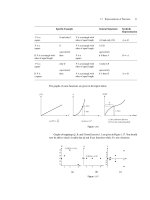
Figure 3.13
Answers to Selected Exercises
Answer to Exercise 3.7
h(x) = x ·
1
x
=
x
x
=
1 for x = 0
undefined for x = 0
1
x
h
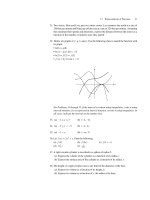
Figure 3.14
Your calculator probably won’t indicate the pinhole in the graph.
Answer to Exercise 3.8
i.
f(3)=
3
3 − 1
+ 2(3)
=
3
2
+ 6 = 7.5
132 CHAPTER 3 Functions Working Together
ii.
f(y +1)=
y +1
(y + 1) − 1
+ 2(y + 1)
=
y + 1
y
+ 2y + 2
= 1 + 1/y + 2y + 2
= 2y + 3 + 1/y
iii.
f(1/x) =
1/x
(1/x) − 1
+ 2(1/x)
=
1
x
1
x
−
x
x
+
2
x
=
1
x
1−x
x
+
2
x
=
1
x
x
1 − x
+
2
x
=
1
1 − x
+
2
x
If you want to add the fractions, get a common denominator.
x
(1 − x)x
+
2(1 − x)
x(1 − x)
=
x + 2 − 2x
(1 − x)x
=
2 − x
(1 − x)x
iv.
f(x +h) =
x + h
x + h − 1
+ 2(x + h) =
x + h
x + h − 1
+
(2x + 2h)(x + h − 1)
x + h − 1
=
x + h + 2x
2
+ 2xh − 2x + 2hx + 2h
2
− 2h
x + h − 1
=
2x
2
+ 4xh − x + 2h
2
− h
x + h − 1
v.
f(2h)
h
=
2h
2h−1
+ 2(2h)
h
=
2h
2h−1
+ 4h
h
=
2h
2h−1
+
4h(2h−1)
2h−1
h
=
2h+8h
2
−4h
2h−1
h
3.4 Altered Functions, Altered Graphs: Stretching, Shrinking, Shifting, and Flipping 133
=
8h
2
− 2h
2h − 1
1
h
=
(8h − 2)(h)
2h − 1
1
h
=
8h − 2
2h − 1
or
2(4h − 1)
2h − 1
Solution to Exercise 3.11
All but the last two pairs of functions give a decomposition.
PROBLEMS FOR SECTION 3.4
1. The zeros of the function f(x)are at x =−4, −1, 2, and 8. What are the zeros of
(a) m(x) = 5f(x)?
(b) g(x) = f(x+2)?
(c) h(x) = f(2x)?
(d) j(x)=f(x −1)?
Verify your answers analytically.
2. The zeros of the function f(x) are at x =−5, −2, 0, and 5. Find the zeros of the
following functions. If there is not enough information to determine this, say so.
(a) g(x) = 3|f(x)|
(b) h(x) = w(f (x)), where w(x) =−2x
2
(c) p(x) = 3f(x)+1
(d) q(x) = 4f(x+1)
(e) m(x) = 4f(−x)
(f) n(x) =−f(x)
3. The graph of y = f(x)is symmetric about the y-axis. Which of the following functions
is equal to f(x)?
(a) g(x) =−f(x)
(b) h(x) = f(−x)
(c) j(x)=−f(−x)
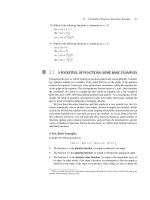
4. Using what you know about shifting, flipping, and stretching, match the graphs on page
135 with the equations.
(a) y =
−3
x
(b) y =
1
x−3
(c) y =
1
x+1
− 1
(d) y = 2
1
x+1
+ 1
(e) y =
−2
x+1
− 1
134 CHAPTER 3 Functions Working Together
x
y
y = 2
y = –1
y = –1
x
y
x
y
x
y
x
y
x
y
(i) (ii) (iii)
(iv) (v) (vi)
5. Below is the graph of y = 2
x
.
As x →∞, y→∞.
As x →−∞, y→0.
2
x
1
x
y
Using what you know about shifting, flipping, and sliding, match the graphs on the
following page with the equations.
(a) y =−2
x
(b) y = 2
−x
(c) y = 2
x
+ 1
(d) y = 2
−x
− 1
(e) y =−2
−x
+1
(f) y =−2
x
+1
3.4 Altered Functions, Altered Graphs: Stretching, Shrinking, Shifting, and Flipping 135
(i)
y
x
y
x
y
x
y
x
y
x
y
x
y
x
y
x
(ii) (iii)
(vii) (viii)(v) (vi)
(iv)
6. Using what you know about shifting, flipping, and stretching, match the graphs below
with the equations.
(a) y =|x−2|
(b) y =−3|x+1|
(c) y =|x+1|+2
(d) y =−|x+1|−1
(i) (ii) (iii)
(vii) (viii)(v) (vi)
(iv)
y
y
yyy
y
yy
xxxx
xxxyx
7. Applying what you learned in the last section of this chapter to the pocketful of
functions you’ve been introduced to (the identity, squaring, reciprocal, and absolute
value functions), graph the following functions. Label any asymptotes and x- and
y-intercepts.
136 CHAPTER 3 Functions Working Together
(a) f(x)=
1
x
2
(b) g(x) =|(x − 1)
2
|
(c) h(x) =|x
2
−1|
(d) j(x)=
1
x+1
+ 2
(e) m(x) =
−1
x−2
+ 1
(f) p(x) =
1
x
8. Which of the functions in the previous problem are even?
9. f is a function with domain [−3, 4]. The graph of f is given below. Sketch g(x) =
f(x +2).What is the domain of g(x)?
1
2
3
(2, 2)
(–3, –2)
(4, –1)
Graph the functions in Problems 10 through 18 by starting with the graph of a famil-
iar function and applying appropriate shifts, flips, and stretches. Label all x- and
y-intercepts and the coordinates of any vertices and corners. Use exact values,
not numerical approximations.
10. (a) y = (x − 1)
2
(b) y =−x
2
−1
11. (a) y =|x+2|
(b) y =−|x|+2
12. (a) y =−(x + 3)
2
− 1
(b) y = (x − 3)
2
+ 1
13. (a) y =−2(x + 1)
2
+ 3
(b) y + 3 = 7(x + 1)
2
14. (a) y =
2
x+4
+ 1
(b) y =
−1
x−π
15. (a) y =−x+π
(b) y =−(x + π)
3.4 Altered Functions, Altered Graphs: Stretching, Shrinking, Shifting, and Flipping 137
16. (a) y − π = (x − 2π)
2
(b) y − π =−(x − 2π)
2
17. (a) y =
x+3
x+2
(rewrite x + 3asx+2+1)
(b) y =
x+1
x−1
18. (a) y =−1−2|x+1|
(b) y =−1−2(x + 1)
2
For Problems 19 through 21, let f(x)=|x|.Graph the functions on the same set of
axes.
19. g(x) = (x − 3)
2
− 4 and f(g(x))
20. g(x) =−(x + 2)
2
+ 1 and f(g(x))
21. g(x) =|x−2|−3and f(g(x))
22. Let f(x)=
1
x
and g(x) = x
2
. Using what you’ve learned in Section 3.4, graph the
following equations.
(a) y = f(g(x))
(b) y =|g(x − 1) − 4|
(c) y =|f(x)|−1
23. The graph of y = f(x)is given below.
1
–1
– 6 –336
x
f
138 CHAPTER 3 Functions Working Together
Sketch:
(a) y = f(x −3)
(b) y = 2f(x)
(c) y =−.5f(x)
(d) y = f(x/2)
24. A and B are points on the graph of k(x). The x-coordinate of point A is 6 and the
x-coordinate of point B is (6 + h). Write mathematical expressions, using functional
notation, for each of the following.
(a) The change in value of the function from point A to point B
(b) The average rate of change of the function k over the interval [6, 6 + h]
(c) Suppose that the average rate of change of the function k over the interval [6, 6 + h]
is −5. The functions f , g, and h are defined as follows:
f(x)=k(x) + 2, g(x) = k(x + 2), h(x) = 2k(x).
i. Which of the following must also be equal to −5?
A. The average rate of change of the function f over the interval [6, 6 + h]
B. The average rate of change of the function g over the interval [6, 6 + h]
C. The average rate of change of the function h over the interval [6, 6 + h]
ii. One of the functions f , g, and h has an average value of −10 on the interval
[6, 6 + h]. Which is it? Explain briefly.
PART
II
Rates of Change: An Introduction
to the Derivative
4
CHAPTER
Linearity and Local Linearity
4.1 MAKING PREDICTIONS: AN INTUITIVE APPROACH
TO LOCAL LINEARITY
Every day we are bombarded with predictions; weather forecasters, sports announcers, fi-
nancial consultants, demographers, experts, and self-proclaimed experts alike are constantly
letting us know what they think will happen in the future. And, based on certain assump-
tions, each of us makes his or her own projections and acts accordingly. Let’s look at a
couple of examples.
◆
EXAMPLE 4.1 It is Thursday, November 6, 1997, and a student is sitting at her desk making a schedule
for herself. She likes to have completed her daily afternoon run by sunset, so she has been
checking the local newspaper for sunset times. She has recorded the following information.
1
1
These times (and all that follow in this problem) are given in Greenwich mean time for a north latitude of 30
◦
. Source, 1998
World Almanac.
139
140 CHAPTER 4 Linearity and Local Linearity
Date Sunset Time
Tuesday, November 4 5:11 p.m.
Wednesday, November 5 5:10 p.m.
Thursday, November 6 5:09 p.m.
She estimates that on Sunday, November 9, the sun will set at 5:06 p.m. Upon what
assumptions is her projection based? Is it reasonable to use the same assumptions to predict
the time of sunset on November 20, 1997? On December 25, 1997? One year later, on
November 6, 1998?
SOLUTION Over the past few days the hour of sunset had been getting earlier at a rate of 1 minute/day.
2
In other words, the sunset time has been changing at a rate of −1 minute/day. Assuming that
this rate of change remains constant for the next few days, then three days later the sunset
will be three minutes earlier than it was on November 6.
Change in sunset time = (rate of change per day) · (days)
=−1
minute
day
· (3 days) =−3minutes
The predicted sunset time is
5:09 p.m. +
−1
minute
day
· (3 days) = 5:09 p.m. − 3 minutes = 5:06 p.m.
Keep in mind that this prediction is based upon the assumption that the time of sunset is
changing at a constant rate of −1 minute/day throughout the six-day period. If this were
correct, then the graph of sunset time plotted versus the date would be a straight line.
time
date
Figure 4.1
If we used the same assumptions to predict the hour of sunset on November 20, 1997, we’d
get
5:09 p.m. +
−1
minute
day
(14 days) = 5:09 p.m. − 14 minutes = 4:55 p.m.
In fact, on Sunday, November 9, sunset was at 5:07 p.m., while on November 20 it was at
5:02 p.m.
Common sense tells us that it is unreasonable to assume that the sun will continue to set
a minute earlier every day over a long period of time. By December 25 the days are getting
longer; sunset is at 5:07 p.m., not at 4:20 p.m., the prediction based on a constant rate of
2
This is the best we can say given the degree of accuracy in the newspaper accounts. The newspaper has rounded off to the
nearest minute.