Lecture Notes in Computer Science- P62 docx
Bạn đang xem bản rút gọn của tài liệu. Xem và tải ngay bản đầy đủ của tài liệu tại đây (168.23 KB, 5 trang )
294 Y. Sheng et al.
results of FIRLowFilter component are sent to another Oscilloscope component to
display.
Users can compare the results of the Adder component with the result of the
FIRLowFilter component in the two Oscilloscope components.
(6) Execute step (5) iteratively until users push “stop” button.
The experiment result is shown in Fig.11. The left frame is the signal of the Adder
component, and the right frame is the signal processed by the FIRLowFilter compo-
nent. In the experiment flow, we notice that the signals are changed according to the
iteration of the step (5), which improves the effect of the experiment. Then user can
get more knowledge about low-pass filter.
6 Conclusion
In view of the question existing in the design and development of present VL, this
paper proposed the design and realization methods of laboratory platform based on
the integration of Java and Matlab. The combination of Beans components and Mat-
lab in the VL-JM platform enhanced the developing efficiency of components. The
VL-JM platform has the following characteristics:
(1) Make the development of components efficient.
(2) Be independent-platform.
(3) Make it easy to construct one virtual laboratory.
(4) Have friendly user interface.
(5) Make the component reusable.
References
1. JMatLink,
2. Wang, J., Chen, S., Jia, W., Pei, H.: The Design and Implementation of Virtual Laboratory
Platform in Internet. In: Proceedings of The First International Conference on Web-based
Learning in China, August 17-19, 2002, pp. 169–177 (2002)
3. Cao, J., Chan, A., Cao, W., Yeung, C.: Virtual Programming Lab for Online Distance
Learning. In: Fong, J., Cheung, C.T., Leong, H.V., Li, Q. (eds.) ICWL 2002. LNCS,
vol. 2436, pp. 216–227. Springer, Heidelberg (2002)
4. Subramanian, R., Marsic, I.: ViBE: Virtual Biology Experiments. In: Proceeding of the
Tenth International World Wide Web Conference (WWW10) (2001)
5. Wang, J., Lu, W., Jia, W.: A Web-Based Environment for Virtual Laboratory with
CORBA Technology. International Journal of Computer Processing of Oriental Lan-
guages 16(4), 261–274 (2003)
6. Muller, S., Waller, H.: Efficient Integration of Real-Time Hardware and Web Based Ser-
vices Into MATLAB. In: ESS 1999 11th European Simulation Symposium and Exhibition,
October 26-28, 1999. Erlangen-Nuremberg (1999)
7. Lobov, A., Lastra, J.L.M., Tuokko, R.: A Collaborative Framework for Learning Robot
Mechanics: RIO-Robotics Illustrative Software. In: The 33rd ASEE/IEEE Frontiers in
Education Conference, November 5-8, 2003, pp. 12–16 (2003)
8. Bai, Y.: Application Interface Programming Using Multiple Languages, March 21, 2003,
pp. 266–287. Prentice Hall PTR, Englewood Cliffs (2003)
A Virtual Laboratory Platform Based on Integration of Java and Matlab 295
9. Jianxin, W., Bei, P., Weijia, J.: Design and Implementation of Virtual Computer Network
Lab Based on NS2 in the Internet. In: Liu, W., Shi, Y., Li, Q. (eds.) ICWL 2004. LNCS,
vol. 3143, pp. 346–353. Springer, Heidelberg (2004)
10. Wang, J., Liu, L., Jia, W.: The Design and Implementation of Digital Signal Processing
Virtual Lab Based on Components. In: Lau, R., Li, Q., Cheung, R., Liu, W. (eds.) ICWL
2005. LNCS, vol. 3583, pp. 291–301. Springer, Heidelberg (2005)
11.
F. Li et al. (Eds.): ICWL 2008, LNCS 5145, pp. 296–303, 2008.
© Springer-Verlag Berlin Heidelberg 2008
Multi-agent Framework Support for Adaptive
e-Learning
Wanjie Liang, Jianmin Zhao, and Xinzhong Zhu
College of Mathematics, Physics and Information Engineering, Zhejiang Normal
University, Jinhua, China
, ,
Abstract. In the past years, agent technology is considered one of the most in-
novative technologies for the development of software systems. Meanwhile,
following the rapid development of Internet, particularly web page interaction
technology, web-based learning has become increasingly popular. However,
there not yet has a perfect framework in e-learning system’s software designing.
This paper proposes a multi-agent framework to realize an adaptive e-learning
system. Experimental results indicate that applying the proposed framework for
personalized e-learning system is feasible and robust.
Keywords: Multi-agent; Adaptive e-learning; Web-based tutoring.
1 Introduction
In the past decades, the rapid growth of the internet has brought a great deal of
changes in our educational environment. Internet and web rapid development has
provided new mentality and method for e-learning. E-learning has a inherited merit
like not limit by time, spatial and place in the traditional learning, learners may par-
ticipate on-line study, on-line test, on-line discussion as well as on-line Q/A and so
on. Otherwise it provides abundant, rich, colorful and an alternating interface between
man and computer for study. It can stimulate learner’s study interest, thus the goal of
acquisition knowledge, self-renewal even knowledge innovation is achieved. The
merit of e-learning not only lies in it’s a very good content carrier could visit at any
time, but also lies in it provides many exchanged channels allowed teachers and stu-
dents to discussion. The emerging e-learning is reshaping the instructional community
and provides tremendous cost savings for both instructors and learners[1,2,3].
But it lacks in interaction aspect, intelligence, personality, adaptability, simultane-
ously and returning feedback information not in time, its easy to misleading in
learner's study process. Otherwise, it is not realize leaner’s characteristics intelli-
gently, it causes learner lose one's head when in front of the websites which filling
lots of teaching information, and can not learning effectively. Therefore, how to en-
hance the e-learning intellectualized degree is our urgent work.
In recent years for achieved this goal, in the artificial intelligence domain, multi-
agent technology provides a good opportunity. With the rapid development of
AI(Artificial Intelligence),the agent technology is nearly mature. The agent has many
Multi-agent Framework Support for Adaptive e-Learning 297
characteristics, such as autonomy, proclivity, reactivity, sociality, collaboration, intel-
ligence, and so on. Thus, in the agent environment, educational application focus on
information searching, information organization, scheduled events response, problem
solving, knowledge mining and regular service of internet. Hence, using agent tech-
nology, e-learning systems makes itself disadvantages up effectively[4]. In the real
world, questions are extremely complex, individual agent function is extremely lim-
ited, generally, it is very difficult to complete the assigned task, and then, needs to
organize many agents to form multi-agent system through suitable system structure to
undertake tasks together, the multi-agent system could make up the insufficiency of
single agent and its function surpass single agent[13].
MAS(Multi-Agent System) technology has impressively emerged as a new para-
digm for software development[5]. As autonomous software components, agents can
interact through a standard protocol and collaborate with each other to achieve com-
mon goals. MAS can help application designers to conceptualize solutions better: this
paradigm may be more naturally suitable for certain types of applications; they can
help improving code modularity and reusability; they can help hiding network, system
and protocol heterogeneity. The features – autonomy, sociality, and communication
possessed by agents make it easy to decompose a complex task into some simple ones
and then assign them to individual agent that collaborate, negotiate and eventually
achieve the common goal. Naturally, the agent-based software engineering paradigm
is particularly suitable for developing various distributed systems because it could
accelerate development with agent components and enhance modularity, speed, reli-
ability, flexibility and reusability. At present, considerable research in agent technol-
ogy applications for e-education has been conducted over the past few years.
The main contribution of this paper is to propose a multi-agent framework to real-
ize an adaptive e-learning system. In the e-learning context, the indispensable func-
tions are the diagnosis(assessment),online helping, adaptive navigation and course-
ware recommendation[6] and so on. In this framework, each function is undertaken
by an intelligence agent.
This paper is organized as follows: Section 2 describes the system architecture of
the adaptive e-learning system and the functions of each agent. In section 3, we give
a experiment and evaluation of the system. Finally, we draw our conclusion in
Section 4.
2 System Architecture
This section describes the system architecture, system components, and functions of
each agent in the proposed personalized e-learning system. The system architecture of
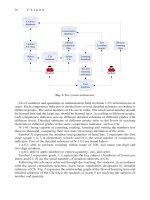
the adaptive e-learning system are outlined in Fig. 1.
2.1 System Architecture and Components
Here, an adaptive e-learning system based on multi-agent technology, which includes
eight intelligent agents, four databases and two repositories are presented. The eight
intelligent agents are learner interface agent, teacher/expert interface agent, diagno-
sis/assessment agent, adaptive navigation agent ,courseware recommendation agent,
298 W. Liang, J. Zhao, and X. Zhu
auto-reply agent, courseware/testing items management agent and database manage-
ment agent, respectively; the four databases include learner account database, learner
profile database, testing items database and teacher/expert account database; The two
repositories include the courseware repository and answer document repository.
Learner
nterface gent aims at providing a flexible learning interface for learners
to interact with the personalized e-learning system. The
eacher/ xpert nterface
gent aims at providing a friendly management interface for teacher/expert to manage
the courseware and testing items of the system
. The function of atabase an-
agement
gent is to manage the four databases and the two repositories. All
intelligent agents
need interacting with the four database or the two reposito-
ries must use the
atabase anagement gent . The ourse-
ware/
esting items anagement gent aims at managing the courseware and testing
items of the adaptive e-learning. Teachers or experts can use the agent to create new
testing items
course units, upload testing items courseware to the testing items
courseware database and delete or modify testing items courseware from the testing
items
courseware database. The uto- eply gent has two functions, one is to
answer learner’s questions automatically,
is to organize and manage the
nswer ocument of the system. The iagnosis/ ssessment gent is the important
agent in the system,
which in charge of investigating the
learner who first use the system, providing a final test while the learner finishes the
whole learning process and storing these resulting information in the user profile da-
tabase for personalized e-learning services. Moreover, the
daptive avigation gent
is responsible for guiding the learner’s learning process based on the learner’s study-
ing situation and storing learning records into the
profile database. The
Fig. 1. The system architecture of the adaptive e-learning system