Lecture Notes in Computer Science- P29 docx
Bạn đang xem bản rút gọn của tài liệu. Xem và tải ngay bản đầy đủ của tài liệu tại đây (240.69 KB, 5 trang )
140 Y. Miao, P. Sloep, and R. Koper
4 An Initial Validation of the Conceptual Model
Validation studies have been conducted to test if the conceptual model would meet
the requirements described in section 2. In this section, we present the results of these
initial validation studies.
Completeness: The OUNL/CITO model [9] is an extensible educational model for
assessment, which provides a broad basis for interoperability specifications for the
whole assessment process from design to decision-making. The OUNL/CITO model
was validated against Stiggins’ [23] guidelines for performance assessments and the
four-process framework of Almond et al. [1]. In addition, the model’s expressiveness
was investigated through describing a performance assessment in teacher education
using OUNL/CITO model terminologies. Brinke et. al. [9] reported that the
OUNL/CITO model met the requirement of completeness. This paper bases the APS
validation study of completeness on the OUNL/CITO model. Indeed, the conceptual
model of APS is based on the OUNL/CITO model. However, like QTI, the
OUNL/CITO model is a document-centric one. The concepts of stage and correspond-
ing activities are not explicitly included in the model although they are conceptually
used to develop and organize the model. As a consequence, an assessment description
based on the OUNL/CITO model cannot be executed by a process enactment service,
because important information about control flow and artifact flow from one activ-
ity/role to another is missing in the OUNL/CITO model. Nevertheless, APS extracts
almost all concepts represented explicitly and implicitly in the OUNL/CITO model. We
reformulated these concepts from a perspective of process support. APS explicitly for-
malizes concepts such as stage, activity, artifact, service, and rule, and re-organizes
them around the activity. As already mentioned, like LD, APS is an activity-centric and
process-based model. We removed some run-time concepts such as assessment-take and
assessment-session from the OUNL/CITO model, because they are related to the execu-
tion of the model. Moreover, because some concepts such as assessment policy, assess-
ment population, and assessment function are complicated for ordinary teachers and
instruction designers, APS does not explicitly include them. If need be, the attribute
description of the assessment design in APS can be used to represent these concepts
implicitly. In addition, terms such as assessment plan and decision rule are replaced by
other terms such as UoA (in fact, an instance of a UoA) and rule, which are expressed in
a technically operational manner. We conclude that all concepts in the OUNL/CITO
model can be mapped to APS. Furthermore, in order to model formative assessments,
APS integrates the learning/teaching stage and the activities specified in LD. Thus APS
meets the basic requirements of completeness.
Flexibility: As mentioned when we presented the process structure model in section
3.3, APS enables users to specify various assessment process models by tailoring the
generic process structure model and by making different detailed designs at the com-
ponent (e.g., role, activity, artifact, and service) level. We tested the flexibility by
conducting several case studies. In order to explain how to model a case based on
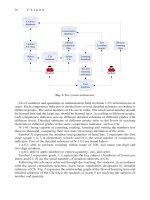
APS, we present a simple peer assessment model. As shown in Fig. 4, this three-stage
model involves two learners. In the first stage, each learner writes a different article
and sends it to the peer learner. Then each learner reviews the article received and
Modeling Units of Assessment for Sharing Assessment Process Information 141
sends a comment with a grade back to the peer learner. Finally, each learner reads the
received feedback. In the same way, we have tested three more complicated peer
assessment models, a 360 degree feedback model, and a programmed instruction
model. For lack of the space, a detailed description of these case studies is omitted.
All validation studies, however, reveal that APS is sufficiently expressive to describe
these various forms of assessment. Thus APS supports flexibility to at least some
extent.
Fig. 4. A Simple Peer Assessment Model
Adaptability: Adaptation can be supported in APS at two levels. The first is at the
assessment task level. As we know, QTI can support adaptation by adjusting assess-
ment item/test (e.g., questions, choices, and feedback) to the responses of the user.
APS, however, supports adaptation at task level much more broadly. According to an
assessee’s personal characteristics, learning goals/needs, response/performance, and
circumstantial information, an assessment-specific activity can be adapted by adjust-
ing the input/output artifact, service needed, completion-condition, post-completion-
actions, and even the attributes of these associated components. For example, a rule
could be: if (learning_goal:competenceA.proficiency_level >= 5) then (a test with a
simulator) else (a test with a questionnaire). The second level is the assessment proc-
ess level. APS supports adaptation of assessment strategies and approaches by chang-
ing the process structure through showing/hiding scenarios, changing the sequence of
stages, showing/hiding activities/activity-structure. The adaptation is expressed as
rules in APS. An example of such a rule is: if (learning within a group) then (peer
assessment) else (interview with a teacher).
Compatibility: The domain of application of APS overlaps with those of both LD and
QTI. However, they operate at different levels of abstraction. LD and QTI provide a
wealth of capabilities for modeling assessment process models, but the code can become
lengthy and complex. For this reason, we developed APS at a higher level of abstraction
by providing assessment-specific concepts. These built-in constructs provide shortcuts
for many of the tasks that are time-consuming if one uses LD and QTI to model them.
However, APS is built on the top of LD and QTI, and the assessment-specific concepts
are specializations of the generic concepts in LD and QTI. For example, concepts such as
constructing assessment item and commenting in APS are specializations of the generic
142 Y. Miao, P. Sloep, and R. Koper
concept support-activity in LD. An assessment process model based on APS can be
transformed into an executable model represented in LD and QTI. Thus, we should be
able to use an integrated LD and QTI run-time environment to execute various forms of
assessment based on APS. In addition, APS will be organized using the IMS Content
Package specification. It can use IEEE Learning Object Metadata (LOM) to describe the
meta-data of elements in APS. Moreover, the IMS Reusable Definition of Competency
or Educational Objectives can be used to specify traits and assessment objectives. The
IMS ePortfolio can be used to model portfolios (coupled with artifacts in APS) and inte-
grate a portfolio editor. The IMS Learner Information Profile can be used to import
global properties from a run-time environment and export them to it. IMS Enterprise can
be used for mapping roles when instantiating a UoA. Therefore, APS is compatible with
most existing, relevant e-learning technical specifications.
5 Conclusions and Future Work
This paper addressed the problems one faces when attempting to use QTI and LD to
support the management of assessment processes, in particular, formative assessment
and competence assessment. In order to support the sharing of assessment process
information in an interoperable, abstract, and efficient way, we developed APS as a
high-level assessment-specific process modeling language. We have developed the
conceptual model of APS by adopting a domain-specific modeling approach. The
conceptual model has been described through detailing the semantics aggregation
model, the conceptual structure model, and the process structure model. The first
validation study has been conducted through investigating whether the conceptual
model of APS meets the requirements of completeness, flexibility, adaptability, and
compatibility. The results suggest that the model does indeed do so.
APS should meet additional requirements (e.g., reproducibility, formalization, and
reusability), which we intend to investigate after the development of the information
model and XML Schemas binding. In order to enable practitioners to easily design
and customize their own assessment process models, an authoring tool for modeling
assessment processes with APS will be developed in the near future. In order to exe-
cute an instantiated model in existing LD and QTI compatible run-time environments,
transformation functions have to be developed as well. Then we will carry out ex-
periments to investigate the feasibility and usability of APS and the corresponding
authoring tool. Finally, we will propose APS as a candidate, new open e-learning
technical standard.
Acknowledgments. The work described in this paper has been fully supported by the
European Commission under the TENCompetence project [project No: IST-2004-
02787].
References
1. Almond, R.G., Steinberg, L., Mislevy, R.J.: A sample assessment using the four process
framework. CSE Report 543. Center for study of evaluation. University of California, Los
Angeles (2001)
2. APIS:
Modeling Units of Assessment for Sharing Assessment Process Information 143
3. AQuRate:
4. Biggs, J.B.: Teaching for Quality Learning at University. Society for Research in. Society
for Research in Higher Education & Open University Press, Buckingham (1999)
5. Black, P., Wiliam, D.: Assessment and classroom learning. Assessment in Education 5(1),
7–74 (1998)
6. Boud, D.: Enhancing Learning through Self-Assessment. Routledge (1995)
7. Boud, D., Cohen, R., et al.: Peer Learning and Assessment. Assessment and Evaluation in
Higher Education 24(4), 413–426 (1999)
8. Bransford, J., Brown, A., Cocking, R.: How People Learn: Mind, Brain, Experience and
School, Expanded Edition. National Academy Press, Washington (2000)
9. Brinke, D.J., Van Bruggen, J., Hermans, H., Latour, I., Burgers, J., Giesbers, B., Koper,
R.: Modeling assessment for re-use of traditional and new types of assessment. Computers
in Human Behavior 23, 2721–2741 (2007)
10. Brown, S., Knight, P.: Assessing Learners in Higher Education. Kogan Page, London
(1994)
11. Freeman, M., McKenzie, J.: Implementing and evaluating SPARK, a confidential web-
based template for self and peer assessment of student teamwork: benefits of evaluating
across different subjects. British Journal of Educational Technology 33(5), 553–572
(2002)
12. Gehringer, E.F.: Electronic peer review and peer grading in computer-science courses. In:
Proceedings of the 32nd ACM SIGCSE Technical Symposium on Computer Science Edu-
cation, Charlotte, North Carolina (2001)
13. Gipps, C.: Socio-cultural perspective on assessment. Review of Research in Education 24,
355–392 (1999)
14. Koper, E.J.R.: Modelling Units of Study from a Pedagogical Perspective: the Pedagogical
Meta-model behind EML (provided as input for the IMS Learning Design), Educational
Technology Expertise Centre, Open University of the Netherlands (2001),
15. Koper, R., Olivier, B.: Representing the Learning Design of Units of Learning. Journal of
Educational Technology & Society 7(3), 97–111 (2004)
16. LD:
17. Lockyer, J.: Multisource feedback in the assessment of physician competencies. Journal
Contin Educ. Health Prof. 23(1), 4–12 (2003)
18. Miao, Y., Koper, R.: An Efficient and Flexible Technical Approach to Develop and De-
liver Online Peer Assessment. In: Proceedings of CSCL 2007, New Jersey, USA, pp. 502–
511 (2007)
19. Miao, Y., Koper, R.: A Domain-specific Modeling Approach to the Development of
Online Peer Assessment. In: Navarette, T., Blat, J., Koper, R. (eds.) Proceedings of the 3rd
TENCompetence Open Workshop on Current Research on IMS Learning Design and Life-
long Competence Development Infrastructures, Barcelona, Spain, pp. 81–88 (2007),
20. QTI:
21. QuestionMark:
22. Wills, G., Davis, H., Chennupati, S., Gilbert, L., Howard, Y., Jam, E.R., Jeyes, S., Millard,
D., Sherratt, R., Willingham, G.: R2Q2: Rendering and Reponses Processing for QTIv2
Question Types. In: Danson, M. (ed.) Proceedings of the 10th International Computer As-
sisted Assessment Conference, pp. 515–522. Loughborough University, UK (2006)
144 Y. Miao, P. Sloep, and R. Koper
23. Stiggins, R.J.: Het ontwerpen en ontwikkelen van performance-assessment toetsen. [De-
sign and development of performance assessments]. In: Kessels, J.W.M., Smit, C.A. (eds.)
Opleiders in organisaties/Capita Selecta, afl. 10, pp. 75–91. Kluwer, Deventer (1992)
24. TENCompetence project:
25. Topping, K.J.: Peer assessment between students in colleges and universities. Review of
Educational Research 68, 249–276 (1998)