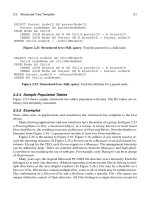
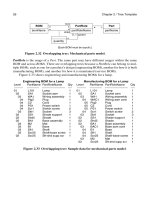
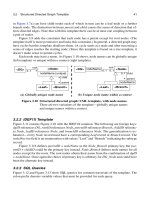
PATTERNS OF DATA MODELING- P39 doc
Bạn đang xem bản rút gọn của tài liệu. Xem và tải ngay bản đầy đủ của tài liệu tại đây (144.24 KB, 5 trang )
13.4 Softcoding Variations 177
13.4.2 Cut Metadata
A simplification is to forego metadata. This is essentially what the UML does with tagged
values. Figure 13.12 and Figure 13.13 show the corresponding revision. In essence the model
stores values without metadata. The advantage of omitting metadata is simplicity. The down-
side is that the values are less structured, less controlled, and more vulnerable to errors. This
approach can be useful for a small amount of miscellaneous data, but is not suitable for large
quantities.
Figure 13.11 Softcoded values—add value metadata: IDEF1X model.
entityTypeID
entityTypeName (AK1.1)
EntityType
entityID
logicalIdentifier (AK1.1)
Entity
attributeID
dataType
Attribute
maxLength
minMultiplicity
maxMultiplicity
entityTypeID (FK) (AK1.1, AK2.1)
attributeName (AK1.2)
sequenceNumber (AK2.2)
valueString
valueDateTime
SoftcodedValue
valueID
dateOfEntry
entityID (FK)
valueInteger
valueDecimal
enumValueID
valueInteger
EnumValue
valueDecimal
valueString
valueDateTime
attributeID (FK) (AK1.1)
sequenceNumber (AK1.2)
entityTypeID (FK)
attributeID (FK)
dataSourceID
dataSourceName (AK1.1)
DataSource
overrideUOMID (FK)
dataSourceID (FK)
unitOfMeasureID
unitOfMeasName (AK1.1)
UnitOfMeasure
defaultUnitOfMeasureID (FK)
Figure 13.12 Softcoded values—cut metadata: UML model.
*
1
SoftcodedValue
valueInteger
valueDecimal
valueString
valueDateTime
attributeName
Entity
<logicalIdentifier>
178 Chapter 13 / Softcoded Values
13.4.3 Store All SoftcodedValues as Strings
Figure 13.14 and Figure 13.15 show the option of storing all values as strings and converting
them to the appropriate data type upon access. This simplifies the model at the cost of type
conversions. Type conversions complicate programming and can introduce round-off errors.
13.4.4 Subtype by Data Type
An implementation can subtype SoftcodedValue, Attribute, and EnumValue according to the
dataType (Figure 13.16, Figure 13.17). Note that the model’s structure does not enforce that
SoftcodedValue and Attribute subtypes must correspond. For example, ValueInteger should
only be associated with AttributeInteger. Programming code must enforce this intent.
13.4.5 Require All Attributes to be Enumerated
Another possibility is to require that all softcoded values be enumerated (Figure 13.18, Fig-
ure 13.19). Enumerations control data entry so there should be approval for new EnumVal-
ues. The resulting database has clean data since users can not introduce variations such as
alternate spellings, abbreviations, and upper/lower case combinations for the same thing.
Figure 13.13 Softcoded values—cut metadata: IDEF1X model.
entityID
logicalIdentifier (AK1.1)
Entity
valueString
valueDateTime
SoftcodedValue
valueID
attributeName
entityID (FK)
valueInteger
valueDecimal
attributeName
*
1
10 1
*
1
Attribute
dataType
maxLength
minMultiplicity
maxMultiplicity
{ordered}
*
1
1
*
{ordered}
EnumValue
valueString
SoftcodedValue
valueString
Figure 13.14 Softcoded values—store all values as strings: UML model.
Entity
<logicalIdentifier>
EntityType
name {unique}
13.4 Softcoding Variations 179
Figure 13.15 Softcoded values—store all values as strings: IDEF1X model.
entityTypeID
entityTypeName (AK1.1)
EntityType
entityID
logicalIdentifier (AK1.1)
Entity
attributeID
dataType
Attribute
maxLength
minMultiplicity
maxMultiplicity
entityTypeID (FK) (AK1.1, AK2.1)
attributeName (AK1.2)
sequenceNumber (AK2.2)
attributeID (FK)
SoftcodedValue
valueID
valueString
entityID (FK)
enumValueID
valueString
EnumValue
attributeID (FK) (AK1.1)
sequenceNumber (AK1.2)
entityTypeID (FK)
1
{ordered}
1
{ordered}
1
{ordered}
Figure 13.16 Softcoded values—subtype by data type: UML model.
EnumValInteger
valueInteger
AttributeString
maxLength
AttributeInteger AttributeDateTimeAttributeDecimal
EnumValDateTime
valueDateTime
EnumValDecimal
valueDecimal
EnumValString
valueString
1
{ordered}
****
ValueDecimal
valueDecimal
ValueString
valueString
ValueInteger
valueInteger
ValueDateTime
valueDateTime
attributeName
10 1
Attribute
minMultiplicity
maxMultiplicity
{ordered}
*
1
*
1
*
1
SoftcodedValue
Entity
<logicalIdentifier>
EntityType
name {unique}
180 Chapter 13 / Softcoded Values
Figure 13.17 Softcoded values—subtype by data type: IDEF1X model.
attributeDiscrim
AttribString
attribStrID (FK)
maxLength
AttribDecimal
attribDecID (FK)
AttribDateTime
attribDatTimID (FK)
AttribInteger
attribIntID (FK)
attributeID
Attribute
minMultiplicity
maxMultiplicity
attributeDiscrim
entityTypeID (FK) (AK1.1, AK2.1)
attributeName (AK1.2)
sequenceNumber (AK2.2)
entityTypeID
entityTypeName (AK1.1)
EntityType
enumValDecID
valueDecimal
EnumValDec
attribDecID (FK) (AK1.1)
sequenceNum (AK1.2)
enumValStrID
valueString
EnumValStr
attribStrID (FK) (AK1.1)
sequenceNum (AK1.2)
enumValIntID
valueInteger
EnumValInt
attribIntID (FK) (AK1.1)
sequenceNum (AK1.2)
enumValDatTimID
valueDateTime
EnumValDatTim
attribDatTimID (FK) (AK1.1)
sequenceNum (AK1.2)
valueDiscrim
ValueString
valueStrID (FK)
valueString
ValueDecimal
valueDecID (FK)
ValueDateTime
valueDatTimID (FK)
ValueInteger
valueIntID (FK)
attributeID (FK)
SoftcodedValue
valueID
valueDiscrim
entityID (FK)
valueDecimal valueInteger valueDateTime
entityID
logicalIdentifier (AK1.1)
Entity
entityTypeID (FK)
13.4 Softcoding Variations 181
13.4.6 Enable Time History
The previous softcoded value models have treated data and metadata as invariant. An exten-
sion is to let data change over time. For example, each SoftcodedValue could have effective
and expiration dates to track its history
. Then a database can record a SoftcodedValue in ad-
vance of when it is needed. It can also keep a
SoftcodedValue after it becomes obsolete. Sim-
ilarly, Attributes and EnumValues could have effective and expiration dates.
attributeName
*
1
1 0 1
*
Attribute
dataType
maxLength
minMultiplicity
maxMultiplicity
{ordered}
*
1
{ordered}
EnumValue
valueInteger
valueDecimal
valueString
valueDateTime
Figure 13.18 Softcoded values—all values are enumerated: UML model.
*
Entity
<logicalIdentifier>
EntityType
name {unique}
Figure 13.19 Softcoded values—all values are enumerated: IDEF1X model.
entityTypeID
entityTypeName (AK1.1)
EntityType
entityID
logicalIdentifier (AK1.1)
Entity
attributeID
dataType
Attribute
maxLength
minMultiplicity
maxMultiplicity
entityTypeID (FK) (AK1.1, AK2.1)
attributeName (AK1.2)
sequenceNumber (AK2.2)
enumValueID
valueInteger
EnumValue
valueDecimal
valueString
valueDateTime
attributeID (FK) (AK1.1)
sequenceNumber (AK1.2)
entityTypeID (FK)
Entity_EnumValue
entityID (FK)
enumValueID {FK)