The Intelligent Investor: The Definitive Book On Value part 38 potx
Bạn đang xem bản rút gọn của tài liệu. Xem và tải ngay bản đầy đủ của tài liệu tại đây (138.96 KB, 10 trang )
Here the vast majority of issues appear to be cut out, by their per-
formance record and their price ratios, in accordance with the
defensive investor’s needs as we judge them. We exclude one crite-
rion from our tests of public-utility stocks—namely, the ratio of
current assets to current liabilities. The working-capital factor takes
care of itself in this industry as part of the continuous financing of
its growth by sales of bonds and shares. We do require an adequate
proportion of stock capital to debt.
4
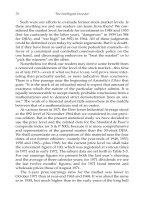
In Table 14-4 we present a résumé of the 15 issues in the Dow
Jones public-utility average. For comparison, Table 14-5 gives a
similar picture of a random selection of fifteen other utilities taken
from the New York Stock Exchange list.
As 1972 began the defensive investor could have had quite a
wide choice of utility common stocks, each of which would have
met our requirements for both performance and price. These com-
panies offered him everything he had a right to demand from
simply chosen common-stock investments. In comparison with
prominent industrial companies as represented by the DJIA, they
offered almost as good a record of past growth, plus smaller fluctu-
ations in the annual figures—both at a lower price in relation to
earnings and assets. The dividend return was significantly higher.
The position of the utilities as regulated monopolies is assuredly
more of an advantage than a disadvantage for the conservative
investor. Under law they are entitled to charge rates sufficiently
remunerative to attract the capital they need for their continuous
expansion, and this implies adequate offsets to inflated costs.
While the process of regulation has often been cumbersome and
perhaps dilatory, it has not prevented the utilities from earning a
fair return on their rising invested capital over many decades.
356 The Intelligent Investor
celed and decommissioned nuclear energy plants; nor did he foresee the
consequences of bungled regulation in California. Utility stocks are vastly
more volatile than they were in Graham’s day, and most investors should
own them only through a well-diversified, low-cost fund like the Dow Jones
U.S. Utilities Sector Index Fund (ticker symbol: IDU) or Utilities Select Sec-
tor SPDR (XLU). For more information, see: www.ishares.com and www.
spdrindex.com/spdr/. (Be sure your broker will not charge commissions to
reinvest your dividends.)
TABLE 14-4 Data on the Fifteen Stocks in the Dow Jones Utility Av
erage at September 30, 1971
Earns.
Per Share
Price
Price/
1970
Sept. 30,
Book Price/ Book Div. vs.
1971 Earned
a
Dividend Value Earnings Value Yield
1960
Am. Elec. Power
26 2.40 1.70 18.86 11
ϫ
138% 6.5% +87%
Cleveland El. Ill.
34
3
⁄4
3.10 2.24 22.94 11 150 6.4
86
Columbia Gas System
33 2.95 1.76 25.58 11
129 5.3 85
Commonwealth Edison 35
1
⁄2
3.05 2.20 27.28 12 130 6.2
56
Consolidated Edison
24
1
⁄2
2.40 1.80 30.63 10
80 7.4 19
Consd. Nat. Gas
27
3
⁄4
3.00 1.88 32.11 9
86 6.8 53
Detroit Edison
19
1
⁄4
1.80 1.40 22.66 11
84 7.3 40
Houston Ltg. & Power 42
3
⁄4
2.88 1.32 19.02 15 222 3.1
135
Niagara-Mohawk Pwr. 15
1
⁄2
1.45 1.10 16.46 11
93 7.2 32
Pacific Gas & Electric
29 2.65 1.64 25.45 11
114 5.6 79
Panhandle E. Pipe L.
32
1
⁄2
2.90 1.80 19.95 11 166 5.5
79
Peoples Gas Co.
31
1
⁄2
2.70 2.08 30.28 8 104 6.6
23
Philadelphia El.
20
1
⁄2
2.00 1.64 19.74 10 103 8.0
29
Public Svs. El. & Gas
25
1
⁄2
2.80 1.64 21.81 9 116 6.4
80
Sou. Calif. Edison
29
1
⁄4
2.80 1.50 27.28 10 107 5.1
85
Average
28
1
⁄2
2.66 1.71 23.83 10.7ϫ
121% 6.2% +65%
a
Estimated for year 1971.
TABLE 14-5 Data on a Second List of Public-Utility Stocks at September 30, 1971
Earns.
Per Share
Price
Price/
1970
Sept. 30,
Book Price/ Book Div. vs.
1971 Earned Dividend Value Earnings V
alue Yield 1960
Alabama Gas
15
1
⁄2
1.50 1.10 17.80 10
ϫ
87% 7.1% +34%
Allegheny Power
22
1
⁄2
2.15 1.32 16.88 10 134 6.0
71
Am. Tel. & Tel.
43 4.05 2.60 45.47 11
95 6.0 47
Am. Water Works
14 1.46 .60 16.80 10 84
4.3 187
Atlantic City Elec.
20
1
⁄2
1.85 1.36 14.81 11 138 6.6
74
Baltimore Gas & Elec.
30
1
⁄4
2.85 1.82 23.03 11 132 6.0
86
Brooklyn Union Gas
23
1
⁄2
2.00 1.12 20.91 12 112 7.3
29
Carolina Pwr. & Lt.
22
1
⁄2
1.65 1.46 20.49 14 110 6.5
39
Cen. Hudson G. & E.
22
1
⁄4
2.00 1.48 20.29 11 110 6.5
13
Cen. Ill. Lt.
25
1
⁄4
2.50 1.56 22.16 10 114 6.5
55
Cen. Maine Pwr.
17
3
⁄4
1.48 1.20 16.35 12 113 6.8
62
Cincinnati Gas & Elec. 23
1
⁄4
2.20 1.56 16.13 11 145 6.7
102
Consumers Power
29
1
⁄2
2.80 2.00 32.59 11 90 6.8
89
Dayton Pwr. & Lt.
23 2.25 1.66 16.79 10
137 7.2 94
Delmarva Pwr. & Lt.
16
1
⁄2
1.55 1.12 14.04 11 117 6.7
78
Average
23
1
⁄2
2.15 1.50 21.00 11
ϫ
112% 6.5% +71%
For the defensive investor the central appeal of the public-utility
stocks at this time should be their availability at a moderate price
in relation to book value. This means that he can ignore stockmar-
ket considerations, if he wishes, and consider himself primarily as
a part owner of well-established and well-earning businesses. The
market quotations are always there for him to take advantage of
when times are propitious—either for purchases at unusually
attractive low levels, or for sales when their prices seem definitely
too high.
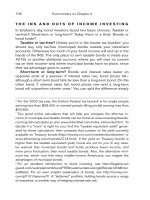
The market record of the public-utility indexes—condensed in
Table 14-6, along with those of other groups—indicates that there
have been ample possibilities of profit in these investments in the
past. While the rise has not been as great as in the industrial index,
the individual utilities have shown more price stability in most
periods than have other groups.* It is striking to observe in this
table that the relative price/earnings ratios of the industrials and
the utilities have changed places during the past two decades.
Stock Selection for the Defensive Investor 359
* In a remarkable confirmation of Graham’s point, the dull-sounding Stan-
dard & Poor’s Utility Index outperformed the vaunted NASDAQ Composite
Index for the 30 years ending December 31, 2002.
TABLE 14-6 Development of Prices and Price/Earnings Ratios
for Various Standard & Poor’s Averages,
1948–1970.
Industrials Railroads Utilities
Year Price
a
P/E Ratio Price
a
P/E Ratio Price
a
P/E Ratio
1948 15.34 6.56 15.27 4.55 16.77 10.03
1953 24.84 9.56 22.60 5.42 24.03 14.00
1958 58.65 19.88 34.23 12.45 43.13 18.59
1963 79.25 18.18 40.65 12.78 66.42 20.44
1968 113.02 17.80 54.15 14.21 69.69 15.87
1970 100.00 17.84 34.40 12.83 61.75 13.16
a
Prices are at the close of the year.
These reversals will have more meaning for the active than for the
passive investor. But they suggest that even defensive portfolios
should be changed from time to time, especially if the securities
purchased have an apparently excessive advance and can be
replaced by issues much more reasonably priced. Alas! there will
be capital-gains taxes to pay—which for the typical investor seems
to be about the same as the Devil to pay. Our old ally, experience,
tells us here that it is better to sell and pay the tax than not sell and
repent.
Investing in Stocks of Financial Enterprises
A considerable variety of concerns may be ranged under the
rubric of “financial companies.” These would include banks,
insurance companies, savings and loan associations, credit and
small-loan companies, mortgage companies, and “investment
companies” (e.g., mutual funds).* It is characteristic of all these
enterprises that they have a relatively small part of their assets in
the form of material things—such as fixed assets and merchandise
inventories—but on the other hand most categories have short-
term obligations well in excess of their stock capital. The question
of financial soundness is, therefore, more relevant here than in the
case of the typical manufacturing or commercial enterprise. This,
in turn, has given rise to various forms of regulation and supervi-
sion, with the design and general result of assuring against
unsound financial practices.
Broadly speaking, the shares of financial concerns have pro-
duced investment results similar to those of other types of common
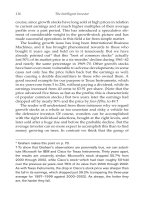
shares. Table 14-7 shows price changes between 1948 and 1970 in
six groups represented in the Standard & Poor’s stock-price
indexes. The average for 1941–1943 is taken as 10, the base level.
360 The Intelligent Investor
* Today the financial-services industry is made up of even more components,
including commercial banks; savings & loan and mortgage-financing compa-
nies; consumer-finance firms like credit-card issuers; money managers and
trust companies; investment banks and brokerages; insurance companies;
and firms engaged in developing or owning real estate, including real-estate
investment trusts. Although the sector is much more diversified today,
Graham’s caveats about financial soundness apply more than ever.
The year-end 1970 figures ranged between 44.3 for the 9 New York
banks and 218 for the 11 life-insurance stocks. During the sub-
intervals there was considerable variation in the respective price
movements. For example, the New York City bank stocks did quite
well between 1958 and 1968; conversely the spectacular life-
insurance group actually lost ground between 1963 and 1968.
These cross-movements are found in many, perhaps most, of the
numerous industry groups in the Standard & Poor’s indexes.
We have no very helpful remarks to offer in this broad area of
investment—other than to counsel that the same arithmetical stan-
dards for price in relation to earnings and book value be applied to
the choice of companies in these groups as we have suggested for
industrial and public-utility investments.
Railroad Issues
The railroad story is a far different one from that of the utilities.
The carriers have suffered severely from a combination of severe
competition and strict regulation. (Their labor-cost problem has of
Stock Selection for the Defensive Investor 361
TABLE 14-7 Relative Price Movements of Stocks of Various
Types of Financial Companies Between 1948
and 1970
1948 1953 1958 1963 1968 1970
Life insurance 17.1 59.5 156.6 318.1 282.2 218.0
Property and liability
insurance 13.7 23.9 41.0 64.7 99.2 84.3
New York City banks 11.2 15.0 24.3 36.8 49.6 44.3
Banks outside
New York City 16.9 33.3 48.7 75.9 96.9 83.3
Finance companies 15.6 27.1 55.4 64.3 92.8 78.3
Small-loan companies 18.4 36.4 68.5 118.2 142.8 126.8
Standard & Poor’s
composite 13.2 24.8 55.2 75.0 103.9 92.2
a
Year-end figures from Standard & Poor’s stock-price indexes. Average of 1941–
1943 = 10.
course been difficult as well, but that has not been confined to rail-
roads.) Automobiles, buses, and airlines have drawn off most of
their passenger business and left the rest highly unprofitable; the
trucks have taken a good deal of their freight traffic. More than half
of the railroad mileage of the country has been in bankruptcy (or
“trusteeship”) at various times during the past 50 years.
But this half-century has not been all downhill for the carriers.
There have been prosperous periods for the industry, especially the
war years. Some of the lines have managed to maintain their earn-
ing power and their dividends despite the general difficulties.
The Standard & Poor’s index advanced sevenfold from the low
of 1942 to the high of 1968, not much below the percentage gain in
the public-utility index. The bankruptcy of the Penn Central Trans-
portation Co., our most important railroad, in 1970 shocked the
financial world. Only a year and two years previously the stock
sold at close to the highest price level in its long history, and it had
paid continuous dividends for more than 120 years! (On p. 423
below we present a brief analysis of this railroad to illustrate how a
competent student could have detected the developing weaknesses
in the company’s picture and counseled against ownership of its
securities.) The market level of railroad shares as a whole was seri-
ously affected by this financial disaster.
It is usually unsound to make blanket recommendations of
whole classes of securities, and there are equal objections to broad
condemnations. The record of railroad share prices in Table 14-6
shows that the group as a whole has often offered chances for a
large profit. (But in our view the great advances were in them-
selves largely unwarranted.) Let us confine our suggestion to this:
There is no compelling reason for the investor to own railroad
shares; before he buys any he should make sure that he is getting
so much value for his money that it would be unreasonable to look
for something else instead.*
362 The Intelligent Investor
* Only a few major rail stocks now remain, including Burlington Northern,
CSX, Norfolk Southern, and Union Pacific. The advice in this section is at
least as relevant to airline stocks today—with their massive current losses
and a half-century of almost incessantly poor results—as it was to railroads
in Graham’s day.
Selectivity for the Defensive Investor
Every investor would like his list to be better or more promising
than the average. Hence the reader will ask whether, if he gets him-
self a competent adviser or security analyst, he should not be able to
count on being supplied with an investment package of really supe-
rior merits. “After all,” he may say, “the rules you have outlined are
pretty simple and easygoing. A highly trained analyst ought to be
able to use all his skill and techniques to improve substantially on
something as obvious as the Dow Jones list. If not, what good are all
his statistics, calculations, and pontifical judgments?”
Suppose, as a practical test, we had asked a hundred security
analysts to choose the “best” five stocks in the Dow Jones Average,
to be bought at the end of 1970. Few would have come up with
identical choices and many of the lists would have differed com-
pletely from each other.
This is not so surprising as it may at first appear. The underlying
reason is that the current price of each prominent stock pretty well
reflects the salient factors in its financial record plus the general
opinion as to its future prospects. Hence the view of any analyst that
one stock is a better buy than the rest must arise to a great extent
from his personal partialities and expectations, or from the placing
of his emphasis on one set of factors rather than on another in his
work of evaluation. If all analysts were agreed that one particular
stock was better than all the rest, that issue would quickly advance
to a price which would offset all of its previous advantages.*
Stock Selection for the Defensive Investor 363
* Graham is summarizing the “efficient markets hypothesis,” or EMH, an aca-
demic theory claiming that the price of each stock incorporates all publicly
available information about the company. With millions of investors scouring
the market every day, it is unlikely that severe mispricings can persist for
long. An old joke has two finance professors walking along the sidewalk;
when one spots a $20 bill and bends over to pick it up, the other grabs his
arm and says, “Don’t bother. If it was really a $20 bill, someone would have
taken it already.” While the market is not perfectly efficient, it is pretty close
most of the time—so the intelligent investor will stoop to pick up the stock
market’s $20 bills only after researching them thoroughly and minimizing the
costs of trading and taxes.
Our statement that the current price reflects both known facts
and future expectations was intended to emphasize the double
basis for market valuations. Corresponding with these two kinds
of value elements are two basically different approaches to security
analysis. To be sure, every competent analyst looks forward to the
future rather than backward to the past, and he realizes that his
work will prove good or bad depending on what will happen and
not on what has happened. Nevertheless, the future itself can be
approached in two different ways, which may be called the way of
prediction (or projection) and the way of protection.*
Those who emphasize prediction will endeavor to anticipate
fairly accurately just what the company will accomplish in future
years—in particular whether earnings will show pronounced and
persistent growth. These conclusions may be based on a very care-
ful study of such factors as supply and demand in the industry—or
volume, price, and costs—or else they may be derived from a
rather naïve projection of the line of past growth into the future. If
these authorities are convinced that the fairly long-term prospects
are unusually favorable, they will almost always recommend the
stock for purchase without paying too much regard to the level at
which it is selling. Such, for example, was the general attitude with
respect to the air-transport stocks—an attitude that persisted for
many years despite the distressingly bad results often shown after
1946. In the Introduction we have commented on the disparity
between the strong price action and the relatively disappointing
earnings record of this industry.
364 The Intelligent Investor
* This is one of the central points of Graham’s book. All investors labor
under a cruel irony: We invest in the present, but we invest for the future.
And, unfortunately, the future is almost entirely uncertain. Inflation and inter-
est rates are undependable; economic recessions come and go at random;
geopolitical upheavals like war, commodity shortages, and terrorism arrive
without warning; and the fate of individual companies and their industries
often turns out to be the opposite of what most investors expect. Therefore,
investing on the basis of projection is a fool’s errand; even the forecasts of
the so-called experts are less reliable than the flip of a coin. For most peo-
ple, investing on the basis of protection—from overpaying for a stock and
from overconfidence in the quality of their own judgment—is the best solu-
tion. Graham expands on this concept in Chapter 20.
By contrast, those who emphasize protection are always espe-
cially concerned with the price of the issue at the time of study.
Their main effort is to assure themselves of a substantial margin of
indicated present value above the market price—which margin
could absorb unfavorable developments in the future. Generally
speaking, therefore, it is not so necessary for them to be enthusias-
tic over the company’s long-run prospects as it is to be reasonably
confident that the enterprise will get along.
The first, or predictive, approach could also be called the quali-
tative approach, since it emphasizes prospects, management, and
other nonmeasurable, albeit highly important, factors that go
under the heading of quality. The second, or protective, approach
may be called the quantitative or statistical approach, since it
emphasizes the measurable relationships between selling price and
earnings, assets, dividends, and so forth. Incidentally, the quantita-
tive method is really an extension—into the field of common
stocks—of the viewpoint that security analysis has found to be
sound in the selection of bonds and preferred stocks for invest-
ment.
In our own attitude and professional work we were always
committed to the quantitative approach. From the first we wanted
to make sure that we were getting ample value for our money in
concrete, demonstrable terms. We were not willing to accept the
prospects and promises of the future as compensation for a lack of
sufficient value in hand. This has by no means been the standard
viewpoint among investment authorities; in fact, the majority
would probably subscribe to the view that prospects, quality of
management, other intangibles, and “the human factor” far out-
weigh the indications supplied by any study of the past record, the
balance sheet, and all the other cold figures.
Thus this matter of choosing the “best” stocks is at bottom a
highly controversial one. Our advice to the defensive investor is
that he let it alone. Let him emphasize diversification more than
individual selection. Incidentally, the universally accepted idea of
diversification is, in part at least, the negation of the ambitious pre-
tensions of selectivity. If one could select the best stocks unerringly,
one would only lose by diversifying. Yet within the limits of the
four most general rules of common-stock selection suggested for
the defensive investor (on pp. 114–115) there is room for a rather
considerable freedom of preference. At the worst the indulgence of
Stock Selection for the Defensive Investor 365