Spinal Disorders: Fundamentals of Diagnosis and Treatment Part 73 pot
Bạn đang xem bản rút gọn của tài liệu. Xem và tải ngay bản đầy đủ của tài liệu tại đây (442.98 KB, 10 trang )
ab c
Case Introduction
Female patient with a 22-year history of low back pain and a de novo scoliosis (primary degenerative scoliosis) exemplify-
ing the natural history of this scoliosis type. The patient first sought medical help for low back pain at the age of 33 years.
The radiograph exhibited a short left-convex lumbar scoliosis (8°), which in retrospect can be attributed to a disc degen-
eration of L3/4 (disc space narrowing) and an asymmetry at the L2/3 level (a). At that time, the patient was treated with
NSAIDs and physiotherapy with some improvement. However, she was never really pain-free. When she was 50 years old,
she had increasing back pain with radiating pain mostly into the right anterior thigh. In the meantime, the patient
entered menopause, and the curve now measured a Cobb angle of 25° with a lateral translation and rotation of L3
toward the left side (
b). Five years later the curve measured 40°, an average 3° curve increase per year. The curve was now
clearly identifiable as a short, left-convex curve from L2–L4 (end vertebrae) (
c). The overall frontal balance was still more
or less in equilibrium. However, the sagittal profile converted toward a lumbar kyphosis. The patient now complained
not only about difficulty of controlling back pain, but also about classical claudication symptoms when walking
400–500 m. The pain disappeared when resting. The back pain was much less when resting in bed, but increased when
standing up in the vertical position. The translation/rotation of the apical vertebra L3 had also increased compared to
5 years previously. This curve demonstrates a truly progressive degenerative de novo adult scoliosis, which ended with
the complete set of symptoms and signs which finally necessitate surgery. This process involves a mechanical deteriora-
tion of the lumbar spine, which expresses itself in clinical signs and symptoms related to instability, mostly axial-vertical
instability with some translational component, central canal and/or foraminal neurocompression, fatigue of unbalanced
paravertebral muscles and finally curve progression. The understanding of the natural history and behavior of such a pri-
mary degenerative scoliotic curve may help to make a decision for or against relatively early surgery. In the case of early
surgery, the intervention may be more limited and simple, both for the patient and the surgeon.
The prevalence
of degenerative scoliosis
is increasing
Degenerative scoliosis seems to be becoming more frequent in an increasingly
aging society for several reasons, which may include the more aggressive and pre-
cise diagnosis than was possible 20 years ago, a different perception of pain in a
modern urbanized society, and the desire of a large component of our society to be
active in sports and to pursue leisure activities also after retirement. It seems, how-
714 Section Spinal Deformities and Malformations
ever, that degenerative scoliosis is not a characteristic disease of industrialized
society, since the same pathology can be observed in other, less developed socie-
ties [7].
Pathogenesis
Primary (de novo)
degenerative scoliosis
results from segmental
degeneration
Primary degenerative adult scoliosis, specifically in the lumbar spine, is charac-
terized by a quite uniform pathomorphology and pathomechanism [1]. The
asymmetric degeneration of the disc and/or the facet joint leads to an asymmet-
ric loading of the spinal segment and consequently of a whole spinal area. This
again leads to an asymmetric deformity, for example scoliosis and/or kyphosis
[6, 14]. Such a deformity again triggers asymmetric degeneration and induces
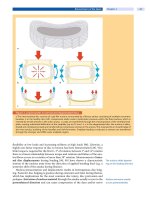
asymmet ric loading, creating a vicious circle (
Fig. 1a).Thedestructionofdiscs,
facet joints and joint capsules usually ends in some form of uni- or multisegmen-
tal sagittal and/or frontal latent or obvious instability. There may not only be a
spondylolisthesis, meaning a slip in the sagittal plane, but also translational dis-
locations in the frontal plane or rather three-dimensionally when the instability
expresses itself in a rotational dislocation [15].
The biological reaction to an unstable joint or, in the case of the spine, an
unstable segment, is the formation of osteophytes at the facet joint (spondylart-
hritis), and at the vertebral endplates (spondylosis), both contributing to the
increasing narrowing of the spinal canal together with the hypertrophy and calci-
fication of the ligamentum flavum and joint capsules, creating central and reces-
sal spinal stenosis (
Fig. 2). The pathomorphological and pathomechanical rela-
tionship directly relates to the clinical presentation of an adult degenerative scoli-
The progressive degenera-
tion and deformity often
leads to central and
foraminal stenosis
osis (Fig. 1b). The osteophytes of the facet joints and the spondylotic osteophytes,
however, may not sufficiently stabilize a diseased spinal segment. Such a condi-
tion leads to a dynamic,mostlyforaminal stenosis withradicularpainorclaudi-
cation type pain, specifically when the spine is loaded vertically.
ab
Figure 1. Pathogenesis of degenerative scoliosis
a Degenerative scoliosis results from a close interaction of asymmetric loading, degeneration and deformity. b The clini-
cal symptoms are closely related to the pathomorphology.
Degenerative Scoliosis Chapter 26 715
Figure 2. Degenerative changes
Deformity and spinal imbalance lead to secondary degeneration, i.e., facet joint arthrosis (hypertrophy), disc degenera-
tion, spondylosis spurs and osteophytes, and calcified ligaments as a biological reaction with the goal of stabilizing the
spine. As a consequence spinal stenosis develops. When decompression is performed destabilization results.
Classification
Degenerative scoliosis forms a major part of the adult scoliosis group. This group
comprises a wide spectrum of different pathologies, which may look very similar
at the end-stage, when many patients are seeking help from a spine surgeon for
the first time [15]. These patients usually have a long history of back pain and spi-
nal discomfort and have undergone all the possible symptomatic treatment
modalities such as exercise, acupuncture, braces and other complementary med-
ical measures as well as pain medication.
There is no established classification system for degenerative scoliosis [1, 7].
However, the most important distinction is between primary degenerative scoli-
osis and secondary degenerative scoliosis (
Table 1).
Table 1. Classification of degenerative scoliosis
Primary (de novo) degenerative scoliosis Secondary degenerative scoliosis
develops de novo after skeletal maturity results from degenerative alterations of
curves existing prior to skeletal maturity
Classification systems
or degenerative idiopathic
scoliosis is inadequate to
describe de novo scoliosis
Several attempts have been made to elucidate some systematic structure in this
kind of pathology. A classification on the basis of the curve type, very much as in
the idiopathic scoliosis classification by Lenke [21], has been proposed. This clas-
sification may be able to cover the adult idiopathic scoliosis group with second-
ary degeneration but is not necessarily adequate for the primary degenerative
scoliosis type. Another attempt at classification has recently been presented by
Schwab et al. [13, 27], who distinguished three groups based on measurements of
the endplate obliquity of L3 in the frontal plane, and of the lumbar lordosis mea-
sured between the L1 and S1 superior endplates in the sagittal plane of a standard
X-ray.
716 Section Spinal Deformities and Malformations
This is obviously a classification which can be applied solely to primary degener-
ative lumbar scoliosis. The three distinct types with increasing severity from
Type1toType3are:
Type 1 – lordosis >55°, L3 obliquity <15°
Type 2 – lordosis 35–55°, L3 obliquity 15–25°
Type 3 – lordosis <35°, L3 obliquity >25°
The interesting characteristic of this classification is the attempt to correlate the
objective radiological findings with the self-reported pain and disability.
We have recently proposed an etiological classification which basically distin-
guishes three types, Type 3 being subdivided into two subtypes [1]:
Type 1 – primary degenerative scoliosis (“de novo” form), mostly located in
the lumbar or thoracolumbar spine.
Type 2 – progressive idiopathic scoliosis in adult life of the thoracic, thora-
columbar and/or lumbar spine. A rough distinction can be made between
adult idiopathic scoliosis in patients less than 40 years of age and those aged
over40years.
Type 3 – secondary degenerative scoliosis comprising:
Subtype 3a: degeneration of secondary curves following idiopathic or other
forms of scoliosis or occurring in the context of a pelvic obliq-
uity due to a leg length discrepancy, hip pathology or a lumbo-
sacral transitional anomaly, mostly located in the thoracolum-
bar, lumbar or lumbosacral spine.
Subtype 3b: scoliosis secondary to metabolic disease (mostly osteoporosis)
[18] combined with asymmetric arthritic disease and/or verte-
bral fractures.
There is no classification
gold standard
The clinical entity of an adult degenerative scoliosis can indeed be present since
childhood or adolescence and can become progressive and/or symptomatic only
in adult life [5, 24], or a scoliosis may appear de novo in adult life only without
any precedence in early life. In this chapter we deal predominantly with Type 1
scoliosis, partially with Type 3a and only marginally with Type 2. The chapter is
not closed over the classification issue, since an ideal classification must be sim-
ple, easy to apply and imply treatment options that are designed to correlate well
with the clinical picture and outcome.
Clinical Presentation
History
Patients with adult degenerative scoliosis seek medical help for four major rea-
sons[1,6,7,16,23],whichalsopresentascardinal symptoms:
back pain
claudication symptoms and/or radicular pain
neurological deficits
increasing deformity (curve progression)
Cosmesis does not have the same significance as in adolescent scoliosis; neverthe-
less recent studies show that the self-perception of scoliotic adult patients plays an
important role in a health assessment analysis [13]. The clinical picture as out-
lined above can be substantially aggravated by concomitant osteoporosis [18].
Patients have a long history
of back pain before they
complain of claudication
symptoms
Usually these patients have a long history of back pain and only in a second
stage do they complain about leg pain, claudication symptoms and difficulty, for
instance, climbing or descending stairs. Most of these patients experience pain
Degenerative Scoliosis Chapter 26 717
when in an upright position under an axial load and are more or less pain free
when lying down. Most of them report loss of height over time and some patients
have increased pain when turning in bed or twisting during physical activity,
which relates to a certain instability of the deformed and mechanically weakened
spine.
Back Pain
Back pain is often
related to instability
Back pain is the most frequent clinical problem of adult scoliosis, and presents
itself with a multiform mosaic of symptoms. Back pain at the site of the curve can
be localized either at the apex or in its concavity, and facet joint pain can be local-
izedinthecountercurvefrombelowthecurvetoabovethecurve[32,33].Back
pain can be combined with radicular leg pain, and can be the expression of mus-
cular fatigue or of a real mechanical instability. Unbalanced, overloaded and
stressed paravertebral back muscles may become very sore and in return will not
contribute to balance the muscle play, consequently becoming part of a vicious
circle.Thisisespeciallytruewhenthelumbarcurveisaccompaniedbytheloss
of lumbar lordosis [10, 15, 20]. This muscular pain is rather diffuse, is distributed
over the lower back and is often permanent at the insertion of the muscle tendons
at the iliac crest, sacrum, os coccyx and bony process of the spine. The back pain
can be constant and non-specific, which is a bad prognostic sign regarding the
treatment outcome. The pain, however, can be present only when the patient is
upright, especially when standing and sitting, presenting itself as a so-called
Patients often complain
of axial back pain due to
segmental instability
axial pain or only during certain movements or physical activities, pointing
rather to a mechanical unstable segment or a whole spinal region. Patients often
indicate that they can control their pain well when lying down flat or on their side
and when the axial load is taken off the spine.
Spinal Claudication
Claudication is the second most important symptom of adult degenerative scoli-
osis and may express itself as:
radicular claudication
central claudication
Central, lateral and recess
stenosis are frequent
The symptoms become worse when standing or walking. The patient can have a
true radicular pain due to a localized compression or root traction. The roots are
compressed not necessarily on the concave side due to a narrow foramen, but
oftenontheconvexside, rather expressing a dynamic overstretch of the root [20,
32, 33]. There may, however, be a single or multilevel spinal stenosis which can be
central or more in the lateral recess creating claudication symptoms. Root com-
pressions can occur at the bottom of the curve or at the transition to the sacrum
and can be linked to a hypermobility of an overloaded bottom segment, espe-
cially in cases of stiff curves. Short lumbosacral or lumbar curves as counter
curves to long fused thoracolumbar scoliosis often show a severe spinal stenosis
at the transition from the stiff upper spinal area to the lower lumbosacral area.
Neurological Compromise
Neurological deficits
occur late
Neurological deficit is the third most important clinical presentation and may
include individual roots, several roots or the whole cauda equina with apparent
bladder and rectal sphincter problems. An objective neurological deficit, how-
ever, is rare and when present is due to a significantly compressed space in the
spinal canal with a relatively acute aggravation and decompensation. A seques-
718 Section Spinal Deformities and Malformations
Figure 3. Neurological compromise
Sequestrated disc with neurological radicular deficit in a
severely degenerated lumbar scoliosis in a 79-year-old frail
female patient at the concave side of level L4/5. Since the
decompression needed to be done within the curve close
to the apex, an additional stabilization of the L4/5 joint has
been done in order to avoid a possible progression of the
curve and the deterioration of the neurological findings.
teredorcalcifieddiscwithinthecurvemaybethecauseofsuchanacuteneuro-
logical deficit. It can be accentuated or only become clinically relevant due to a
latent or obvious segmental instability (
Fig. 3).
Increasing Deformity
Osteoporosis accelerates
curve progression
Finally, increasing deformity due to curve progression is a relevant sign of degen-
erative scoliosis [23, 24]. Curve progression may be an issue from the moment
the curve occurs in younger age. It may, however, only become relevant when the
curve has reached a certain size and/or when osteoporotic asymmetric collapse
may contribute significantly to the curve [18]. Once a curve has reached a certain
extent of curve degrees, the progression will automatically follow due to the axial
Larger curves tend to
progress faster than small
curves for biomechanical
reasons
mechanical overload of individual facet joints and/or osteoporotic vertebral
bodies. The progression of the curve may well be an indication for surgical treat-
ment.Surgeonsneedtobeawareoftheamountofaggravationwhichmayoccur
when no surgery is done. The increasing age of patients should be borne in mind
along with all the medical consequences which automatically increase the risk of
a surgical intervention [25, 26, 29, 31]. Therefore, a surgical intervention may
occasionally be indicated in order to avoid further progression and degeneration
in a patient with potential medical risks.
Physical Findings
The clinical examination usually easily demonstrates a patient with a deformed
backortrunkoncethecurvehasprogressedbeyondabout35°.Examination
with the patient in the standing position may reveal:
an oblique pelvis
alumbarorthoracichump
an unequal shoulder level
an asymmetric lumbar triangle
loss of lordosis (flatback)
lossofsagittalandcoronalbalance
The hump is often already visible in the standing position but more so when the
patient is bending forward. A counter rib hump is an expression of a primary or
compensatory thoracic or thoracolumbar scoliosis. Severely deformed patients
may stand with flexed knees to shift their anterior trunk in balance back into a
Note sagittal and coronal
imbalance
position over the center of the pelvis. This out-of-balance position in the sagittal
Degenerative Scoliosis Chapter 26 719
plane is due to the lumbar flat back or kyphosis. Usually, patients are still quite
mobile in spite of a radiologically relatively stiff curve. The lumbar triangle is
usually accentuated on the concave side and flat on the convex side. The side
bending as well as flexion and extension of the lumbar curve is usually very lim-
ited in progressed curves. Neurological deficits are rare and can vary from some
sensory radicular signs to paraparesis due to a complete stenosis of the spinal
canal or rarely a multilevel radicular syndrome. Reflex anomalies may occur in
isolation or in combination with other neurological deficits. Sometimes the dis-
tinct neurological deficit has to be correlated with the target muscles of the spe-
cific lumbar roots.
Diagnostic Work-up
The relevant diagnostic measures in patients with degenerative scoliosis consist
of both imaging studies and interventional radiological studies. Laboratory tests
are only necessary as a preoperative evaluation for patients planned to undergo
surgery.
Imaging Studies
Very often the whole armentarium of imaging studies is necessary to understand
the complexity of a curve and specifically, if present, the concomitant neurologi-
cal signs or deficits.
Standard Radiographs
Full body standing
radiographs are
indispensable
Whole spine X-rays wherethecenteroftheskullandthepelvisarevisibleare
necessary in both the frontal and the lateral planes. Spot views predominantly of
the lumbar spine are necessary to analyze the affection by the scoliosis in the dif-
ferent segments. Oblique radiographs are helpful in exploring facet joint alter-
ations and foramina. Functional views including side bending as well as flexion/
extension films are necessary. Functional radiographs are better performed with
the patient in the supine position than under axial load. If performed with the
patient in the supine position, there is a need for the physician to attend the X-ray
capture of the patient. On standard radiographs there may be clues [14, 15] as to
whether a scoliosis is truly a primary degenerative scoliosis or rather a secondary
Radiographs sometimes
exhibit clues to the etiology
of the curve (primary
vs. secondary)
degenerative scoliosis (Fig. 4). It is important to look at earlier radiographs to
understand the natural history and therefore the etiology of the curve. The sagit-
tal contour of the lumbar spine is important in terms of pain and outcome since
curves with a loss of lordosis <25° are usually painful and have a more complex
treatment requirement [13].
Magnetic Resonance Imaging
Magnetic resonance imaging is the imaging modality of choice to explore neural
compromise and disc degeneration. Coronal views are very helpful in assessing
neural compromise in relation to the curve. However, degenerative scoliosis is
often very polymorphic with MRI due to the complex pathology, parts of which
may still be difficult to understand and may leave us uncertain as to what the
leading pathology is. For example, deformity may be interpreted on one of the
MRI cuts as spinal stenosis since the whole deformity is not in the same plane;
however, the patient has no signs of spinal stenosis at all.
720 Section Spinal Deformities and Malformations
abcd
Figure 4. Primary and secondary degenerative scoliosis
a, b Secondary degenerative scoliosis on the basis of an idiopathic scoliosis is usually more strongly expressed, c, d less
osteoporotic and longer than a primary degenerative scoliosis . In both end stages there are translational and rotational
dislocations of individual vertebrae.
Computed Tomography
Computed tomogr aphy with or without a myelogram is the diagnostic imaging
method of choice in the case of diagnostic uncertainties related to the three-
dimensional curve pattern, precise localization of root compressions and their
correlation with clinical findings.
Interventional Radiological Procedure
In the context of the evaluation of the pain source, spinal injection studies (see
Chapter
10 ) are especially helpful since their findings may change the therapeu-
tic approach [1, 20, 33]. Helpful interventional studies are:
provocative discography
facet joint blocks
nerve root blocks
epidural blocks
Injection studies are
sometimes helpful in
identifying the pain source
It is important, for instance in lumbar curves, to find out whether the pain occurs
within the curve or below the main curve, or whether it usually involves L4/5 and
L5/S1, or rarely whether it is above the curve at the thoracolumbar junction.
Since the pain can be generated in one or several segments, it is recommended to
perform the discograms or the facet blocks sequentially in order to isolate the
really painful segment. In addition, discography can be used as a pain provoca-
tion test as well as a pain elimination test (i.e., injecting local anesthestic possibly
withsomesteroids).Thetestisdoublepositivewhenpainisfirstelicitedduring
injection and disappears shortly after the injection. The selective use of epidural
blocks at stenotic levels or selective nerve root blocks is another helpful tool to
identify the level clinically relevant to the symptomatology on the one hand and
as a therapeutic tool on the other hand in case surgery is not feasible or is decided
to be delayed.
Degenerative Scoliosis Chapter 26 721
Additional Diagnostic Tools
A temporary immobilization
cast can reveal mechanical
back pain
If, despite all of these tests, the pain remains unexplained, it may in rare cases be
helpful to put on a temporary immobilization cast in the form of a thoracolum-
bar orthosis (TLO) or thoracolumbosacral orthosis (TLSO) to see whether an
overall stabilization and fusion of the whole scoliotic spinal area could be benefi-
cial for the patient, specifically in cases of an overall tendency of the spine to stat-
ically collapse.
In elderly people with degenerative scoliosis, with plain predominant symp-
toms of claudication, leg pain and multilevel stenotic segments in the imaging
studies, neurophysiologic studies (see Chapter
12 )maybehelpfultoidentify
the level responsible for the clinical presentation. A clear topographic diagnosis
would certainly help to minimize the surgery in these patients.
Osteodensitometry (DEXA) is indicated whenever there is a suspicion of oste-
oporosis because of the implications with regard to curve progression and poten-
tial spinal fixation.
Non-operative Treatment
The indication for or against surgery and, more specifically, the type of surgery
to be performed involves complex decision-making [1]. Certainly, surgery is only
anoptionwhenthenon-surgicalmeasureshavenoeffectordonothavethepros-
pect of any relevant long-term help.
The general objectives of treatment derive from the cardinal symptoms of
degenerative scoliosis (
Table 2):
Table 2. General objectives of treatment
relieve pain reverse neurological deficit
eliminate spinal claudication prevent curve progression
The non-surgical treatment options basically consist of:
non-steroid anti-inflammatory drugs (NSAIDs)
muscular relaxation
pain medication
muscle exercises
Figure 5. Therapeutic
options
722 Section Spinal Deformities and Malformations
gentle traction (in selected cases)
spinal injection studies
orthosis
Manipulations should be
avoided
Manipulations and physical activation should be avoided because they may
increase the pain. Therapeutic epidural and selective nerve root blocks as well as
facet joint blocks may help to control the pain temporarily. Sometimes, a well-fit-
ted brace to support the painful spine area may be necessary [23].
In order to plan the most promising therapeutic approach for each patient, a
clear understanding of the prominent symptoms or clinical signs is mandatory.
The symptoms and clinical signs can be addressed by various therapeutic treat-
ment modalities (
Fig. 5).
Operative Tr eatment
The decision about
treatment approach and
type of surgery is complex
A surgical approach to degenerative adult scoliosis is obviously complex in terms
of decision-making, e.g., ascertaining the surgical indication and choosing the
patient and the procedure appropriately.
The technical difficulties, however, are equally relevant. The aggravating factors
and difficulties with this type of surgery are manifold. Curve magnitude and age
of the patient are, for instance, significant predictors of curve flexibility [2, 4, 29,
31]. The understanding of this association allows the treatment options over time
to be better addressed. The possible surgical technique can be divided into:
posterior procedures
anterior procedures
combined procedures
In all these procedures, a simple decompression or stabilization with pedicle
screws [2, 4, 8, 22, 28] can be done alone or in combination. In some cases, addi-
tional correction may be considered, either by clearly defined osteotomies or by
sequential segmental corrections through instrumentation. This is particularly
of interest in combined sagittal/frontal rigid deformities.
The goals of the various treatments depending on curve type are summarized
in
Table 3.
Table 3. Surgical treatment options
Scoliosis type Decompression Correction Posterior stabilization
and fusion
Anterior stabiliza-
tion and fusion
Primary (de novo)
degenerative scoli-
osis (lumbar, thora-
columbar)
rarely laminectomy,
often necessary by
laminotomy, en-
largement of lateral
recess and foramen
not a primary objec-
tive (depends on pain
pattern and spinal
balance)
usually posterior stabili-
zation and posterolat-
eral fusion sufficient.
Occasionally selectively
combined with PLIF in
younger patients.
usually not neces-
sary
Secondary lumbar
or thoracolumbar
degenerative sco-
liosis (idiopathic
curves)
often necessary in
elderly patients with
a long-lasting his-
tory, not so much in
younger patients
in younger patients
correction possible
usually posterior stabili-
zation and posterolat-
eral fusion sufficient.
Occasionally PLIF in
younger patients
usually not neces-
sary. As stand
alone procedure
possible in youn-
ger patients
cave thoracic curve:
overall balance man-
datory
Progressing idio-
pathic curve in
patients younger
than 40 years (tho-
racolumbar curves)
rarely necessary younger patients: cor-
rection and balanced
spine desired. Com-
bined anterior/poste-
rior release often nec-
essary
posterior pedicle fixa-
tion posterolateral
fusion, pedicle based
anterior stand
alone surgery at
the thoracolum-
bar junction pos-
sible
Degenerative Scoliosis Chapter 26 723