Spinal Disorders: Fundamentals of Diagnosis and Treatment Part 54 doc
Bạn đang xem bản rút gọn của tài liệu. Xem và tải ngay bản đầy đủ của tài liệu tại đây (360.3 KB, 10 trang )
Table 1. Etiology-based classification
Congenital stenosis Acquired stenosis
idiopathic degenerative
achondroplastic congenital with secondary degenerative changes
isthmic spondylolisthesis
metabolic
iatrogenic (postlaminectomy)
post-traumatic
eralized disorders such as achondroplasia. Identification is usually in infancy or
childhood. Stenosis may develop at several levels of the vertebral column and
may often lead to serious neurologic deficits. The vast majority of patients pre-
sent with acquired lumbar canal stenosis. It may occur due to degenerative pro-
cesses of the lumbar spine during aging [65, 99] or less frequently is caused by
general metabolic disorders, postsurgical or post-traumatic conditions.
An anatomic classification differentiates (
Fig. 3):
central stenosis
lateral recess stenosis
foraminal stenosis
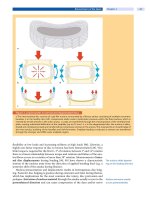
a b
c
Figure 3. Classification of spinal stenosis
a Central spinal stenosis with severe compression of the cauda
equina (arrows).
b Lateral recess stenosis with compression of the
exiting nerve roots.
c Lateral stenosis with compression of the
nerve root (*) as a result of enlargement of the superior process of
the facet joint (arrowhead) and a foraminal disc herniation (arrow).
518 Section Degenerative Disorders
A pathomorphological classification considers the underlying pathology such as:
hypertrophy of the ligamentum flavum
hypertrophy of the facet joints
osteophyte formations (spurs)
disc herniation
synovial facet joint cysts
vertebral displacements (anterior/lateral)
Clinical Presentation
History
The symptom onset
of spinal stenosis
is usually insidious
Lumbar spinal stenosis is usually a chronic condition, sometimes but not typi-
cally with a long history of low-back pain. Occasionally, the stenosis may become
symptomatic after a minor trauma or unusual physical stress but usually the
onset is insidious. Patients with a congenitally narrow canal may acutely present
with major neurologic deficit due to the occurrence of an additional disc protru-
sion. In patients with severe congenital stenosis, symptoms may occur in their
twenties to thirties, whereas symptom onset in the sixth and seventh decades is
common for acquired degenerative stenosis.
The cardinal symptom of spinal stenosis is neurogenic claudication,which
presents as:
numbness, weakness and discomfort in the legs while walking or prolonged
standing
regression of symptoms during sitting and rest
Leg symptoms
usually improve or
disappear during sitting
The characteristic finding in neurogenic claudication is that the symptoms
regress during sitting and rest.
During sitting (forward bending) the spinal canal is widened, which decreases
the compression of the cauda equina. Patients may be asymptomatic while riding
a bicycle because they are in a forward bend position.
The painfree walking
distance can vary from
day to day
The p ainfree walking distance mayvaryfromdaytoday.Typicallysymptoms
will occur at a smaller distance if walking downhill due to the increased lumbar
lordosis with consecutive narrowing of the spinal canal. Patients may provoke
symptoms after a certain walking distance but be able to continue further before
having to bend forward or sitting for pain relief. Furthermore, the distance
required to develop these symptoms will decrease with increasing severity of the
degenerative changes. At rest, the patients usually complain of few or no symp-
toms at all. The leg symptoms may also be described as paresthesia, cramps,
burning pain, or weakness. Some patients only report heaviness or deadness of
the limbs and a sense that their legs are giving way.
Nerve root claudication
is characterized by radicular
pain on walking
Patients with lateral canal stenosis may present with a radicular claudication.
Similarly to neurogenic claudication, the symptoms can be provoked during walk-
ing and prolonged standing but are localized to a nerve root dermatome. The symp-
toms are not so clear in cases of a multilevel foraminal stenosis. These patients,
however, often report signs of a mild radiculopathy during rest which worsens on
activity. However, some patients present with a radicular pain syndrome during
rest and particularly during the night. It is assumed that in those cases the postural
change results in a narrowing of the foramen, which results in the pain provocation.
Additional but less frequent symptoms may be:
mechanical low-back pain (worse on activity)
atypical leg pain (non-radicular distribution)
cauda equina syndrome (very rare)
Lumbar Spinal Stenosis Chapter 19 519
Walking-related back and
buttock pain is not
uncommon
In patients suffering from lumbar spinal stenosis, pain in the lower spine, but-
tocks or posterior legs is not uncommon. Often this back pain becomes worse
on activity. This finding can be due to the stenosis itself and can be explained by
an involvement of the posterior rami of the nerve roots. It may also be related
to a segmental instability, e.g. degenerative spondylolisthesis (
Case Introduc-
tion
). Rarely, the patients present with an acute or subacute onset of a cauda
equina syndrome. Nevertheless, it is important to explore the urinary function
and ask for bowel incontinence because many patients do not see the correla-
Always explore for bowel
and bladder dysfunction
tion with their main symptoms and tend not to report bowel and bladder dys-
function.
Physical Findings
The physical exam most
frequently is normal
Clinical examination in spinal stenosis most often is remarkably normal. As in
any spinal disorder, a thorough neurological examination (see Chapter
11 )is
mandatory. The most frequent physical findings are [50]:
limited lumbar extension 66–100%
sensory deficit 32–58%
muscle weakness 18–52%
straight leg raising 10–90%
absent knee reflexes 10–50%
absent ankle reflexes 50–68%
Consider peripheral
neuropathy in cases of
absent ankle jerks
and sensory deficits
However, these symptoms are obviously non-specific. Pain with extension or a
voluntary decrease in the range of lumbar extensions is often seen. Dermatomal
sensory loss and muscle weakness are uncommon at rest, although they may
appear if the patient is reexamined after walking to their tolerance limit. Loss of
ankle jerks and distal vibration sense may be present, but are common in the
older age group. Straight-leg raising is usually normal.
Assess the peripheral pulses
to detect vascular stenosis
Diminished peripheral pulses or limitation of hip movement may increase
suspicion for the most frequent differential diagnosis, i.e. vascular claudication
and osteoarthritis of the hip joint. Sometimes signs of a cervical myelopathy may
be seen, because lumbar stenosis is associated with cervical canal narrowing in
5%of cases [21].
A reliable assessment of the walking distance is an important parameter for
determining the outcome of surgical treatment. The so-called shuttle walking
test has been evaluated for spinal stenosis and can be recommended for this pur-
pose [93].
Diagnostic Work-up
The diagnosis of spinal stenosis is mainly based on the patient’s clinical symp-
toms and signs. However, the confirmation of a clinical diagnosis is only made by
imaging studies [3, 12, 14, 52, 90]. Neurophysiologic studies can be helpful to fur-
ther confirm the diagnosis and allow for a differential diagnosis.
Imaging Studies
Standard Radiographs
Standard anteroposterior and lateral radiographs do not permit a final diag-
nosis. Nevertheless, findings (
Fig. 4
) often associated with spinal stenosis
are:
520 Section Degenerative Disorders
degenerative spondylolisthesis
degenerative scoliosis
congenitally narrow spinal canal
Degenerative
spondylolisthesis
is indicative of a
spinal stenosis
Degenerative spondylolisthesis particularly at the L4/5 level in females is fre-
quently associated with spinal stenosis (
Fig. 4a). Isthmic spondylolisthesis is
most common at the L5/S1 level and will produce nerve root impingement at the
level of the defect while degenerative spondylolisthesis is more likely to produce
constriction of the entire cauda equina. In patients with degenerative scoliosis,
the stenosis is often found at the apex of the curve (L2/3 and L3/4) (
Fig. 4b). On
the anteroposterior view, the interpedicular distance should be identified. In
healthy individuals it increases progressively from the L1 to the L5 level. If the
interpedicular distance is narrow (
Fig. 4c), it indicates a narrow spinal canal.
Radiological signs for congenital or developmental stenosis inthe lateral view are
short pedicles indicating a decreased sagittal canal diameter (
Fig. 4d).
Less reliable findings implying lateral recess or foraminal stenosis are:
disc space narrowing
isthmic spondylolisthesis
severe facet osteoarthritis
a
b
c
d
Figure 4. Radiographic findings
a Degenerative spondylolisthesis at the L4/5 level. b Degenerative scoliosis with
lateral shifting of the L2 and L3 vertebrae indicating central and lateral recess
stenosis.
c, d Congenitally narrow spinal canal with a narrow interpedicular dis-
tance and short pedicles.
Lumbar Spinal Stenosis Chapter 19 521
The spinous processes and laminae should be identified to diagnose any previous
surgical decompressive procedure. Scalloping of the posterior aspect of the verte-
bral body may suggest a congenital process such as achondroplasia, acromegaly,
neurofibromatosis, mucopolysaccharidosis, or a tumor.
Magnetic Resonance Imaging
MRI is the imaging study
of choice
Magnetic resonance imaging (MRI) is excellent in demonstrating potential
causes of nerve root compression, including spinal stenosis. Compared to com-
puted tomography (CT), MRI has a significant advantage because of its better
soft tissue resolution. Encroachment on the spinal canal with inward bulging of
discs and yellow ligaments usually plays a significant role in narrowing of the
bony spinal canal and can be depicted excellently by MRI.
MRI studies usually encompass a T1- and T2-weighted sagittal and a T2-
weighted axial scan. Characterist ic findings of spinal stenosis include:
thickened ligamentum flavum (
Fig. 5a)
facet joint hypertrophy (
Fig. 5b)
hourglass appearance of spinal canal on sagittal images (
Fig. 5c)
facet joint synovial cysts (
Fig. 5d, e)
trefoil appearance of the thecal sac (indicative of spinal lipomatosis)
obliterated perineural fat in neural foramina (
Fig. 5f)
short pedicles
vertebral endplate osteophytes
Parasagittal T1-weighted images define the integrity of the foramen. The normal
nerve root has a low signal and is surrounded by the higher intensity signal of fat.
Obliteration of the fat is indicative of a foraminal stenosis (
Fig. 5f).
The extent of stenosis and
clinical symptoms are not
closely correlated
Stenosis is not a pathological entity per se as it appears in up to 21% of asymp-
tomatic subjects over 60 years of age on MR images [13]. In addition, a poor cor-
relation between radiological stenosis and symptoms is well established [33].
Debate arises about the value of a funct ional examination of the spinal canal. A
simple assessment of the postural influence, e.g. on a degenerative spondylolisthe-
sis, can be made by comparing the standard radiograph with the prone MRI. Often
a partial reduction during the prone position is seen which indicates the mobility
of the slip. Upright MRI has been reported to be helpful in the diagnostic assess-
Functional examinations
rarely change treatment
strategy
ment [88, 102], but the chance of detecting a pathology not seen on conventional
MRI which would change the therapeutic approach is minimal [101]. So far, no sin-
gle study has proven the added diagnostic value in terms of treatment decisions.
Computed Tomography and CT Myelography
CT is rarely needed in the presence of an MRI scan. The benefits of CT over plain
films are that it can provide greater resolution in terms of an increased ability to
appreciate density differences. A second advantage of CT is its ability to image in
differentplanes,eitherdirectlyorbymultiplanarreconstruction.OnCT,midsag-
ittal lumbar canal diameters less than 10 mm are regarded as an absolute stenosis
and midsagittal lumbar canal diameters less than 13 mm represent a relative ste-
nosis [98].
CT myelography is an
alternative in case
of MRI contraindications
Compared to MR imaging, the disadvantage of CT is that it does not allow
good visualization of the nerve roots and exposes patients to radiation. If MRI is
not indicated (e.g. pacemaker, metallic artifacts), CT myelography provides the
best alternative to confirm nerve root involvement. However, CT myelography
may not display foraminal stenosis because the dural root sheath ends at the
entrance of the foramen.
522 Section Degenerative Disorders
a bc
def
Figure 5. MRI characteristics of spinal stenosis
a Hypertrophy of the yellow ligament (arrowheads)onaT2Waxialscan.b Facet joint hypertrophy with joint effusion
(arrowheads) on a T2W axial image.
c Hourglass appearance of the spinal canal (arrowheads) on a sagittal T2W image.
d Large facet joint synovial cysts on the right side (arrowheads) and a small cyst on the left side (arrow). e Alargefacet
joint cyst is compressing the thecal sac shown on a T2W sagittal image.
f Fat in the foramen appears with a bright signal
on T1W image (arrows). Obliterated perineural fat (arrowheads) in neural foramina indicating foraminal stenosis which is
aggravated by a small disc protrusion.
Neurophysiologic Studies
Neurophysiologic studies
are helpful in the diagnostic
work-up of equivocal cases
Neurophysiologic studies are a reasonable supplement to the clinical and radio-
logical assessments. Somatosensory evoked potentials (SSEPs) and motor
evoked potentials (MEPs) investigate the central nervous system pathways while
EMG and nerve conduction velocity (H-reflex, F-wave) are especially useful for
investigating peripheral sensorimotor pathways (see Chapter
12 ).
Neurophysiologic studies allow the affection of the cauda equina to be confirmed
in the majority of patients and provide a differential diagnosis from peripheral
neuropathy, musculoskeletal and vascular disorders, which are especially frequent
in the older population. In a study population of patients undergoing lumbar
decompression, the neurological examination was normal in 70% of patients or
showed only minor and non-specific motor and/or sensory deficits. However, 87%
of patients showed pathological electrophysiological recordings. The tibial SSEP
was delayed in 79% and the H-reflex in 56% of patients. A diminished compound
motoractionpotential(CMAP)wasfoundin39%ofpatients[20].
Lumbar Spinal Stenosis Chapter 19 523
Neurophysiologic assessment is indicated:
to confirm the clinical relevance of imaging findings in equivocal cases
to identify a peripheral neuropathy
to differentiate radiculopathy and mononeuropathy
to differentiate non-specific neurological complaints
Differential Diagnosis
The most common differential diagnosis of neurogenic claudication is intermit-
tent ischemic claudication due to peripheral vascular disease (
Table 2):
Table 2. Differentiation of vascular and neurogenic claudication
Signs and symptoms Vascular Neurogenic
walking distance fixed variable
type of pain
cramps, tightness dull ache, numbness
relief at cessation of activity
immediate delayed
back pain
rarely occasionally
pain relief
standing flexion and sitting
posture provocation
uncommon common
walking up hill
pain no pain
bicycle riding
pain no pain
pulses
absent normal
trophic changes
likely absent
muscle atrophy
rarely occasionally
In equivocal cases, ultrasound screening for the presence of pulses and subse-
quently angiography is indicated for differential diagnosis. The bicycle test of
von Gelderen can be used to distinguish neurogenic from vascular claudication
syndromes [19]. Neurogenic claudication has been described as a result of spinal
arteriovenous malformations, but such a presentation is extremely rare. Tumors
of the cauda equina usually do not produce claudication symptoms. Other differ-
ential diagnoses are less frequent. Low-back pain and referred pain associated
with non-stenotic lumbar degenerative disease may sometimes mimic neuro-
genic claudication.
Peripheral neuropathy
is a frequent concomitant
finding or differential
diagnosis
Peripheral neuropathy is often found as an independent additional pathology
in elderly patients presenting with spinal stenosis. A preoperative diagnosis is
important for a proper consultation of the patient about the future treatment
result because the neuropathy will remain unaddressed and may result in patient
dissatisfaction.
Non-operative Treatment
The prevailing symptom of patients with lumbar spinal stenosis is neurogenic
claudication while back and radicular leg pain is less frequently a predominant
complaint. Neurogenic claudication results from a narrowing of the spinal canal,
nerve root canals, or intervertebral foramina which cannot be addressed by any
form of non-operative treatment. However, it is anecdotally well known that the
course of patients with spinal stenosis is sometimes very stable over time and
many patients report intermittent improvement.
524 Section Degenerative Disorders
Natural History
Natural course of spinal
stenosis is generally benign
Little is known about the natural history of spinal stenosis. Some authors
reported that the natural course is benign and that the subjective and physical
manifestations can be remarkably stable [43]. After a mean follow-up period of
59 months, symptoms were unchanged in 70%, improved in 15%, and worsened
in 15% of patients [43]. Since no proof of deterioration was found, it was con-
cluded that expectant observation could be an alternative to surgery [43]. Despite
a benign natural history, the long term course is characterized by a slow deterio-
ration because the motion segment degeneration (
Fig. 2)progressivelyleadstoa
worsening of the stenosis. The end stage of the disease can be described in terms
of a completely immobilized patient in whom the stenosis severely impacts on
the remaining quality of life.
Non-operative Options
Conservative measures may be indicated to relieve symptoms in patients with
only mild and intermittent symptoms or only minimal interference with lifestyle
(
Table 3):
Table 3. Favorable indications for non-operative treatment
mild claudication symptoms concomitant back pain
mild to moderate radiculopathy minimal interference with lifestyle
absence of motor deficits
Conservative therapy may be the first choice if surgery is associated with a poten-
tially high perioperative risk for general medical reasons.
Conservative treatment options may consist of:
medication (analgetics, NSAIDs, muscle relaxants)
administration of calcitonin (nasal spray, subcutaneous, intramuscular)
postural education
therapeutic exercise with avoidance of extension
epidural infiltration of corticosteroids (see Chapter 10 )
The scientific evidence for
the effectiveness of conser-
vative measures is limited
Various types of oral medication are available to control pain in patients with spi-
nal stenosis and help to control the symptoms. However, there is no evidence in
the literature on the clinical effectiveness. The administration of calcitonin has
been reported to improve the symptoms of neurogenic claudication [22, 75].
However,arecentwell-conductedrandomizedcontrolledstudy[73]didnotfind
evidence that nasal application of calcitonin is more effective than placebo treat-
ment. Some patients may improve their function as a result of postural education
and instructions for a home exercise program. As extension worsens the symp-
toms by reducing the size of the spinal canal, it is obvious that extension exercises
must be avoided. Epidural injec tions anecdotally have a temporary beneficial
effect and may be considered as a treatment in elderly patients in whom surgery
would be too risky or who refused surgery. However, the therapeutic value of epi-
dural injections in all lumbar spinal disorders and particularly in spinal stenosis
(see Chapter
10 ) remains controversial [26, 60, 84].
Well conducted studies comparing conservative with surgical treatment are
few in number and difficult to compare because of the heterogeneity of the study
population. However, studies comparing non-operative and surgical treatment
demonstrated better overall results of surgery [4, 7, 8, 44]. Moreover, only one
Lumbar Spinal Stenosis Chapter 19 525
single randomized study compared short- and long-term results of medical and
surgical therapy. Amundsen et al. [4] concluded that an initial conservative
approach is advisable for oligosymptomatic patients because those with an
unsatisfactory result can be treated surgically later without impairment of the
prognosis.
Operative Treatment
General Principles
Surgery for lumbar spinal stenosis is generally accepted when conservative treat-
ment has failed or if the stenosis substantially impacts on the patients’ lifestyle.
The general goals of the operative treatment are to improve quality of life by
reducing symptoms such as those in
Table 4:
Table 4. Indications for surgery
moderate to severe claudication symptoms significant interference with lifestyle
progressive neurological deficits (rare) caudaequinasyndrome(veryrare)
With the exception of a cauda equina syndrome or progressive neurologic defi-
cits, the indication for surgery remains relative and is dominated by the subjec-
tive interference with the patients’ quality of life.
Surgical Techniques
The surgical technique is largely dependent on the type of stenosis (i.e. central,
lateral recess, or foraminal) and the presence of concomitant back pain. The
principal surgical options for decompression of central and/or lateral spinal ste-
nosis are:
decompression (uni-/bilateral laminotomy or laminectomy)
decompression with non-instrumented fusion
decompression with instrumented fusion
Laminotomy and Laminectomy
Laminectomy may
increase or create
segmental instability
Theobjectiveofdecompressionistocreatemorespaceforthecaudaequinaand
nerve roots by liberating the neural structures from compressing soft tissues
(disc herniation, hypertrophied flavum, thickened facet joint capsules) and osse-
ous structures (hypertrophied facet joints, osteophytes). Until the last decade,
total laminectomy was the standard method of decompression in central spinal
stenosis. However, the recognition that total laminectomy may increase or cause
segmental instability [31, 35] has led to a more conservative approach, preserv-
ing the lamina and only removing those parts which actually cause the stenosis
[91].
Selective decompression is the surgical technique of choice in patients pre-
senting with neurogenic claudication without relevant back pain (
Case Study 1).
Favorable indications include:
central stenosis predominantly due to flavum hypertrophy
nerve root claudication due to lateral recess stenosis
absence of degenerative spondylolisthesis and scoliosis
absence of osseous foraminal stenosis
526 Section Degenerative Disorders
abc
d
Case Study 1
A 26-year-old male complained of severe bilateral leg pain which was worse on
walking. He did not report any significant back pain. Physiotherapy was not
helpful and the patient was severely incapacitated by the pain. NSAIDs had
only little effect. A lateral radiograph (
a) revealed evidence for a congenitally
narrow spinal canal with short pedicles (arrows). T1W (
b)andT2W(c)sagittal
images demonstrated a narrow spinal canal with secondary degenerative
changes. Disc protrusions (arrowheads) and hypertrophied flavum (arrows)at
the level of L4/5 and L5/S1 worsened the preexisting narrow spinal canal. The
axial T2W image (
b) showed a severe stenosis at the level of L4/5. Note the
rather advanced degenerative changes of the facet joint (arrowheads) already
in young age. The patient was treated by a selective bilateral decompression
with preservation of the interspinous ligaments and undercutting of the lami-
nae. At 6 weeks postoperatively the patient was completely pain free and
resumed normal activities.
Decompression alone
is indicated in patients
without deformity
This procedure (Fig. 6) can be performed with the assistance of loops or the
microscope althoughthereisnoevidenceforthesuperiorityofamicrosurgical
approach. A technical detail is related to the preservation of the facet joint cap-
sules when an undercutting medial facetectomy is required to decompress the
thecal sac.
In selected cases, a unilateral approach suffices to bilaterally decompress the
thecal sac (over-the-top technique) by undercutting of the laminae, preserving
the interspinous ligaments and the contralateral muscles [53].
Total laminectomy is still indicated in cases in which the thecal sac cannot be
sufficiently decompressed or the access to the foramen is obliterated (foraminal
stenosis). In rare cases of cauda equina syndrome, total laminectomy is indicated
to ensure adequate neural decompression. Laminectomy alone should be
avoided in cases with preexisting instability such as:
degenerative spondylolisthesis
isthmic spondylolisthesis with secondary degenerative changes
degenerative scoliosis
Clinical outcomes
of laminectomy and
laminotomy are similar
Clinical results of decompressive laminectomy are favorable with appropriate
indications accounting for preexisting instability. Patient satisfaction varies from
57% to 81% with regard to excellent to good results [1, 38, 39, 41, 45, 46, 48, 49,
78, 79, 83, 89]. While the postoperative outcome of decompressive laminectomy
is well maintained for several years after surgery, the condition is known to dete-
Lumbar Spinal Stenosis Chapter 19 527