The grammar of the english verb phrase part 33 ppt
Bạn đang xem bản rút gọn của tài liệu. Xem và tải ngay bản đầy đủ của tài liệu tại đây (395.42 KB, 7 trang )
I. The semantics of the present perfect 217
(c) As far as the full situation is concerned, there are three temporal W-
interpretations
: the ‘indefinite reading’ (i. e. the full situation comes to
an end before t
0
), the ‘continuative reading’ (i. e. the time of the full situa-
tion includes t
0
) and the ‘up-to-now reading’ (i. e. the terminal point of the
full situation is adjacent to t
0
). These will be discussed in 5.3Ϫ4 below.
5.2.4 Later on in this chapter we will explain that the present perfect has not
only one core meaning, two T-interpretations and three W-interpretations, but
also (at least in its ‘up-to-now’ W-interpretation) two functional readings, one
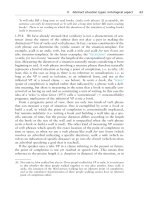
of which allows further possible readings. Figure 5.1 gives an overview of all
these ‘meanings’ (in the nontechnical sense of the word). (What is not men-
tioned in this table is that, as we will see, it is sometimes possible to distinguish
afewusage types within a given W-interpretation. Thus, the so-called ‘resulta-
tive perfect’, ‘hot news perfect’ and ‘perfect of experience’ are all (nontemporal)
W-readings which are assigned to certain present perfect sentences that receive
the indefinite temporal W-interpretation Ϫ see 5.13Ϫ16.)
Figure 5.1. The various readings of clauses in the present perfect.
218 5. The absolute use of the present perfect
II. The temporal W-interpretations of
present perfect clauses
5.3 Introduction
Since the situation time may coincide with the pre-present or be included in it, and
since the time of the full situation can similarly contain the situation time in terms of
coincidence or inclusion, there are in principle four possibilities as far as the W-relation
between the time of the full situation and the pre-present time-zone is concerned. In
practice, however, clauses in the present perfect can only receive three different tempo-
ral W-interpretations concerning the location of the full situation relative to the pre-
present: an ‘indefinite’, ‘continuative’ or ‘up-to-now’ reading. The reading is ‘indefinite’
if the time of the full situation does not lead up to the endpoint of the pre-present
zone, as in Meg has already washed the elephant. The reading is ‘continuative’ if the
time of the full situation is taken to include t
0
,asinMeg has been washing the elephant
for half an hour now. The reading is an ‘up-to-now’ interpretation if the full situation
covers the entire pre-present but does not include t
0
,asinWhere have you been?
(addressed to someone who has just come in).
5.3.1 Whereas the T-interpretations of a clause in the present perfect concern
the location of the situation time (ϭ time of the predicated situation) relative
to t
0
, the temporal W-interpretations concern the relation between the time of
the ‘full situation’ (see 2.16.1) and t
0
. Such a temporal W-interpretation de-
pends in part on the semantics of the tense (i. e. on the location of the situation
time in the tense structure) but also on other factors, such as ontological aspect
(Aktionsart), grammatical aspect, actualization aspect (bounded vs non-
bounded Ϫ see 1.44.1), time-specifying adverbials, duration adverbials, and
other contextual and pragmatic factors. This is true of all W-interpretations.
Thus, the temporal W-interpretation of At five o’clock I was working involves
(at least) the following elements: (a) The situation time is located in the past
time-sphere; (b) The situation time coincides with the Adv-time (ϭ at five
o’clock); (c) The time of the full situation is not represented as bounded and
is longer than the situation time.
5.3.2 A situation time may in principle either coincide with the time of the
full situation or be a subpart of it Ϫ remember the discussion of Ten minutes
ago John was in the library; perhaps he still is in 1.44.2. In other words,
irrespective of the tense used, the time of a full situation ‘contains’ the situation
time in terms of inclusion or coincidence. (Inclusion requires the clause to be
homogeneous, i. e. the full situation must not be represented as bounded Ϫ see
II. The temporal W-interpretations of present perfect clauses 219
1.44.2.) When the present perfect is used, the pre-present similarly contains the
situation time in terms of inclusion or coincidence. We can conclude from these
statements that there are four theoretical possibilities as to the temporal rela-
tion between the pre-present zone and the time of the full situation.
(a) The first possibility is that the situation time coincides with the time of
the full situation and is included in the pre-present. In that case the clause
receives a ‘
before now’ T-interpretation. This allows only one temporal
W-interpretation, viz. that in which the time of the full situation lies en-
tirely before t
0
in the pre-present. This possibility is illustrated by the fol-
lowing:
[Nobody can enter the house, because] I have locked the door and hidden the key.
(The full situations are interpreted as lying wholly before t
0
.)
Because it is typical of this temporal W-reading that the precise temporal loca-
tion of the situation in the pre-present zone remains indefinite, we call this the
indefinite reading of the present perfect (or, more correctly, of the clause in
the present perfect).
(b) The second theoretical possibility is that the situation time coincides with
the pre-present zone and is included in the time of the full situation. (The
latter is only possible if the full situation is homogeneous and hence non-
bounded Ϫ see 1.45.) In this case the full situation not only fills the entire
period leading up to t
0
but also extends beyond it. That is, the full situation
also includes t
0
and possibly part of the post-present, though the present
perfect itself does not say anything about the post-present (nor, directly,
about the inclusion of t
0
, because it is the situation time, not the time of
the full situation, that is relevant to the semantics of a tense). This possibil-
ity leads to a temporal W-interpretation which is traditionally referred to
as the
continuative reading. For example:
Ian’s been living in Lincoln since 1998. (continuative reading: the sentence is W-
interpreted as implying that Ian is still living in Lincoln)
For two months now there has been a famine in this country. (ϭ ‘There has been
a famine throughout the pre-present, and it is still continuing.’)
(c) The third theoretical possibility is that the situation time coincides with
the time of the full situation and with the pre-present zone. This leads to
the temporal W-interpretation that the time of the full situation fills the
entire period leading up to t
0
but does not include t
0
. We refer to this as
the
up-to-now reading. (In this label, ‘up-to-now’ has the same meaning
as in ‘period up to now’: in the same way as a pre-present period leads up
to t
0
but does not include it, the up-to-now reading of a clause means
that the full situation is taken to lead up to t
0
but without including t
0
.)
For example:
220 5. The absolute use of the present perfect
(said to someone who has just come in) Where have you been?
[Representative Jo Ann Emerson recently announced Dec. 13 as the day traffic is
anticipated to cross the new Bill Emerson Memorial Bridge. “We couldn’t be more
excited about this,” said MoDOT District Engineer Scott Meyer.] “We’ve been
telling the public the bridge would be opened by the end of the year [and we are
very pleased to finally have an anticipated date for the bridge completion.”] (www)
(d) The fourth theoretical possibility is that the situation time is included in
(i. e. is shorter than) the pre-present and is also included in the time of the
full situation. Since the latter possibility requires the full situation to be
homogeneous and nonbounded, this leads to the expectation that the situa-
tion must be either a state or a dynamic (nonstative) situation represented
as ongoing by the progressive form. Let us consider these two possibil-
ities separately.
As regards states, it would at first sight seem to be impossible to find examples
of present perfect sentences in which the full situation is a state and the two
conditions (viz. the situation time is included in the pre-present and also in-
cluded in the time of the full situation) are satisfied. In all of the following
examples the full situation is interpreted as bounded (ϭ having come to an
end), which means that the situation time is interpreted as coinciding with the
time of the full situation, so that the temporal W-interpretation is an indefinite
reading: the full situation lies wholly before t
0
.
John has been in the house.
John has just been in the house.
Has John ever been in the house?
The reason why the time of the full situation is W-interpreted as coinciding
with the situation time is that this is the unmarked kind of containment relation
between the time of the full situation and the time of the predicated situation
(ϭ situation time). In these examples there is nothing triggering the marked
interpretation that the situation time is only a portion of the time of the full sit-
uation.
However, the situation time of a state is interpreted as included in the time
of the full situation if the state functions as ‘background’ situation for an in-
tervening situation:
You’ve never been behind someone when all of a sudden they slow down for no
apparent reason and make a turn with no signal? (www) (The time of the predicated
situation is the portion before the slowing down and the full situation continues
during the slowing down.)
Clearly, this reading is not a new kind of reading but an ‘indefinite reading’.
II. The temporal W-interpretations of present perfect clauses 221
If the situation is not a state, the two conditions (viz. the situation time is
included in the pre-present and also included in the time of the full situation)
can only be fulfilled if the progressive form is used. As noted in 1.22.4, the
progressive form refers to some middle part of the full situation (because it
disregards the situation’s terminal point). That middle part is the situation
time. Unlike an expression of state (e. g. be in the house), a progressive form
thus automatically represents the situation time as included in (i. e. shorter
than) the time of the full situation, which means that the second condition is
fulfilled. Fulfilment of the first condition (viz. the situation time is included in
the pre-present rather than co-extensive with it) is then also possible.
It should be noted, however, that this use of the progressive form is re-
stricted to three types of present perfect sentences, illustrated by the follow-
ing:
(1) Who’s the man you’ve just been talking to?
3
(2) Have you ever been working on a project?
(3) Have you ever been working on a project [when you had to give it up temporar-
ily for lack of funding]?
In (1), the full situation, which is longer than the situation time which coincides
with the Adv-time (just), can only be W-interpreted as having come to an end
before t
0
. This means that (1) receives an indefinite W-interpretation which is
a ‘recency interpretation’ (see 5.16 and 5.25.5). Sentence (2), which is not ac-
ceptable for some speakers, also receives an indefinite reading (which, however,
is not a recency reading). The speaker asks the hearer if the situation of his
working on a project has been in progress at one or more bygone times within
the pre-present. Sentence (3), which is fully acceptable because the when-clause
provides the vantage point from with the situation is viewed as being in pro-
gress, receives a similar indefinite reading.
4
In sum, possibility (d) does not give rise to a fourth type of W-interpretation:
all the examples given receive an indefinite reading, i. e. the same reading as is
engendered by possibility (a).
3. The following is an authentic example of this type:
Are you quite sure you haven’t just been speaking to the cryptic “K” herself? (DOC)
4. This kind of sentence is special in that the when-clause is not a time-specifying adverbial
but a ‘narrative’ when-clause, i. e. a clause which ‘pushes forward’ the action Ϫ see
13.1.3. This means that the when-clause does not specify the time of the head clause
situation. It is rather the other way round: the head clause expresses the background
situation in the middle of which the when-clause situation actualizes. This means that
this sentence is only acceptable if one mentally restructures it so that the perfect is
separated from the progressive: the perfect goes with the (indefinite) interruption Ϫ have
you ever had to give up a project temporarily for lack of funding? Ϫ and the progressive
goes with the background situation Ϫ while you were working on that project. These
paraphrases make it clear that the sentence receives an indefinite reading.
222 5. The absolute use of the present perfect
5.4 The three W-interpretations of clauses in the
present perfect
This section goes further into the three temporal W-interpretations of clauses in the
present perfect, viz. the indefinite, continuative and up-to-now readings.
5.4.1 As far as the W-relation between the time of the full situation and the
pre-present time-zone is concerned, clauses in the present perfect can thus re-
ceive three different temporal W-interpretations: an indefinite, continuative or
up-to-now reading. (When it comes to interpreting tensed clauses, it is the
time of the full situation that is important. This is because a full temporal W-
interpretation depends not only on the semantics of the tense Ϫ i. e. the loca-
tion of the situation time Ϫ but also on other factors, such as adverbials and
aspectual, contextual and pragmatic factors.)
On the
indefinite interpretation, the full situation is taken to actualize
at some indefinite time (or times) in the course of the pre-present (which leads
up to t
0
but does not include it). Even if the clause is L-homogeneous, as in I
have lived in Rome or Have you ever been watching your favourite programme
[when unexpected visitors arrived]?, not only the situation time but also the
time of the full situation is taken to be included in the pre-present, i. e. the full
situation is interpreted as not extending up to t
0
. (In other words, the situation
is interpreted as W-bounded, though it is L-homogeneous.) On the
continua-
tive interpretation
the speaker’s message is taken to be that the full situation
not only covers the entire pre-present period but also includes t
0
. That is, the
full situation is still continuing at t
0
. (For example: I’ve been waiting for him
for two hours now.) Finally, on the
up-to-now interpretation, the full situa-
tion is taken to cover the entire pre-present, but without including t
0
.(For
example: [Oh, there you are!] What have you been doing?)
The following sentences further illustrate the threefold distinction:
I’ve received e-mails from her before, you know. (indefinite reading; the full situation
lies completely before t
0
)
Someone has opened the window! (similar)
[I know my way around here because] I’ve been working for this firm since 1998.
(continuative reading: I am still working for this firm.)
I’ve had this car for a long time. (continuative reading: I still have the car in ques-
tion)
[Hello, Tom! It’s a long time since I last saw you.] What have you been doing? (up-
to-now reading: the question concerns the addressee’s actions during the complete
pre-present period, but these actions are not continuing at t
0
)
II. The temporal W-interpretations of present perfect clauses 223
Three weeks have elapsed since then. (up-to-now reading: the reference is to a dura-
tion-specifying situation which fills the entire pre-present)
“How many times has Bill seen Sharon this week?” Ϫ “Bill’s seen her three times.”
(up-to-now readings of the subtype which in 5.4.7 we will call the ‘number-quantify-
ing constitution reading’: both speakers are concerned with the question how many
times Bill has seen Sharon in a period leading up to now. This means that they are
not concerned with the occurrence of one or two full situations at some indefinite
time(s) in the pre-present but rather with the situational constitution of a specific
period leading up to now. In other words, speaker A asks speaker B to ‘measure’
the period leading up to now by counting the number of actualizations in it. Speaker
B does so in his reply.)
[Helen is going through a depression. I know because] I’ve seen her three times this
week [and each time she talked about how bad she felt.] (indefinite reading: the
speaker’s concern in this sentence is not with the situational constitution of the
period leading up to now, i. e. with the number of actualizations in this period, but
with adducing evidence for the claim that the speaker knows that Helen is going
through a depression.)
The last two examples illustrate an important point: the indefinite, continuative
and up-to-now readings are W-interpretations that are allowed by the seman-
tics of the present perfect but which the present perfect does not suggest on its
own. Which reading is intended must be clear from the context (i. e. either
from elements inside the sentence Ϫ e. g. an adverbial, the (non)homogeneous
representation of the situation Ϫ or from the context in which the sentence
is used).
5.4.2 The three temporal W-interpretations that can be assigned to a present
perfect clause are represented in Figures 5.2Ϫ4. (The circles around t
0
are
meant to visualize the fact that the pre-present zone does not include t
0
, but
leads up to it. The horizontal slanting line in Figure 5.4 means that the full
situation covers both the pre-present zone and t
0
.)
Figure 5.2. Representation of the indefinite reading.
5.4.3 It may be necessary to reiterate that in the examples given in 5.4.1 the
three readings concern the times of the full situations. They are therefore W-