Fundamentals of english grammar third edition part 21 pps
Bạn đang xem bản rút gọn của tài liệu. Xem và tải ngay bản đầy đủ của tài liệu tại đây (386.76 KB, 7 trang )
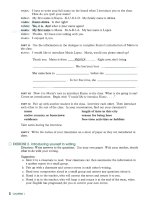
EXERCISE
10.
Questions
wlth
WHO, WHO(M),
and
WHAT.
(Chart
5-4)
Directions:
Work in pairs.
Speaker
A.
Complete each question with
who, whom,
or
what.
Speaker
B:
Answer the question.
Example:
. .
.
are
you currently reading?
SPEAKER
A:
What are you currently reading?
SPBAKER
B:
A
novel about a cowboy.
1.
. . .
do you like to read?
2.
. . .
do you like to spend a lot of time with?
3.
. . .
is your idea of the perfect vacation?
4.
.
. .
do you like to spend your vacations
with?
5.
.
.
.
are the most important people in your life?
Switch
roles.
6.
.
. .
was the most memorable event of your childhood?
7.
. . .
stresses you out?
8.
.
.
.
do you need that you don't have?
9.
.
.
.
would you most like to invite to dinner? The person can be living or dead.
10.
.
. .
has had the most influence on you in your lie?
i-5
SPOKEN AND WRITTEN CONTRACTIONS WITH
QUESTION WORDS
I
is
(a)
"When's
he coming?"
"Why's
she late?"
are
(b)
"Whar're
these?"
"rn're
they?"
did
(c)
"Who'd
you see?"
"What'd
you do?"
will
(d)
"Where'U
you
be?"
"When'U
they
be here?"
WOKBN
WRlTIBN
is
(e)
Ed?"
(f)
Uhere's
EA?
"What's
that?"
Uha+'s
*at?
"Who's
he?"
Uho's he?
with question words
in
speaking. These
contractions are usually
NOT
written.
Only contractions with
is
and
where, what,
or
who
are commonly used
in
writing.'
'Conuactions an used
in
inforrnd writing, such
ss
letters
m
frimds
or e-milo, but an generally not appropriate
in
more
forms1 writing, such as
in
magazine srliclea
or
reference boob.
0
EXERCISE
11.
Spoken contractlons wlth questlon words. (Chart
5-5)
Directions:
Listen to your teacher say the following questions in contracted speech, and
practice saying them-yourself.
1.
Where is my book?
3.
Why is Anita absent?
2.
What is
in
that drawer?
4.
Who is that man?
128
CHAPTER
5
~. .
-~
:
.
10. Why did you say that?
i,'
. .
I-;
Who are those men?
,
.:'.
'
'
.,
.
6.
Where
are
you going?
'i,
i;,
2,.
:,$
1
1.
Who did you see at the party?
A
,.
-1
7.
What are you doing?
12. Where will you be?
8.
Where did Bob go last
night?
13. When will you arrive?
9.
What did you say?
14.
Who will meet you at the airport?
EXERCISE
12.
Information questions. (Charts 5-2
-t
5-5)
.,
Directions: Create any appropriate question for the given answer.
Example:
Larry.
-t
Who is the
fax
from?
Who(m) did you
go
to the mrwie with?
Etc.
1. Yesterday.
6.
Because I was tired:
'1
Y,,
;
,
:
1
2.
A
new pair of shoes.
7.
A
sandwich.
,
.,
c.
':
3.
Mr.
Soto.
8.
I don't know.
4.
Six-thirty.
9.
Tomorrow.
. .
-,.':I+.
5.
To the zoo. 10. My brother.
EXERCISE
13.
Asking for the meaning of a word. (Chart
5-4)
Directions: Ask your classmates for the meaning of each italicized word
in
the sentences
below. Refer to a dictionary as necessary. Work in groups or as a class.
:I.
r
Example:
It's raining. Perhaps we should take a taxi.
.
.
STUDENT
A:
What
does
"perhaps"
mean?
STUDENT
B:
"Perhaps" means "maybe."
I
,.:
i:i.,
,
1.
Water
is
essmriol to all forms of lie on earth.
2.
Why do soap bubblesfloat?
. .
~
3.
I
think
Carol's mad.
. .,
,
.
,
>I
4.
Some
fish
bury
themselves in sand on the ocean bottom and live their entire lives
there.
5.
Mr. Chan gently put
his
hand beneath the baby's head.
\.
!
i.1~:
% 'i
,
6.
I
grabbed
my briefcase and started
running
for the bus.
7.
We walked hand in hand through the orchard.*
i
!IT
:
.,
'
8.
Mark and Olivia went to Hawaii on their honymoon.
9.
I'm not very good at small talk, so
I
avoid social situations like cocktail parties.
10.
Mr.
Weatherbee liked to have hedges between his house
and
his neighbors' houses. He
planted the bushes close together so that people couldn't see through them.
*To
ask
far
the
menaing of
a
noun,
rwo
question forms
pre
common.
For
example, using
the
noun "pockt":
What
dora
"pka"numr?
OR
Whet
i#
apoehst?lWhat arepodau?
Asking
Questions
129
QUESTION
1
ANSWER
(a)
Whar
doe8
Bob
do
every morning?
@)
What
did
you
do
yesterday?
(c)
What
is
Anna
doing
(right now)?
(d)
Whar
are
you
going
to
do
tomorrow?
(e)
Whar
do
you
want
to
do
tonight?
(f)
What
would
you
like
to
do
tomorrow?
(g)
Whor
will
you
do
tomorrow?
(h)
What
ahould
I
do
about my headache?
He
goes
w
dms.
I
went downtown.
She's
studying.
I'm going
w
go
rn
the beach.
I
want
w
go
w
a mwie.
I
would
like to visit Jim.
I'll
go
downrown.
You
should lake an aspirin.
What
+
a form of
do
is used
to ask questions about
activities. Examples of forms
of
do:
am
doing,
will
do,
aw
going
to
do,
did, etc.
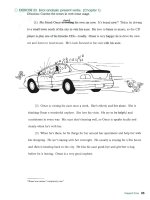
EXERCISE
14.
Using
WHAT
+
a
form
of
DO.
(Chart
5-6)
DirecFions:
Create questions. Use
what
+
a
form of
do.
1.
A:
uha+
aye
yo&
doiy
right now?
B:
I'm studying.
2.
A:
last night?
B:
I
studied.
3.
A:
tomorrow?
B: I'm going to visit my relatives.
4. A:
tomorrow?
B: I want to go to the beach.
5.
A:
this evening?
B:
I
would like to
go
to a movie.
6.
A:
tomorrow?
B: I'm planning to stay home and relax most of the day.
7.
A.
in
class every day?
B: I study English.
8.
A:
(for
a
living)?*
B: I'm
a
teacher.
*What
doyov
do?
has
a
sped meaning.
It
means:
Whar
is
your
ocrup.rin,yourjob?
Another
way
of
asking
the
asme
question:
Whm
do
you
&for
rr
130
CHAPTER
5
:
'5
;.
I,
.
:
-
. .
whg&
stopped~o,~~o,r sueeding?
.
-
::?I
,
,
'
,.
:,.p
"
,3J
B: He (the police officer) gave me a ticket.
,"
,
.
-
,;
10.
A:
in
the
winter?
B:
It
(a bear) hibernates.
11.
A:
I
have the hiccups.
?
B: You should drink a glass of water.
.
.L
.
">
12.
A:
?
,
B: He
(Mr.
Rice) is a businessman. He works for General Electric.
.
,
.,,
;.
-;,A:
?
8
,
::
-
;B:
She (Mrs. Rice) designs websites. She works for
an
Internet company.
I
EXERCISE
15.
Using
WHAT
+
a form
of
DO
and verb tense teview. (Chart
5-6)
BreccFMns:
Work in pairs. Ask a classmate a question. Use
what
+
do.
I:<:
I
c
I.
.
.
s:2iq!:;oJ
'.: :~',.
'.
Example:
tomorrow
.
11
1.
SPEAKER
A:
What are
y~b
g&g
to do tomorrow?
/
What do you want to do tokorrow?
I
What would vou like to do tomorrow?
/
Etc.
SPEAKER
B:
(Answer
the
question.)
;<
!
,-
i
,,Jxj
.c.
,.
Switch roles.
.
,q,
,
:.
.j
?A
!
t
.
,
i
1.
last night
7.
this morning
2. right now
3.
next Saturday
9.
on weekends
.,'
2
.',)'
.
.
4.
this afternoon
,i
,
.,I
,.I
.
.
10. after class yesterday,,,
(.
f
5.
tonight
.
11. after class today
1
i
,.
6.
every morning
:,
.
,
,
,
:,.,
12. since you amved
in
this city
.~
.
~
~
Asking
Questlonr
131
QUBSTION
ANSWER
I
Boots.
Sandals.
Tennis shoes.
(a)
What
kind
qfsh
did you buy? Loafers.
Running shoes.
,
High
heels.
Etc.
What
kind
of
asks for
information about
a
specitic
type (a specific kind) in
a
general category.
In (a):
general category
=
shoes
specific kinds
=
boots
sandals
tennis shoes
etc.
@)
What
kind
offnu't
do you like best?
Apples.
Bananas.
Oranges.
Grapefruit.
Grapes.
Strawberries.
u
Etc.
In
(b):
general category
=
hit
specific kinds
=
apples
bananas
oranges
I
etc.
EXERCISE
16.
Using
WHAT
KIND
OF,
(Chart
5-7)
Direnions:
Complete each question. Give other possible answers to the question.
1.
A:
What kind of
shoes
are you wearing?
B: Boots.
(Other possible answers:
looif
rrs/vwwiw shodetc
1,
:.
:
1
2.
A:
What kind of
w~oit
do you eat most often?
B: Beef.
(Otherpossible answers:
chtckedl oiwb/~ork/&-C.
1
3.
A:
What kind of do you like best?
:I,,
"f~,.,
B: Rock 'n roll.
(Otherpossible answers:
1
4.
A:
What kind of would you like to have?
.
-
:
B: A Mercedes-Benz.
(Other possible answers:
$:~~,:.'r,
.
5.
A:
What kind of do you like to read?
B: Science fiction.
(Other possible answers:
)
132
CHAPTER
6
6.
A:
What kind of do you have?
B:
.
(Other
possibb answers:
1
7.
A:
What kind of do you like best?
B
:
.
(Other
possible answers:
)
8.
A:
What kind of is
(
.
.
.
)
wearing?
B:
.
(Other
possibb answers:
I
EXERCISE
17.
Uslng
WHAT
KIND
OF.
(Chart
5-7)
Directim:
Find classmates who own the following things. Ask them questions using
what
kind
of.
Example:
a camera
SPEAKER
A:
DO
YOU
have a camera?
SPEAKER
B:
Yes.*
SPEAKER
A:
What kind of camera do you have?
SPEAKER
B:
I
have a 35-millimeter Kodak camera.
1.
a camera
6.
a computer
2.
aTV
7.
a watch
3. a bicycle
8.
a dog
4.
a car
9.
a cell phone
5.
a refrigerator
10.
(use
your
own
words)
1
'
5-8
USING
WHICH
(a)
TOM:
May
I
borrow a pen from you?
ANN:
Sure. I have two pens. This pen has black ink.
That pen has red ink.
Which
pen
do you want?
OR
Whichom
do you want?
OR
Which
do you want?
@)
WE:
I lie these earrings, and
I
like those, too.
BOB:
Which (earringaIoms)
are you going to buy?
SUE:
I
fhik I'll get these.
In
(a):
Ann
uses
which
(not
what)
because
she wantsTom to choose.
Which
is used when the speaker wants
someone to make a choice, when the speaker
is offering alternatives:
this one or that one;
these or
those.
Which
can be used with either singular or
plural nouns.
(c)
JIM:
Here's a photo of my daughter's class.
Which
can be used to ask about people as
KIM:
Very
nice.
Which one
is your daughter? well as
things.
(d)
SUE:
My aunt gave me some money for my birthday.
I'm
going
to take it
with
me to the mall.
BOB:
What
are
you going to buy
with
it?
SUE:
I
haven't decided yet.
In (d):The question doesn't involve
choosing from a particular group of items, so
Bob uses
what,
not
which.
*It
the
mm
is
"no:'
aak
mother
question
fmm
rhe
lisr.
0
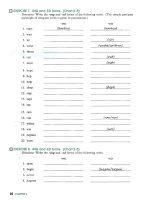
EXERCISE 18. WHICH
vs.
WHAT. (Chart 5-8)
Directions:
Complete the questions with
which
or
what.
1.
A:
This hat comes
in
brown and in gray.
\rJh~ch
color do you think
your husband would prefer?
B:
Gray, I
thii.
2.
A:
I've never been to Mrs. Hall's house.
A
color is it?
B:
Gray.
3.
A:
I have two dictionaries. one do you want?
B:
The Arabic-English dictionary, not the English-English one.
8
.
.
.
,
,
.f
!,
4.
A:
May
I
help you?
'~'
1
<
B:
Please.
A:
are you looking for?
,
.
,.:,
B:
An
Arabic-English dictionary.
,
,
2,
:
.:
,,r
I
.
,
:.
.
A:
Right over there in the reference section.
'
.
:."
,I
,-I
B:
Thanks.
.
.
>
.
.
,
.
:i
,I,
I
,,I./.,,
,
.
i
I?
1.'
5.
A:
did you get on your last test?
B:
I don't want to tell you. It was an awful grade.
.,,
<I,.
6.
A:
If
I
need only half an onion,
half should I use and
half should I save?
B:
Save the root half. It lasts longer.
,:!
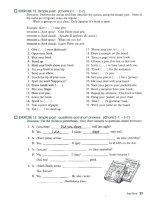
EXERCISE 19.
CH
vs.
WHAT. (Chart 5-8)
he
'
'
,h
or
what.
.
ich
do
.I
B:
That one. (I want that book.)
,
2:
A:
\rJhak
did
yok
bky
whe~
yoh
we^+
shop pi^??
:,.$I+
B: A
book. (I bought a book when I went shopping.)
,
>
.%<
* :3
.,
?,I<,
,t
'!
Ytl
.r>,,w
3.
A:
Could I borrow your pen for a minute?
.
.
,
.,
I,
,., ,iI'
A'
,
,
I
7'
B:
Sure.
I have two.
.
.
,,,,
,
,St
hf>el
,&,,<,ti
.~
~-
A:
That one. (I would like that one.)
,
,I,
4.
A:
B:
A
pen. (Chris borrowed a pen from me.)
.
. .
,
~,
! li
,I
I
5.
A:
.
,I
:.!
>I
YV>\,!d
ml
B:
Two pieces of hard candy. (I have two pieces of hard candy in my hand.) Would
you like one?
-
-
-
-
A:
Yes. Thanks.
I
B
:
A:
The yellow one. (I'd like the yellow one.)
134
CHAPTER
5