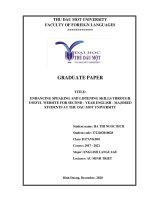
an investigation into the autonomous learning of english major students at thu dau mot university
Bạn đang xem bản rút gọn của tài liệu. Xem và tải ngay bản đầy đủ của tài liệu tại đây (246.07 KB, 15 trang )
<span class="text_page_counter">Trang 1</span><div class="page_container" data-page="1">
<b> THU DAU MOT UNIVERSITYFACULTY OF FOREIGN LANGUAGES</b>
Course: Report Writing in English (0+2)Major: English Language Lecturer: Nguyen Thi Xuan Hong
Group 12
<b>1. Nguyễn Minh Nhị2. Đỗ Quỳnh Anh</b>
<b>3. Nguyễn Thị Hồng Hạnh</b>
Binh Duong, November 2023
</div><span class="text_page_counter">Trang 2</span><div class="page_container" data-page="2"><b>TRƯỜNG ĐH THỦ DẦU</b>
<b>MỘTCỘNG HOÀ XÃ HỘI CHỦ NGHĨA VIỆTNAMKHOA NGOẠI NGỮĐộc lập –Tự do – Hạnh phúc</b>
<i>Bình Dương, ngày 05 tháng 08 năm 2021</i>
<b>PHIẾU CHẤM ĐIỂM MÔN REPORT WRITING IN ENGLISH</b>
<b>1. Họ và tên giảng viên chấm: Âu Minh Triết</b>
Lớp/Nhóm: HK3.CQ.05 Khoá học: Report Writing in
4. Phần đánh giá và cho điểm của giảng viên: (Theo thang điểm 10, lẽ đến 0.1 điểm)
<b>Tiêu chíđánh</b>
<b>Các cấp độ đánh giáĐiểm chấmTỐTKHÁ<sup>TRUNG</sup></b>
<b>BÌNH<sup>KÉM</sup><sup>GK 1</sup><sup>GK 2</sup></b>
Cấu trúc 1.0
Cấu trúc hợp lí, bố cục chặt chẽ, rõ ràng, trình bày đúng quy định.
Cấu trúc hợp lý, nhưng bố cục một số chỗ chưa chặt chẽ, chưa rõ ràng, chưa trình bày đúng quy định.
Cấu trúc chưa hợp lí, bố cục chưa chặt chẽ, rõ ràng, trình bày đúng quy định.
Cấu trúc chưa hợp lí, bố cục khơng rõ ràng, trìnhbày khơngđúng quy định.
Tríchdẫn và
Trích dẫn và trình bày tài liệu
Trích dẫn và trình bày tài liệu tham
Trích dẫn và trình bày tài liệu
Trích dẫn và trình bày tài
</div><span class="text_page_counter">Trang 3</span><div class="page_container" data-page="3">tham khảo, hình vẽ, bảng, biểu rõ ràng và đúng quy định.
khảo, hình vẽ,bảng, biểu đúng quy địnhnhưng một số chỗ chưa rõ ràng.
tham khảo đúng quy định nhưng chưa rõ ràng.
liệu tham khảo không đúng quy định, khơng rõ ràng.
Ngơn ngữ, chính xác, mạch lạc, khơng có lỗi chính tả,ngữ pháp, lỗi in ấn, khơng sao chép.
Ngơn ngữ, chính xác, mạch lạc, khơng có lỗi chính tả, ngữ pháp, lỗi in ấn, khơng sao chép, nhưng cịn một số chỗ sử dụng ngơn ngữ chưa chính xác.
Ngơn ngữ mạch lạc, nhưng nhiều chỗ chưa chínhxác, có lỗi chính tả, có lỗi in ấn.
Ngơn ngữ khơng mạch lạc, khơng chính xác khơng rõ ràng, có lỗi chính tả, có lỗi in ấn, có dấu hiệu sao chép.
<b>2: Nộidung</b>
1.0 Khối lượngcơng việc hợp lí, tư liệu phong phú, chính xác, phù hợp mục đích nghiêncứu, nhận xét xác đáng, khả năng suy
Khối lượng công việc hợplí, tư liệu phong phú, chính xác, phù hợp mục đích nghiên cứu, nhận xét xác đáng, khả năng suy luận,phân tích, tổng hợp khá.
Khối lượng cơng việc hợp lí, tư liệu phù hợp mục đích nghiên cứu, phân tích, tổng hợp đạt u cầu.
Tư liệu khơng phùhợp với mục đích nghiên cứu, khơng có phân tích, tổng hợp.
</div><span class="text_page_counter">Trang 4</span><div class="page_container" data-page="4">luận, phân tích, tổng hợp tốt.
Biết vận dụng các phương pháp nghiên cứu phù hợp với nội dung nghiên cứu của đề tài.
Biết vận dụngcác phương pháp nghiên cứu phù hợp với nội dung nghiên cứu của đề tài nhưng một số chỗ sử dụng chưa đúng phương pháp.
Phương pháp nghiên cứuphù hợp một phần với nội dung nghiên cứucủa đề tài.
Phương pháp nghiên cứu khôngphù hợp với nội dung nghiên cứu của đềtài.
Kết quảnghiên
Chính xác, có khả năng sáng tạo, phát hiện vấn đềvà giải quyết vấn đề, có giá trị thực tiễn, khoa học cao.
Chính xác, phát hiện vấn đề và giải quyết vấn đề khá, có giá trị thực tiễn, khoa học khá.
Chính xác,phát hiện vấn đề và giải quyết vấn đề, ít có giá trị thực tiễn, khoa học.
Khơng chính xác,khơng có khả năng sáng tạo, không phát hiện vấn đề và giải quyết vấn đề, khơng có giá trị thực tiễn, khoa học.
<b>3: Tính</b>
Tínhmới vàtính thời
Đề tài có cái mới và mang tính thời sự đáp
Đề tài có cái mới, ít mang tính thời sự, đáp ứng được
Đề tài ít cócái mới nhưng đáp ứng được
Khơng có cái mới vàkhông đápứng được
</div><span class="text_page_counter">Trang 5</span><div class="page_container" data-page="5"><b>sáng tạovà triển</b>
<b>vọngcủa đề</b>
ứng được chuẩn đầu ra của chương trình đào tạo.
chuẩn đầu ra của chương trình đào tạo.
chuẩn đầu ra của chương trình đào tạo.
chuẩn đầu ra của chương trình đào tạo.
Đề tài mang tính ứng dụng cao.
Đề tài mang tính ứng dụngkhá.
Đề tài có mang tính ứng dụng.
Khơng mang tính ứng dụng.
</div><span class="text_page_counter">Trang 6</span><div class="page_container" data-page="6">text. If there is any copy, I take full responsibility to the subject, faculty and school teachers.
</div><span class="text_page_counter">Trang 7</span><div class="page_container" data-page="7">To complete this report, I have received a lot of help and advicefrom many individuals and organizations. I have completed this researchpaper based on suggestions, learning as well as cultivating experience.
First of all, I would like to thank my instructor, Ms. Nguyen ThiXuan Hong. Thank you for your enthusiastic and dedicated guidanceduring my study and completion of my research. She always gave meadvice and suggestions as well as new and useful knowledge to help mecomplete this essay. Her knowledge, as well as his advice andsuggestions, helped me a lot. I feel very happy and lucky to be guided bythe teacher.
I would also like to express my sincere thanks to my fellowstudents in the English Report Writing class and an English major at ThuDau Mot University who participated in the survey to help me completemy research.
In summary, I hope that teachers and those who are interested inthis research paper can forgive me for the shortcomings in the researchprocess as well as completing this research paper.
</div><span class="text_page_counter">Trang 8</span><div class="page_container" data-page="8"><b>ABSTRACT </b>
To acquire English skills, students must go beyond what they learn in class. Asa result, pupils must develop self-directed learning skills. Particularly first-yearpupils. However, not all students are capable of devising an appropriate andeffective self-study approach on their own. Students may struggle with self-study due to a lack of support from teachers. This study looks into self-studyand challenges in self-study among English major students at Thu Dau MotUniversity. Following that, some suggestions for improving self-study amongfirst-year students are made. To investigate the self-study issue, I ran an onlinesurvey of 80 students from Thu Dau Mot University's total enrollment. Theanalysis shows that students majoring in English at Thu Dau Mot Universityhave not focused on self-study because they have many difficulties and havenot come up with an appropriate strategy.
<b>Keywords: self-study</b>
</div><span class="text_page_counter">Trang 9</span><div class="page_container" data-page="9">English is a global lingua franca and is widely used. It is the official languageof nearly 60 sovereign states and is the most commonly spoken language insovereign states including the United Kingdom, United States, Canada,Australia, Ireland, New Zealand and a number of Caribbean countries.Therefore, self-learning the language is really necessary. Up to now, there havebeen many articles and studies analyzing the self-study of people, especiallystudents. Especially in language learning, learner autonomy is especiallyimportant because language learners need to develop autonomy in learning andusing language (Pennycook, 1997). Independent learning of English providesadditional opportunities for the abilities learned in class to be practiced moredeeply because the opportunities and conditions to do so in class are limited(Hu & Zhang, 2017). Autonomy gives students a sense of confidence andmotivates them to make their own judgments (Balỗkanl, 2010). However,self-studying English is still quite difficult for many people. So, in this researcharticle we will discuss practical problems and solutions for students'autonomous language learning.
This study was conducted for three purposes. The first purpose of the study isto test the English awareness of learners mainly about autonomous learning atThu Dau Mot University. The second purpose of the research is to find out theproblems that students encounter in the process of learning language autonomy.The third purpose of the research is to provide some effective strategies forstudents to improve their language self-study ability.
This research contributes to helping students find solutions to the difficultiesthey encounter in independent learning when learning languages. From there,they also understand the importance of self-study for themselves and society.The research was conducted to survey the attitudes during self-study anddifficulties in the learning process of English students at Thu Dau MotUniversity. The report includes the following main parts: First, the literature
</div><span class="text_page_counter">Trang 10</span><div class="page_container" data-page="10">review addresses the definition of autonomy in learning, the importance ofautonomy in language learning, and the problems students encounter whenself-studying. and possible causes as well as previous studies. Second, identifythe methodology indicating the research method used in this thesis includingresearch method, population and sampling, research tools, data collectionprocess and analysis method. data. Third, list the findings and results showingthe results of the article's analysis process in investigating TDMU Englishmajor students in self-study activities. And finally, a summary of the mainfindings, limitations, future directions, as well as recommendations andimplications for future research in the same field of autonomous learning.
3. What might be effective strategies for students to improve their autonomouslearning?
</div><span class="text_page_counter">Trang 11</span><div class="page_container" data-page="11"><b>LITERATURE REVIEW2.1 Theoretical Framework </b>
<b>2.1.1. Autonomous learning</b>
The concept of learner autonomy appeared in the 60s of the 20th centuryin Western countries, and by the mid-1970s, learning autonomy quicklybecame an attractive topic for applied linguistics researchers and opened upresearch problems in language teaching and is understood from many otherpoints of view. The founder of the concept of learner autonomy is Henri Holec.In 1981, the term “learner autonomy” was first coined. According to Dam(1995), who approaches the definition of autonomy from a different angle,autonomy is the desire to take charge of one’s learning to meet one's needs andgoals. According to Beson and Voller (1997), autonomy in learning refers to asituation in which students fully complete their studies on their own, to skillsthat can be acquired and used for self-directed learning, to the student'sassumption of responsibility for their education, or to the student’s right tomake decisions regarding their education. The relevant literature is riddled withinnumerable.
<b>2.1.2 The importance of autonomy in language learning</b>
The importance of autonomy lies in the fact that it equips the student toovercome obstacles of different nature that may rise between him and hislearning goals. In language learning specifically, learner autonomy is especiallyimportant given that the learner of a language needs to develop autonomy tolearn and autonomy to use the language (Pennycook, 1997).
First of all, autonomous English learning offers additional opportunities for theabilities learned in class to be exercised further because the opportunities andconditions for doing so in class are limited (Hu & Zhang, 2017). As a result,kids learn more effectively and are more involved in their studies. Second,autonomy fosters students’ motivation and self-assurance in their English
</div><span class="text_page_counter">Trang 12</span><div class="page_container" data-page="12">studies. Autonomy gives pupils a sense of confidence and motivates them tomake their judgments (Balỗkanl, 2010).
Autonomous learning also helps students catch up with new sources ofinformation. Information is becoming obsolete at an unprecedented rate.Modern native English speakers have quite different conversations than thosedescribed in textbooks. Because of the numerous complicated opportunities anddifficulties that globalization brings, autonomy is becoming more and morecrucial to adapt to changes in the social environment. In conclusion,autonomous learning is important for learning English as a second language.
<b>2.1.3. Students’ perceptions of autonomous learning of English </b>
According to Littlewood (1999) contends that Asian students may attainthe same amount of autonomy as their Western counterparts with the rightlearner teaching. Holden and Miyuki (1999) assert that because Japanesestudents often take teacher-centered courses, they do not have enoughopportunities to grow in their autonomy. According to Holden and Usuki’sresearch, pupils favor instructors who adopt unconventional roles rather thanlecturing or imparting their knowledge. The readiness, capacity, and ability tolearn independently of Hong Kong University students were examined by Chan(2001) who also showed how educational and behavioral standards impede thedevelopment of learners’ autonomy. As a result, Asian nations’ educational andbehavioral traditions deliberately prevent pupils from being independent. Chan(2001) also contends that educators should support their pupils’ development asindependent learners by enhancing their knowledge and altering theinstructional strategies that have hampered their ability to do so.
<b>2.2 Previous studies </b>
Autonomous learning has been attracting more and more attention in thefield of second language teaching and learning since it was put forward. To geta better understanding of the autonomous learning competence of freshmen ofEnglish major in university, many investigations were conducted throughoutthe world. For example, one study done in China found that the autonomouslearning competence of freshmen is poor and worrying (Sun, 2016). Freshmen
</div><span class="text_page_counter">Trang 13</span><div class="page_container" data-page="13">are motivated to learn English, yet they continue with their traditional studymethods and rely more on their professors. They struggle to use the availableresources for relevant learning and are unable to use metacognitive methods fortheir language acquisition. All of these flaws prevent progress. Therefore, kidshave a dire need to develop their capacity for independent learning.
Recent studies on autonomous learning in language learning using variousmethodologies in the setting of Vietnamese universities have been conductedby certain Vietnamese scholars. Trinh (2005) concentrated autonomouslearning exclusively on Can Tho University's EFL course curriculum. Heconducted his research using a three-dimensional model of planning,monitoring and regulating. Then, Nguyen (2009) concentrated on strategy-based teaching by adopting a model with two dimensions, namely self-initiation, and self-regulation, and worked on developing an approach and task-specific training. Dang (2012) then developed a four-dimension model,consisting of monitoring, initiating, goal-setting, assessing, and employingInformation Communication Technologies, to study how EFL studentsperceived and performed in autonomous learning in both online and offlinelearning contexts.
</div><span class="text_page_counter">Trang 14</span><div class="page_container" data-page="14"><b>METHODOLOGY </b>
To achieve the research objective, the researcher used a questionnaire as aresearch tool, including a set of structured questions designed to obtain datafrom 80 first-year students majoring in linguistics. English among the totalnumber of students in the foreign language department of Thu Dau MotUniversity. The questionnaire has a total of 12 questions and is divided intofour main parts, each part aims to answer research questions such as finding outthe perceptions of first-year English majors about self-study. Explore issues inself-study of first-year students majoring in English at TDMU and collect dataon self-study strategies, self-monitoring, self-assessment and self-studymethods. Sampling was chosen based on random sampling.
After designing the questionnaires to collect data from students, theresearcher implemented online data collection by creating online questionnaireforms at For student questionnaires, to makestudents more interested in answering the questionnaire, its items were groupedinto four separate parts and displayed the hidden way. This means that whenstudents finish answering the first part, the second part is shown, and this takesplace until the end. The data collection procedure took place in the firstsemester of the academic year 2023-2024, from October 27th, 2023 toNovember 17th, 2023. In the end, it took 8 days to collect data from thestudents.
After one week getting the data from English major students at Thu DauMot University by sending the questionnaire, the data was analyzed by threeprocedures. First of all, we collected the data of the questionnaire from Googleform to analyze. Then we conduct the analysis, evaluation and interpretation of
</div>