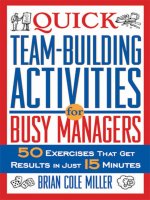
Quick Team-Building Activities for Busy Managers: 50 Exercises That Get Results in Just 15 Minutes_9 pot
Bạn đang xem bản rút gọn của tài liệu. Xem và tải ngay bản đầy đủ của tài liệu tại đây (243.58 KB, 19 trang )
Try these ➤ Designate one participant as “where the buck
variations . . . stops.” When movement starts and moves around
the group, that participant will NOT repeat it.
This variation is effective after a few rounds of
the regular activity. Ask how much influence one
person can have in affecting team behavior.
140 QUICK TEAM-BUILDING ACTIVITIES FOR BUSY MANAGERS
miller chap 08 7/24/03 3:48 PM Page 140
BUT NOTHING
(FEEDBACK)
This is . . . A quick verbal activity in which participants give
each other personal feedback using “but. . .”
The purpose Participants learn how easily “but. . .” can interfere
is . . . with constructive feedback by creating defensiveness,
even when they mean well. They will also learn to
replace “but. . .” with “and. . .”
Use this
➤ Feedback is not being received very well.
when . . .
➤ Individuals feel like others are not listening with
open minds.
➤ You don’t have prep time and/or materials for any-
thing more elaborate.
Materials ➤ No materials are necessary for this activity.
you’ll
need . . .
Here’s 1. Have the participants pair up.
how . . . 2. Each participant has 30 seconds to think of some-
thing she likes about the other’s outfit and one
way the outfit could be improved.
3. The first participant tells the other what she likes
first, then says, “but. . .” and finishes the sentence
with how it could be even better.
4. The other participant then does the same to the
first participant.
QUICK TEAM-BUILDING ACTIVITIES FOR BUSY MANAGERS 141
miller chap 08 7/24/03 3:48 PM Page 141
5. Now have each participant repeat what she just
said, replacing “but” with “and.”
For “I like that tie, but it would bring out your blue eyes
example . . . better if it was red.”
“I like that tie, and it would bring out your blue eyes
better if it was red.”
“That is a nice dress, but you would look even more
professional if you had earrings, too.”
“That is a nice dress, and you would look even more
professional if you had earrings, too.”
Ask these ➤ How did it feel to hear “but?” (Annoying, defensive,
questions . . . insincere, etc.) How did it feel to hear “and?”
(Helped, respected, supported, etc.)
➤ What does “but” usually mean? (Disregard what
you just heard, because here is the real truth.)
➤ Why do we say “but” so often when giving sug-
gestions or feedback?
➤ What implications does this have for us back on
the job?
Tips for ➤ Share an example to give participants a sense of
success . . . how the statements should sound.
➤ Make sure all pairs have finished their “but” state-
ments before giving the cue to make the “and”
statements.
➤ Point out that the word “but” usually negates
everything that precedes it.
Try these
➤ The more personal the feedback, the better. If the
variations . . . group is uncomfortable giving feedback on each
other’s outfits, though, select something else, such
as the coffee in the lunchroom, a movie they have
both seen, and so forth.
142 QUICK TEAM-BUILDING ACTIVITIES FOR BUSY MANAGERS
miller chap 08 7/24/03 3:48 PM Page 142
➤ After the meeting, ask for feedback on the meeting
without the “but.” (I liked that we had an agenda,
and next time I hope we can stick to it better.)
➤ If the group is comfortable giving feedback to each
other already, have them do it on their recent job
performance rather than their outfit.
➤ Add an element of fun to this activity by starting
with participants making something creatively
(with clay, markers, balloons, building blocks,
etc.), and then give the feedback to each other
about the creation rather then their outfits.
QUICK TEAM-BUILDING ACTIVITIES FOR BUSY MANAGERS 143
miller chap 08 7/24/03 3:48 PM Page 143
BUT NOTHING
(IDEAS)
This is . . . A quick, verbal activity in which participants give
each other feedback on their ideas using “yes,
but. . .”
The purpose Participants learn how easily “yes, but. . .” can shut
is . . . down communication and creativity, even if well
intentioned. They will also learn to replace “yes,
but. . .” with “yes, and. . .”
Use this ➤ Ideas are being shot down frequently; creativity is
when . . . being stifled.
➤ Individuals feel like others are not listening with
open minds.
➤ You don’t have prep time and/or materials for any-
thing more elaborate.
Materials ➤ No materials are necessary for this activity.
you’ll
need . . .
Here’s 1. Have the participants pair up.
how . . . 2. Each pair is to plan a vacation together (money is
no object).
3. One partner starts by suggesting something to the
other.
4. The other responds by saying, “Yes, but. . .” and
finishes her sentence.
144
QUICK TEAM-BUILDING ACTIVITIES FOR BUSY MANAGERS
miller chap 08 7/24/03 3:48 PM Page 144
5. The first partner then responds by saying, “Yes,
but. . .” and finishes her sentence.
6. The conversations continue back and forth this
way for 2 minutes.
7. Then, have the same pairs do the same thing with
only one change—each sentence must begin with
“Yes, and. . .”
8. The conversations continue this way for 2 minutes.
For “I want to go someplace warm.”
example . . . “Yes, but let’s make sure it’s not Florida.”
“Yes, but Puerto Rico could be nice.”
“Yes, but I hope one of us speaks Spanish.”
“Yes, but we could bring a dictionary, if necessary.”
“I want to go someplace warm.”
“Yes, and let’s make sure it’s not Florida.”
“Yes, and St. Martin could be nice.”
“Yes, and I hope one of us speaks French.”
“Yes, and we could bring a dictionary, if necessary.”
Ask these ➤ How did it feel to hear “but?” (Annoying, defensive,
questions . . . competitive, etc.) And how did it feel to hear “and?”
(Accepted, listened to, respected, etc.)
➤ Did you get along further with your plans during
the first or second round? Why?
➤ Why do we say “yes, but. . .” so often? (It is in-
grained in us; The “but” allows us to disagree without
being disagreeable; etc.)
➤ When is “yes, but. . .” useful or appropriate?
➤ What implication does this have for us back on
the job?
Tips for ➤ Read the examples above to give participants a feel
success . . . for how the conversation might go.
➤ Encourage them to keep the conversation moving.
They are not planning a real vacation, so they do
not have to be accurate, precise, or realistic.
QUICK TEAM-BUILDING ACTIVITIES FOR BUSY MANAGERS 145
miller chap 08 7/24/03 3:48 PM Page 145
➤ The second dialogue does not have to duplicate
word for word the first dialogue.
Try these ➤ Ask the Debrief questions after the first round of
variations . . . “buts” while the team’s thoughts and feelings are
still fresh.
➤ Plan a party, family reunion, or any other elaborate
event that might be fun.
➤ Divide the participants into small groups instead
of pairs. The “Yes, but. . .” conversation goes
around the circle.
146 QUICK TEAM-BUILDING ACTIVITIES FOR BUSY MANAGERS
miller chap 08 7/24/03 3:48 PM Page 146
FIRST
IMPRESSIONS
This is . . . An activity in which participants determine their
first impressions of people picked at random from
magazines.
The purpose Participants see how strong and important others’
is . . . first impression of them can be.
Use this
➤ Individuals interact with customers a great deal.
when . . . ➤ First impressions of the group are critical for their
success.
➤ Individuals are resisting their uniforms or other
aspects of “the look” you want.
Materials ➤ One envelope for each team that contains four or
you’ll five pictures of people from magazines. Avoid
need . . . famous or recognizable people. Avoid settings and
backgrounds that are not neutral.
Here’s 1. Divide the group into teams of four to six.
how . . . 2. Give each group an envelope containing pictures
of various people.
3. They have 6 minutes to discuss their first impres-
sions of the people based solely on what they see
in the picture.
4. Have them report back to the larger group on
one of the pictures to which their team felt the
strongest first impression.
QUICK TEAM-BUILDING ACTIVITIES FOR BUSY MANAGERS 147
miller chap 08 7/24/03 3:48 PM Page 147
For “This woman is probably a professional. Look at the
example . . . way her head is held up high. She’s probably as-
sertive and very sure of herself. Oh, and check out
that necklace. Doesn’t it just scream “success”?
“No, I think that necklace begs for attention! I agree
she looks pretty assertive, though. She also seems
to. . .”
Ask these
➤ How easy was it to agree on your first impressions
questions . . . of these people?
➤ What were some of the reasons for disagreement?
(Different upbringing, different history with a certain
kind of look, etc.)
➤ What judgments are others making about us and
the way we present ourselves?
➤ What implications does this have for us on the
job?
Tips for ➤ Keep the Debrief away from discussing whether
success . . . first impressions are fair or not. Accept that they
happen, and focus on how you can leverage that
fact for your organization.
➤ Collect the pictures from various magazines. Try
for as eclectic a mix as possible for each envelope.
➤ Be sensitive to racial or gender biases in your
group and the pictures.
➤ Give a 1-minute warning before discussions are to
end.
Try these
➤ You can focus the first impressions specifically on
variations . . . facial expressions, clothing, body language, or
whatever else you want to emphasize.
➤ You could refocus the Debrief to make this discus-
sion more about diversity—accepting others for
who and what they are. After giving out the en-
velopes of pictures, ask the teams to decide which
148 QUICK TEAM-BUILDING ACTIVITIES FOR BUSY MANAGERS
miller chap 08 7/24/03 3:48 PM Page 148
one they would most want to have join their
team, and which one they would least like to
have join their team. Why?
➤ Have the teams “fix” each picture by identifying
how they would improve the look of each one to
make them ready to join their team. Focus the
Debrief on what they learned from each other
concerning how they feel the group should be
presenting themselves.
➤ Ask what product or service each pictured person
would be representing or selling.
QUICK TEAM-BUILDING ACTIVITIES FOR BUSY MANAGERS 149
miller chap 08 7/24/03 3:48 PM Page 149
JUNK TO
JEWELS
This is . . . An activity in which participants take work-related
items and show how those reflect what each partici-
pant brings to the strength of the team.
The purpose Participants appreciate their own and each others’
is . . . contribution to the team’s success.
Use this
➤ A significant project or work effort is beginning.
when . . . ➤ Individuals are not feeling confident about their
ability to get the job done.
➤ Individuals need to bond together.
Materials ➤ An array of items commonly found in your work
you’ll environment—paper clips, pens, erasers, calculators,
need . . . coffee mugs, staplers, sticky notes, rubber bands,
and so forth.
Here’s 1. Have each participant select an item that best
how . . . represents what he or she feels he or she has to
contribute to the team’s success.
2. Have each participant share with the group why
she chose the object she did.
3. Give the team 5 minutes to now make a sculpture
using their items. The final sculpture should show
how the individual parts would come together to
strengthen the team and ensure success.
150
QUICK TEAM-BUILDING ACTIVITIES FOR BUSY MANAGERS
miller chap 08 7/24/03 3:48 PM Page 150
For “I chose a calculator because I tend to be very
example . . . analytical. I like to find solutions. I get more from
the search for the answer than I do from the glory
of having found it.”
“I also chose the calculator, but for me, it is because I
am very detail focused. Approximations and guesses
are not good enough for me. So I will attend to the
details for this group.”
Ask these
➤ Why is it that the same item meant different things
questions . . . to different people?
➤ What were you thinking as you tried to incorpo-
rate everything into a sculpture? (I wasn’t sure how
the stapler could be included; I wanted the pen to be
more central; Some were more concerned about the
finished product than others; etc.)
➤ What implications does this have for us back on
the job?
Tips for ➤ If the group is large (more than 15 people), divide
success . . . the group into teams that represent intact work
groups.
➤ Have more than one of each item on the table so
several participants can choose the same thing (for
different reasons?).
➤ A formal Debrief may be unnecessary if you dis-
cuss as participants each share their strengths.
Try these
➤ You can make this activity more personal by having
variations . . . the participants select the item that best reflects
their personality, and then explain why.
➤ Make this a development activity. Have the par-
ticipants select the item that best represents what
they want to develop in themselves. Invite the
others to support and assist them.
QUICK TEAM-BUILDING ACTIVITIES FOR BUSY MANAGERS 151
miller chap 08 7/24/03 3:48 PM Page 151
KUDOS
This is . . . A recognition activity in which their peers, not their
boss, appreciate the participants.
The purpose Participants receive recognition and appreciation
is . . . from each other and have it reinforced by the whole
team.
Use this
➤ A significant project or work effort has been
when . . . completed—to celebrate the success.
➤ Individuals are feeling down or less confident
about themselves.
➤ Individuals need to recognize and appreciate
what’s going right among themselves.
➤ Individuals need to bond together.
Materials
➤ A box or two of Kudos
®
candy bars.
you’ll
need . . .
Here’s 1. Show a box of Kudos
®
bars to the group, and make
how . . . sure everyone knows what the word kudos means.
2. Explain that they are to use the candy bars to recog-
nize each other for things they have accomplished.
3. Anyone can give anyone else a candy bar. They
can give more than one, if they like.
4. The only stipulation is that it must be accompa-
nied by a brief and specific explanation of why.
5. Do not go in any order. Do not require anyone to
give a candy bar. Let this be entirely voluntary.
152
QUICK TEAM-BUILDING ACTIVITIES FOR BUSY MANAGERS
miller chap 08 7/24/03 3:48 PM Page 152
6. You go first. Give a Kudos
®
bar to a participant.
As you do, explain what that person did to receive
the bar.
7. Encourage the participants to follow your lead—
someone (anyone) can now give a candy bar to
someone else.
8. Initiate a short round of applause for the recipient
after each award.
9. Continue until the enthusiasm dies down, or until
you run out of candy bars.
For “Kudos to Vanessa for helping me research that
example . . . billing error last Thursday. She helped me whittle
down the possible causes for the error. I was able
to get back to the customer with an answer much
quicker than if I had worked on it by myself.”
Ask these ➤ How difficult (or easy) was it to give each other
questions . . . recognition? Why?
➤ How does recognition from your peers differ from
recognition you get from me?
➤ What do you think would happen if we gave feed-
back like this to colleagues outside our group (ven-
dors, internal clients, suppliers, customers, support
staff, etc.)?
Tips for ➤ The first participant to give a candy bar may be
success . . . tentative, but once the concept catches on, partic-
ipants often start fighting over who gets to recog-
nize whom next (and isn’t that a wonderful
“fight” to have?).
➤ The recipient of the candy bar is never expected
to give one to someone else. Let whoever wants to
give a candy bar give one. Do not worry about tak-
ing turns or going in order.
QUICK TEAM-BUILDING ACTIVITIES FOR BUSY MANAGERS 153
miller chap 08 7/24/03 3:48 PM Page 153
➤ You may want to tell one participant about the ac-
tivity beforehand and ask him to be prepared to
hand out a candy bar after you do, just to get the
ball rolling.
➤ You can use this as a regular feature of your on-
going staff meetings. It never gets old, and the par-
ticipants will never run out of things to recognize
and appreciate in each other.
➤ Keep the recognition on par with the reward. If
someone does something truly outstanding,
perhaps something more than a candy bar is
appropriate.
➤ Don’t worry about everyone getting a candy bar.
This is not about fairness. (Maybe those who do
not get one this time will think about why they
did not get recognized, and change.) This is espe-
cially OK if you make this activity a regular or
semiregular activity for the group.
➤ If someone gives a candy bar and is not specific,
ask them to share an example (not to “test” them,
but to give the rest of the group an idea of what
specifically is being recognized).
Try these ➤ You can use other small rewards besides Kudos
®
variations . . . bars—perhaps something more relevant to your
organization?
➤ Give a candy bar to each participant, and have
each give it to someone else in recognition or
appreciation.
154 QUICK TEAM-BUILDING ACTIVITIES FOR BUSY MANAGERS
miller chap 08 7/24/03 3:48 PM Page 154
LABELS
This is . . . A planning activity in which participants treat each
other differently based on written labels they wear
on their foreheads.
The purpose Participants learn first hand how it feels to be
is . . . treated a certain way because of generalizations
or prejudices. They learn how this hampers good
communication.
Use this
➤ The group needs to appreciate the diversity of its
when . . . members better.
➤ Individuals are approaching each other, customers,
partners, or others with preconceived notions
about them.
➤ Labels and prejudices are getting in the way of
communication and collaboration.
Materials ➤ A set of six labels for each group. Labels should be
you’ll large enough that participants can read them from
need . . . several feet away.
➤ Labels can be directive, like “disagree with me,”
“ignore me,” “treat me like the leader,” “laugh at
me,” “respect my opinions,” “find fault with me,”
“argue with me,” “agree with me,” “interrupt me,”
and so forth. Or, they can be simple labels, such as
“arrogant,” “helpful,” “self-promoting,” “brown-
noser,” “cooperative,” “a pushover,” “defensive,”
“leader,” and so forth.
QUICK TEAM-BUILDING ACTIVITIES FOR BUSY MANAGERS 155
miller chap 08 7/24/03 3:48 PM Page 155
Here’s 1. Divide the group into teams of six.
how . . . 2. Distribute a set of six labels to each team, face down.
3. Each team member sticks a label on the forehead
of the person next to him or her.
4. All participants can read what is on others’ labels
but not their own. Do not tell anyone what is on
his or her own label.
5. Give the teams a task to plan (plan a departmental
picnic, how they will participate in this year’s
community fund raiser, etc.). They will have
7 minutes to do this.
6. As they discuss, they must respect the label each
participant is wearing. React and respond accord-
ing to what it says.
7. After 7 minutes, even if the task is not complete,
stop the teams and discuss.
Ask these ➤ What happened? Did you accomplish your task?
questions . . . Why or why not?
➤ How satisfied are you with the outcome? Why?
➤ How did you feel about treating people with
these labels? (It was not me; It felt forced; It was
fun; etc.) Did it get easier over time? Why? (Others
reinforced the label; I got used to treating her that
way; etc.)
➤ How did you feel about the way you were being
treated? (Frustrated, angry, puzzled, annoyed, etc.)
What was your reaction then? (I fought harder; I
disengaged; I treated him even worse; etc.)
➤ What implications does this have for us back on
the job?
Tips for ➤ Use your judgment in dividing teams. For example,
success . . . if you have 11 participants, remove one label from
one set, and have one team of 6 and one team of
5 participants, so that everyone can have the expe-
156 QUICK TEAM-BUILDING ACTIVITIES FOR BUSY MANAGERS
miller chap 08 7/24/03 3:48 PM Page 156
rience. If there are 13 participants, have a seventh
label ready.
➤ Some people may be reluctant to adhere to the la-
bels. As you observe, encourage participants to take
the labels they see to heart and act accordingly.
Try these ➤ Try different labels or different combinations of
variations . . . labels with different teams to explore various
themes or dynamics.
➤ Precede this activity with an activity to reinforce
creativity and individuality. Have each participant
make a paper hat from newsprint. Then affix the
labels to their hats and have them wear them for
this activity.
➤ Make the labels represent different stakeholders on
a project or different types of customers and so
forth.
➤ Have only one group of six to eight participants
with labels do the task, while the rest of your
group observes.
➤ Instead of planning a picnic, have the teams grap-
ple with a real work-related problem or issue.
QUICK TEAM-BUILDING ACTIVITIES FOR BUSY MANAGERS 157
miller chap 08 7/24/03 3:48 PM Page 157
RAINBOW OF
DIVERSITY
This is . . . An activity in which participants use crayons as a
metaphor for their own diversity.
The purpose Participants appreciate the similarities and differences
is . . . among themselves.
Use this ➤ Individuals need to recognize and appreciate what’s
when . . . going right among them.
➤ Individuals are not appreciating each other very
well.
➤ Individuals need to bond together
Materials ➤ A different colored crayon for each participant (for
you’ll a large group, get a large box of 64 crayons!).
need . . .
Here’s 1. Give a crayon to each participant.
how . . . 2. Have them pair up with someone else whose
crayon color is close to their own color.
3. They have 2 minutes to discover all the ways that
they, as individuals, are similar to each other.
4. Have them pair up again, this time with someone
whose crayon color is very different from their
own color.
5. They now have 2 minutes to discover all the ways
that they, as individuals, are different from each
other.
158
QUICK TEAM-BUILDING ACTIVITIES FOR BUSY MANAGERS
miller chap 08 7/24/03 3:48 PM Page 158