Microstrip Antennas Part 2 pptx
Bạn đang xem bản rút gọn của tài liệu. Xem và tải ngay bản đầy đủ của tài liệu tại đây (787.45 KB, 30 trang )
Design of Low-Cost Probe-Fed Microstrip Antennas
19
and a 75-mm square ground plane was designed using the HFSS software for operation at
1.603 GHz. The optimized antenna dimensions are shown in Fig. 28(a), the simulated input
impedance and axial ratio results are presented in Fig. 28(b) and the reflection coefficient
magnitude in Fig. 29. As expected, the microstrip antenna with the new geometry exhibits very
good AR (0.1 dB) and reflection coefficient magnitude (-48 dB) characteristics at 1.603 GHz,
without the need for any external matching network.
1.40 1.45 1.50 1.55 1.60 1.65 1.70 1.75 1.80
-30
-25
-20
-15
-10
-5
0
0.0
2.5
5.0
7.5
10.0
12.5
15.0
17.5
20.0
Axial ratio [dB]
|
Γ| [dB]
Frequency [GHz]
|Γ|
Axial ratio
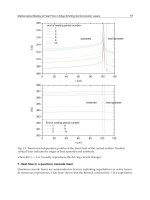
Fig. 29. CP truncated-corner patch: axial ratio and reflection coefficient magnitude.
5.2.2 Globalstar Antenna
Moderately thick microstrip antennas can also be used for bandwidth improvement. To
exemplify such application a prototype of a Globalstar antenna was manufactured using a
low-loss substrate (
ε
r
= 2.55, tan δ = 0.0022 and h = 4.572 mm). Left-handed CP Globalstar
mobile-terminals require two radiators. The first is designed for uplink frequencies (Tx -
1.61073 to 1.62549 GHz) while the other receives the downlink ones (Rx - 2.48439 to 2.49915
GHz) (Nascimento et al., 2007a). The antenna geometry and a photo of the prototype are
shown in Figs. 30(a) and (b), respectively.
The optimized antenna dimensions (using the HFSS software) are presented on Table 2 for the
radiators designed on finite ground plane and dielectric (
L = 140 mm; W = 85 mm).
Tx Rx
L
T1
54.90 mm L
R1
34.40 mm
L
T2
55.90 mm L
R2
35.85 mm
C
T
7.55 mm
C
R
5.75 mm
P
T
15.85 mm
P
R
9.00 mm
D
T
71.00 mm
D
R
15.00 mm
Table 2. Globalstar antenna dimensions.
Microstrip Antennas
20
x
y
T
D
2
T
L
1T
L
1
R
L
2
R
L
R
D
T
C
T
C
R
C
R
C
X
R
R
P
2
1
/
R
L
X
T
T
P
2
1
/
T
L
L
W
(a)
(b)
Fig. 30. Globalstar antenna: (a) geometry - (b) photo of the prototype.
The axial ratio and reflection coefficient magnitude are presented in Figs. 31 and 32 for the
Tx and Rx antennas, respectively.
1.59 1.60 1.61 1.62 1.63 1.64 1.65
0
1
2
3
4
5
6
7
8
9
-55
-50
-45
-40
-35
-30
-25
-20
-15
-10
|Γ| [dB]
Axial ratio [dB]
Fre
q
uenc
y
[GHz]
Axial ratio
|Γ|
Fig. 31. Globalstar antenna axial ratio and reflection coefficient magnitude: Tx radiator.
Design of Low-Cost Probe-Fed Microstrip Antennas
21
2.42 2.44 2.46 2.48 2.50 2.52 2.54 2.56
0
1
2
3
4
5
6
7
8
9
-50
-45
-40
-35
-30
-25
-20
-15
-10
-5
|Γ| [dB]
Axial ratio [dB]
Frequency [GHz]
Axial ratio
|Γ|
Fig. 32. Globalstar antenna axial ratio and reflection coefficient magnitude: Rx radiator.
Results for the input impedance on the Smith chart are presented in Figs. 33 and 34 for the
Tx and Rx antennas, respectively. These results indicate that the antenna meets the
Globalstar specifications.
10 25 50 100 250
-10j
10j
-25j
25j
-50j
50j
-100j
100j
-250j
250j
Prototype
HFSS
1.540 GHz
1.696 GHz
1.618 GHz
Fig. 33. Globalstar antenna input impedance: Tx radiator.
Microstrip Antennas
22
10 25 50 100 250
-10j
10j
-25j
25j
-50j
50j
-100j
100j
-250j
250j
Prototype
HFSS
2.492 GHz
2.210 GHz
2.774 GHz
Fig. 34. Globalstar antenna input impedance: Rx radiator.
5.3 CP antenna radiation efficiency measurements
The radiation efficiency of a LP microstrip antenna can be efficiently measured using the
Wheeler cap (Choo et al., 2005; Pozar & Kaufman, 1988; Sona & Rahmat-Samii 2006).
According to Wheeler, the radiation resistance of an antenna can be separated from its loss
resistance by enclosing the antenna with a radiation shield cap placed at a distance greater
than
λ
/(2π) (Wheeler, 1959). Consequently, since a linearly-polarized microstrip antenna can
be modeled as a parallel
RLC circuit, its efficiency is calculated by
out ca
p
out
GG
G
η
−
=
, (11)
where
G
cap
is the conductance of the admittance measured with the cap in place and G
out
is
the conductance of the admittance measured with the cap removed.
In the case of a CP microstrip antenna an innovative radiation efficiency analysis using the
Wheeler cap method was presented in (Nascimento & Lacava, 2009). This procedure is
discussed next, for the case of the Glonass antenna designed in Section 5.2.1.
Differently from the standard design, the two orthogonal resonant modes in the new
approach are now asymmetrically positioned in relation to the frequency for optimal axial
ratio as presented in Fig. 28 (b). In addition, at the lower resonant frequency (1.468 GHz), its
15.45-dB axial ratio shows the antenna tends to be linearly polarized around this frequency.
This result supports the use of the Wheeler cap method for measuring the antenna radiation
efficiency at this frequency.
The cap geometry is shown in Fig. 35 where the radiator is positioned inside a cubic cavity
of electrically conducting walls of 270-mm internal dimension.
Design of Low-Cost Probe-Fed Microstrip Antennas
23
Fig. 35. Geometry of the Wheeler cap simulation through the HFSS package.
HFSS simulation results for the real part of the input impedance are presented in Fig. 36,
both with and without the cubic cavity. Making use of equation (11) for the lower resonant
mode (
G
cap
= 1.92 mS and G
out
= 7.43 mS), the radiation efficiency computed from the
Wheeler method is 74.16%. The free-space radiation efficiency, computed with the HFSS
package is 74.68% at 1.468 GHz, which is only 0.7% off. Consequently, the Wheeler cap
method can be used for accurately determining the radiation efficiency of TCRP radiators.
1.43 1.48 1.53 1.58 1.63 1.68
0
60
120
180
240
300
360
420
480
540
Antenna in free space
Antenna inside the cap
Real part of Z
in
[Ω]
Fre
q
uenc
y
[GHz]
Fig. 36. Low-cost Glonass antenna: real part of its input impedance.
6. Conclusion
In this chapter, new effective strategies for designing probe-fed moderately thick LP and CP
microstrip antennas were presented. As the design procedures do not make use of external
networks, the antenna construction process is considerably simplified. Besides, as the new
Microstrip Antennas
24
methodologies are based on properties of the antenna equivalent circuit, they can be applied
to the design of microstrip radiators of arbitrary patch shapes. Moreover, it is not restricted
to low-cost substrate thus applying equally well to the design of LP or CP microstrip
patches printed on any moderately thick commercial microwave laminates. Experimental
results for LP and CP radiators validate the design strategies for both the LP and CP cases.
Moreover, the Wheeler cap method is shown to be an effective means for simulating the
radiation efficiency of CP microstrip antennas.
The excellent practical results obtained when matching microstrip patch radiators to a 50-
Ω
SMA connector can be readily extended to the synthesis of inductive or capacitive input
impedances, as for example in the case of optimization of the noise figure and stability of
low-noise power amplifiers connected directly to the antenna. Another possible application
is the design of low-cross-polarization probe-fed microstrip arrays (Marzall, et al., 2009;
Marzall et al., 2010).
7. References
Alexander, M. J. (1989). Capacitive matching of microstrip antennas. IEE Proceedings of
Microwaves, Antennas and Propagation
, Vol. 137, No. 2, (Apr. 1989) (172-174), ISSN:
0950-107X.
Chang, F. S. & Wong, K. L. (2001), A broadband probe-fed patch antenna with a thickened
probe pin,
Proceedings of Asia-Pacific Microwave Conference, (1247-1250), ISBN: 0-
7803-7138-0, Taipei, China, Dec. 2001
Chen, H. M.; Lin, Y. F.; Cheng, P. S.; Lin, H. H.; Song, C. T. P. & Hall, P. S. (2005), Parametric
study on the characteristics of planar inverted-F antenna.
IEE Proceedings of
Microwaves, Antennas and Propagation
, (Dec. 2005) (534-538), ISSN: 1350-2417.
Choo, H.; Rogers, R. & Ling, H. (2005), Comparison of three methods for the measurement
of printed antennas efficiency,
IEEE Transactions on Antennas and Propagation, Vol.
53, No. 7, (Jul. 2005) (2328-2332), ISSN: 0018-926X.
Dahele, J. S.; Hall, P. S. & Haskins, P. M. (1989), Microstrip patch antennas on thick
substrates,
Proceedings of Antennas and Propagation Society International Symposium,
pp. 458-462, San Jose, CA, USA, Jun. 1989.
Engest, B. & Lo, Y. T. (1985), A study of circularly polarized rectangular microstrip
antennas,
Technical Report, Electromagnetics Laboratory, University of Illinois.
Gardelli, R.; La Cono, G. & Albani, M. (2004), A low-cost suspended patch antenna for
WLAN access points and point-to-point links,
IEEE Antennas and Wireless
Propagation Letters,
Vol. 3, (2004) (90-93), ISSN: 1536-1225.
Garg, R.; Bhartia, P.; Bahl, I. & Ittipiboon, A. (2001).
Microstrip Antenna Design Handbook,
Artech House, ISBN: 0-89006-513-6, Boston.
Hall, P. S. (1987). Probe compensation in thick microstrip patches.
Electronics Letters, Vol. 23,
No. 11, (May 1987) (606-607), ISSN: 0013-5194.
Haskins, P. M. & Dahele, J. S. (1998), Capacitive coupling to patch antenna by means of
modified coaxial connectors,
Electronics Letters, Vol. 34, No. 23, (Nov. 1998) (2187-
2188), ISSN: 0013-5194.
HFSS (2010), Product overview,
Available: (Sept. 2010).
Design of Low-Cost Probe-Fed Microstrip Antennas
25
IEEE Std 145 (1993). IEEE Standard Definitions of Terms for Antennas, ISBN: 1-55937-317-2,
New York, USA.
James, J. R. & Hall, P. S. (1989).
Handbook of Microstrip Antennas, Peter Peregrinus, ISBN: 0-
86341-150-9, London.
Lee , K. F. & Chen, W. (1997).
Advances in Microstrip and Printed Antennas, John Wiley, ISBN:
0-471-04421-0, New York.
Lumini, F.; Cividanes, L. & Lacava, J. C. S. (1999), Computer aided design algorithm for
singly fed circularly polarized rectangular microstrip patch antennas,
International
Journal of RF and Microwave Computer-Aided Engineering, Vol. 9, No. 1, (Jan. 1999)
(32-41), ISBN: 1096-4290.
Marzall, L. F., Schildberg, R. & Lacava, J. C. S. (2009), High-performance, low-cross-
polarization suspended patch array for WLAN applications,
Proceedings of Antennas
and Propagation Society International Symposium
, pp. 1-4, ISBN: 978-1-4244-3647-7,
Charleston, SC, USA, June 2009.
Marzall, L. F., Nascimento
D.C., Schildberg, R. & Lacava, J. C. S. (2010), An effective strategy
for designing probe-fed linearly-polarized thick microstrip arrays with symmetrical
return loss bandwidth,
PIERS Online, Vol. 6, No. 8, (July 2010) (700-704), ISSN:
1931-7360.
Nascimento, D. C.; Mores Jr., J.A.; Schildberg, R. & Lacava, J. C. S. (2006), Low-cost
truncated corner microstrip antenna for GPS application,
Proceedings of Antennas
and Propagation Society International Symposium
, pp. 1557-1560, ISBN: 1-4244-0123-2,
Albuquerque, NM, USA, July 2006.
Nascimento, D. C.; Bianchi, I.; Schildberg, R. & Lacava, J. C. S. (2007a), Design of probe-fed
truncated corner microstrip antennas for Globalstar system,
Proceedings of Antennas
and Propagation Society International Symposium
, pp. 3041-3044, ISBN: 978-1-4244-
0877-1, Honolulu, HI, USA, June 2007.
Nascimento, D. C.; Schildberg, R. & Lacava, J. C. S. (2007b), New considerations in the
design of low-cost probe-fed truncated corner microstrip antennas for GPS
applications,
Proceedings of Antennas and Propagation Society International Symposium,
pp. 749-752, ISBN: 978-1-4244-0877-1, Honolulu, HI, USA, June 2007.
Nascimento, D. C.; Schildberg, R. & Lacava, J. C. S. (2008). Design of low-cost microstrip
antennas for Glonass applications.
PIERS Online, Vol. 4, No. 7, (2008) (767-770),
ISSN: 1931-7360.
Nascimento, D. C. & Lacava, J. C. S. (2009), Circularly-polarized microstrip antenna
radiation efficiency simulation based on the Wheeler cap method,
Proceedings of
Antennas and Propagation Society International Symposium
, pp. 1-4, ISBN: 978-1-4244-
3647-7, Charleston, SC, USA, June 2009.
Niroojazi, M. & Azarmanesh, M. N. (2004), Practical design of single feed truncated corner
microstrip antenna,
Proceedings of Second Annual Conference on Communication
Networks and Services Research, 2004
, pp. 25-29, ISBN: 0-7695-2096-0, Fredericton,
NB, Canada, May 2004.
Pozar, D. M. & Kaufman, B. (1988), Comparison of three methods for the measurement of
printed antennas efficiency,
IEEE Transactions on Antennas and Propagation, Vol. 36,
No. 1, (Jan. 1988) (136-139), ISSN: 0018-926X.
Microstrip Antennas
26
Richards, W. F.; Lo, Y. T. & Harrison, D. D. (1981), An improved theory for microstrip
antennas and applications,
IEEE Transactions on Antennas and Propagation, Vol. 29,
No 1, (Jan. 1981) (38-46), ISSN: 0018-926X.
Sona, K. S. & Rahmat-Samii, Y. (2006), On the implementation of Wheeler cap method in
FDTD,
Proceedings of Antennas and Propagation Society International Symposium, pp.
1445-1448, ISBN: 1-4244-0123-2, Albuquerque, NM, USA, July 2006.
Teng, P. L.; Tang, C. L. & Wong, K. L. (2001), A broadband planar patch antenna fed by a
short probe feed,
Proceedings of Asia-Pacific Microwave Conference, pp. 1243-1246,
ISBN: 0-7803-7138-0, Taipei, China, Dec. 2001.
Tinoco S., A. F.; Nascimento, D. C. & Lacava, J. C. S. (2008), Rectangular microstrip antenna
design suitable for undergraduate courses,
Proceedings of Antennas and Propagation
Society International Symposium
, pp. 1-4, ISBN: 978-1-4244-2041-4, San Diego, CA,
USA, July 2008.
Tzeng, Y. B.; Su, C. W. & Lee, C. H. (2005), Study of broadband CP patch antenna with its
ground plane having an elevated portion,
Proceedings of Asia-Pacific Microwave
Conference
, pp. 1-4, ISBN: 0-7803-9433-X, Suzhou, China, Dec. 2005
Vandenbosch, G. A. E. & Van de Capelle, A. R. (1994), Study of the capacitively fed
microstrip antenna element,
IEEE Transactions on Antennas and Propagation, Vol. 42,
No. 12, (Dec. 1994) (1648-1652), ISSN: 0018-926X.
Volakis, J. L. (2007).
Antenna Engineering Handbook. 4th ed., McGraw-Hill, ISBN: 0-07-147574-
5, New York.
Wheeler, H. A. (1959), The radiansphere around a small antenna,
Proceedings of the IRE, Vol.
47, No. 8, (Aug. 1959) (1325-1331), ISSN: 0096-8390.
2
Analysis of a Rectangular Microstrip Antenna
on a Uniaxial Substrate
Amel Boufrioua
Electronics Department University of Constantine,
25000 Constantine,
Algeria
1. Introduction
Over the past years microstrip resonators have been widely used in the range of microwave
frequencies. In general these structures are poor radiators, but by proper design the
radiation performance can be improved and these structures can be used as antenna
elements (Damiano & Papiernik, 1994). In recent years microstrip patch antennas became
one of the most popular antenna types for use in aerospace vehicles, telemetry and satellite
communication. These antennas consist of a radiating metallic patch on one side of a thin,
non conducting, supporting substrate panel with a ground plane on the other side of the
panel. For the analysis and the design of microstrip antennas there have been several
techniques developed (Damiano & Papiernik, 1994; Mirshekar-Syahkal, 1990). The spectral
domain approach is extensively used in microstrip analysis and design (Mirshekar-Syahkal,
1990). In such an approach, the spectral dyadic Green’s function relates the tangential
electric fields and currents at various conductor planes. It is found that the substrate
permittivity is a very important factor to be determined in microstrip antenna designs.
Moreover the study of anisotropic substrates is of interest, many practical substrates have a
significant amount of anisotropy that can affect the performance of printed circuits and
antennas, and thus accurate characterization and design must account for this effect (Bhartia
et al. 1991). It is found that the use of such materials may have a beneficial effect on circuit or
antenna (Bhartia et al. 1991; Pozar, 1987). For a rigorous solution to the problem of a
rectangular microstrip antenna, which is the most widely used configuration because its
shape readily allows theoretical analysis, Galerkin’s method is employed in the spectral
domain with two sets of patch current expansions. One set is based on the complete set of
orthogonal modes of the magnetic cavity, and the other employs Chebyshev polynomials
with the proper edge condition for the patch currents (Tulintsef et al. 1991).
This chapter describes spectral domain analyses of a rectangular microstrip patch antenna
that contains isotropic or anisotropic substrates in which entire domain basis functions are
used to model the patch current, we will present the effect of uniaxial anisotropy on the
characterization of a rectangular microstrip patch antenna, also because there has been very
little work on the scattering radar cross section of printed antennas in the literature,
including the effect of a uniaxial anisotropic substrate, a number of results pertaining to this
case will be presented in this chapter.
Microstrip Antennas
28
2. Theory
An accurate design of a rectangular patch antenna can be done by using the Galerkin
procedure of the moment method (Pozar, 1987; Row & Wong, 1993; Wong et al., 1993). An
integral equation can be formulated by using the Green’s function on a thick dielectric
substrate to determine the electric field at any point.
The patch is assumed to be located on a grounded dielectric slab of infinite extent, and the
ground plane is assumed to be perfect electric conductor, the rectangular patch with length a
and width b is embedded in a single substrate, which has a uniform thickness of h (see Fig.
1), all the dielectric materials are assumed to be nonmagnetic with permeability μ
0
. To
simplify the analysis, the antenna feed will not be considered.
The study of anisotropic substrates is of interest, however, the designers should, carefully
check for the anisotropic effects in the substrate material with which they will work, and
evaluate the effects of anisotropy.
Fig. 1. Geometry of a rectangular microstrip antenna
Anisotropy is defined as the substrate dielectric constant on the orientation of the applied
electric field. Mathematically, the permittivity of an anisotropic substrate can be represented
by a tensor or dyadic of this form (Bhartia et al., 1991)
⎥
⎥
⎥
⎦
⎤
⎢
⎢
⎢
⎣
⎡
=
zzzyzx
yzyyyx
xzxyxx
0
εεε
εεε
εεε
.εε (1)
For a biaxially anisotropic substrate the permittivity is given by
⎥
⎥
⎥
⎦
⎤
⎢
⎢
⎢
⎣
⎡
=
z
y
x
0
ε00
0ε0
00ε
.εε (2)
h
x
y
z
zx
ε,ε
a
b
0
a. Plan view
y
x
z
h
zx
ε,ε
Radiatin
g
conductor
0
a
b
b. Cross sectional view
Ground plan
Analysis of a Rectangular Microstrip Antenna on a Uniaxial Substrate
29
For a uniaxially anisotropic substrate the permittivity is
⎥
⎥
⎥
⎦
⎤
⎢
⎢
⎢
⎣
⎡
=
z
x
x
0
ε00
0ε0
00ε
.εε
(3)
0
ε
is the free-space permittivity.
x
ε is the relative permittivity in the direction perpendicular to the optical axis.
z
ε
is the relative permittivity in the direction of the optical axis.
Many substrate materials used for printed circuit antenna exhibit dielectric anisotropy,
especially uniaxial anisotropy (Bhartia et al. 1991; Wong et al., 1993).
In the following, the substrate material is taken to be isotropic or uniaxially anisotropic with
the optical axis normal to the patch.
The boundary condition on the patch is given by (Pozar, 1987)
0
incscat
=+ EE (4)
inc
E Tangential components of incident electric field.
scat
E Tangential components of scattered electric field.
While it is possible to work with wave equations and the longitudinal components
z
E
~
and
z
H
~
, in the Fourier transform domain, it is desired to find the transverse fields in the (TM,
TE) representation in terms of the longitudinal components. Assuming an
tωi
e time
variation, thus Maxwells equations
E
E
H εωi
t
ε =
∂
∂
=×∇ (5)
H
H
E
00
μωi
t
μ −=
∂
∂
=×∇ (6)
Applying the divergence condition component
0
zyx
=
∂
∂
+
∂
∂
+
∂
∂
=⋅∇
z
y
x
E
E
E
E (7)
0
zyx
=
∂
∂
+
∂
∂
+
∂
∂
=⋅∇
z
y
x
H
H
H
H (8)
1i −=
ω
is the angular frequency.
From the above equations and after some algebraic manipulation, the wave equations for
z
E and
z
H are respectively
0kε
zε
ε
yx
2
0z
2
2
z
x
2
2
2
2
=+
∂
∂
+
∂
∂
+
∂
∂
z
zzz
E
EEE
(9)
Microstrip Antennas
30
0kε
zε
ε
yx
2
0z
2
2
z
x
2
2
2
2
=+
∂
∂
+
∂
∂
+
∂
∂
z
zzz
H
HHH
(10)
With
0
k propagation constant for free space,
000
μεωk =
By assuming plane wave propagation of the form
zki
yki
xki
z
y
x
eee
±
±
±
A Fourier transform pair of the electric field is given by (Pozar, 1987)
(
)
(
)
∫∫
∞−
−
−
= dydxeezy,x,k,k,k
~
yki
xki
zyx
y
x
EE
(11)
()
(
)
∫∫
∞−
=
yx
yki
xki
zyx
2
dkdkeek,k,k
~
π4
1
zy,x,
y
x
EE (12)
A Fourier transform pair of the magnetic field is given by (Pozar, 1987)
(
)
(
)
∫∫
∞−
−
−
= dydxeezy,x,k,k,k
~
yki
xki
zyx
y
x
HH
(13)
()
(
)
∫∫
∞−
=
yx
yki
xki
zyx
2
dkdkeek,k,k
~
π4
1
zy,x,
y
x
HH (14)
It is worth noting that ~ is used to indicate the quantities in spectral domain.
In the spectral domain
x
ki
x
=
∂
∂
,
y
ki
y
=
∂
∂
,
z
ki
z
=
∂
∂
and tωi
t
=
∂
∂
After some straightforward algebraic manipulation the transverse field can be written in
terms of the longitudinal components
z
E
~
,
z
H
~
z
2
s
z
2
s
x
H
k
E
k
E
~
kμω
z
~
ε
kεi
~
y0
x
xz
+
∂
∂
= (15)
z
2
s
z
2
s
y
H
k
E
k
E
~
kμω
z
~
ε
kεi
~
x0
x
yz
−
∂
∂
= (16)
z
~
ki
~
kεεω
~
x
y0z
∂
∂
+−=
z
2
s
z
2
s
x
H
k
E
k
H
(17)
z
~
ki
~
kεεω
~
y
x0z
∂
∂
+−=
z
2
s
z
2
s
y
H
k
E
k
H
(18)
s
k is the transverse wave vector, yxk
s
ˆ
k
ˆ
k
yx
+= ,
s
k=
s
k
k
x
and k
y
are the spectral variables corresponding to x and y respectively.
From the wave equations (9) and (10), the general form of
z
E
~
and
z
H
~
is
Analysis of a Rectangular Microstrip Antenna on a Uniaxial Substrate
31
zkizki
zz
ee
~
11z
DCE +=
−
(19)
zkizki
zz
ee
~
22z
DCH +=
−
(20)
C
1
, D
1
, C
2
and D
2
are the unknowns to be determined.
By substitution of (19) and (20) in (15)-(18) and after some algebraic manipulation the
transverse field in the (TM, TE) representation can be written by
()
(
)
()
()
()
s
kk
s
h
s
s
e
s
ss
kBA
kE
kE
kE
zz
zi
s
zi
eke
z,
~
z,
~
z,
~
−
+=
⎥
⎥
⎦
⎤
⎢
⎢
⎣
⎡
= (21)
()
(
)
()
() () ()
[]
s
k
s
k
s
s
h
s
s
e
s
ss
kBkAkg
kH
kH
kH
zz
zizi
ee
z,
~
z,
~
z,
~
−
−=
⎥
⎥
⎦
⎤
⎢
⎢
⎣
⎡
=
(22)
The superscripts e and h denote the TM and the TE waves, respectively.
A and B are two unknowns vectors to be determined, note that are expressed in terms of C
1
,
D
1
, C
2
and D
2
.
Where
()
⎥
⎥
⎥
⎥
⎦
⎤
⎢
⎢
⎢
⎢
⎣
⎡
=
0
h
z
e
z
x0
μω
k
0
0
k
εεω
s
kg
(23)
⎥
⎦
⎤
⎢
⎣
⎡
=
h
z
e
z
k0
0k
z
k
,
2
1
2
s
z
x
2
0x
e
z
k
ε
ε
kεk
⎟
⎟
⎠
⎞
⎜
⎜
⎝
⎛
−=
and
()
2
1
2
s
2
0x
h
z
kkεk −=
e
z
k and
h
z
k are respectively propagation constants for TM and TE waves in the uniaxial
dielectric.
By eliminating the unknowns A and B, in the equations (21) and (22) we obtain the
following matrix which combines the tangential field components on both sides z1 and z2 of
the considered layer as input and output quantities
()
()
()
()
(
)
(
)
() ()
()
(
)
()
()
()
⎥
⎦
⎤
⎢
⎣
⎡
−
⎥
⎥
⎦
⎤
⎢
⎢
⎣
⎡
×
⎥
⎦
⎤
⎢
⎣
⎡
=
⎥
⎥
⎦
⎤
⎢
⎢
⎣
⎡
+
+
−
−
−
s
e(h)
s
s
s
s
kJ
kH
kE
Ig
gI
kH
kE
~
0
z,
~
z,
~
hkcoshksini
hksinihkcos
z,
~
z,
~
1
he
1
he
e(h)
z
e(h)
z
e(h)
z
1e(h)
z
2
he
2
he
(24)
I is the unit matrix.
(
)
s
e(h)
kJ
~
is the current on the patch.
In the spectral domain the relationship between the patch current and the electric field on
the patch is given by
(
)
(
)
(
)
ssss
kJkGkE
~~
⋅=
(25)
G is the spectral dyadic Green’s function
Microstrip Antennas
32
⎥
⎦
⎤
⎢
⎣
⎡
=
h
e
0
0
G
G
G (26)
he
, GG are given by
(
)
() ()
hkcoskεhksinik
hksinkk
iω
1
z1zxz1
e
z
z1z
e
z
0
e
+
−
=
ε
G
(26a)
(
)
() ()
hkcoskhksinik
hksink
iω
1
z1
h
zz1z
z1
2
0
0
h
+
−
=
ε
G (26b)
In the case of the isotroipc substrate
(
)
()
()
z1z1zr
z1
0
0
e
khkcotkεi1
hkcos
ε
μ
−
=G (26c)
() ()
()
zz1z1z10
0
h
khkcotki1hkcos
1
ε
μ
−
=G (26d)
Where
()
hkcoskk
z0z1
= and
(
)
2
1
2
s
2
0z
kkk −=
()
s
kJ
~
is the current on the patch which related to the vector Fourier transform of J(r
s
), as
(Chew & Liu, 1988)
() ( )()
∫∫
∞
∞−
⋅−=
sssss
rJrkFkkJ ,d
~
(27)
Where
()
ss
rk
ss
rkF
⋅
⎥
⎦
⎤
⎢
⎣
⎡
−
=
i
xy
yx
s
e
kk
kk
k
1
,, yxr
s
ˆ
y
ˆ
x += (28)
x
ˆ
unit vector in x direction.
y
ˆ
unit vector in y direction.
The surface current on the patch can be expanded into a series of known basis functions J
xn
and J
ym
()
(
)
()
∑∑
==
⎥
⎦
⎤
⎢
⎣
⎡
+
⎥
⎦
⎤
⎢
⎣
⎡
=
M
1m
ym
m
N
1n
xn
n
J
0
b
0
J
a
s
s
s
r
r
rJ
(29)
Where a
n
and b
m
are the unknown coefficients to be determined in the x and y direction
respectively.
The latter expression is substituted into equation (27); the results can be given by
() () ()
s
s
s
s
s
kJ
k
kJ
k
kJ
ym
M
1m
m
x
y
xn
N
1n
n
y
x
~
b
k
k
1
~
a
k
k
1
~
∑∑
==
⎥
⎦
⎤
⎢
⎣
⎡
−
+
⎥
⎦
⎤
⎢
⎣
⎡
= (30)
Analysis of a Rectangular Microstrip Antenna on a Uniaxial Substrate
33
(
)
s
kJ
xn
~
and
(
)
s
kJ
ym
~
are the Fourier transforms of
(
)
s
rJ
xn
and
(
)
s
rJ
ym
respectively.
One of the main problems with the computational procedure is to overcome the complicated
time-consuming task of calculating the Green’s functions in the procedure of resolution by
the moment method. The choice of the basis function is very important for a rapid
convergence to the true values (Boufrioua & Benghalia, 2008; Boufrioua, 2009).
Many subsequent analyses involve entire-domain basis functions that are limited to
canonical shapes such as rectangles, circles and ellipses. Recently, much work has been
published regarding the scattering properties of microstrip antennas on various types of
substrate geometries. Virtually all this work has been done with entire domain basis
functions for the current on the patch.
For the resonant patch, entire domain expansion currents lead to fast convergence and can
be related to a cavity model type of interpretation (Boufrioua, 2009; Pozar & Voda, 1987).
The currents can be defined using a sinusoid basis functions defined on the whole domain,
without the edge condition (Newman & Forrai, 1987; Row & Wong, 1993), these currents
associated with the complete orthogonal modes of the magnetic cavity. Both x and y
directed currents were used, with the following forms (Chew & Liu, 1988; Row & Wong,
1993)
()
⎥
⎦
⎤
⎢
⎣
⎡
⎟
⎠
⎞
⎜
⎝
⎛
+
⎥
⎦
⎤
⎢
⎣
⎡
⎟
⎠
⎞
⎜
⎝
⎛
+=
2
b
y
b
πn
cos
2
a
x
a
πn
sin
21
xn s
rJ (31a)
()
⎥
⎦
⎤
⎢
⎣
⎡
⎟
⎠
⎞
⎜
⎝
⎛
+
⎥
⎦
⎤
⎢
⎣
⎡
⎟
⎠
⎞
⎜
⎝
⎛
+=
2
b
y
b
πm
sin
2
a
x
a
πm
cos
21
ym s
rJ
(31b)
The Fourier transforms of J
xn
and J
ym
are obtained from equation (27) and given by
()
∫∫
−
−
−
−
⎟
⎟
⎠
⎞
⎜
⎜
⎝
⎛
⎟
⎠
⎞
⎜
⎝
⎛
+×
⎟
⎟
⎠
⎞
⎜
⎜
⎝
⎛
⎟
⎠
⎞
⎜
⎝
⎛
+=
b/2
b/2
2
yik
a/2
a/2
1
xik
xn
2
b
y
b
πn
cosedy
2
a
x
a
πn
sinedx
~
y
x
s
kJ (32a)
()
∫∫
−
−
−
−
⎟
⎟
⎠
⎞
⎜
⎜
⎝
⎛
⎟
⎠
⎞
⎜
⎝
⎛
+×
⎟
⎟
⎠
⎞
⎜
⎜
⎝
⎛
⎟
⎠
⎞
⎜
⎝
⎛
+=
b/2
b/2
2
yik
a/2
a/2
1
xik
ym
2
b
y
b
πm
sinedy
2
a
x
a
πm
cosedx
~
y
x
s
kJ (32b)
Since the chosen basis functions approximate the current on the patch very well for
conventional microstrips, only one or two basis functions are used for each current
component.
Using the equations (32.a) and (32.b), the integral equation describing the field
E in the patch
can be discretized into the following matrix
(
)
(
)
()
()
(
)
()
0
1M
1N
MM
4
NM
3
MN
2
NN
1
=
⎥
⎦
⎤
⎢
⎣
⎡
⋅
⎥
⎦
⎤
⎢
⎣
⎡
×
×
×
×
××
b
a
ZZ
ZZ
(33)
Where the impedance matrix terms are
()
[]
()()
.
~
~
kk
k
1
d
xn
xk
h2
y
e2
x
2
s
kn
1 sss
kJkJGGkZ −×+=
∫∫
∞
∞−
(34a)
Microstrip Antennas
34
()
[]
()()
sss
kJkJGGkZ
ym
xk
he
2
s
yx
km
2
~
~
k
kk
d −×−=
∫∫
∞
∞−
(34b)
()
[]
()()
sss
kJkJGGkZ
xn
yl
he
2
s
yx
ln
3
~
~
k
kk
d −×−=
∫∫
∞
∞−
(34c)
()
[
]
()()
sss
kJkJGGkZ
ym
yl
h2
x
e2
y
2
s
lm
4
~
~
kk
k
1
d −⋅+=
∫∫
∞
∞−
(34d)
()
()
⎥
⎦
⎤
⎢
⎣
⎡
×
×
1M
1N
b
a
are the unknown current modes on the patch
It should be noted that the roots of the characteristic equation given by (33) are complex,
Muller’s algorithm has been employed to compute the roots and hence to determine the
resonant frequency.
The integration of the matrix elements in equations (34) must be done numerically, but can
be simplified by conversion from the
(
)
yx
k,k coordinates to the polar coordinates
(
)
α,k
ρ
with the following change.
∫∫∫∫∫∫
∞∞
∞−
∞
∞−
∞
∞−
==
0
2π
0
ρρyxs
dαkdkdkdkdk
(35)
3. Antenna characteristics
Since the resonant frequencies are defined to be the frequencies at which the field and the
current can sustain themselves without a driving source. Therefore, for the existence of
nontrivial solutions, the determinant of the [z] matrix must be zero, i.e
(
)
(
)
0ωdet
=
Z (36)
This condition is satisfied by a complex frequency
ir
fiff +=
that gives the resonant
frequency
r
f
, the half power bandwidth
ri
f2fBW =
and the other antenna characteristics.
Stationary phase evaluation yields convenient and useful results for the calculation of
antenna patterns or radar cross section (Pozar, 1987).
The scattered far-zone electric field from the patch can then be found in spherical
coordinates with components
θ
E and
φ
E and the results are of the form
(
)
⎥
⎥
⎦
⎤
⎢
⎢
⎣
⎡
⎥
⎦
⎤
⎢
⎣
⎡
−
=
⎥
⎦
⎤
⎢
⎣
⎡
h
e
h
e
0
0
~
~
θcos0
0
r2π
rkiexp
ki
J
J
G
G
E
E
φ
θ
(37)
In the above equation, k
x
and k
y
are evaluated at the stationary phase point as
cosφsinθkk
0x
= (38a)
φsinθsinkk
0y
=
(38b)
The radar cross section of a microstrip patch has recently been treated (Knott et al., 2004),
although, there has been very little work on the radar cross section of patch antennas in the
Analysis of a Rectangular Microstrip Antenna on a Uniaxial Substrate
35
literature. The solution of the electric field integral equation via the method of moments has
been a very useful tool for accurately predicting the radar cross section of arbitrarily shaped in
the frequency domain (Reddy et al., 1998). In this chapter we will considere only monostatic
scattering. The radar cross section computed from (Knott et al., 2004; Reddy et al., 1998), for a
unit amplitude incident electric field the typical scattering results are of the form
2
scat
θ
2
θθ
Erπ4σ = (39)
θθ
σ is
θ
ˆ
-polarized backscatter from a unit amplitude
θ
ˆ
polarized incident field
(
)
θθ
10
σlog10RCS =
(40)
RCS is the radar cross section.
Computer programs have been written to evaluate the elements of the impedance matrix
and then to solve the matrix equation. In Figure 2, comparisons are shown for the calculated
and measured data presented by W. C. Chew and Q. Liu, deduced from table. I (Chew &
Liu, 1988) and the calculated results from our model, for a perfectly conducting patches of
different dimensions
a(cm)×b(cm), without dielectric substrates (air) with thickness of
0.317cm. It is important to note that the normalization is with respect to
f
0
of the magnetic
wall cavity, the mode studied in this work is the dominant mode TM01. Our calculated
results agree very well with experimental results, the maximum difference between the
experimental and numerical results is less than 7%, this shift may indicate physical
tolerances of the patch size or substrate dielectric parameters.
Fig. 2. Comparison between our calculated resonant frequencies and measured results
versus the dimensions of the patch.
0
0.05 0.1 0.15 0.2 0.25
0.6
0.65
0.7
0.75
0.8
0.85
0.9
0.95
1
Calculated results of (Chew & Liu, 1988)
Measured results in (Chew & Liu, 1988)
Our results
Normalized resonant fre
q
uenc
y
(
f
/
f
0
)
Dimensions, a (cm) × b (cm)
Microstrip Antennas
36
The influence of uniaxial anisotropy in the substrate on the resonant frequency, the quality
factor and the half power band width of a rectangular microstrip patch antenna with
dimensions
a=1.5cm, b=1.0cm and the substrate has a thickness h=0.159 cm, for different
pairs of relative permittivity (ε
x
, ε
z
) is shown in Table 1. The obtained results show that the
positive uniaxial anisotropy slightly increases the resonant frequency and the half power
band width, while the negative uniaxial anisotropy slightly decreases both the half power
band width and the resonant frequency.
Comparisons are shown in table 2 for the calculated data presented by (Bouttout et al., 1999)
and our calculated results for a rectangular patch antenna with dimensions
a=1.9cm, b=2.29
cm and the substrate has a thickness
h=0.159cm. The obtained results show that when the
permittivity along the optical axis
z
ε
is changed and
x
ε
remains constant the resonant
frequency changes drastically, on the other hand, we found a slight shift in the resonant
frequency when the permittivity
x
ε
is changed and
z
ε
remains constant, these behaviors
agree very well with those obtained by (Bouttout et al., 1999).
Uniaxial
anisotropy
type
Relative
permittivity
x
ε
Relative
permittivity
z
ε
Resonant
frequency
Ghz
Band width
BW
%
Quality
factor
Q
isotropic 2.35 2.35 8.6360194 9.0536891 11.0452213
isotropic 7.0 7.0 5.2253631 3.1806887 31.4397311
positive 1.88 2.35 8.7241626 9.1377564 10.9436053
negative 2.82 2.35 8.5537694 8.9779555 11.1383933
negative 8.4 7.0 5.1688307 3.1550166 31.6955535
positive 5.6 7.0 5.2869433 3.2124019 31.1293545
Table 1. Resonant frequency, band width and quality factor for the isotropic, positive and
negative uniaxial anisotropic substrates
Resonant frequencies (Ghz)
x
ε
z
ε
AR
(Bouttout et al., 1999) Our results
2.32 2.32 1 4.123 4.121
4.64 2.32 2 4.042 4.041
2.32 1.16 2 5.476 6.451
1.16 2.32 0.5 4.174 4.171
2.32 4.64 0.5 3.032 3.028
Table 2. Dependence of resonant frequency on relative permittivity (
x
ε
,
z
ε
)
The anisortopic ratio
z
x
ε
ε
=AR
Analysis of a Rectangular Microstrip Antenna on a Uniaxial Substrate
37
(a)
z
ε
changed,
x
ε
=
z
ε
= 5,
x
ε
= 5,
z
ε
= 6.4,
x
ε
= 5,
z
ε
= 3.6.
(b)
x
ε
changed,
x
ε
=
z
ε
= 5,
x
ε
= 3.6,
z
ε
= 5,
x
ε
= 6.4,
z
ε
= 5.
Fig. 3. Normalized radar cross section versus angle
θ
for the isotropic, positive uniaxial
anisotropic and negative uniaxial anisotropic substrates.
5
0 10 20 30 40 50 60 70 80 90
-40
-35
-30
-25
-20
-15
-10
-5
0
Angle
θ
, deg
Radar cross section, (dB)
0 10 20 30 40 50 60 70 80 90
-40
-35
-30
-25
-20
-15
-10
-5
0
Angle
θ
, deg
Radar cross section, (dB)
Microstrip Antennas
38
(a)
z
ε
changed,
x
ε
=
z
ε
= 5,
x
ε
= 5,
z
ε
= 6.4,
x
ε
= 5,
z
ε
= 3.6
(b)
x
ε
changed,
x
ε
=
z
ε
= 5,
x
ε
= 3.6,
z
ε
= 5,
x
ε
= 6.4,
z
ε
= 5.
Fig. 4. Radiation pattern versus the angle
θ
for the isotropic, positive uniaxial anisotropic
and negative uniaxial anisotropic substrates.
-60 -40 -20 0 20 40 60 80 100
0
0.2
0.4
0.6
0.8
1
1.2
1.4
1.6
-100
-80
Angle
θ
(deg)
Electric field, (E)
-100 -80 -60 -40 -20 0 20 40 60 80 100
0
0.2
0.4
0.6
0.8
1
1.2
1.4
1.6
Angle
θ
(deg)
Electric field, (E)
Analysis of a Rectangular Microstrip Antenna on a Uniaxial Substrate
39
(a)
z
ε
changed,
x
ε
=
z
ε
= 5,
x
ε
= 5,
z
ε
= 6.4,
x
ε
= 5,
z
ε
= 3.6.
(b)
x
ε
changed,
x
ε
=
z
ε
= 5,
x
ε
= 3.6,
z
ε
= 5,
x
ε
= 6.4,
z
ε
= 5.
Fig. 5. Radar cross section versus the directivity for the isotropic, positive uniaxial
anisotropic and negative uniaxial anisotropic substrates.
4.5
5
5.5
6
6.5
7
7.5
-79
-78
-77
-76
-75
-74
-73
-72
-71
-70
Radar cross section, (dBsm)
Directivity, (dB)
4.5
5
5.5
6
6.5
7
7.5
-79
-78
-77
-76
-75
-74
-73
-72
-71
-70
Radar cross section, (dBsm)
Directivity, (dB)
Microstrip Antennas
40
Figures 3 and 4 show the influence of uniaxial anisotropy in the substrate on the radiation
and the radar cross section displayed as a function of the angle θ at
°
=
0φ
plane and at the
frequency 5.95 Ghz, where the isotropic(
z
ε
=
x
ε
), positive uniaxial anisotropic (
z
ε
>
x
ε
) and
negative uniaxial anisotropic substrates (
z
ε
<
x
ε
) are considered, a rectangular patch
antenna with dimensions
a=1.5cm, b=1.0 cm is embedded in a single substrate with
thickness
h=0.2 cm. The obtained results can be seen to be the same as discussed previously
in the case of the resonant frequency, moreover the permittivity
z
ε
along the optical axis is
the most important factor in determining the resonant frequency, the radiation and the
radar cross section when the pair (
x
ε
,
z
ε
) changes.
The same remarks hold for the variation of the radar cross section versus the directivity
figures (5. a, b).
It is worth noting that the radar cross section in equation (39) is calculated at one frequency.
If one needs the radar cross section over a frequency range, this calculation must be
repeated for the different frequencies of interest.
4. Conclusion
The moment method technique has been developed to examine the resonant frequency, the
radiation, the half power band width, the directivity and the scattering radar cross section of
a rectangular microstrip patch antenna. The boundary condition for the electric field was
used to derive an integral equation for the electric current, the Galerkin's procedure of the
moment method with entire domain sinusoidal basis functions without edge condition was
investigated, the resulting system of equations was solved for the unknown current modes
on the patch, it is important to note that the dyadic Green’s functions of the problem were
efficiently determined by the (TM, TE) representation. Since there has been a little work on
the scattering radar cross section of patch antennas including the effect of uniaxial
anisotropic substrate in the literature, a number of results pertaining to this case were
presented in this chapter. The obtained results show that the use of the uniaxial anisotropy
substrates significantly affects the characterization of the microstrip patch antennas. The
numerical results indicate that the resonant frequency and the half power band width are
increased due to the positive uniaxial anisotropy when
x
ε
change, on the other hand,
decreased due to the negative uniaxial anisotropy. Moreover the
z
ε
permittivity has a
stronger effect on the resonant frequency, the radiation and the radar cross section than the
permittivity
x
ε
. Also the effect of the uniaxial substrate on the radar cross section versus the
directivity was presented. Accuracy of the computed techniques presented and verified with
other calculated results.
A new approach for enhancement circular polarisation output in the rectangular patch
antenna based on the formulation presented in this chapter is in progress and will be the
subject of a future work, when two chamfer cuts will be used to create the right or the left
handed circular polarisation by exciting simultaneously two nearly degenerate patch
modes. The analysis presented here can also be extanded to study a biaxially anisotropic
substrate and the effect of dielectric cover required for the protection of the antenna from
the environment. Also the radar cross section monostatic and bistatic and the other antenna
characteristics will be study for this case in our future work.
Analysis of a Rectangular Microstrip Antenna on a Uniaxial Substrate
41
5. References
Bhartia, P.; Rao, K. V. S.& Tomar, R. S. (1991). Millimeter Wave Microstrip and Printed Circuit
Antennas
, Publisher, Artech House, ISBN 0-89006-333-8, Boston, London
Boufrioua, A. & Benghalia, A. (2008). Radiation and resonant frequency of a resistive patch
and uniaxial anisotropic substrate with entire domain and roof top functions,
Elsevier, EABE, Engineering Analysis with Boundary Elements, Vol., 32, No. 7, (March
2008), (591-596), ISSN 0955-7997
Boufrioua, A. (2009). Resistive Rectangular Patch Antenna with Uniaxial Substrate. In:
Antennas: Parameters, Models and Applications (Ed. Albert I. Ferrero), (163-190),
Publisher, Nova, ISBN 978-1-60692-463-1, New York
Bouttout, F.; Benabdelaziz, F.; Benghalia, A.; Khedrouche, D. & Fortaki, T. (1999), Uniaxially
Anisotropic Substrate Effects on Resonance of Rectangular Microstrip Patch
Antenna,
Electronics Letters, Vol. 35, No. 4, (February 1999), (255-256), ISSN 0013-
5194
Chew, W. C. & Liu, Q. (1988), Resonance Frequency of a Rectangular Microstrip Patch, IEEE
Transactions on Antennas and Propagation, Vol. 36, No. 8, (August 1988), (1045-1056),
ISSN 0018-926X
Damiano, J. P. & Papiernik, A. (1994), Survey of Analytical and Numerical Models for
Probe-Fed Microstrip Antennas,
IEE proceeding. Microwaves, Antennas and
Propagation, Vol. 141, No. 1, (February 1994), (15-22), ISSN 1350-2417
Knott, E. F.; Shaeffer, J. F. & Tuley, M. T. (2004). Radar Cross Section, Publisher SciTech, ISBN
1-891121-25-1, Raleigh, NC
Mirshekar-Syahkal, D. (1990). Spectral Domain Method for Microwave Integrated Circuits,
Publisher, John Wiley & Sons Inc, ISBN 0-86380-099-8, New York
Newman, E. H. & Forrai, D. (1987). Scattering from a Microstrip Patch,
IEEE Transactions on
Antennas and Propagation
, Vol. 35, No. 3, (March 1987), (245-251) ISSN 0018-926X
Pozar, D. M. (1987). Radiation and Scattering from a Microstrip Patch on a Uniaxial
Substrate,
IEEE Transactions on Antennas and Propagation, Vol. 35, No. 6, (June 1987),
( 613-621), ISSN 0018-926X
Pozar, D. M. & Voda, S. M. (1987). A Rigorous Analysis of a Microstripline Fed Patch
Antenna,
IEEE Transactions on Antennas and Propagation, Vol. 35, No. 12, (December
1987), (1343-1350), ISSN 0018-926X
Reddy, V. M.; Deshpand, D.; Cockrell, C. R. & Beck, F. B. (1998). Fast RCS Computation
Over a Frequency Band Using Method of Moments in Conjuction with Asymptotic
Waveform Evaluation Technique,
IEEE Transactions on Antennas and Propagation,
Vol. 46, No. 8, (August 1998), (1229-1233), ISSN 0018-926X
Row, J. S. & Wong, K. L. (1993). Resonance in a Superstrate-Loaded Rectangular Microstrip
Structure,
IEEE Transactions on Antennas and Propagation, Vol. 41, No. 8, (August
1993), ( 1349-1355), ISSN 0018-9480
Tulintsef, A. N.; Ali, S. M. & Kong, J. A. (1991). Input Impedance of a Probe-Fed Stacked
Circular Microstrip Antenna,
IEEE Transactions on Antennas and Propagation, Vol. 39,
No. 3, (March 1991), (381-390), ISSN 0018-926X
Microstrip Antennas
42
Wong, K. L.; Row, J. S.; Kuo, C. W. & Huang, K. C. (1993). Resonance of a Rectangular
Microstrip Patch on a Uniaxial Substrate,
IEEE Transactions on Microwave Theory and
Techniques
, Vol., 41 No. 4, (April 1993), (698-701), ISSN 0018-9480
3
Artificial Materials based
Microstrip Antenna Design
Merih Palandöken
Berlin Institute of Technology
Germany
1. Introduction
The demand on the portable mobile devices is increasing progressively with the
development of novel wireless communication techniques. In that respect, novel design
methods of wireless components have to be introduced to fulfill many performance criteria
simultaneously. Compact size, light weight, low profile and low cost are now quite
important challenges for a system designer to accomplish in the design and performance
enhancement of every wireless mobile component. One of these wireless components to be
enhanced inevitably and matched with these new challenges in any communication system
is the antenna. Therefore, this chapter is mainly dealing with the novel antenna design
method, which is based on artificial materials. How to engineer artificially the ground plane,
substrate or radiating part of the antenna as a solution for better antenna designs are
explained from basic electrical limitations upto proposed design solutions.
In this chapter, basic concepts in electrically small antennas are introduced in Section 2 to
determine the fundamental performance limitations of small antennas. The minimum Q and
maximum gain of electrically small antennas, which are the main targets in the antenna
design, are addressed to point out the effect of electromagnetic material parameters and
physical dimensions on the antenna radiation performance. In Section 3, the concept of
electromagnetic parameter engineering and how to engineer substrate effective parameters
are introduced along with the design of broadband artificial material loaded dipole antenna
in detail as a design example to understand how to combine these artificial materials with
the radiating sections for better antenna performance than conventional alternative designs.
In Section 4, rather than manipulation of effective parameters of substrate, the concept of
artificial ground plane, like high impedance surface (HIS), electromagnetic bandgap
structures (EBG) for more directive and high gain antennas is explained with a numerical
example of the design of electrically small artificial magnetic conductor (AMC) ground
plane. In the last section, in the microstrip antenna design with artificial materials, the
radiating part of the antenna is structured with electrically small self-resonant cells to design
electrically smaller, higher gain antennas in a certain physical dimension than the
conventional antennas. Each above mentioned concepts are detailed with pioneering
references for more interested readers.