Sspc sp10
Bạn đang xem bản rút gọn của tài liệu. Xem và tải ngay bản đầy đủ của tài liệu tại đây (555.98 KB, 6 trang )
ME
6607940
0004181
554
SSPC/NACE
SSPC-SP
Joint Standard
10/NACE No. 2
Near-White Blast Cleaning
September 15, 1994
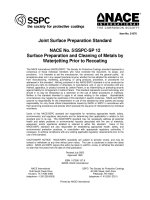
Joint Surface Preparation Standard
SSPC-SP 10/NACE No. 2
Near-White Blast Cleaning
This Steel Structures Painting Council (SSPC)/(NACE)
ternational
(NACE)
standard
individual
members
who
scope
and
provisions.
represents
have
a consensus
reviewed
Its acceptance
this
does
In-
of those
document,
its
not in any respect
preclude anyone, whether he has adopted the standard or not,
from manufacturing,
processes,
dard.
marketing,
or procedures
Nothing contained
purchasing,
not
or using
in conformance
in this standard
products,
with
this stan-
is to be construed
as
granting any right, by implication or otherwise, to manufacture,
sell, or use in connection with any method,
uct covered
anyone
way
or prod-
by Letters Patent, or as indemnifying or protecting
against
standard
apparatus,
liability for infringement of Letters
represents
minimum
requirements
and
Patent. This
should
in no
be interpreted as a restriction on the use of better proce-
dures or materials. Neither is this standard intended to apply in
all cases,
may
relating to the subject.
negate
stances.
the
SSPC
usefulness
and
NACE
Unpredictable circumstances
of
this
assume
standard
in
specific
in-
no responsibility for the in-
Foreword
This joint standard covers the use of blast cleaning
prior to the application of a protective coating or lining system.
This standard
spectors,
SSPC
for
only
those
official
interpretations
issued
by
or NACE in accordance with their respective governing
procedures
and policies, which
preclude the issuance of inter-
pretations by individual volunteers.
The
White
use.
This SSPC/NACE
standard
may
CAUTIONARY
equipment
NOTICE:
detailed
SSPC/NACE
or
standards
time without prior notice. SSPC
and NACE
1.
standard
was
prepared
blast
cleaning.
cleaning,
and
by
the
SSPC/NACE
Joint
This standard covers the requirements for Near-White
1.2.
The mandatory
tions 1 to 9 as follows:
to
requirements
are described
in Sec-
Section 1
General
Section 2
Definition
Section 3
Reference Documents
Section 4
Procedure Before Blast Cleaning
Section 5
Blast Cleaning Methods and Operation
Section 6
Blast Cleaning Abrasives
Section 7
Procedures
and
at any
Foilowing
Immediately
Blast
Cleaning
Prior to Coating
and
Lining
user is cau-
tioned to obtain the latest edition.
Section 8
Inspection
Section 9
Safety and Environmental Requirements
1.3
Section 10, ‘‘Comments,”’ and Appendix A, ‘‘Explana-
tory Notes,” are not mandatory requirements of this standard.
(NACE International
P.O. Box 218340
2.
Houston, TX 77281-8340
713-492-0535
Definition
2.1
without
@Steel Structures Painting Council
40 24th St., 6th Floor
Pittsburgh, PA 15222
COPYRIGHT
1999
Steel
Structures
October
05,
1999
16:04:38
blast
General
1.1.
require that action be
The
is near-white
commercial
Metal Blast Cleaning of steel surfaces by the use of abrasives.
taken to reaffirm, revise, or withdraw this standard no later than
five years from the date of initial publication.
standard
cleaning,
on Surface Preparation.
are sub-
ject to periodic review and may be revised or withdrawn
of this
blast
Surface Preparation Committee and NACE Unit Committee T-6G
address
referred
a
ing. This task group is comprised of members of both the SSPC
all safety problems and hazards associated with the use of materials, Operations, and/or
within this document.
focus
metal
This
prior to its
not necessarily
be to define
Task Group A on Surface Preparation by Abrasive Blast Clean-
and for deter-
mining their applicability in relation to this standard
responsibility it may
brush-off blast cleaning are addressed in separate standards.
Users of this standard are responsible for reviewing appro-
priate health, safety, and regulatory documents
is intended for use by specifiers, applicators, in-
or others whose
standard degree of surface cleanliness.
terpretation or use of this standard by other parties and accept
responsibility
abra-
sives to achieve a defined degree of cleaning of steel surfaces
A
near-white
magnification,
blast
shall
cleaned
be
free
dust, dirt, mill scale, rust, coating,
surface,
when
of all visible
oxides,
viewed
oil, grease,
corrosion
products,
and other foreign matter, except for staining as noted in Section
2.2.
Painting
Council
Information
Handling
Servic
Me
SSPC/NACE Joint Standard
SSPC-SP
Near-White
September
2.2
10/NACE
No
4627940
0004182 490 mm
Blast Gieasing
15, 1994
Random
blast cleaning should be determined before blasting commences. NOTE: Additional information on visual standards and
comparators is given in Section A.4 of Appendix A.
staining
shall be limited to no more than 5
percent of each unit area of surface as defined in Section 2.6,
and may consist of light shadows, slight streaks, or minor discolorations caused by stains of rust, stains of mill scale, or
5.
stains of previously applied coating.
5.1.
Clean, dry compressed air shall be used for nozzle
blasting. Moisture separators, oi} separators, traps, or other
equipment may be necessary to achieve this requirement.
2.3
Acceptable variations in appearance that do not affect surface cleanliness as defined in Section 2.1 include variations caused by type of steel, original surface condition, thickness of the steel, weld metal, mill or fabrication marks, heat
treating, heat-affected zones, blasting abrasive, and differences
5.2
Any of the following methods of surface preparation
may be used to achieve a near-white blast cleaned surface:
in the blast pattern.
Dry abrasive
5.2.1
nozzles, and abrasive.
When a coating is specified, the surface shall be
2.4
roughened to a degree suitable for the specified coating sys2.5
Immediately prior to coating application, the surface
shail comply with the degree of cleaning as specified herein.
5.3
Other methods of surface preparation (such as wet
abrasive blasting) may be used to achieve a near-white blast
cleaned surface by mutual agreement between those responsible for performing the work and those establishing the requirements. NOTE: Information on the use of inhibitors to prevent the
formation of rust immediately after wet blast cleaning is given in
2.7
Visual standards or comparators may be specified to
supplement the written definition. In any dispute, the written
standards shall take precedence over visual standards and
comparators. NOTE: Additional information on visual standards
and comparators is given in Section A.4 of Appendix A.
Section A.9 of Appendix A.
Reference Documents
are referenced
6.
in this stan-
dard.
1
Mineral and Slag Abrasives
SSPC-SP 1
Solvent Cleaning
SSPC-PA Guide 3
A Guide to Safety in Coating Application
whether the abrasive will be recycled.
The cleanliness and size of recycled abrasives shall
6.2
be maintained to ensure compliance with this standard.
3.2
The latest issue, revision, or amendment of the referin effect on the date of invitation to bid shail
documents
ence
govern unless otherwise specified. If there is a conflict between
the cited reference documents and this standard, this standard
shall prevail unless otherwise indicated in the procurement documents (project specification).
4.
6.3.
oil, grease,
1 addresses
1. Note that even though SSPC-AB
mineral and slag abrasives, the tests are applica-
ble to most abrasives.
6.4.
Any limitations or restrictions on the use of specific
abrasives, quantity of contaminants, or degree of embedment
shall be included in the procurement documents (project specification) covering the work, because abrasive embedment and
abrasives containing contaminants may not be acceptable for
Before blast cleaning, visible deposits of oi! or grease
removed in accordance with SSPC-SP 1 or other
agreed-upon method.
4.2
Before
sharp fins, sharp
removed from the
ment documents
blast cleaning, surface imperfections such as
edges, weld spatter, or burning slag shall be
surface to the extent required by the procure(project specification). NOTE: Additional information on surface imperfections is given in Section A.5 of Appendix A.
4.3
The blast cleaning abrasive shall be dry and free of
and other contaminants as determined by the test
methods found in SSPC-AB
Procedure Before Blast Cleaning
4.1
shall be
Blast Cleaning Abrasives
6.1.
The selection of abrasive size and type shall be
based on the type, grade, and surface condition of the steel to
be cleaned, type of blast cleaning system employed, the finished surface to be produced (cleanliness and roughness), and
Steel Structures Painting Council (SSPC) Standards:
SSPC-AB
air, blast
5.2.3
Dry abrasive blasting using a closed-cycle, recirculating abrasive system with centrifugal wheels and abrasive.
mm square]).
The following documents
using compressed
ery.
2.6 Unit area for determining staining shall be approximately 9 in? (6400 m2) {i.e., a square 3 in x 3 in [80 mm x 80
3.1
blasting
5.2.2
Dry abrasive blasting using a closed-cycle, recirculating abrasive system with compressed air, blast nozzle, and
abrasive, with or without vacuum for dust and abrasive recov-
tem.
3.
Blast Cleaning Methods and Operation
some service requirements. NOTE: Additional information
abrasive selection is given in Section A.2 of Appendix A.
on
7. Procedures Following Blast Cleaning and
Immediately Prior to Coating
If a visual standard or comparator is specified to sup-
shall
plement the written standard, the condition of the steel prior to
7.1.
be
Visible deposits of cil, grease, or other contaminants
removed according to SSPC-SP 1 or other method
S8
COPYRIGHT
1999
Steel
Structures
October
05,
1999
16:04:38
Painting
Council
Information
Handling
Servic
Me
4627940
0004183
agreed upon by those responsible for establishing the requirements and those responsible for performing the work.
Any visible rust that forms on the surface of the steel
Appendix A.
areas to meet the requirements of this standard before coating.
NOTE: Information on rust-back (re-rusting) and surface condensation is given in Sections A.6, A.7 and A.8 of Appendix A.
and
are
for establishing the requirements. Materials and work areas
shall be accessible to the inspector. The procedures and times
of inspection shall be as agreed upon by those responsible for
establishing the requirements and those responsible for performing the work.
No.
1). It
A.2. ABRASIVE SELECTION:
Types of metallic and nonmetallic abrasives are discussed in the Surface Preparation
Commentary (SSPC-SP COM). It is important to recognize that
blasting abrasives may become embedded in or leave residues
on the surface of the steel during preparation. While normally
such embedments or residues are not detrimental, care should
be taken to ensure that the abrasive is free of detrimental
amounts of water-soluble, solvent-soluble, acid-soluble, or
other soluble contaminants (particularly if the prepared steel is
to be used in an immersion environment). Criteria for selecting
and evaluating nonmetallic abrasives are provided in SSPC-AB
1, “Mineral and Slag Abrasives.”’
8.2
Conditions not complying with this standard shail be
corrected. In the case of a dispute, an arbitration or settlement
procedure established in the procurement documents (project
specification) shall be followed. If no settlement procedure is
established, then a procedure mutually agreeabie to purchaser
and supplier shall be used.
8.3
The procurement documents (project specification)
should establish the responsibility for inspection and for any
required affidavit certifying compliance with this standard.
Safety and Environmental Requirements
A.3| SURFACE PROFILE:
Surface profile is the roughness of the surface that results from abrasive blast cleaning.
The profile depth (or height) is dependent upon the size, type,
and hardness of the abrasive, particle velocity and angle of impact, hardness of the surface, amount of recycling, and the
proper maintenance of working mixtures of grit and/or shot.
The allowable minimum/maximum height of profile is usually dependent upon the thickness of the coating to be applied.
Large particle-sized abrasives (particularly metallic abrasives)
can produce a profile that may be too deep to be adequately
covered by a single thin-film coat. Accordingly, it is recommended that the use of larger abrasives be avoided in these
9.1
Because abrasive blast cleaning is a hazardous operation, all work shall be conducted in compliance with applicable insurance underwriter, local, state, and federal occupational
and environmental health and safety rules and regulations.
NOTE: SSPC-PA Guide 3, '‘A Guide to Safety in Coating Application,” addresses safety concerns for coating work.
10.
5/NACE
should be used when a high degree of blast cleaning is required. The primary functions of blast cleaning before coating
are: {a) to remove material from the surface that can cause
early failure of the coating system and (b) to obtain a suitable
surface roughness. The hierarchy of blasting standards is as
follows: white metal blast cleaning, near-white blast cleaning,
commercial blast cleaning, and brush-off blast cleaning.
subject to inspection by a representative of those responsible
9.
7
4.1
Explanatory Notes
than white metal blast cleaning (SSPC-SP
materials supplied under this standard
5
11.10
10
9
3.2
8
6
A.1_
FUNCTION:
Near-white blast cleaning (SSPC-SP
10/NACE No. 2) provides a greater degree of cleaning than
commercial blast cleaning (SSPC-SP 6/NACE No. 3) but less
Inspection
Work
Commentary Section
Abrasive Selection_......................
Degree of Cleaning..........................
Hilm Thickness .............................
Wet Abrasive Blast Cleaning........
Maintenance Coalting..................
Rust Back (Re-rusting)................
Surface Profile................................
Visual Standards and
Comparators.................................
Weld Spatter................................
after blast cleaning shall be removed by reblasting the rusted
8.1.
SSPC/NACE Joint Standard
SSPC-SP 10/NACE No. 2
Near-White Blast Cleaning
September 15, 1994
Subject
7.3
After blast cleaning, surface imperfections that remain
(e.g., sharp fins, sharp edges, weld spatter, burning slag,
scabs, slivers, etc.} shall be removed to the extent required in
the procurement documents (project specification). Any damage to the surface profile resulting from the removal of surface
imperfections shall be corrected to meet the requirements of
Section 2.4. NOTE: Additional information on surface imperfections is given in Section A.5 of Appendix A.
8.
SH
“Surface Preparation Commentary.”’ The recommendations
contained in the Appendix and SSPC-SP COM are believed to
represent good practice, but are not to be considered as requirements of this standard. The sections of SSPC-SP COM
that discuss subjects related to near-white blast cleaning are
listed below.
7.2
Dust and residues shall be removed from prepared
surfaces by brushing, blowing off with clean, dry air, vacuum
cleaning, or other methods agreed upon by those responsible
for establishing the requirements and those responsible for performing the work. Moisture separators, oil separators, traps, or
other equipment may be necessary to achieve clean, dry air.
7.4
327
Comments
10.1
Additional information and data relative to this standard are contained in Appendix A. Detailed information and
data are presented in a separate document, SSPC-SP COM,
59
COPYRIGHT
1999
Steel
Structures
October
05,
1999
16:04:38
Painting
Council
Information
Handling
Servic
Wm
SSPC/NACE Joint Standard
SSPC-SP
Near-White
September
10/NACE No. 2
6627940
DOO4L8+
Blast Cleaning
15, 1994
face defects (steel laminations, weld porosities, or deep corrosion pits) may not be evident until the surface preparation has
been completed. Therefore, proper planning for such surface
repair work is essential because the timing of the repairs may
occur before, during, or after the blast cleaning operation. Section 4 of SSPC-SP COM and NACE Standard HP0178, “Fabrication Details, Surface Finish Requirements, and Proper Design
Considerations for Tanks and Vessels to Be Lined for Immersion Service,”’ contain additional information on surface imperfections.
cases. However, larger abrasives may be needed to facilitate
removal of thick coatings, heavy mill scale, or rust. If control of
profile (minimum/maximum) is deemed to be significant to coating performance, it should be addressed in the procurement
documents (project specification).
Typical maximum profile heights achieved with commercial
abrasive media are shown in Table 8 of the Surface Preparation
Commentary (SSPC-SP COM). Surface profile should be measured in accordance with NACE Standard RP0287, ‘Field Measurement of Surface Profile of Abrasive Blast Cleaned Steel
Surfaces
Using
a Replica Tape,"’
Method for Field
Cleaned Steel.”
A.4.
Measurement
VISUAL STANDARDS
of
or ASTM”
Surface
D 4417,
Profile
of
AND COMPARATORS:
“Test
A.6
Blast
Note
Visual Comparator for Surfaces of New Steel Air-
other. Under mild ambient conditions, if chemical contamination
(complements
is not present
Section
A.6),
it is best to blast clean
and
ronmental conditions may require more expedient coating application to avoid contamination from fallout. Chemical contamination should be removed prior to coating (see Section A.6).
Standard TM0170)
Comparator for Surface Finishing of
is a plastic weld replica that comple-
ments NACE Standard RP0O178. Other available visual
dards are described in Section 7 of SSPC-SP COM.
(see
coat a surface during the same day. Severe atmospheric envi-
NACE
Visual Comparator for Surfaces of New Steel Airblast Cleaned with Slag Abrasive (complements NACE
The NACE Visual
Welds Prior to Coating
Steel contaminated
A.7
RUST-BACK:
Rust-back (re-rusting) occurs when
freshly cleaned steel is exposed to moisture, contamination, or
a corrosive atmosphere. The time interval between blast cleaning and rust-back will vary greatly from one environment to an-
Visual Comparator for Surfaces of New Steel Cen-
trifugally Blast Cleaned with Steel Shot
NACE Standard TM0175)
CONTAMINATION:
tional Shipbuilding Research Program®), and the International
Organization for Standardization).
blast Cleaned with Sand Abrasive (complements NACE
Standard TM0170)
NACE
Visual Comparator for Surfaces of New Steel Centrifugally Blast Cleaned with Steel Grit (complements
NACE Standard TM0175)
NACE
CHEMICAL
with soluble salts (i.e., chlorides and sulfates) develops rustback rapidly at intermediate and high humidities. These soluble
salts can be present on the steel surface prior to blast cleaning
as a result of atmospheric contamination. In addition, contaminants can be deposited on the steel surface during blast cleaning whenever the abrasive is contaminated. Therefore, rustback can be minimized by removing these salts from the steel
surface (preferably before blast cleaning) and eliminating
sources of recontamination during and after blast cleaning.
Identification of the contaminants and their concentrations may
be obtained from laboratory and field tests. A number of tests
for soluble salts have been examined by SSPC, ASTM, the Na-
that the use of visual standards or comparators in conjunction
with this standard is required only when specified in the procurement document (project specification) covering the work.
However, it is strongly recommended that the procurement document require the use of visual standards or comparators.
SSPC-Vis 1-89 provides color photographs for the various
grades of surface preparation as a function of the initial condition of the steel. NACE visual comparators are encapsulated
steel coupons depicting different finished blast conditions:
NACE
263s
A.8
DEW POINT:
Moisture condenses on any surface
that is colder than the dew point of the surrounding air. Therefore, it is recommended that the temperature of the steel surface be at least 5°F (3 °C) above the dew point during dry blast
cleaning operations. It is advisable to visually inspect for moisture and periodically check the surface temperature and dew
point during blast cleaning operations and to avoid the application of coating over a damp surface.
stan-
A.5
SURFACE
IMPERFECTIONS:
Surface
imperfections can cause premature failure when the service is severe.
Coatings tend to pull away from sharp edges and projections,
leaving little or no coating to protect the underlying steel. Other
features that are difficult to properly cover and protect include
AQ
crevices, weld porosity, laminations, etc. The high expense to
WET
ABRASIVE
BLAST
CLEANING:
Steel that is
remedy the surface imperfections requires weighing the benefits
of edge rounding, weld spatter removal, etc., versus a potential
coating failure.
Poorly adhering contaminants, such as weld slag residues, loose weld spatter, and some minor surface laminations,
may be removed during the blast cleaning operation. Other sur-
wet abrasive blast cleaned may rust rapidly. Clean water should
be used for rinsing (studies have shown that water of at least
15,000 ohm-cm resistivity is preferred). Inhibitors may need to
be added to the water or applied to the surface immediately after blast cleaning to temporarily prevent rust formation. The
coating should then be applied before any rusting is visible.
(1) ASTM, 1916 Race Street, Philadelphia, PA 19103-1187
{2} National Shipbuilding Research Program, c/o Naval Surface Weapons Center,
Carderock Division, (C1253), Bethesda, MD 20089-5000.
(3) international Organization for Standardization, 1 rue de Varembe, Case Postale
56, CH
1121 Geneva 20, Switzerland.
60
COPYRIGHT
1999
Steel
Structures
October
05,
1999
16:04:38
Painting
Council
Information
Handling
Servic
MM
8627940
0006165
LTT BH
SSPC/NACE Joint Standard
SSPC-SP 10/NACE No. 2
Near-White Blast Cleaning
September
CAUTION:
15, 1994
Some inhibitive treatments may interfere with the performance of certain coating systems.
sured, refer to SSPC-PA 2, “Measurement
Thickness with Magnetic Gages.”
A.10
FILM THICKNESS:
It is essential that ample coating be applied after abrasive blast cleaning to adequately cover
the peaks of the surface profile. The dry film thickness above
the peaks of the profile should equal the thickness known to be
needed for the desired protection. If the dry film thickness over
the peaks is inadequate, premature rust-through or failure will
occur. To ensure that coating thicknesses are properly mea-
this standard is used in maintenance coating, specific instructions should be given on the extent of surface to be blast
cleaned or spot blast cleaned to this degree of cleanliness.
SSPC-PA Guide 4, ‘‘Guide to Maintenance Recoating with Oil
Base or Alkyd Coating Systems,” provides a description of accepted practices for retaining old sound coating, removing unsound coating, feathering, and spot cleaning.
A.11.
MAINTENANCE
AND
REPAIR
of
Dry
COATING:
Coating
When
61
COPYRIGHT
1999
Steel
Structures
October
05,
1999
16:04:38
Painting
Council
Information
Handling
Servic
MM
8627940
0004186
O36 mm
62
COPYRIGHT
1999
Steel
Structures
October
05,
1999
16:04:38
Painting
Council
Information
Handling
Servic