Astm a 123
Bạn đang xem bản rút gọn của tài liệu. Xem và tải ngay bản đầy đủ của tài liệu tại đây (2.34 MB, 8 trang )
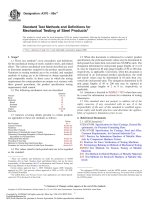
Designation: A 123/A 123M — 02
Standard Specification for
Zinc (Hot-Dip Galvanized) Coatings on Iron and Steel
Products"
‘This standard is issued under the fixed designation A 123/A 123M; the number immediately following the designation indicates the year
of original adoption or, in the case of revision, the Sear of last revision, ‘number in parentheses indicates the year of last reapproval.
‘A superscript epsilon (€) indicates an editorial change since the last revision or reapproval.
This standard has been approved for use by agencies of the Department of Defense.
shall be done
1. Scope
1.1 This specification
covers
the requirements
for zinc
coating (galvanizing) by the hot-dip process on iron and steel
products made from rolled pressed and forged shapes, castings,
plates, bars, and strips.
equivalent of the test or
2.1 ASTM Standards:
A47/A 47M Specification for Ferritic Malleable Iron Cast-
fabricated products, for example, assembled steel products,
structural steel fabrications, large tubes already bent or welded
before galvanizing, and wire work fabricated from uncoated
steel wire. This specification also covers steel forgings and iron
castings incorporated into pieces fabricated before galvanizing
or which are too large to be centrifuged (or otherwise handled
to remove excess galvanizing bath metal).
ings?
A90/A 90M Test Method for Weight [Mass] of Coating on
Iron and Steel Articles with Zine or Zine-Alloy Coatings?
A 143 Practice for Safeguarding Against Embrittlement of
Hot-Dip Galvanized Structural Steel Products and Proce-
dure for Detecting Embrittlement®
Note 1—This specification covers those products previously addressed
A 153/A 153M
Specification for Zinc Coating (Hot-Dip) on
Iron and Steel Hardware?
in Specifications A 123-78 and A 386-78.
This
sheet
or to
The
the metric
2, Referenced Documents
1.2 This specification covers both unfabricated products and
1.3.
steel
lines,
1.4
using
inspection method as appropriate. In the case of orders in SI
units, such shall be stated to the galvanizer when the order is
placed,
A 384/A 384M Practice for Safeguarding Against Warpage
and Distortion During Hot-Dip Galvanizing of Steel Assemblies?
A 385 Practice for Providing High-Quality Zinc Coatings
specification does not apply to wire, pipe, tube, or
which is galvanized on specialized or continuous
steel less than 22 gage (0.0299 in.) (0.76 mm] thick.
galvanizing of hardware items that are to be
(Hot-Dip)?
centrifuged or otherwise handled to remove excess zinc (such
A 767/A 767M
as bolts and similar threaded fasteners, castings and rolled,
pressed and forged items) shall be in accordance with Speci-
Specification
for Zinc-Coated
fication A 153/A 153M.
of Hot-Dip Galvanized Coatings?
1.5 Fabricated reinforcing steel bar assemblies are covered
by the present specification. The galvanizing of separate
reinforcing steel bars shall be in accordance with Specification
A902 Terminology Relating to Metallic Coated Steel Prod-
ucts?
B 6 Specification for Zine*
B 487 Test Method for Measurement of Metal and Oxide
A 767/A 767M.
1.6 This specification is applicable to orders in either
inch-pound units (as A123) or SI units (as A 123M). Inchpound units and SI units are not necessarily exact equivalents.
Within the text of this specification and where appropriate, ST
units are shown in parentheses. Each system shall be used
Coating Thickuesses by Microscopical Examination of a
Cross Section®
B 602 Test Method for Attribute Sampling of Metallic and
Inorganic Coatings®
independently of the other without combining values in any
way, In the case of orders in ST units, all testing and inspection
E376
Practice
‘This spevificution is under the jurisdiction of ASTM Committee AUS on
Metallic Cuated fron and Steel Products and is the dircet responsibility of
Subcommittee 05.13 on Structural Shapes and Hardware Specifications.
Current edition approved October 10, 2002. Published December 2002. Originally published ax A 123 ~ 28 7. Last previous edition A 123
- 01a,
2 Annual
3 Annual
+ Annual
$ Animal
Annual
Book of
Book of
Book of
Book of
Book of
for
Measuring
ASTM Standards,
ASTM Stundards,
ASTM Standards,
ASTM Standards,
ASTM Standards,
Vol
Vol
Vol
Vol
Vol
Coating
01.02.
01.06.
01.04,
03.04
0:
Copyright @ ASTM International, 100 Barr Harbor Dnve, PO Box C700, West Conshohocken, PA 19428-2959, United Siates.
COPYRIGHT 2003: ASTM Intematonat
Galvanized
Steel Bars for Concrete Reinforcement*
A780 Practice for Repair of Damaged and Uncoated Areas
1
Document srovced by IHS Licans
00:45'50 MST Questions or comment
Policy Management Grous al 1200-4
2ytaapo3
the Document
Thickness
by
Aly a 12314 123M — 02
Magnetic-Field
Methods”
or Eddy-Current
(Electromagnetic)
Test
3.2.2. black, acj—denotes the condition of not galvanized or
otherwise coated. For purposes of this specification the word
“black” does not refer to the color or condition of surface, or to
a surface deposit or contamination.
3. Terminology (See Fig. 1)
3.1 Definitions:
3.2.3 coating thickness grade, n—the numerical value from
3.1.1 The following terms and definitions are specific to this
specification,
Terminology
A 902
contains
other
definitions relating to metallic-coated steel products.
terms
Table 1 at the intersection of a material category and a
and
thickness range.
3.2.4 gross dross inclusions, n—the iron/zinc intermetallics
present in a galvanized coating in a form other than finely
dispersed pimples.
3.2.4.1 Discussion—These inclusions would create an ex-
3.2 Definitions of Terms Specific to This Standard:
3.2.1 average coating thickness, n—the average of three
specimen coating thicknesses.
~
posed steel spot if they were removed trom the coating. These
breil BOGE SASTM, Siaridate, Vel 03.03
inclusions are raiscd surfaces and are easily knocked off
Multi-Specimen Articles
Articles whose Surface Area Is greater than 160 sq.in. (100,000 sq. mm)
3 Test Articles
each composed of
3 Specimens
Test Article
1
Each Specimen (5 or more measurements widely
dispersed) must have Minimum Average Coating
1
Thickness of (Table 1) -1 grade
Specimen
EachTest Article in the Sample (3 Specimens each) must
have Minimum Average Coating Thickness of (Table 1)
n
Articles whose Surface Area is equal to or less than 160 sq.in. (100,000 sq. mm)
Lot
PE
Bryon se
3 Test Articles
Each Specimen (5 or more measurements widely dispersed) must
have Minimum Average Coating Thickness of (Table 1) -1 grade
All Test Articles (Specimens) Together must have Minumum
Average Coating Thickness
of (Table 1)
FIG. 1 Single- and Multi-Specimen Articles
COPYRIGHT 2063: ASTM Intemational
2
fly a 123/A 123M - 02
TABLE 1 Minimum Average Coating Thickness Grade by Material Category
Matenal Category
All Specimens Tested
Steel Thickness Range (Measured), in. (mm)
Yio to to Hs (3.2104.8) >3⁄%s lo <1⁄4(>4.8 to <6.4)
65
75
85
65
75
85
45
75
75
50
60
85
45
45
35
Structural Shapes and Piate
Strip and Bar
Pipe and Tubing
Wire
through contact with lifling straps or chains, tools, fixtures, or
other galvanized parts.
3.2.5 material category, n—the general class or type of
material or process of manufacture, or both, that nominally
describes a unit of product, or from which a unit of product is
made. For example, bar grating belongs to the category “strip.”
handrail belongs to the category “pipe,” etc.
3.2.6 multi-specimen article, n—a unit of product whose
surface arca is greater than 160 in. [100000 mm]. For
thickness
testing
purposes,
sections,
nominally
articles
whose
surface
area
is
BY (26.4)
100
100
75
80
3.2.10 specimen coating thickness, n—the average thick-
ness from no less than five test measurements on a specimen,
when
each measurement
location
is selected to provide the
widest dispersion (in all applicable directions) of locations for
the steel category of the test article within the confines of the
specimen volume.
3.2.11 test article, n— an individual unit of product that is
a member of the sample and that is examined for conformance
to a part of this specification.
greater than 160 in.’ are subdivided into three continuous local
4, Ordering Information
constitutes a specimen. In the case of any such local section
shall include the following:
4.1.1 Quantity (number of pieces to be galvanized) and total
weight.
equal
in surface
area,
each
of which
4.1 Orders for coatings provided under this specification
containing more than one material category or steel thickness
range as delineated in Table 1, that section will contain more
than one specimen (see Fig. 1),
3.2.7 sample, n—a collection of individual units of product
from a single lot selected in accordance with Section 7, and
intended to represent that lot for acceptance. If a sample is
taken as representing the lot for acceptance, the sample shall be
taken at random from the lot without regard to the perceived
quality or appearance of any individual unit in the lot being
sampled. The sample consists of one or more test articles,
3.2.8 single-specimen article, n—a unit of product whose
or contamination.
that
5. Materials and Manufacture
surface area is equal to or less than 160 in.” [100 000 mm*] or
is centrifuged
or otherwise
similarly
handled
in
the
galvanizing process to remove excess galvanizing bath metal
(free zinc). For thickness testing purposes, the entire surface
area of each unit of product constitutes a specimen. In the case
of any such article containing more than one material category
or steel thickness range as delineated in Table |, that article
will contain more than one specimen
(see Fig.
|).
3.2.9 specimen, n— the surface of an individual test article
or a portion of a test article, upon which thickness measurements are to be performed, which is a member of a lot, or a
member
of a sample
representing
that lot.
For magnetic
thickness measurements, specimen excludes any area of the
surface which is subject to processes (such as flame cutting,
machining, threading, etc.) that can be expected to result in
surface conditions not representative of the general surface
condition of the test article, or is disqualified by the measurement method, The minimum average coating thickness grade
for any
specimen
shall
be one coating grade
below
that
required for the appropriate material category and thickness in
Table |, For a unit of product whose surface area is equal to or
less than 160 in.? [100.000 mm?J, the entire surface area of
cach test article constitutes a specimen. In the
case of an article
containing more than one material category or steel thickness
range as delineated in Table 1, that article will contain more
than one specimen, as appropriate (see Fig. 1).
COPYRIGHT 2003: ASTM intematonal
4.1.2. Description (type and size of products) and weight.
4.1.3 ASTM
4.1.4
specification designation and year of issue.
Material identification (see 5.1) and surface condition
4.1.5 Sampling plan, if different from 7.3.
4.1.6 Special test requirements (see 8.1).
4.1.7 Special requirements (special stacking, heavier coating weight, etc.).
4.1.8 Tagging or piece identification method.
5.1 Steel or lron—The specification, grade, or designation
and type and degree of surface contamination of the iron or
steel in articles to be galvanized shall be supplied by the
purchaser to the hot-dip galvanizer prior to galvanizing.
Nore 2—The presence in steels and weld metal, in certain percentages,
of some
clements
such
as silicon, carbon, and phosphorus
tends
to
accelerate the growth of the zinc-iron alloy layer so that the coating may
have a matte finish with little or no outer zinc layer. The galvanizer has
only limited control over this condition. The mass, shape. and amount of
cold working of the product being galvanized may also affect this
condition. Practice A385 provides guidance on steel selection
discusses the effects of various elements in steel compositions
and
(for
example, silicon), that influence coating weight and appearance.
5.2 Fabrication—The design and fabrication of the product
to be galvanized are the responsibilities of the designer and the
fabricator. Practices A 143, A 384, and A 385 provide guidance
for steel fabrication for optimum hot dip galvanizing and shall
be complicd with in both design and fabrication. Consultation
between the designer, fabricator, and galvanizer at appropriate
stages in the desizn and fabrication process will reduce future
problems.
5.3 Castings—The composition and heat treatment of iron
and steel castings shall conform to specifications designated by
the purchaser. Some types of castings have been known to
Document provides by 946 LZenkeevE+soeldobd 1880420101, Ugerr, 92/18/2003
20:45:50 MST Guestons
of commenis sbout ini massage. aiease cal Ine Document
Poicy Management
Group wl 1-800-481-7584
Afy 4123/4 123m ~ 02
show
potential
Ít
the
problems
with
predisposition
to being
em-
brittled during the normal thermal cycle of hot-dip galvanizing.
is
responsibility
of
the
purchaser
to
heat
treat
or
ros
otherwise allow for the possibility of such embrittling phenomcna. The requirements for malleable iron castings to be
galvanized shall be as stated in Specification A 47,
5.4 Zinc—The zinc used in the galvanizing bath shall
conform to Specification B 6. If a zinc alloy is used as the
primary feed to the galvanizing bath, then the base material
used to make that alloy shall conform to Specification B 6.
3.5 Bath Composition—The molten metal in the working
volume of the galvanizing bath shall contain not less than an
average value of 98.0% zine by weight.
Note 3—The galvanizer may choose to add ace amounts of certain
elements (for example, aluminum, nickel, and tin) to the zinc bath (o help
in the processing of certain reactive steels or to enhance the cosmetic
appearance of the finished product, The use of these trace elements is
permitted provided that the bulk chemistry of the galvanizing bath is at
least 98.0 % zine by weight. The elements can be added to the galvanizing
bath as part of a pre-alloyed zinc feed, or they can be added to the bath by
the galvanizer using a master feed alloy.
6. Coating
Properties
6.1 Coating Thickness—The average thickness of coating
for all specimens tested shall conform to the requirements of
Table | for the categories and thicknesses of the material being
galvanized. Minimum average thickness of coating for any
individual specimen is one coating grade less than thatrequired
in Table
1,
Where
products
consisting
of various
material
thicknesses or categories are galvanized, the coating thickness
grades for each thickness range and material category of
material shall be as shown in Table |. In the case of orders in
SI units, the values in Table 1, shall be applicable as metric
units in micrometres. In the case of orders in inch-pound units,
the measured value shall be converted to coating grade units by
the use of Table 2. The specification of coating thicknesses
heavier than those required by Table 1 shall be subject to
mutual agreement between the galvanizer and the purchaser.
35
dã
5
§:
60
65
75
80
85
100
14
18
20
2.2
24
26
30
31
3.3
3.9
Specimen
Specimen
Not I—Each specimen comprises nominally one third of the total
surface area of the article. A minimum of five measurements should be
made within the volume of each specimen. as widely dispersed within that
volume as is practical, so as to represent as much as possible, the general
coating thickness within that specimen volume.
FIG. 2 Articles Made
of Many
Components
average for each test article shall average not less than one
coating grade below that required in Table 1.
6.1.2 For articles whose surface area is equal to or less than
160 in.* [100 000 mm”) (single-specimen arcicles), the average
of all test articles in the sample must meet the appropriate
minimum average coating thickness grade requirements of
Table 1, and for each test article, its specimen coating thickness
shall be not less than one coating grade below that required in
Table 1.
6.1.3 No individual measurement, or cluster of measurements at the same general location, on a test specimen shall be
this specification provided that when those measurements are
to determine
the specimen coating thickness grade for that specimen,
requirements of 6.1.1 or 6.1.2, as appropriate are met.
the
Note +—The coating thickness grades in Table I represent the minivalue obtainable with a high level of confidence for the ranges
typically found in each material category. While most coating thicknesses
mum
will be in excess of those values, some materials in sạch category may be
less reactive (for example, because of chemistry or surface condition) than
other materials of the steel category spectrum. Therefore, some articles
may have a coating grade at or close to the minimum requirement shown
in Table 1. In such cases, the precision and accuracy of the coating
thickness measuring technique should be taken into consideration when
specification. Purchasers desiring a guarantee of heavier coatings than the
in the sample must meet the appropriate minimum average
mis
2
averaged with the other dispersed measurements
Specimen delineation steps, and Fig. 3 is a graphic representation of the coating thickness inspection steps.)
6.1.1 For articles whose surface area is greater than 160
in.? [100°000 mm?} (multi-specimen articles), each test article
Coste
Specimen
cause for rejection under the coating thickness requirements of
(Fig. 2 is a graphic representation of the sampling and
coating thickness grade requirements of Table
specimen coating thickness grade comprising
a
Fejecting such articles for coating thickness below that required by this
1, and each
that overall
minimum
thicknesses shown herein should use the special requirements
(see 4.1.6) to specify coating thickness grades higher than those shown in
TABLE 2 Coating Thickness Grade*
oust?
08
1.0
12
1.3
14
15
LẺ
1.9
20
23
ym
35
45
50
55
30
§5
75
80
95
100
gim?
245
320
355
390
425
480
530
565
800
705
“The values in micrometres (ym) are based on ‘he Coaling Grace. The other
values are based on conversions using the fcllowing formulas: mils = pm x 0.03937;
oustt?= ym ¥. 0.02316; gim 2 = ym x 7.067.
COPYRIGHT 2003; ASTM International
a
ocument rovided ay HS Lien
'2nMeb/1869500101,
20:45:50
NST Guestions er 2b,
Poley Management Srous at 1800-15 tu34 Me mestage: le
23-3003
Aly a 1237/0 123M - 02
Select Test Articles
shall not be grounds for rejection (see Note 7). Surface
Anlicles Presented
for Inspection
+
According to Sampling
Plan
(The Sample)
conditions related to deficiencies related to design, detailing, or
fabrication as addressed by PracticeA 385 shall not be grounds
for rejection. The zinc coating on threaded components of
(The Lot)
Test
Articles Fit
Single Material
Category
dance with the methods
to be coated on that article, or 36 in.” per short ton [256 cm? per
Nore S—Inaccessible surface areas are those which cannot be reached
for appropriate surface preparation and application of repair materials as
described in Practice A 780, Such inaccessible areas, for example, would
be the intemal surfaces of certain tanks. poles, pipes, tubes, and so forth.
6.2.3 The thickness of renovation shall be that required by
the thickness grade for the appropriate material category and
thickness range in Table | in accordance with the requirements
of 6.1, except that for renovation using zinc paints, the
thickness of renovation shall be 50 % higher than that required
Test Each Specimen
tor Compliance with
Section 6.1
by Table
Nore 6—The requirements for the finish of a galvanized product
address themselves to a visual type of inspection. They do not address the
matter of measured coating thickness variations that can be encountered
because of different steels or different thicknesses ofa given steel being
used in an assembly.
Nore 7—Items which are prepared for galvanizing by abrasive cleaning will generally develop a thicker coating with a moderately rougher
surface.
with Section 6.1
Lot Fails for
Thickness
Lot Passes for
Thickness
FIG. 3 Coating Thickness Inspection Steps
Table 1. In addition, the purchaser should anticipate the need for test
batches or extra preparation steps, or both, such as blasting before
galvanizing or other methods, to attempt to reach the higher requiremen
ts
with consistency. Some higher-than-standard thicknesses may be impractical or unattainable
6.2 Finish—The
coating
shall
be continuous
(except
as
provided below), and as reasonably smooth and uniform in
thickness as the weight, size, shape of the item, and necessary
handling of the item during the dipping and draining operatio
ns
al the galvanizing kettle will permit. Except for local excess
coating thickness which would interfere with the use
of the
product, or make it dangerous to handle (edge tears or
spikes),
rejection for nonuniform coating shall be made only for
plainly
visible excess coating not related to design factors
such as
holes, joints, or special drainage problems (see Note 6), Since
surface smoothness is a relative term, minor roughnes
s that
does not interfere with the intended use of the product,
or
roughness
that
is related
to the
as-received
(un-galvanized)
surface condition, steel chemistry, or steel reactivity to
zine
COPYRIGHT 2003; ASTM Inlanational
I, but not greater than 4.0 mils.
6.2.4 When areas requiring renovation exceed the criteria
previously provided, or are inaccessible for repair, the coating
shall be rejected.
Each Specimen
Avg. Complies
Section 6.1
unless directed by
metric ton] of piece weight, whichever is less.
per Test Article
‘Avg, of Ail
Specimen
Complies with
in Practice A 780
the purchaser to leave the uncoated areas untreated for subsequent renovation by the purchaser,
6.2.1 Each area subject to renovation shall be 1 in. (25 mm]
or less in its narrowest dimension.
6.2.2 The total area subject to renovation on each article
shall be no more than '4 of | % of the accessible surface area
One Specimen
Subdivide Each Test
Article into Three
Specimen
to
that required in Specification A 153/A 153M. Surfaces that
remain uncoated after galvanizing shall be renovated in accor-
Inspect each Material
Category Separately
‘Article Surtace
Area > 160 in2 or
100,000 mma,
articles galvanized under this specification shall conform
6.3 Threaded Components in Assemblies— The zinc coating
on external threads shall not be subjected to a cutting, rolling,
or finishing tool operation, unless specifically authorized by the
purchaser. Internal threads are not prohibited from being
tapped or retapped after galvanizing. Coatings shall conform to
the requirements of Specification A 153/A 153M.
6.4 Appearance—Upon shipment from the galvanizing fa-
cility, galvanized articles shall be free from uncoated areas,
blisters, flux deposits, and gross dross inclusions. Lumps,
projections, globules, or heavy deposits of zinc which will
interfere with the intended use of the material will not be
pennined. Plain holes of 4-in. (12.5-mm] diameter or more
shall be clean and reasonably free from excess zinc. Marks in
the
zinc
coating
caused
by
tongs
or
other
items
used
in
handling the article during the galvanizing operation shall not
be cause for rejection unless such marks have exposed the base
metal and the bare metal areas exceed allowable maximums
from 6.2.1 and 6.2.2. The pieces shall be handled so that after
galvanizing they will not freeze together on cooling.
Note 3—Depending upon product design or material thickness, or
both. fiming or excess zine buildup in plain holes of less than 1⁄4-in
Document srovided 3y 1S Lewatse=EsxenkMebU1390400101, Usarz, 23/18/2003
90:46:59
AVST ushon£
abou!
fh message: please cathe Document
Poly Manasemant
Grouper comments
al 1-800-151-1594
fly a 123/A 123m
— 02
(12.5-mm] diameter nay occur that requires additional work to make the
holes usable as intended.
6.5 Adherence---The zinc coating shall withstand handling
consistent with the nature and thickness of the coating and the
nonnal usc of the article, without peeling or flaking.
Nore 9—Although some material may be formed afer galvanizing, in
general the zine coating on the articles covered by this specification is too
heavy to permit severe bending without damaging the coating,
7, Sampling
-
7.1 Sampling of each lot shall be performed for conform-
the coating shall be determined by magnetic thickness gage
measurements in accordance with Practice E376 unless the
methods described in 8.2.2, 8.2.3, or 8.2.4 are used. For each
specimen (as described in 3.2.9) five or more measurements
shall be made at points widely dispersed throughout the
volume occupied by the specimen so as to represent as much as
practical, the entire surface area of the test specimen. The
average of the five or more measurements thus made for each
specimen is the specimen coating thickness.
8.2.1.1 For articles whose surface area is greater than 160
in.* (100 000 mm*] (multi-specimen articles as described in
ance with the requirements of this specification.
7.2 A lot is a unit of production or shipment from which a
sample is taken for testing. Unless otherwise agreed upon
between the galvanizer and the purchaser, or established within
this specification, the lot shall be as follows: For testing at a
3.2.6), the average of the three specimen coating thickness
grades comprising each test article is the average coating
thickness for that test article. A specimen must be evaluated for
each steel category and material thickness within the requirements for each specimen of the test article.
type and size comprising a single order or a single delivery
load, whichever is the smaller, or any number of articles
identified as a lot by the galvanizer, when these have been
galvanized within a single production shift and in the same
bath. For test by the purchaser after delivery, the lot consists of
the single order or the single delivery load, whichever is the
smaller, unless the lot identity, established in accordance with
the above, is maintained and clearly indicated in the shipment
by the galvanizer.
7.3 The method of selection and number of test specimens
shall be agreed upon between the galvanizer and the purchaser,
Otherwise, the test specimens shall be selected at random from
each lot. In this case, the minimum number of specimens from
cach lot shall be as follows:
than
galvanizer’s facility, a lot is one or more articles of the same
Number of Pieces in Lot
3
4
501
1201
3.201
10.001
or less
to 500
to 1 200
t0 3200
to 10 000,
and over
Number of Specimens
all
3
5
8
13
20
Norr 10— Where a number of identical items are to be galvanized, a
statistical sampling plan may be desired. Such a plan is contained in Test
Method B 602 which addresses sampling procedures for the inspection
clectrodeposited metallic coatings and related finishes. If Test Methodof
B 602 is used, the level of sampling shall be agreed upon between
Balvanizer and the purchaser at the time the coating order is placed, the
7.4 A test specimen which fails to conform to arequirement
of this specification shall not be used to determine the
conformance to other requirements.
8. Test Methods
«
8.1 Test Requirements—The following tests shall be con-
ducted to ensure that the zine coating is being fumished in
accordance with this specification, The specifying of tests for
8.2.1.2 For articles whose surface area is equal to or less
160 in.?{100000
described
in
3.2.8),
thickness grades
sample.
the
mm?)
COPYRIGHT 2003: ASTM intcnatonal
for the
8.2.2 Stripping Method—The
average weight of coating
shall be determined by stripping a test article, a specimen
removed from a test article, or group of test articles in the case
of very small items such as nails, etc., in accordance with Test
Method A 90/A 90M unless the methods described in 8.2.1,
8.2.3, or 8.2.4 are used. The weight of coating per unit area
thus determined is converted to equivalent coating thickness
values in accordance with Table 2 (rounding up or down as
appropriate). The thickness of coating thus obtained is the test
article coating thickness, or in the case of a specimen removed
from a test article, is the specimen average coating thickness.
8.2.2.1 The stripping method is a destructive test and is
appropriate for single specimen articles, but is not practical for
multi-specimen articles,
8.2.3
Weighing Before and After Galvanizing—The average
weight of coating shall
be determined
by weighing
articles
before and after galvanizing, subtracting the first weight from
the second and dividing the result by the surface area unless the
methods described in 8.2.1, 8.2.2, or 8.2.4 are used. The first
weight shall be determined after pickling and drying and the
second after cooling to ambient temperature. The weight of
coating per unit area thus determined is converted to equivalent
coating thickness values according to Table 2 (rounding up or
down as appropriate). The thickness of coating thus obtained is
for single-specimen
specimen articles.
Magnetic Thickness Measurements
The
— thickness of
thickness
8.2.1.3 In the case of threaded components, the thickness of
8.2 Thickness of Coating Test—The thickness of coating
is
Fan
by one or more of the three methods described as
8.2.1
articles as
specimen coating
coating shall be made on a portion of the article that does not
include any threads.
8.2.1.4 The use of magnetic measurement methods is appropriate for larger articles, and is appropriate for smaller
articles when there is sufficient flat surface area for the probe
tip to sit flat on the surface using Practice E 376.
the test article coating thickness.
ollows.
of all
is the average coating
adhesion and embrittlement shall be subject to mutual
agreement berween the galvanizer and purchaser. Visual
inspection
of the coating shall be made for compliance with
the require-
ments
(single-specimen
average
8
The weighing before and after method is appropriate
articles,
but is not practical
for multi-
Note 11—Both the stripping method and the weighing before and after
method do not take into account the weight of iron reacted from the article
Document
by IMS LicensamxEcxonMoni1 890500101, U
20:48:50 MSTsrowcea
Questions
or comments about ihe message: pl
Poucy Nanapemant
Group at 1-200-151-1584
fy a 12314 123m - 02
that is incorporated into the coating. Thus, the methods may underestimate
coating weight (and therelore the calculated thickness) by up to [0 %. The
accuracy of both methods will be influenced by the accuracy to which the
surface area of the articles tested can be determined.
8.2.4 Microscopy—The thickness of coating shall be determined by cross-sectional and optical measurement in accordance with Test Method B 487 unless the methods described in
8.2.1, 8.2.2, or 8.2.3 are used. The thickness thus determined is
a point value. No less than five such measurements shall be
made at locations on the test article which are as widely
dispersed as practical, so as to be representative of the whole
surface of the test article. The average of no less than five such
measurements is the specimen coating thickness.
8.2.4.1 The microscopy method is a destructive test and is
appropriate for single-specimen articles, but is not practical for
multi-specimen articles.
8.2.5 Referee Method—In
the event of a dispute over
thickness of coating measurements, the dispute shall be resolved as follows:
8.2.5.1 For multi-specimen articles, a new sample shall be
taken randomly from the lot of material, which has twice the
number of test articles as the sample which failed to conform
to this specification. If the lot size is such that the sample size
cannot be doubled, then the sample size shall be as
but the number of widely dispersed sites at which
ments were made shall be doubled, and these
constitute the new sample. This new sample shall be
previous,
measuresites will
measured
using magnetic thickness gages which have been calibrated for
accuracy against reference material thickness standards, If the
lot is found to be nonconforming by the new sample, the
galvanizer has the right to sort the lot for conforming articles
by individual test, to re-galvanize non-conforming articles, or
to renovate the nonconforming articles in accordance with 6.2.
8.2.5.2 For single-specimen articles, a new sample shall be
taken
randomly from the lot of material, which
has twice the
number of test articles as the sample which failed to conform
to this specification. The test method for the new sample shall
be selected by mutual agreement between the purchaser and
galvanizer.
If the lot is found to be nonconforming by the new
sample, the galvanizer has the right to sort the lot for
conforming articles by individual test, to re-galvanize nonconforming articles, or to renovate the nonconforming articles
in accordance with 6.2.
8.3 Adhesion—Determine adhesion of the zinc coating to
the surface of the base metal by cutting or prying with the point
ofa stout knife, applied with considerable pressure in a manner
tending to remove a portion of the coating. The adhesion shall
be considered inadequate if the coating flakes off in the form of
a layer of the coating so as to expose the base metal in advance
of the knife point. Do not use testing carried out at edges or
comers
(points
of
lowest
coating
adhesion)
to
determine
adhesion of the coating. Likewise, do not use removal of small
particles of the coating by paring or whittling to determine
failure.
8.4 Embritlement—Test for embrittlement shall be made
in
COPYRIGHT 2003; ASTM international
accordance
with
Practice
A 143.
These
tests
shall
not
required unless strong evidence of embrittlement is present.
be
9. Inspection, Rejection, and Retest
9.1 Inspection by the Galvanizer—lIt is the responsibility of
the galvanizer to ensure compliance with this specification.
This shall be achieved by an in-plant inspection program
designed to maintain the coating thickness, finish, and appearance within the requirements of this specification unless the
inspection is performed in accordance with 9.2.
9.2 Inspection By the Purchaser—The purchaser shall accept or reject material by inspection either through the galvanizer’s inspector, the purchaser’s inspector, or an independent
inspector. The inspector representing the purchaser shall have
access
at all times
to those areas of the galvanizer's
facility
which concem the application of the zine coating to the
material ordered while work on the contract of the purchaser is
being performed. The galvanizer shall afford the inspector all
reasonable facilities to satisfy him that the zinc coating is being
furnished in accordance with this specification.
9.3 Location—The material shall be inspected at the galvanizer’s plant prior to shipment. However, by agreement the
purchaser is not prohibited from making tests which govern the
acceptance or rejection of the materials in his own laboratory
or elsewhere.
9.4 Reinspection—When inspection of materials to deter-
mine conformity with the visual requirements of 6.2 warrants
rejection of a lot, the galvanizer is not prohibited from sorting
the lot and submit it once again for acceptance after he has
removed any nonconforming articles and replaced them with
conforming articles.
9.5 The sampling plan that was used when the lot was first
inspected shall be used for resampling of a sorted lot. By
mutual agreement, the galvanizer is not prohibited from
submitting the lot remaining after sorting and removing nonconforming articles without replacement of the nonconforming
articles. In such case, the now-smaller lot shall be treated as a
new lot for purposes of inspection and acceptance.
9.6 Materials that have been rejected for reasons other than
embrittlement are not prohibited from being stripped and
regalvanized and again submitted for inspection and test at
which time they shall conform to the requirements of this
specification.
10. Certification
10.1 When specified in the purchase order or contract, the
purchaser shall be fumished certification that samples representing each lot have been either tested or inspected as directed
by this specification and the requirements have been met.
When specified in the purchase order or contract, a report of
the test results shall be furnished.
11. Keywords
IL. coatings—zine; galvanized coatings: steel products—
metallic coated; zine coatings—steel products
Cocument provided by IMS LicanseesEaxonoDU1 890500101, Users, 03/18/2003
00:45:50 MST Questions or commenis about ins message: please cal the Document
Policy Management Group af '-800-151-1 584
ily a 123/A 123M
— 02
ASTM Intemational takes no position respecting the validity of any patent rights asserted in connection with any item mentioned
in this standard, Users of this standard are expressly advisedthat determination of the validity of any such patent rights, and the risk
of infringement of such rights, are entirely their own responsibilty.
every five years and
This standard is subject to revision at any time by the responsible technical committee and must be reviewed
or for additional standards
itnot revised, either reapproved or withdrawn. Your comments are invited either for revision of this standard
at a meeting of the
and should be addressed to ASTM International Headquarters. Your comments will receive careful consideration
responsible technical committee, which you may attend. If you fee! that your comments have not received a fair hearing you should
make your views known to the ASTM Committee on Standards, at ihe address shown below.
This standard is copyrighted by ASTM Intemational, 100 Barr Harbor Drive, PO Bax C700, West Conshohocken,ASTMPA at19428-2959,
the above
United States. Individual reprints (single or multiple.copies) of this standard may be obtained by contacting
address or al 610-832-9585 (phone), 610-832-9555 (lax), or (e-mail); or through the ASTM website
(www.asim.org).
COPYRIGHT 2003; ASTM Inlernaional
8
Document provided by IHS LicenseesExxonMoni/1890500101, Users, 03/18/2003
20:45:50 MST Quustions
ot commants abou! this message: please call the Document
Policy Management Group at 1-200-151-1584