Examination oft Army’ Financial s Statements for Fiscal Year 1991_part2 doc
Bạn đang xem bản rút gọn của tài liệu. Xem và tải ngay bản đầy đủ của tài liệu tại đây (779.37 KB, 10 trang )
B-249197
Real Property Accounts
Are Not Accurately
Reported
The Army reported $61 billion of real property in its September 30,19!41,
report on financial position. Of this amount, the Corps of Engineers
reported almost $28 billion in real property, but records were not
maintained to show the cost of its real property assets, accordingly, we
were unable to substantiate this amount. For the balance of $33 billion, we
found discrepancies between the amounts reported on the Army
installations’ general ledgers and the subsidiary property records, as well
as other weaknesses in recording real property transactions. For example,
at six installations, the general ledger property accounts were
approximately $461 million less than the subsidiary property records.
Some of the costs of completed military construction projects were
included in both the Corps of Engineers’ construction-in-progress
accounts and Army installations’ property records, thus causing the
financial statements to double count the value of this property. The Corps
was unable to determine the extent of the overstatement in the
construction-in-progress account balance of $34 billion as of
September 30,19!X.
Not All Liabilities
Reported ’
Contrary to established policy, the Army did not record all estimable
liabilities or disclose in the footnotes to the financial statements billions of
dollars of potential liabilities for chemical weapons destruction,
environmental pollution claims, and cleanup of hazardous waste sites.
Internal Controls Are
NOt Satisfactory
.
.
.
Our tests of the internal controls affecting or potentially affecting the
Army’s Principal Statements showed they could not be relied upon to
achieve their intended objectives. The internal controls we evaluated were
those designed to
safeguard assets against loss from unauthorized use or disposition;
assure the execution of transactions in accordance with budgetary
authority and applicable laws and regulations; and
properly record, process, and s
ummarize transactions to permit the
preparation of financial statements and to maintain accountability for
assets.
Our work disclosed material weaknesses in internal controls that, in our
opinion, result in more than a relatively low risk that (1) unauthorized use
or disposition of assets could lead to losses considered to be material in
relation to the Principal Statements and (2) instances of noncompliance
PAgc B
GAOUF’MD-92-83 Army’r 1991 F’hncid Statementa
This is trial version
www.adultpdf.com
B-248197
and misstatements material in-relation to the Principal Statements could
occur and not be detected within a timely period. A number of these
weaknesses are root causes preventing us from expressing an overall
opinion on the Principal Statements. Some specific weaknesses in internal
controls not already mentioned are discussed below.
Inventory Systems Do Not
Serious problems were noted in the manner in which the Army manages
Provide Financial
and controls its inventories.
Accountability and Control
l
The Army has unrequired inventories of $2 billion, or 12 percent of its
reported total inventory. An additional $2 billion in unrequired inventory
had been written down to a $60 million scrap value.
l
Obvious errors in inventory reports and records, such as negative
inventory account balances, were not investigated.
. Large amounti of military equipment and related Inventories awaiting
repair were unsecured and unprotected, and security over depot
warehouses was lax.
As a result of these and other deficiencies, the Army’s inventories are
highly susceptible to mismanagement and loss.
Unsupported A~ustments
The Defense F’inance and Accounting Service initiated and processed
Made to Financial
aQiustments and corrections valued at $260 billion after the end of fiscal
Statements
year 1031. However, offMals were unable to provide records or
documentation to support many of the adjustments and, in those cases
where documentation did exist, there was no evidence of supervisory
review or approval of the adjustments.
Controls Over
Contractor-Held Property
Are Not in Place
&
The Army does not have a system or procedure to track and monitor
property owned by the Army but held by contractors. Once property is
given to contractors, it is dropped from the Army’s records, leaving the
contractor to account for the property in its possession. As of
September 30,1991, contractors reported that they had almost
$11.3 billion of inventory, equipment, and real property that was owned by
the government.
Aqny Did Not”Report All
The additional material internal control and systems weaknesses noted in
M&wial Control
our audit and our evaluation of the overall magnitude of other known
Weaknesses
weaknesses lead us to disagree with the Army’s fiscal year 1991 report to
Page10
This is trial version
www.adultpdf.com
B-249197
the Secretary of Defense on internal controls. The Army reports annually
to the Secretary of Defense as part of
DOD'S
evaluation of controls under
the Federal Managers’ Financial Integrity Act of 1982 (FMFIA) (31 U.S.C.
3612). In the 1991 report, the Secretary stated that the Army’s internal
control structure, except for 12 material weaknesses, provided reasonable
assurance that control objectives were achieved.
Compliance With
Certain Laws and
Regulations
We tested the Army’s compliance with the provisions of selected laws and
regulations listed on page 13. We are continuing to address the legal
implications of the following two matters and, if necessary, we will report
separately on them:
-
. The Corps of Engineers awards its Civil Works Revolving Fund equipment
contracts if it is estimated that the required payments can be made out of
the Fund’s projected revenue. However, the Corps does not record these
contracts as obligations when the contracts are awarded. This practice
raises the issue of whether the Corps is violating the general requirements
to record contracts as obligations and ensure that contracts are supported
by available budget authority.
l
The Aviation Systems Command made unsupported adjustments of its
recorded obligations. This action raises the issue of whether the
adjustments obscured potential violations of the Anti-Deficiency Act and
whether the Command violated an Army regulation that requires reports
and follow-up on potential violations.
Subject to the resolution of these two matters, our tests disclosed no
specific instances of material noncompliance with the selected laws and
regulations. However, as discussed above, we disagree with the Army’s
1991 report to the Secretary of Defense on internal controls. Offrce of
Management and Budget
(OMB)
Bulletin 91-14 (September 10,lQQl)
b
characterizes a conflict between an agency’s FMFLA report and the auditor’s
evaluation of the agency’s internal control system as a condition of
noncompliance with Fn4r+k
Reported
information by program and activity, and other supplemental
information
contain a wide range of data, some of which are not directly related to the
Principal Statements. Our limited tests of this information and the other
problems identified in our audit prevent us from expressing an opinion on
Page 11
GAOAFMD-82-88 Army% 1991 Financial Statementa
This is trial version
www.adultpdf.com
B-248187
this information. We have expressed concerns to
DOD
and Army officials
about how the Overview and Combining Statements are presented.
The Overview does not adequately describe the Army’s mission and goals
and its progress in attaming its goals. It discusses several programs that
are relatively minor in comparison to the Army’s overall mission and goals
and that represent a small percent of its appropriations and assets. These
programs include counternarcotics, disaster relief and emergency
assistance, and security assistance. Likewise, the performance measures
presented do not address the Army’s primary mission and goals and do not
show the costs of the various programs. A discussion of the Army’s overall
mission and major programs, such as new weapons procurement and
inventory management, would be much more informative and useful.
The Combining Statements do not consist of like functions for which
meaningful performance measures could be identified. For example, the
Conventional Ammunition Working Capital Fund, which fInancea the
production of conventional ammunition, was consolidated with the Corps
of Engineers’ Revolving Fund, which finances Corps activities and
equipment.
Objectives, Scope,
Army’s management is responsible for
and Methodology
9 preparing the annual financial statements in conformity with applicable
accounting principles,
l
establishing and maintaining internal controls and systems to provide
reasonable assurance that the broad control objectives of FMFIA are met,
and
l
complying with applicable laws and regulations.
b
Our responsibility is to perform tests to obtain reasonable assurance about
whether the Principal Statements are reliable and whether relevant
internal controls are in place and operating effectively. We are also
responsible for testing compliance with provisions of selected laws and
regulations and for performing limited procedures with respect to certain
other information appearing in these annual financial statements.
In carrying.out these responsibilities, we
l
examined, on a test basis, evidence supporting the amounts and
disclosures in the Principal Statements;
Page 12
This is trial version
www.adultpdf.com
B-24197
.
.
.
.
.
.
.
.
.
.
.
.
.
.
.
.
.
.
Our work was also limited in the following respeds:
sssessed the accounting standards used and significant estimates made by
management;
and
evaluated the overall presentation of the Principal Statements.
We also evaluated and tested relevant internal controls which
encompassed the following areas:
financial reporting,
stock fund inventories,
ammunition inventory,
facilities,
military equipment,
civilian pay,
military Pay,
depot maintenance,
equipment,
construction, and
treasury.
We tested compliance with selected provisions of the following laws and
regulations:
Prompt Payment Act (31 U.S.C. 39913906) and Office of Management and
Budget implementing regulations (OMB Circular A-126);
Anti-Deficiency Act (31 U.S.C. 1341,1342, and 1611-1619);
Federal Managers’ F’inancial Integrity Act of 1982 (31 U.S.C. 3612(b) and
(cl>;
Chief Financial Officers Act of 1999 (Public Law 101-676) and OMB
implementing regulations
(OMB
Bulletins 91-14 and 91-16); and
Department of Defense appropriation acts.
We also considered compliance with the process required by FMFIA for
evaluating and reporting on internal control and accounting systems. We
did not evaluate all internal controls relevant to operating objectives as
broadly defined by FMFIA and implementing guidance, such as those
controls relevant to preparing statistical reports and ensuring’ efficient
operations. We limited our work to accounting and other controls
necessary to support amounts and disclosures in the Principal Statements
and to achieve the objectives outlined in our opinion on internal controls.
Page18
This is trial version
www.adultpdf.com
B2491B7
Classified Programs Not Audited, The Army directs certain programs and
maintains assets which are classified for national security reasons.
According to an Army official, the consolidated statement of financial
position does not contain information about classified assets. While at
other times we have reviewed specific aspects of classified programs at
the request of the Congress, we performed no auditing procedures related
to classified programs and assets during this audit.
Certain Disbursements of Army Funds Not Audited. During fiscal year
1991, approximately $12.6 billion of disbursements were made from Army
fimds by non-Army entities. These entities-primarily the Defense
Logistics Agency; the General Services Administration; and the
Departments of State, Air Force, and Navy-are responsible through
interservice and interagency agreements for administering contracts for
the Army. We did not perform auditing procedures at non-Army entities
concerning disbursements of Army funds; however, we did review the
Army’s procedures related to these disbursements.
Army National Guard and Army Reserves Not Audited. The consolidated
statement of financial position includes assets for which the Army
National Guard or Army Reserves are accountable. These entities are
operating units of the Army and receive their funding through Army
appropriations. As of September 30,1991, the Army National Guard and
Army Reserves reported assets of $24.4 billion and $6 billion and expenses
of $6 billion and $3 billion, respectively. Together, Army National Guard
and Army Reserve assets comprise 8 percent of total Army assets, while
their expenses comprise 8 percent of total Army expenses for fiscal year
1991. We did not audit these entities.
Rage 14
GAOIAFMD-92-88 Army’r 1991 FIxuncial Statuments
This is trial version
www.adultpdf.com
B448187
ln all other respects, our work was done in accordance with Government
Auditing Standards and
OMB
Bulletin 91-14, “Audit Requirements for
Federal Financial Statements.”
Other Reports
Our audit work has enabled us to make important and comprehensive
recommendations for improving financial management and accounting for
both the Army and
DOD.
These recommendations will be included in
separate detailed reports.
Charles A. Bowsher
Comptroller General
of the United States
June 24,1992
Page16
This is trial version
www.adultpdf.com
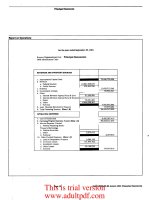
Principal Statements
Finnnelal Dnnitlnn
IU of September 30. 1991
Identlllcatlon:
Department/Agency:
Department of the Army
Bureau/Organ&atlonal Unit:
principal
Statements
OMB Identlficatton Code:
Basis Used:
I
ASSETS
I I
Total
1. Fund Balance with Treasury (Note 1.C)
and Cash
a. Fund Balance
b. Cash
c. Foreign Currency, Net
d. Subtotal
2. Accounts Receivable (Note l.E)
a. Federal Agencies
1. Current
2. Noncurrent
b. Public
1. Current
2. Noncurrent
c. Less: AIIowances
d. Subtotal
3. Advances and Prepayments Mote 1.F)
a. Federal Agencies
b. Public
c. Subtotal
4. Inventories Mote l.G)
a. Operating consumables
b. Product or Service
Components
c. StockplIed materials
d. Other
e. Subtotal
5. Investments. Net
a. Federal Securltles
b. Non-Federal Securities
c. Other-Public Securities
d, Subtotal
6. Loans Recetvables
a. Federal Agencies
1. Current
2. Noncurrent
b. Public
1. Current
2. Noncurrent
c. Less: Allowances
d. Subtotal
-
I/
- 47999675569
9 * .
I
I
550.000
Page 16
GAO/APMD-92432 Army*o 1991 Phuncial Statementi
This is trial version
www.adultpdf.com
Principal Stdemente
as of September 30, 1991
EZxp from Cap Lease
es-Other hnmunltlon)
9. TwrALAssm
LIABILITIES
10. Accounts Payable (Note 1.4
a. Federal Agencies
b. Public
c. Subtotal
11. Interest Payable
a. Federal Agencies
b. Public
c. Subtotal
12. Accrued Payroll and &m&s (Note lp
13. Ac&cd unhnded Annual Leave @Jots 1.x.J
14. Unearned F&venue (Advances)
a. Federal Agenctes
b. Public
c. Subtotal
15. Deposit Funds
16. Debt Issued Under Borrowing
a. Gross Federal Debt
b. lntragovemmental Debt
c. Other Debt
d. Subtotal
17. ActuartaJ Llablllttes
a. Pension Plans
b. insurance and Annulty
Programs
c. Subtotal
30.636.272.374
345,806,394.071
5.566.822.250
5.092.374.731
10.659.196.981
2.510,862.214
I .500.689.575
416.019.540
/ 6 7 8 0.3 8
1.916,709,115
26,034,520
662,560
662,560
Page 17
GAO/AF’MD-92-88 Army’e 1991 Financial Statements
This is trial version
www.adultpdf.com
Prindpal Statementa
U of September 30, 1991
lAabIutIel Continued
18. Other Ltabtlttler, (Note 1.M)
a. Property Fumlshed by Others
b. lnsuranct Reserve. Civil Works
c. Capttal Lease. Clvii Works
d. Unearned income
e. Other
I
Total
I
t Subtotal
19. ‘TOTAL LIABILITIES
E$UITY
20. Unexpended Financed Budget
Authority
a. Unexpended Approprtatlons
b. Less: Unftlled Customer
Orders
c. Subtotal
2 1. Invested Capital
22. Revolving Fund Balance(s)
a. Appropriated Capital
b. Cumulative Results
c. DonatIons
d. Subtotal
I
624.966.679
r 38,087.369,827
23. Trust Fund Balances
24. ‘IWML EQUlTf (Note l.lQ
1 1.857.115.941
25. ‘l-OWL LIABILlTIES AND EQUMY
,328,450,121.654
345,806.394.071
7?$?E%j
20,230,326,635
Page 18
WAFMD-92-88 Armfe 1991 Fhanchl Itatemenb
‘.
1~
:<
This is trial version
www.adultpdf.com